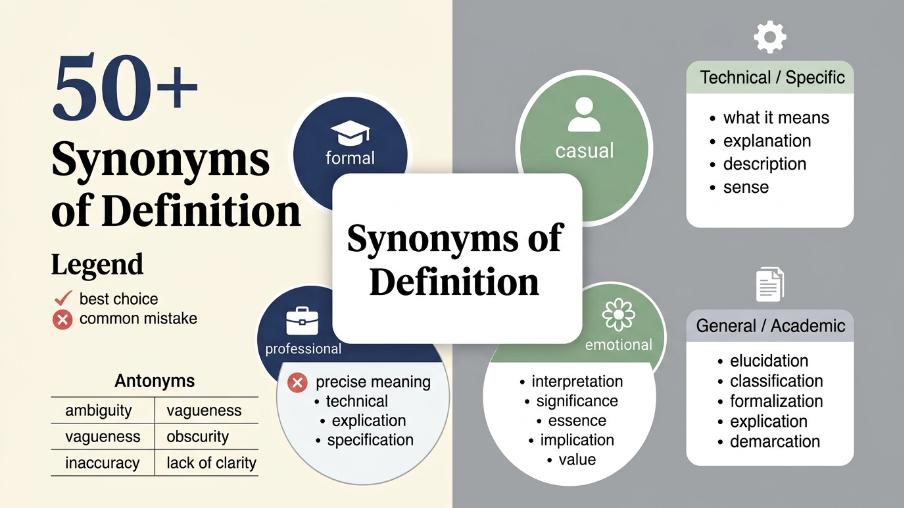
Have you ever found yourself repeating the word “definition” over and over? Perhaps you are writing an academic essay and need to explain a key term. Maybe you are crafting a professional report and you have to clarify the scope of a project. It can feel awkward and repetitive.
Variety is the key to strong writing. Using a range of synonyms not only keeps your reader engaged but also shows a deeper command of the English language. This guide will help you choose the perfect replacement for “definition” in any situation. We will explore the subtle meanings and tones of each alternative.
What Does “Definition” Mean?
A definition is a statement that explains the exact meaning of a word or phrase. The best synonyms depend on your context. For formal situations, use delineation or specification. For casual use, try meaning or description.
Meaning, Tone and Context
- Simple Definition
A definition is the precise explanation of the nature or meaning of something. It sets the boundaries of a concept. - Part of Speech
It is a noun. It can be countable, as in “two definitions,” or uncountable, as in “the definition is clear.” - Tone
The word “definition” is almost entirely neutral. It is a factual term used in logic, language, and everyday life. - Formality Level
It is standard English. It works well in both formal essays and casual conversation, though more specific synonyms might be better for formal writing. - Common Use Cases
We use definitions in dictionaries, academic papers, legal documents, and everyday conversations to clarify what we mean. It is essential for precise communication. - Important Word Forms
The verb form is “define.” The adjective form is “definitive,” meaning final or absolute. The opposite concept is “ambiguity.”
When and How to Use “Definition”
Use “definition” when you need to establish a clear and mutual understanding of a term. It helps avoid confusion and ensures everyone is on the same page.
Here are examples across different contexts:
- Academic Context
The professor asked us to memorize the textbook definition of photosynthesis for the exam. - Professional Context
The project plan needs a clear definition of the client’s expectations before we begin work. - Personal Context
My definition of a successful weekend is one without any work emails. - Emotional Context
For him, the definition of true friendship included unwavering loyalty and trust. - Creative Context
The poet challenged the conventional definition of love through her verses. - Social Media Context
That meme perfectly fits my definition of procrastination. - Resume Context
Managed a project requiring the definition of new workflows to improve efficiency.
Another Word for “Definition”
The best single replacement depends entirely on the intent behind your sentence.
- Professional Writing
Use “specification” when discussing requirements. - Academic Writing
Use “delineation” when explaining the boundaries of a theory. - Casual Conversation
Use “meaning” for a simple, everyday explanation. - Emotional Writing
Use “interpretation” to show a personal or subjective understanding. - Creative Writing
Use “depiction” to describe what something is like in a vivid way. - Resume or Workplace Use
Use “delineation” to describe defining roles or responsibilities. - Social Media Captions
Use “meaning” or “gist” for a quick and relatable post. - Stronger Meaning
Use “explication” to suggest a deep, thorough explanation. - Softer Meaning
Use “description” for a general overview.
When Not to Use “Definition”
The word “definition” can sometimes feel too rigid or academic. It might sound cold in an emotional context. It can also be too vague when you need a very specific term.
For instance, “definition” is weak in a creative context. A poet does not want a rigid “definition” of a feeling. They want an “interpretation” or an “evocation.”
Example Improvement:
Instead of saying, “The artist provided a definition of sadness,” you could say, “The artist provided a poignant interpretation of sadness.
Words Commonly Confused With “Definition”
Several words are related to “definition” but have specific uses. Understanding them helps you choose the right one.
- Definition vs. Meaning: “Meaning” is the general sense of a word or action. “Definition” is a formal, precise statement of that meaning.
- Definition vs. Description: A “description” is a detailed account of something. A “definition” is a precise explanation of its essential nature.
- Definition vs. Interpretation: An “interpretation” is a subjective view of something. A “definition” is usually objective.
- Definition vs. Explanation: An “explanation” makes something clear. A “definition” is a specific type of explanation that establishes the boundaries of a term.
- Definition vs. Delineation: A “delineation” is a very careful and precise definition, often used in legal or formal contexts.
- Definition vs. Denotation: “Denotation” is the literal, dictionary definition of a word, as opposed to its connotation or emotional association.
Best Synonym by Context for “Definition”
The following table provides the best synonym for “definition” in different scenarios.
| Context | Best Synonym | Why It Works | Example |
|---|---|---|---|
| Formal Writing | Delineation | It implies a precise and careful charting of boundaries. | The legal document requires a clear delineation of property lines. |
| Academic Writing | Explication | It suggests a deep, thorough analysis of a concept. | The philosopher offered a masterful explication of the theory. |
| Professional Use | Specification | It points to detailed requirements and standards. | The contract outlines the technical specifications for the software. |
| Resume Context | Determination | This is a strong verb that can also be used as a noun. | Responsible for the determination of project milestones. |
| Casual Conversation | Meaning | It is the most common and straightforward synonym. | What is the exact meaning of that phrase? |
| Creative Writing | Depiction | It provides a vivid image or representation. | The film offered a haunting depiction of loneliness. |
| Emotional Tone | Interpretation | It shows a personal or heartfelt understanding. | My interpretation of happiness includes time with family. |
| Strong Intensity | Clarification | It suggests resolving confusion and making things crystal clear. | The manager’s email brought clarification to the complex issue. |
| Soft or Moderate Tone | Description | It gives a general idea without being overly rigid. | He gave a brief description of his new job. |
| Social Media Captions | Take | A modern and informal way to say “definition” or “meaning. | That’s my take on the situation. |
Which Synonym Should You Choose?
Choosing the right synonym is about matching the word to the context and your audience.
- Consider the Context. For a law document, use “delineation.” For an email to a friend, use “meaning.”
- Think About Formality. “Explication” is very formal. “Take” is informal. Choose what fits your situation.
- Check the Emotional Impact. Do you want to be neutral, like “definition”? Or do you want to be personal, like “interpretation”?
- Assess Professional Value. In a resume or business plan, words like “specification” sound more competent and precise than “meaning.”
Real Life Examples of “Definition” in Sentences
Here are examples across different real world situations.
- Academic Context: For his thesis, he needed to find the exact definition of the word “justice.”
- Workplace Context: The definition of our goals was crucial for the team’s success.
- Writing Context: The first chapter of the book gave a clear definition of the main concepts.
- Conversational Context: In her opinion, the definition of a good friend had changed over the years.
- Social Media Context: No one can agree on the definition of “art” these days.
- Resume Context: Played a key role in the delineation of department responsibilities, improving efficiency.
- Email Context: I am writing to seek further definition on the budget allocation.
- Storytelling Context: His definition of bravery was not the absence of fear, but the strength to act in spite of it.
25 Synonyms of “Definition”
Here is a list of 25 synonyms for “definition,” each with a unique explanation and example.
| Synonym | Simple Meaning | Best Used For | Example Sentence |
|---|---|---|---|
| Meaning | The general idea or sense. | Everyday conversation. | Can you explain the meaning of this poem? |
| Description | A detailed account of something. | Writing and speaking. | Her description of the house was very vivid. |
| Explanation | Making something clear or easy to understand. | Educational contexts. | The teacher gave a clear explanation of the process. |
| Interpretation | Your personal understanding. | Personal or emotional contexts. | My interpretation of the data differs from yours. |
| Delineation | Precise charting of boundaries. | Formal or legal documents. | The chart offers a clear delineation of roles. |
| Specification | Detailed requirements or standards. | Professional and technical use. | Please send the full specification for the printer. |
| Explication | Deep analysis of a concept. | Academic papers. | The essay is an explication of ancient philosophy. |
| Clarification | Making something less confusing. | Emails and instructions. | We need clarification on the new policy. |
| Depiction | A visual representation or description. | Art and creative writing. | The painting is a moving depiction of war. |
| Determination | Firmly deciding or establishing. | Legal or analytical contexts. | The determination of the cause was challenging. |
| Elucidation | Making something clear and bright. | Formal speeches or writing. | The expert provided a helpful elucidation. |
| Exposition | A comprehensive explanation. | Long-form writing or lectures. | Her exposition of the novel was thorough. |
| Denotation | The literal dictionary meaning. | Linguistic analysis. | The denotation of “dog” is a four-legged mammal. |
| Designation | Giving a title or name. | Official or formal contexts. | The designation of the area is a national park. |
| Construction | How something is built or structured. | Philosophical or analytical. | Their construction of reality is quite different. |
| Concept | A general abstract idea. | Intellectual discussion. | The concept of freedom is universal. |
| Characterization | The way something is depicted. | Literary criticism. | The characterization of the hero was believable. |
| Portrayal | The way someone or something is shown. | Media and arts. | The movie’s portrayal of history was controversial. |
| Rendering | A translation or interpretation. | Art or music. | Her rendering of the song was beautiful. |
| Stipulation | A specific condition or requirement. | Legal contracts. | The contract includes a stipulation about payment. |
| Provision | A condition in a legal document. | Formal agreements. | The provision states that the landlord must fix any leaks. |
| Term | A word or phrase that denotes something. | General contexts. | The term for this phenomenon is “global warming.” |
| Makeup | The composition or structure. | General analysis. | The makeup of the committee was diverse. |
| Gist | The main or essential part. | Informal summary. | I get the gist of your argument. |
| Take | A personal opinion or interpretation. | Informal social media. | What is your take on this current trend? |
Synonym Groups and Usage Differences
Understanding how to group these synonyms helps you find the perfect word faster.
Professional vs. Personal Synonyms
Professional synonyms are precise and formal. They include words like specification, delineation, and stipulation. Personal synonyms are more subjective. They include words like meaning, interpretation, and take.
Formal vs. Conversational Synonyms
Formal synonyms are best for reports and essays. They include explication, elucidation, and exposition. Conversational synonyms are great for texts and casual emails. They include meaning, description, and gist.
Academic Synonyms
Academic writing demands precision. The best synonyms are explication for analysis, delineation for boundaries, and denotation for literal meaning.
Professional and Business Synonyms
In the workplace, clarity is king. Use specification for technical details, delineation for defining responsibilities, and clarification to resolve confusion.
Creative or Literary Synonyms
Creative writers need vivid language. Use depiction for imagery, portrayal for character, and rendering for interpretation.
Slang or Modern Synonyms
The modern synonym “take” is a great, casual alternative. It means a personal opinion or interpretation. It is acceptable for social media, but avoid it in academic or professional writing.
Strongest vs. Weaker Synonyms
Here is an intensity scale from mild to strongest.
Mild: Meaning, Description, Gist
Moderate: Clarification, Interpretation, Construction
Strong: Delineation, Explication, Specification
Emotional vs. Neutral Synonyms
Emotional synonyms add a personal or subjective layer. These include interpretation, portrayal, and rendering. Neutral synonyms stay factual. These include denotation, specification, and definition.
Antonyms of “Definition”
The antonyms of definition relate to confusion, vagueness, and ambiguity.
| Antonym | Meaning | Example Sentence |
|---|---|---|
| Ambiguity | Open to more than one meaning. | There is too much ambiguity in the contract. |
| Confusion | A lack of understanding. | The instructions caused nothing but confusion. |
| Vagueness | Lacking precision or detail. | The vagueness of his answer was frustrating. |
| Obscurity | The state of being unknown or unclear. | The document is full of obscurity. |
| Uncertainty | Not being sure or confident. | There is a great deal of uncertainty about the plan. |
| Nonsense | Something that does not make sense. | That theory is complete nonsense. |
| Misconception | A mistaken idea or belief. | That is a common misconception about the topic. |
| Fallacy | A false belief. | The argument is based on a fallacy. |
| Contradiction | A statement that contradicts itself. | His speech was full of contradiction. |
| Blur | An unclear visual or mental image. | The lines between genres have become a blur. |
| Distortion | A misrepresentation of the truth. | That is a distortion of the facts. |
| Mystery | Something that is difficult to understand. | His motives remain a mystery. |
| Complication | A complex or difficult situation. | The complication arose from a simple error. |
| Question | An uncertainty or doubt. | There is a big question over his involvement. |
| Guess | An estimate without certainty. | That is just a guess, not a fact. |
Comparison: Definition vs. Similar Words
Compare “definition” with six other commonly confused or related words.
Definition vs. Meaning
The main difference is that a definition is a formal statement, while meaning is the general idea. Definition is more specific and objective.
Which one is stronger?
Definition is stronger because it is more precise.
Which one is more formal?
Definition is more formal.
Example Sentence:
Definition: The dictionary provided the definition of the word.
Meaning: He pondered the meaning of the message.
Definition vs. Description
A definition explains the essential nature of something. A description provides a detailed account of its qualities. Description is broader.
Which one is more formal?
Definition is more formal.
Which one is more formal?
Definition is more formal.
Example Sentence:
Definition: The definition of a “chair” is a seat for one person.
Description: She gave a description of the chair’s color and fabric.
Definition vs. Interpretation
An interpretation is subjective and personal. A definition is objective and factual. Interpretation is about your view, while definition is about the established view.
Which one is more formal?
Definition is more formal.
Which one is stronger?
Definition is stronger in a factual sense.
Example Sentence:
Definition: The legal definition of “negligence” is clear.
Interpretation: My interpretation of the law is different from yours.
Definition vs. Denotation
Denotation is the literal dictionary definition. It is often discussed in contrast to connotation, the emotional association.
Which one is more formal?
Denotation is a more technical linguistic term.
Which one is stronger?
They are equally strong in their specific fields.
Example Sentence:
Definition: The definition of “home” is a place of residence.
Denotation: The denotation of “snake” is a reptile, but its connotation can be negative.
Definition vs. Specification
Specification usually refers to technical details or requirements. Definition can be about any concept.
Which one is more formal?
Specification is very formal and technical.
Which one is stronger?
Specification is stronger when talking about precise requirements.
Example Sentence:
Definition: The definition of our mission was too broad.
Specification: The hardware specifications are listed on the website.
Definition vs. Elucidation
Elucidation is a formal word that means to make something clear and bright. It implies a deeper insight than a simple definition.
Which one is more formal?
Elucidation is extremely formal and academic.
Which one is more formal?
Elucidation is more formal.
Example Sentence:
Definition: The teacher’s definition was helpful.
Elucidation: The professor’s elucidation of the theory was enlightening.
Common Phrases and Expressions with “Definition”
Here are some common phrases that use “definition.”
1. By Definition
Meaning: According to the actual meaning of the word.
Example sentence: By definition, a square has four equal sides.
2. The Very Definition
Meaning: A perfect example of something.
Example sentence: Her kindness is the very definition of a good friend.
3. Defy Definition
Meaning: To be impossible to explain clearly.
Example sentence: The beauty of the sunset defies definition.
4. A Broad Definition
Meaning: A loose, general explanation.
Example sentence: He gave a broad definition of success.
5. A Strict Definition
Meaning: A precise, narrow explanation.
Example sentence: The law uses a strict definition of this term.
6. Beyond Definition
Meaning: So unique or complex that it cannot be defined.
Example sentence: The feeling of love is often beyond definition.
Common Mistakes to Avoid
Avoid these common errors when using “definition” or its synonyms.
- Using a generic synonym in a formal setting. Do not use “meaning” in a legal document when you need “stipulation.
- Using “definition” when a more precise synonym is needed. Instead of “definition of requirements,” use “specification of requirements.
- Confusing “definition” with “interpretation.” A definition is objective; an interpretation is subjective. Do not mix them up.
- Using an overly dramatic synonym for a simple situation. You do not need an “explication” of the time. You need an “explanation.”
- Repeating “definition” too often. This is why you are reading this guide. Vary your language.
- Choosing a synonym with the wrong emotional tone. Using “interpretation” is personal, while “denotation” is cold. Pick the right one.
- Using slang in academic writing. Saying “that is my take” in a research paper is too informal. Use “interpretation” instead.
FAQs
Here are answers to some frequently asked questions.
1. What is the best synonym for definition?
The best synonym depends on your context. For formal writing, use “delineation.” For casual use, use “meaning.”
2. What is a formal synonym of definition?
A strong formal synonym is “delineation.” Others include “explication” and “specification.”
3. What is an informal synonym of definition?
A great informal synonym is “meaning.” In modern slang, you can also use “take.
4. What is another word for definition in professional writing?
Use “specification” to discuss requirements or “delineation” for boundaries.
5. What is the difference between definition and interpretation?
A definition is an objective explanation. An interpretation is a subjective, personal understanding.
6. What is the opposite of definition?
The opposite of definition is ambiguity, which is a lack of clarity or an open-ended meaning.
Conclusion
A definition is the fundamental statement that gives a word its meaning. Choosing the right synonym, whether it is a formal “delineation” or a simple “meaning,” will transform your writing. Remember that context and tone are your guides. Consider your audience and the emotional weight of your words. A strong vocabulary is your key to precise and powerful communication. Start paying attention to the words you use, and you will become a better writer.

3 thoughts on “50+ Synonyms of Definition| Meaning & Best Alternatives For 2026”