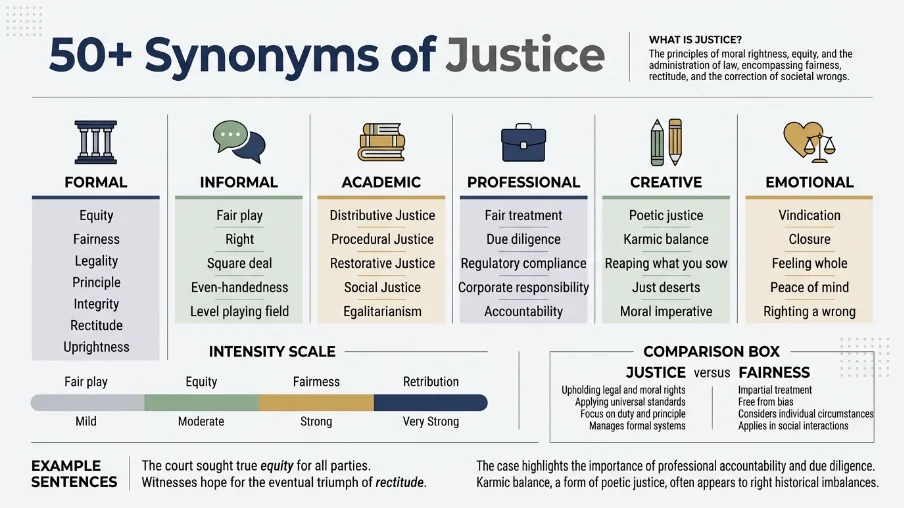
You are writing an important email, a college essay, or a professional report. You need to describe fairness, moral rightness, or legal accountability. You keep using the word “justice” over and over. The repetition makes your writing feel flat and unpolished. You know there must be better ways to express the idea, but you are not sure which synonyms actually fit the context. This guide solves that problem. It explains the word justice, explores its best synonyms, and shows you exactly which alternative works in every situation. By the end, you will choose precise vocabulary with confidence.
What Are the Best Synonyms of “Justice”?
Justice means fairness, moral rightness, or the fair treatment of people under the law. The best synonyms depend on your context. For formal writing, choose impartiality or equity. For casual conversation, use fairness. For academic contexts, consider legitimacy or due process. Professional writing often prefers objectivity or legal remedy. Emotional writing may call for righteousness or reparation. Each synonym carries a different tone and strength, so context matters.
Meaning, Tone, and Context
Simple Definition
Justice refers to the quality of being fair, morally right, and lawful. It involves giving each person what they deserve, whether through legal systems, ethical decisions, or social treatment.
Part of Speech
Noun
Overall Tone
Justice is a neutral to positive word. It carries strong moral weight and implies fairness, truth, and accountability.
Formality Level
Justice is formal to semi-formal. It appears frequently in legal, academic, and professional contexts. It also appears in everyday conversation when discussing fairness, but its tone remains serious and weighty.
Common Uses
Native English speakers commonly use justice in discussions about:
- Legal systems and court proceedings
- Social fairness and human rights
- Ethical decision-making
- Moral philosophy and academic writing
- News reporting about legal matters
- Everyday conversations about fairness
Word Forms
Noun: justice
Adjective: just
Adverb: justly
Related noun: justness
Related noun: justification
Opposite form: injustice
When and How to Use “Justice”
Choose justice when you need to discuss fairness, legal accountability, or moral rightness. This word works best in serious, weighty contexts where the stakes are meaningful. Avoid using justice casually because it carries significant moral and legal weight.
Here are 7 realistic examples showing proper usage across contexts:
Professional Context:
The company established a new review process to ensure justice for all employees who file complaints.
Academic Context:
The philosopher argued that true justice requires both fair laws and fair enforcement of those laws.
Workplace Context:
Our HR department focuses on justice and equity in every hiring decision.
Personal Context:
She felt a deep sense of justice when the truth finally came out.
Email Context:
We need to ensure justice is served by thoroughly investigating every claim.
Resume Context:
Implemented new policies that improved justice and fairness in performance evaluations.
Social Media Context:
The community rallied together to demand justice for those who were unfairly treated.
Best Synonyms of “Justice”
Every synonym carries a slightly different weight. No two words are identical in every situation. The following recommendations help you choose the most accurate word for your specific context.
Professional Writing: Impartiality
Impartiality works best because it emphasizes objectivity and absence of bias. Professionals value decisions made without favoritism.
Academic Writing: Equity
Equity appears frequently in academic discussions about fairness and resource distribution. It carries a precise, scholarly tone.
Business Communication: Fairness
Fairness is straightforward, widely understood, and appropriate for most business contexts. It avoids legal or philosophical complexity.
Casual Conversation: Fairness
Fairness sounds natural in everyday speech. It is simple, clear, and accessible to all listeners.
Emotional Writing: Righteousness
Righteousness adds moral conviction and emotional weight. It expresses strong belief in what is right.
Creative Writing: Justness
Justness offers a slightly poetic, expressive alternative that adds literary texture.
Resume Writing: Equity
Equity signals that you prioritize fairness and inclusion, which resonates with modern employers.
Workplace Communication: Accountability
Accountability emphasizes responsibility and consequences, which fits workplace discussions about conduct.
Stronger Meaning: Vindication
Vindication implies that justice has been fully achieved and that the right side has prevailed.
Softer Meaning: Fairness
Fairness is gentle, accessible, and less legally charged than justice.
When Not to Use “Justice”
Justice is not always the best choice. Here are situations where you should consider alternatives.
When the word sounds too general:
Justice can feel vague if you are discussing specific legal procedures. Instead of saying “justice was served,” specify what actually happened.
When the word sounds too formal:
In casual conversation, justice often sounds dramatic. For everyday fairness, use fairness instead.
When the word sounds too strong:
Justice implies serious moral or legal matters. For minor fairness issues, use fairness or impartiality.
When the word sounds outdated:
In modern business contexts, justice can feel legalistic. Equity or fairness often communicate more clearly.
Example of poor usage:
Incorrect: We need justice in our team meeting schedules.
Better: We need fairness in our team meeting schedules.
Why: Justice is too weighty for scheduling decisions. Fairness communicates the idea naturally.
Another example:
Incorrect: The teacher provided justice to students with questions.
Better: The teacher was impartial with all students.
Why: Justice sounds legal and dramatic. Impartiality describes the teacher’s neutral behavior accurately.
Words Commonly Confused With “Justice”
Justice vs Fairness
Difference: Justice involves moral and legal rightness. Fairness is simpler and focuses on equal treatment.
When to Use It: Use justice for legal or moral matters. Use fairness for everyday situations.
Example: The judge ensured justice was served. The manager ensured fairness in shift assignments.
Justice vs Equity
Difference: Equity emphasizes giving people what they need based on circumstances. Justice emphasizes legal and moral rightness.
When to Use It: Use equity in social policy or resource distribution. Use justice in legal or ethical discussions.
Example: The policy promoted equity by supporting disadvantaged students. The verdict delivered justice for the victim.
Justice vs Impartiality
Difference: Impartiality focuses on absence of bias. Justice focuses on moral and legal correctness.
When to Use It: Use impartiality when emphasizing objectivity. Use justice when emphasizing moral rightness.
Example: The arbitrator maintained impartiality throughout the hearing. The ruling restored justice.
Justice vs Legitimacy
Difference: Legitimacy means lawfulness or validity. Justice means moral rightness.
When to Use It: Use legitimacy for legal validity. Use justice for moral fairness.
Example: The court questioned the legitimacy of the contract. The community demanded justice.
Justice vs Righteousness
Difference: Righteousness carries a strongly moral, sometimes religious tone. Justice is more legally and socially focused.
When to Use It: Use righteousness in moral or spiritual contexts. Use justice in legal and social contexts.
Example: She spoke with righteousness about the cause. The judicial system aims for justice.
Justice vs Vindication
Difference: Vindication means proving someone right after doubt. Justice means fairness or legal accountability.
When to Use It: Use vindication for personal reputation. Use justice for systemic fairness.
Example: The acquittal brought vindication for the defendant. The new laws promoted justice.
Best Synonyms of “Justice” by Context
| Context | Best Synonym | Why It Works | Example |
|---|---|---|---|
| Formal writing | Impartiality | Emphasizes objectivity and lack of bias | The committee maintained impartiality throughout the review process. |
| Academic writing | Equity | Precise, scholarly, and widely accepted in academic discourse | The study examined equity in educational funding across districts. |
| Professional communication | Fairness | Clear, straightforward, and accessible to all | We prioritize fairness in all client interactions. |
| Business emails | Fairness | Direct and professionally appropriate | We must ensure fairness in how we distribute workloads. |
| Resume writing | Equity | Signals modern values and inclusive leadership | Led initiatives to improve equity and inclusion in hiring practices. |
| Workplace communication | Accountability | Emphasizes responsibility and consequences | The new policy increases accountability for all team members. |
| Casual conversation | Fairness | Simple, natural, and easy to understand | I just want fairness in how chores are divided. |
| Everyday speaking | Fairness | Accessible and appropriate for all situations | Is that really fair? |
| Creative writing | Justness | Adds poetic texture and literary quality | The justness of her decision became clear over time. |
| Storytelling | Righteousness | Adds emotional weight and moral conviction | He fought with righteousness for his people. |
| Emotional writing | Vindication | Expresses strong emotion and triumph | She finally experienced vindication after years of doubt. |
| Strong emphasis | Vindication | Carries maximum emotional and moral weight | The verdict brought vindication for the entire community. |
| Mild tone | Fairness | Gentle, non-confrontational, and inclusive | Let’s approach this with fairness for everyone. |
| Social media captions | Fairness | Short, accessible, and easy to share | All we ask for is fairness. |
| American English | Justice | Standard across all American contexts | Justice was served today. |
How to Choose the Best Synonym of “Justice”
Follow this practical decision guide when selecting a synonym.
First, identify your audience:
For legal professionals, choose justice or impartiality. For general readers, choose fairness. For academic peers, choose equity or legitimacy.
Second, consider your tone:
For serious, formal writing, use impartiality or legitimacy. For conversational writing, use fairness. For emotional expression, use righteousness or vindication.
Third, evaluate your purpose:
If you are describing legal systems, choose justice. If you are describing moral rightness, choose righteousness. If you are describing equal treatment, choose equity or impartiality.
Fourth, assess emotional intensity:
For neutral communication, choose fairness. For strong advocacy, choose righteousness. For triumphant outcomes, choose vindication.
Fifth, check naturalness:
Read your sentence aloud. If the synonym sounds forced or overly dramatic, choose a simpler alternative. Fairness rarely sounds wrong.
Real Life Examples of “Justice”
School Context:
The principal promised to restore justice after the unfair disciplinary action.
College Context:
The philosophy course explored different theories of justice and their modern applications.
Workplace Context:
Our team focuses on justice in performance evaluations to ensure everyone is rated fairly.
Business Context:
The company revised its policies to promote justice and accountability at all levels.
Email Context:
I want to ensure justice is done before we finalize this agreement.
Resume Context:
Developed and implemented fairness policies that increased employee satisfaction.
Conversation Context:
Do you really think justice was served in that situation?
Storytelling Context:
The small community fought for justice against the powerful corporation.
Blogging Context:
True justice requires more than laws; it requires action and accountability.
Social Media Context:
Standing up for justice means speaking out when something is wrong.
25 Best Synonyms of “Justice”
| Synonym | Simple Meaning | Best Used For | Example Sentence |
|---|---|---|---|
| Fairness | Equal and reasonable treatment | Everyday conversation | We need fairness in how resources are distributed. |
| Equity | Giving people what they need based on circumstances | Academic and professional writing | The policy promotes equity for underrepresented groups. |
| Impartiality | Absence of bias or favoritism | Formal and legal contexts | The judge demonstrated impartiality throughout the trial. |
| Legitimacy | Lawfulness and validity | Legal and political discussions | The legitimacy of the election was questioned. |
| Righteousness | Moral rightness and conviction | Emotional and spiritual contexts | She spoke with righteousness about the injustice. |
| Justness | Quality of being morally right | Creative and literary writing | The justness of his cause inspired many followers. |
| Vindication | Proof of being right after doubt | Emotional and triumphant contexts | The new evidence brought vindication for the defendant. |
| Accountability | Responsibility for actions | Workplace and professional settings | Managers must ensure accountability for all decisions. |
| Objectivity | Judgment based on facts, not emotions | Academic and journalistic writing | The reporter maintained objectivity in the story. |
| Due process | Fair legal procedures | Legal and formal contexts | The accused was entitled to due process. |
| Legal remedy | Legal compensation or correction | Legal writing | The victim sought legal remedy for the harm. |
| Retribution | Punishment for wrongdoing | Strong moral or legal contexts | Many demanded retribution for the crime. |
| Compensation | Payment or restitution for loss | Professional and legal writing | The victims received fair compensation. |
| Reformation | Improvement through correction | Social policy and rehabilitation | The justice system should focus on reformation. |
| Restoration | Return to a previous fair state | Social and community contexts | The program focuses on restoration of rights. |
| Morality | Principles of right and wrong | Philosophical and ethical writing | The issue goes beyond law to fundamental morality. |
| Integrity | Honesty and strong moral principles | Professional and personal contexts | She handled the situation with integrity. |
| Honesty | Truthfulness and fairness | Everyday and professional contexts | We value honesty in all our business dealings. |
| Probity | Strong moral integrity | Formal and professional writing | The official was known for probity in office. |
| Uprightness | Honest and morally good character | Literary and formal contexts | His uprightness earned him community respect. |
| Ethicality | Conformity to moral standards | Academic and professional writing | The ethicality of the decision was examined. |
| Decency | Proper and fair behavior | Everyday and social contexts | We should treat everyone with decency. |
| Propriety | Conformity to what is correct | Formal and professional contexts | The propriety of the proceedings was maintained. |
| Rectitude | Morally correct behavior | Literary and formal contexts | She displayed rectitude in all her professional dealings. |
| Truth | Factual accuracy and fairness | Philosophical and legal contexts | The truth finally came out in court. |
Synonyms of “Justice” by Usage
Professional vs Personal Synonyms
Professional synonyms: Impartiality, equity, accountability, objectivity, probity, rectitude. These words work in workplaces, legal settings, and professional communications. They emphasize systems, procedures, and objective standards.
Personal synonyms: Fairness, decency, honesty, integrity. These words fit everyday conversations, personal relationships, and social discussions. They emphasize individual character and daily interactions.
Formal vs Conversational Synonyms
Formal synonyms: Impartiality, legitimacy, due process, rectitude, probity. Use these in reports, essays, business writing, presentations, and formal emails.
Conversational synonyms: Fairness, decency, honesty. Use these in casual conversations, texting, and informal emails. They sound natural and approachable.
Academic Synonyms
Academic synonyms: Equity, impartiality, legitimacy, objectivity, ethicality, due process. These words appear frequently in research papers, academic essays, reports, and scholarly discussions. They sound authoritative and precise.
Why they sound more authoritative: Academic synonyms emphasize systems, principles, and objective standards. They avoid emotional language and focus on measurable or definable concepts.
Professional and Business Synonyms
Resumes: Equity, impartiality, accountability, objectivity. These signal that you value fairness and inclusion.
Interviews: Fairness, integrity, accountability. These sound genuine and relatable while remaining professional.
Meetings: Accountability, fairness, objectivity. These keep discussions focused on solutions.
Presentations: Legitimacy, equity, impartiality. These add weight to formal presentations.
Performance reviews: Accountability, fairness, objectivity. These maintain professionalism while addressing sensitive topics.
Client communication: Fairness, accountability, transparency. These build trust and confidence.
Business emails: Fairness, accountability, clarity. These remain professional without sounding legalistic.
Creative and Literary Synonyms
Expressive alternatives: Justness, righteousness, rectitude, probity, vindication.
How they add emotion or imagery: Justness adds poetic quality. Righteousness adds moral fire. Vindication adds triumph. Rectitude adds noble character. Probity adds formal integrity. These words create vivid, memorable descriptions in fiction, poetry, speeches, and storytelling.
Slang or Modern Synonyms
Slang for justice is limited because justice is a weighty, formal concept. However, modern English sometimes uses “fair shake” or “square deal” in casual contexts. These are acceptable in conversation but should be avoided in professional, academic, or legal writing. They sound informal and lack precision.
Strongest to Mildest Synonyms
Mild: Fairness, decency, honesty, propriety
Moderate: Impartiality, objectivity, equity, accountability
Strong: Justice, legitimacy, due process, rectitude
Very Strong: Vindication, retribution, righteousness, probity
Emotional intensity increases from mild to very strong. Fairness is gentle and non-confrontational. Vindication is powerful and triumphant. Retribution suggests punishment and consequences.
Emotional vs Neutral Synonyms
Emotional synonyms: Righteousness, vindication, retribution, integrity.
These words express stronger feelings, moral conviction, and personal investment. Use them when you want to inspire, persuade, or express deep belief.
Neutral synonyms: Fairness, impartiality, objectivity, equity.
These words simply communicate information without adding emotion. Use them in professional, academic, and journalistic contexts where objectivity matters.
Antonyms of “Justice”
| Antonym | Meaning | Example Sentence |
|---|---|---|
| Injustice | Unfairness or violation of rights | The injustice of the decision shocked everyone. |
| Inequality | Unequal treatment or opportunity | The policy created inequality in the workplace. |
| Bias | Unfair preference for one side | Bias in hiring decisions undermines trust. |
| Prejudice | Preconceived unfair judgment | Prejudice against certain groups is unacceptable. |
| Unfairness | Lack of equal treatment | The unfairness of the process was obvious. |
| Corruption | Dishonest or illegal behavior | Corruption in government destroys public trust. |
| Partiality | Unfair favoritism | The manager’s partiality created resentment. |
| Discrimination | Unfair treatment based on characteristics | Discrimination violates basic human rights. |
| Inequity | Lack of fairness or justice | The inequity in education funding is severe. |
| Favoritism | Preference for one person or group | Favoritism in promotions demoralized the team. |
| Oppression | Prolonged cruel or unjust treatment | Oppression violates fundamental freedoms. |
| Exploitation | Unfair use of others for benefit | The exploitation of workers is a serious injustice. |
| Subjugation | Forced control over others | Subjugation of minorities is morally wrong. |
| Tyranny | Cruel and oppressive government | Tyranny replaces justice with fear. |
| Wrongdoing | Illegal or unethical behavior | The wrongdoing must be addressed. |
“Justice” vs Similar Words
Justice vs Fairness
Main Difference: Justice is broader and includes legal and moral dimensions. Fairness focuses on equal treatment and reasonable decisions.
Which Is Stronger: Justice is stronger because it encompasses legal systems and moral rightness.
Which Is More Formal: Justice is more formal and legal.
When to Use Each: Use justice for legal, moral, or systemic matters. Use fairness for everyday situations.
Examples:
Justice: The legal system exists to deliver justice.
Fairness: We just want fairness in the schedule.
Justice vs Equity
Main Difference: Justice emphasizes moral and legal rightness. Equity emphasizes giving people what they need based on circumstances.
Which Is Stronger: Justice is stronger in legal contexts. Equity is stronger in social policy contexts.
Which Is More Formal: Both are formal, but equity is more academic.
When to Use Each: Use justice in legal and ethical discussions. Use equity in social policy and resource distribution.
Examples:
Justice: The verdict delivered justice for the victim.
Equity: The grant program promotes equity in education.
Justice vs Impartiality
Main Difference: Impartiality focuses on absence of bias. Justice focuses on moral and legal correctness.
Which Is Stronger: Justice is stronger because it encompasses more than objectivity.
Which Is More Formal: Both are formal, but impartiality is more procedural.
When to Use Each: Use impartiality when emphasizing objectivity. Use justice when emphasizing moral rightness.
Examples:
Justice: Communities demand justice for wrongdoing.
Impartiality: Arbitrators must maintain impartiality.
Justice vs Legitimacy
Main Difference: Legitimacy means lawfulness or validity. Justice means moral rightness.
Which Is Stronger: Justice is stronger in moral terms. Legitimacy is stronger in legal terms.
Which Is More Formal: Both are formal, but legitimacy is more legal.
When to Use Each: Use legitimacy for legal validity. Use justice for moral fairness.
Examples:
Justice: The movement fights for social justice.
Legitimacy: The legitimacy of the contract was upheld.
Justice vs Righteousness
Main Difference: Righteousness carries a strongly moral, sometimes religious tone. Justice is more legally and socially focused.
Which Is Stronger: Righteousness is stronger emotionally. Justice is stronger structurally.
Which Is More Formal: Justice is more formal. Righteousness is more personal and emotional.
When to Use Each: Use righteousness in moral or spiritual contexts. Use justice in legal and social contexts.
Examples:
Justice: The court exists to deliver justice.
Righteousness: He spoke with righteousness about the injustice.
Justice vs Vindication
Main Difference: Vindication means proving someone right after doubt. Justice means fairness or legal accountability.
Which Is Stronger: Vindication is stronger emotionally. Justice is stronger systemically.
Which Is More Formal: Justice is more formal. Vindication is more personal.
When to Use Each: Use vindication for personal reputation. Use justice for systemic fairness.
Examples:
Justice: The reforms promote justice for all citizens.
Vindication: The new evidence brought vindication.
Common Phrases and Expressions with “Justice”
Poetic justice
Meaning: A situation where good is rewarded and bad is punished in a fitting way.
Example Sentence: In a case of poetic justice, the dishonest executive lost everything.
Justice served
Meaning: The legal or moral system has worked correctly.
Example Sentence: Many felt that justice served when the verdict was announced.
Bring to justice
Meaning: To ensure someone is legally punished for wrongdoing.
Example Sentence: The authorities worked hard to bring the criminal to justice.
Criminal justice system
Meaning: The system of laws, courts, and prisons that deals with crime.
Example Sentence: The criminal justice system needs reform to ensure fairness.
Social justice
Meaning: Fairness in society regarding wealth, opportunities, and privileges.
Example Sentence: The organization advocates for social justice in underserved communities.
Obstruction of justice
Meaning: Interfering with legal proceedings.
Example Sentence: The witness was charged with obstruction of justice.
Justice delayed is justice denied
Meaning: When justice takes too long, it is not really justice.
Example Sentence: The case took years to resolve, proving that justice delayed is justice denied.
Common Mistakes to Avoid
Mistake 1: Using “justice” when “fairness” is more appropriate
Incorrect: We need justice in how we distribute office supplies.
Better: We need fairness in how we distribute office supplies.
Why: Justice is too weighty for minor issues. Fairness communicates the idea naturally.
Mistake 2: Confusing “justice” with “revenge”
Incorrect: He sought justice by destroying their property.
Better: He sought justice through proper legal channels.
Why: Justice involves lawful processes. Revenge is personal and often unlawful.
Mistake 3: Using “justice” casually
Incorrect: I want justice because my coffee was cold.
Better: I want a refund because my coffee was cold.
Why: Justice is for serious matters. Minor complaints do not require justice.
Mistake 4: Using overly formal synonyms in everyday conversation
Incorrect: I demand rectitude in how my coworkers treat me.
Better: I expect fair treatment from my coworkers.
Why: Rectitude sounds overly formal and unnatural in everyday speech.
Mistake 5: Using “justice” when describing personal opinions
Incorrect: My justice is different from yours.
Better: My view of fairness is different from yours.
Why: Justice is a system, not a personal preference.
Mistake 6: Overusing “justice” in professional writing
Incorrect: Our company values justice, justice in hiring, and justice in promotions.
Better: Our company values fairness, impartiality, and equity in all processes.
Why: Repetition weakens writing. Using varied synonyms improves clarity and impact.
Mistake 7: Using slang synonyms in formal writing
Incorrect: The system needs to give everyone a fair shake.
Better: The system needs to provide justice and equity for everyone.
Why: Slang sounds unprofessional in formal contexts.
Frequently Asked Questions
1. What are the best synonyms of “justice”?
The best synonyms of justice include fairness, equity, impartiality, legitimacy, and righteousness. Your choice depends on context. Fairness works in everyday conversation, while impartiality fits formal legal writing.
2. What are the best formal synonyms of “justice”?
The best formal synonyms of justice include impartiality, legitimacy, due process, rectitude, and probity. These words appear frequently in legal documents, academic papers, and professional reports.
3. What are common informal synonyms of “justice”?
Common informal synonyms of justice include fairness and decency. These words work well in everyday conversation and casual writing. They are accessible and easy to understand.
4. What is another word for “justice” in professional writing?
In professional writing, good alternatives to justice include equity, accountability, and impartiality. These words emphasize systems, fairness, and objective standards without sounding overly legalistic.
5. What is the difference between “justice” and “fairness”?
Justice involves legal and moral rightness, while fairness focuses on equal and reasonable treatment. Justice is broader and more formal. Fairness is simpler and more conversational.
6. What is the opposite of “justice”?
The opposite of justice is injustice. Other antonyms include inequality, bias, prejudice, unfairness, corruption, and oppression. Each describes a lack of fairness or moral rightness.
Conclusion
Justice is a powerful word that carries significant moral and legal weight. It means fairness, moral rightness, and lawful accountability. The best synonyms depend entirely on your context and audience. For professional writing, choose impartiality or equity. For academic work, choose legitimacy or due process. For everyday conversation, fairness is almost always the right choice. No single synonym works perfectly in every situation. Understanding tone, formality, and emotional intensity helps you choose the most effective word every time. The next time you write about fairness, accountability, or legal matters, consider your purpose, audience, and the precise meaning you want to convey. That thoughtful approach will instantly elevate your vocabulary and communication.

1 thought on “50+ Synonyms of Justice| Meanings, Uses, Examples and Best Alternatives For 2026”