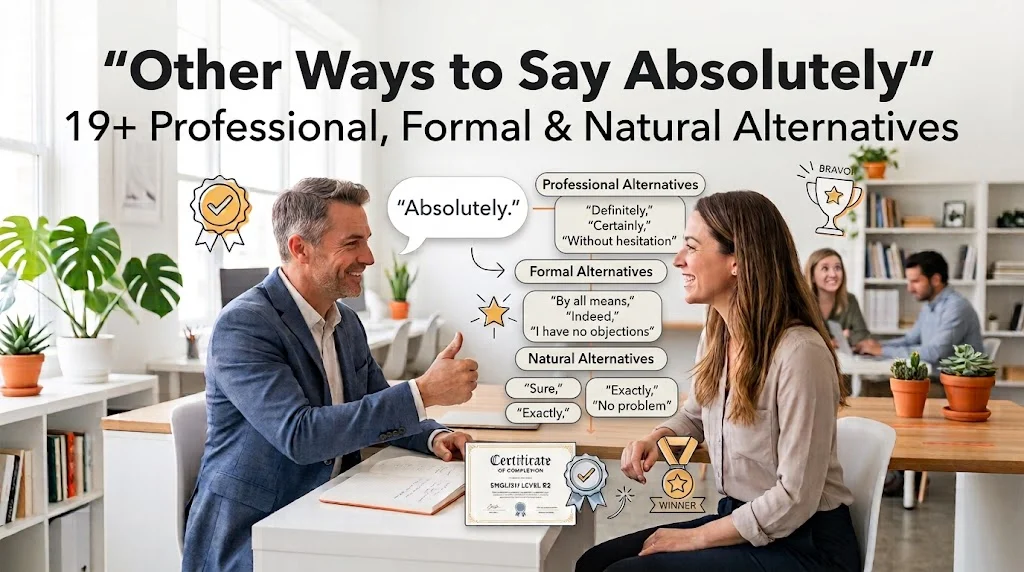
Other ways to say absolutely include certainly, definitely, of course, without a doubt, undoubtedly, and by all means. Choose the expression based on your meaning, tone, and situation.
5 best alternatives: certainly, definitely, of course, without a doubt, undoubtedly
The word absolutely is one of the most useful ways to show strong agreement, certainty, or completeness in English. You might use it to mean “yes,” “completely,” or “without question.”
However, repeating the same word can make your English sound less varied. Learning other ways to say absolutely helps you choose more precise expressions for professional emails, workplace meetings, academic writing, presentations, and everyday conversations.
The best alternatives to absolutely depend on what you mean. Some sound formal, some are neutral, and others are friendly or casual. Understanding that difference is the key to sounding natural.
“Good vocabulary is not about using bigger words. It is about choosing the right word.”
Quick Categories
Formal Alternatives
- Certainly
- Without a doubt
- Undoubtedly
- Most certainly
- By all means
Pro Tip
Use these expressions when you want your English to sound confident and polished. Certainly is especially flexible because it works in professional speech, emails, and formal writing.
Professional Alternatives
- Certainly
- Definitely
- I completely agree
- Without a doubt
- Indeed
Pro Tip
In professional communication, choose expressions that sound confident without becoming dramatic. Certainly and definitely are usually safer choices than highly casual phrases.
Business Email Alternatives
- Certainly
- Of course
- By all means
- Definitely
- Most certainly
Pro Tip
For emails, certainly is a particularly useful choice because it can communicate agreement or willingness without sounding too casual.
Academic Alternatives
- Certainly
- Undoubtedly
- Indeed
- Without a doubt
- Most certainly
Pro Tip
Academic writing usually benefits from precise language. Undoubtedly can work when the evidence genuinely supports a strong claim, but avoid using it simply to sound sophisticated.
Casual Alternatives
- Of course
- For sure
- Definitely
- Sure
- Absolutely
Pro Tip
In everyday conversation, of course, definitely, and for sure sound natural. Your relationship with the listener matters more than formality alone.
Informal Expressions
- Totally
- For sure
- Sure
- You bet
- Exactly
Pro Tip
These expressions are common in relaxed conversations but may sound too informal in a formal email, academic essay, or job application.
Common Mistakes
1. Using “absolutely” for every kind of agreement
Why it is a problem: Absolutely can be strong, so repeating it may make your speech sound predictable.
Correct approach: Vary your response according to meaning.
Example:
Instead of repeating “Absolutely,” try “Certainly,” “Definitely,” or “Of course.”
2. Using “undoubtedly” without strong support
Why it is a problem: Undoubtedly expresses very strong certainty. In academic or professional writing, the claim should justify that confidence.
Correct version:
“The policy will undoubtedly affect small businesses” only when the evidence supports that level of certainty.
3. Using casual phrases in formal writing
Mistake: “You bet we can complete the report.”
Why it is unsuitable: “You bet” is conversational and friendly rather than formal.
Better: “Certainly, we can complete the report by Friday.”
4. Confusing “absolutely” with “exactly”
Why it is a problem: They can both show strong agreement, but they do not always have the same meaning.
Correct version:
“Absolutely” can mean strong agreement, while “exactly” often means that something is precisely correct.
5. Treating every synonym as interchangeable
Why it is a problem: Synonyms often differ in tone, strength, and context.
Example:
“By all means” can express permission, while “undoubtedly” expresses certainty. They cannot replace each other in every sentence.
What Does “Absolutely” Mean?
Absolutely is an adverb used to express strong agreement, certainty, or completeness.
In conversation, it often means “yes, definitely” or “I completely agree.”
It can also strengthen an adjective:
- absolutely certain
- absolutely correct
- absolutely essential
- absolutely impossible
Natural example:
“Do you think we should review the proposal again?”
“Absolutely.”
Here, absolutely means “yes, definitely.”
When to Use “Absolutely”
You can use absolutely in many situations:
- Business: “Absolutely. I’ll send the revised proposal today.”
- Academic: “The result is absolutely consistent with the earlier findings.”
- Emails: “Absolutely. We can arrange the meeting for Thursday.”
- Meetings: “Absolutely. I agree with that approach.”
- Daily conversation: “Would you like some coffee?” “Absolutely.”
- Spoken English: It is especially common as a short, emphatic response.
- Written English: It can work naturally when the context calls for strong emphasis.
- Formal situations: It is acceptable, but alternatives such as “certainly” may sound more polished.
- Informal situations: “Absolutely,” “totally,” and “for sure” can all work depending on the conversation.
“The right alternative changes the tone without changing your meaning.”
Is “Absolutely” Professional or Polite?
Polite? ✔ Yes
Professional? ✔ Yes, depending on context
Formal? ✔ Sometimes
Natural? ✔ Very
“Absolutely” is not an inherently informal word. Native English speakers use it in professional meetings, customer service, interviews, and business conversations.
The main difference is strength. It sounds more emphatic than a simple “yes.”
For example:
Business-style example:
“Would you be available to review the document today?”
“Absolutely. I’ll take a look this afternoon.”
For highly formal writing, certainly may fit better. For relaxed conversation, absolutely remains completely natural.
Pros and Cons
Pros
- Very common in modern English
- Shows strong agreement clearly
- Works in spoken and written English
- Can sound confident and enthusiastic
- Easy for English learners to use naturally
Cons
- Can sound repetitive if overused
- Sometimes stronger than necessary
- May sound enthusiastic when a neutral response is better
- Some formal contexts may favor “certainly” or “undoubtedly”
Before You Choose an Alternative
The following alternatives will help you expand your English vocabulary without simply replacing one word with another.
Pay attention to strength, formality, and context. A phrase that sounds perfect in a friendly conversation may feel too casual in a client email.
“Choosing the right phrase matters as much as choosing the right words.”
Expert Tip: Native speakers adjust expressions according to the situation, their relationship with the listener, and the level of certainty they want to communicate.
Other Ways to Say “Absolutely” (With Examples)
These 15 alternatives cover formal, professional, neutral, academic, casual, and conversational English. Some are close synonyms, while others replace absolutely only in particular contexts.
1. Phrase: Certainly
Meaning:
Certainly means “definitely” or “without question” and often sounds polite and confident.
Explanation:
This is one of the most useful professional alternatives to absolutely. It works particularly well when confirming information, agreeing to a request, or responding politely. It is more formal than “sure” but still natural in modern English.
Style: Formal, Professional, Neutral
Example Sentence:
“Certainly, I can forward the updated figures before the meeting.”
Best Use: Business communication
Avoid Using In: Very casual chats
Tone: Polished, Respectful
Formality Level: ⭐⭐⭐⭐ Formal
Usage Frequency: Very Common
CEFR Level: B2
Common Collocations:
- certainly agree
- certainly possible
- certainly true
- certainly help
- certainly consider
Context Variability:
- Spoken: “Certainly, I understand your concern.”
- Professional: “We can certainly discuss that option.”
- Casual: “Certainly!” can sound slightly formal but remains understandable.
2. Phrase: Definitely
Meaning:
Definitely means “without doubt” or “certainly.”
Explanation:
It is one of the most natural modern alternatives to absolutely. Native speakers use it frequently in everyday conversation, workplace discussions, emails, and informal professional communication.
Style: Neutral, Professional, Casual
Example Sentence:
“I’ll definitely join the planning session tomorrow.”
Best Use: Everyday agreement
Avoid Using In: Highly formal prose
Tone: Confident, Natural
Formality Level: ⭐⭐⭐ Neutral
Usage Frequency: Very Common
CEFR Level: B1
Common Collocations:
- definitely agree
- definitely worth
- definitely want
- definitely need
- definitely possible
Context Variability:
- Spoken: “Definitely. That sounds like a good idea.”
- Professional: “We should definitely review the figures first.”
- Casual: “I’ll definitely be there.”
3. Phrase: Of Course
Meaning:
Of course shows agreement, confirmation, permission, or something the speaker considers obvious.
Explanation:
This expression is extremely common and flexible. However, tone matters: depending on your voice, “of course” can sound warm and helpful or slightly impatient.
Style: Neutral, Friendly, Natural
Example Sentence:
“Of course, I’d be happy to help you prepare the presentation.”
Best Use: Polite agreement
Avoid Using In: Sensitive disagreement
Tone: Friendly, Assuring
Formality Level: ⭐⭐⭐ Neutral
Usage Frequency: Very Common
CEFR Level: B1
Common Collocations:
- of course I can
- of course not
- of course you can
- of course I agree
- of course we can
Context Variability:
- Spoken: “Of course, go ahead.”
- Professional: “Of course, I’ll send the document.”
- Casual: “Of course! No problem.”
4. Phrase: Without a Doubt
Meaning:
Without a doubt means that you feel completely certain about something.
Explanation:
This phrase is stronger and more deliberate than ordinary agreement. It works well in professional discussions, presentations, and writing when you want to emphasize confidence.
Style: Formal, Confident, Professional
Example Sentence:
“Without a doubt, clear communication improves teamwork.”
Best Use: Strong certainty
Avoid Using In: Weak opinions
Tone: Assertive, Confident
Formality Level: ⭐⭐⭐⭐ Formal
Usage Frequency: Common
CEFR Level: B2
Common Collocations:
- without a doubt the best
- without a doubt important
- without a doubt true
- without a doubt useful
Context Variability:
- Spoken: “She is, without a doubt, the right person.”
- Professional: “Without a doubt, this change will improve efficiency.”
- Casual: “That was, without a doubt, the funniest part.”
5. Phrase: Undoubtedly
Meaning:
Undoubtedly means “certainly” or “without any reasonable doubt.”
Explanation:
Undoubtedly is more formal and is especially common in polished writing. It can work in academic and professional contexts, but it should not be used merely to make a sentence sound sophisticated.
Style: Formal, Academic, Professional
Example Sentence:
“Undoubtedly, careful planning played a major role in the project’s success.”
Best Use: Formal writing
Avoid Using In: Casual conversation
Tone: Authoritative, Formal
Formality Level: ⭐⭐⭐⭐⭐ Very Formal
Usage Frequency: Common
CEFR Level: C1
Common Collocations:
- undoubtedly important
- undoubtedly successful
- undoubtedly one of
- undoubtedly true
Context Variability:
- Spoken: “She is undoubtedly talented.”
- Professional: “This is undoubtedly a valuable opportunity.”
- Casual: Possible, but often more formal than needed.
Native Speaker Tip
Definitely and of course are among the most natural choices for everyday speech. Undoubtedly is more formal and is more common in careful writing. Use certainly when you want a polished professional tone.
“Natural English is flexible English.”
6. Phrase: By All Means
Meaning:
By all means means “certainly” or “yes, please do,” especially when giving permission or encouragement.
Explanation:
This phrase is useful, but it is not a direct replacement for absolutely in every sentence. It commonly responds to a request rather than simply expressing certainty.
Style: Polite, Formal, Encouraging
Example Sentence:
“If you would like to add another point, by all means, go ahead.”
Best Use: Giving permission
Avoid Using In: Simple certainty
Tone: Welcoming, Respectful
Formality Level: ⭐⭐⭐⭐ Formal
Usage Frequency: Common
CEFR Level: C1
Common Collocations:
- by all means go ahead
- by all means ask
- by all means use
- by all means continue
Context Variability:
- Spoken: “By all means, come in.”
- Professional: “By all means, share your suggestions.”
- Casual: “By all means, take the last cookie.”
7. Phrase: Most Certainly
Meaning:
Most certainly is a strong and polished way to express complete agreement or certainty.
Explanation:
It sounds more formal than “definitely” and can feel especially emphatic. It is useful when you want to give a confident answer without sounding overly casual.
Style: Formal, Confident, Polished
Example Sentence:
“Most certainly, we can accommodate your request.”
Best Use: Formal agreement
Avoid Using In: Casual texting
Tone: Assured, Respectful
Formality Level: ⭐⭐⭐⭐⭐ Very Formal
Usage Frequency: Occasional
CEFR Level: C1
Common Collocations:
- most certainly agree
- most certainly possible
- most certainly will
- most certainly welcome
Context Variability:
- Spoken: “Most certainly.”
- Professional: “We would most certainly welcome the opportunity.”
- Casual: Usually sounds too formal.
8. Phrase: Indeed
Meaning:
Indeed confirms or emphasizes a statement, often with a formal or thoughtful tone.
Explanation:
Indeed is not always a direct synonym for absolutely. It works best when agreeing with or reinforcing a statement rather than answering every question with a simple “yes.”
Style: Formal, Academic, Professional
Example Sentence:
“The proposal is, indeed, worth considering.”
Best Use: Formal emphasis
Avoid Using In: Relaxed texting
Tone: Thoughtful, Formal
Formality Level: ⭐⭐⭐⭐ Formal
Usage Frequency: Common
CEFR Level: B2
Common Collocations:
- indeed correct
- indeed important
- indeed true
- indeed the case
Context Variability:
- Spoken: “Indeed, that is a fair point.”
- Professional: “The findings are indeed significant.”
- Casual: Possible, but can sound deliberately formal.
9. Phrase: For Sure
Meaning:
For sure means “definitely” or “certainly.”
Explanation:
This is a common conversational expression. It sounds relaxed and natural in speech but is less suitable for formal reports, academic essays, or serious business correspondence.
Style: Casual, Friendly, Natural
Example Sentence:
“I’ll call you after the interview, for sure.”
Best Use: Casual conversation
Avoid Using In: Formal reports
Tone: Relaxed, Confident
Formality Level: ⭐⭐ Casual
Usage Frequency: Very Common
CEFR Level: B1
Common Collocations:
- for sure agree
- for sure know
- for sure coming
- for sure help
Context Variability:
- Spoken: “For sure, I agree.”
- Professional: Understandable, but “definitely” is usually better.
- Casual: “For sure! See you later.”
10. Phrase: Positively
Meaning:
Positively can mean “definitely” or “without question,” especially when emphasizing certainty.
Explanation:
This use is less common in everyday conversation than definitely or certainly. It can sound formal, emphatic, or slightly old-fashioned depending on the sentence.
Style: Formal, Emphatic, Less Common
Example Sentence:
“The new process will positively improve the customer experience.”
Best Use: Strong assertion
Avoid Using In: Casual responses
Tone: Assertive, Formal
Formality Level: ⭐⭐⭐⭐ Formal
Usage Frequency: Occasional
CEFR Level: C1
Common Collocations:
- positively certain
- positively identify
- positively confirm
- positively affect
Context Variability:
- Spoken: “I positively remember meeting him.”
- Professional: “The change will positively affect productivity.”
- Casual: Usually replace it with “definitely.”
Expert Insight
In workplace communication, certainty should match evidence. In an email, “certainly” can sound polished, while “definitely” feels more conversational. In academic writing, avoid strong words such as “undoubtedly” unless your evidence supports the claim.
11. Phrase: Surely
Meaning:
Surely expresses strong expectation, belief, or confidence that something is true.
Explanation:
Surely is sometimes interchangeable with absolutely, but its meaning can shift depending on context. It may also express surprise or challenge, as in “Surely you knew?”
Style: Neutral, Formal, Contextual
Example Sentence:
“Surely there is a practical solution to this problem.”
Best Use: Strong expectation
Avoid Using In: Direct agreement
Tone: Confident, Reflective
Formality Level: ⭐⭐⭐ Neutral
Usage Frequency: Common
CEFR Level: B2
Common Collocations:
- surely possible
- surely understand
- surely know
- surely enough
Context Variability:
- Spoken: “Surely you can see the difference.”
- Professional: “Surely we can find a workable solution.”
- Casual: “Surely that can’t be right.”
12. Phrase: Completely
Meaning:
Completely means “entirely” or “in every part,” and it can replace absolutely when describing the degree of something.
Explanation:
Unlike “certainly,” completely is usually about degree, not agreement. For example, “I completely agree” means that your agreement is total.
Style: Neutral, Professional, Natural
Example Sentence:
“I completely understand why the deadline needs to change.”
Best Use: Total agreement
Avoid Using In: Permission requests
Tone: Clear, Direct
Formality Level: ⭐⭐⭐ Neutral
Usage Frequency: Very Common
CEFR Level: B1
Common Collocations:
- completely agree
- completely understand
- completely different
- completely satisfied
- completely certain
Context Variability:
- Spoken: “I completely agree with you.”
- Professional: “We completely understand your concerns.”
- Casual: “I completely forgot about it.”
13. Phrase: Entirely
Meaning:
Entirely means “completely” or “wholly.”
Explanation:
Entirely is more formal than completely and is especially useful in professional and academic writing. It describes degree rather than simple agreement.
Style: Formal, Academic, Professional
Example Sentence:
“The outcome was not entirely unexpected.”
Best Use: Formal writing
Avoid Using In: Very casual speech
Tone: Precise, Polished
Formality Level: ⭐⭐⭐⭐ Formal
Usage Frequency: Common
CEFR Level: B2
Common Collocations:
- entirely different
- entirely appropriate
- entirely reasonable
- entirely dependent
- entirely correct
Context Variability:
- Spoken: “I’m not entirely sure.”
- Professional: “That approach is entirely reasonable.”
- Casual: “I’m entirely serious” can sound slightly formal.
14. Phrase: Totally
Meaning:
Totally means “completely” and is often used informally to show strong agreement.
Explanation:
Totally is common in relaxed spoken English, particularly among friends and in informal online communication. It is usually too casual for academic writing and formal business documents.
Style: Casual, Informal, Enthusiastic
Example Sentence:
“I totally understand why you want to change the plan.”
Best Use: Friendly conversation
Avoid Using In: Formal documents
Tone: Relaxed, Enthusiastic
Formality Level: ⭐⭐ Casual
Usage Frequency: Very Common
CEFR Level: B1
Common Collocations:
- totally agree
- totally understand
- totally different
- totally worth it
Context Variability:
- Spoken: “I totally agree.”
- Professional: Usually choose “completely agree” instead.
- Casual: “Totally! That makes sense.”
15. Phrase: Exactly
Meaning:
Exactly confirms that something is correct, accurate, or precisely what you mean.
Explanation:
Exactly is not a full synonym for absolutely, but it is a useful alternative when absolutely means strong agreement. It is especially natural when responding to someone’s point.
Style: Neutral, Professional, Conversational
Example Sentence:
“Exactly that is the issue we need to solve first.”
Best Use: Strong agreement
Avoid Using In: Complete certainty claims
Tone: Direct, Confident
Formality Level: ⭐⭐⭐ Neutral
Usage Frequency: Very Common
CEFR Level: B1
Common Collocations:
- exactly right
- exactly what
- exactly correct
- exactly the point
- exactly as planned
Context Variability:
- Spoken: “Exactly! That’s what I meant.”
- Professional: “Exactly. That distinction is important.”
- Casual: “Exactly! You get it.”
Native Speaker Tip
For everyday agreement, definitely, of course, and exactly are highly natural. Most certainly and undoubtedly are stronger and more formal. Totally is common in relaxed speech but should not be your default for professional writing.
Avoid These in Formal Situations
Some expressions are perfectly correct English but are too casual for formal communication.
| Casual Expression | Why Avoid It | Better Alternative |
| You bet | Very conversational | Certainly |
| Sure thing | Friendly and informal | Certainly |
| Totally | Casual and emphatic | Completely |
| For sure | Relaxed spoken English | Definitely |
| Yep, absolutely | Too conversational | Certainly |
The goal is not to avoid these expressions completely. Use them with friends, classmates, or colleagues you know well when the setting is relaxed.
Best Phrases by Situation
| Situation | Best Phrase |
| Business Email | Certainly |
| Client Meeting | Definitely |
| Academic Essay | Undoubtedly |
| Presentation | Certainly |
| Workplace Discussion | Definitely |
| Job Interview | Certainly |
| Team Collaboration | Absolutely |
| Everyday Conversation | Of course |
See Also
- Other Ways to Say “I Agree” Learn natural, polite, and professional agreement expressions.
- Professional English Guide Build stronger vocabulary for emails, meetings, interviews, and workplace communication.
Top 10 Alternatives Compared
| Phrase | Tone | Formality | Best Use | Frequency |
| Certainly | Polished | Formal | Business communication | Very Common |
| Definitely | Confident | Neutral | Everyday and work | Very Common |
| Of course | Friendly | Neutral | Polite responses | Very Common |
| Without a doubt | Assertive | Formal | Strong certainty | Common |
| Undoubtedly | Authoritative | Very Formal | Academic writing | Common |
| By all means | Welcoming | Formal | Giving permission | Common |
| Most certainly | Assured | Very Formal | Formal agreement | Occasional |
| Indeed | Thoughtful | Formal | Formal emphasis | Common |
| For sure | Relaxed | Casual | Conversation | Very Common |
| Completely | Direct | Neutral | Total agreement | Very Common |
Which One Should You Use?
Best Overall
Definitely is a versatile choice because it sounds natural in both everyday and many professional conversations.
Best Professional
Certainly works well when you want a polished, confident response without sounding overly formal.
Best Academic
Undoubtedly can express strong certainty in formal writing when the evidence genuinely supports the claim.
Best Business Email
Certainly is usually a safe option for confirming requests, willingness, or agreement.
Best Everyday Conversation
Of course sounds warm and natural in many ordinary conversations.
Most Natural
Definitely is one of the easiest replacements for absolutely in modern spoken English.
Most Polite
Certainly often sounds especially courteous when responding to a request.
Commonly Confused Phrases
“Absolutely” vs. “Definitely”
Both can express strong certainty or agreement. Absolutely often carries more enthusiasm, while definitely can sound slightly more neutral.
“Absolutely” vs. “Certainly”
Both can mean “yes” or “without doubt.” Certainly generally sounds more polished and formal.
“Absolutely” vs. “Undoubtedly”
Both can express certainty, but undoubtedly is more formal and is more common in careful writing.
“Absolutely” vs. “Exactly”
These overlap when responding to an opinion. Exactly means “that is precisely correct,” while absolutely usually expresses strong agreement.
“Absolutely” vs. “Completely”
Completely usually describes degree: “I completely agree.” Absolutely can express agreement, certainty, or intensity depending on the sentence.
“Synonyms are rarely identical twins; they are usually close relatives with different personalities.”
Scenario Practice
1. Business Meeting
Situation: Your manager proposes reviewing customer feedback before changing the product.
Which phrase would you choose?
Answer: “Definitely.”
Why: It sounds confident and natural without being overly formal.
2. Job Interview
Situation: The interviewer asks whether you are willing to learn a new reporting system.
Which phrase would you choose?
Answer: “Certainly.”
Why: It sounds positive, professional, and respectful.
3. Presentation
Situation: You want to emphasize that communication affected the project’s success.
Which phrase would you choose?
Answer: “Without a doubt.”
Why: It gives the statement strong emphasis and confidence.
4. Class Discussion
Situation: Another student makes a point you strongly support.
Which phrase would you choose?
Answer: “Exactly.”
Why: It directly confirms that you agree with the speaker’s point.
5. Email Reply
Situation: A colleague asks whether you can review a document this afternoon.
Which phrase would you choose?
Answer: “Certainly.”
Why: It is concise, polite, and professional.
Mini Quiz
1. Which phrase is most suitable for a formal business email?
A. You bet
B. Totally
C. Certainly
D. Yep
Answer: C
2. Which expression is most casual?
A. Undoubtedly
B. Certainly
C. For sure
D. Most certainly
Answer: C
3. Which word is best for expressing total agreement?
A. Completely
B. Perhaps
C. Apparently
D. Possibly
Answer: A
4. Which phrase is especially suitable for academic writing when evidence supports strong certainty?
A. You bet
B. Undoubtedly
C. Sure thing
D. Totally
Answer: B
5. Someone makes a point you strongly agree with. Which response is most natural?
A. Exactly
B. Entirely
C. Undoubtedly
D. Positively
Answer: A
Answer Key
- C : Certainly: Polite and professional.
- C : For sure: Common in relaxed conversation.
- A : Completely: Expresses total agreement or degree.
- B : Undoubtedly: Formal and suitable for supported claims.
- A : Exactly: Directly confirms another person’s point.
Frequently Asked Questions
What is the most formal way to say “absolutely”?
Undoubtedly and most certainly are among the more formal choices, although the best option depends on the sentence. Certainly is often more useful in real professional communication because it sounds polished without becoming overly formal. In academic writing, undoubtedly can work when the evidence genuinely supports strong certainty.
Which phrase is best for professional emails?
Certainly is one of the safest choices for professional emails. It can confirm a request, show willingness, or express agreement without sounding overly casual. For example, “Certainly, I can provide the revised document by Friday” sounds clear, polite, and professional.
What is the difference between “absolutely” and “definitely”?
Both can express strong certainty or agreement, but their tone can differ. Absolutely often sounds more emphatic or enthusiastic, while definitely is frequently more neutral. “Absolutely!” can strongly confirm a suggestion, while “Definitely” can simply mean “yes, without doubt.”
Which alternative sounds most natural?
Definitely is one of the most natural alternatives to absolutely in everyday English. Of course, exactly, and certainly are also common, but each has a slightly different function. The most natural choice depends on whether you are expressing certainty, agreement, permission, or complete understanding.
Can I use these expressions in business meetings?
Yes, but choose according to tone. Certainly, definitely, absolutely, and exactly can all work well in business meetings. More casual expressions such as totally, for sure, and you bet are better reserved for relaxed conversations or workplaces with an informal communication style.
Discussion Question
Which expression do you use most often when you want to say “absolutely” in English and which one would you like to start using more?
Conclusion
Learning different ways to say absolutely gives you more control over your English. Instead of relying on one expression, you can choose certainly for professional communication, definitely for natural everyday speech, undoubtedly for formal writing, or of course for a friendly response.
The best way to build this vocabulary is to practice each expression in a real situation. Try using these alternatives in conversations, emails, meetings, presentations, and professional writing. With regular practice, choosing the right phrase will become easier, and your English will sound more precise, confident, and natural.
