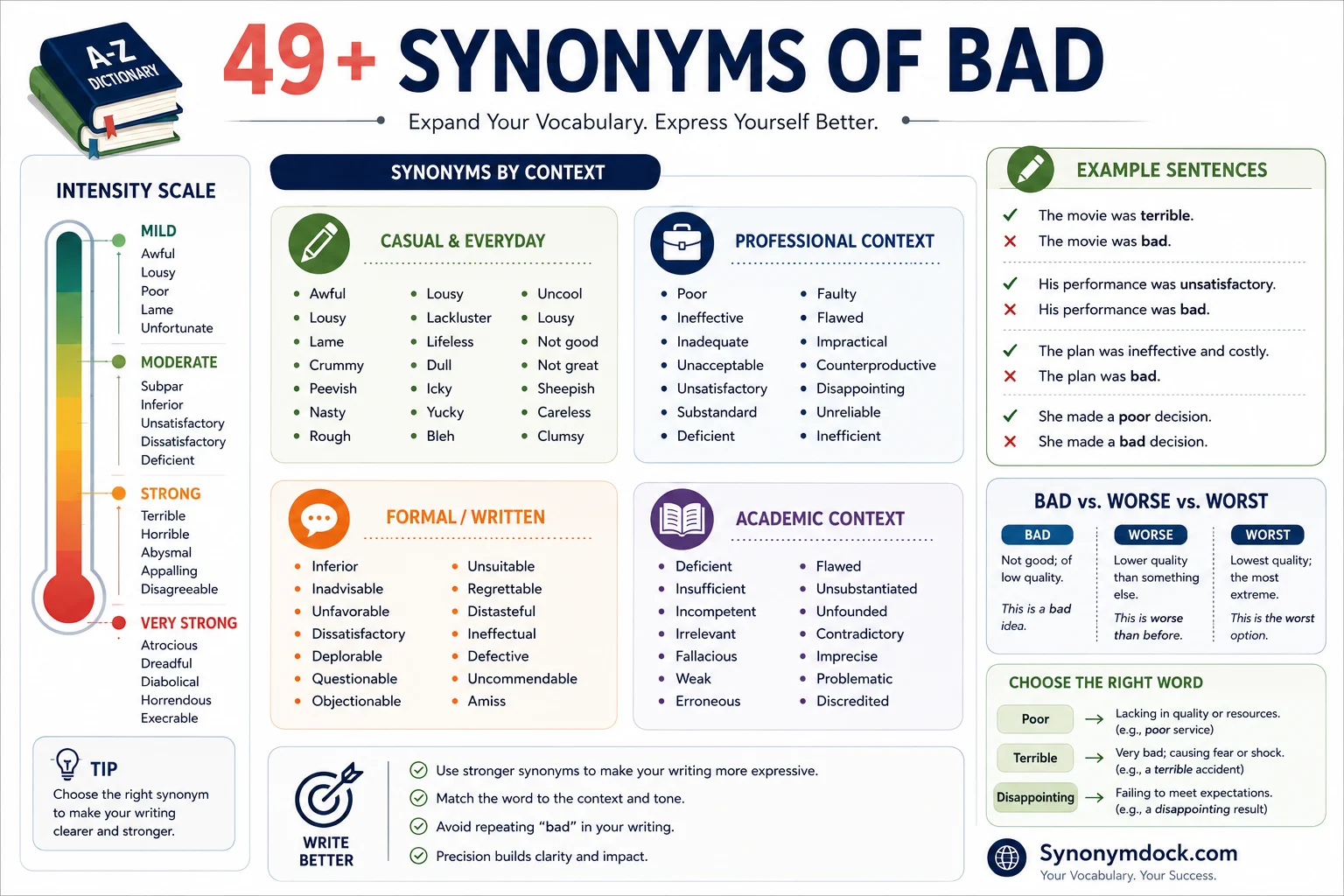
The word “bad” describes something unpleasant, harmful, or of low quality. For formal writing, choose poor, unsatisfactory, or substandard. For casual conversation, use terrible or awful. In professional settings, words like damaging or detrimental are more precise. If you need to describe immoral actions, wicked or evil are appropriate .
Have you ever been writing an email, an essay, or a social media caption and realized you have used the word “bad” five times in two paragraphs? It is a common habit. The word is easy to reach for, but it often leaves your writing feeling vague and unpolished. Choosing the right synonym of bad can instantly clarify your meaning, sharpen your tone, and make your communication more effective. This guide will help you move beyond generic language and choose the most powerful word for any situation.
Meaning, Tone, and Context
Simple Definition: Bad is an adjective used to describe something that is not good. This can mean it is of low quality, harmful, morally wrong, unpleasant, or spoiled .
Part of Speech: Adjective (can also be an adverb informally).
Overall Tone: Negative. It carries a clearly negative connotation, but the intensity varies widely based on what it is describing.
Formality Level: Neutral. It is appropriate for any setting, but using it too often can make your writing sound vague.
Common Uses: Native speakers use “bad” to describe everything from the weather and food to a person’s character and a difficult situation. Its overuse has made it a default term for a wide range of negative experiences .
When and How to Use “Bad”
“Bad” is best used as a general, straightforward word. You should choose it when you do not need to be specific.
- Professional: “The quarterly results were not as bad as we had initially projected.”
- Academic: “The study’s methodology was not bad, but it had several limitations.”
- Workplace: “We received some bad feedback from the client about the first draft.”
- Personal: “I had a bad day at work today.”
- Email: “I am sorry to deliver this bad news, but the event has been canceled.”
- Resume: “Leaving that job was a bad situation, so I chose to pursue other opportunities.”
- Social Media: “The weather is so bad today, but it is perfect for staying in and reading.”
Best Synonyms of “Bad”
No synonym is identical in every situation. The best word depends heavily on what you are trying to say.
- For Professional Writing:Detrimental or Adverse .
- Why: These words sound more formal and precise than “bad,” making your writing sound more authoritative.
- For Academic Writing:Inadequate or Substandard .
- Why: These terms clearly indicate a failure to meet a standard without being overly emotional.
- For Business Communication:Damaging .
- Why: It implies a serious and quantifiable negative impact on a project or company.
- For Casual Conversation:Terrible .
- Why: It is common, easy to use, and gets the point across without being too formal or dramatic.
- For Emotional Writing:Dreadful or Awful .
- Why: These words convey a stronger sense of personal distress or upset.
- For Creative Writing:Abysmal or Atrocious .
- Why: They are vivid and descriptive, allowing you to paint a clear picture for the reader.
- For Resume Writing:Unfortunate .
- Why: It is a softer, more professional way to discuss negative circumstances or transitions.
- For Workplace Communication:Unacceptable .
- Why: This phrase is assertive and direct, especially when addressing performance or behavior.
- For a Stronger Meaning:Appalling or Horrendous .
- Why: These words express an extreme degree of badness.
- For a Softer Meaning:Inferior .
- Why: It is a more clinical and less emotional way to say something is not as good as something else.
When Not to Use “Bad”
Using “bad” is not always the best choice. Here are situations where it sounds less effective.
- When the word sounds too vague. If you are writing a review, saying “the service was bad” is not helpful.
- Why: It does not specify what was wrong.
- Better: “The service was unprofessional.”
- When the word sounds too weak. If you are describing a serious moral issue, “bad” is not strong enough.
- Why: It does not convey the severity of the action.
- Better: “His actions were corrupt.”
- When you need to be professional. In a report to a superior, “bad results” does not sound technical.
- Why: It is too informal and vague for a professional document.
- Better: “The strategy produced adverse results.”
- When the word sounds too informal. In an academic paper, “bad evidence” is not appropriate.
- Why: It sounds subjective and unscientific.
- Better: “The evidence was deficient.”
Words Commonly Confused With “Bad”
- Bad vs. Evil
- Difference: “Evil” describes a profound and intentional moral wrongness, whereas “bad” is a general term for anything not good .
- When to Use It: Use “evil” when describing someone who is genuinely malevolent or a deeply wicked act.
- Example (Bad): “It was a bad situation.”
- Example (Evil): “He committed an evil crime.”
- Bad vs. Poor
- Difference: “Poor” is often used for quality or performance, while “bad” is more general. It is a more neutral and formal choice .
- When to Use It: Use “poor” in formal writing to describe work, conditions, or health.
- Example (Bad): “He has a bad memory.”
- Example (Poor): “He has a poor memory.”
- Bad vs. Harmful
- Difference: “Harmful” specifically means something causes physical or mental damage. “Bad” is a broader term for something unpleasant or incorrect .
- When to Use It: Use “harmful” when discussing health, the environment, or anything that causes injury.
- Example (Bad): “Smoking is bad for you.”
- Example (Harmful): “Smoking is harmful to your health.”
Best Synonyms of “Bad” by Context
| Context | Best Synonym | Why It Works | Example |
|---|---|---|---|
| Formal Writing | Substandard | It objectively suggests a failure to meet an expected quality level . | “The inspector deemed the housing conditions substandard.” |
| Professional Communication | Detrimental | It shows a sophisticated understanding of negative impacts . | “The new policy could be detrimental to team morale.” |
| Creative Writing | Abysmal | It is a powerful, evocative word that paints a picture of something extremely bad . | “The team’s performance was so abysmal that the crowd started to boo.” |
| Storytelling | Dreadful | It creates a sense of fear or deep concern, perfect for building suspense . | “The captain knew the ship was heading for dreadful weather.” |
| Emotional Writing | Horrific | It describes something extremely shocking and upsetting . | “They witnessed the horrific aftermath of the accident.” |
| Strong Emphasis | Appalling | It expresses a sense of deep moral outrage or extreme shock at a situation . | “The treatment of the prisoners was absolutely appalling.” |
How to Choose the Best Synonym of “Bad”
Choosing the right word is easier if you ask yourself a few questions. First, consider your audience. Are you writing a formal report for a senior manager or a quick text to a friend? This will determine if you need a formal or casual synonym. Next, think about the purpose. Are you trying to express sorrow, criticize quality, or describe a moral failing? The best word will depend on the specific meaning you want to convey . Finally, think about intensity. Is the situation slightly negative or severely damaging? Words like “poor” or “inferior” are mild, whereas “atrocious” and “appalling” are extremely strong.
Real Life Examples of “Bad”
- School: “My essay was returned with a poor grade because I didn’t follow the instructions.”
- College: “The professor said my thesis statement was insufficient to form the basis of a 10-page paper.”
- Workplace: “Because of a faulty component, we had to delay the product launch.”
- Business: “The merger was detrimental to the company’s long-term growth goals.”
- Email: “I am sending you this email to apologize for my unprofessional behavior.”
- Resume: “I managed a project that was facing unfavorable market conditions.”
- Conversation: “The restaurant we went to was terrible; the service was really slow.”
- Storytelling: “The castle was under a wicked spell that had frozen everyone in time.”
- Blogging: “My attempt at baking a macaron was an absolute disaster.”
- Social Media: “Just had the most atrocious haircut of my entire life.”
25 Best Synonyms of “Bad”
| Synonym | Simple Meaning | Best Used For | Example Sentence |
|---|---|---|---|
| 1. Poor | Not of a good standard . | Formal writing, performance reviews. | “The restaurant received poor reviews from the food critic.” |
| 13. Inferior | Lower in standard or quality . | Formal/objective comparisons. | “Foreign-made products were considered inferior to local ones.” |
| 14. Substandard | Failing to meet a standard . | Academic/professional writing. | “The report highlighted the substandard conditions in the housing.” |
| 15. Inadequate | Not enough; insufficient . | Academic or professional contexts. | “The research had inadequate funding for the project.” |
| 16. Unacceptable | Not satisfactory or allowable . | Workplace communication. | “The behavior from our opponents was completely unacceptable.” |
| 17. Mischievous | Naughty; causing trouble playfully . | Describing children or playful behavior. | “The mischievous puppy had chewed up all of my shoes.” |
| 18. Wicked | Evil or morally wrong . | Storytelling, strong moral judgment. | “The play featured a wicked witch who cursed the kingdom.” |
| 19. Evil | Profoundly immoral or malevolent . | Describing villains, serious crimes. | “The world has seen some truly evil dictators.” |
| 24. Deplorable | Shockingly bad and deserving strong condemnation . | Formal, strong criticism. | “The living conditions in the camp were deplorable.” |
| 25. Horrible | Very bad; unpleasant or shocking . | General use, expressing disgust or fear. | “The test results were just a horrible mess.” |
Synonyms of “Bad” by Usage
Professional vs Personal Synonyms
In the workplace, you should use words that sound objective and competent. Words like unsatisfactory, deficient, and adverse are much better than “bad” in a professional environment. In a personal conversation, you can be more emotional and informal, using words like terrible, awful, or lousy .
Formal vs Conversational Synonyms
In formal settings like reports, essays, and presentations, choose substandard, damaging, or inadequate. In casual settings like texts and daily conversation, words like terrible, awful, and crappy are more common and natural .
Academic Synonyms
For research, essays, and academic discussions, choose precise vocabulary. Words like substandard, deficient, inadequate, and detrimental are more authoritative and objective. They show that you understand the specific nuances of the topic you are writing about .
Professional and Business Synonyms
For resumes and client communication, use unfortunate and damaging. For business emails, unfavorable and unacceptable are ideal. These words maintain a sense of professionalism and do not sound overly emotional or vague. It is best to avoid overly emotional words like “horrendous” in a business document.
Creative and Literary Synonyms
In storytelling and creative writing, expressive words like dreadful, deplorable, abysmal, and atrocious are excellent. They help the reader visualize the scene and feel the emotion. Using a word like corrupt can create a far more vivid picture of a villain than simply calling them “bad” .
Slang or Modern Synonyms
There are several modern slang or informal terms used for “bad.” Lousy is a classic Americanism . Crappy is a common, somewhat vulgar way to say something is not good . The pits is a slightly dated but still understood term . These words should be avoided in formal or professional writing. The word bad can even be used as slang for “good” in some contexts, but this is highly context-dependent and best avoided for clear communication .
Strongest to Mildest Synonyms
Mild: Poor, Inferior, Inadequate, Unsatisfactory
Moderate: Bad, Harmful, Damaging, Unpleasant
Strong: Terrible, Awful, Dreadful
Very Strong: Appalling, Atrocious, Abysmal, Horrific, Wicked, Evil
Emotional vs Neutral Synonyms
Emotional Synonyms: Dreadful, deplorable, and atrocious express strong feelings and moral outrage.
Neutral Synonyms: Inferior , inadequate , and substandard communicate information objectively. They are the best choice for data-driven communication like professional reports.
Antonyms of “Bad”
| Antonym | Meaning | Example Sentence |
|---|---|---|
| 1. Good | Of high quality or standard. | “The food was surprisingly good.” |
| 2. Excellent | Extremely good. | “The team put in an excellent performance.” |
| 3. Acceptable | Satisfactory; adequate. | “His work was considered acceptable.” |
| 4. Beneficial | Favorable or advantageous. | “The new policy will be beneficial.” |
| 5. Superior | Higher in quality or rank. | “The company’s products are of superior quality.” |
| 6. Virtuous | Having or showing high moral standards. | “She is a virtuous and honest woman.” |
| 7. Pleasant | Giving a sense of happy satisfaction. | “The weather was incredibly pleasant.” |
| 8. Fresh | Not stale, rotten, or spoiled. | “This fish is perfectly fresh.” |
| 9. Kind | Having or showing a friendly, generous nature. | “He was a kind and generous soul.” |
| 10. Right | Morally good. | “It is not right to lie.” |
| 11. Favorable | Expressing approval. | “The reviews were all favorable.” |
| 12. Sound | In good condition; not damaged. | “The house is in sound condition.” |
| 13. Excellent | Extremely good. | “Her English is excellent.” |
| 14. Fine | Of high quality. | “He is a fine musician.” |
| 15. Great | Of ability, quality, or eminence. | “He is a great leader.” |
Comparison: “Bad” vs Similar Words
Bad vs Poor
- Main Difference: “Poor” is more objective and often refers to the quality of something, while “bad” is more general and can refer to any negative aspect . “Poor” is a more formal and neutral choice.
- Which Is Stronger? “Bad” can sometimes be stronger depending on context, but both are generally mild.
- Which Is More Formal? “Poor” is more formal.
- When to Use Each: Use “poor” for formal evaluations. Use “bad” in general conversation.
- Examples:
- Bad: “The movie was really bad.”
- Poor: “The movie was a poor adaptation of the book.”
Bad vs Evil
- Main Difference: “Evil” implies deliberate malice and profound immorality, whereas “bad” is a much broader, general term .
- Which Is Stronger? “Evil” is significantly stronger.
- Which Is More Formal? “Evil” is suitable for both formal and informal contexts but is very serious.
- When to Use Each: Use “evil” for serious crimes or villains. Use “bad” for everyday problems.
- Examples:
- Bad: “He had a bad temper.”
- Evil: “He was an evil tyrant.”
Common Phrases and Expressions with “Bad”
1. “Bad news”
- Meaning: Information that is unwelcome or upsetting .
- Example: “I have some bad news about the project.”
2. “Bad luck”
- Meaning: An unfortunate or undesirable outcome caused by chance.
- Example: “It was just bad luck that the bus was late.”
3. “Feeling bad”
- Meaning: Feeling sick, sorry, or guilty .
- Example: “I’m feeling bad about all the things I didn’t get done today.”
4. “Go bad”
- Meaning: To spoil, rot, or decay (usually referring to food) .
- Example: “The milk will go bad if you don’t put it back in the fridge.”
5. “In a bad mood”
- Meaning: Feeling irritable or unhappy .
- Example: “Don’t bother him right now; he is in a bad mood.”
6. “Look bad”
- Meaning: To appear unfavorable or embarrassing to others.
- Example: “The company was trying to avoid looking bad in front of the media.”
7. “My bad”
- Meaning: An informal way of acknowledging a mistake.
- Example: “I left the keys in the car, my bad.”
Common Mistakes to Avoid
- Mistake: Choosing a vague synonym instead of a precise one.
- Incorrect: “The experiment had a bad result.”
- Better: “The experiment had an inconclusive result.”
- Why: Being specific shows you are a more careful thinker.
- Mistake: Confusing “bad” with “badly” as an adverb.
- Incorrect: “He felt badly about the mistake.”
- Better: “He felt bad about the mistake.”
- Why: In standard American English, “feel bad” refers to an emotional or physical state, while “feel badly” means you have a poor sense of touch.
- Mistake: Using an overly informal synonym in a formal document.
- Incorrect: “The new strategy was a lousy idea.”
- Better: “The new strategy was a poor idea.”
- Why: “Lousy” is too casual for a professional report.
- Mistake: Selecting an overly dramatic or emotional word.
- Incorrect: “I got a horrific papercut.”
- Better: “I got a painful papercut.”
- Why: “Horrific” is far too strong for a minor injury.
- Mistake: Using the same word repeatedly.
- Incorrect: “The food was bad, the service was bad, and the music was bad.”
- Better: “The food was appalling, the service was unacceptable, and the music was dreadful.”
- Why: Variation makes your writing more interesting and professional.
- Mistake: Choosing a synonym with the wrong emotional tone.
- Incorrect: “They shared a sinful chocolate cake.”
- Better: “They shared a decadent chocolate cake.”
- Why: “Sinful” implies moral wrongness, while “decadent” implies luxurious indulgence.
Frequently Asked Questions
1. What are the best synonyms of “bad”?
The best synonyms for “bad” depend on context. Use “poor” or “unsatisfactory” for quality, “harmful” or “detrimental” for impact, and “evil” or “wicked” for immorality .
2. What are the best formal synonyms of “bad”?
Excellent formal synonyms include “inadequate,” “substandard,” “deficient,” and “unfavorable.” These are perfect for academic, business, and professional writing .
3. What are common informal synonyms of “bad”?
Some of the most common informal synonyms are “terrible,” “awful,” and “lousy.” These words are commonly used in everyday conversation with friends and family .
4. What is another word for “bad” in professional writing?
In professional writing, you can use “detrimental,” “adverse,” or “unfavorable.” These words sound objective and authoritative, making them a better choice than the word “bad.”
5. What is the difference between “bad” and “evil”?
“Bad” is a general term for anything not good. “Evil” is much stronger and describes a profound, deliberate, and unforgivable moral wrongness .
6. What is the opposite of “bad”?
The most common opposites of “bad” are “good,” “excellent,” and “beneficial.” More specific opposites include “fresh” for food and “virtuous” for a person’s character .
Conclusion
The word “bad” is a common word that can mean many different things, from “poor quality” to “evil.” This guide shows that the best synonym of bad is never a single word. The right choice depends on your audience, your tone, and the specific message you want to send. By understanding the subtle differences between words like “detrimental” and “atrocious,” you can communicate with much greater clarity and impact. A simple piece of advice is to always ask yourself, “What exactly is ‘bad’ about this?” and then choose a word that specifically answers that question.

2 thoughts on “49+ Synonyms of Bad| Meanings, Uses, Examples, and Best Alternatives”