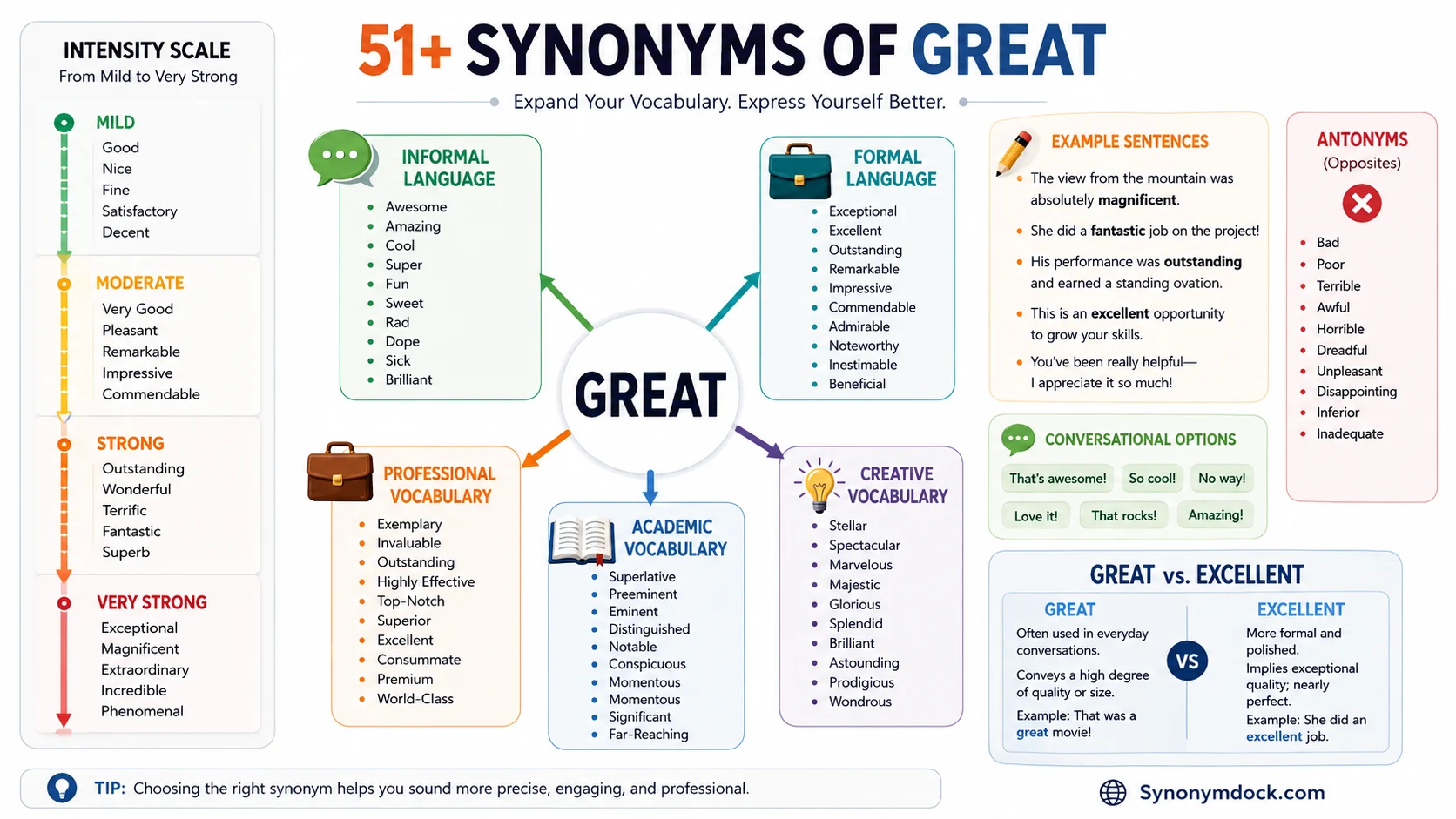
Great is a versatile adjective meaning excellent, large, important, or skillful. The best synonym depends on your context. For formal writing, use “excellent” or “significant.” For casual conversation, try “fantastic” or “awesome.” For professional settings, “exceptional” and “outstanding” work well.
Have you ever written an email, essay, or social media caption and realized you used the word “great” three times in two sentences? You are not alone. Many writers rely on this familiar adjective because it feels safe and easy. But using the same word repeatedly makes your writing sound dull and imprecise. The focus keyword, “synonym of great,” exists because people instinctively know there must be a better way to express themselves. Choosing the right alternative improves clarity, adjusts your tone, and makes your communication more engaging. This guide helps you select the perfect synonym for any situation.
Meaning, Tone, and Context
Simple Definition
Great describes something that is considerably above average in quality, size, importance, or intensity.
Part of Speech
Adjective. It can also function as a noun when referring to an important person, as in “one of the greats” .
Overall Tone
Positive. However, the word itself carries a neutral-positive weight that can be easily modified by the context .
Formality Level
Neutral to informal. While acceptable in most settings, “great” is often considered too casual for highly formal academic papers or business reports .
Common Uses
Native English speakers use “great” constantly. They use it to describe enjoyable experiences like movies or parties. They use it to emphasize size, as in “a great number of people.” They use it to highlight importance, such as “a great leader.” They also use it to express enthusiasm in casual conversation .
Word Forms
- Adjective: great
- Noun: great (as in “one of the all-time greats”)
- Adverb: great (informal, as in “things are going great”)
- Related Forms: greater (comparative), greatest (superlative)
When and How to Use “Great”
Great is your default positive adjective. Use it when you need a quick, safe compliment. However, because it has multiple meanings, its vagueness can be a weakness. Great is the baseline, but the best synonyms elevate your writing above that baseline.
Here are 7 realistic examples of great in action.
Professional:
- “The team did a great job on the quarterly report.”
Academic:
- “The French Revolution was a great turning point in European history.”
Workplace:
- “We had a great response to the new policy.”
Personal:
- “That was a great meal, thank you.”
Email:
- “I think your proposal is great for our upcoming project.”
Resume:
- “Led a great team of 15 software engineers.”
Social Media:
- “Just had a great day at the beach!”
Best Synonyms of “Great”
No synonym is a perfect match for every situation. The word “great” is a chameleon. It changes meaning based on what it describes. The best replacement depends on whether you are describing size, importance, quality, or skill. For professional writing, use “substantial” or “significant” . For academic writing, choose “significant” or “paramount” . For business communication, select “outstanding” or “superb.” For casual conversation, use “fantastic” or “awesome” . For emotional writing, “wonderful” or “magnificent” adds warmth. For creative writing, “epic” or “sublime” paints a vivid picture. For resume writing, use “exceptional” or “notable.” For workplace communication, “commendable” or “admirable” is effective .
For a stronger meaning, choose “tremendous” or “colossal.” For a softer meaning, stick with “good” or “fine.”
When Not to Use “Great”
Using great can be a missed opportunity. In some situations, the word sounds too general or vague. It fails to convey precise meaning. For instance, if you describe a complex scientific breakthrough as “great,” you are underselling its importance. A stronger word would emphasize its significance. Additionally, in formal reports, “great” might sound too informal. Using a synonym can elevate the professional tone. Another common issue is using great when you mean “large.” Alternatives like “vast,” “enormous,” or “massive” are far more descriptive .
Situation: Too Vague
Original: “The results were great.”
Problem: This does not explain what made the results good. Were they significant? Impressive? Complete?
Better: “The results were exceptional.” This implies they were rare and outstanding.
Rewritten: “The results exceeded expectations and were truly exceptional.”
Situation: Too Informal
Original: “The study presents a great contribution to the field.”
Problem: “Great” sounds casual for a formal academic context.
Better: “The study presents a significant contribution to the field.” .
Rewritten: “The study presents a significant contribution to the field of neuroscience.”
Words Commonly Confused With “Great”
Many words are similar to great, but each has a distinct nuance. Choosing the wrong one can make your sentence sound awkward or convey the wrong meaning.
| Word | Difference | When to Use It | Example |
|---|---|---|---|
| Good | A lower bar than great. Good suggests adequacy, while great suggests exceeding expectations. | When something meets a standard but is not exceptional. | “The presentation was good, but I think we can improve it.” |
| Big | Focuses exclusively on physical size. | When you want to emphasize dimensions or mass. | “They own a big house on the hill.” |
| Important | Relates to significance and consequence. | When you want to emphasize that something matters. | “This is an important decision.” |
| Excellent | Implies superior quality. Often more formal than “great.” | In professional contexts when you are evaluating something. | “Her performance was excellent.” |
| Excellent | Implies superior quality. Often more formal than “great.” | In professional contexts when you are evaluating something. | “Her performance was excellent.” |
| Amazing | Implies causing great surprise or wonder. It suggests something is surprising, while “great” is more expected . | When something literally fills you with amazement. | “The magician’s trick was amazing.” |
| Terrific | Similar to great but carries a bit more enthusiasm. | When you want to sound energetic and positive. | “That’s a terrific idea!” |
Best Synonyms of “Great” by Context
The following table provides a quick reference for the best synonym to use in 15 different contexts.
| Context | Best Synonym | Why It Works | Example |
|---|---|---|---|
| Formal writing | Significant | Demonstrates importance and consequence . | “The policy had a significant impact on the economy.” |
| Academic writing | Paramount | Emphasizes supreme importance . | “Accuracy is paramount in scientific research.” |
| Professional communication | Outstanding | Highlights superior quality effectively . | “Your work on this project has been outstanding.” |
| Business emails | Excellent | Sounds professional and direct . | “Excellent work on the presentation materials. |
| Resume writing | Exceptional | Conveys remarkable achievement . | “Demonstrated exceptional leadership skills.” |
| Workplace communication | Commendable | Shows respect and recognizes effort . | “His dedication to the team is commendable.” |
| Casual conversation | Fantastic | Sounds enthusiastic and friendly . | “We had a fantastic time at the concert.” |
| Everyday speaking | Cool | Relaxed and widely accepted . | “That’s a cool new phone.” |
| Creative writing | Epic | Implies grand scale and adventure . | “The hero embarked on an epic journey.” |
| Storytelling | Magnificent | Creates a strong visual impression . | “The view from the mountain was magnificent.” |
| Emotional writing | Wonderful | Conveys a sense of deep pleasure and warmth . | “It was a wonderful feeling to finally succeed.” |
| Strong emphasis | Tremendous | Denotes extreme size, power, or intensity . | “They faced a tremendous challenge.” |
| Mild tone | Good | Safe and neutral . | “That’s a good point.” |
| Social media captions | Awesome | Informal and engaging . | “Just had an awesome weekend!” |
| American English | Amazing | Universally used for enthusiastic praise . | “This pizza is amazing!” |
| British English | Brilliant | Commonly used in the UK for excellent . | “That’s a brilliant idea, mate!” |
How to Choose the Best Synonym of “Great”
Choosing the right word should be a deliberate process. Follow this decision guide.
- Define Your Meaning. Are you describing quality, size, importance, or skill?
- Assess Your Audience. Are you writing for a professor, a boss, or a friend? A college professor requires formal vocabulary. A social media post needs casual words .
- Check the Emotional Strength. Do you want to be mild, moderate, or very strong? “Nice” is weak. “Superb” is strong .
- Consider the Writing Purpose. An academic essay calls for “significant.” A personal story calls for “wonderful.”
- Trust Your Ear. Read the sentence aloud. Does the synonym sound natural? Native English speakers prioritize what sounds right .
- Avoid Repetition. If you have already used a synonym in the same paragraph, try a different one. This shows range and keeps the reader engaged.
Real Life Examples of “Great”
Here are realistic examples demonstrating how to replace “great” in various situations.
School:
- Original: “I got a great score on my math test.”
- Better: “I got an excellent score on my math test.”
College:
- Original: “The professor is a great teacher.”
- Better: “The professor is an outstanding educator.”
Workplace:
- Original: “We had a great meeting.”
- Better: “We had a productive meeting.”
Business:
- Original: “This is a great opportunity.”
- Better: “This is a prime opportunity.”
Email:
- Original: “Thank you for the great feedback.”
- Better: “Thank you for the constructive feedback.”
Resume:
- Original: “I have a great ability to lead teams.”
- Better: “Proven ability to lead cross-functional teams.”
Conversation:
- Original: “The movie was great.”
- Better: “The movie was fantastic.”
Storytelling:
- Original: “It was a great storm.”
- Better: “It was a ferocious storm.”
Blogging:
- Original: “This recipe is great for beginners.”
- Better: “This recipe is ideal for beginners.”
Social Media:
- Original: “Great day at the park.”
- Better: “Glorious day at the park.”
25 Best Synonyms of “Great”
Here are exactly 25 high-quality synonyms you can start using today.
| Synonym | Simple Meaning | Best Used For | Example Sentence |
|---|---|---|---|
| Excellent | Of the highest quality . | Professional contexts, formal writing. | “His work is always excellent.” |
| Exceptional | Unusually good, standing out . | Resumes and performance reviews. | “She has exceptional writing skills.” |
| Superb | Extremely good, impressive . | Describing food, art, or performances. | “The food at the new restaurant is superb.” |
| Outstanding | Exceptionally good . | Professional settings and accolades. | “Her contributions were outstanding.” |
| Magnificent | Impressively beautiful or grand . | Describing scenery or buildings. | “The palace is magnificent.” |
| Wonderful | Inspiring delight and pleasure . | Emotional writing, personal stories. | “We had a wonderful vacation.” |
| Fantastic | Extremely good and enjoyable . | Casual conversation. | “That was a fantastic meal.” |
| Tremendous | Very great in amount or intensity . | Emphasizing effort or size. | “It was a tremendous undertaking.” |
| Terrific | Of great size or intensity, excellent . | Expressing enthusiasm. | “The support has been terrific.” |
| Brilliant | Exceptionally clever or impressive . | British English, intellectual praise. | “He had a brilliant idea.” |
| Notable | Worthy of attention . | Academic writing, job applications. | “She is a notable researcher.” |
| Significant | Important and meaningful . | Reports, academic papers. | “There was a significant change.” |
| Grand | Impressive and magnificent . | Describing events or architecture. | “The wedding was a grand affair.” |
Synonyms of “Great” by Usage
Professional vs Personal Synonyms
In the workplace, choose words that add weight and professionalism. Avoid casual synonyms that might sound immature. Use “exceptional,” “outstanding,” or “commendable” for professional settings . In personal conversations, you have more flexibility. Use “fantastic,” “awesome,” or “terrific” to show enthusiasm .
Formal vs Conversational Synonyms
Formal writing such as reports, essays, and academic papers requires precise and restrained language. “Significant,” “considerable,” and “substantial” are safe and effective choices . Formal emails and presentations also benefit from this vocabulary. In contrast, conversational English is more relaxed. Texting with friends often uses slang like “cool” or “epic.” Casual conversations benefit from “great” itself or “amazing” .
Academic Synonyms
In academic discussions, words that demonstrate authority and precision are preferred. “Significant” and “paramount” show analytical thinking . “Notable” draws attention to important data . Use “substantial” when discussing quantities or evidence .
Professional and Business Synonyms
For resumes and interviews, you need strong, confident words. “Exceptional” and “outstanding” are perfect for highlighting your achievements . Use “stellar” for performance . Use “commendable” for ethical behavior . These words prove you understand professional expectations.
Creative and Literary Synonyms
Writing fiction, poetry, or descriptive passages needs emotional and visual language. “Magnificent” and “sublime” create grand, beautiful images . “Epic” suggests adventure and scale . “Glorious” adds a sense of triumph. “Prodigious” implies a remarkable quality .
Slang or Modern Synonyms
Modern slang provides casual alternatives. “Awesome” remains a standard for positive experiences . “Cool” is universal for approval . “Epic” is used for anything considered impressive . Avoid slang in formal writing or professional emails .
Strongest to Mildest Synonyms
Understanding the intensity scale helps you control your emotional impact.
| Intensity | Synonyms |
|---|---|
| Mild | Good, Nice, Fine |
| Moderate | Great, Very Good, Excellent |
| Strong | Terrific, Superb, Wonderful |
| Very Strong | Tremendous, Exceptional, Magnificent, Epic, Awesome |
Emotional vs Neutral Synonyms
Emotional Synonyms
These words carry weight and express strong feelings.
- Wonderful: Warm and personal.
- Magnificent: Awe and admiration.
- Tremendous: Shock and respect.
- Awesome: Wonder and enthusiasm.
- Fantastic: Excitement and joy.
Neutral Synonyms
These words communicate information objectively.
- Excellent: A factual evaluation of quality.
- Significant: An objective measure of importance.
- Substantial: A factual measure of size or amount.
- Outstanding: A factual statement about performance.
- Notable: An objective observation of noticeability.
Antonyms of “Great”
Understanding opposites can clarify the meaning of “great.” Here are 15 accurate antonyms for great in its various forms.
| Terrible | Extremely bad or poor . | “The food was terrible, not great at all.” |
| Awful | Extremely bad or unpleasant . | “The news was simply awful.” |
| Mediocre | Of only moderate quality . | “His performance was mediocre, not great.” |
| Insignificant | Unimportant, having little value . | “The findings were statistically insignificant.” |
| Unimportant | Lacking importance . | “This is an unimportant detail.” |
| Small | Little in size . | “It is a small town, not a great metropolis.” |
| Tiny | Extremely small . | “She has a tiny apartment.” |
| Poor | Low in quality . | “The service was poor.” |
| Inferior | Lower in quality . | “The product is inferior.” |
| Bad | Not good . | “This is bad news.” |
| Minor | Lesser in importance . | “A minor problem, nothing great.” |
| Trivial | Of little value or importance . | “These are trivial matters.” |
Comparison: “Great” vs Similar Words
Great vs Excellent
Main Difference: Excellent is a more precise evaluation of quality. It sets a higher bar than “great” . “Great” is a general positive, while “excellent” indicates superiority.
Which Is Stronger? Excellent.
Which Is More Formal? Excellent.
When to Use Each: Use “great” in casual conversation. Use “excellent” in a formal review to emphasize superior performance .
Examples:
- Great: “That’s a great idea, let’s try it.”
- Excellent: “The experiment’s results were excellent, proving our hypothesis.”
Great vs Amazing
Main Difference: “Amazing” implies that something causes wonder or astonishment . “Great” is more about general approval.
Which Is Stronger? Amazing.
Which Is More Formal? Great, though both are informal.
When to Use Each: Use “great” for everyday things. Use “amazing” when something exceeds expectations in a surprising way .
Examples:
- Great: “I had a great sandwich for lunch.”
- Amazing: “The magician’s performance was amazing.”
Great vs Important
Main Difference: “Important” focuses on significance and consequence. “Great” can mean important but also means good or large .
Which Is More Formal? Important.
Which Is More Specific? Important.
When to Use Each: Use “important” when discussing matters of weight or consequence . Use “great” when describing size or quality.
Examples:
- Great: “It is a great painting.”
- Important: “This is an important meeting you cannot miss.”
Great vs Big
Main Difference: “Big” is exclusively for physical size . “Great” can refer to size, quality, or intensity.
Which Is More Formal? Neither, but “great” sounds more refined.
When to Use Each: Use “big” for simple, physical descriptions . Use “great” for emotional or qualitative descriptions.
Examples:
- Great: “It was a great honor to meet you.”
- Big: “He gave me a big hug.”
Great vs Terrific
Main Difference: “Terrific” is very similar but generally sounds more energetic .
Which Is Stronger? Terrific .
Which Is More Formal? Great is slightly more formal, but both are informal.
When to Use Each: Use “terrific” when you want to convey extra enthusiasm .
Examples:
- Great: “The movie was great.”
- Terrific: “That’s a terrific suggestion, let’s go with it!”
Great vs Magnificent
Main Difference: “Magnificent” is much more extravagant. It implies splendor and grandeur .
Which Is Stronger? Magnificent.
Which Is More Formal? Magnificent.
When to Use Each: Use “magnificent” for impressive sights or events . Use “great” for everyday items.
Examples:
- Great: “It was a great wedding.”
- Magnificent: “The church had a magnificent stained-glass window.”
Common Phrases and Expressions with “Great”
The Great Gatsby (Referring to a famous book)
- Meaning: Using “Great” as an epithet to signify someone who is magnificent or legendary.
- Example: “He was a real estate mogul, a modern-day Great Gatsby.”
Great Scott!
- Meaning: An old-fashioned exclamation of surprise or amazement .
- Example: “Great Scott! Is that the time?”
The Great Unwashed
- Meaning: A derogatory term for the general population.
- Example: “He looked down on the great unwashed from his penthouse.”
A Great Deal
- Meaning: A large amount of something .
- Example: “I have a great deal of work to finish by Friday.”
Great Minds Think Alike
- Meaning: A saying used when two people have the same idea.
- Example: “We both brought the same gift! Great minds think alike.”
Go Great Guns
- Meaning: To do something very fast and successfully.
- Example: “The project is going great guns now that we have the budget.”
To Be a Great One For
- Meaning: To be very enthusiastic about something.
- Example: “She’s a great one for long walks on the beach.”
Common Mistakes to Avoid
Mistake 1: Using “Great” When You Mean “Large”
Incorrect: “The great elephant stood in the room.”
Better: “The massive elephant stood in the room.”
Why: “Great” is vague. “Massive” provides a clearer visual image.
Mistake 2: Using “Great” as a Substitute for “Important” in Formal Writing
Incorrect: “The great issue is funding.”
Better: “The paramount issue is funding.”
Why: “Paramount” emphasizes supreme importance better.
Mistake 3: Overusing “Great” in a Resume
Incorrect: “I have great communication skills.”
Better: “I possess exceptional communication skills.”
Why: “Exceptional” sounds more impressive and professional .
Mistake 4: Choosing a Vague Synonym Like “Nice”
Incorrect: “She is a nice manager.”
Better: “She is an admirable manager.”
Why: “Nice” is a low-value word. “Admirable” shows respect and specificity.
Mistake 5: Using Slang in a Professional Email
Incorrect: “The sales figures are awesome.”
Better: “The sales figures are excellent.”
Why: “Excellent” is professional. “Awesome” is too casual .
Frequently Asked Questions
What are the best synonyms of “great”?
The best synonyms depend on context. For quality, use “excellent,” “outstanding,” or “superb.” For size, use “enormous” or “vast.” For importance, use “significant” or “paramount.”
What are the best formal synonyms of “great”?
The best formal synonyms include “significant,” “substantial,” “considerable,” “paramount,” and “notable.” These are appropriate for academic papers, reports, and professional proposals .
What are common informal synonyms of “great”?
Common informal synonyms include “awesome,” “cool,” “fantastic,” “terrific,” and “amazing.” These are best for social media, texting, and friendly conversations .
What is another word for “great” in professional writing?
The most common professional synonyms are “exceptional,” “outstanding,” “excellent,” and “commendable.” These words highlight superior performance in a formal and respectful way .
What is the difference between “great” and “amazing”?
The difference is intensity and expectation. “Great” is a general positive evaluation. “Amazing” implies that something caused surprise or wonder .
What is the opposite of “great”?
The most common opposites are “terrible,” “awful,” “mediocre,” and “insignificant.” The best antonym depends on which meaning of “great” you are using .
Conclusion
Great is a useful and common word that describes excellent quality, large size, or significant importance. However, it is a general word, and using it too often makes your writing sound dull and imprecise. This guide has provided the best synonyms for great for every context, from formal reports to casual conversations and creative writing. Remember that no synonym works perfectly in every situation. The right word depends on your audience, tone, and purpose. Next time you are tempted to write “great,” pause and choose a stronger, more precise word. Your readers will notice the difference. This is how you can master the synonym of great and improve your everyday communication.
