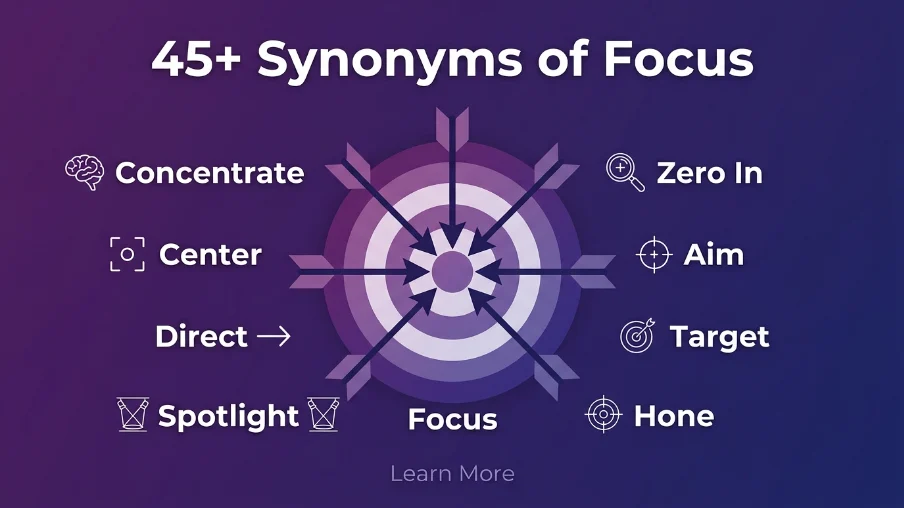
Focus means to direct your attention or effort toward one thing. The best synonyms include concentrate, center, direct, spotlight, zero in, hone in, fixate, attend, aim, and target. But each synonym has a slightly different meaning, tone, or context, so choosing the right one depends on your situation.
Do you ever feel like you’re using the word focus too often? Whether you’re writing about productivity, studying, concentration, business goals, or a complex idea, repeating the same word can make your writing feel less varied. Fortunately, choosing the right focus synonym can make your sentences clearer, more precise, and more engaging.
Learning synonyms for focus is especially useful when the word functions in different ways. As a verb, focus can mean to concentrate your attention on something, direct your efforts toward a goal, or adjust something for greater clarity. As a noun, it can refer to the central subject, main point, or area of attention. This is why the best focus verb synonym depends on the sentence and intended meaning.
If you’re wondering another word for focus, looking for a synonym for focus, or exploring a focus thesaurus, context should always guide your choice. Words such as concentrate, concentrate on, emphasize, center, target, prioritize, and direct may work in certain situations, but they don’t all carry exactly the same nuance. A strong synonym should preserve the original meaning while making your writing sound natural.
This guide provides 30 carefully selected alternatives to focus, with clear definitions, example sentences, and practical usage tips. It covers common focus synonyms, less obvious alternatives, and useful choices for academic, professional, conversational, and creative writing. You’ll also see how another word for focusing can change depending on whether you’re describing attention, effort, purpose, or the main subject of a discussion.
Whether you’re searching for a synonym of focus, comparing synonyms focus, or simply want more variety in your vocabulary, this guide will help you choose the right expression with confidence. Each alternative is explained according to its meaning and typical usage so you can avoid replacing focus with a word that sounds unnatural or changes the intended message.
What Does “Focus” Mean?
Definition
In simple terms, focus means giving your full attention to one thing. It can describe concentrating on a task, like studying for an exam. It can also mean directing something toward a target, like focusing a camera or focusing your energy on a goal. When you focus, you shut out distractions and put your mental or physical energy into one specific area.
Pronunciation
| Feature | Value |
|---|---|
| US IPA | /ˈfoʊkəs/ |
| UK IPA | /ˈfəʊkəs/ |
| Syllables | 2 |
| Tip | Stress the first syllable: FO-kus |
Grammar
| Grammar Feature | Information |
|---|---|
| Part of Speech | Noun and Verb |
| Common Position | Subject, object, or after prepositions |
| Typical Pattern | focus on X (verb) or the focus of X (noun) |
Example Sentences:
- I need to focus on my homework right now. (verb)
- The focus of our discussion is the budget. (noun)
- She has amazing focus when she reads. (noun)
Grammar Note: Focus can be a verb (to focus on something) or a noun (the focus of something). As a verb, it’s often followed by on. The plural form is focuses or foci (the Latin plural).
Word Family
| Word | Part of Speech | Meaning |
|---|---|---|
| Focus | Verb/Noun | To direct attention; the center of attention |
| Focused | Adjective | Paying full attention; clear and direct |
| Focusing | Adjective/Verb | The act of directing attention |
| Unfocused | Adjective | Not paying attention; lacking clarity |
| Overfocus | Verb | To focus too much on one thing |
| Refocus | Verb | To focus again or differently |
| Self-focused | Adjective | Paying attention only to yourself |
| Focusedness | Noun | The quality of being focused |
30 Synonyms of “Focus”
1. Concentrate
Meaning: To direct all your mental effort toward one thing.
Best Used For: Daily conversation, studying, work tasks, and describing mental effort.
Formality: Neutral
Tone: Neutral, practical
Frequency: ⭐⭐⭐⭐⭐ Very Common
CEFR Level: B1
Example Sentence 1: I can’t concentrate with all this noise outside.
Example Sentence 2: She concentrated hard on solving the math problem.
Usage Tip: Concentrate is the most common synonym for focus when talking about mental attention. It’s natural in almost every situation. Use it when you want to emphasize the effort of keeping your mind on one thing. Don’t confuse it with concentration (the noun form) or concentrated (which can mean strong or dense).
2. Center
Meaning: To place something at the middle or to make something the main point of attention.
Best Used For: Describing where attention is directed, both literally and figuratively.
Formality: Neutral
Tone: Neutral, descriptive
Frequency: ⭐⭐⭐⭐ Common
CEFR Level: A2
Example Sentence 1: Our conversation centered around the new project.
Example Sentence 2: The story centers on a young girl’s journey.
Usage Tip: Center is great when you want to describe the main subject of discussion, attention, or activity. It’s often used with around or on. Use it instead of focus when you’re talking about topics, discussions, or stories. It’s less intense than concentrate and works well in both formal and informal settings.
3. Direct
Meaning: To aim or point something toward a specific thing.
Best Used For: Professional contexts, giving instructions, and describing targeted actions.
Formality: Neutral to formal
Tone: Professional, purposeful
Frequency: ⭐⭐⭐⭐ Common
CEFR Level: B1
Example Sentence 1: The teacher directed our attention to the main idea.
Example Sentence 2: We need to direct all our resources toward completing this project.
Usage Tip: Direct is a great choice when you want to sound professional and purposeful. It suggests guidance and intention. Use it in business writing, instructions, and when talking about channeling energy or resources. It’s more formal than focus and sounds decisive.
4. Spotlight
Meaning: To give special attention to something or someone.
Best Used For: Creative writing, media, and situations where something is highlighted.
Formality: Neutral to informal
Tone: Attention-grabbing, vivid
Frequency: ⭐⭐⭐ Moderate
CEFR Level: B2
Example Sentence 1: The documentary spotlights the challenges faced by refugees.
Example Sentence 2: Let’s spotlight the key achievements from this year.
Usage Tip: Spotlight is a vivid, metaphorical word. It suggests shining a literal or figurative light on something to make it stand out. Use it in presentations, reviews, and creative writing. It’s more colorful than focus and adds energy to your writing. Avoid it in very formal academic papers.
5. Zero In
Meaning: To direct all attention toward a specific target or detail.
Best Used For: Investigative contexts, problem-solving, and precision work.
Formality: Informal
Tone: Intent, precise
Frequency: ⭐⭐⭐ Moderate
CEFR Level: B2
Example Sentence 1: The detective zeroed in on the suspect’s alibi.
Example Sentence 2: Let’s zero in on the most important part of the problem.
Usage Tip: Zero in comes from shooting and aiming at a target. It suggests precision and intention. Use it when you want to emphasize focusing on a specific detail. It’s informal and works best in conversation, creative writing, and informal professional settings. Avoid it in formal academic or business writing.
6. Hone In
Meaning: To focus on a specific target or detail, often to improve skill.
Best Used For: Skill development, training, and precision work.
Formality: Neutral
Tone: Purposeful, developmental
Frequency: ⭐⭐⭐ Moderate
CEFR Level: B2
Example Sentence 1: The coach helped us hone in on our weak points.
Example Sentence 2: She honed in on the most effective marketing strategy.
Usage Tip: Hone in is similar to zero in but often suggests improvement or refinement. It’s commonly used in professional development and skill-building contexts. Note that many linguists consider home in the more traditional phrase, but hone in is widely accepted and used. Use it when you want to emphasize getting better at something through focused attention.
7. Fixate
Meaning: To focus intensely on something, often to an unhealthy degree.
Best Used For: Psychology, describing obsession, and intense attention.
Formality: Neutral to formal
Tone: Intense, sometimes negative
Frequency: ⭐⭐⭐ Moderate
CEFR Level: B2
Example Sentence 1: He fixates on small mistakes and can’t move forward.
Example Sentence 2: The media fixated on the celebrity’s personal life.
Usage Tip: Fixate suggests extreme focus that can be unhealthy or obsessive. Use it when you want to describe someone who can’t stop thinking about one thing. It has a negative or intense connotation, so use it carefully. In psychology, it’s used to describe obsessive attachment. Avoid it when you mean positive, productive focus.
8. Attend
Meaning: To direct attention to something.
Best Used For: Formal writing, instructions, and professional contexts.
Formality: Formal
Tone: Professional, attentive
Frequency: ⭐⭐⭐⭐ Common (in specific contexts)
CEFR Level: B1
Example Sentence 1: Please attend to the details in the report.
Example Sentence 2: She attended carefully to the patient’s needs.
Usage Tip: Attend is a formal way to say pay attention to. It’s commonly used in professional and service-oriented contexts. Use it in business writing, formal instructions, and when describing careful attention to someone’s needs. It sounds polite and professional. Don’t confuse it with attend meaning “go to” (attend a meeting).
9. Aim
Meaning: To direct effort or attention toward a particular goal.
Best Used For: Goal-setting, planning, and purposeful action.
Formality: Neutral
Tone: Purposeful, directional
Frequency: ⭐⭐⭐⭐ Common
CEFR Level: A2
Example Sentence 1: We need to aim our efforts toward customer satisfaction.
Example Sentence 2: She aims to finish the project by Friday.
Usage Tip: Aim suggests directing action toward a goal. It works well for planning, goal-setting, and talking about intentions. It’s slightly more action-oriented than focus and suggests purpose. Use it when you want to emphasize moving toward something specific. It’s natural in both conversation and professional contexts.
10. Target
Meaning: To direct effort or attention at a specific group, area, or goal.
Best Used For: Business, marketing, and goal-oriented contexts.
Formality: Neutral
Tone: Strategic, purposeful
Frequency: ⭐⭐⭐⭐ Common
CEFR Level: B1
Example Sentence 1: Our marketing campaign targets young professionals.
Example Sentence 2: We should target the areas that need the most improvement.
Usage Tip: Target is very common in business and marketing. It suggests strategic focus on a specific group or goal. It’s more action-oriented than focus and implies intention and planning. Use it when you want to sound strategic and purposeful. It works well in both conversation and professional writing.
11. Home In
Meaning: To move toward and focus on a target or goal.
Best Used For: Skill development, guided attention, and precision work.
Formality: Neutral
Tone: Precise, purposeful
Frequency: ⭐⭐ Rare
CEFR Level: B2
Example Sentence 1: The team homed in on the most effective solution.
Example Sentence 2: She homed in on the key argument in the debate.
Usage Tip: Home in is the traditional and linguistically preferred version of hone in. It comes from homing pigeons, which find their way home. Use it when you want to describe moving toward a target with increasing precision. It’s slightly more formal than zero in and works well in professional contexts.
12. Pivot
Meaning: To change focus or direction around a central point.
Best Used For: Business, strategy, and situations involving change.
Formality: Neutral
Tone: Strategic, adaptable
Frequency: ⭐⭐⭐ Moderate
CEFR Level: B2
Example Sentence 1: The company pivoted to focus on online sales.
Example Sentence 2: Let’s pivot our discussion to the main issue.
Usage Tip: Pivot suggests changing direction while keeping the central point. It’s become very common in business for describing strategic changes. Use it when you want to emphasize turning your attention to something else. It sounds dynamic and adaptable. Avoid it in formal academic writing unless it’s relevant.
13. Zoom In
Meaning: To focus on details, similar to zooming in with a camera.
Best Used For: Analysis, discussion, and detailed examination.
Formality: Informal
Tone: Analytical, detailed
Frequency: ⭐⭐⭐ Moderate
CEFR Level: B1
Example Sentence 1: Let’s zoom in on the specific details of the proposal.
Example Sentence 2: The researcher zoomed in on the most significant findings.
Usage Tip: Zoom in is a modern, metaphor-rich word from photography and technology. It suggests looking at details closely. Use it in conversation, presentations, and informal writing. It’s great for making your language more vivid. Avoid it in very formal academic writing.
14. Narrow
Meaning: To reduce the scope and focus on fewer things.
Best Used For: Decision-making, research, and refinement.
Formality: Neutral
Tone: Analytical, selective
Frequency: ⭐⭐⭐⭐ Common
CEFR Level: B1
Example Sentence 1: Let’s narrow our focus to three main options.
Example Sentence 2: She narrowed down the list of possible causes.
Usage Tip: Narrow is perfect when you want to describe reducing options or limiting scope. It’s often used with down. It suggests a process of elimination and refinement. Use it in decision-making, research, and project planning contexts. It’s natural and easy to understand.
15. Delve
Meaning: To investigate deeply and focus on details.
Best Used For: Research, exploration, and deep investigation.
Formality: Neutral to formal
Tone: Investigative, thorough
Frequency: ⭐⭐⭐ Moderate
CEFR Level: B2
Example Sentence 1: Let’s delve deeper into the causes of the problem.
Example Sentence 2: The book delves into the complexities of modern life.
Usage Tip: Delve suggests exploring deeply and thoroughly. It’s excellent for research and investigative writing. Use it when you want to emphasize going beyond the surface. It’s slightly formal and adds sophistication to your writing. Avoid it in casual conversation.
16. Crystallize
Meaning: To make thoughts or ideas clear and focused.
Best Used For: Creative writing, idea development, and clarity.
Formality: Neutral to formal
Tone: Clarifying, illuminating
Frequency: ⭐⭐ Rare
CEFR Level: C1
Example Sentence 1: Her speech crystallized the main issues for everyone.
Example Sentence 2: The experience crystallized his career goals.
Usage Tip: Crystallize is a beautiful, sophisticated word. It suggests making something clear and focused, like crystals forming. Use it when you want to describe ideas becoming clear. It’s great for creative and academic writing. Avoid it in everyday conversation.
17. Gravitate
Meaning: To be drawn toward a particular focus or interest.
Best Used For: Describing attraction and natural tendency.
Formality: Neutral
Tone: Natural, descriptive
Frequency: ⭐⭐⭐ Moderate
CEFR Level: B2
Example Sentence 1: She gravitates toward creative projects.
Example Sentence 2: People naturally gravitate to leaders with confidence.
Usage Tip: Gravitate suggests being naturally drawn toward something. It’s a great word for describing interests, preferences, and natural tendencies. Use it when you want to describe attraction rather than deliberate focus. It’s more descriptive than focus and adds color to your writing.
18. Single Out
Meaning: To focus on one person or thing specifically.
Best Used For: Criticism, praise, and highlighting specific cases.
Formality: Neutral
Tone: Specific, sometimes critical
Frequency: ⭐⭐⭐ Moderate
CEFR Level: B1
Example Sentence 1: Let’s not single out one person for blame.
Example Sentence 2: The report singled out the most successful strategies.
Usage Tip: Single out suggests focusing on one specific person or thing, often for special attention. It can be positive (singling out for praise) or negative (singling out for criticism). Use it when you want to emphasize that something is specifically chosen for attention. It’s natural in conversation and writing.
19. Sharpen
Meaning: To make more precise or focused.
Best Used For: Skills, arguments, and precision.
Formality: Neutral
Tone: Refining, improving
Frequency: ⭐⭐⭐ Moderate
CEFR Level: B1
Example Sentence 1: We need to sharpen our focus on customer needs.
Example Sentence 2: She sharpened her argument with clear evidence.
Usage Tip: Sharpen suggests making something more focused and effective. It’s great for describing skill improvement and refining arguments. Use it when you want to emphasize becoming more precise. It’s more active than focus and suggests improvement. Works well in professional and skill-development contexts.
20. Orient
Meaning: To direct attention or align toward a particular focus.
Best Used For: Training, education, and professional contexts.
Formality: Formal
Tone: Instructional, professional
Frequency: ⭐⭐⭐ Moderate
CEFR Level: B2
Example Sentence 1: The training program orients new employees to company policies.
Example Sentence 2: We need to orient our strategy toward future growth.
Usage Tip: Orient is a formal word that suggests directing attention or aligning with a specific focus. It’s often used in professional and educational contexts. Use it when you want to sound professional and instructional. It’s more formal than focus and suggests guidance. Avoid it in casual conversation.
21. Tune In
Meaning: To focus attention on something, like tuning a radio.
Best Used For: Listening, media, and conscious attention.
Formality: Informal
Tone: Attentive, engaged
Frequency: ⭐⭐⭐ Moderate
CEFR Level: B1
Example Sentence 1: You need to tune in to what people are really saying.
Example Sentence 2: She tuned in to the speaker’s main message.
Usage Tip: Tune in is a metaphor from radios and television. It suggests adjusting your attention to receive information. Use it in casual conversation and when describing attentive listening. It’s informal and friendly. Avoid it in formal writing unless you’re being deliberately conversational.
22. Set Sights On
Meaning: To focus on a goal or target.
Best Used For: Goal-setting, ambition, and planning.
Formality: Neutral
Tone: Ambitious, purposeful
Frequency: ⭐⭐⭐ Moderate
CEFR Level: B2
Example Sentence 1: She’s set her sights on becoming a doctor.
Example Sentence 2: We set our sights on expanding into new markets.
Usage Tip: Set sights on is a great phrase for describing ambition and goals. It comes from aiming a weapon or telescope. Use it when you want to emphasize determination and purpose. It’s more vivid than focus and suggests aiming high. Natural in conversation and writing.
23. Train
Meaning: To direct or point something toward a target.
Best Used For: Literal pointing (camera, weapon) and figurative attention.
Formality: Neutral
Tone: Directional, precise
Frequency: ⭐⭐⭐ Moderate
CEFR Level: B1
Example Sentence 1: The photographer trained his camera on the sunset.
Example Sentence 2: We trained our efforts on reducing waste.
Usage Tip: Train is a precise word for directing something toward a target. It’s often used with cameras, weapons, and efforts. Use it when you want a slightly more formal or precise word for direct. It’s less common than focus but adds variety. Works well in professional and technical writing.
24. Channel
Meaning: To direct energy or attention through a specific channel.
Best Used For: Energy, creativity, and directing resources.
Formality: Neutral
Tone: Purposeful, strategic
Frequency: ⭐⭐⭐ Moderate
CEFR Level: B2
Example Sentence 1: She channels her energy into creative projects.
Example Sentence 2: We need to channel our resources toward growth.
Usage Tip: Channel suggests directing something through a specific pathway. It’s great for describing energy, creativity, and resources. Use it when you want to emphasize purposeful direction. It’s more vivid than focus and suggests flow. Works well in professional and creative contexts.
25. Rivet
Meaning: To hold attention completely, as if fixed in place.
Best Used For: Describing captivating attention.
Formality: Neutral to formal
Tone: Captivating, intense
Frequency: ⭐⭐ Rare
CEFR Level: C1
Example Sentence 1: The performance riveted the audience’s attention.
Example Sentence 2: He was riveted by the documentary’s shocking revelations.
Usage Tip: Rivet is a strong, vivid word. It suggests being so focused that you can’t look away, like being fixed in place by a rivet. Use it when you want to describe complete, intense attention. It’s more dramatic than focus and adds impact. Reserve it for creative or powerful writing.
26. Drill Down
Meaning: To focus on details after understanding the big picture.
Best Used For: Business analysis, data, and project management.
Formality: Informal to neutral
Tone: Analytical, detailed
Frequency: ⭐⭐ Rare
CEFR Level: B2
Example Sentence 1: Let’s drill down into the quarterly data.
Example Sentence 2: The report drills down into the specifics of each case.
Usage Tip: Drill down is a modern business expression. It suggests going from general to specific, like drilling into the ground. Use it in business meetings, analysis, and project discussions. It’s professional yet conversational. Avoid it in formal academic writing.
27. Pinpoint
Meaning: To identify or locate something with precise focus.
Best Used For: Problem-solving, identification, and precision.
Formality: Neutral
Tone: Precise, detective-like
Frequency: ⭐⭐⭐ Moderate
CEFR Level: B2
Example Sentence 1: We need to pinpoint the source of the problem.
Example Sentence 2: She pinpointed exactly where things went wrong.
Usage Tip: Pinpoint suggests identifying something with precision. It’s great for problem-solving and analysis. Use it when you want to emphasize identifying a specific cause or location. It’s more specific and action-oriented than focus. Works well in both conversation and professional writing.
28. Refocus
Meaning: To focus again, often on something different.
Best Used For: Adapting, strategy shifts, and new priorities.
Formality: Neutral
Tone: Adaptive, strategic
Frequency: ⭐⭐⭐ Moderate
CEFR Level: B1
Example Sentence 1: We need to refocus on our primary goals.
Example Sentence 2: After the interruption, she refocused her attention.
Usage Tip: Refocus is perfect when you need to change your focus to something else or regain focus after distraction. Use it when you want to describe shifting attention. It’s neutral and works in almost any context. It’s more specific than focus when you need to describe a change in attention.
29. Lock Onto
Meaning: To focus on something unwaveringly.
Best Used For: Intense focus, both mental and in technology.
Formality: Neutral to informal
Tone: Intense, determined
Frequency: ⭐⭐ Rare
CEFR Level: B2
Example Sentence 1: The missile locked onto its target.
Example Sentence 2: She locked onto the most important point in the debate.
Usage Tip: Lock onto suggests an unshakeable focus, like technology tracking a target. Use it when you want to emphasize unwavering attention. It’s vivid and intense. Great for creative writing and informal descriptions. Avoid it in very formal contexts.
Synonyms Comparison Table
| Synonym | Best Context | Formality | Tone | Frequency |
|---|---|---|---|---|
| Concentrate | Mental effort, studying | Neutral | Practical | ⭐⭐⭐⭐⭐ |
| Center | Topics, discussions | Neutral | Descriptive | ⭐⭐⭐⭐ |
| Direct | Professional, instructions | Neutral | Purposeful | ⭐⭐⭐⭐ |
| Spotlight | Media, highlighting | Neutral | Vivid | ⭐⭐⭐ |
| Zero in | Precision, investigation | Informal | Intent | ⭐⭐⭐ |
| Fixate | Psychology, obsession | Neutral | Intense | ⭐⭐⭐ |
| Attend | Formal, professional | Formal | Attentive | ⭐⭐⭐⭐ |
| Aim | Goals, planning | Neutral | Purposeful | ⭐⭐⭐⭐ |
| Target | Business, marketing | Neutral | Strategic | ⭐⭐⭐⭐ |
| Delve | Research, investigation | Formal | Thorough | ⭐⭐⭐ |
Best Synonyms by Situation
| Situation | Best Synonym | Why It Works |
|---|---|---|
| Daily Conversation | Concentrate or Focus | Natural and easy |
| Business Email | Direct or Target | Professional and clear |
| Academic Writing | Delve or Crystallize | Sophisticated and precise |
| School Assignment | Concentrate or Focus | Simple and appropriate |
| Professional Meeting | Direct or Target | Strategic and purposeful |
| Presentation | Spotlight or Focus | Engaging and clear |
| Creative Writing | Spotlight or Rivet | Vivid and imagery-rich |
| Social Media | Focus or Tune in | Modern and relatable |
| Movie Review | Spotlight or Focus | Describes attention naturally |
| Book Review | Delve or Crystallize | Captures deep analysis |
Formal vs Informal Synonyms
Formal Alternatives
| Synonym | Best Used For |
|---|---|
| Attend | Professional attention |
| Orient | Training, education |
| Crystallize | Clarifying ideas |
| Delve | Research, investigation |
| Direct | Professional direction |
| Center | Formal discussions |
Neutral Alternatives
| Synonym | Best Used For |
|---|---|
| Concentrate | Most situations |
| Focus | Almost any context |
| Aim | Goals and plans |
| Target | Business and strategy |
| Narrow | Decision-making |
Informal Alternatives
| Synonym | Best Used For |
|---|---|
| Zero in | Precision focus |
| Spotlight | Highlighting |
| Tune in | Listening, attention |
| Zoom in | Detailed analysis |
| Lock onto | Intense focus |
When to Choose Each Level of Formality: Use formal synonyms in academic papers, business reports, and professional presentations. Use neutral synonyms in everyday writing, emails, and most conversations. Use informal synonyms with friends, in creative writing, and on social media. The key is matching your word to your audience and situation.
Strong vs Mild Synonyms
Mild
- Focus — Basic attention
- Aim — General direction
- Center — The main point
- Attend — Giving attention
These words are suitable for everyday situations. They don’t carry strong emotional weight.
Moderate
- Concentrate — Focused mental effort
- Direct — Purposeful attention
- Target — Strategic focus
- Narrow — Reducing scope
These words are more expressive than mild synonyms. They suggest a connection that matters but isn’t overwhelming.
Strong
- Fixate — Intense, sometimes obsessive focus
- Rivet — Captivating, can’t look away
- Crystallize — Complete clarity
- Lock onto — Unshakeable attention
- Zero in — Precise, unwavering focus
Use these words carefully. They convey intensity and should be reserved for situations where a strong focus truly exists. Overusing them can make your writing sound exaggerated.
Real-Life Examples
In the Workplace:
- “We need to direct all our resources toward completing this project on time.”
- “The training program orients new employees to our company values.”
In Academic Writing:
- “The study delves into the complex relationship between social media and mental health.”
- “This chapter crystallizes the key arguments in the debate.”
In Everyday Conversation:
- “I can’t concentrate with all this background noise.”
- “Let’s focus on finding a solution instead of blaming anyone.”
In Creative Writing:
- “The documentary spotlights the struggles of refugee families.”
- “Her speech riveted the audience’s attention for an hour.”
In Business Emails:
- “Please focus on the key metrics in the attached report.”
- “We’re targeting our marketing efforts at young professionals.”
In Social Media:
- “Tune in tomorrow for the big announcement!”
- “Trying to focus on my goals this year.”
Common Collocations
| Common Phrase | Better Alternative |
|---|---|
| Focus attention | Direct attention, concentrate |
| Focus on details | Delve into details, zoom in |
| Focus group | Target group, targeted audience |
| Focus your energy | Channel your energy |
| Main focus | Central focus, primary focus |
| Sharp focus | Razor-sharp focus, acute focus |
| Single focus | Singular focus, undivided attention |
| Lose focus | Lose concentration, get distracted |
Common Phrases
| Phrase | Meaning | Stronger Alternative |
|---|---|---|
| Focus on the goal | Keep attention on the goal | Set sights on the goal |
| Maintain focus | Keep concentrating | Stay locked on |
| Sharp focus | Very clear attention | Razor-sharp focus |
| Focus your mind | Concentrate mentally | Sharpen your mind |
| Center of focus | The main point | Central point |
| Focus group | Group giving opinions | Target group |
| In focus | Clear and sharp | Perfectly clear |
Context Guide
| Situation | Best Synonym | Reason |
|---|---|---|
| Essay | Delve or Crystallize | Academic and precise |
| Speech | Spotlight or Focus | Clear and impactful |
| Business Email | Direct or Target | Professional and clear |
| Novel | Rivet or Spotlight | Imagery-rich and emotional |
| Presentation | Focus or Spotlight | Audience-friendly |
| Conversation | Concentrate or Focus | Natural and easy |
| Academic Writing | Delve or Orient | Formal and precise |
| Marketing Copy | Target or Spotlight | Strategic and engaging |
Related Words
Near Synonyms
- Concentrate — Focus mental effort
- Center — The main point of attention
- Direct — Aim toward something
- Aim — Intentional focus on a goal
Antonyms
- Distraction — Something that takes attention away
- Neglect — Failing to pay attention
- Ignore — Refusing to pay attention
- Overlook — Missing something through lack of focus
- Dispersion — Spreading attention widely
Related Adjectives
- Focused — Giving full attention
- Concentrated — Intensely focused
- Unfocused — Lacking attention
- Distracted — Attention pulled elsewhere
- Attentive — Paying careful attention
Related Nouns
- Concentration — The act of focusing
- Attention — Mental focus
- Priority — Something given focus
- Objective — A focused goal
Related Verbs
- Concentrate — To focus mentally
- Direct — To aim attention
- Attend — To pay attention
- Refocus — To focus again
- Channel — To direct energy or attention
Frequently Asked Questions
What is another word for focus?
The most common synonyms for focus are concentrate, center, direct, aim, and target. For mental focus, use concentrate. For discussions, use center. For professional contexts, use direct or target. Each synonym has a slightly different meaning and context.
Which synonym sounds the most professional?
Direct, target, and orient sound the most professional. Use direct for instructions, target for strategic focus, and orient for training and guidance. These words are common in business writing and professional communications.
What is the strongest synonym for focus?
Fixate, rivet, and crystallize are the strongest synonyms. Fixate suggests obsessive focus, rivet means captivating attention, and crystallize means making ideas completely clear. Use these for intensity, but use them carefully.
Which synonym is best for essays?
Delve, crystallize, and center work best in essays. Delve suggests deep investigation, crystallize helps clarify complex ideas, and center describes the main topic. They’re formal enough for academic writing.
What’s the difference between focus and concentrate?
Focus is broader it can describe attention, energy, or even camera focus. Concentrate is specifically about mental effort. You can focus a camera but you can’t concentrate a camera. For mental attention, they’re often interchangeable.
Which synonym is most common in everyday English?
Focus itself is most common, followed by concentrate and aim. Native speakers use these daily. For everyday situations, stick with focus or concentrate. They’re natural and widely understood.
What is the opposite of focus?
The main opposites are distraction, neglect, and ignorance. Distraction takes attention away, neglect means failing to focus, and ignorance means not paying attention at all. Choose based on whether you mean mental, physical, or intentional disconnection.
Is focus a verb or noun?
Focus can be both a verb and a noun. As a verb: “I need to focus on my work.” As a noun: “My focus is on my work.” This flexibility makes it very useful in English.
Conclusion
Focus is one of the most essential words in English. It describes how we direct attention, energy, and effort toward what matters most. But using the same word repeatedly can make your writing feel flat.
Now you have 30 powerful synonyms to choose from. Remember:
- Use concentrate for mental focus and effort
- Use center for the main topic of discussion
- Use direct or target for professional contexts
- Use delve or crystallize for academic and deep analysis
- Use spotlight or rivet for creative and vivid descriptions
The key to choosing the right synonym is understanding your context, tone, and audience. A word that sounds great in a business meeting might feel out of place in a casual conversation. Practice using these synonyms in your daily writing and speaking, and soon they’ll feel completely natural.
Start small try replacing focus with concentrate or aim in your next conversation. Then experiment with more advanced words like delve or crystallize when the situation is right. Your vocabulary will grow, and your English will sound more fluent and natural.

1 thought on “45+ Synonyms of Focus | Meaning, Examples & Usage For 2026”