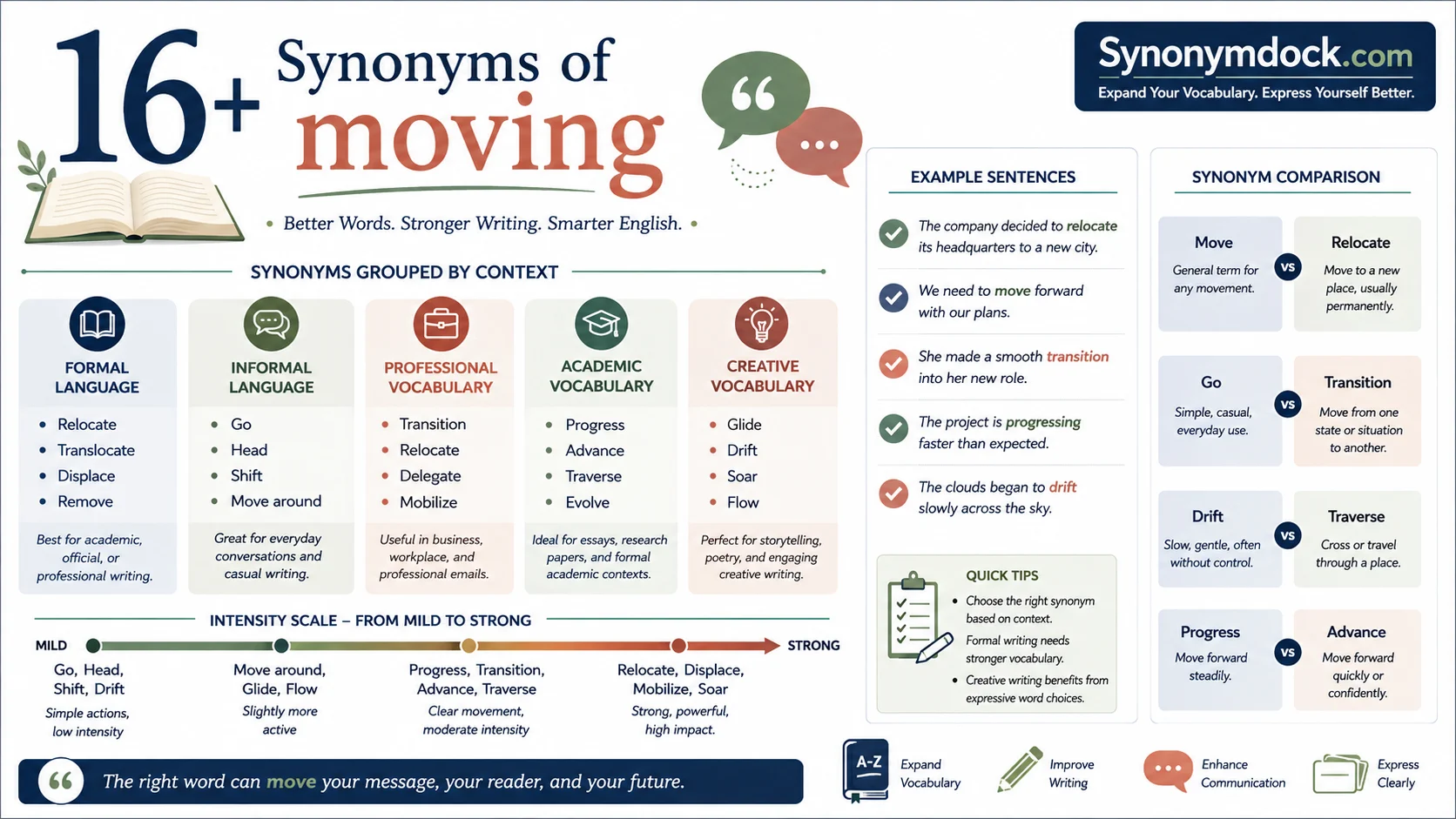
“Moving” has two primary meanings: physical displacement and emotional impact. For physical motion, the best synonyms are shifting and mobile. For emotional depth, the strongest choices are touching, poignant, and affecting. For professional contexts, use compelling or persuasive. The best synonym depends entirely on your intended context and emotional intensity. Choose the one that fits your message most accurately .
Have you ever found yourself describing a powerful film as “moving,” then struggled to find another word that captures the same feeling? Perhaps you are writing a cover letter and want to avoid repeating the same vocabulary. The word “moving” appears frequently in our daily communication, yet relying on it too often can make our writing feel flat. Understanding the synonyms of moving allows you to express yourself with greater precision and emotional depth. Choosing the right synonym improves clarity and ensures your message resonates with your audience .
Meaning, Tone, and Context
Simple Definition
The word “moving” has two distinct definitions. First, it refers to something that changes position or is capable of changing position. Second, it describes something that arouses deep emotion, often sadness or sympathy .
Part of Speech
- Adjective (most common)
- Verb form: “moving” as the present participle of “move”
Overall Tone
“Moving” is a neutral to positive word, but its tone shifts depending on context. When describing physical motion, it is purely factual. When describing emotional impact, it carries a warm, sincere, and often somber tone .
Formality Level
The word “moving” sits comfortably at a semi-formal to neutral level. It works well in everyday conversation, professional emails, and most writing contexts. Its synonyms range from very formal to casual, allowing you to adjust formality as needed.
Common Uses
Native English speakers use “moving” in two primary situations. First, they use it to describe something in physical motion, such as a moving car or moving parts in a machine . Second, they use it to describe stories, speeches, films, or personal experiences that evoke strong emotion, like a moving eulogy or a moving farewell letter.
Word Forms
- Noun: movement
- Verb: move, moves, moved
- Adjective: moving, movable, unmoving
- Adverb: movingly
- Opposite form: unmoving, still
When and How to Use “Moving”
Choose “moving” when you need a versatile word that conveys either physical motion or emotional impact. It is a safe, widely understood choice that works in most situations. However, for maximum impact, consider whether a more specific synonym would serve your purpose better.
Here are examples of “moving” in real-world contexts:
Professional: The CEO delivered a moving speech about the company’s commitment to community service.
Academic: The study presents moving evidence of the psychological effects of long-term isolation.
Workplace: We need to consider the moving parts of this project before making a final decision.
Personal: Watching my grandmother receive that award was one of the most moving moments of my life.
Email: Thank you for the moving tribute you wrote about our late colleague.
Resume: Led a moving initiative that resulted in a 20% increase in employee engagement.
Social Media: This documentary is absolutely moving. Everyone needs to watch it.
Best Synonyms of “Moving”
No synonym perfectly matches “moving” in every situation. Your choice should depend on your specific meaning, audience, and emotional intention. Here are the best synonyms for various contexts:
Professional writing: Compelling, persuasive, influential
Academic writing: Poignant, affecting, significant
Business communication: Persuasive, impactful, powerful
Casual conversation: Touching, emotional, sweet
Emotional writing: Poignant, heartbreaking, stirring, affecting
Creative writing: Soul-stirring, evocative, haunting, heartwarming
Resume writing: Impactful, compelling, transformative
Workplace communication: Active, dynamic, responsive
Stronger meaning: Heartbreaking, gut-wrenching, devastating
Softer meaning: Tender, gentle, sentimental, touching
When Not to Use “Moving”
When the Word Sounds Too General
“If something is ‘moving,’ but you want to specify whether it made people cry, feel hopeful, or feel angry, ‘moving’ is too vague.”
Incorrect: The book was moving.
Better: The book was heartbreaking.
Why: The stronger synonym communicates the specific emotional experience more clearly.
When the Word Sounds Too Vague
Incorrect: The presentation was moving.
Better: The presentation was compelling.
Why: “Compelling” suggests the presentation was persuasive and engaging, not just emotional.
When the Word Sounds Too Informal
Incorrect: We found the research data moving.
Better: We found the research data significant.
Why: “Moving” implies emotion, which may not suit objective academic or scientific writing. “Significant” maintains a neutral, professional tone.
When the Word Sounds Too Weak
Incorrect: The tragedy was moving.
Better: The tragedy was devastating.
Why: “Devastating” conveys the severity and magnitude of the tragedy more accurately.
When the Word Is Outdated
“Moving” is not outdated, but some synonyms like “affecting” may sound overly formal or old-fashioned in casual conversation. Use “touching” or “emotional” instead.
Words Commonly Confused With “Moving”
Moving vs Shifting
Difference: “Moving” is the general term for changing position. “Shifting” specifically implies a slight change of position, often within a limited area .
When to Use Moving: Use it for general change of position or residence. “We are moving to a new city.”
When to Use Shifting: Use it for small changes of position. “She kept shifting in her seat.”
Moving vs Touching
Difference: “Moving” refers to any deep emotional response, while “touching” specifically evokes tenderness, sympathy, or compassion .
When to Use Moving: Use it for any emotionally impactful experience. “The documentary about war was deeply moving.”
When to Use Touching: Use it for gentle, tender moments. “The child’s letter to her father was touching.”
Moving vs Poignant
Difference: Both describe deep emotion, but “poignant” specifically evokes sadness or regret. “Moving” covers a broader range of emotions .
When to Use Moving: Use it for general emotional impact. “The graduation speech was moving.”
When to Use Poignant: Use it for bittersweet or sad moments. “The aging couple’s farewell was poignant.”
Moving vs Affecting
Difference: “Moving” is the least specific term. “Affecting” suggests a more profound, sometimes bittersweet, emotional impact .
When to Use Moving: Use it for straightforward emotional description. “The film was moving.”
When to Use Affecting: Use it for heart-rending experiences. “We found the photo of the hostages’ release to be deeply affecting.”
Moving vs Stirring
Difference: “Stirring” suggests an exciting, turbulent, but positive emotional response. “Moving” can refer to any deep emotion, including sadness .
When to Use Moving: Use it for sad or sentimental moments. “Her eulogy was moving.”
When to Use Stirring: Use it for uplifting, inspiring moments. “The president gave a stirring speech about freedom.”
Moving vs Emotional
Difference: “Moving” describes something that causes an emotional response in the observer. “Emotional” describes the person experiencing the emotion or something charged with emotion .
When to Use Moving: Use it to describe the stimulus. “It was a moving story.”
When to Use Emotional: Use it to describe the response. “The story made everyone emotional.”
Best Synonyms of “Moving” by Context
| Context | Best Synonym | Why It Works | Example |
|---|---|---|---|
| Formal writing | Poignant | Conveys depth and sophistication | The memorial featured a poignant tribute. |
| Academic writing | Significant | Maintains objectivity while noting importance | The findings had significant implications. |
| Professional communication | Compelling | Suggests persuasive power and engagement | Her argument was compelling. |
| Business emails | Impactful | Suggests measurable effect | Your contribution was impactful. |
| Resume writing | Transformative | Conveys meaningful change | Led a transformative initiative. |
| Workplace communication | Dynamic | Suggests energy and adaptability | We need a dynamic team approach. |
| Casual conversation | Touching | Sounds warm and genuine | That was such a touching story. |
| Everyday speaking | Emotional | Clear and universally understood | The movie was really emotional. |
| Creative writing | Evocative | Describes imagery and feeling | The scene was powerfully evocative. |
| Storytelling | Haunting | Suggests lingering emotional effect | The image of the empty house was haunting. |
| Emotional writing | Heartbreaking | Communicates intense sadness | The news was heartbreaking. |
| Strong emphasis | Devastating | Conveys overwhelming emotional impact | The loss was devastating. |
| Mild tone | Tender | Suggests gentle affection | Their farewell was tender. |
| Social media captions | Heartwarming | Positive and shareable | This video is so heartwarming. |
How to Choose the Best Synonym of “Moving”
Choosing the best synonym requires careful consideration of your audience, purpose, and the emotional weight you wish to convey.
Start with the meaning. Are you describing physical motion or emotional impact? If physical, choose “shifting,” “mobile,” or “dynamic.” If emotional, consider synonyms like “touching,” “poignant,” or “stirring.”
Consider your audience. For academic or professional writing, use formal synonyms like “poignant,” “significant,” or “compelling.” For casual conversations, use simpler terms like “touching” or “emotional.”
Evaluate the emotional strength. “Moving” itself sits in the middle of the emotional intensity spectrum. Choose stronger synonyms like “heartbreaking” or “devastating” for intense emotions. Choose milder synonyms like “tender” or “sentimental” for gentle feelings .
Think about your writing purpose. For a resume, choose “impactful” or “transformative.” For a blog post, choose “heartwarming” or “soul-stirring.” For a formal report, choose “significant” or “noteworthy.”
Test the synonym in your sentence. Read the sentence aloud with your chosen synonym. Does it feel natural? Does it capture the exact meaning you intend? If not, try another option.
Real Life Examples of “Moving”
School: The teacher read a moving story about friendship that touched every student in the class.
College: Her college admissions essay was so moving that it brought the committee to tears.
Workplace: The farewell speech was emotional and moving, reminding everyone of the colleague’s lasting impact.
Business: The client was moved by our presentation, and the compelling narrative sealed the deal.
Email: Your kind words about my work were deeply moving and appreciated.
Resume: Developed and implemented a moving volunteer program that engaged 200 employees.
Conversation: “How was the movie?” “It was really moving. I cried at the end.”
Storytelling: The moving tale of the soldier’s return home captured the hearts of everyone who heard it.
Blogging: This is a moving account of one woman’s journey through illness and recovery.
Social media: This video is so moving. It reminds us what really matters in life.
25 Best Synonyms of “Moving”
| Synonym | Simple Meaning | Best Used For | Example Sentence |
|---|---|---|---|
| Touching | Creating gentle feelings of sympathy | Casual conversation, personal stories | His tribute to his mother was deeply touching. |
| Poignant | Evoking sadness or regret | Literary writing, formal speeches | The film offered a poignant reminder of lost youth. |
| Stirring | Producing excitement and positive emotion | Inspirational speeches, patriotic writing | Her stirring performance brought the audience to its feet. |
| Affecting | Creating deep, often bittersweet emotion | Academic analysis, reviews | The painting was so affecting that visitors stood in silence. |
| Heartbreaking | Causing intense sadness or sorrow | Emotional narratives, personal tragedies | The story of the orphaned children was heartbreaking. |
| Compelling | Powerful and persuasive | Business writing, professional contexts | His compelling argument convinced the board to act. |
| Impactful | Having a strong effect or influence | Resumes, professional communication | Her impactful presentation changed company policy. |
| Evocative | Bringing strong feelings to mind | Creative writing, descriptive passages | The imagery in the poem was powerfully evocative. |
| Heartwarming | Inspiring gladness and pleasure | Positive stories, feel-good content | The community response was truly heartwarming. |
| Emotional | Full of or causing strong feelings | Everyday conversation, informal writing | The reunion was an emotional moment for everyone. |
| Tender | Gentle and affectionate | Romantic or family contexts | She gave him a tender farewell. |
| Expressive | Showing feelings clearly | Creative writing, emotional descriptions | Her expressive performance moved the audience. |
| Propulsive | Driving forward with force | Dynamic descriptions, action scenes | The story had a propulsive momentum. |
| Gripping | Holding attention intensely | Reviews, storytelling | The gripping documentary held us spellbound. |
Synonyms of “Moving” by Usage
Professional vs Personal Synonyms
Professional synonyms such as “compelling,” “impactful,” and “persuasive” work best in workplaces. They convey strength and influence without unnecessary emotion. “Compelling” suggests that an argument is so strong that it demands acceptance. “Impactful” suggests measurable results.
Personal synonyms such as “touching,” “emotional,” and “heartwarming” sound more natural in everyday conversations and personal writing. They feel warmer and more genuine. “Touching” often describes personal stories or gestures.
Formal vs Conversational Synonyms
Formal synonyms fit reports, essays, business writing, and presentations. Use “poignant,” “affecting,” or “significant” to maintain a professional tone. “Poignant” works well in academic writing when describing emotional subjects.
Conversational synonyms suit emails, casual conversations, and social media. Use “emotional,” “moving,” or “touching” for everyday communication. These words are universally understood and feel natural in speech.
Academic Synonyms
For research, essays, and academic discussions, choose precise and authoritative vocabulary. “Poignant” conveys emotional depth in literary analysis. “Significant” indicates importance in research findings. “Compelling” suggests that evidence is strong and convincing. “Evocative” is excellent for describing literary imagery. These synonyms elevate academic writing and demonstrate advanced vocabulary .
Professional and Business Synonyms
For resumes, interviews, meetings, and client communication, choose words that demonstrate impact and influence. “Compelling” works for describing persuasive abilities. “Impactful” suggests that you made a tangible difference. “Persuasive” is ideal for sales or marketing roles. “Transformative” is powerful for describing significant changes you led. “Dynamic” suggests energy and adaptability.
Creative and Literary Synonyms
For storytelling, fiction, poetry, and descriptive writing, choose expressive alternatives that add imagery and depth. “Evocative” paints vivid pictures in the reader’s mind. “Haunting” creates a lingering emotional effect. “Soul-stirring” suggests profound spiritual or emotional impact. “Gripping” describes stories that hold attention completely. “Propulsive” creates a sense of forward movement and urgency.
Slang or Modern Synonyms
There are no widely recognized slang synonyms for “moving” that capture its emotional meaning. Some modern usages include “hits different” (in slang contexts) but these are not established synonyms. For physical motion, informal options include “on the move” or “in motion.” Stick to standard synonyms for emotional contexts to ensure clarity.
Strongest to Mildest Synonyms
Intensity Scale
Mild: tender, sentimental, gentle
Moderate: touching, moving, emotional, heartwarming
Strong: poignant, affecting, stirring, evocative
Very Strong: heartbreaking, devastating, soul-stirring, haunting
The emotional intensity of your synonym should match the impact you want to create. For a gentle, sweet story, use “tender” or “heartwarming.” For a deeply sad event, use “heartbreaking” or “devastating.” “Poignant” occupies the strong end but specifically conveys bittersweet or regretful emotion .
Emotional vs Neutral Synonyms
Emotional Synonyms
Words like “poignant,” “touching,” “heartbreaking,” and “soul-stirring” express strong feelings. They are appropriate for personal writing, storytelling, and situations where emotional expression is welcome. Use them when you want to create a deep emotional connection with your reader.
Neutral Synonyms
Words like “significant,” “noteworthy,” and “impactful” simply communicate information without adding unnecessary emotion. They are ideal for academic, professional, and business contexts where objectivity is important. Use them when you need to convey importance without emotional overtones.
Antonyms of “Moving”
| Antonym | Meaning | Example Sentence |
|---|---|---|
| Still | Not moving; stationary | The still water reflected the mountains perfectly. |
| Unmoving | Not capable of being moved emotionally or physically | He remained unmoving despite the pleas. |
| Static | Lacking movement or change | The static display failed to attract visitors. |
| Stationary | Fixed in place; not moving | The stationary car blocked traffic. |
| Fixed | Securely placed; not movable | The fixed sculpture became a local landmark. |
| Immobile | Unable to move | The injured patient remained immobile. |
| Inactive | Not engaged in action or movement | The inactive volcano posed no threat. |
| Stagnant | Not flowing or moving | The stagnant water smelled unpleasant. |
| Unemotional | Not showing or feeling emotion | Her unemotional response surprised everyone. |
| Stoic | Not showing emotion | He remained stoic throughout the ordeal. |
| Unaffecting | Not producing a strong emotional response | The uninspired performance was unaffecting. |
| Uninspiring | Not exciting or encouraging | The uninspiring speech put everyone to sleep. |
| Unimpressive | Not making a strong impact | The unimpressive display disappointed visitors. |
| Apathetic | Showing no interest or emotion | The apathetic audience showed little reaction. |
| Indifferent | Showing no concern or emotion | She was indifferent to his passionate plea. |
Comparison: “Moving” vs Similar Words
Moving vs Poignant
Main Difference: “Moving” covers a broad range of emotional responses. “Poignant” specifically describes deep sadness or regret, often with a bittersweet quality .
Which Is Stronger? “Poignant” is stronger because it denotes a specific, intense emotional reaction.
Which Is More Formal? “Poignant” is more formal and literary. It is commonly found in academic writing, literature, and serious journalism.
When to Use Each: Use “moving” for general emotional impact. Use “poignant” when you want to emphasize sadness or regret, especially in formal writing.
Examples:
- Moving: The film was moving.
- Poignant: The poignant farewell brought tears to everyone’s eyes.
Moving vs Stirring
Main Difference: “Stirring” suggests excitement and positive emotion, while “moving” can be positive or negative .
Which Is Stronger? Both can be strong, but “stirring” implies active excitement, while “moving” can be quieter.
Which Is More Formal? Both are used in formal and informal contexts.
When to Use Each: Use “stirring” for inspiring, uplifting moments. Use “moving” for sentimental or sad moments.
Examples:
- Moving: The soldier’s letter home was moving.
- Stirring: The general’s speech to the troops was stirring.
Moving vs Affecting
Main Difference: “Moving” is the least specific emotional adjective. “Affecting” suggests a profound, often bittersweet, impact .
Which Is Stronger? “Affecting” is generally stronger.
Which Is More Formal? “Affecting” is more formal and is often found in literary criticism.
When to Use Each: Use “moving” for straightforward emotional descriptions. Use “affecting” when you want to describe something that is heart-rending.
Examples:
- Moving: The charity appeal was moving.
- Affecting: The photo of the refugees was deeply affecting.
Moving vs Touching
Main Difference: “Touching” specifically emphasizes tenderness and sympathy, while “moving” covers all deep emotions .
Which Is Stronger? “Moving” can be stronger, but “touching” conveys a specific kind of gentle emotion.
Which Is More Formal? Both are used across contexts, though “touching” feels slightly more personal.
When to Use Each: Use “touching” for kind gestures or gentle stories. Use “moving” for more intense emotional experiences.
Examples:
- Moving: The tragic documentary was moving.
- Touching: The child’s card to his grandmother was touching.
Moving vs Emotional
Main Difference: “Moving” describes the stimulus that causes emotion. “Emotional” describes the person experiencing the emotion or the situation .
Which Is Stronger? “Emotional” can feel more intense because it describes the personal experience.
Which Is More Formal? Both are widely used, but “moving” is often preferred in formal writing.
When to Use Each: Use “moving” to describe what you saw or heard. Use “emotional” to describe how someone felt or reacted.
Examples:
- Moving: The letter was moving.
- Emotional: The reunion was an emotional moment.
Moving vs Compelling
Main Difference: “Moving” focuses on emotional impact. “Compelling” focuses on persuasive power and being unable to resist .
Which Is Stronger? “Compelling” is stronger in professional contexts because it suggests irresistible influence.
Which Is More Formal? “Compelling” is more formal and is commonly used in business and academic writing.
When to Use Each: Use “moving” for emotional stories. Use “compelling” for arguments, presentations, and professional communication.
Examples:
- Moving: Her moving testimony touched the jury.
- Compelling: His compelling argument convinced everyone.
Common Phrases and Expressions with “Moving”
| Phrase | Meaning | Example Sentence |
|---|---|---|
| Moving on | Proceeding forward; leaving behind | After the breakup, she focused on moving on with her life. |
| Moving forward | Looking to the future | Moving forward, we need to improve our communication. |
| Moving parts | Components that change position | The machine has many moving parts that require regular maintenance. |
| Moving target | Something that changes constantly | Regulating the internet is a moving target. |
| Moving picture | Film or movie | The moving picture captivated audiences everywhere. |
| Moving violation | A traffic offense while driving | He received a ticket for a moving violation. |
Common Mistakes to Avoid
Mistake 1: Choosing a Vague Synonym Instead of a Precise One
Incorrect: The book was emotional.
Better: The book was heartbreaking.
Why: “Emotional” is vague and could describe joy, anger, or sadness. “Heartbreaking” specifies the exact emotion.
Mistake 2: Confusing “Moving” with “Moved”
Incorrect: The story was moved.
Better: The story was moving. OR The audience was moved by the story.
Why: “Moving” describes the story. “Moved” describes the audience’s reaction.
Mistake 3: Using an Informal Synonym in Formal Writing
Incorrect: The research findings were touching.
Better: The research findings were significant.
Why: “Touching” sounds too casual and emotional for academic writing.
Mistake 4: Selecting an Overly Dramatic Synonym
Incorrect: The small gesture of kindness was devastating.
Better: The small gesture of kindness was touching.
Why: “Devastating” is too strong for a small gesture.
Mistake 5: Repeating the Same Word Too Often
Incorrect: The moving film was about a moving story of a moving family reunion.
Better: The heartwarming film told a touching story of a family reunion.
Why: Varying your synonyms makes writing more interesting.
Mistake 6: Choosing a Synonym with the Wrong Emotional Tone
Incorrect: The tragedy was heartwarming.
Better: The tragedy was devastating.
Why: “Heartwarming” suggests positive emotion. “Devastating” suggests sadness, which fits a tragedy.
Mistake 7: Using Slang in Academic or Professional Writing
Incorrect: The presentation hit different.
Better: The presentation was compelling.
Why: Slang is inappropriate in professional and academic contexts.
Frequently Asked Questions
1. What are the best synonyms of “moving”?
The best synonyms depend on your context. For emotional impact, use touching, poignant, or stirring. For physical motion, use mobile, shifting, or dynamic. For professional writing, use compelling or impactful .
2. What are the best formal synonyms of “moving”?
For formal writing, use poignant, affecting, significant, or compelling. These synonyms maintain a professional tone while conveying emotional depth or importance .
3. What are common informal synonyms of “moving”?
Common informal synonyms include touching, emotional, and sweet. These words feel natural in everyday conversation and personal writing. Heartwarming is also popular in casual contexts .
4. What is another word for “moving” in professional writing?
In professional writing, use compelling, impactful, or persuasive. These words suggest strength and influence without unnecessary emotion. Dynamic is also excellent for describing energetic or adaptable situations .
5. What is the difference between “moving” and “touching”?
“Moving” describes any deep emotional response. “Touching” specifically evokes tenderness, sympathy, or compassion. “Moving” is more general, while “touching” is gentler and more specific .
6. What is the opposite of “moving”?
The main opposites of “moving” are still, unmoving, static, and stationary. For emotional contexts, opposites include unemotional, unaffecting, and uninspiring .
Conclusion
The word “moving” is a powerful and versatile adjective that describes both physical motion and emotional impact. However, using its synonyms allows you to communicate with greater precision and effect. Whether you choose “poignant” for a sad moment, “stirring” for an inspiring speech, or “compelling” for a persuasive argument, the right synonym enhances clarity and emotional resonance .
Remember that no synonym works perfectly in every situation. Consider your audience, your purpose, and the emotional intensity you wish to convey. Choose the synonym that most accurately reflects your intended message. Expand your vocabulary by regularly exploring synonyms of moving and practicing them in your writing.

2 thoughts on “16+ Synonyms of Moving| Meanings, Uses and Best Alternatives”