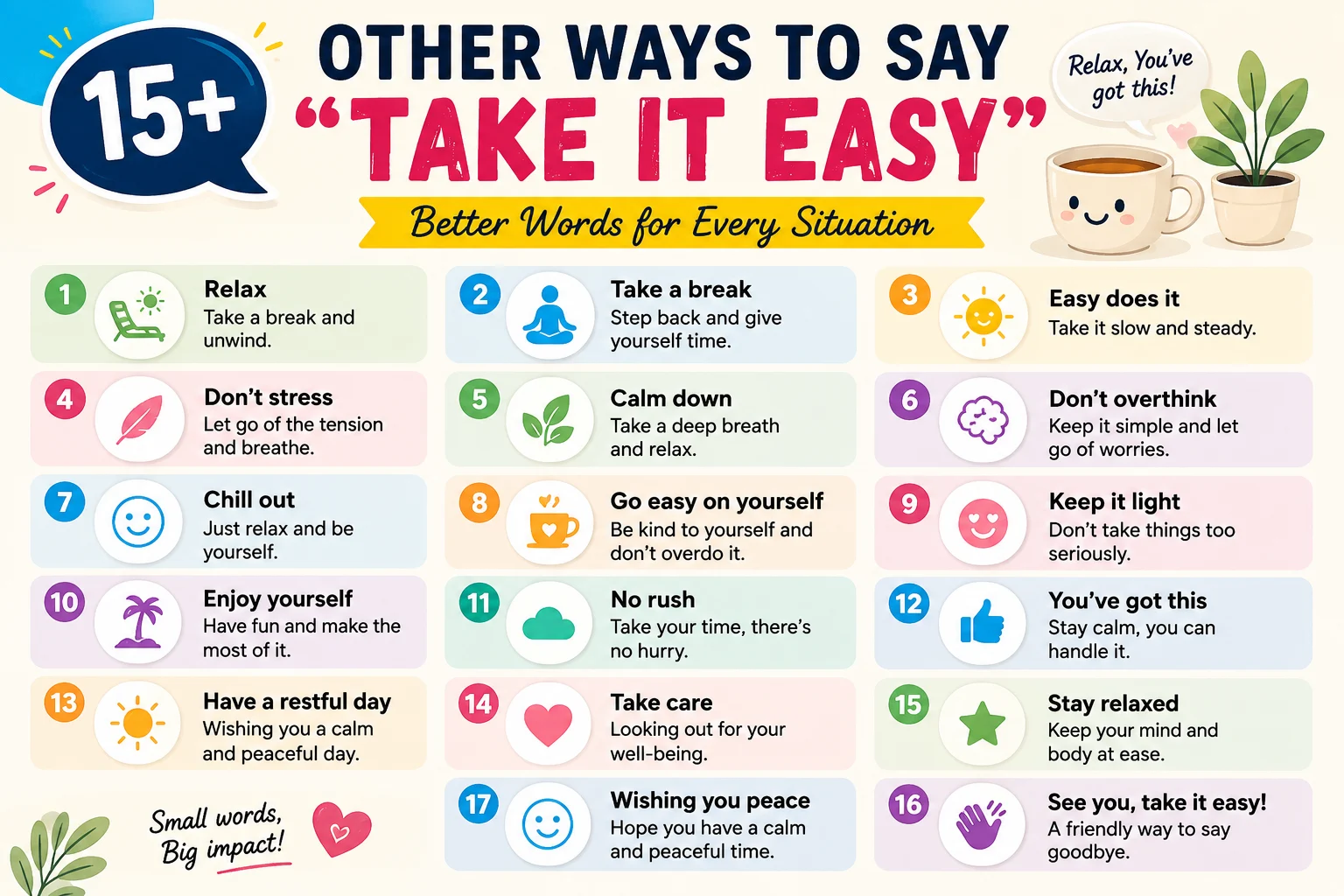
“Take it easy” is one of those phrases that feels natural and friendly. It is a casual way to say goodbye that implies you want the other person to relax and not stress. However, it can sometimes sound too informal for certain professional contexts, and overusing it may make you sound repetitive.
Mastering other ways to say “take it easy” will help you communicate more effectively in different situations. Whether you are wrapping up a meeting, saying goodbye to a friend, or ending a phone call, having a varied vocabulary of farewells will make you sound more fluent and natural.
Top 5 alternatives: Relax, Don’t work too hard, Take care of yourself, I’ll be here if you need me, Chill out.
Quick Categories
Formal Alternatives
- Please take care
- I wish you well
- I hope you have a pleasant evening
- I trust you will take good care
- I hope you get some rest
Pro Tip: Formal alternatives are perfect for professional settings, client interactions, or formal correspondence where “take it easy” might be too casual.
Professional Alternatives
- Please don’t overexert yourself
- Thank you for your hard work
- I appreciate your effort
- I hope you have a restorative break
- Please look after yourself
Pro Tip: Professional alternatives show you care about the person’s well-being while maintaining workplace boundaries.
Casual Alternatives
- Chill
- Relax
- Don’t stress
- Unwind
- Take a breather
Pro Tip: Casual alternatives are great for friends, family, and informal conversations. They are short, natural, and easy to use in everyday situations.
Warm & Supportive Alternatives
- Take care of yourself
- I’ll be here if you need me
- Let me know if I can help
- Don’t hesitate to reach out
- I’m here for you
Pro Tip: Warm alternatives show deeper emotional support and care, making them suitable for friends, family, and close colleagues.
Humorous Alternatives
- Don’t stress yourself out
- Try not to worry too much
- Don’t stay up all night
- Enjoy your free time
- Go easy on yourself
Pro Tip: Humorous alternatives can lighten the mood and show a playful side, but use them with people who appreciate your sense of humor.
Common Mistakes
Mistake 1: Using “Take it easy” in formal professional settings
Why it is incorrect: “Take it easy” can sound too casual and potentially disrespectful when used with a boss, senior executive, or client.
Correct version: Use “Please take care” or “I hope you have a pleasant evening.”
Example Sentence: Instead of “Take it easy, boss” to your manager, say “I hope you have a good evening.”
Mistake 2: Using “Chill” in professional contexts
Why it is incorrect: “Chill” is highly informal and may make you sound unprofessional or even immature in the workplace.
Correct version: Use “Please look after yourself” or “Relax” in casual professional contexts.
Example Sentence: Instead of “Chill out” to a colleague, say “Try to relax this weekend.”
Mistake 3: Overusing “Don’t work too hard”
Why it is incorrect: While this phrase is well-intentioned, overusing it can make you sound insincere or like you’re simply going through the motions.
Correct version: Mix it up with alternatives like “Take care of yourself” or “I hope you have a restful break.”
Example Sentence: Instead of “Don’t work too hard” to every colleague, vary your phrasing.
Mistake 4: Using “Take it easy” when someone is genuinely stressed
Why it is incorrect: If someone is deeply worried or anxious, “take it easy” can sound dismissive or insensitive.
Correct version: Use “I’ll be here if you need me” or “Let me know if I can help.”
Example Sentence: Instead of “Take it easy” to a stressed friend, say “I’m here for you if you need anything.
Mistake 5: Misinterpreting “Take it easy” as “take things slowly”
Why it is incorrect: “Take it easy” is a farewell that means “relax” or “take a break.” It does not mean “be slow” or “be lazy.”
Correct version: Understand that it is a casual way to say goodbye and wish someone well.
Example Sentence: “Take it easy” means “relax,” not “be lazy.”
What Does “Take It Easy” Mean?
Definition: A casual farewell meaning “relax” or “don’t stress.”
Grammar: It is a phrase used as an interjection, often at the end of a conversation.
Simple Explanation: “Take it easy” is a way of telling someone to relax and not to work too hard. It is a friendly, informal way to say goodbye.
Example Sentence: “I’ll catch you later. Take it easy!”
When to Use “Take It Easy”
“Take it easy” is most appropriate in casual settings. Use it when:
- Saying goodbye to friends
- Ending a conversation with colleagues you know well
- Wrapping up a casual phone call
- Telling someone to relax after a stressful time
“The best farewell shows you genuinely care about the other person’s well-being.”
Is It Professional or Polite?
Polite? ✔ Yes, in casual contexts. It is a kind and caring expression.
Professional? ❌ No, it is too casual for most professional settings. In the workplace, it can come across as unprofessional.
Formal? ❌ No, it is distinctly informal.
Natural? ✔ Yes, it sounds very natural among friends.
Business-style example: Instead of “Take it easy” to a colleague, you could say “Have a good evening and get some rest.”
Explanation: “Take it easy” is a warm and friendly phrase, but its informality makes it inappropriate for formal workplace communication. Using more professional alternatives shows respect and awareness of appropriate boundaries.
Pros and Cons
Pros
- Short and easy to say
- Warm and friendly
- Expresses genuine care
- Very natural in casual English
Cons
- Too casual for professional settings
- Can sound dismissive to some people
- Overused
- Not appropriate for formal written communication
“The right farewell phrase balances friendliness with professionalism.”
25+ Alternatives to Say “Take It Easy”
1. Phrase: Relax
Meaning: A direct way to tell someone to calm down or rest.
Explanation: This is a short, simple, and direct alternative to “take it easy.” Native speakers often use it in casual conversations with friends or family.
Example Sentence: “You’ve been working so hard. Just relax this weekend!”
Best Use: Friends, family, casual conversations
Avoid Using In: Professional emails, formal meetings
Tone: Casual, Direct
Formality Level: ⭐⭐ Casual
Usage Frequency: Very Common
CEFR Level: A2
Common Collocations:
- just relax
- relax a little
- try to relax
Context Variability:
- Spoken English: “Relax, everything will be fine.”
- Professional English: “Relax” is too casual.
- Casual Conversation: Very natural.
2. Phrase: Don’t Work Too Hard
Meaning: A friendly way to tell someone to take a break.
Explanation: This phrase is a very common and friendly alternative. It expresses care and concern for the other person’s well-being.
Example Sentence: “Thanks for all your help today. Don’t work too hard!”
Best Use: Colleagues, friends, casual work settings
Avoid Using In: Formal business letters, official correspondence
Tone: Friendly, Caring
Formality Level: ⭐⭐⭐ Neutral
Usage Frequency: Very Common
CEFR Level: B1
Common Collocations:
- don’t work too hard
- don’t work yourself too hard
- work hard
Context Variability:
- Spoken English: “Don’t work too hard, okay?”
- Professional English: Acceptable with colleagues.
- Casual Conversation: Very common.
3. Phrase: Take Care of Yourself
Meaning: A warm expression of concern for someone’s well-being.
Explanation: This phrase is more personal and caring than “take it easy.” It shows you genuinely care about the other person’s health and happiness.
Example Sentence: “I hope you feel better soon. Take care of yourself.”
Best Use: Friends, family, close colleagues
Avoid Using In: Very formal written communication
Tone: Warm, Caring
Formality Level: ⭐⭐⭐ Neutral
Usage Frequency: Very Common
CEFR Level: A2
Common Collocations:
- take care of yourself
- look after yourself
- take care
Context Variability:
- Spoken English: “Take care of yourself.”
- Professional English: Acceptable but personal.
- Casual Conversation: Very common.
4. Phrase: Chill Out
Meaning: A very casual way to say “relax.
Explanation: This is a slang phrase that is popular among younger people. It is informal and friendly.
Example Sentence: “The presentation went really well. Chill out!”
Best Use: Friends, young people, casual settings
Avoid Using In: Professional contexts, formal emails
Tone: Very Casual, Slang
Formality Level: ⭐ Very Casual
Usage Frequency: Very Common (among younger speakers)
CEFR Level: B1
Common Collocations:
- chill out
- chill
- just chill
Context Variability:
- Spoken English: “Chill out, it’s no big deal.”
- Professional English: Avoid.
- Casual Conversation: Very common.
5. Phrase: Don’t Overdo It
Meaning: A friendly way to tell someone not to push themselves too hard.
Explanation: This phrase is a caring way to say “take it easy.” It suggests that the person should avoid excessive work or stress.
Example Sentence: “You’ve been working overtime all week. Don’t overdo it!”
Best Use: Colleagues, friends, family
Avoid Using In: Very formal contexts
Tone: Caring, Concerned
Formality Level: ⭐⭐⭐ Neutral
Usage Frequency: Common
CEFR Level: B1
Common Collocations:
- don’t overdo it
- overdo it
- overdo things
Context Variability:
- Spoken English: “Don’t overdo it this weekend.”
- Professional English: Acceptable.
- Casual Conversation: Very common.
6. Phrase: Unwind
Meaning: A more formal way to say “relax.
Explanation: “Unwind” suggests relaxing after a period of stress or hard work. It sounds more sophisticated than “chill out.”
Example Sentence: “I hope you get a chance to unwind after this big project.”
Best Use: Professional contexts, semi-formal conversations
Avoid Using In: Very casual conversations with friends
Tone: Sophisticated, Relaxed
Formality Level: ⭐⭐⭐⭐ Formal
Usage Frequency: Common
CEFR Level: B2
Common Collocations:
- take some time to unwind
- need to unwind
- unwind after work
Context Variability:
- Spoken English: “I need to unwind.”
- Professional English: “I hope you get a chance to unwind.”
- Casual Conversation: Acceptable but sounds formal.
7. Phrase: Take a Breather
Meaning: A way to tell someone to take a short break.
Explanation: This phrase is often used in the workplace or in busy environments. It suggests taking a short break to recharge.
Example Sentence: “We’ve been working on this for hours. Let’s take a breather!”
Best Use: Workplace, busy environments
Avoid Using In: Very formal written communication
Tone: Casual, Friendly
Formality Level: ⭐⭐⭐ Neutral
Usage Frequency: Common
CEFR Level: B1
Common Collocations:
- take a breather
- need a breather
- breather
Context Variability:
- Spoken English: “Let’s take a breather.”
- Professional English: Acceptable.
- Casual Conversation: Very common.
8. Phrase: Don’t Stress
Meaning: A casual way to tell someone not to worry.
Explanation: This phrase is used to reassure someone who is anxious or worried. It is short, friendly, and encouraging.
Example Sentence: “Everything is under control. Don’t stress!”
Best Use: Friends, family, casual conversations
Avoid Using In: Formal contexts
Tone: Reassuring, Casual
Formality Level: ⭐⭐ Casual
Usage Frequency: Very Common
CEFR Level: B1
Common Collocations:
- don’t stress
- don’t stress out
- don’t worry
Context Variability:
- Spoken English: “Don’t stress, it’ll be fine.”
- Professional English: Too casual.
- Casual Conversation: Very common.
9. Phrase: I’ll Be Here if You Need Me
Meaning: A supportive phrase offering help and presence.
Explanation: This phrase is very caring and supportive. It goes beyond a simple “take it easy” and reassures the person that you are available for them.
Example Sentence: “I know you have a lot going on. I’ll be here if you need me.”
Best Use: Friends, family, close colleagues
Avoid Using In: Professional settings with new acquaintances
Tone: Supportive, Caring
Formality Level: ⭐⭐⭐ Neutral
Usage Frequency: Common
CEFR Level: B1
Common Collocations:
- here if you need me
- here for you
- available if you need me
Context Variability:
- Spoken English: “I’ll be here if you need me.”
- Professional English: Acceptable with colleagues.
- Casual Conversation: Very comforting.
10. Phrase: Please Take Care
Meaning: A polite and caring farewell.
Explanation: This phrase is more formal and polite than “take it easy.” It is a kind way to say goodbye to someone you care about.
Example Sentence: “Thank you for your help today. Please take care.”
Best Use: Professional contexts, client communication
Avoid Using In: Very casual conversations
Tone: Polite, Caring
Formality Level: ⭐⭐⭐⭐ Formal
Usage Frequency: Very Common
CEFR Level: A2
Common Collocations:
- please take care
- take care
- take good care
Context Variability:
- Spoken English: “Please take care.”
- Professional English: “Please take care” is acceptable.
- Casual Conversation: Sounds somewhat formal.
11. Phrase: Enjoy Your Free Time
Meaning: A friendly wish for someone to enjoy their leisure time.
Explanation: This phrase expresses a positive hope that the other person will have a relaxing and enjoyable break from work or routine.
Example Sentence: “You’ve earned a break. Enjoy your free time!”
Best Use: Colleagues, friends, casual settings
Avoid Using In: Very formal contexts
Tone: Friendly, Positive
Formality Level: ⭐⭐⭐ Neutral
Usage Frequency: Common
CEFR Level: B1
Common Collocations:
- enjoy your free time
- enjoy your time off
- enjoy your break
Context Variability:
- Spoken English: “Enjoy your free time!”
- Professional English: Acceptable.
- Casual Conversation: Very common.
12. Phrase: Go Easy on Yourself
Meaning: A kind and gentle way to say “take it easy.
Explanation: This phrase is more gentle and empathetic than “take it easy.” It suggests that the person should be kind to themselves and not be too hard on themselves.
Example Sentence: “You’ve been through a lot lately. Go easy on yourself.”
Best Use: Friends, family, emotional support
Avoid Using In: Professional contexts
Tone: Gentle, Caring
Formality Level: ⭐⭐⭐ Neutral
Usage Frequency: Common
CEFR Level: B1
Common Collocations:
- go easy on yourself
- be easy on yourself
- take it easy
Context Variability:
- Spoken English: “Go easy on yourself.”
- Professional English: Acceptable but personal.
- Casual Conversation: Very comforting.
13. Phrase: I Appreciate Your Hard Work
Meaning: A professional way to acknowledge someone’s effort.
Explanation: This phrase is a professional and respectful alternative to “take it easy.” It shows you value the person’s contributions.
Example Sentence: “Thank you for your dedication to this project. I appreciate your hard work.”
Best Use: Professional emails, meetings, formal conversations
Avoid Using In: Very casual conversations with friends
Tone: Professional, Appreciative
Formality Level: ⭐⭐⭐⭐ Formal
Usage Frequency: Very Common
CEFR Level: B2
Common Collocations:
- appreciate your hard work
- appreciate your effort
- appreciate your dedication
Context Variability:
- Spoken English: “I appreciate your hard work.”
- Professional English: Standard.
- Casual Conversation: Sounds formal.
14. Phrase: Have a Restful Evening
Meaning: A polite wish for a relaxing evening.
Explanation: This phrase is formal and specific. It is a great way to end a workday or a formal event.
Example Sentence: “Thank you for your time. Have a restful evening.”
Best Use: Formal meetings, client communication
Avoid Using In: Very casual social settings
Tone: Polite, Formal
Formality Level: ⭐⭐⭐⭐ Formal
Usage Frequency: Common
CEFR Level: B2
Common Collocations:
- have a restful evening
- have a relaxing evening
- have a good evening
Context Variability:
- Spoken English: “Have a restful evening.”
- Professional English: “Have a restful evening” is appropriate.
- Casual Conversation: Sounds formal.
15. Phrase: Try to Take It Slow
Meaning: A gentle way to say “take it easy.
Explanation: This phrase is a more direct and slow-paced version of “take it easy.” It suggests that the person should not rush and should enjoy a slower pace of life.
Example Sentence: “Life is too fast sometimes. Try to take it slow.”
Best Use: Friends, family, reflective conversations
Avoid Using In: Professional contexts
Tone: Gentle, Slow
Formality Level: ⭐⭐⭐ Neutral
Usage Frequency: Common
CEFR Level: B1
Common Collocations:
- take it slow
- take things slow
- slow down
Context Variability:
- Spoken English: “Try to take it slow.”
- Professional English: Acceptable but personal.
- Casual Conversation: Very natural.
16. Phrase: Don’t Worry, Be Happy
Meaning: A playful and cheerful way to say “relax.
Explanation: This phrase is a cheerful and musical reference to the famous song. It is a lighthearted way to tell someone to relax and enjoy life.
Example Sentence: “Everything will work out fine. Don’t worry, be happy!”
Best Use: Friends, playful contexts
Avoid Using In: Professional settings
Tone: Cheerful, Playful
Formality Level: ⭐ Very Casual
Usage Frequency: Occasional
CEFR Level: B1
Common Collocations:
- don’t worry
- be happy
- worry not
Context Variability:
- Spoken English: “Don’t worry, be happy!”
- Professional English: Avoid.
- Casual Conversation: Very playful.
17. Phrase: I Wish You Well
Meaning: A formal and sincere farewell.
Explanation: This is a classic, elegant way to say goodbye. It expresses good wishes for the other person’s future.
Example Sentence: “It was a pleasure meeting you. I wish you well.”
Best Use: Formal letters, events, professional networking
Avoid Using In: Everyday casual conversations
Tone: Formal, Sincere
Formality Level: ⭐⭐⭐⭐⭐ Very Formal
Usage Frequency: Common
CEFR Level: B2
Common Collocations:
- wish you well
- wish you the best
- best wishes
Context Variability:
- Spoken English: “I wish you well.”
- Professional English: “I wish you well” is very formal.
- Casual Conversation: Sounds too formal.
18. Phrase: Take a Break
Meaning: A direct way to say “stop working.
Explanation: This is a clear and simple way to tell someone to stop working and rest. It is common in the workplace.
Example Sentence: “You’ve been looking tired. Take a break!”
Best Use: Workplace, casual settings
Avoid Using In: Very formal contexts
Tone: Direct, Friendly
Formality Level: ⭐⭐⭐ Neutral
Usage Frequency: Very Common
CEFR Level: A2
Common Collocations:
- take a break
- take a rest
- take a moment
Context Variability:
- Spoken English: “Take a break.”
- Professional English: Very common.
- Casual Conversation: Very natural.
19. Phrase: Stay Healthy
Meaning: A caring wish for someone’s health.
Explanation: This phrase has become very common. It expresses genuine concern for the other person’s well-being.
Example Sentence: “We have so many meetings this week. Stay healthy!”
Best Use: All contexts, especially during cold and flu season
Avoid Using In: Very formal written communication
Tone: Caring, Concerned
Formality Level: ⭐⭐⭐ Neutral
Usage Frequency: Very Common
CEFR Level: A2
Common Collocations:
- stay healthy
- keep healthy
- stay well
Context Variability:
- Spoken English: “Stay healthy!”
- Professional English: Acceptable.
- Casual Conversation: Very common.
20. Phrase: I Hope You Get Some Rest
Meaning: A kind wish for the other person to relax.
Explanation: This phrase is more specific than “take it easy.” It focuses on the need for physical rest.
Example Sentence: “I know you’ve been working around the clock. I hope you get some rest.”
Best Use: Friends, family, close colleagues
Avoid Using In: Very formal contexts
Tone: Caring, Kind
Formality Level: ⭐⭐⭐ Neutral
Usage Frequency: Common
CEFR Level: B1
Common Collocations:
- get some rest
- get enough rest
- rest up
Context Variability:
- Spoken English: “I hope you get some rest.”
- Professional English: Acceptable.
- Casual Conversation: Very common.
21. Phrase: Keep Calm and Carry On
Meaning: A well-known phrase meaning “stay calm and keep going.”
Explanation: This is a famous British slogan that has become a modern phrase for staying calm. It is friendly and encouraging.
Example Sentence: “Everything will be fine. Keep calm and carry on!”
Best Use: Encouraging contexts, casual conversations
Avoid Using In: Formal writing, professional emails
Tone: Encouraging, Calm
Formality Level: ⭐⭐⭐ Neutral
Usage Frequency: Common
CEFR Level: B2
Common Collocations:
- keep calm
- carry on
- stay calm
Context Variability:
- Spoken English: “Keep calm and carry on.”
- Professional English: Acceptable but casual.
- Casual Conversation: Very common.
22. Phrase: Cheers
Meaning: A British informal farewell.
Explanation: In British English, “cheers” is used to say goodbye, thank you, or make a toast. It is a very common and versatile phrase.
Example Sentence: “Well, I’m off to my next meeting. Cheers!”
Best Use: British contexts, casual conversations
Avoid Using In: Formal emails, official correspondence
Tone: Casual, Friendly
Formality Level: ⭐⭐ Casual
Usage Frequency: Very Common (UK)
CEFR Level: B1
Common Collocations:
- cheers
- cheers mate
- cheers for now
Context Variability:
- Spoken English: “Cheers!”
- Professional English: Acceptable but casual.
- Casual Conversation: Very common in the UK.
23. Phrase: All the Best
Meaning: A warm wish for future success.
Explanation: This is a versatile and positive phrase. It works in many contexts and expresses a hopeful sentiment.
Example Sentence: “I wish you all the best in your new role.”
Best Use: Professional emails, personal farewells
Avoid Using In: Very emotional, dramatic situations
Tone: Warm, Encouraging
Formality Level: ⭐⭐⭐ Neutral
Usage Frequency: Very Common
CEFR Level: B1
Common Collocations:
- all the best
- all the best to you
- best of luck
Context Variability:
- Spoken English: “All the best!”
- Professional English: Standard.
- Casual Conversation: Very common.
24. Phrase: Have a Nice Day
Meaning: A common and polite farewell.
Explanation: This is a standard, polite way to end a conversation. It is friendly, universally understood, and appropriate in most situations.
Example Sentence: “Thank you for your help. Have a nice day!”
Best Use: Service interactions, casual and professional contexts
Avoid Using In: Very formal letters
Tone: Polite, Friendly
Formality Level: ⭐⭐⭐ Neutral
Usage Frequency: Very Common
CEFR Level: A1
Common Collocations:
- have a nice day
- have a good day
- have a great day
Context Variability:
- Spoken English: “Have a nice day!”
- Professional English: Very common.
- Casual Conversation: Very common.
25. Phrase: Look After Yourself
Meaning: A caring expression telling someone to take care.
Explanation: This phrase is more common in British English. It is a warm and personal way to say goodbye.
Example Sentence: “I’ll see you next week. Look after yourself!”
Best Use: Friends, family, personal contexts
Avoid Using In: Professional communication
Tone: Warm, Caring
Formality Level: ⭐⭐⭐ Neutral
Usage Frequency: Common (UK)
CEFR Level: B1
Common Collocations:
- look after yourself
- look after each other
- look after your health
Context Variability:
- Spoken English: “Look after yourself.”
- Professional English: Avoid in formal contexts.
- Casual Conversation: Very natural.
Top 10 Alternatives Compared
| Phrase | Tone | Formality | Best Use | Frequency |
| Relax | Casual, Direct | Casual | Friends, family | Very Common |
| Don’t work too hard | Friendly, Caring | Neutral | Colleagues, friends | Very Common |
| Take care of yourself | Warm, Caring | Neutral | Friends, family | Very Common |
| Unwind | Relaxed, Sophisticated | Formal | Professional contexts | Common |
| Take a breather | Casual, Friendly | Neutral | Workplace, busy settings | Common |
| I’ll be here if you need me | Supportive, Caring | Neutral | Friends, close colleagues | Common |
| Please take care | Polite, Caring | Formal | Professional contexts | Very Common |
| Enjoy your free time | Friendly, Positive | Neutral | Colleagues, friends | Common |
| Go easy on yourself | Gentle, Caring | Neutral | Friends, family | Common |
| I appreciate your hard work | Professional, Appreciative | Formal | Workplace, emails | Very Common |
Which One Should You Use?
Best Overall
“Take care of yourself” This phrase is warm, caring, and appropriate in most situations. It shows genuine concern without being overly emotional or too casual.
Best Professional
“I appreciate your hard work” This is polished and respectful. It acknowledges effort while maintaining workplace boundaries.
Best Casual
“Relax” This is short, direct, and natural. It is perfect for friends and family.
Best Supportive
“I’ll be here if you need me” This is caring and reassuring. It goes beyond a simple “take it easy” and offers genuine support.
Best Formal
“Please take care” This is polite and professional. It is ideal for formal interactions and client communication.
Avoid These in Formal Situations
“Chill out” This is slang and highly unprofessional. Use “Please take care” instead.
“Take it easy” This is too casual for formal settings. Use “I wish you well” or “Please take care” instead.
“Don’t stress” This is too familiar for formal contexts. Use “Please don’t overexert yourself” instead.
“Keep calm and carry on” This is a meme, not professional phrasing. Use “I hope you have a relaxing break” instead.
“Cheers” This is regional slang. Use “Thank you for your time” or “All the best” instead.
FAQs
What is the most professional way to say “take it easy”?
The most professional way is to say “I appreciate your hard work” or “Please take care.” These phrases are polite, respectful, and show you care about the person’s well-being without being too casual.
Which phrase is best for saying goodbye to a colleague?
Don’t work too hard” or “Take care of yourself” are excellent choices for colleagues. They are friendly and caring but maintain a professional tone.
What is the difference between “take it easy” and “relax”?
“Take it easy” is a farewell that means “relax and don’t stress.” “Relax” is a more direct command. Both mean the same thing, but “relax” is shorter and more direct.
Which alternative sounds most natural in British English?
Cheers” is a very natural, common way to say goodbye in British English. “All the best” is also widely used and appropriate in many contexts.
Can I use these expressions in professional emails?
Yes, but choose carefully. “I appreciate your hard work,” “All the best,” and “Please take care” are all appropriate for professional emails. Avoid “Chill out,” “Relax,” and “Take it easy” in professional communication.
Conclusion
Finding other ways to say “take it easy” can help you make your message feel more natural and thoughtful. Whether you want to encourage someone to relax, wish them well, or simply say goodbye in a friendly way, there are plenty of alternatives to choose from. From “relax and take care” to “don’t overdo it” and “have a restful day,” the right phrase depends on the situation and your relationship with the person. Choose an expression that matches your tone, and your message will sound warm, genuine, and appropriate.
