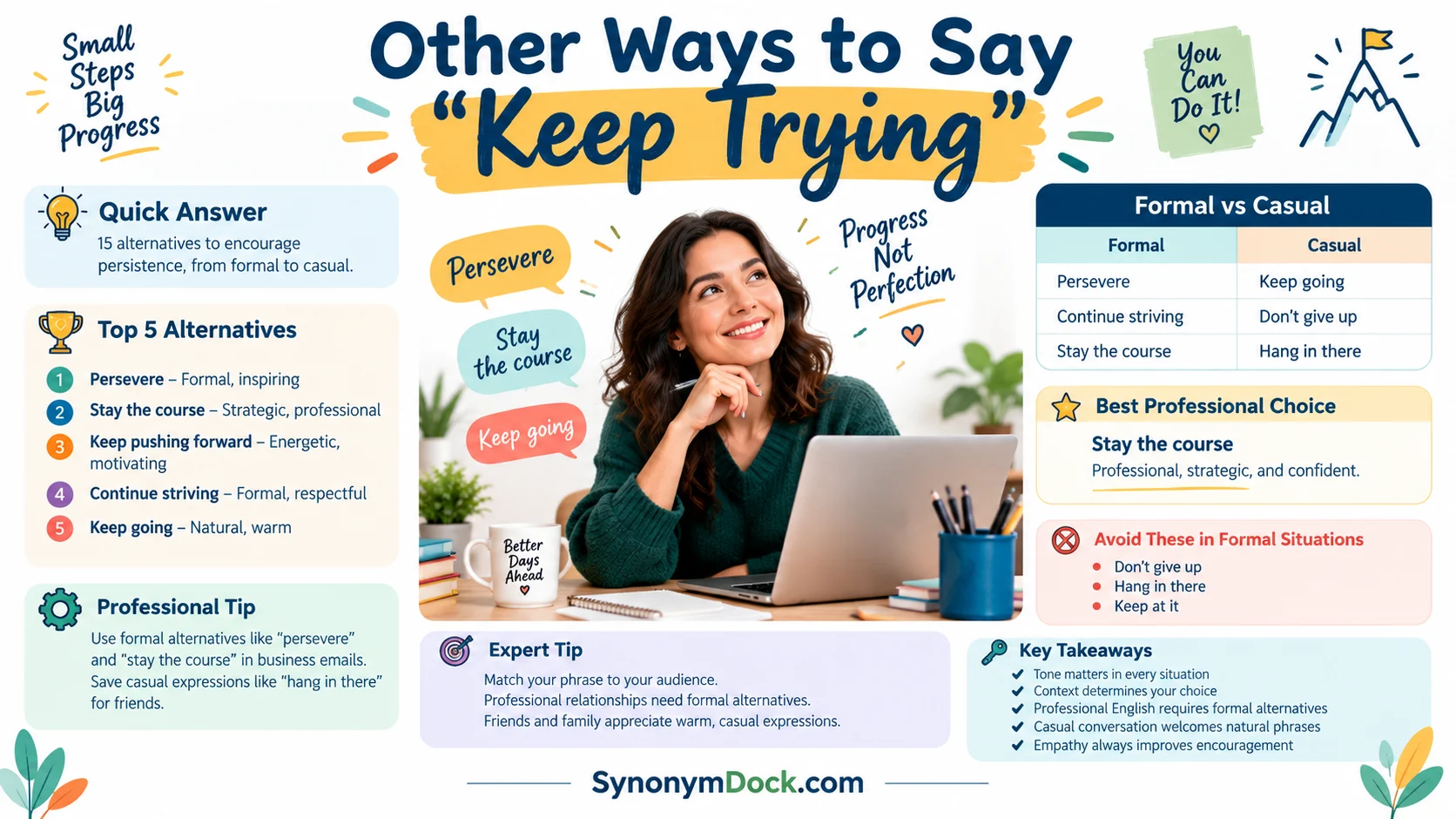
What are other ways to say “keep trying”? There are many professional and casual alternatives, including persevere, stay the course, don’t give up, keep pushing forward, and remain determined. The best choice depends on your audience and setting, from business emails to personal encouragement.
Top 5 alternatives:
Persevere, Stay the course, Keep pushing forward, Continue striving, Remain determined
We all encounter moments when we need to encourage someone to keep going. Whether you’re writing a motivational email, speaking to a colleague, or leaving a supportive comment, the phrase “keep trying” often feels repetitive.
Learning other ways to say “keep trying” elevates your communication. It adds variety, clarity, and emotional depth to your encouragement. Professional English thrives on precision choosing the right alternative shows confidence and thoughtfulness.
In this guide, you’ll discover 15 powerful expressions to replace “keep trying.” Each alternative comes with real examples, tone guidance, and practical usage tips. Whether you need formal alternatives for business communication or casual phrases for everyday conversation, you’ll find exactly what you need.
Quick Categories
Formal Alternatives
- Persevere
- Stay the course
- Continue striving
Professional Alternatives
- Maintain momentum
- Keep pushing forward
- Remain determined
Business Email Alternatives
- Continue your efforts
- Stay committed
- Keep up the good work
Academic Alternatives
- Persist in your studies
- Continue your pursuit
- Sustain your efforts
Casual Alternatives
- Hang in there
- Keep at it
- Stay with it
Informal Expressions
- Don’t give up
- Keep going
- Stick with it
Pro Tip
Use formal alternatives in professional emails and academic writing. Save casual expressions for friends, social media, and informal conversations. Matching the tone to your audience makes your encouragement more effective.
What Does “Keep Trying” Mean?
Definition: “Keep trying” means continuing to make an effort toward a goal despite difficulties, failures, or setbacks. It expresses encouragement and persistence.
Grammar: This phrase functions as an imperative verb phrase. “Keep” functions as the main verb, followed by the gerund “trying.”
Simple explanation: When you tell someone to “keep trying,” you’re saying, “Don’t stop your efforts. Continue working toward what you want.”
Example sentence: “Even after failing the driving test three times, Sarah’s father told her to keep trying.”
When to Use “Keep Trying”
“Keep trying” works in many situations but varies in appropriateness:
- Encouraging a friend who feels defeated
- Motivating a colleague facing a challenging project
- Supporting a student struggling with difficult material
- In casual conversation when someone shares a setback
- On social media comments and posts
- In parenting when children face frustration
When to avoid “keep trying”:
- Formal business reports – use more professional alternatives
- Academic writing – choose precise vocabulary
- Performance reviews – the phrase sounds too casual
- Client communications – opt for more polished language
- Speeches or presentations – consider stronger alternatives
Is It Professional or Polite?
Polite? ✔ Yes – It expresses support and encouragement.
Professional? ⚠ Depends on context – Acceptable in casual workplace settings but too informal for formal business communication.
Formal? ✘ No – It’s neutral to casual in register.
Natural? ✔ Yes – This is an everyday expression native speakers use frequently.
Example in business: “Please keep trying to resolve the issue” sounds appropriate in an internal team message but would be too casual in a client-facing email.
Common Mistakes
Mistake 1: Overusing the same phrase
Why it’s incorrect: Repetition makes your writing sound uninspired and unprofessional.
Correct version: Vary your vocabulary using the alternatives in this guide.
Example: Instead of “Keep trying. Keep trying. Keep trying,” use “Keep pushing forward. Stay the course. Don’t give up.”
Mistake 2: Using casual alternatives in formal situations
Why it’s incorrect: Phrases like “hang in there” sound unprofessional in business emails.
Correct version: Use formal alternatives like “persevere” or “stay the course.”
Example: Instead of “Hang in there with the project,” write “Please continue your efforts on the project.”
Mistake 3: Using formal alternatives with friends
Why it’s incorrect: Formal language sounds stiff and unnatural in casual settings.
Correct version: Choose casual or informal expressions.
Example: Instead of “I encourage you to persevere” to a friend, say “Keep at it you’ve got this!”
Mistake 4: Forgetting to show genuine empathy
Why it’s incorrect: Encouragement without acknowledgment of difficulty feels hollow.
Correct version: Combine alternatives with acknowledgment.
Example: Instead of “Persevere,” try “I know this is challenging, but continue striving toward your goal.”
Mistake 5: Using the wrong tone for written vs. spoken English
Why it’s incorrect: Some phrases work better in writing than speech, and vice versa.
Correct version: Match your choice to the medium.
Example: “Maintain momentum” works well in emails but sounds too formal in casual conversation.
Pros and Cons of “Keep Trying”
Pros
- Universally understood by all English speakers
- Simple and direct communication
- Warm and encouraging tone
- Appropriate for most casual situations
Cons
- Can sound repetitive and unoriginal
- Too casual for professional environments
- Lacks the emotional depth of stronger alternatives
- May feel dismissive if used without empathy
Transition to the Main List
Now that you understand when “keep trying” works and when it doesn’t, let’s explore the best alternatives. You’ll learn expressions that fit every situation, from formal business emails to casual conversations with friends.
Each alternative includes practical guidance on usage, tone, and formality. By the end, you’ll confidently choose the perfect phrase for every situation.
Expert Tip Box
Expert Tip:
Native speakers rarely rely on one expression for encouragement. They vary their language based on context, relationship, and intensity. The best communicators match their phrasing to the situation casual with friends, professional at work, and empathetic when someone is struggling.
Main Section: Other Ways to Say “Keep Trying” (With Examples)
These 15 alternatives will transform how you encourage others. Each expression serves a different purpose, so choose wisely based on your audience and setting.
[1]. Phrase: Persevere
Meaning: To continue doing something despite difficulties or opposition.
Explanation: This formal expression comes from Latin and carries a sense of dignified persistence. Native speakers use it in professional contexts, motivational speeches, and academic writing. It sounds more sophisticated than “keep trying” and suggests resilience.
Example Sentence: “Despite the technical challenges, our development team will persevere to deliver the project on time.”
Best Use: Business communication, motivational contexts, academic writing
Avoid Using In: Casual conversation, text messages, social media
Tone: Formal, Inspiring, Dignified
Formality Level: ⭐⭐⭐⭐⭐ Very Formal
Usage Frequency: Occasional
CEFR Level: C1
Common Collocations:
- persevere through challenges
- persevere despite setbacks
- persevere toward a goal
- persevere in the face of adversity
Context Variability:
- Spoken English: “We must persevere through these challenges.”
- Professional English: “The team’s ability to persevere has been remarkable.”
- Casual Conversation: Too formal for everyday use.
[2]. Phrase: Stay the Course
Meaning: To continue following a chosen path or plan without changing direction.
Explanation: This expression originated from sailing, where a ship stays on its plotted course despite changing winds. Native speakers use it to encourage persistence toward a long-term goal, especially when progress feels slow.
Example Sentence: “Our quarterly results are modest, but we need to stay the course and trust our strategy.”
Best Use: Business strategy, leadership communication, team motivation
Avoid Using In: Personal casual conversations, text messages
Tone: Professional, Determined, Steady
Formality Level: ⭐⭐⭐⭐ Formal
Usage Frequency: Common in business
CEFR Level: B2
Common Collocations:
- stay the course through uncertainty
- stay the course on this project
- stay the course despite pressure
- stay the course with our plan
Context Variability:
- Spoken English: “Let’s stay the course and see this through.”
- Professional English: “The board recommends we stay the course on this initiative.”
- Casual Conversation: Less common in everyday chat.
[3]. Phrase: Keep Pushing Forward
Meaning: To continue making progress despite obstacles or resistance.
Explanation: This dynamic expression creates a sense of active movement and determination. Native speakers favor it in motivational contexts, sports settings, and workplace encouragement. It implies not just persistence but active advancement.
Example Sentence: “The competition is fierce, but we need to keep pushing forward with our product launch.”
Best Use: Motivational speeches, team meetings, personal encouragement
Avoid Using In: Highly formal business reports, academic writing
Tone: Energetic, Determined, Encouraging
Formality Level: ⭐⭐⭐ Neutral
Usage Frequency: Common
CEFR Level: B1
Common Collocations:
- keep pushing forward through difficulties
- keep pushing forward toward success
- keep pushing forward despite obstacles
- keep pushing forward with your goals
Context Variability:
- Spoken English: “Keep pushing forward you’re almost there!”
- Professional English: “We must keep pushing forward with this initiative.”
- Casual Conversation: “Just keep pushing forward, and you’ll get there.”
Native Speaker Tip
Native speakers often choose “keep pushing forward” when they want to convey active determination. “Persevere” sounds more dignified but less accessible. For most workplace situations, “stay the course” is preferred because it suggests strategic persistence rather than just effort. Choose “push forward” when you want to sound motivational and energetic.
[4]. Phrase: Continue Striving
Meaning: To keep making great efforts toward achieving something important.
Explanation: “Striving” implies dedicated, purposeful effort not just trying but working with intention. Native speakers use this in formal and professional contexts, particularly when acknowledging someone’s consistent efforts over time.
Example Sentence: “We appreciate your dedication and encourage you to continue striving toward our shared objectives.”
Best Use: Professional emails, performance reviews, academic encouragement
Avoid Using In: Casual conversation, text messages, social media
Tone: Formal, Respectful, Encouraging
Formality Level: ⭐⭐⭐⭐ Formal
Usage Frequency: Occasional
CEFR Level: B2
Common Collocations:
- continue striving for excellence
- continue striving toward your goals
- continue striving to improve
- continue striving despite challenges
Context Variability:
- Spoken English: “Please continue striving for this standard.”
- Professional English: “We encourage employees to continue striving for innovation.”
- Casual Conversation: Uncommon in everyday speech.
[5]. Phrase: Remain Determined
Meaning: To stay resolute and committed to a goal or decision.
Explanation: This expression emphasizes the mental attitude behind persistence the unwavering commitment to a goal. Native speakers use it in professional settings when discussing motivation, leadership, and personal development.
Example Sentence: “The market conditions are challenging, but we must remain determined to achieve our targets.”
Best Use: Leadership communication, motivational contexts, business strategy
Avoid Using In: Casual personal conversation
Tone: Professional, Resolute, Confident
Formality Level: ⭐⭐⭐⭐ Formal
Usage Frequency: Common in business
CEFR Level: B2
Common Collocations:
- remain determined to succeed
- remain determined despite obstacles
- remain determined toward your goal
- remain determined throughout the process
Context Variability:
- Spoken English: “Stay determined you can do this.”
- Professional English: “Our team remains determined to deliver quality results.”
- Casual Conversation: “He remains determined to finish his degree.”
[6]. Phrase: Maintain Momentum
Meaning: To keep the force or speed of progress moving forward.
Explanation: This business-oriented expression focuses on preserving forward movement rather than just continuing effort. Native speakers use it frequently in project management, sales, and strategic planning to emphasize sustainable progress.
Example Sentence: “We’ve seen positive results this quarter. Now we need to maintain momentum through the next phase.”
Best Use: Project updates, team meetings, business strategy
Avoid Using In: Personal encouragement, casual conversation
Tone: Professional, Strategic, Confident
Formality Level: ⭐⭐⭐⭐ Formal
Usage Frequency: Common in business
CEFR Level: B2
Common Collocations:
- maintain momentum in the market
- maintain momentum toward your target
- maintain momentum through challenges
- maintain momentum with marketing efforts
Context Variability:
- Spoken English: “Let’s maintain momentum and push forward.”
- Professional English: “We need to maintain momentum to meet our annual targets.”
- Casual Conversation: Not commonly used.
[7]. Phrase: Don’t Give Up
Meaning: To continue trying despite difficulty or discouragement.
Explanation: This is one of the most common and direct alternatives. Native speakers use it in emotional situations to provide simple, heartfelt encouragement. It works perfectly in personal contexts but sounds too casual in professional writing.
Example Sentence: “I know job hunting is exhausting, but don’t give up the right opportunity is out there.”
Best Use: Personal encouragement, social media, casual conversation
Avoid Using In: Professional emails, business reports, formal writing
Tone: Warm, Encouraging, Direct
Formality Level: ⭐⭐ Casual
Usage Frequency: Very Common
CEFR Level: A2
Common Collocations:
- don’t give up on your dreams
- don’t give up on yourself
- don’t give up without a fight
- don’t give up after one failure
Context Variability:
- Spoken English: “Please don’t give up you’re so close.”
- Professional English: Too casual for most business settings.
- Casual Conversation: “Don’t give up! You’ve got this.”
[8]. Phrase: Keep Going
Meaning: To continue moving forward or continuing an activity.
Explanation: This simple, versatile phrase works in almost any casual situation. Native speakers use it frequently because it’s natural, encouraging, and universally understood. It lacks the formality of professional alternatives but works beautifully in most everyday contexts.
Example Sentence: “Your book is challenging to write, but keep going you have a powerful story to share.”
Best Use: Personal encouragement, social media, casual settings
Avoid Using In: Formal business writing, official correspondence
Tone: Friendly, Encouraging, Natural
Formality Level: ⭐⭐ Casual
Usage Frequency: Very Common
CEFR Level: A2
Common Collocations:
- keep going toward your target
- keep going despite the hardship
- keep going with your efforts
- keep going to reach your goal
Context Variability:
- Spoken English: “Keep going you can finish this race.”
- Professional English: “Keep going with this project” (casual workplace).
- Casual Conversation: “Just keep going, and you’ll make it.”
Expert Insight
When choosing between “don’t give up” and “keep going,” consider your audience. “Don’t give up” can sound slightly more emotional and personal, making it ideal for close relationships. “Keep going” sounds more neutral and works better in casual professional settings. In business communication, neither phrase is ideal for formal writing choose “continue striving” or “stay the course” instead.
[9]. Phrase: Stay Committed
Meaning: To remain dedicated and loyal to a goal, cause, or responsibility.
Explanation: This professional expression emphasizes loyalty and dedication rather than just effort. Native speakers use it when discussing long-term goals, team projects, and personal development in workplace settings.
Example Sentence: “The project timeline has been extended, but we ask everyone to stay committed to delivering quality work.”
Best Use: Professional emails, team leadership, project management
Avoid Using In: Casual conversation, social media
Tone: Professional, Dedicated, Reliable
Formality Level: ⭐⭐⭐⭐ Formal
Usage Frequency: Common in business
CEFR Level: B2
Common Collocations:
- stay committed to the cause
- stay committed to your goals
- stay committed to the plan
- stay committed to excellence
Context Variability:
- Spoken English: “Stay committed to your fitness journey.”
- Professional English: “We encourage staff to stay committed to our values.”
- Casual Conversation: Less common in everyday chat.
[10]. Phrase: Hang in There
Meaning: To remain patient and persistent during a difficult period.
Explanation: This casual, idiomatic expression conveys warmth and understanding. Native speakers use it to provide emotional support, particularly when someone is struggling through a temporary challenge. It’s more empathetic than “keep trying” and suggests patience.
Example Sentence: “I know the training program is brutal, but hang in there it gets easier after the first month.”
Best Use: Friendly encouragement, personal support, casual conversation
Avoid Using In: Professional emails, business communication, formal writing
Tone: Warm, Casual, Empathetic
Formality Level: ⭐⭐ Casual
Usage Frequency: Common
CEFR Level: B1
Common Collocations:
- hang in there through the tough times
- hang in there just a little longer
- hang in there until things improve
- hang in there because it’s worth it
Context Variability:
- Spoken English: “Hang in there things will get better.”
- Professional English: Too casual for formal settings.
- Casual Conversation: “Hang in there, buddy. You’ve got this.”
Quick Recap
Best Professional Choice: Stay the course
Best Casual Choice: Keep going
Best Formal Choice: Persevere
Most Natural Choice: Keep pushing forward
Most Empathetic Choice: Hang in there
[11]. Phrase: Stick with It
Meaning: To continue doing something without giving up.
Explanation: This casual phrase suggests loyalty and persistence toward a specific activity or goal. Native speakers use it in friendly conversations when encouraging consistency rather than just effort.
Example Sentence: “Learning a new language is challenging, but stick with it you’ll notice improvement soon.”
Best Use: Friendly encouragement, personal goals, casual conversation
Avoid Using In: Professional emails, formal business communication
Tone: Friendly, Casual, Encouraging
Formality Level: ⭐⭐⭐ Neutral-Casual
Usage Frequency: Common
CEFR Level: B1
Common Collocations:
- stick with it until the end
- stick with it through the challenges
- stick with it and you’ll succeed
- stick with it for long-term results
Context Variability:
- Spoken English: “Stick with it you’re making progress.”
- Professional English: “Stick with it” can work in casual team settings.
- Casual Conversation: “I know it’s hard, but stick with it.”
Native Speaker Tip
Native speakers often combine “stick with it” with a specific timeframe to make encouragement more concrete. For example, “Stick with it for another month” sounds more helpful than just “Stick with it.” When you want to emphasize consistency over intensity, this phrase works better than “keep pushing.”
[12]. Phrase: Keep at It
Meaning: To continue working persistently toward a goal.
Explanation: This casual, natural expression feels very conversational. Native speakers use it in everyday situations to provide uncomplicated encouragement. It lacks the intensity of “push forward” but conveys steady, reliable effort.
Example Sentence: “Your garden is starting to bloom beautifully keep at it and you’ll have a wonderful summer display.”
Best Use: Friendly conversation, hobbies, personal projects
Avoid Using In: Professional writing, formal communication
Tone: Friendly, Casual, Supportive
Formality Level: ⭐⭐ Casual
Usage Frequency: Common
CEFR Level: B1
Common Collocations:
- keep at it and you’ll improve
- keep at it until you master it
- keep at it with your practice
- keep at it every single day
Context Variability:
- Spoken English: “Keep at it you’re doing great.”
- Professional English: Too casual for formal business.
- Casual Conversation: “Your cooking is getting better. Keep at it!”
[13]. Phrase: Continue Your Efforts
Meaning: To keep working toward a goal without interruption.
Explanation: This formal expression neutralizes the emotional aspect of encouragement while maintaining professionalism. Native speakers use it in official communication, performance reviews, and formal requests.
Example Sentence: “We appreciate the work completed thus far and request you continue your efforts on the remaining tasks.”
Best Use: Professional emails, official communication, performance reviews
Avoid Using In: Casual conversation, social media
Tone: Professional, Formal, Neutral
Formality Level: ⭐⭐⭐⭐ Formal
Usage Frequency: Occasional
CEFR Level: B2
Common Collocations:
- continue your efforts toward completion
- continue your efforts in this area
- continue your efforts to improve
- continue your efforts on the project
Context Variability:
- Spoken English: “Please continue your efforts on this.”
- Professional English: “We encourage you to continue your efforts toward excellence.”
- Casual Conversation: Uncommon in everyday speech.
[14]. Phrase: Persist
Meaning: To continue firmly or obstinately despite opposition or difficulty.
Explanation: This concise, formal verb emphasizes determination against obstacles. It’s shorter than “persevere” but carries similar weight. Native speakers use it in academic writing, professional contexts, and formal speeches.
Example Sentence: “Our research suggests that successful entrepreneurs persist through multiple failures before achieving breakthroughs.”
Best Use: Academic writing, professional speeches, formal communication
Avoid Using In: Casual conversation, personal encouragement
Tone: Formal, Direct, Determined
Formality Level: ⭐⭐⭐⭐⭐ Very Formal
Usage Frequency: Occasional
CEFR Level: C1
Common Collocations:
- persist in the face of adversity
- persist despite challenges
- persist toward your goal
- persist with determination
Context Variability:
- Spoken English: “We must persist in our efforts.”
- Professional English: “The company persists in its commitment to sustainability.”
- Casual Conversation: Uncommon in everyday speech.
[15]. Phrase: Keep Up the Good Work
Meaning: To continue doing the excellent work that someone is already doing.
Explanation: This encouraging expression acknowledges past success while encouraging future effort. Native speakers use it frequently in workplace settings, schools, and casual contexts when someone’s work deserves recognition.
Example Sentence: “Your presentation was outstanding keep up the good work and you’ll go far in this role.”
Best Use: Professional praise, educational settings, workplace motivation
Avoid Using In: Formal legal documents, highly formal contexts
Tone: Encouraging, Warm, Supportive
Formality Level: ⭐⭐⭐ Neutral-Professional
Usage Frequency: Very Common
CEFR Level: A2
Common Collocations:
- keep up the good work on this project
- keep up the good work with your studies
- keep up the good work and stay focused
- keep up the good work everyone
Context Variability:
- Spoken English: “Keep up the good work, team!”
- Professional English: “We appreciate your contribution keep up the good work.”
- Casual Conversation: “Your baking is amazing. Keep up the good work!”
Top 10 Alternatives Compared
| Phrase | Tone | Formality | Best Use | Frequency |
| Persevere | Inspiring, Dignified | ⭐⭐⭐⭐⭐ | Academic, Speeches | Occasional |
| Stay the Course | Professional, Steady | ⭐⭐⭐⭐ | Business, Strategy | Common |
| Keep Pushing Forward | Energetic, Motivating | ⭐⭐⭐ | Team Meetings, Sports | Common |
| Continue Striving | Formal, Respectful | ⭐⭐⭐⭐ | Performance Reviews | Occasional |
| Remain Determined | Resolute, Confident | ⭐⭐⭐⭐ | Leadership, Motivation | Common |
| Maintain Momentum | Strategic, Business | ⭐⭐⭐⭐ | Project Management | Common |
| Don’t Give Up | Warm, Direct | ⭐⭐ | Personal Support | Very Common |
| Keep Going | Friendly, Natural | ⭐⭐ | Everyday Encouragement | Very Common |
| Stay Committed | Dedicated, Reliable | ⭐⭐⭐⭐ | Professional, Long-term | Common |
| Hang in There | Empathetic, Casual | ⭐⭐ | Emotional Support | Common |
Which One Should You Use?
Best Overall
Stay the course – This balances professionalism with accessibility and works in most written and spoken contexts.
Best Professional
Maintain momentum – Perfect for business settings, especially when discussing progress and strategy.
Best Academic
Persevere – Formal enough for papers and presentations while remaining inspiring.
Best Business Email
Continue your efforts – Neutral, professional, and appropriate for formal written communication.
Best Everyday Conversation
Keep going – Natural, warm, and understood by everyone in casual settings.
Most Natural
Keep pushing forward – This expression feels effortless and energetic in speech.
Most Polite
Stay committed – Shows respect for someone’s dedication while encouraging continuation.
Commonly Confused Phrases
“Keep trying” vs. “Keep going”
“Keep trying” focuses on the act of attempting, while “keep going” emphasizes forward movement. In English, “keep going” sounds slightly more natural in most contexts.
“Persevere” vs. “Persist”
“Persevere” suggests continuing despite difficulty with a positive, dignified tone. “Persist” can sometimes imply stubbornness. Choose “persevere” for a more uplifting meaning.
“Hang in there” vs. “Stick with it”
“Hang in there” suggests enduring a difficult situation, while “stick with it” emphasizes loyalty to a specific activity. Native speakers use “hang in there” for emotional challenges and “stick with it” for practical ones.
“Stay the course” vs. “Maintain momentum”
“Stay the course” emphasizes sticking to a plan, while “maintain momentum” emphasizes keeping progress moving. In business, use “stay the course” for strategy and “maintain momentum” for progress.
“Continue striving” vs. “Continue your efforts”
“Continue striving” sounds more inspirational and dedicated, while “continue your efforts” sounds more neutral and procedural. Choose based on the emotional tone you need.
Scenario Practice
Scenario 1: A team is struggling with a major project deadline.
Which phrase would you choose?
“Stay the course” works best. It acknowledges difficulty while reinforcing the importance of the original plan. Example: “I know this project is demanding, but we must stay the course to deliver quality results.”
Scenario 2: A friend is applying for jobs and facing rejection.
Which phrase would you choose?
“Hang in there” or “Don’t give up” suits this situation. Both expressions show empathy for emotional challenges. Example: “Hang in there your skills are valuable, and the right role will come along.”
Scenario 3: A student is preparing for an important exam.
Which phrase would you choose?
“Keep going” or “Keep up the good work” works well. Both encourage steady effort without feeling overwhelming. Example: “You’ve been studying hard keep up the good work this final week.”
Scenario 4: A business is facing market challenges.
Which phrase would you choose?
“Remain determined” or “Maintain momentum” fits this professional context. Example: “Market conditions are tough, but we must remain determined to achieve our targets.”
Scenario 5: You’re writing a motivational email to a colleague.
Which phrase would you choose?
“Continue striving” or “Stay committed” communicates professionalism and support. Example: “I appreciate your dedication. Please continue striving toward our shared objectives.”
Mini Quiz
1. Which phrase is most formal?
A) Keep going
B) Hang in there
C) Persevere
D) Don’t give up
2. Which expression works best in a business email?
A) Stick with it
B) Continue your efforts
C) Keep at it
D) Hang in there
3. What’s the most natural-sounding alternative in conversation?
A) Maintain momentum
B) Persist
C) Keep pushing forward
D) Continue striving
4. Which phrase emphasizes strategic planning?
A) Don’t give up
B) Stay the course
C) Keep going
D) Hang in there
5. Which phrase is best for offering emotional support?
A) Persevere
B) Continue your efforts
C) Hang in there
D) Maintain momentum
Answer Key
- C) Persevere – This is the most formal option among these choices.
- B) Continue your efforts – This neutral, professional expression suits formal email.
- C) Keep pushing forward – This expression feels energetic and natural in conversation.
- B) Stay the course – This phrase emphasizes following a strategic plan.
- C) Hang in there – This expression shows empathy and emotional support.
Avoid These in Formal Situations
1. Don’t give up
Why avoid: Sounds too emotional and direct for professional contexts.
Better alternative: “Persevere” or “Continue your efforts”
2. Hang in there
Why avoid: Too casual and familiar for formal communication.
Better alternative: “Remain determined” or “Stay committed”
3. Keep at it
Why avoid: This phrase is too conversational for business settings.
Better alternative: “Continue striving” or “Maintain momentum”
4. Stick with it
Why avoid: While natural in speech, it sounds unprofessional in writing.
Better alternative: “Stay the course” or “Stay committed”
5. Keep up the good work
Why avoid: Can sound patronizing or too informal in serious professional contexts.
Better alternative: “We appreciate your efforts and encourage continued dedication”
Native Speaker Note
Native English speakers prefer different alternatives based on their personal style. Younger speakers gravitate toward “keep pushing” and “stay with it.” Professionals over 40 often choose “persevere” and “stay the course.” The most universally accepted phrase across all age groups is “keep going.”
In American workplace culture, “stay committed” and “keep up the good work” are more common than British equivalents. British professionals frequently use “stick with it” and “carry on” in casual workplace settings. These differences are subtle but worth noting if you work in an international environment.
FAQs
What is the most formal way to say “keep trying”?
“Persevere” is the most formal alternative. This dignified expression suits academic writing, professional speeches, and formal business communication. You can also use “continue striving” or “persist” for formal contexts. These expressions convey determination without casualness.
Which phrase is best for professional emails?
“Continue your efforts” or “stay committed” works best in professional emails. Both expressions sound polished and neutral while maintaining professionalism. For internal team emails, “maintain momentum” and “stay the course” are excellent choices that sound strategic and confident.
What’s the difference between “persevere” and “persist”?
“Persevere” carries a more positive, inspiring tone and suggests dignified effort despite obstacles. “Persist” can sometimes imply stubbornness or continuing despite being wrong. For motivation, choose “persevere.” For neutral description, “persist” works equally well.
Which alternative sounds most natural in conversation?
“Keep going” and “keep pushing forward” sound most natural in casual conversation. Native speakers use these expressions frequently because they feel effortless and authentic. They work well in personal encouragement, friendly advice, and everyday situations.
Can I use these expressions in business meetings?
Yes, but choose carefully. Use “stay the course,” “maintain momentum,” and “remain determined” in professional meetings. Avoid casual expressions like “hang in there” and “don’t give up” unless you have a very close relationship with your team. Match the formality to your workplace culture.
Conclusion
Learning other ways to say “keep trying” transforms your English communication. Instead of repeating the same phrase, you now have 15 powerful alternatives at your disposal. Each expression serves a different purpose formal, professional, casual, or empathetic.
Practice using these alternatives in your daily conversations, emails, and written communication. Notice how native speakers choose different phrases for different situations. Over time, you’ll naturally select the perfect expression without thinking twice.
Remember: Great communicators don’t just say the same thing repeatedly. They adapt their language to their audience and situation. Start using these alternatives today, and you’ll sound more fluent, professional, and confident in every conversation.

4 thoughts on “Other Ways to Say “Keep Trying” |21+ Examples For 2026”