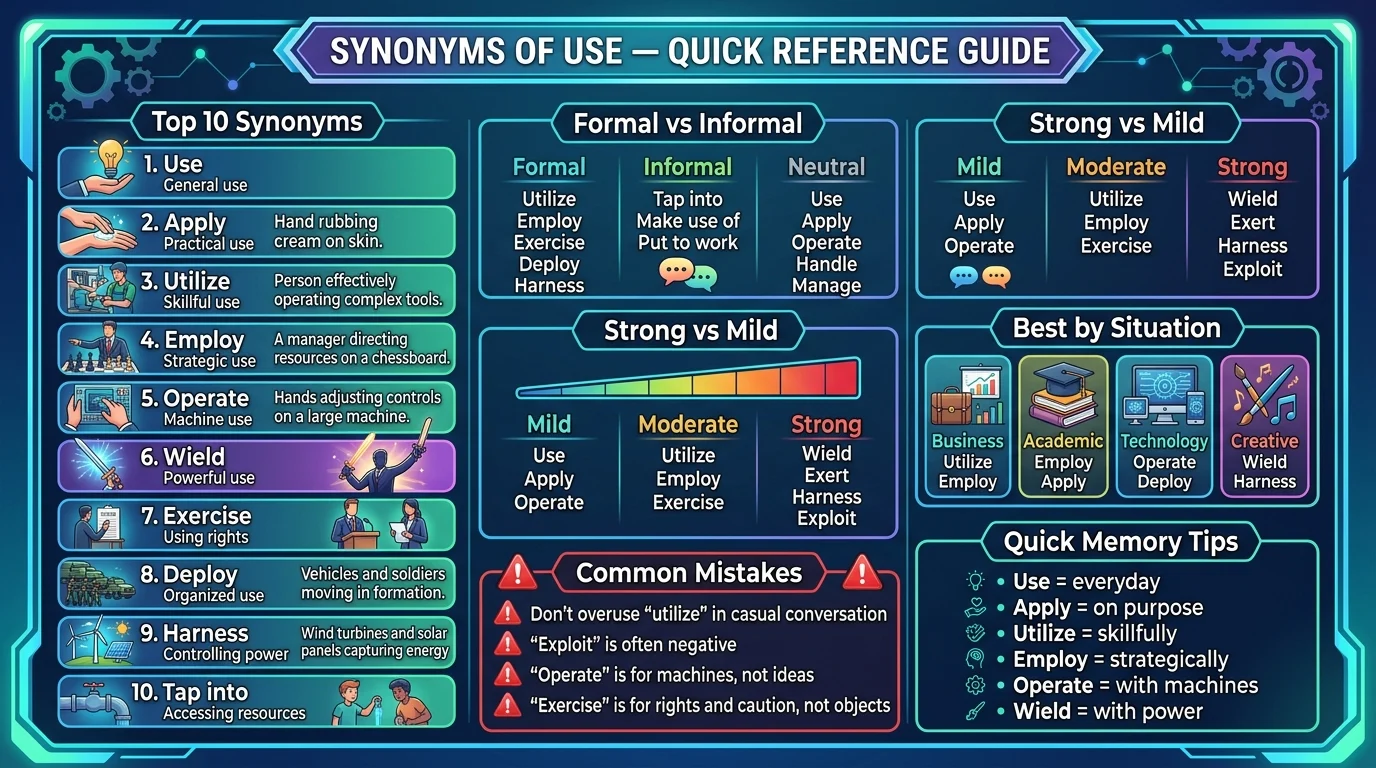
Use means to take something for a purpose or to do something with it. The best synonyms include utilize, employ, apply, operate, wield, exercise, practice, and manipulate. But each synonym has a slightly different meaning, tone, or context, so choosing the right one depends on your situation.
Have you ever felt like you were overusing the word use? It’s one of the most common verbs in English, and that’s exactly why you need alternatives. Whether you’re writing a business report, an academic essay, or just trying to sound more natural in conversation, having a variety of synonyms at your fingertips makes a huge difference.
In this guide, you’ll discover 30 powerful synonyms for use, complete with clear meanings, real examples, and practical usage tips. You’ll learn which words sound professional, which ones fit casual conversations, and which ones native speakers prefer in different situations. By the end, you’ll never struggle to find the right word for use again.
What Does “Use” Mean?
Definition
In simple terms, use means to take something and make it serve a purpose. You use a pen to write. You use your phone to call someone. You use your skills to solve a problem. It’s one of the most basic actions in English anytime you take an object, idea, or ability and apply it to achieve something, you’re using it. The word can refer to physical objects, mental abilities, or even people in some contexts.
Pronunciation
| Feature | Value |
|---|---|
| US IPA | /juːz/ (verb) /juːs/ (noun) |
| UK IPA | /juːz/ (verb) /juːs/ (noun) |
| Syllables | 1 |
| Tip | The verb rhymes with “news” while the noun rhymes with “goose.” |
Grammar
| Grammar Feature | Information |
|---|---|
| Part of Speech | Verb (and noun) |
| Common Position | After a subject, before an object |
| Typical Pattern | use + something or use + something + for/to |
Example Sentences:
- I use my phone to check the weather every morning.
- She used her experience to get the job.
- Please use the front door when you arrive.
Grammar Note: Use is a regular verb with the forms use, used, used. It’s also a noun meaning “purpose” or “benefit” (It has no use). As a verb, it’s pronounced with a /z/ sound at the end; as a noun, it’s pronounced with an /s/ sound.
Word Family
| Word | Part of Speech | Meaning |
|---|---|---|
| Use | Verb/Noun | To take something for a purpose; the act of using |
| Used | Adjective | Having been used; accustomed to |
| Useful | Adjective | Having a purpose or benefit |
| Useless | Adjective | Having no purpose or benefit |
| User | Noun | A person who uses something |
| Usage | Noun | The way something is used |
| Reuse | Verb | To use again |
| Misuse | Verb/Noun | To use incorrectly or badly |
30 Synonyms of “Use”
1. Utilize
Meaning: To use something for a practical purpose, often in a skillful way.
Best Used For: Formal writing, business contexts, and when emphasizing practical application.
Formality: Formal
Tone: Professional, practical
Frequency: ⭐⭐⭐⭐ Common
CEFR Level: B2
Example Sentence 1: The company plans to utilize renewable energy sources for all its factories.
Example Sentence 2: She utilized her network to find new clients for her business.
Usage Tip: Utilize is a great formal alternative to use. It suggests using something skillfully or for a specific purpose. However, don’t use it to replace every use sometimes it sounds unnecessarily complex. Native speakers often use it in professional reports and presentations. It’s best when you want to sound more sophisticated or technical.
2. Employ
Meaning: To use something as a tool, method, or resource.
Best Used For: Professional writing, academic contexts, and discussing strategies.
Formality: Formal
Tone: Professional, strategic
Frequency: ⭐⭐⭐⭐ Common
CEFR Level: B1
Example Sentence 1: The study employed a new method to analyze the data.
Example Sentence 2: We need to employ a different approach to solve this problem.
Usage Tip: Employ is a formal synonym that often appears in academic and professional writing. It can mean using a tool, method, or even a person (as in employ a worker). It sounds more deliberate and planned than use. Avoid using it in casual conversation it can sound overly formal.
3. Apply
Meaning: To put something to use for a particular purpose.
Best Used For: Following instructions, using knowledge or skills, and putting things into practice.
Formality: Neutral to formal
Tone: Practical, instructional
Frequency: ⭐⭐⭐⭐⭐ Very Common
CEFR Level: A2
Example Sentence 1: Apply the cream gently to your face every morning.
Example Sentence 2: He was able to apply what he learned in the course to his job.
Usage Tip: Apply is versatile and very common. It’s perfect for instructions (apply makeup), using knowledge (apply your skills), and following rules (apply the rules). It has a slightly different meaning from use it often implies putting something into action or onto something. It’s a must-know word for English learners.
4. Operate
Meaning: To use or control a machine, system, or device.
Best Used For: Technology, machinery, equipment, and vehicles.
Formality: Neutral
Tone: Technical, functional
Frequency: ⭐⭐⭐⭐ Common
CEFR Level: B1
Example Sentence 1: He learned how to operate the new printing machine.
Example Sentence 2: She operates the crane at the construction site.
Usage Tip: Operate is the right word for using machines, devices, and vehicles. It implies controlling or managing something that has moving parts or a system. You operate a car, a computer, or a forklift. Don’t use it for abstract things like skills or ideas that would sound unnatural.
5. Wield
Meaning: To hold and use a tool, weapon, or power effectively.
Best Used For: Creative writing, describing power or influence, and physical tools.
Formality: Neutral to literary
Tone: Powerful, commanding
Frequency: ⭐⭐ Rare
CEFR Level: B2
Example Sentence 1: The knight wielded his sword with great skill.
Example Sentence 2: She wields considerable influence in the industry.
Usage Tip: Wield is a powerful, slightly literary word. It suggests using something with skill and control. It’s often used for weapons, tools, and power. Native speakers use it to describe authority (wield power) or physical objects (wield a pen). It adds drama and strength to your writing. Avoid it in everyday, casual conversation.
6. Exercise
Meaning: To use a skill, right, or power.
Best Used For: Discussing rights, authority, skills, and caution.
Formality: Formal
Tone: Official, deliberate
Frequency: ⭐⭐⭐ Moderate
CEFR Level: B2
Example Sentence 1: Citizens should exercise their right to vote.
Example Sentence 2: Please exercise caution when driving in the rain.
Usage Tip: Exercise is a formal synonym used almost exclusively for abstract things rights, powers, skills, and caution. You exercise authority, patience, or judgment. It sounds official and intentional. Don’t use it for physical objects (exercise a hammer is wrong). It’s commonly found in legal, political, and professional contexts.
7. Exert
Meaning: To use force, power, or influence.
Best Used For: Physical effort, influence, and control.
Formality: Formal
Tone: Forceful, intentional
Frequency: ⭐⭐ Rare
CEFR Level: B2
Example Sentence 1: She had to exert all her strength to lift the heavy box.
Example Sentence 2: The government exerted pressure on the company to comply.
Usage Tip: Exert is about using force or power. It’s often physical (exert strength), but it can also be metaphorical (exert influence). It sounds formal and intentional. Use it when you want to emphasize effort or pressure. It’s less common than use and works best in formal or descriptive writing.
8. Deploy
Meaning: To use something strategically or effectively.
Best Used For: Military contexts, technology, business, and strategic planning.
Formality: Formal
Tone: Strategic, operational
Frequency: ⭐⭐⭐ Moderate
CEFR Level: B2
Example Sentence 1: The army deployed troops to the border region.
Example Sentence 2: The company deployed new software across all departments.
Usage Tip: Deploy suggests using something in a planned, strategic way. It’s common in military, business, and technology contexts. You deploy troops, resources, or software. It sounds professional and organized. Avoid using it for everyday tasks it’s too formal for casual conversation.
9. Tap Into
Meaning: To use or access a resource or source of energy.
Best Used For: Resources, skills, networks, and potential.
Formality: Informal to neutral
Tone: Resourceful, positive
Frequency: ⭐⭐⭐ Moderate
CEFR Level: B1
Example Sentence 1: We need to tap into new markets to grow our business.
Example Sentence 2: The training helped her tap into her creative potential.
Usage Tip: Tap into is a phrasal verb that means to access or use a resource. It’s common in business and everyday conversation. It suggests finding and using something valuable that wasn’t being used before. It’s a friendly, approachable alternative to use. Use it when you want to sound energetic and resourceful.
10. Make Use Of
Meaning: To use something in a way that is beneficial.
Best Used For: Everyday conversation, resources, and opportunities.
Formality: Neutral
Tone: Positive, practical
Frequency: ⭐⭐⭐⭐⭐ Very Common
CEFR Level: A2
Example Sentence 1: You should make use of the library’s resources.
Example Sentence 2: She made good use of her time during the holiday.
Usage Tip: Make use of is a very common phrase that simply means use. It’s slightly more natural than use in many situations because it emphasizes the benefit of using something. Native speakers use it all the time in both conversation and writing. It’s a great alternative when you want to sound more engaging.
11. Apply Yourself To
Meaning: To use effort or focus on something.
Best Used For: Work, study, and personal development.
Formality: Neutral
Tone: Encouraging, focused
Frequency: ⭐⭐ Rare
CEFR Level: B1
Example Sentence 1: If you apply yourself to learning English, you’ll improve quickly.
Example Sentence 2: She applied herself to the task and finished early.
Usage Tip: Apply yourself to is a phrase that means to use effort or concentration on something. It’s about putting your energy into a task. It’s common in self-help, academic, and motivational contexts. It’s more personal and effort-focused than a simple use.
12. Command
Meaning: To have and use authority, respect, or a skill.
Best Used For: Language skills, authority, and attention.
Formality: Formal
Tone: Powerful, confident
Frequency: ⭐⭐⭐ Moderate
CEFR Level: B2
Example Sentence 1: She commands a great deal of respect in her field.
Example Sentence 2: He commands a large vocabulary in English.
Usage Tip: Command is a strong, impressive word. It means to have and use something effectively, especially authority or skill. You command respect, attention, or a language. It suggests control and expertise. Use it when you want to sound confident and impressive it’s a great word for describing someone’s abilities.
13. Draw Upon
Meaning: To use experience, knowledge, or resources that you have available.
Best Used For: Experience, knowledge, skills, and resources.
Formality: Formal
Tone: Reflective, resourceful
Frequency: ⭐⭐ Rare
CEFR Level: B2
Example Sentence 1: The author drew upon his own experiences to write the novel.
Example Sentence 2: She drew upon her network to find a new job.
Usage Tip: Draw upon means to use something you have learned or experienced. It suggests using knowledge or resources from your past. It’s common in academic writing and storytelling. It’s a sophisticated alternative to use, especially when discussing personal experience or skills.
14. Avail Yourself Of
Meaning: To use an opportunity, service, or resource that is available to you.
Best Used For: Opportunities, services, and resources.
Formality: Formal
Tone: Formal, opportunity-focused
Frequency: ⭐ Rare
CEFR Level: C1
Example Sentence 1: You should avail yourself of the free gym membership.
Example Sentence 2: He availed himself of the company’s training program.
Usage Tip: Avail yourself of is a formal phrase that means to use an available opportunity or resource. It sounds quite sophisticated and is common in business and formal writing. It’s not used in everyday conversation. Use it when you want to sound very professional, especially in emails or formal documents.
15. Bring Into Play
Meaning: To use something that affects a situation.
Best Used For: Strategies, skills, and plans.
Formality: Neutral to formal
Tone: Strategic, active
Frequency: ⭐⭐ Rare
CEFR Level: B2
Example Sentence 1: The manager brought new strategies into play to increase sales.
Example Sentence 2: We need to bring all our resources into play to solve this problem.
Usage Tip: Bring into play means to use something in a way that influences a situation. It suggests taking action and using resources effectively. It’s common in professional and strategic contexts. It’s a more interesting phrase than a simple use.
16. Resort To
Meaning: To use something as a final option when other choices fail.
Best Used For: Describing using alternatives when necessary, often negative.
Formality: Neutral to formal
Tone: Negative, desperate
Frequency: ⭐⭐⭐ Moderate
CEFR Level: B2
Example Sentence 1: He resorted to borrowing money when he lost his job.
Example Sentence 2: The company resorted to layoffs to cut costs.
Usage Tip: Resort to means to use something as a last choice, often because other options are unavailable. It often has a negative tone it suggests desperation or necessity. You resort to lying, cheating, or drastic measures. Use it when you want to emphasize that something is a final option.
17. Put To Use
Meaning: To use something in a practical way.
Best Used For: Skills, resources, and opportunities.
Formality: Neutral
Tone: Practical, positive
Frequency: ⭐⭐⭐ Moderate
CEFR Level: B1
Example Sentence 1: She quickly put her new skills to use at work.
Example Sentence 2: You should put your savings to use by investing them.
Usage Tip: Put to use is a natural phrase that means to use something in a practical way. It’s common in everyday conversation and writing. It emphasizes that something is being used for a real purpose, not just kept or stored. It’s a great, simple alternative to use.
18. Call Upon
Meaning: To use someone’s skills or qualities to achieve something.
Best Used For: Skills, abilities, and people’s help.
Formality: Formal
Tone: Formal, resourceful
Frequency: ⭐⭐ Rare
CEFR Level: B2
Example Sentence 1: The project will call upon all of our resources.
Example Sentence 2: He called upon his experience to solve the problem.
Usage Tip: Call upon means to use something you have, especially skills or abilities. It’s slightly formal and often used in professional writing. It can also mean asking someone for help (call upon a colleague). It’s a sophisticated alternative to use.
19. Put Into Practice
Meaning: To use something you have learned in a real situation.
Best Used For: Knowledge, skills, and ideas.
Formality: Neutral to formal
Tone: Practical, educational
Frequency: ⭐⭐⭐ Moderate
CEFR Level: B1
Example Sentence 1: Now it’s time to put what you’ve learned into practice.
Example Sentence 2: The team put the new plan into practice immediately.
Usage Tip: Put into practice means to apply knowledge or ideas in real situations. It’s common in education, business, and self-help. It’s a great phrase when you want to emphasize moving from theory to action. It’s more specific and engaging than a simple use.
20. Bring To Bear
Meaning: To use influence, pressure, or power to achieve something.
Best Used For: Influence, pressure, and power.
Formality: Formal
Tone: Forceful, strategic
Frequency: ⭐ Rare
CEFR Level: C1
Example Sentence 1: She brought all her experience to bear on the problem.
Example Sentence 2: They brought pressure to bear on the government.
Usage Tip: Bring to bear is a formal phrase that means to use influence or power to achieve a result. It suggests using something intentionally and effectively. It’s common in formal writing, journalism, and politics. It’s a very sophisticated alternative to use.
21. Expend
Meaning: To use or spend time, money, or effort.
Best Used For: Resources like time, money, and energy.
Formality: Formal
Tone: Analytical, efficient
Frequency: ⭐⭐ Rare
CEFR Level: B2
Example Sentence 1: They expended a great deal of effort on the project.
Example Sentence 2: We cannot expend more money on this plan.
Usage Tip: Expend means to use up or spend resources. It’s often used for time, money, and energy. It sounds formal and businesslike. It implies that resources are being consumed. It’s a good word for reports and formal discussions about resources.
22. Harness
Meaning: To use something powerful or natural to achieve a purpose.
Best Used For: Energy, power, potential, and natural resources.
Formality: Formal
Tone: Powerful, constructive
Frequency: ⭐⭐ Rare
CEFR Level: B2
Example Sentence 1: The new technology harnesses solar energy.
Example Sentence 2: We need to harness the power of social media for our campaign.
Usage Tip: Harness is a great word for using powerful forces natural energy, technology, or potential. It suggests controlling and directing something powerful for a good purpose. It’s common in discussions about energy, technology, and business strategy. It sounds very professional and forward-thinking.
23. Appropriate
Meaning: To take and use something, often without permission.
Best Used For: Money, property, and resources (often in negative contexts).
Formality: Formal
Tone: Negative, legal
Frequency: ⭐⭐ Rare
CEFR Level: B2
Example Sentence 1: The government appropriated private land for the new highway.
Example Sentence 2: He was accused of appropriating company funds.
Usage Tip: Appropriate as a verb means to take something for your own use, often without permission. It’s a formal word with a negative tone. It’s common in legal and political contexts. Be careful it’s different from the adjective appropriate, which means suitable. Don’t use it for everyday positive use.
24. Exploit
Meaning: To use something in a way that is unfair or to gain advantage.
Best Used For: Resources, advantages, and people (often negative).
Formality: Neutral to formal
Tone: Negative, opportunistic
Frequency: ⭐⭐⭐ Moderate
CEFR Level: B2
Example Sentence 1: The company exploited cheap labor in developing countries.
Example Sentence 2: He exploited the situation to get a promotion.
Usage Tip: Exploit is often negative it suggests using something or someone unfairly for your own gain. However, it can also be neutral (exploit natural resources). It’s a useful word but be careful with the tone. In business, exploit opportunities is positive, while exploit workers is negative. Context is everything!
25. Manipulate
Meaning: To use something skillfully or control something unfairly.
Best Used For: Data, people, and situations.
Formality: Neutral
Tone: Negative (often), skillful (sometimes)
Frequency: ⭐⭐⭐ Moderate
CEFR Level: B2
Example Sentence 1: He manipulated the data to get the results he wanted.
Example Sentence 2: She manipulated the controls with precision.
Usage Tip: Manipulate has two meanings. It can mean to use something skillfully (manipulate the controls), or it can mean to unfairly control someone (manipulate people). The second meaning is more common. Be careful with this word in most contexts, it has a negative tone.
26. Handle
Meaning: To use or deal with something effectively.
Best Used For: Tools, situations, and people.
Formality: Neutral
Tone: Capable, practical
Frequency: ⭐⭐⭐⭐⭐ Very Common
CEFR Level: A2
Example Sentence 1: She knows how to handle difficult customers.
Example Sentence 2: Be careful when you handle that equipment.
Usage Tip: Handle means to use or manage something effectively. It’s very common in everyday English. You handle a problem, a tool, or a situation. It suggests competence and control. It’s a great, natural alternative to use in many contexts, especially when dealing with people or situations.
27. Manage
Meaning: To use or control something, often with limited resources.
Best Used For: Resources, time, and situations.
Formality: Neutral
Tone: Capable, controlled
Frequency: ⭐⭐⭐⭐⭐ Very Common
CEFR Level: A2
Example Sentence 1: She managed the project from start to finish.
Example Sentence 2: We need to manage our resources more carefully.
Usage Tip: Manage means to use or control resources effectively. It’s very common in business and everyday life. You manage a team, a budget, or your time. It’s a versatile word and a natural alternative to use when you want to emphasize control and effectiveness.
28. Employ (as a strategy)
Meaning: To use a method or approach.
Best Used For: Strategies, methods, and tactics.
Formality: Formal
Tone: Professional, strategic
Frequency: ⭐⭐⭐⭐ Common
CEFR Level: B1
Example Sentence 1: The army employed a new strategy to win the battle.
Example Sentence 2: We should employ different methods to solve this problem.
Usage Tip: Employ as a synonym for use is especially common in business and academic writing. It sounds professional and deliberate. It’s a great word for describing strategies, methods, and approaches. Use it when you want to sound strategic and formal.
29. Put to Work
Meaning: To use someone or something to achieve a purpose.
Best Used For: People, skills, and resources.
Formality: Neutral
Tone: Practical, active
Frequency: ⭐⭐⭐ Moderate
CEFR Level: B1
Example Sentence 1: Let’s put our team to work on this project.
Example Sentence 2: He put his experience to work in the new role.
Usage Tip: Put to work is a natural, informal alternative to use. It suggests using someone or something actively to achieve a purpose. It’s common in workplaces and everyday conversation. It’s more engaging than a simple use and emphasizes action and productivity.
30. Turn To
Meaning: To use something when you need help or a solution.
Best Used For: Resources, people, and solutions.
Formality: Neutral
Tone: Needy, resourceful
Frequency: ⭐⭐⭐ Moderate
CEFR Level: B1
Example Sentence 1: She turned to her colleagues for support.
Example Sentence 2: We turned to technology to solve the problem.
Usage Tip: Turn to means to use someone or something as a source of help. It’s a gentle, natural alternative to use. You turn to a person, a book, or a resource. It’s common in both conversation and writing. It emphasizes seeking help or solutions.
Synonyms Comparison Table
| Synonym | Best Context | Formality | Tone | Frequency |
|---|---|---|---|---|
| Use | General, all contexts | Neutral | Neutral | ⭐⭐⭐⭐⭐ |
| Apply | Instructions, skills | Neutral | Practical | ⭐⭐⭐⭐⭐ |
| Utilize | Formal writing | Formal | Professional | ⭐⭐⭐⭐ |
| Employ | Strategies, methods | Formal | Strategic | ⭐⭐⭐⭐ |
| Operate | Machines, equipment | Neutral | Technical | ⭐⭐⭐⭐ |
| Wield | Power, tools | Neutral | Powerful | ⭐⭐ |
| Exercise | Rights, caution | Formal | Official | ⭐⭐⭐ |
| Exert | Strength, pressure | Formal | Forceful | ⭐⭐ |
| Deploy | Military, technology | Formal | Strategic | ⭐⭐⭐ |
| Tap into | Resources, potential | Informal | Resourceful | ⭐⭐⭐ |
Best Synonyms by Situation
| Situation | Best Synonym | Why It Works |
|---|---|---|
| Daily Conversation | Use or Apply | Natural and easy |
| Business Email | Utilize or Employ | Professional and clear |
| Academic Writing | Employ or Apply | Formal and precise |
| School Assignment | Use or Apply | Simple and appropriate |
| Professional Meeting | Deploy or Utilize | Strategic and business-like |
| Presentation | Use or Employ | Clear and audience-friendly |
| Creative Writing | Wield or Harness | Imagery-rich and powerful |
| Social Media | Use or Tap into | Modern and engaging |
| Technology Context | Operate or Deploy | Technical and precise |
| Strategic Planning | Deploy or Employ | Focused and professional |
Formal vs Informal Synonyms
Formal Alternatives
| Synonym | Best Used For |
|---|---|
| Utilize | Practical use in formal contexts |
| Employ | Methods, strategies |
| Exercise | Rights, powers |
| Exert | Strength, influence |
| Deploy | Resources, technology |
| Harness | Power, potential |
| Appropriate | Taking resources (often negative) |
Neutral Alternatives
| Synonym | Best Used For |
|---|---|
| Use | Almost any context |
| Apply | Instructions, practice |
| Operate | Machines, systems |
| Handle | People, situations |
| Manage | Resources, time |
| Turn to | Seeking help, solutions |
Informal Alternatives
| Synonym | Best Used For |
|---|---|
| Tap into | Resources, potential |
| Put to work | People, skills |
| Make use of | Everyday contexts |
| Put into practice | Learned skills |
When to Choose Each Level of Formality: Use formal synonyms in academic papers, business reports, and strategic documents. Use neutral synonyms in everyday writing, emails, and general conversation. Use informal synonyms with friends, on social media, and in casual situations. Matching your word to your audience makes your communication more effective.
Strong vs Mild Synonyms
Mild
- Use — Simple and neutral
- Apply — Practical use
- Operate — Machine use
- Handle — Managing use
These words are suitable for everyday situations. They describe basic, neutral use without strong emotional or intensity.
Moderate
- Utilize — Skillful use
- Employ — Strategic use
- Exercise — Intentional use of rights
- Deploy — Organized use
These words are more expressive and intentional. They suggest purpose and strategy in using something.
Strong
- Wield — Skillful, commanding use
- Exert — Forceful use
- Harness — Controlling powerful forces
- Exploit — Using for advantage (often negative)
- Manipulate — Skillful or unfair use
These words convey intensity. They should be used carefully and only when the situation justifies them. Exploit and manipulate are often negative, so be aware of the tone.
Real-Life Examples
In the Workplace:
- “We need to utilize our resources more efficiently.”
- “She handles customer complaints with patience.”
In Academic Writing:
- “The study employed a new method for data analysis.”
- “You should apply critical thinking to evaluate the evidence.”
In Everyday Conversation:
- “I use my phone to stay in touch with family.”
- “She tapped into her network to find a new job.”
In Creative Writing:
- “The hero wielded his sword with unmatched skill.”
- “She harnessed the power of nature to save the village.”
In Business Emails:
- “We plan to deploy the new software next week.”
- “Please apply the guidelines to your project.”
In Technology Contexts:
- “The technician operates the equipment in the lab.”
- “The company deployed cloud computing to improve efficiency.”
Common Collocations
| Common Phrase | Better Alternative |
|---|---|
| Use time wisely | Make the most of your time |
| Use resources effectively | Utilize resources strategically |
| Use a method | Employ a method |
| Use skills | Apply your skills |
| Use power | Wield power |
| Use caution | Exercise caution |
| Use force | Exert force |
| Use technology | Harness technology |
| Use an opportunity | Seize an opportunity |
| Use a tool | Operate a tool |
Common Phrases
| Phrase | Meaning | Stronger Alternative |
|---|---|---|
| Use your head | Think carefully | Apply your mind |
| Use your time wisely | Use time well | Manage your time effectively |
| Put to good use | Use beneficially | Make the most of |
| Use your influence | Use your power | Wield your influence |
| Use the opportunity | Take advantage | Seize the opportunity |
| Use all resources | Use available resources | Tap into all resources |
| Use of force | Using physical power | Exertion of force |
Context Guide
| Situation | Best Synonym | Reason |
|---|---|---|
| Essay | Apply or Employ | Academic and precise |
| Speech | Use or Harness | Clear and impactful |
| Business Email | Utilize or Employ | Professional and clear |
| Novel | Wield or Command | Imagery-rich and powerful |
| Presentation | Use or Deploy | Audience-friendly |
| Conversation | Use or Apply | Natural and easy |
| Academic Writing | Employ or Apply | Formal and precise |
| Marketing Copy | Tap into or Use | Engaging and modern |
Related Words
Near Synonyms
- Apply — To put something to use
- Employ — To use a method or tool
- Utilize — To use skillfully
- Operate — To use a machine or system
- Wield — To use power or tools effectively
Antonyms
- Waste — To use poorly or not at all
- Ignore — To not use or notice
- Neglect — To fail to use properly
- Abandon — To stop using
- Avoid — To not use
Related Adjectives
- Useful — Having a purpose or benefit
- Useless — Having no purpose
- Used — Having been used before
- Usable — Able to be used
Related Nouns
- Usage — The way something is used
- Utility — The state of being useful
- Function — The purpose or use of something
- Application — The act of using something
Related Verbs
- Apply — To put to use
- Employ — To use for a purpose
- Deploy — To use strategically
- Manipulate — To use skillfully or unfairly
- Exploit — To use for advantage
Frequently Asked Questions
What is another word for “use”?
The most common synonyms for use are utilize, employ, apply, and operate. The best choice depends on your context. For formal writing, choose utilize or employ. For instructions, choose apply. For machines, choose operate.
Which synonym sounds the most professional?
Utilize and employ sound the most professional. Use utilize when you want to emphasize practical use, and employ when you want to emphasize strategic use. These words are common in business reports, academic papers, and professional emails.
What is the strongest synonym for “use”?
Wield, exert, and harness are strong synonyms. Wield suggests expert control, exert suggests force, and harness suggests controlling powerful forces. They should be used carefully and only when you want to emphasize intensity or skill.
Which synonym is best for essays?
Employ and apply are best for essays. Employ is great for methods and strategies, while apply is perfect for using knowledge and theories. They’re formal enough for academic writing and precise in meaning.
What’s the difference between “use” and “utilize”?
Use is a general word that works in almost any context. Utilize is more formal and suggests using something skillfully or for a specific purpose. In everyday conversation, use is always natural. In formal writing, utilize can add professionalism.
Which synonym is most common in everyday English?
Use itself is the most common, followed by apply and operate. Native speakers use these words daily. Apply is especially common for instructions and skills, while operate is common for technology and machines.
What is the opposite of “use”?
The main opposites are waste, ignore, neglect, and abandon. Waste means using something poorly, ignore means not using something, neglect means failing to use properly, and abandon means stopping use completely.
Is “use” a verb or a noun?
Use is both a verb and a noun. As a verb, it means to take something for a purpose. As a noun, it means the act of using something or its purpose (The use of technology is growing). The pronunciation changes verb rhymes with “news,” noun rhymes with “goose.”
Conclusion
Use is one of the most essential verbs in English. It describes an action we perform countless times every day. But using the same word repeatedly can make your writing sound dull and repetitive.
Now you have 30 powerful synonyms to choose from. Remember:
- Use utilize or employ for formal, professional contexts
- Use apply for instructions and putting skills to use
- Use operate for machines and equipment
- Use wield or harness for powerful, creative writing
- Use tap into or make use of for natural, conversational English
The key to choosing the right synonym is understanding your context, tone, and audience. A formal word like utilize might sound odd in casual conversation, while use is always safe. Practice using these synonyms in your daily writing and speaking, and soon they’ll feel completely natural.
Start with one or two new words each week. Try using apply instead of use when talking about skills. Use operate for technology. Over time, your vocabulary will grow, and your English will sound more fluent and professional. Happy learning!
