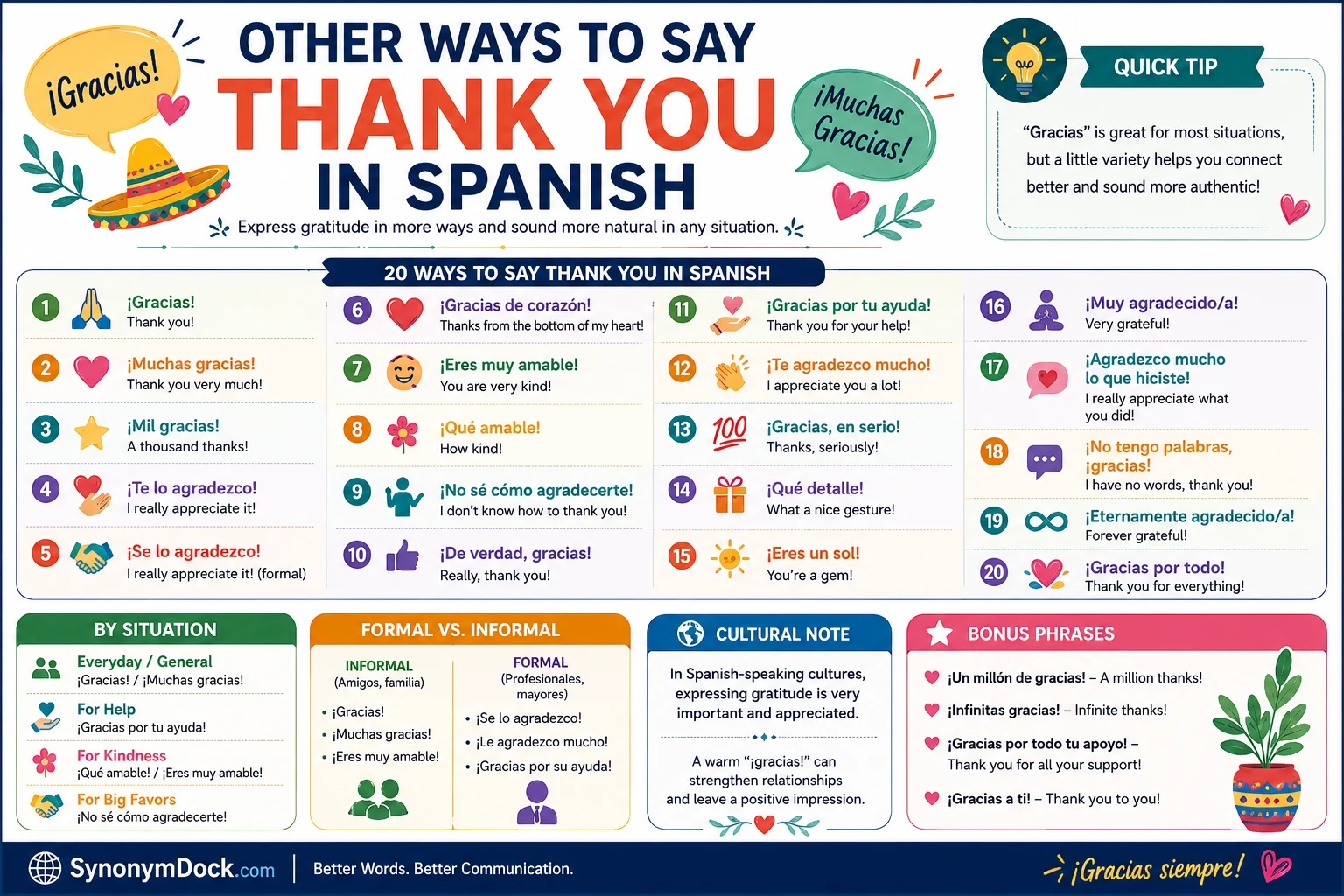
The most common way to say thank you in Spanish is gracias, but you can also use muchas gracias, muchísimas gracias, mil gracias, te lo agradezco, and se lo agradezco to express different levels of gratitude.
If you’ve been learning Spanish, you already know that gracias is the go-to word for “thank you.” But just like in English, native speakers rarely stick to just one expression. Learning other ways to say thank you in Spanish helps you sound more natural, build stronger connections, and navigate different social situations with confidence.
Whether you’re writing a professional email, chatting with friends, or thanking a stranger for directions, having a variety of expressions at your disposal makes a real difference. In this guide, you’ll discover 15 powerful alternatives to gracias, organized by formality and context, complete with examples and practical tips.
Quick Categories
Formal Alternatives
- Se lo agradezco
- Le estoy muy agradecido/a
- Muy agradecido/a
- No sé cómo agradecerle
Pro Tip
Use formal alternatives when speaking with elders, authority figures, or in professional settings. The usted form signals respect and courtesy.
Professional & Business Email Alternatives
- Le agradezco su tiempo
- Gracias por su apoyo
- Muy amable
- Se lo agradezco de antemano (thanks in advance)
Pro Tip
In business emails, pair your thanks with specific details about what you’re grateful for. Specificity adds sincerity and professionalism.
Academic Alternatives
- Le agradezco profundamente
- Estoy muy agradecido/a por su orientación
- Aprecio mucho su colaboración
- Gracias por su tiempo y atención
Pro Tip
Academic gratitude often requires a formal, measured tone. Use le agradezco and aprecio to maintain professional distance while showing respect.
Casual / Informal Alternatives
- Te lo agradezco
- Mil gracias
- Un millón de gracias
- Gracias de todo corazón
- Te debo una
Pro Tip
Casual expressions are perfect for friends and family. Just remember that overusing heartfelt phrases like gracias de todo corazón in everyday situations can sound dramatic.
Informal Expressions
- Muchísimas gracias
- Infinitas gracias
- ¡Qué lindo! (Thanks, how nice!)
- Eres un ángel (You’re an angel)
- Gracias a ti (Thanks to you – when someone thanks you)
Pro Tip
Informal expressions often use diminutives, augmentatives, or playful exaggerations to show enthusiasm. Use them to match the energy of the conversation.
“The right expression of gratitude can turn a simple interaction into a meaningful connection.”
What Does “Thank You” Mean in Spanish?
Definition: Gracias is the standard Spanish word for “thank you,” derived from the Latin gratias (thanks). It expresses gratitude, appreciation, or acknowledgment.
Grammar Note: Gracias is always feminine and plural. When saying “thank you for,” use gracias por followed by a noun or infinitive verb.
Example: Gracias por tu ayuda. (Thank you for your help.)
Simple Explanation: Think of gracias as your foundation. It works in nearly every situation, from ordering coffee to receiving a gift.
When to Use “Gracias”
Common Situations:
- Daily conversation: Almost anytime someone does something for you
- Business: Perfectly acceptable in professional settings
- Emails: Works well, but stronger alternatives may be better for formal correspondence
- Meetings: Appropriate for acknowledging contributions
- Spoken English: Very common and natural
- Written English: Standard in all forms of writing
- Formal: Yes, gracias is neutral enough for formal contexts
- Informal: Absolutely, it’s the universal choice
Key Insight: Gracias is never wrong. It’s the Swiss Army knife of Spanish gratitude always useful, always appropriate.
Is It Professional or Polite?
Polite? ✔ Yes, gracias is universally polite.
Professional? ✔ Yes, but it may sound basic in high-stakes professional contexts.
Formal? Sometimes it works well in formal settings but lacks the weight of more formal expressions.
Natural? ✔ Yes, native speakers use gracias constantly.
Example Comparison:
| Context | Standard | More Nuanced |
|---|---|---|
| Receiving a coffee | Gracias. | Muchas gracias. |
| Receiving professional advice | Gracias. | Se lo agradezco mucho. |
Takeaway: Gracias is polite and professional, but upgrading your expression shows extra thought and cultural awareness.
Pros and Cons of Using “Gracias”
Pros
- Universally understood across all Spanish-speaking regions
- Works in every context formal, informal, spoken, written
- Short and easy to pronounce
- Never offensive or inappropriate
Cons
- Can sound basic or repetitive if overused
- Doesn’t convey the depth of emotion in meaningful situations
- May seem less sincere in formal or heartfelt contexts
- Misses opportunities to show cultural fluency and warmth
The Bottom Line: Gracias is your reliable default. But just as in English, repeating “thanks” in every situation can feel robotic. The alternatives below will help you sound more natural and emotionally intelligent.
15 Other Ways to Say Thank You in Spanish
[1]. Muchas gracias
Meaning: Thank you very much.
Explanation: This is the most common upgrade from gracias. Adding muchas (many) intensifies the expression while keeping it appropriate for both formal and informal contexts.
Example Sentence: ¡Muchas gracias por venir a mi fiesta! (Thank you very much for coming to my party!)
Best Use: Daily conversation, workplace, emails, casual settings
Avoid Using In: Situations requiring formal, distant politeness (though it’s still acceptable)
Tone: Warm, appreciative, natural
Formality Level: ⭐⭐⭐ Neutral
Usage Frequency: Very Common
CEFR Level: A1
Common Collocations:
- muchas gracias por todo
- muchas gracias a todos
- muchas gracias por tu ayuda
Context Variability:
- Spoken: ¡Muchas gracias!
- Professional: Muchas gracias por su tiempo.
- Casual: Muchas gracias, te lo agradezco.
[2]. Muchísimas gracias
Meaning: Thank you so, so much / Thank you very, very much.
Explanation: The suffix -ísimas acts as an intensifier, making this expression stronger than muchas gracias. It conveys genuine enthusiasm and works best in informal or emotionally warm contexts.
Example Sentence: ¡Encontraste mi billetera! ¡Muchísimas gracias! (You found my wallet! Thank you so, so much!)
Best Use: Casual conversation, expressing strong gratitude
Avoid Using In: Very formal business emails or legal documents
Tone: Enthusiastic, warm, appreciative
Formality Level: ⭐⭐ Casual
Usage Frequency: Common
CEFR Level: A2
Common Collocations:
- muchísimas gracias por tu ayuda
- muchísimas gracias a todos
- muchísimas gracias de verdad
Context Variability:
- Spoken: ¡Muchísimas gracias por todo!
- Professional: Less common but acceptable for close colleagues
- Casual: ¡Muchísimas gracias, eres un sol!
[3]. Mil gracias
Meaning: A thousand thanks / Thanks so much.
Explanation: Literally “a thousand thanks,” this idiomatic expression is warmer and more playful than muchas gracias. It’s common across Spanish-speaking regions and works in both casual and slightly formal contexts.
Example Sentence: ¡Mil gracias por darme un ride al aeropuerto! (A thousand thanks for giving me a ride to the airport!)
Best Use: Friendly conversation, showing enthusiasm
Avoid Using In: Highly formal written correspondence (though it’s still polite)
Tone: Warm, enthusiastic, slightly playful
Formality Level: ⭐⭐⭐ Neutral-to-Casual
Usage Frequency: Common
CEFR Level: A2
Common Collocations:
- mil gracias por tu ayuda
- mil gracias por todo
- mil gracias a todos
Context Variability:
- Spoken: ¡Mil gracias por venir!
- Professional: Acceptable in less formal work settings
- Casual: ¡Mil gracias por el regalo!
[4]. Un millón de gracias
Meaning: A million thanks.
Explanation: This is a more emphatic version of mil gracias. While less common than “a thousand thanks,” it’s still understood and appreciated, especially when you want to show overwhelming gratitude.
Example Sentence: Un millón de gracias por ayudar con el evento. (A million thanks for helping with the event.)
Best Use: Emphasizing strong gratitude, casual conversations
Avoid Using In: Formal business emails where restraint is preferred
Tone: Expressive, warm, enthusiastic
Formality Level: ⭐⭐ Casual
Usage Frequency: Occasional
CEFR Level: B1
Common Collocations:
- un millón de gracias por todo
- un millón de gracias a todos
- un millón de gracias por tu apoyo
Context Variability:
- Spoken: ¡Un millón de gracias!
- Professional: Rarely used
- Casual: Common among friends and family
[5]. Te lo agradezco (Informal) / Se lo agradezco (Formal)
Meaning: I thank you / I appreciate it.
Explanation: This phrase is warmer and more personal than a simple gracias. The difference between te (informal) and se (formal) determines the level of politeness. It refers to a specific action or favor.
Example Sentence (Informal): Te lo agradezco por explicarme paso a paso. (I appreciate you explaining it to me step by step.)
Example Sentence (Formal): Se lo agradezco, pero no puedo aceptar regalos. (I appreciate it, but I cannot accept gifts.)
Best Use: Both formal and informal contexts, referring to specific acts
Avoid Using In: Situations where a general thank you is appropriate
Tone: Sincere, personal, appreciative
Formality Level: Varies (⭐ Casual with te, ⭐⭐⭐⭐ Formal with se)
Usage Frequency: Very Common
CEFR Level: B1
Common Collocations:
- te lo agradezco de corazón
- se lo agradezco mucho
- te lo agradezco en el alma
Context Variability:
- Spoken: Te lo agradezco, de verdad.
- Professional: Se lo agradezco por su tiempo.
- Casual: Te lo agradezco con toda el alma.
[6]. Le agradezco / Te agradezco
Meaning: I thank you (formal/informal).
Explanation: Using the verb agradecer directly makes this a slightly more formal alternative to te lo agradezco. It’s common in professional settings, service interactions, and when speaking with strangers.
Example Sentence: Le agradezco mucho su tiempo y su ayuda. (I thank you very much for your time and your help.)
Best Use: Professional emails, speaking with service providers, formal conversations
Avoid Using In: Very casual chats with close friends (though it’s still understood)
Tone: Respectful, professional, formal
Formality Level: ⭐⭐⭐⭐ Formal
Usage Frequency: Common in formal settings
CEFR Level: B1
Common Collocations:
- le agradezco su tiempo
- te agradezco tu ayuda
- agradezco mucho su esfuerzo
Context Variability:
- Spoken: Te agradezco por escucharme.
- Professional: Le agradezco su atención.
- Casual: Less common; friends use te lo agradezco
[7]. Muy agradecido / Muy agradecida
Meaning: Very grateful (male/female).
Explanation: This abbreviated expression is commonly used in formal settings or when you want to sound professional and concise. Remember to match the gender of the speaker (agradecido for males, agradecida for females).
Example Sentence: Muy agradecido, Don Kevin. (Very grateful, Mister Kevin.)
Best Use: Formal letters, professional emails, formal conversations
Avoid Using In: Very casual or playful conversations
Tone: Formal, respectful, professional
Formality Level: ⭐⭐⭐⭐ Formal
Usage Frequency: Occasional (formal contexts)
CEFR Level: B1
Common Collocations:
- muy agradecido por su ayuda
- muy agradecida por su tiempo
- eternamente agradecido
Context Variability:
- Spoken: Muy agradecido por todo.
- Professional: Common in business correspondence
- Casual: Rarely used
[8]. Estoy muy agradecido / Estoy muy agradecida
Meaning: I’m very grateful (male/female).
Explanation: This full sentence version expresses deep, sincere gratitude. It’s commonly used in formal situations and heartfelt conversations. Like muy agradecido, the ending changes based on gender.
Example Sentence: Estoy muy agradecido por su orientación durante la reunión. (I’m very grateful for your guidance during the meeting.)
Best Use: Formal settings, expressing sincere thanks, professional correspondence
Avoid Using In: Casual conversations where simpler expressions are more natural
Tone: Sincere, warm, professional
Formality Level: ⭐⭐⭐⭐ Formal
Usage Frequency: Common (formal/heartfelt contexts)
CEFR Level: B1
Common Collocations:
- estoy muy agradecido por su apoyo
- estoy muy agradecida por tu amistad
- estoy eternamente agradecido
Context Variability:
- Spoken: Estoy muy agradecido por todo lo que hiciste.
- Professional: Common in emails and formal letters
- Casual: Less common among friends
[9]. No sé cómo agradecerte / No sé cómo agradecerle
Meaning: I don’t know how to thank you (informal/formal).
Explanation: This phrase expresses genuine overwhelm at someone’s kindness or help. It’s one of the most heartfelt ways to say thank you in Spanish and works well in both formal and informal contexts.
Example Sentence: No sé cómo agradecerte todo esto. (I don’t know how to thank you for all this.)
Best Use: Expressing deep gratitude, after significant favors
Avoid Using In: Everyday situations where it would sound exaggerated
Tone: Heartfelt, genuine, sincere
Formality Level: Varies (⭐ Casual with te, ⭐⭐⭐⭐ Formal with le)
Usage Frequency: Occasional (special situations)
CEFR Level: B2
Common Collocations:
- no sé cómo agradecerte
- no sé cómo agradecerle su ayuda
- no sé cómo agradecerte tanto
Context Variability:
- Spoken: ¡No sé cómo agradecerte!
- Professional: No sé cómo agradecerle su apoyo.
- Casual: No sé cómo agradecerte, de verdad.
[10]. Gracias de todo corazón
Meaning: Thanks from the bottom of my heart.
Explanation: This emotional expression conveys deep, sincere gratitude. It’s used when someone has done something extraordinarily meaningful for you.
Example Sentence: Gracias de todo corazón por cuidar a mi madre. (Thanks from the bottom of my heart for taking care of my mother.)
Best Use: Expressing profound gratitude to friends, family, or someone who helped significantly
Avoid Using In: Everyday situations or formal business contexts where it might seem overly emotional
Tone: Heartfelt, emotional, sincere
Formality Level: ⭐⭐ Casual (despite being formal-sounding, it’s mostly used in emotional personal contexts)
Usage Frequency: Occasional (special situations)
CEFR Level: B1
Common Collocations:
- gracias de todo corazón por todo
- gracias de todo corazón a todos
- gracias de corazón
Context Variability:
- Spoken: Gracias de todo corazón por estar aquí.
- Professional: Rarely used
- Casual: Common with close relationships
[11]. Gracias por todo
Meaning: Thanks for everything.
Explanation: This is a warm, general expression used when you want to acknowledge someone’s multiple acts of kindness or overall support.
Example Sentence: Gracias por todo lo que hiciste. (Thanks for everything you did.)
Best Use: Ending a conversation, after receiving multiple forms of help
Avoid Using In: Situations requiring specific, detailed thanks
Tone: Warm, general, appreciative
Formality Level: ⭐⭐⭐ Neutral
Usage Frequency: Very Common
CEFR Level: A1
Common Collocations:
- gracias por todo lo que haces
- gracias por todo tu apoyo
- gracias por todo y perdón
Context Variability:
- Spoken: Bueno, gracias por todo.
- Professional: Gracias por todo su apoyo.
- Casual: ¡Gracias por todo, te quiero mucho!
[12]. Muy amable
Meaning: Very kind / That’s very kind of you.
Explanation: This phrase is often used in service settings to show appreciation for someone’s helpfulness or courtesy. It’s particularly common in Spain.
Example Sentence: Muy amable, señorita. (Very kind, miss.)
Best Use: Responding to service, thanking strangers, polite interactions
Avoid Using In: Situations where someone has done a significant favor it might seem too casual
Tone: Polite, courteous, appreciative
Formality Level: ⭐⭐⭐ Neutral (polite but accessible)
Usage Frequency: Common (service contexts)
CEFR Level: A2
Common Collocations:
- muy amable de su parte
- muchas gracias, muy amable
- es muy amable
Context Variability:
- Spoken: Muy amable, gracias.
- Professional: Muy amable por su tiempo.
- Casual: ¡Ay, qué amable!
[13]. Aprecio mucho / Lo aprecio mucho
Meaning: I really appreciate it.
Explanation: This is a direct translation of the English phrase and is used to express genuine appreciation. It can work in both formal and informal contexts.
Example Sentence: Tu ayuda fue importante, lo aprecio mucho. (Your help was important, I really appreciate it.)
Best Use: Professional and personal contexts where you want to express sincere appreciation
Avoid Using In: Very casual conversations with close friends (though it’s still fine)
Tone: Sincere, professional, warm
Formality Level: ⭐⭐⭐ Neutral
Usage Frequency: Common
CEFR Level: B1
Common Collocations:
- aprecio mucho tu ayuda
- lo aprecio mucho de verdad
- aprecio mucho su tiempo
Context Variability:
- Spoken: Lo aprecio mucho, gracias.
- Professional: Aprecio mucho su colaboración.
- Casual: ¡Lo aprecio un montón!
[14]. Gracias a ti / Gracias a usted
Meaning: Thanks to you (informal/formal).
Explanation: This is used when someone thanks you and you want to turn the gratitude back to them. It’s the Spanish equivalent of “thank YOU” with emphasis.
Example Sentence: ¡Gracias a ti, la fiesta fue un éxito! (Thanks to you, the party was a success!)
Best Use: Responding to someone who has just thanked you
Avoid Using In: Situations where someone hasn’t thanked you first
Tone: Reciprocal, appreciative, warm
Formality Level: Varies (⭐ Casual with ti, ⭐⭐⭐ Formal with usted)
Usage Frequency: Very Common
CEFR Level: A2
Common Collocations:
- gracias a ti por todo
- gracias a usted por su ayuda
- no, gracias a ti
Context Variability:
- Spoken: ¡No, gracias a ti!
- Professional: Gracias a usted por su tiempo.
- Casual: Common among friends
[15]. Te debo una
Meaning: I owe you one.
Explanation: This casual expression is used among friends or close acquaintances to acknowledge a favor and promise future reciprocity.
Example Sentence: Gracias por venir conmigo. Te debo una. (Thanks for coming with me. I owe you one.)
Best Use: Casual conversations, friends, peers
Avoid Using In: Formal situations, professional settings, or with strangers
Tone: Friendly, casual, playful
Formality Level: ⭐ Very Casual
Usage Frequency: Common (among friends)
CEFR Level: B1
Common Collocations:
- te debo una (muy) grande
- te debo una por esto
- te debo una, de verdad
Context Variability:
- Spoken: ¡Te debo una, colega!
- Professional: Not appropriate
- Casual: Very common among friends
“Choosing the right expression of gratitude shows you understand both the language and the culture behind it.”
Native Speaker Tips
Tip #1: Native Spanish speakers often combine expressions for maximum effect. You might hear ¡Muchas gracias, muy amable! (Thank you very much, how kind!) or ¡Mil gracias, te lo agradezco mucho! (A thousand thanks, I really appreciate it!).
Tip #2: The formality of the situation determines which “you” form you should use. Use tú and its associated verbs (te, tu) for friends and family. Use usted and its forms (se, su, le) for strangers, elders, and professional contacts. If you’re unsure, it’s safer to start formal.
Tip #3: When thanking someone for something specific, always use por (not para). For example: gracias por tu ayuda (thank you for your help), not gracias para tu ayuda.
Tip #4: If you want to sound truly authentic in a casual setting, try using ¡Qué lindo! (How nice!) or ¡Qué detalle! (What a thoughtful gesture!) along with your thanks. These are common in everyday conversation.
Expert Insight
In professional Spanish, specificity matters. Instead of a general gracias, try Le agradezco la oportunidad de trabajar en este proyecto (I thank you for the opportunity to work on this project) or Agradezco mucho su tiempo y su orientación (I really appreciate your time and guidance).
The verb agradecer is also useful in professional writing. Agradezco su respuesta (I appreciate your response) is a common opening line for follow-up emails.
Top 10 Alternatives Compared
| Phrase | Tone | Formality | Best Use | Frequency |
|---|---|---|---|---|
| Muchas gracias | Warm, appreciative | Neutral | Daily conversation | Very Common |
| Muchísimas gracias | Enthusiastic | Casual | Strong gratitude | Common |
| Mil gracias | Warm, playful | Casual-neutral | Friendly thanks | Common |
| Te/Se lo agradezco | Sincere, personal | Varies (informal/formal) | Specific favors | Very Common |
| Le/T e agradezco | Formal, respectful | Formal | Professional settings | Common |
| Muy agradecido/a | Formal, professional | Formal | Professional emails | Occasional |
| Estoy muy agradecido/a | Sincere, warm | Formal | Heartfelt formal thanks | Common |
| No sé cómo agradecerte/le | Heartfelt | Varies | Deep gratitude | Occasional |
| Gracias de todo corazón | Emotional | Casual | Heartfelt personal thanks | Occasional |
| Muy amable | Polite, courteous | Neutral | Service interactions | Common |
Which One Should You Use?
Best Overall: Muchas gracias it’s the most versatile, works in every context, and is the natural upgrade from gracias.
Best Professional: Se lo agradezco formal, respectful, and personal. Ideal for professional emails and workplace conversations.
Best Academic: Le agradezco profundamente expresses deep gratitude while maintaining professional distance.
Best Business Email: Le agradezco su tiempo y atención specific, professional, and courteous.
Best Everyday Conversation: Te lo agradezco sincere, natural, and warm without being overly dramatic.
Most Natural: Muchas gracias it’s the phrase native speakers use most often after the basic gracias.
Most Polite: No sé cómo agradecerle shows humility and deep appreciation in formal situations.
Common Mistakes
Mistake 1: Using para instead of por after gracias
- Why it’s incorrect: Gracias por is the correct structure for “thank you for.” Para means “for” in the sense of purpose or destination.
- Correct version: Gracias por tu ayuda (Thank you for your help)
- Example: ❌ Gracias para tu ayuda | ✔ Gracias por tu ayuda
Mistake 2: Forgetting gender agreement in adjectives
- Why it’s incorrect: Spanish adjectives must agree with the gender of the speaker.
- Correct version: Estoy muy agradecido (male) / Estoy muy agradecida (female)
- Example: ❌ Estoy muy agradecido (said by a female) | ✔ Estoy muy agradecida
Mistake 3: Using te lo agradezco in very formal situations
- Why it’s incorrect: Te is informal; use se for formal contexts.
- Correct version: Se lo agradezco
- Example: ❌ Te lo agradezco, señor. | ✔ Se lo agradezco, señor.
Mistake 4: Overusing emotional phrases like gracias de todo corazón
- Why it’s incorrect: It sounds dramatic and insincere if used for minor things.
- Correct version: Reserve it for genuinely meaningful moments.
- Example: ❌ Gracias de todo corazón por el café. | ✔ Gracias por el café.
Mistake 5: Not adjusting for regional differences
- Why it’s incorrect: Some phrases are more common in certain regions.
- Correct version: In Spain, Muy amable is very common. In Latin America, Con gusto is often used as a response to thanks.
- Example: While de nada is universal, using con gusto in Latin America sounds more natural.
Commonly Confused Phrases
“Gracias” vs. “Se lo agradezco”
Gracias is a quick, general thank you. Se lo agradezco is a formal, personal “I thank you for it,” referring to a specific action. Use gracias for everyday situations and se lo agradezco for formal or more meaningful moments.
“Muchísimas gracias” vs. “Mil gracias”
Both express strong gratitude, but muchísimas gracias is more common in everyday speech. Mil gracias has a slightly more playful, poetic quality and is often used in casual conversations.
“Te lo agradezco” vs. “Te agradezco”
Te lo agradezco emphasizes “it” (referring to a specific thing). Te agradezco is a more direct “I thank you” without the explicit “it.” Both are correct, but te lo agradezco is more common in spoken Spanish.
“Muy agradecido” vs. “Estoy muy agradecido”
Muy agradecido is often used as a standalone phrase in formal contexts (e.g., ending a letter). Estoy muy agradecido is a complete sentence meaning “I am very grateful.”
Avoid These in Formal Situations
| Expression | Why to Avoid | Better Alternative |
|---|---|---|
| Te debo una | Too casual; implies informal debt | Se lo agradezco or Le estoy muy agradecido |
| Gracias a ti | Reciprocal informal thanks | Agradezco su ayuda |
| ¡Qué lindo! | Too casual; sounds like a compliment to a friend | Muy amable or Gracias por su gentileza |
| Te lo agradezco (with tú) | Informal “you” | Se lo agradezco (with usted) |
| Eres un ángel | Too playful and intimate | Le estoy muy agradecido |
Scenario Practice
Scenario 1: Business Meeting
You’ve just received helpful feedback from a senior executive. Which phrase would you choose?
✔ Correct: Se lo agradezco mucho por su tiempo y orientación. (I thank you very much for your time and guidance.)
Explanation: Using se shows respect for a senior professional. Being specific about su tiempo y orientación adds professionalism.
Scenario 2: A Friend Helps You Move
Your friend spends hours helping you carry furniture. Which phrase would you choose?
✔ Correct: ¡Mil gracias por tu ayuda! Te debo una. (A thousand thanks for your help! I owe you one.)
Explanation: The casual, enthusiastic tone is perfect for friends. Te debo una keeps it friendly and reciprocal.
Scenario 3: Thank You Note for a Professional Reference
Someone wrote a recommendation letter for you. Which phrase would you choose?
✔ Correct: Le estoy muy agradecido por su apoyo. No sé cómo agradecerle. (I’m very grateful for your support. I don’t know how to thank you.)
Explanation: Formal, heartfelt, and appropriate for a significant professional favor.
Scenario 4: Receiving a Gift from a Family Member
Your grandmother gives you a handmade blanket. Which phrase would you choose?
✔ Correct: ¡Ay, gracias de todo corazón! ¡Qué detalle tan bonito! (Oh, thanks from the bottom of my heart! What a beautiful gesture!)
Explanation: Emotional and personal, matching the significance and warmth of the gesture.
Scenario 5: Thanking a Barista for Coffee
You’ve just received your morning coffee. Which phrase would you choose?
✔ Correct: Muchas gracias. (Thank you very much.)
Explanation: Warm but not over-the-top. Perfect for brief service interactions.
Mini Quiz
1. You’re writing an email to a client. Which is the most appropriate phrase?
A) Te lo agradezco
B) Se lo agradezco
C) ¡Un millón de gracias!
D) Gracias a ti
2. A friend just helped you fix your computer. Which casual expression works best?
A) Muy agradecido
B) No sé cómo agradecerle
C) Te debo una
D) Le estoy muy agradecido
3. Which phrase should you avoid in a formal meeting?
A) Se lo agradezco
B) Muchas gracias
C) Te debo una
D) Le agradezco su tiempo
4. You’re a female speaker. Which is correct?
A) Estoy muy agradecido
B) Estoy muy agradecida
C) Muy agradecido
D) Both A and C
5. Which phrase would be most natural after receiving a compliment?
A) Gracias de todo corazón
B) Mil gracias
C) Gracias
D) No sé cómo agradecerte
Answer Key
1. B) Se lo agradezco Se is formal (for usted), while te is informal.
2. C) Te debo una This casual “I owe you one” is perfect among friends.
3. C) Te debo una Too casual for professional settings.
4. B) Estoy muy agradecida Feminine speakers use the -a ending.
5. C) Gracias A simple “thank you” is natural for compliments. More elaborate thanks may seem overly dramatic.
FAQs
What is the most formal way to say “thank you” in Spanish?
The most formal expression is Se lo agradezco profundamente (I deeply thank you) or Le estoy muy agradecido/a (I am very grateful to you). Both show respect and are used in professional or formal contexts, especially when speaking with elders or superiors.
Which phrase is best for professional emails?
For professional emails, use Le agradezco su tiempo (I thank you for your time) or Se lo agradezco por su ayuda (I appreciate your help). These are specific, formal, and widely used in business correspondence across Spanish-speaking countries.
What is the difference between “Te lo agradezco” and “Se lo agradezco”?
The difference is formality. Te lo agradezco uses te (informal “you”), while Se lo agradezco uses se (formal “you”). Use te with friends, family, and people your age. Use se with strangers, elders, and in professional contexts.
Which alternative sounds most natural to native speakers?
Muchas gracias is the most natural alternative to gracias. It adds warmth without being over-the-top and works in virtually every situation from casual to formal. Native speakers use it constantly.
Can I use these expressions in business meetings?
Yes, but choose carefully. Use Se lo agradezco or Le agradezco su tiempo for formal meetings. Avoid casual expressions like Te debo una or Mil gracias, which are better suited for informal settings.
Conclusion
Learning other ways to say thank you in Spanish opens up new possibilities for connection. Whether you’re using muchas gracias in daily conversation, se lo agradezco in a professional email, or gracias de todo corazón to a loved one, each expression adds nuance and warmth to your communication. The right choice signals that you understand not just the language, but the culture and relationships behind it.
Practice these phrases in real conversations, and don’t be afraid to experiment. Start with the more common expressions and gradually work in the formal and heartfelt ones as your confidence grows. Your Spanish will sound more authentic, and native speakers will appreciate the extra effort you put into choosing the right words.

3 thoughts on “Other Ways to Say Thank You in Spanish |20+ Examples For 2026”