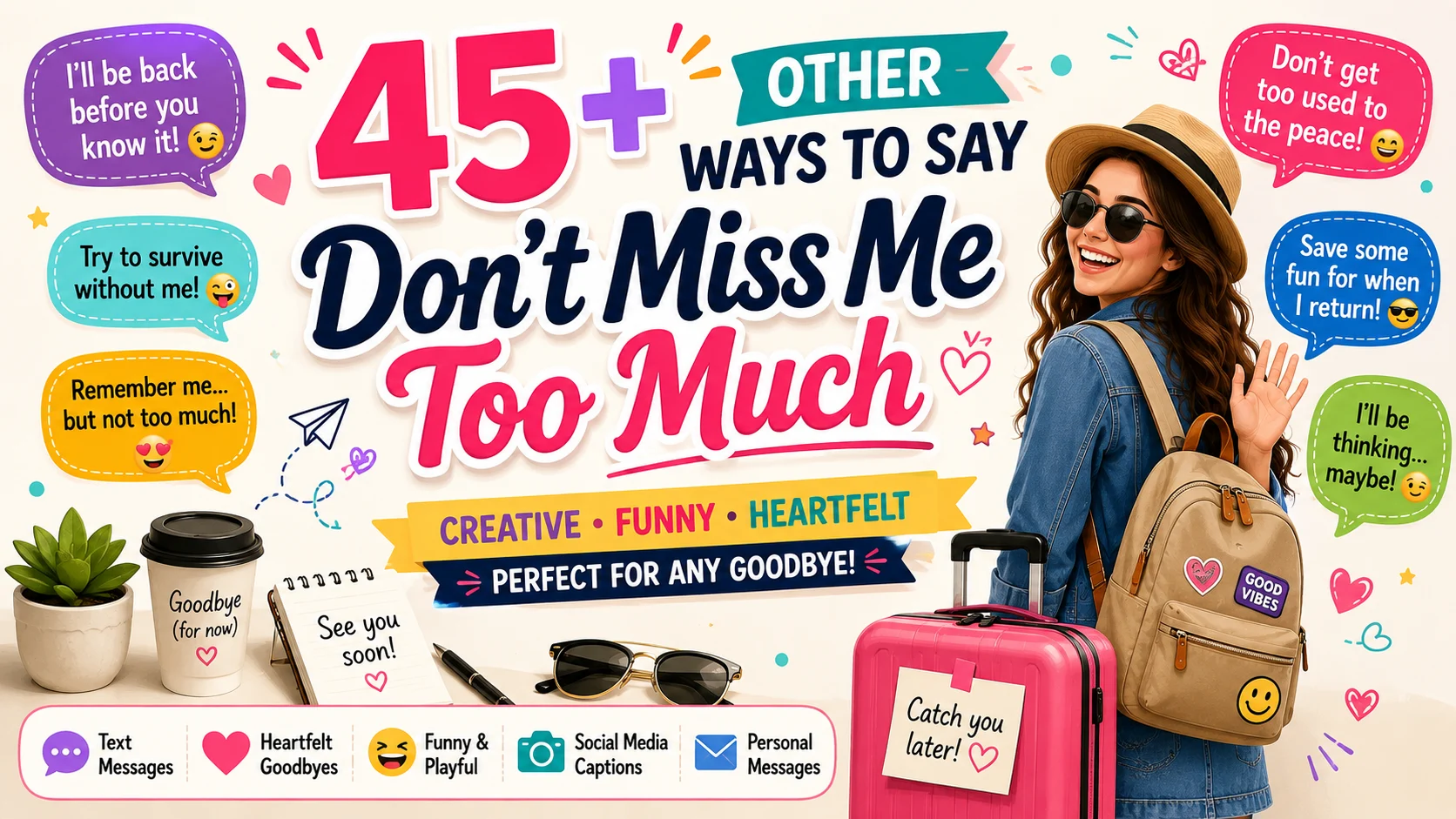
Saying goodbye is never easy, especially when you share a close bond with someone. The phrase “don’t miss me too much” is a playful, lighthearted way to acknowledge the parting while keeping the mood cheerful. But using it in every situation can feel repetitive or even inappropriate.
Mastering other ways to say “don’t miss me too much” helps you match your farewell to the relationship, the setting, and the emotional tone of the moment. Whether you’re leaving a job, saying goodbye to a friend, or signing off after a meaningful conversation, the right phrase can leave a warm, lasting impression. This guide provides 25+ alternatives to help you say goodbye with charm, wit, and emotional intelligence.
Top 5 alternatives: I’ll be thinking of you, Take care of yourself, I’ll miss you too, Don’t have too much fun without me, I’m only a call away.
Quick Categories
Playful & Witty Alternatives
- Don’t have too much fun without me
- Try not to miss me too much
- I’ll be back before you know it
- Don’t forget about me
- I’ll be counting the days
Pro Tip: Playful alternatives work best with close friends, family, or colleagues you share a warm rapport with. They keep the tone light and affectionate.
Sentimental & Warm Alternatives
- I’ll miss you more
- I’ll be thinking of you
- Take care of yourself
- I’m only a call away
- I’ll hold you in my heart
Pro Tip: Use sentimental phrases when the departure is emotional or when you want to express genuine care. These work well for long-distance situations or significant goodbyes.
Professional Alternatives
- I look forward to our next meeting
- I’ll be in touch
- Please don’t hesitate to reach out
- I hope to see you again soon
- I appreciate your time and support
Pro Tip: Professional alternatives maintain boundaries while showing appreciation. They are ideal for workplace farewells, client meetings, and networking events.
Casual & Lighthearted Alternatives
- See you soon!
- Catch you later
- Take it easy
- Talk soon
- Until next time
Pro Tip: Casual alternatives are perfect for everyday situations with friends, neighbors, or acquaintances. They feel natural and unforced.
Short & Simple Alternatives
- Miss me!
- Stay safe
- Take care
- Bye for now
- All the best
Pro Tip: Short phrases work well when you’re in a hurry or want to keep the goodbye simple and sweet.
Common Mistakes
Mistake 1: Using overly emotional phrases in professional settings
Why it is incorrect: Emotional alternatives like “I’ll hold you in my heart” are too personal for workplace relationships and can create awkwardness.
Correct version: Use “I look forward to our next meeting” or “I appreciate your time.”
Example Sentence: Instead of “I’ll miss you so much” to a client, say “Thank you for your time today.
Mistake 2: Saying “Don’t have too much fun without me” to a superior
Why it is incorrect: This phrase can sound presumptuous and unprofessional when used with a manager, boss, or senior colleague.
Correct version: Use “I appreciate your time” or “I look forward to working with you again.”
Example Sentence: Instead of “Don’t have too much fun without me” to your boss, say “Thank you for the opportunity.
Mistake 3: Using “Miss me!” in formal contexts
Why it is incorrect: “Miss me!” is very casual and demanding in tone. It comes across as childish in professional or formal situations.
Correct version: Use “I hope to see you again soon.”
Example Sentence: Instead of “Miss me!” in an email, say “I look forward to connecting again.”
Mistake 4: Overusing “I’ll miss you more” in competitive contexts
Why it is incorrect: Using this as a competition rather than a genuine emotional expression can seem insincere or dismissive.
Correct version: Say it once with genuine feeling.
Example Sentence: Instead of “I’ll miss you more, times ten!” say “I’ll miss you more truly.
Mistake 5: Forgetting to match the emotional tone
Why it is incorrect: Using a lighthearted phrase when someone is genuinely emotional can seem insensitive.
Correct version: Match the tone to the situation.
Example Sentence: Instead of “Don’t have too much fun without me” when someone is crying, say “I’ll be thinking of you.”
What Does “Don’t Miss Me Too Much” Mean?
Definition: A playful, affectionate phrase used when saying goodbye, implying that while you expect the other person to miss you, you don’t want them to feel sad or lonely.
Grammar: It is a sentence in the imperative mood, with “don’t” as a negative command, followed by the verb “miss.”
Simple Explanation: The speaker is acknowledging the emotional impact of their departure but is keeping the tone light and humorous. It’s a way of saying, “I know you’ll miss me, but cheer up!
Example Sentence: “I’ll be back in two weeks. Don’t miss me too much!”
When to Use “Don’t Miss Me Too Much”
This phrase is most appropriate when you have a close, warm relationship with someone. Use it when:
- Leaving for a trip or vacation
- Moving to a new city
- Leaving a job (with close colleagues)
- Saying goodbye to a friend or family member
- Ending a meaningful conversation
“The best farewells balance warmth, humor, and genuine emotion.”
Is It Professional or Polite?
Polite? ✔ Yes, in casual contexts.
Professional? ❌ No, it is too casual for most professional settings.
Formal? ❌ No, it is informal and playful.
Natural? ✔ Yes, it sounds very natural among friends.
Business-style example: “I look forward to reconnecting soon.”
Explanation: “Don’t miss me too much” is a phrase you would use with friends and family, not clients or senior executives. In professional settings, focus on appreciation and future collaboration.
Pros and Cons
Pros
- Playful and lighthearted
- Shows emotional warmth
- Common and easily understood
- Creates a positive, memorable farewell
Cons
- Too casual for professional settings
- Can be misunderstood in a new relationship
- May feel insincere if said too often
- Not appropriate for emotionally serious goodbyes
“The right farewell phrase demonstrates emotional intelligence and social awareness.”
25+ Alternatives to Say “Don’t Miss Me Too Much”
1. Phrase: Don’t Have Too Much Fun Without Me
Meaning: A playful way to say you wish you were there and will be missed.
Explanation: This phrase is a humorous and lighthearted way to say goodbye. It suggests that the other person might have fun without you, and you’re jokingly telling them not to.
Example Sentence: “I’ll be at the conference all week. Don’t have too much fun without me!”
Best Use: Friends, colleagues you joke with, family
Avoid Using In: Formal settings, with new acquaintances
Tone: Playful, Humorous
Formality Level: ⭐⭐ Casual
Usage Frequency: Very Common
CEFR Level: B1
Common Collocations:
- don’t have too much fun without me
- have fun without me
- don’t have all the fun
Context Variability:
- Spoken English: “Don’t have too much fun without me!”
- Professional English: Avoid.
- Casual Conversation: Very common and playful.
2. Phrase: I’ll Be Thinking of You
Meaning: A warm promise that the other person will be on your mind.
Explanation: This is a sweet and sincere way to say goodbye. It reassures the person that you will remember them during your absence.
Example Sentence: “I’ll be thinking of you while I’m away. Take care!”
Best Use: Friends, family, close relationships
Avoid Using In: Professional emails, casual acquaintances
Tone: Warm, Sincere
Formality Level: ⭐⭐⭐ Neutral
Usage Frequency: Common
CEFR Level: B1
Common Collocations:
- thinking of you
- will be thinking of you
- thinking about you
Context Variability:
- Spoken English: “I’ll be thinking of you.”
- Professional English: Acceptable but intimate.
- Casual Conversation: Very natural.
3. Phrase: Take Care of Yourself
Meaning: A caring expression showing concern for someone’s well-being.
Explanation: This is a versatile and warm farewell. It works in many contexts because it expresses genuine care without being overly emotional.
Example Sentence: “I hope everything goes well with your move. Take care of yourself.”
Best Use: Friends, family, casual professional settings
Avoid Using In: Very formal business letters
Tone: Warm, Caring
Formality Level: ⭐⭐⭐ Neutral
Usage Frequency: Very Common
CEFR Level: A2
Common Collocations:
- take care of yourself
- take care
- look after yourself
Context Variability:
- Spoken English: “Take care of yourself.”
- Professional English: “Take care” is acceptable.
- Casual Conversation: Very common.
4. Phrase: I’ll Miss You More
Meaning: A playful way to express that you will miss someone deeply.
Explanation: This phrase is often used as a playful competition between two people. It shows affection and warmth.
Example Sentence: “You’ll miss me? I’ll miss you more I promise!”
Best Use: Friends, family, close relationships
Avoid Using In: Professional settings, new relationships
Tone: Playful, Affectionate
Formality Level: ⭐⭐⭐ Neutral
Usage Frequency: Very Common
CEFR Level: B1
Common Collocations:
- I’ll miss you more
- I’ll miss you
- miss you
Context Variability:
- Spoken English: “I’ll miss you more.”
- Professional English: Avoid.
- Casual Conversation: Very playful.
5. Phrase: I’m Only a Call Away
Meaning: A reassuring phrase that you are always available.
Explanation: This is a kind and supportive way to say goodbye. It offers comfort and security to the other person.
Example Sentence: “If you ever need anything, remember I’m only a call away.”
Best Use: Friends, family, close colleagues
Avoid Using In: Very formal contexts
Tone: Supportive, Reassuring
Formality Level: ⭐⭐⭐ Neutral
Usage Frequency: Common
CEFR Level: B1
Common Collocations:
- call away
- only a call away
- just a call away
Context Variability:
- Spoken English: “I’m only a call away.”
- Professional English: Acceptable in a supportive tone.
- Casual Conversation: Very natural.
6. Phrase: I’ll Hold You in My Heart
Meaning: A very emotional and sentimental farewell.
Explanation: This is a deeply emotional phrase. It is used when you have a very strong bond with someone and are parting for a significant period.
Example Sentence: “No matter how far apart we are, I’ll hold you in my heart.”
Best Use: Deep relationships, significant goodbyes
Avoid Using In: Professional contexts, casual acquaintances
Tone: Deeply Emotional, Romantic
Formality Level: ⭐⭐⭐⭐ Formal
Usage Frequency: Occasional
CEFR Level: B2
Common Collocations:
- hold you in my heart
- in my heart
- close to my heart
Context Variability:
- Spoken English: “I’ll hold you in my heart.”
- Professional English: Avoid.
- Casual Conversation: Very romantic.
7. Phrase: Try Not to Miss Me Too Much
Meaning: A direct, playful variation of the original phrase.
Explanation: This is a slightly more direct way of saying “don’t miss me too much.” It’s humorous and affectionate.
Example Sentence: “I’m leaving for the weekend try not to miss me too much!”
Best Use: Friends, family, playful relationships
Avoid Using In: Professional contexts
Tone: Playful, Humorous
Formality Level: ⭐⭐ Casual
Usage Frequency: Common
CEFR Level: B1
Common Collocations:
- try not to miss me
- miss me too much
- don’t miss me
Context Variability:
- Spoken English: “Try not to miss me too much!”
- Professional English: Avoid.
- Casual Conversation: Very playful.
8. Phrase: I’ll Be Back Before You Know It
Meaning: A reassuring phrase that the parting is temporary.
Explanation: This is a comforting way to say goodbye. It assures the other person that the time apart will pass quickly.
Example Sentence: “I’ll be back before you know it I promise!”
Best Use: Friends, family, temporary departures
Avoid Using In: Professional contexts
Tone: Reassuring, Warm
Formality Level: ⭐⭐⭐ Neutral
Usage Frequency: Common
CEFR Level: B1
Common Collocations:
- before you know it
- back before you know it
- it’ll fly by
Context Variability:
- Spoken English: “I’ll be back before you know it.”
- Professional English: Acceptable but casual.
- Casual Conversation: Very common.
9. Phrase: I Look Forward to Our Next Meeting
Meaning: A professional way to express anticipation.
Explanation: This phrase is ideal for professional settings. It shows you value the relationship and expect to continue it.
Example Sentence: “Thank you for your time today. I look forward to our next meeting.”
Best Use: Business meetings, client interactions, interviews
Avoid Using In: Casual personal conversations
Tone: Professional, Polite
Formality Level: ⭐⭐⭐⭐ Formal
Usage Frequency: Very Common
CEFR Level: B2
Common Collocations:
- look forward to our next meeting
- look forward to meeting again
- look forward to seeing you
Context Variability:
- Spoken English: “I look forward to our next meeting.”
- Professional English: Standard.
- Casual Conversation: Sounds formal.
10. Phrase: I’ll Be in Touch
Meaning: A promise to maintain contact.
Explanation: This is a common phrase in professional and semi-professional contexts. It shows you intend to communicate again soon.
Example Sentence: “Let me think about your proposal. I’ll be in touch next week.”
Best Use: Professional emails, business meetings
Avoid Using In: Very formal letters
Tone: Professional, Friendly
Formality Level: ⭐⭐⭐ Neutral
Usage Frequency: Very Common
CEFR Level: B1
Common Collocations:
- be in touch
- get in touch
- stay in touch
Context Variability:
- Spoken English: “I’ll be in touch.”
- Professional English: Very common.
- Casual Conversation: Acceptable but slightly formal.
11. Phrase: Please Don’t Hesitate to Reach Out
Meaning: An open invitation for future communication.
Explanation: This phrase is warm, professional, and helpful. It invites the other person to contact you without hesitation.
Example Sentence: “If you need any more information, please don’t hesitate to reach out.”
Best Use: Professional emails, client communication
Avoid Using In: Very casual personal messages
Tone: Professional, Helpful
Formality Level: ⭐⭐⭐⭐ Formal
Usage Frequency: Very Common
CEFR Level: B2
Common Collocations:
- don’t hesitate to reach out
- don’t hesitate to contact
- don’t hesitate to get in touch
Context Variability:
- Spoken English: “Please don’t hesitate to reach out.”
- Professional English: Standard.
- Casual Conversation: Sounds formal.
12. Phrase: I’ll Be Counting the Days
Meaning: Expressing eager anticipation of a future meeting.
Explanation: This is a warm and sentimental phrase. It shows you are looking forward to seeing the person again.
Example Sentence: “I’m so excited for our trip next month. I’ll be counting the days!”
Best Use: Friends, family, loved ones
Avoid Using In: Professional contexts
Tone: Sentimental, Eager
Formality Level: ⭐⭐⭐ Neutral
Usage Frequency: Common
CEFR Level: B1
Common Collocations:
- counting the days
- counting down the days
- can’t wait
Context Variability:
- Spoken English: “I’ll be counting the days.”
- Professional English: Acceptable but casual.
- Casual Conversation: Very common.
13. Phrase: Don’t Forget About Me
Meaning: A playful plea to be remembered.
Explanation: This phrase is used humorously to remind someone to remember you. It shows a close, comfortable relationship.
Example Sentence: “You’ll be so busy with work. Don’t forget about me!”
Best Use: Friends, family, playful relationships
Avoid Using In: Professional settings, new relationships
Tone: Playful, Lighthearted
Formality Level: ⭐⭐ Casual
Usage Frequency: Very Common
CEFR Level: B1
Common Collocations:
- don’t forget about me
- forget about me
- never forget
Context Variability:
- Spoken English: “Don’t forget about me!”
- Professional English: Avoid.
- Casual Conversation: Very playful.
14. Phrase: Take It Easy
Meaning: A relaxed and friendly way to say goodbye.
Explanation: This phrase is used in casual settings to encourage the other person to relax. It is common in American English.
Example Sentence: “Alright, I’m heading out. Take it easy!”
Best Use: Friends, colleagues, casual acquaintances
Avoid Using In: Formal written communication
Tone: Relaxed, Friendly
Formality Level: ⭐⭐ Casual
Usage Frequency: Very Common
CEFR Level: B1
Common Collocations:
- take it easy
- take it slow
- take it all in
Context Variability:
- Spoken English: “Take it easy, man.”
- Professional English: Acceptable but casual.
- Casual Conversation: Very common.
15. Phrase: Stay Safe
Meaning: A caring wish for someone’s safety.
Explanation: This phrase has become increasingly common. It expresses genuine concern for the other person’s well-being.
Example Sentence: “I hope you have a safe journey. Stay safe!”
Best Use: Friends, family, casual settings
Avoid Using In: Very formal business contexts
Tone: Caring, Concerned
Formality Level: ⭐⭐⭐ Neutral
Usage Frequency: Very Common
CEFR Level: A2
Common Collocations:
- stay safe
- be safe
- keep safe
Context Variability:
- Spoken English: “Stay safe out there!”
- Professional English: Acceptable.
- Casual Conversation: Very common.
16. Phrase: Until We Speak Again
Meaning: A polished, professional way to say goodbye.
Explanation: This phrase is ideal for ending a conversation or email when you expect to communicate again. It sounds professional and considerate.
Example Sentence: “Thank you for sharing your insights with me today. Until we speak again.”
Best Use: Professional emails, formal correspondence
Avoid Using In: Very casual personal conversations
Tone: Formal, Professional
Formality Level: ⭐⭐⭐⭐ Formal
Usage Frequency: Common
CEFR Level: B2
Common Collocations:
- until we speak again
- until we meet again
- until then
Context Variability:
- Spoken English: “Until we speak again.”
- Professional English: Standard.
- Casual Conversation: Sounds formal.
17. Phrase: I Appreciate Your Time and Support
Meaning: A professional and grateful farewell.
Explanation: This is a courteous and professional way to end an interaction. It expresses gratitude for the person’s time and assistance.
Example Sentence: “I really appreciate your time and support during this project.”
Best Use: Work emails, meetings, interviews
Avoid Using In: Personal social situations
Tone: Professional, Grateful
Formality Level: ⭐⭐⭐⭐ Formal
Usage Frequency: Very Common
CEFR Level: B2
Common Collocations:
- appreciate your time
- appreciate your support
- appreciate your assistance
Context Variability:
- Spoken English: “I appreciate your time.”
- Professional English: Standard.
- Casual Conversation: Sounds formal.
18. Phrase: I Hope to See You Again Soon
Meaning: A warm and hopeful farewell.
Explanation: This is a friendly and positive expression. It conveys a genuine wish to reconnect.
Example Sentence: “It was wonderful meeting you. I hope to see you again soon.”
Best Use: Social events, professional networking
Avoid Using In: Close personal relationships
Tone: Warm, Hopeful
Formality Level: ⭐⭐⭐ Neutral
Usage Frequency: Very Common
CEFR Level: B1
Common Collocations:
- hope to see you again
- see you again soon
- hope to meet again
Context Variability:
- Spoken English: “I hope to see you again soon.”
- Professional English: Acceptable.
- Casual Conversation: Very common.
19. Phrase: Talk Soon
Meaning: A quick and friendly promise to communicate.
Explanation: This is a short, casual phrase used when you expect to speak with the person again soon.
Example Sentence: “I have to go to my next meeting. Talk soon!”
Best Use: Friends, colleagues, casual settings
Avoid Using In: Formal letters, official correspondence
Tone: Casual, Friendly
Formality Level: ⭐⭐ Casual
Usage Frequency: Very Common
CEFR Level: A2
Common Collocations:
- talk soon
- talk to you soon
- speak soon
Context Variability:
- Spoken English: “Talk soon!”
- Professional English: Acceptable.
- Casual Conversation: Very common.
20. Phrase: Cheers for Now
Meaning: A British informal farewell.
Explanation: “Cheers” is a versatile British expression used to say thank you, goodbye, or to make a toast. “Cheers for now” means goodbye for now.
Example Sentence: “I’ll catch up with you later. Cheers for now!”
Best Use: Casual British contexts, friends
Avoid Using In: Formal professional contexts
Tone: Casual, Friendly
Formality Level: ⭐⭐ Casual
Usage Frequency: Very Common (UK)
CEFR Level: B1
Common Collocations:
- cheers for now
- cheers mate
- cheers
Context Variability:
- Spoken English: “Cheers for now!”
- Professional English: Avoid in formal emails.
- Casual Conversation: Very common in the UK.
21. Phrase: All the Best
Meaning: A warm wish for future success.
Explanation: This phrase is versatile and works in many contexts. It expresses a positive, encouraging sentiment.
Example Sentence: “I’m excited for your new journey. All the best!”
Best Use: Professional emails, farewells, events
Avoid Using In: Very personal emotional situations
Tone: Warm, Encouraging
Formality Level: ⭐⭐⭐ Neutral
Usage Frequency: Very Common
CEFR Level: B1
Common Collocations:
- all the best
- all the best to you
- best of luck
Context Variability:
- Spoken English: “All the best!”
- Professional English: Standard.
- Casual Conversation: Very common.
22. Phrase: I’ll See You on the Other Side
Meaning: A phrase that implies you will meet again in different circumstances.
Explanation: This is a more literary and profound expression. It can be used for significant life changes or journeys.
Example Sentence: “I’m starting my new chapter tomorrow. I’ll see you on the other side!”
Best Use: Major life transitions, emotional goodbyes
Avoid Using In: Professional contexts
Tone: Deep, Literary
Formality Level: ⭐⭐⭐⭐ Formal
Usage Frequency: Occasional
CEFR Level: C1
Common Collocations:
- see you on the other side
- on the other side
- meet on the other side
Context Variability:
- Spoken English: “I’ll see you on the other side.”
- Professional English: Avoid.
- Casual Conversation: Used for major transitions.
23. Phrase: May the Force Be with You
Meaning: A playful Star Wars reference meaning good luck.
Explanation: This is a geeky, playful phrase. It is a fun way to say goodbye to friends who appreciate the reference.
Example Sentence: “Good luck with your presentation! May the force be with you.”
Best Use: Friends, pop culture enthusiasts, geeks
Avoid Using In: Professional contexts, with people who don’t get the reference
Tone: Playful, Geeky
Formality Level: ⭐ Very Casual
Usage Frequency: Occasional
CEFR Level: B2
Common Collocations:
- may the force be with you
- the force is strong with you
- star wars
Context Variability:
- Spoken English: “May the force be with you!”
- Professional English: Avoid.
- Casual Conversation: Used for humor.
24. Phrase: Until Next Time
Meaning: A friendly and neutral farewell.
Explanation: This is a versatile, neutral phrase that works in many situations. It expresses an expectation of future contact.
Example Sentence: “I’ll catch you later then. Until next time!”
Best Use: Friends, colleagues, acquaintances
Avoid Using In: Very formal contexts
Tone: Neutral, Friendly
Formality Level: ⭐⭐⭐ Neutral
Usage Frequency: Very Common
CEFR Level: B1
Common Collocations:
- until next time
- til next time
- until then
Context Variability:
- Spoken English: “Until next time!”
- Professional English: Acceptable.
- Casual Conversation: Very common.
25. Phrase: I’ll Miss You
Meaning: A simple, direct, and honest emotional expression.
Explanation: Sometimes, the most powerful phrase is the most direct. “I’ll miss you” conveys deep emotion without complication.
Example Sentence: “I really will miss you. Please stay in touch!”
Best Use: Close friends, family, long-distance relationships
Avoid Using In: Professional contexts, casual acquaintances
Tone: Emotional, Honest
Formality Level: ⭐⭐⭐ Neutral
Usage Frequency: Very Common
CEFR Level: A2
Common Collocations:
- I’ll miss you
- will miss you
- going to miss you
Context Variability:
- Spoken English: “I’ll miss you.”
- Professional English: Acceptable but emotional.
- Casual Conversation: Very common.
Top 10 Alternatives Compared
| Phrase | Tone | Formality | Best Use | Frequency |
| I’ll be thinking of you | Warm, Sincere | Neutral | Friends, family | Very Common |
| Take care of yourself | Caring, Warm | Neutral | All casual contexts | Very Common |
| I’ll be in touch | Professional, Friendly | Neutral | Business, colleagues | Very Common |
| Don’t have too much fun without me | Playful, Humorous | Casual | Friends, family | Common |
| I’ll miss you more | Playful, Affectionate | Neutral | Close relationships | Very Common |
| I’m only a call away | Supportive, Reassuring | Neutral | Friends, colleagues | Common |
| I look forward to our next meeting | Professional, Polite | Formal | Business meetings | Very Common |
| All the best | Warm, Encouraging | Neutral | Professional, casual | Very Common |
| Stay safe | Caring, Concerned | Neutral | All contexts | Very Common |
| Until we speak again | Formal, Professional | Formal | Professional emails | Common |
Which One Should You Use?
Best Overall
“Take care of yourself” This phrase is warm, caring, and appropriate in almost any situation. It shows genuine concern without being overly emotional.
Best Professional
“I look forward to our next meeting” This is polished and professional. It shows you value the relationship and expect future interaction.
Best Personal
“I’ll be thinking of you” This is sweet and sincere. It shows you will remember the other person during your absence.
Best Playful
“Don’t have too much fun without me” This is humorous and lighthearted. It’s perfect for close friends and family.
Best Reassuring
“I’m only a call away” This is supportive and comforting. It offers a sense of security and availability.
Avoid These in Formal Situations
“Miss me!” This sounds demanding and childish. Use “I hope to see you again soon” instead.
“I’ll miss you more” This is too playful for professional settings. Use “I appreciate your time” instead.
“Don’t have too much fun without me” This is unprofessional. Use “I look forward to our next meeting.”
“I’ll hold you in my heart” This is too emotional for work. Use “I appreciate your support.”
“Try not to miss me too much” This is overly familiar. Use “I hope to see you again.”
FAQ Section
What is the most professional way to say “don’t miss me too much”?
The most professional way is to say “I look forward to our next meeting” or “I’ll be in touch.” These phrases maintain a professional tone while showing you value the relationship. Avoid playful or overly emotional alternatives in the workplace.
Which phrase is best for saying goodbye to a close friend?
“I’ll be thinking of you” or “I’ll miss you” are excellent choices for close friends. They express genuine emotion without being overly dramatic. These phrases create a warm and meaningful farewell.
What is the difference between “take care” and “take care of yourself”?
“Take care” is more casual and commonly used. “Take care of yourself” is slightly warmer and more personal, showing you care about their specific well-being. Both are great alternatives to “don’t miss me too much.”
Which alternative sounds most natural in British English?
Cheers for now” is a very natural, common way to say goodbye in British English. “Ta-ta” and “Cheers” are also used in casual contexts. These phrases sound authentic to native British speakers.
Can I use these expressions in professional emails?
Yes, but choose carefully. “I look forward to our next meeting,” “I’ll be in touch,” and “All the best” are all appropriate for professional emails. Avoid playful phrases like “Don’t have too much fun without me” in work settings.
Conclusion
Goodbyes don’t have to be sad or serious. Sometimes, a lighthearted, funny, or heartfelt message is the perfect way to leave someone smiling. Whether you’re traveling, taking a break, or simply saying goodbye for a while, these alternatives to “Don’t miss me too much” give you plenty of ways to express yourself.
Choose a phrase that matches your relationship and personality, send it with confidence, and leave them with a memorable goodbye just not too much missing!

3 thoughts on “Other Ways to Say “Don’t Miss Me Too Much” |45+ Examples for 2026”