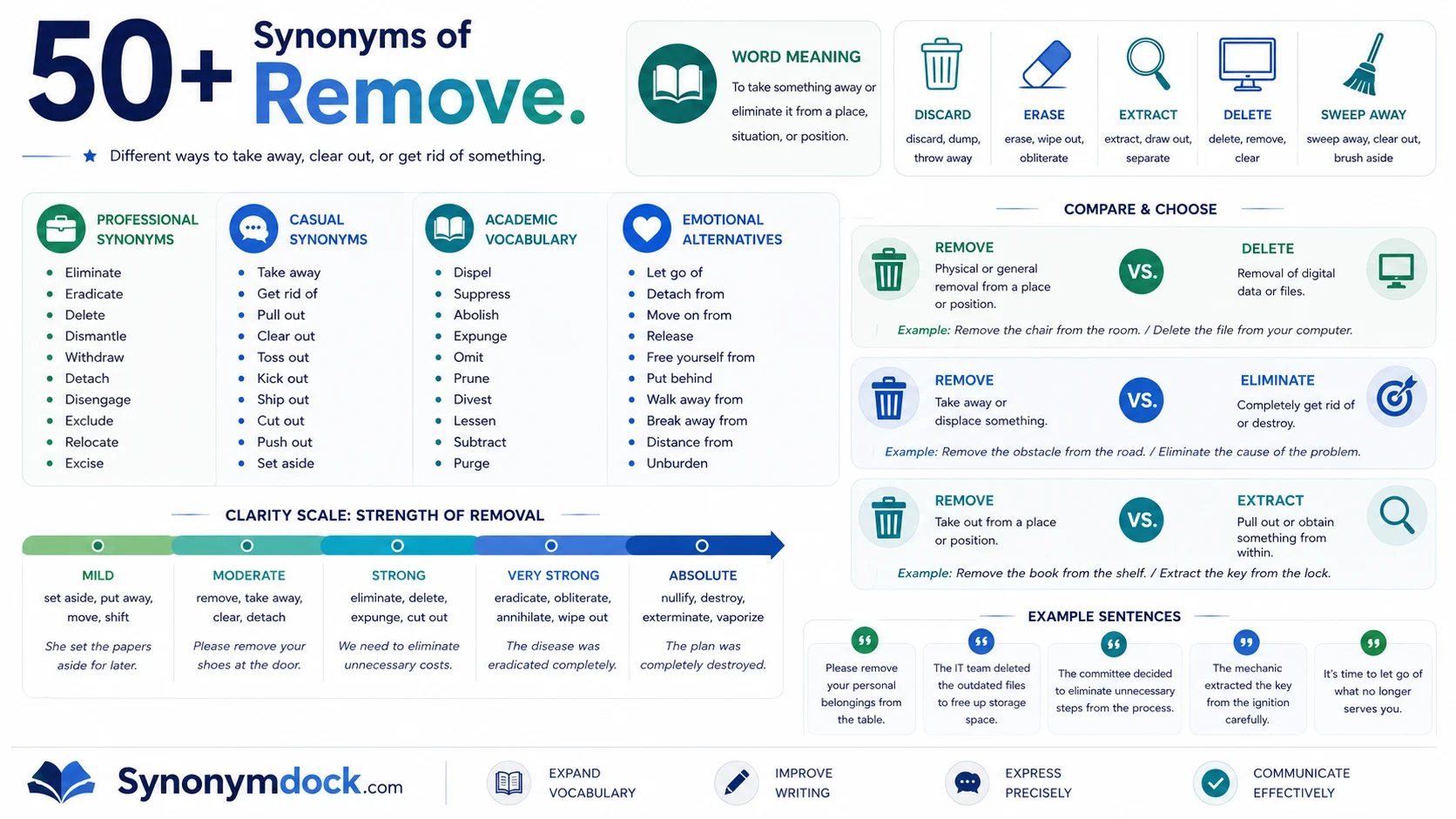
Remove means to take something away from its position or to eliminate something completely. The best synonym depends on your context. For professional writing, use eliminate or extract. For casual conversation, use take out or get rid of. For academic work, choose delete or expunge. For resumes, use eliminated or streamlined. Each synonym changes the tone and meaning slightly.
Have you ever written an email, an essay, or a report and realized you used the same word over and over? Many writers rely on “remove” repeatedly because it feels safe and familiar. But this repetition makes writing feel dull and less engaging. Whether you are working on a school assignment, a professional email, or a creative project, you need a strong vocabulary to communicate clearly. Finding the right synonym of remove can transform your writing from bland to precise.
Choosing a more accurate word helps your reader understand exactly what you mean. A well chosen synonym can clarify whether something is being extracted, deleted, erased, or separated. The best synonym of remove also sets the right tone for your audience. This guide will teach you everything you need to know about remove synonyms so you can write with confidence and clarity.
Meaning, Tone, and Context
Simple Definition
Remove means to take something away from where it is, or to make something no longer exist. It can refer to physical objects, abstract ideas, people, or even emotions. The word is versatile and applies to almost any situation where something is taken away or eliminated.
Part of Speech
Remove is primarily used as a verb. It can also function as a noun meaning a distance or step in a process, though this usage is less common.
Overall Tone
Remove is a neutral word. It does not carry strong positive or negative feelings on its own. The tone depends on the situation. Removing a stain sounds helpful. Removing someone from a position sounds serious. Removing food from a menu sounds neutral.
Formality Level
Remove is neutral in formality. It works in almost any context. You can use it in professional emails, academic papers, casual conversations, and formal reports. This flexibility makes it useful but sometimes too vague.
Common Uses
Native English speakers use remove in many situations. They remove items from storage. They remove names from lists. They remove stains from clothing. They remove obstacles from a path. They remove files from a computer. They remove doubt from someone’s mind. The word appears frequently in instructions, manuals, and everyday conversation.
Word Forms
- Remove (verb): To take something away
- Removed (past tense): Took something away
- Removing (present participle): In the process of taking away
- Removal (noun): The act of taking something away
- Removable (adjective): Able to be taken away
When and How to Use “Remove”
You should choose remove when you want a simple, clear, and neutral word for taking something away. It works well when the specifics of the action matter less than the fact that something was taken. Here are examples in different situations.
Professional: “We need to remove all outdated policies from the employee handbook.”
Academic: “The researcher removed any data that did not meet the study criteria.”
Workplace: “Please remove your personal items from the shared workspace.”
Personal: “I need to remove the old wallpaper before painting the room.”
Email: “I have removed you from the mailing list as requested.”
Resume: “Removed unnecessary steps from the production process.”
Social Media: “Remove the filter before posting the original photo.”
Best Synonyms of “Remove”
No synonym perfectly matches remove in every situation. Each alternative brings its own nuance. Here is the best synonym for different contexts.
Professional writing: Eliminate. This word suggests thoroughness and finality. It works well for processes that need to be completely ended.
Academic writing: Delete. This word is precise for data, text, or information. It sounds analytical and appropriate for research.
Business communication: Extract. Use this when you want to emphasize careful selection and removal of specific elements.
Casual conversation: Get rid of. This phrase sounds natural and everyday. It is the most common informal equivalent.
Emotional writing: Erase. Use this when you want to express complete elimination or the feeling of wiping something away.
Creative writing: Banish. This adds drama and suggests forceful removal, often of something unwanted.
Resume writing: Eliminated. This shows decisive action and results-oriented thinking.
Workplace communication: Withdraw. Use this for removing something that was previously offered or available.
Stronger meaning: Eradicate. This suggests complete and permanent removal, often of something harmful.
Softer meaning: Move. This suggests a gentle change of position without force or finality.
When Not to Use “Remove”
Remove is a safe choice, but it is not always the best choice. Here are situations where you should use a stronger synonym instead.
When Remove Sounds Too General
If you are describing a process of complete destruction, remove feels too gentle.
Incorrect: “We need to remove all traces of the disease.”
Better: “We need to eradicate all traces of the disease.”
Eradicate implies complete and permanent elimination.
When Remove Sounds Too Vague
Remove can mean almost anything. If you need to be specific about the method, choose a more precise word.
Incorrect: “The surgeon removed the tumor.”
Better: “The surgeon extracted the tumor.”
Extract suggests careful, precise removal.
When Remove Sounds Too Weak
Some actions require stronger language. Remove does not communicate significant effort or force.
Incorrect: “The champion removed his opponent from the tournament.”
Better: “The champion eliminated his opponent from the tournament.”
Eliminated suggests decisive victory.
When Remove Sounds Too Formal
In casual conversation with friends, remove can feel stiff and unnatural.
Incorrect: “Can you remove the trash from the kitchen?”
Better: “Can you take the trash out from the kitchen?”
Take out sounds more natural in everyday speech.
When Remove Sounds Too Informal
In academic or formal writing, remove might not sound sophisticated enough.
Incorrect: “The experiment removed the possibility of error.”
Better: “The experiment eliminated the possibility of error.”
Eliminated sounds more thorough and scientific.
When Remove Suggests the Wrong Action
Remove sometimes sounds like simply moving something, not destroying it.
Incorrect: “The software removed the virus.”
Better: “The software deleted the virus.”
Delete sounds more appropriate for digital content.
Words Commonly Confused With “Remove”
Several words are similar to remove but have important differences. Understanding these distinctions will help you choose the right word.
Remove vs Delete
Difference: Delete specifically means to erase or destroy something, especially digital content. Remove can mean taking something away without destroying it.
When to Use Each: Use delete for digital content. Use remove for physical items or abstract concepts.
Example Remove: “The manager removed the outdated files from the system.”
Example Delete: “Please delete that email thread permanently.”
Remove vs Eliminate
Difference: Eliminate suggests complete removal and finality. Remove can be partial or temporary.
When to Use Each: Use eliminate when you want to emphasize complete and permanent removal. Use remove for ordinary taking away.
Example Remove: “Remove the chairs from the meeting room.”
Example Eliminate: “We must eliminate all defects before shipping the product.”
Remove vs Extract
Difference: Extract suggests careful, precise removal, often using some effort or special technique.
When to Use Each: Use extract for careful removal of something embedded. Use remove for general situations.
Example Remove: “Remove the book from the shelf.”
Example Extract: “The dentist extracted my wisdom tooth.”
Remove vs Erase
Difference: Erase suggests wiping something away completely, often with the implication of restoring a blank state.
When to Use Each: Use erase for marks, memories, or digital content. Use remove for most other situations.
Example Remove: “Remove the labels from the jars.”
Example Erase: “The artist decided to erase the entire sketch and start over.”
Remove vs Withdraw
Difference: Withdraw suggests removing something that was previously given or offered.
When to Use Each: Use withdraw for offers, money, or personal presence. Use remove for general situations.
Example Remove: “Remove the battery from the device.”
Example Withdraw: “The company decided to withdraw its offer.”
Remove vs Banish
Difference: Banish suggests forceful, often dramatic removal, especially of people.
When to Use Each: Use banish for dramatic or story-like situations. Use remove for ordinary contexts.
Example Remove: “Remove the clutter from your desk.”
Example Banish: “The king banished the traitor from the kingdom.”
Best Synonyms of “Remove” by Context
| Context | Best Synonym | Why It Works | Example |
|---|---|---|---|
| Formal writing | Eliminate | Sounds thorough and decisive | The committee voted to eliminate the outdated policy. |
| Academic writing | Delete | Precise for data and text | The researcher chose to delete anomalous results. |
| Professional communication | Extract | Suggests careful selection | The team will extract relevant data from the report. |
| Business emails | Withdraw | Professional for offers or requests | I would like to withdraw my previous proposal. |
| Resume writing | Eliminated | Shows decisive action | Eliminated redundant processes to save time. |
| Workplace communication | Remove | Clear and appropriate | Please remove personal items from the break room. |
| Casual conversation | Get rid of | Sounds natural and everyday | I need to get rid of this old furniture. |
| Everyday speaking | Take out | Simple and clear | Take out the recycling before it piles up. |
| Creative writing | Banish | Adds drama and imagery | She hoped to banish all doubt from her mind. |
| Storytelling | Purge | Suggests cleansing and renewal | The hero had to purge the evil from the land. |
| Emotional writing | Erase | Expresses complete elimination | He wanted to erase every memory of that day. |
| Strong emphasis | Eradicate | Suggests total destruction | The program aims to eradicate poverty. |
| Mild tone | Move | Gentle and non-forceful | Please move the boxes to the storage room. |
| Social media captions | Filter out | Modern and current | Filter out the negativity from your feed. |
| American English | Remove | Universal and understood | Remove the package from the door. |
How to Choose the Best Synonym of “Remove”
Use this decision guide to pick the perfect synonym for your situation.
Start with your audience. Professional audiences expect eliminate, extract, or withdraw. Casual audiences understand get rid of or take out best.
Consider your tone. If you want to sound neutral and clear, remove works well. If you want to emphasize finality, choose eliminate or eradicate. If you want to downplay significance, choose move.
Think about emotional weight. Remove is emotionally neutral. Erase and banish are emotionally heavier. Extract is clinically precise.
Match the purpose of your writing. Academic work needs precise vocabulary like delete or extract. Resumes benefit from eliminated or streamlined. Emails work with remove or withdraw.
Consider the method of removal. Physical removal might be extract or take out. Digital removal is delete or erase. Emotional removal is banish or purge.
Avoid guessing. If you are unsure, remove is always acceptable. But choosing a more specific word nearly always improves your writing.
Real Life Examples of “Remove”
School Example
Original: The teacher removed the incorrect answers from the test.
Improved: The teacher deleted the incorrect answers from the test.
Deleted sounds more precise for academic work.
College Example
Original: The student removed unnecessary words from the essay.
Improved: The student deleted unnecessary words from the essay.
Deleted is the standard term for editing text.
Workplace Example
Original: The supervisor removed the safety hazard from the floor.
Improved: The supervisor eliminated the safety hazard from the floor.
Eliminated sounds more thorough and responsible.
Business Example
Original: The company removed the redundant department.
Improved: The company eliminated the redundant department.
Eliminated sounds like a decisive business decision.
Email Example
Original: I will remove you from the group chat.
Improved: I will remove you from the group chat.
Remove is appropriate and clear for email.
Resume Example
Original: Removed waste from production.
Improved: Eliminated waste from production.
Eliminated sounds more active and impactful.
Conversation Example
Original: Remove the milk from the fridge.
Improved: Take the milk out of the fridge.
Take out sounds natural for everyday requests.
Storytelling Example
Original: The wizard removed the curse from the kingdom.
Improved: The wizard banished the curse from the kingdom.
Banished adds a magical, dramatic feel.
Blogging Example
Original: Remove all clutter from your workspace.
Improved: Eliminate all clutter from your workspace.
Eliminate sounds like a decisive productivity tip.
Social Media Example
Original: Remove negative people from your life.
Improved: Filter out negative people from your life.
Filter out sounds modern and intentional.
18 Best Synonyms of “Remove”
| Synonym | Simple Meaning | Best Used For | Example Sentence |
|---|---|---|---|
| Eliminate | Completely get rid of something | Professional and decisive contexts | The company will eliminate outdated procedures. |
| Delete | Erase digital or written content | Academic and computer contexts | Please delete those unwanted files immediately. |
| Extract | Carefully take out something embedded | Medical and research contexts | The surgeon extracted the bullet from his leg. |
| Erase | Wipe away completely, restore blank state | Emotional and creative contexts | The artist erased the drawing and began again. |
| Withdraw | Take back something previously given | Financial and business contexts | I need to withdraw cash from the bank. |
| Banish | Forcefully send away, often dramatically | Creative writing and storytelling | The queen banished the traitor from the palace. |
| Purge | Cleanse by removing unwanted elements | Emotional and political contexts | The new leader purged corruption from the government. |
| Discard | Throw away as unwanted | Everyday and practical contexts | Please discard any expired food from the pantry. |
| Dismiss | Remove from a position or consideration | Professional and legal contexts | The judge dismissed the case due to lack of evidence. |
| Eradicate | Destroy completely, often something harmful | Medical and social contexts | Scientists hope to eradicate the disease globally. |
| Dislodge | Force something from a fixed position | Physical and mechanical contexts | She dislodged the stuck drawer with careful effort. |
| Uninstall | Remove software or applications | Technology contexts | I need to uninstall this program from my computer. |
Synonyms of “Remove” by Usage
Professional vs Personal Synonyms
Professional synonyms work best in workplaces: eliminate, extract, withdraw, dismiss, excise.
Personal synonyms sound better at home: take out, get rid of, toss, throw away, clear.
Professional Example: “The department will eliminate all nonessential positions.
Personal Example: “I need to get rid of these old clothes.”
Formal vs Conversational Synonyms
Formal synonyms for academic and professional writing: eliminate, eradicate, extract, excise, expunge.
Conversational synonyms for everyday talk: take out, get rid of, chuck, toss, ditch.
Formal Example: “The committee will expunge the inaccurate statements from the record.”
Conversational Example: “Just ditch those old papers already.”
Academic Synonyms
Academic writing benefits from precise vocabulary. Choose delete for data and text. Select extract for research samples. Opt for eliminate for variables. Choose expunge for record removal.
Example: “The researcher decided to delete outliers from the data set.”
Professional and Business Synonyms
In business settings, choose words that show decisiveness and professionalism. Use eliminate for cost reduction. Select withdraw for proposals. Choose dismiss for personnel. Use extract for information.
Example: “The CEO eliminated three layers of management to improve efficiency.”
Creative and Literary Synonyms
Creative writing rewards expressive language. Use banish for dramatic scenes. Select purge for cleansing. Choose excise for surgical cuts. Use dislodge for physical struggles.
Example: “The warrior banished the dark spirit from the village.”
Slang or Modern Synonyms
Remove has several casual slang alternatives. “Ditch” means to abandon or get rid of something. “Chuck” means to throw away carelessly. “Toss” means to discard. These are acceptable in casual conversation but should be avoided in professional contexts.
Example: “Let’s ditch this old furniture and get something new.”
Strongest to Mildest Synonyms
Mild: move, shift, take out, clear
Moderate: remove, discard, withdraw, detach
Strong: eliminate, delete, extract, excise
Very Strong: eradicate, banish, purge, expel
The emotional intensity increases as you move up the scale. Move feels gentle and temporary. Eliminate feels final and decisive. Eradicate suggests total destruction.
Emotional vs Neutral Synonyms
Emotional Synonyms: banish, purge, erase, banish. These words express feelings about the removal.
Neutral Synonyms: remove, delete, detach, extract. These words simply communicate information.
Emotional Example: “She wanted to banish all thoughts of failure from her mind.”
Neutral Example: “Please remove the equipment from the storage room.”
Antonyms of “Remove”
| Antonym | Meaning | Example Sentence |
|---|---|---|
| Add | Put something with something else | Please add your name to the list. |
| Insert | Put something into something else | Insert the key into the lock carefully. |
| Place | Put something in a position | Place the book on the shelf. |
| Keep | Continue to have or hold | I decided to keep the old photographs. |
| Retain | Continue to have or hold | The company will retain its top employees. |
| Include | Make something part of a whole | Please include all necessary details in the report. |
| Introduce | Bring something into use or place | We will introduce new safety measures. |
| Attach | Fasten or join something to another | Attach the receipt to the expense report. |
| Establish | Set up or bring into existence | The founder established the company in 2010. |
| Maintain | Keep in existence or continue | She works hard to maintain high standards. |
| Preserve | Keep safe from harm or decay | The museum preserves historical artifacts. |
| Retain | Continue to hold or keep | He retained ownership of the property. |
| Restore | Bring back to a former condition | The restoration team will restore the painting. |
| Reinsert | Put something back in place | Please reinsert the document into the folder. |
| Reintroduce | Bring something back into use | The mayor will reintroduce the recycling program. |
Comparison: “Remove” vs Similar Words
Remove vs Delete
Main Difference: Delete means to erase or destroy permanently, especially digital content. Remove means to take away without necessarily destroying.
Which Is Stronger: Delete feels more final and permanent.
Which Is More Formal: Delete is commonly used in academic and technical contexts.
When to Use Each: Use delete for digital or written content. Use remove for physical items or general situations.
Remove Example: “Remove the chairs from the room after the meeting.”
Delete Example: “Delete the duplicate files from the folder.”
Remove vs Eliminate
Main Difference: Eliminate means to completely get rid of something, often with finality. Remove can be temporary or partial.
Which Is Stronger: Eliminate is much stronger and more decisive.
Which Is More Formal: Eliminate is formal and professional.
When to Use Each: Use eliminate when you want to emphasize complete and permanent removal. Use remove for ordinary situations.
Remove Example: “Remove your jacket and make yourself comfortable.”
Eliminate Example: “The new process will eliminate all waste.”
Remove vs Extract
Main Difference: Extract suggests careful, precise removal, often using effort or special tools.
Which Is Stronger: Extract suggests skill and effort.
Which Is More Formal: Extract is formal and often technical.
When to Use Each: Use extract for careful removal. Use remove for simple taking away.
Remove Example: “Remove the lid from the pot.”
Extract Example: “The dentist extracted the decayed tooth.”
Remove vs Erase
Main Difference: Erase suggests wiping away completely, often with the implication of returning to a blank state.
Which Is Stronger: Erase feels more complete and final.
Which Is More Formal: Erase is moderately formal.
When to Use Each: Use erase for marks, memories, or digital content. Use remove for most physical items.
Remove Example: “Remove the stickers from the window.”
Erase Example: “He wanted to erase the embarrassing memory.”
Remove vs Withdraw
Main Difference: Withdraw suggests taking back something that was previously given or offered.
Which Is Stronger: Withdraw is emotionally neutral but formally precise.
Which Is More Formal: Withdraw is quite formal.
When to Use Each: Use withdraw for money, offers, or personal presence. Use remove for general situations.
Remove Example: “Remove the bottle from the freezer.”
Withdraw Example: “I need to withdraw my application for the position.”
Remove vs Banish
Main Difference: Banish suggests forceful, often dramatic removal, especially of people or abstract concepts.
Which Is Stronger: Banish is dramatically stronger.
Which Is More Formal: Banish is literary and creative.
When to Use Each: Use banish for dramatic storytelling. Use remove for ordinary contexts.
Remove Example: “Remove the clutter from your workspace.”
Banish Example: “The hero banished the darkness from the land.”
Common Phrases and Expressions with “Remove”
Remove the Obstacle
Meaning: To eliminate something that is blocking progress.
Example Sentence: “We need to remove the obstacle to complete the project on time.
Remove All Doubt
Meaning: To completely eliminate uncertainty.
Example Sentence: “Her thorough explanation removed all doubt about the process.”
Remove From Consideration
Meaning: To take something or someone out of the running.
Example Sentence: “The committee removed his application from consideration.”
Remove the Barrier
Meaning: To eliminate something that prevents movement or progress.
Example Sentence: “The new trade agreement will remove the barrier to imports.”
Remove from Office
Meaning: To dismiss someone from an official position.
Example Sentence: “The board voted to remove the CEO from office.”
Remove the Mask
Meaning: To reveal the truth or real identity.
Example Sentence: “The investigation helped remove the mask from the criminal operation.”
Remove the Stigma
Meaning: To eliminate negative social attitudes.
Example Sentence: “The campaign aims to remove the stigma around mental health.”
Remove the Stain
Meaning: To eliminate a blemish or negative reputation.
Example Sentence: “The lawyer worked hard to remove the stain from his client’s reputation.”
Common Mistakes to Avoid
Mistake 1: Using Remove When You Need a More Specific Word
Remove is a general word. Using it for every situation makes writing boring and vague.
Incorrect: “The virus removed all the files.”
Better: “The virus deleted all the files.”
Delete is more precise for digital content.
Mistake 2: Using Delete for Physical Items
Delete is for digital content. Using it for physical items sounds strange.
Incorrect: “Please delete the trash from the kitchen.”
Better: “Please remove the trash from the kitchen.”
Remove works for physical items.
Mistake 3: Using Eliminate for Simple Actions
Eliminate is too strong for everyday actions.
Incorrect: “I need to eliminate this coffee stain.”
Better: “I need to remove this coffee stain.”
Remove sounds appropriate for simple cleaning.
Mistake 4: Choosing Overly Dramatic Synonyms
Using banish or purge for ordinary situations sounds ridiculous.
Incorrect: “I need to banish these old magazines.”
Better: “I need to get rid of these old magazines.”
Get rid of fits casual situations.
Mistake 5: Repeating Remove Too Often
Even the correct word sounds bad when used too frequently. Vary your vocabulary.
Incorrect: “I need to remove the old paint. Then remove the wallpaper. Then remove the carpet.”
Better: “I need to strip the old paint. Then remove the wallpaper. Then take out the carpet.”
Using different synonyms improves readability.
Mistake 6: Using Remove for Withdraw
Remove and withdraw have different meanings. Remove is general. Withdraw is specific to taking back something offered.
Incorrect: “The bank removed the money from my account.”
Better: “The bank withdrew the money from my account.”
Withdraw is the standard banking term.
Mistake 7: Confusing Remove and Extract
Extract implies careful, skilled removal. Remove is simpler.
Incorrect: “The dentist removed his wisdom tooth.”
Better: “The dentist extracted his wisdom tooth.”
Extract sounds more professional for medical procedures.
Frequently Asked Questions
1. What are the best synonyms of remove?
The best synonyms depend on context. For professional writing, use eliminate or extract. For casual speech, use take out or get rid of. For digital content, use delete. For dramatic effect, use banish. Remove works well in almost every situation, but specific synonyms add precision.
2. What are the best formal synonyms of remove?
The best formal synonyms of remove are eliminate, extract, withdraw, excise, and expunge. These words sound professional and sophisticated. They work well in business writing, academic papers, and official documents.
3. What are common informal synonyms of remove?
The most common informal synonyms are take out, get rid of, ditch, toss, and chuck. These words sound natural in everyday conversation. They are appropriate for casual settings and talking with friends.
4. What is another word for remove in professional writing?
Eliminate is the most professional synonym. It suggests thoroughness and finality. Withdraw also works well in business contexts. Extract implies careful selection. Eliminated sounds decisive on resumes.
5. What is the difference between remove and delete?
Remove means to take something away from a place. Delete specifically means to erase or destroy, especially digital content. Remove does not always imply destruction. Delete always implies permanent erasure.
6. What is the opposite of remove?
Antonyms of remove include add, insert, place, keep, and retain. These words describe putting something somewhere or holding on to it. The best opposite depends on what kind of removal you mean.
Conclusion
Remove is a versatile word that means to take something away from where it is. It fits many situations from professional reports to casual conversations. However, using more specific synonyms can dramatically improve your writing. Delete, eliminate, extract, erase, banish, and discard each add distinct meaning and tone.
No single synonym works perfectly in every context. The best choice depends on your audience, your purpose, and the kind of removal you are describing. Always consider whether remove is precise enough or if a stronger word would communicate your message more clearly.
The next time you write about taking something away, pause and ask yourself whether remove is the right word. Could delete make you sound more technical? Does eliminate show stronger action? Would banish add drama to your story?
Choosing the right word shows thoughtfulness and expertise. It makes your writing more engaging and easier to understand. Build your vocabulary one word at a time. You will become a more confident and effective communicator.
