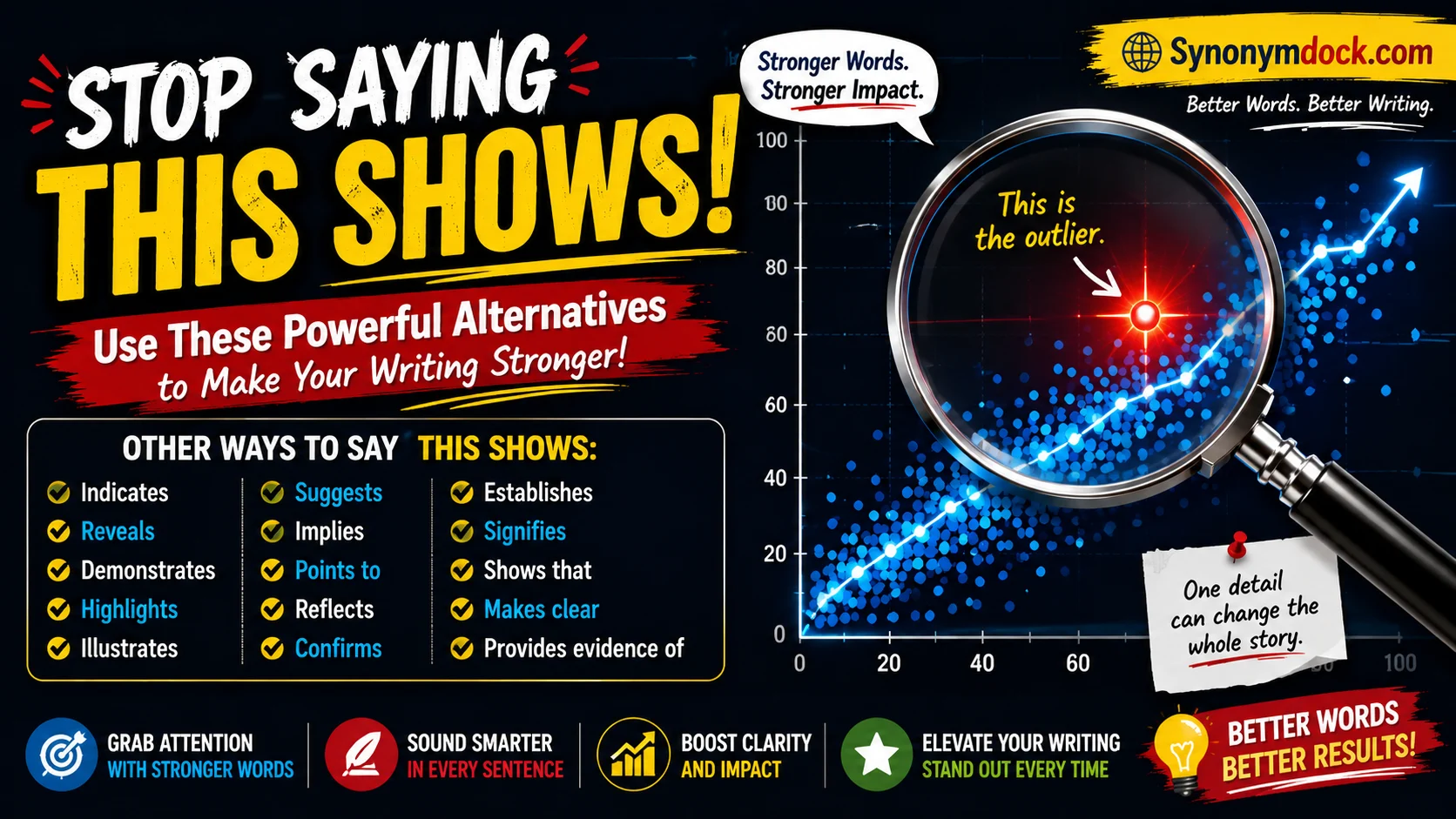
“This shows” connects evidence to conclusions, but it can sound repetitive. Stronger alternatives include this demonstrates, this indicates, this highlights, this illustrates, and this reveals. Choose based on your tone and context.
Have you ever read back an essay and noticed how many times you used the phrase “this shows”? It is one of the most common phrases in English, but it can become repetitive and vague. Learning other ways to say this shows will make your writing stronger and more professional.
Alternatives to this shows help you communicate clearly in academic writing, business emails, and everyday conversations. The right phrase adds precision and shows your command of English. In this guide, you will discover 15 powerful alternatives organized by tone and context, with examples showing exactly how to use each one.
What Does “This Shows” Mean?
“This shows” is a transitional phrase used to connect evidence, observations, or examples to a conclusion or insight. It signals that the information you just presented supports the point you are making.
Simple explanation: When you say “this shows,” you are saying “this proves” or “this is evidence that.”
Grammar note: It functions as a demonstrative pronoun + verb. You typically follow it with a clause beginning with “that.”
Example sentence: The company’s sales data shows that their new marketing strategy is working.
When to Use “This Shows”
| Situation | Is “This Shows” Appropriate? |
|---|---|
| Academic Essays | ✅ Yes, but avoid overuse |
| Business Reports | ✅ Yes |
| Professional Emails | ✅ Yes |
| Presentations | ✅ Yes |
| Casual Conversations | ✅ Yes |
| Creative Writing | ⚠️ Sometimes, but vary it |
Common situations include:
- Academic writing connecting research findings to conclusions
- Business reports explaining what data reveals
- Professional emails highlighting key takeaways
- Daily conversation pointing out something obvious
Is It Professional or Polite?
Polite? ✔ Yes
Professional? ✔ Generally, but it can sound unsophisticated if overused
Formal? ⚠️ Neutral it depends on context
Natural? ✔ Very common
Business-style example: “The quarterly report shows steady growth in our European market.”
While perfectly acceptable, using the same phrase repeatedly can make your writing feel monotonous. Variety signals stronger vocabulary skills.
Quick Categories
Formal Alternatives
- This demonstrates
- This indicates
- This suggests
- This confirms
- This substantiates
Professional Alternatives
- This illustrates
- This highlights
- This reveals
- This reflects
- This underscores
Business Email Alternatives
- This confirms
- This indicates
- This highlights
- This points to
- This supports
Academic Alternatives
- This demonstrates
- This illustrates
- This suggests
- This implies
- This exemplifies
Casual Alternatives
- This shows
- This goes to show
- This proves
- This tells us
- This makes clear
Informal Expressions
- This pretty much shows
- This just goes to show
- This says a lot
- This tells you
- This speaks volumes
Pro Tip
Choose formal alternatives for academic papers and professional reports. Use neutral options like “this illustrates” or “this highlights” for everyday business communication. Save casual expressions for conversations with colleagues you know well.
Scroll-Stopping Pull Quote
“The words you choose to connect ideas show as much about your writing skills as the ideas themselves.”
15 Alternatives to “This Shows”
[1]. This Demonstrates
Meaning: Provides clear proof or evidence of something.
Explanation: This is the closest formal alternative to “this shows” and works well in academic and professional writing. It carries a sense of certainty and is often used when presenting data, research findings, or clear evidence. Native speakers frequently choose “demonstrates” in reports and essays because it sounds more authoritative than “shows.”
Example Sentence: The experiment results demonstrate the effectiveness of the new treatment method.
Best Use: Academic Essays, Research Papers, Scientific Reports
Avoid Using In: Casual Conversation, Creative Writing
Tone: Formal, Authoritative
Formality Level: ⭐⭐⭐⭐⭐ Very Formal
Usage Frequency: Very Common
CEFR Level: B2
Common Collocations:
- demonstrate the effectiveness
- demonstrate the importance
- demonstrate that
- clearly demonstrate
- research demonstrates
Context Variability:
- Spoken English: “The data demonstrates we need to change our approach.”
- Professional English: “This report demonstrates our commitment to sustainability.”
- Casual Conversation: Less common sounds too formal
[2]. This Indicates
Meaning: Suggests or points toward a particular conclusion.
Explanation: “Indicates” is slightly less assertive than “demonstrates.” It suggests that evidence points in a certain direction but allows for interpretation. It is common in data analysis, business reports, and academic writing where conclusions are drawn from evidence.
Example Sentence: The rising numbers indicate growing consumer confidence in the market.
Best Use: Business Reports, Data Analysis, Research Papers
Avoid Using In: Personal Letters, Creative Writing
Tone: Analytical, Professional
Formality Level: ⭐⭐⭐⭐ Formal
Usage Frequency: Very Common
CEFR Level: B2
Common Collocations:
- indicate that
- clearly indicate
- research indicates
- data indicates
- indicate a shift
Context Variability:
- Spoken English: “The signs indicate it might rain later.”
- Professional English: “The survey results indicate a need for better training.”
- Casual Conversation: “His reaction indicates he’s not happy about it.”
[3]. This Highlights
Meaning: Draws attention to or emphasizes a particular point.
Explanation: Use “highlights” when you want to emphasize the importance of something. It is perfect for persuasive writing, presentations, and business communication where you need to make a point stand out. Unlike “shows,” which is neutral, “highlights” adds a layer of significance.
Example Sentence: The case study highlights the challenges faced by small businesses during economic downturns.
Best Use: Presentations, Persuasive Essays, Business Emails
Avoid Using In: Technical Reports, Scientific Papers
Tone: Emphatic, Persuasive
Formality Level: ⭐⭐⭐ Neutral-Formal
Usage Frequency: Very Common
CEFR Level: B2
Common Collocations:
- highlights the importance
- highlights the need
- highlights the fact
- highlights the challenges
- highlights key issues
Context Variability:
- Spoken English: “This highlights why we need to act now.”
- Professional English: “The report highlights several areas for improvement.”
- Casual Conversation: “That highlights exactly what I was trying to say!”
[4]. This Illustrates
Meaning: Provides a clear example that explains or clarifies something.
Explanation: “Illustrates” is ideal when you have provided an example or case study and want to show what it proves or explains. It carries the sense of making an idea easier to understand through concrete evidence.
Example Sentence: The graph illustrates the correlation between exercise and mental health.
Best Use: Academic Writing, Educational Content, Presentations
Avoid Using In: Legal Documents, Very Formal Reports
Tone: Explanatory, Educational
Formality Level: ⭐⭐⭐⭐ Formal
Usage Frequency: Common
CEFR Level: B2
Common Collocations:
- illustrate the point
- illustrate the importance
- illustrate how
- illustrate clearly
- illustrate the relationship
Context Variability:
- Spoken English: “Let me illustrate with an example.”
- Professional English: “This case illustrates our approach perfectly.”
- Casual Conversation: Less common
[5]. This Reveals
Meaning: Brings to light something that was hidden or not previously obvious.
Explanation: “Reveals” carries a dramatic, discovery-focused tone. It is excellent for situations where the evidence uncovers something surprising or significant. In academic writing, it suggests the author has uncovered new insights.
Example Sentence: The investigation reveals previously unknown details about the company’s history.
Best Use: Journalism, Research Papers, Analytical Essays
Avoid Using In: Business Emails, Technical Reports
Tone: Insightful, Dramatic
Formality Level: ⭐⭐⭐⭐ Formal
Usage Frequency: Common
CEFR Level: B2
Common Collocations:
- reveals that
- reveals the truth
- reveals important information
- reveals surprising insights
- reveals the extent
Context Variability:
- Spoken English: “This reveals a lot about his character.”
- Professional English: “The audit reveals some concerning patterns.”
- Casual Conversation: “That reveals why she was so upset!”
[6]. This Confirms
Meaning: Verifies or proves that something is true or correct.
Explanation: Use “confirms” when the evidence validates a hypothesis, expectation, or previous belief. It carries a strong sense of certainty and is particularly useful in scientific and business contexts where verification matters.
Example Sentence: The latest data confirms our initial projections for the fiscal year.
Best Use: Scientific Reports, Business Analysis, Legal Documents
Avoid Using In: Speculative Writing, Casual Conversation
Tone: Definite, Authoritative
Formality Level: ⭐⭐⭐⭐⭐ Very Formal
Usage Frequency: Common
CEFR Level: B2
Common Collocations:
- confirms that
- confirms the findings
- confirms the hypothesis
- confirms suspicions
- confirms the results
Context Variability:
- Spoken English: “This confirms what I suspected all along.”
- Professional English: “The feedback confirms our strategy is working.”
- Casual Conversation: “That confirms it he’s not coming.”
[7]. This Suggests
Meaning: Implies or proposes a conclusion without stating it definitively.
Explanation: “Suggests” is the best choice when the evidence points toward a conclusion but is not conclusive. It is widely used in academic writing and research because it demonstrates intellectual caution and avoids overstatement.
Example Sentence: The findings suggest a possible link between diet and cognitive decline in older adults.
Best Use: Academic Essays, Research Proposals, Analytical Writing
Avoid Using In: Business Reports with Definite Conclusions
Tone: Tentative, Analytical
Formality Level: ⭐⭐⭐⭐ Formal
Usage Frequency: Very Common
CEFR Level: B2
Common Collocations:
- suggests that
- suggests a link
- research suggests
- evidence suggests
- suggests the possibility
Context Variability:
- Spoken English: “This suggests we should wait a bit longer.”
- Professional English: “The data suggests a new approach might work.”
- Casual Conversation: “That suggests he’s not interested.”
Native Speaker Tip
Native speakers often use “this suggests” in academic contexts to avoid sounding overly certain. “This demonstrates” is stronger and reserved for when evidence is conclusive. The choice between them signals how confident you are in your conclusion.
[8]. This Underscores
Meaning: Emphasizes or reinforces the importance of something.
Explanation: “Underscores” is a slightly more sophisticated alternative to “highlights.” It conveys that something deserves special attention or reinforces a previously stated point. It is particularly effective in persuasive writing and formal arguments.
Example Sentence: This experience underscores the importance of thorough preparation before important presentations.
Best Use: Persuasive Essays, Formal Reports, Presentations
Avoid Using In: Casual Conversation, Creative Writing
Tone: Emphatic, Formal
Formality Level: ⭐⭐⭐⭐ Formal
Usage Frequency: Occasional
CEFR Level: C1
Common Collocations:
- underscores the importance
- underscores the need
- underscores the point
- underscores the value
- underscores the significance
Context Variability:
- Spoken English: Rare
- Professional English: “This underscores our commitment to quality.”
- Casual Conversation: Uncommon
[9]. This Reflects
Meaning: Shows or mirrors a broader truth, characteristic, or trend.
Explanation: Use “reflects” when the evidence demonstrates a larger pattern or represents a deeper reality. It is common in sociological, psychological, and cultural analysis. In business writing, it suggests the data aligns with broader organizational or market trends.
Example Sentence: The new policy reflects the company’s commitment to work-life balance.
Best Use: Cultural Analysis, Business Writing, Social Commentary
Avoid Using In: Scientific Reports, Technical Writing
Tone: Analytical, Observational
Formality Level: ⭐⭐⭐ Neutral-Formal
Usage Frequency: Common
CEFR Level: B2
Common Collocations:
- reflects the fact
- reflects the importance
- reflects a shift
- reflects the values
- reflects the changes
Context Variability:
- Spoken English: “This reflects how much things have changed.”
- Professional English: “The numbers reflect our growing market share.”
- Casual Conversation: “That reflects what I’ve been saying all along.”
[10]. This Exemplifies
Meaning: Serves as a perfect or typical example of something.
Explanation: “Exemplifies” is the ideal choice when a single case or example perfectly represents a larger category or idea. It is common in academic writing, particularly in literary analysis and social sciences.
Example Sentence: Her dedication exemplifies the qualities we look for in a team leader.
Best Use: Academic Essays, Employee Evaluations, Literary Analysis
Avoid Using In: Business Reports, Casual Conversation
Tone: Formal, Commendatory
Formality Level: ⭐⭐⭐⭐⭐ Very Formal
Usage Frequency: Occasional
CEFR Level: C1
Common Collocations:
- exemplifies the qualities
- exemplifies the spirit
- exemplifies the values
- exemplifies the principles
- exemplifies the best
Context Variability:
- Spoken English: Rare
- Professional English: “This case exemplifies our best practices.”
- Casual Conversation: Uncommon
[11]. This Conveys
Meaning: Communicates or expresses an idea, emotion, or message.
Explanation: “Conveys” focuses on the communication of meaning rather than proof or evidence. It is ideal for creative writing, media analysis, and contexts where the message matters more than factual proof.
Example Sentence: The design conveys a sense of elegance and sophistication.
Best Use: Creative Writing, Design Reviews, Media Analysis
Avoid Using In: Scientific Reports, Academic Essays
Tone: Interpretive, Expressive
Formality Level: ⭐⭐⭐ Neutral-Formal
Usage Frequency: Common
CEFR Level: B2
Common Collocations:
- conveys the message
- conveys a sense
- conveys the idea
- conveys the meaning
- conveys emotion
Context Variability:
- Spoken English: “This conveys exactly what I mean.”
- Professional English: “The report conveys our progress clearly.”
- Casual Conversation: “That conveys how I feel perfectly.”
[12]. This Supports
Meaning: Provides evidence that backs up a claim or argument.
Explanation: “Supports” is a straightforward alternative that works well when you need to show evidence aligning with a position. It is common in academic writing, business reports, and argumentative essays.
Example Sentence: This data supports the theory that remote work increases productivity.
Best Use: Academic Writing, Business Reports, Argumentative Essays
Avoid Using In: Creative Writing, Casual Conversation
Tone: Formal, Supportive
Formality Level: ⭐⭐⭐⭐ Formal
Usage Frequency: Common
CEFR Level: B2
Common Collocations:
- supports the claim
- supports the argument
- supports the findings
- supports the hypothesis
- supports the conclusion
Context Variability:
- Spoken English: “This supports what I was saying earlier.”
- Professional English: “The evidence supports our recommendation.”
- Casual Conversation: Less common
[13]. This Points To
Meaning: Directs attention toward a conclusion or fact.
Explanation: This alternative is more direct than “suggests” and less definitive than “demonstrates.” It is useful when you want to lead the reader toward a conclusion without stating it forcefully.
Example Sentence: All the evidence points to a single conclusion: we need to change our strategy.
Best Use: Business Analysis, Academic Essays, Reports
Avoid Using In: Scientific Papers, Legal Documents
Tone: Analytical, Neutral
Formality Level: ⭐⭐⭐ Neutral
Usage Frequency: Common
CEFR Level: B2
Common Collocations:
- points to the fact
- points to a conclusion
- points to the need
- points to the importance
- points to evidence
Context Variability:
- Spoken English: “Everything points to him being the culprit.”
- Professional English: “This points to a clear opportunity for growth.”
- Casual Conversation: “That points to what went wrong.”
[14]. This Emphasizes
Meaning: Stresses or gives special importance to a point.
Explanation: Use “emphasizes” when the evidence makes a particular point more significant or urgent. It is stronger than “highlights” and often used in persuasive contexts where the speaker wants the audience to recognize importance.
Example Sentence: This case emphasizes the importance of following safety protocols.
Best Use: Persuasive Writing, Safety Reports, Policy Documents
Avoid Using In: Neutral Reports, Casual Conversation
Tone: Emphatic, Serious
Formality Level: ⭐⭐⭐⭐ Formal
Usage Frequency: Common
CEFR Level: B2
Common Collocations:
- emphasizes the importance
- emphasizes the need
- emphasizes the point
- emphasizes the value
- emphasizes the role
Context Variability:
- Spoken English: “This emphasizes why we need to act now.”
- Professional English: “The findings emphasize the urgency of the situation.”
- Casual Conversation: “That really emphasizes what I was trying to say.”
[15]. This Illustrates (Revisited)
Meaning: Clarifies a point using a concrete example.
Explanation: While we covered this earlier, it deserves emphasis because of its versatility. “Illustrates” is one of the most useful alternatives across academic and professional contexts.
Example Sentence: This case study illustrates how small changes can lead to significant improvements.
Best Use: Educational Content, Case Studies, Explanatory Writing
Avoid Using In: Formal Legal Documents
Tone: Explanatory, Educational
Formality Level: ⭐⭐⭐⭐ Formal
Usage Frequency: Very Common
CEFR Level: B2
Common Collocations:
- illustrates the point
- illustrates how
- illustrates the importance
- illustrates the concept
- illustrates clearly
Context Variability:
- Spoken English: “This illustrates why we should be careful.”
- Professional English: “The example illustrates our approach perfectly.”
- Casual Conversation: “That illustrates exactly what I meant!”
Expert Insight
In professional communication, your choice of transition phrase signals your level of confidence. Use “demonstrates” when you are certain; use “suggests” when the evidence is suggestive but not conclusive. Overusing “shows” can make your writing feel underdeveloped.
Comparison Table: Top 15 Alternatives
| Phrase | Tone | Formality | Best Use | Frequency |
|---|---|---|---|---|
| This demonstrates | Authoritative | Very Formal | Academic, Scientific | Very Common |
| This indicates | Analytical | Formal | Reports, Data Analysis | Very Common |
| This highlights | Emphatic | Neutral-Formal | Persuasive Writing | Very Common |
| This illustrates | Explanatory | Formal | Educational, Case Studies | Common |
| This reveals | Insightful | Formal | Journalism, Discovery | Common |
| This confirms | Definite | Very Formal | Verification, Science | Common |
| This suggests | Tentative | Formal | Academic, Research | Very Common |
| This underscores | Emphatic | Formal | Persuasive, Formal | Occasional |
| This reflects | Analytical | Neutral-Formal | Social Commentary | Common |
| This exemplifies | Commendatory | Very Formal | Academic, Literary | Occasional |
| This conveys | Expressive | Neutral-Formal | Creative, Design | Common |
| This supports | Formal | Formal | Argument, Academic | Common |
| This points to | Neutral | Neutral | Analysis, Business | Common |
| This emphasizes | Emphatic | Formal | Policy, Persuasion | Common |
| This shows | Neutral | Neutral | All contexts | Very Common |
Common Mistakes
Mistake 1: Using “This proves” when evidence is not conclusive
Why it is incorrect: “Proves” implies absolute certainty. If the evidence only suggests or indicates, “proves” is an overstatement.
Correct version: “This suggests” or “This indicates”
Example sentence: ❌ This proves that the new policy will succeed. ✓ This suggests that the new policy may succeed.
Mistake 2: Using too many formal alternatives in casual conversation
Why it is incorrect: Overly formal language sounds unnatural in casual settings.
Correct version: Use simpler expressions like “this shows” or “this tells us”
Example sentence: ❌ “This demonstrates the quality of your baking.” ✓ “This shows how good your baking is.”
Mistake 3: Repeating the same alternative throughout a document
Why it is incorrect: Repetition makes writing monotonous and suggests limited vocabulary.
Correct version: Vary your language based on the strength of each claim
Example sentence: Instead of using “this demonstrates” five times, use “this illustrates,” “this suggests,” and “this highlights.”
Mistake 4: Using “This indicates” without clear evidence
Why it is incorrect: “Indicates” requires evidence or data to support the claim.
Correct version: “This suggests” if evidence is weak or “this shows” for general observations
Example sentence: ❌ The weather indicates he is angry. ✓ The weather suggests it might rain later.
Mistake 5: Confusing “conveys” with “demonstrates”
Why it is incorrect: “Conveys” communicates a message or emotion; “demonstrates” provides proof.
Correct version: Choose based on what you mean to express
Example sentence: ❌ The report conveys the data supports our position. ✓ The report demonstrates the data supports our position.
Avoid These in Formal Situations
| Expression | Why to Avoid | Better Alternative |
|---|---|---|
| This pretty much shows | Too vague and casual | This demonstrates |
| This just goes to show | Informal and conversational | This illustrates |
| This says a lot | Vague and informal | This reveals or This indicates |
| This tells you | Too direct for formal writing | This suggests or This indicates |
| This speaks volumes | Overly dramatic and vague | This underscores or This highlights |
Best Phrases by Situation
| Situation | Best Phrase |
|---|---|
| Business Email | This highlights |
| Client Meeting | This demonstrates |
| Academic Essay | This suggests / This illustrates |
| Presentation | This reveals / This highlights |
| Workplace Discussion | This indicates / This shows |
| Job Interview | This demonstrates |
| Team Collaboration | This reflects |
| Everyday Conversation | This shows / This tells you |
Top 10 Alternatives Compared
| Phrase | Tone | Formality | Best Use | Frequency |
|---|---|---|---|---|
| This demonstrates | Authoritative | Very Formal | Academic, Scientific | Very Common |
| This indicates | Analytical | Formal | Reports, Data | Very Common |
| This highlights | Emphatic | Neutral-Formal | Persuasive | Very Common |
| This illustrates | Explanatory | Formal | Education | Common |
| This reveals | Insightful | Formal | Discovery | Common |
| This confirms | Definite | Very Formal | Verification | Common |
| This suggests | Tentative | Formal | Research | Very Common |
| This underscores | Emphatic | Formal | Persuasive | Occasional |
| This reflects | Analytical | Neutral-Formal | Commentary | Common |
| This conveys | Expressive | Neutral-Formal | Creative | Common |
Which One Should You Use?
Best Overall
This demonstrates It works in most professional and academic contexts and carries a strong, confident tone.
Best Professional
This highlights Perfect for business communication and presentations where you need to emphasize key points.
Best Academic
This suggests Widely used in academic writing to indicate evidence-based conclusions without overstatement.
Best Business Email
This confirms Excellent for validating information in professional correspondence.
Best Everyday Conversation
This shows The original phrase remains the most natural choice for casual communication.
Most Natural
This shows Native speakers use it constantly; the problem is overuse, not correctness.
Most Polite
This suggests Softens conclusions and allows for alternative interpretations.
Commonly Confused Phrases
“This demonstrates” vs “This suggests”
“Demonstrates” is stronger and more definitive. Use it when evidence is conclusive. “Suggests” is more cautious and used when evidence points toward but does not definitively prove a conclusion. In academic writing, using “suggests” where “demonstrates” is warranted can weaken your argument. Conversely, using “demonstrates” where “suggests” is appropriate can make you seem overconfident.
“This highlights” vs “This underscores”
Both emphasize importance, but “underscores” carries a more formal tone. “Highlights” is more common in everyday professional communication. Choose “underscores” for very formal reports and “highlights” for presentations and emails.
“This reveals” vs “This exposes”
“Reveals” suggests uncovering something that was hidden but not necessarily negative. “Exposes” has a more critical tone and often implies uncovering something wrong or harmful. Use “reveals” for discovery; use “exposes” for uncovering problems.
Scenario Practice
Scenario 1: Business Meeting
Situation: You are presenting quarterly sales data that shows growth in two regions and decline in one.
Which phrase would you choose?
Correct answer: “The data indicates growth in the European and Asian markets, while suggesting challenges in North America.”
Explanation: Use “indicates” for clear patterns and “suggests” when the data is less conclusive.
Scenario 2: Job Interview
Situation: You are explaining how a previous project succeeded.
Which phrase would you choose?
Correct answer: “This project demonstrates my ability to lead teams under tight deadlines.”
Explanation: “Demonstrates” is confident and appropriate for highlighting your skills.
Scenario 3: Academic Essay
Situation: You are analyzing a novel’s themes.
Which phrase would you choose?
Correct answer: “The author’s use of imagery reveals the protagonist’s inner conflict.”
Explanation: “Reveals” is ideal for uncovering deeper meanings in literary analysis.
Scenario 4: Email to a Client
Situation: You are confirming that a project is on schedule.
Which phrase would you choose?
Correct answer: “The progress report confirms that we remain on track for the December deadline.”
Explanation: “Confirms” reassures the client and shows accountability.
Scenario 5: Team Collaboration
Situation: You are giving feedback on a colleague’s idea.
Which phrase would you choose?
Correct answer: “This idea reflects a deep understanding of our customers’ needs.”
Explanation: “Reflects” acknowledges the colleague’s insight in a positive, supportive way.
Mini Quiz
Question 1
Which phrase would you use if the evidence is suggestive but not conclusive?
A) This demonstrates
B) This confirms
C) This suggests
D) This proves
Question 2
Which alternative is best for emphasizing important points in a business presentation?
A) This conveys
B) This highlights
C) This supports
D) This reflects
Question 3
What is the main difference between “this reveals” and “this exposes”?
A) Formality level
B) “Reveals” is for discovery; “exposes” implies uncovering problems
C) “Reveals” is informal; “exposes” is formal
D) There is no difference
Question 4
Which alternative is most suitable for a very formal academic paper?
A) This shows
B) This demonstrates
C) This suggests
D) Both B and C
Question 5
What should you avoid when using alternatives to “this shows”?
A) Varying your language
B) Matching phrases to evidence strength
C) Overusing the same alternative repeatedly
D) Considering your audience
Answer Key
Question 1: C) This suggests It indicates a tentative conclusion based on limited evidence.
Question 2: B) This highlights “Highlights” draws attention to important points and is common in presentations.
Question 3: B) “Reveals” is for discovery; “exposes” implies uncovering problems “Exposes” has a critical, negative connotation.
Question 4: D) Both B and C Both “demonstrates” and “suggests” are used in academic writing depending on confidence level.
Question 5: C) Overusing the same alternative repeatedly Varying language is key to avoiding monotony.
FAQs
What is the most formal way to say “this shows”?
“This demonstrates” is the most formal and widely accepted alternative in academic and professional writing. “This confirms” is also very formal when the evidence validates a specific claim.
Which phrase is best for professional emails?
“This highlights” is excellent for emphasizing key points in professional emails. “This confirms” works well when verifying information. “This indicates” is appropriate for data-driven messages. Choose based on what you want to communicate: emphasis, verification, or analysis.
What is the difference between “demonstrates” and “suggests”?
“Demonstrates” is definitive it means the evidence conclusively proves something. “Suggests” is tentative the evidence points toward a conclusion but does not prove it definitively. In academic writing, using “suggests” where “demonstrates” is appropriate can weaken your argument.
Which alternative sounds most natural to native speakers?
“This shows” remains the most natural phrase in everyday conversation. For writing, native speakers often use “this demonstrates,” “this indicates,” and “this suggests” depending on formality. “This highlights” is also very common in professional contexts.
Can I use these expressions in business meetings?
Yes, absolutely. “This demonstrates,” “this indicates,” “this highlights,” and “this suggests” are all appropriate for business meetings. Choose based on how confident you are about your conclusion. Using varied language in presentations also makes you sound more articulate and prepared.
Conclusion
Learning other ways to say this shows is a simple but powerful way to improve your English. The phrase “this shows” is useful, but overusing it makes your writing feel repetitive and unsophisticated. By mastering the 15 alternatives in this guide, you can communicate more precisely, sound more confident, and match your language to any situation whether academic, professional, or casual.
The key is choosing the right alternative for your context and the strength of your evidence. Start by replacing just a few instances of “this shows” in your next essay or email, and you will notice an immediate improvement. With practice, these alternatives will become second nature, and your English will sound more fluent and professional. You already have the tools now it is time to use them.

3 thoughts on “Other Ways to Say “This Shows” |21+ Examples For 2026”