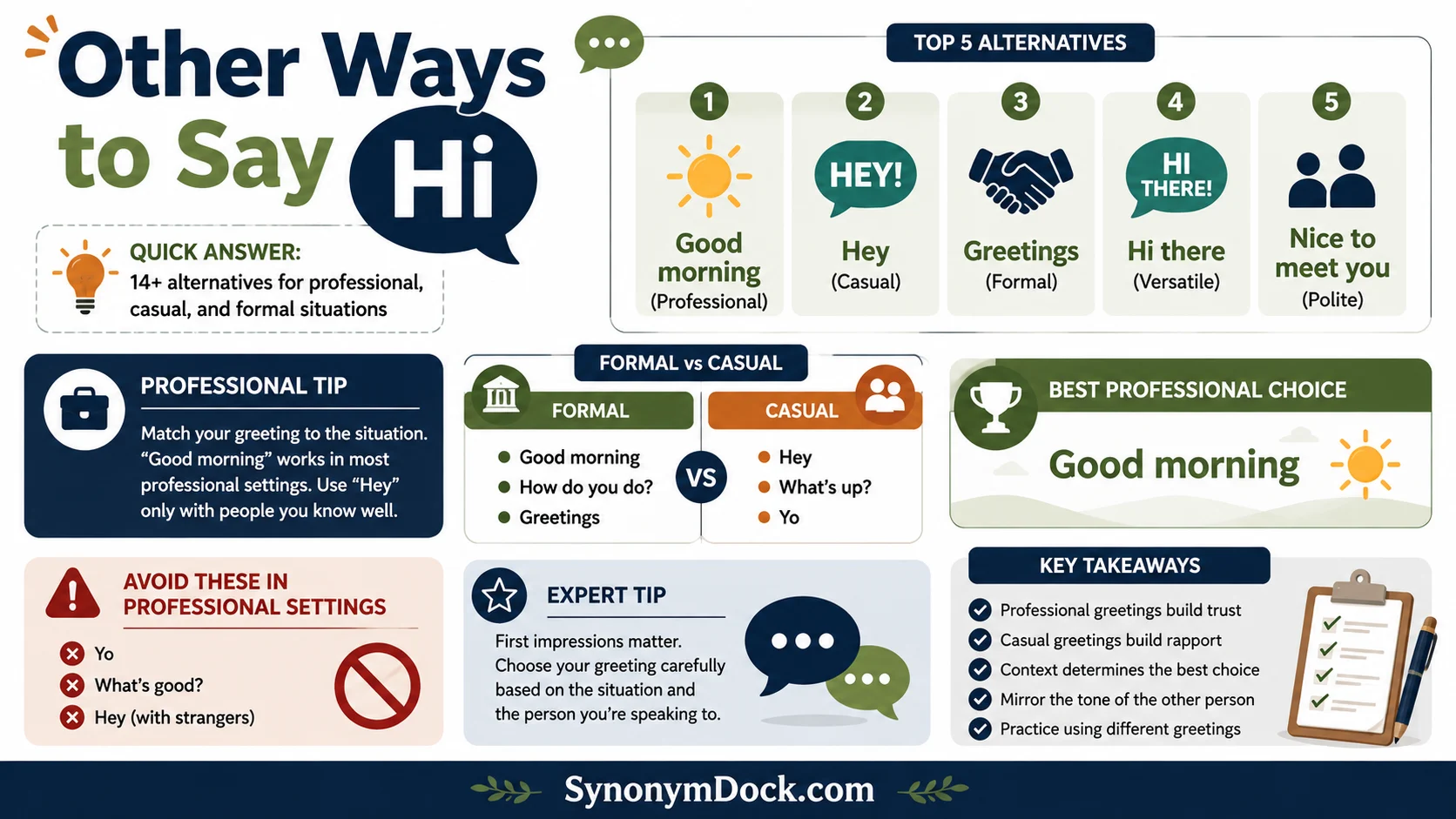
The best alternatives to “hi” depend on your context. For professional settings, try “Good morning/afternoon” or “Hello everyone.” For casual conversations, “Hey there” or “What’s up?” work well. For formal situations, use “Greetings” or “Good day.”
“Hi” is one of the most common English greetings. It’s simple, friendly, and works in many situations. But using the same greeting every time can make your English sound repetitive and basic.
Learning different ways to say “hi” helps you sound more natural, confident, and appropriate for any situation. Whether you’re writing a professional email, starting a business meeting, or greeting friends, choosing the right greeting sets the right tone for the entire conversation.
QUICK CATEGORIES
Formal Alternatives
- Greetings
- Good day
- Good morning/afternoon/evening
- It’s a pleasure to meet you
Pro Tip: Use formal greetings in professional emails, business meetings, and when meeting someone for the first time in a professional context.
Professional Alternatives
- Hello everyone
- Hello team
- Good morning everyone
- Hi there
Pro Tip: “Hello everyone” is perfect for starting meetings or group emails. It’s professional without being too stiff.
Business Email Alternatives
- Dear [Name]
- Hello [Name]
- Good morning [Name]
- Hi [Name]
Pro Tip: Always use the recipient’s name in business emails. It shows attention and respect. “Dear” is more formal, while “Hello” and “Hi” are suitable for most professional emails.
Academic Alternatives
- Good morning, class
- Hello, everyone
- Greetings, colleagues
- Good afternoon, professor
Pro Tip: In academic settings, formality matters. Use titles (Professor, Dr.) and avoid casual greetings like “Hey” or “What’s up?”
Casual Alternatives
- Hey there
- What’s up?
- How’s it going?
- Yo
- Hiya
Pro Tip: These work well with friends, family, and in relaxed social situations. But they’re too casual for most professional settings.
Informal Expressions
- Hey
- What’s good?
- Howdy
- Sup
- ‘Ello
Pro Tip: Some informal greetings are regional or old-fashioned. Use them carefully and only with people you know well.
“The greeting you choose sets the tone for the entire conversation that follows.”
WHAT DOES “HI” MEAN?
“Hi” is a short, informal greeting used to acknowledge someone’s presence or start a conversation. It’s one of the most common English words and works in both spoken and written English.
Example:
Hi, how are you doing today?
WHEN TO USE “HI”
- Daily conversations with friends and family
- Informal emails and messages
- Casual workplace communication
- Starting a phone call
- Greeting someone you know well
- Social media posts and comments
- Text messages and instant messaging
IS IT PROFESSIONAL OR POLITE?
Polite? ✔ Yes, in most contexts
Professional? Sometimes, but often too casual
Formal? No
Natural? Yes
“Hi” is universally understood and generally polite. However, in formal business contexts or when writing to senior colleagues, more formal greetings are usually more appropriate.
PROS AND CONS
Pros
- Short and easy to say
- Friendly and approachable
- Works in almost any situation
- Natural in spoken English
- Easy for beginners to learn
Cons
- Too casual for formal situations
- Can sound unprofessional in business emails
- Limited variety in your vocabulary
- Doesn’t show respect in formal contexts
“Native speakers rarely use the same greeting for every situation. Learning to switch between formal and casual greetings is a sign of fluency.”
15 OTHER WAYS TO SAY “HI”
[1]. Phrase: Good Morning / Afternoon / Evening
Meaning: A formal greeting that specifies the time of day.
Explanation: This greeting is polite, professional, and shows awareness of time. It’s especially effective in formal emails and business meetings. Native speakers use it daily in professional contexts.
Example Sentence:
Good morning, everyone. Thank you for joining today’s meeting.
Best Use: Business meetings, professional emails, formal events
Avoid Using In: Casual texts, late-night conversations
Tone: Professional, Polite
Formality Level: ⭐⭐⭐⭐ Formal
Usage Frequency: Very Common
CEFR Level: A1
Common Collocations:
- good morning everyone
- good afternoon all
- good evening people
- good morning Mr. Smith
- good afternoon team
Context Variability:
- Spoken: “Good morning, how can I help you?”
- Professional: “Good afternoon, I’m calling to confirm our appointment.”
- Casual: Less common in casual settings
Native Speaker Tip: Using the specific time of day shows cultural awareness. In many English-speaking countries, “Good morning” is used until around noon. “Good afternoon” from noon until early evening. “Good evening” is used after dinner time.
[2]. Phrase: Hello Everyone
Meaning: A professional greeting for groups of people.
Explanation: This greeting acknowledges multiple people at once while maintaining a professional tone. It’s widely used in workplace meetings, presentations, and group emails to address everyone equally.
Example Sentence:
Hello everyone, I’d like to welcome you to today’s workshop.
Best Use: Group emails, team meetings, presentations
Avoid Using In: One-on-one conversations, very formal events
Tone: Professional, Inclusive
Formality Level: ⭐⭐⭐ Neutral
Usage Frequency: Very Common
CEFR Level: A1
Common Collocations:
- hello everyone and welcome
- hello team
- hello all
- hello everybody
- hello everyone, I’m [name]
Context Variability:
- Spoken: “Hello everyone, let’s begin.”
- Professional: “Hello everyone, attached is the report.”
- Casual: Occasionally used
[3]. Phrase: Greetings
Meaning: A formal, slightly old-fashioned way to say hello.
Explanation: This greeting sounds sophisticated and formal. It’s often used in writing, formal speeches, or when addressing a group of people. Native speakers use it less frequently in spoken English.
Example Sentence:
Greetings, distinguished guests. We are honored to have you here today.
Best Use: Formal speeches, written correspondence, official events
Avoid Using In: Casual conversation, text messages
Tone: Formal, Distinguished
Formality Level: ⭐⭐⭐⭐⭐ Very Formal
Usage Frequency: Occasional
CEFR Level: B1
Common Collocations:
- greetings and salutations
- warm greetings
- kind greetings
- greetings from [location]
- festive greetings
Context Variability:
- Spoken: “Greetings, everyone. Thank you for being here.”
- Professional: “Greetings from our team in London.”
- Casual: Rarely used
Native Speaker Tip: “Greetings” sounds quite formal and can feel dated in everyday conversation. Use it for formal events, letters, or when you want to sound especially respectful. In most workplace contexts, “Hello everyone” is more natural.
[4]. Phrase: Hey There
Meaning: A casual, friendly way to get someone’s attention or greet them.
Explanation: This greeting is warm, informal, and shows familiarity. It’s very common in North American English and feels approachable and friendly.
Example Sentence:
Hey there, I haven’t seen you in ages! How have you been?
Best Use: Friends, colleagues you know well, casual conversations
Avoid Using In: Formal emails, business meetings, professional settings
Tone: Casual, Friendly
Formality Level: ⭐⭐ Casual
Usage Frequency: Very Common
CEFR Level: A2
Common Collocations:
- hey there stranger
- hey there! how are you?
- hey there, what’s new?
- hey there, glad to see you
- hey there, wait up!
Context Variability:
- Spoken: “Hey there, can you help me with this?”
- Professional: Rarely used in formal contexts
- Casual: “Hey there, are you coming to the party?”
Native Speaker Tip: “Hey there” sounds very natural and friendly in casual American English. However, it’s usually too casual for professional emails or formal conversations. Use it with friends, family, and colleagues you know well.
[5]. Phrase: What’s Up?
Meaning: A very casual greeting that asks about someone’s current situation or mood.
Explanation: This is an informal way to say hello that also invites conversation. It’s extremely common in American English and among young people. It’s not meant to be answered literally it’s just a greeting.
Example Sentence:
Hey, what’s up? Long time no see!
Best Use: Friends, casual conversations, social situations
Avoid Using In: Professional emails, formal meetings, with older people
Tone: Very Casual, Friendly
Formality Level: ⭐ Very Casual
Usage Frequency: Very Common
CEFR Level: A2
Common Collocations:
- what’s up, dude?
- what’s up with you?
- hey, what’s up?
- what’s up, man?
- so what’s up?
Context Variability:
- Spoken: “What’s up? Are you free later?”
- Professional: Avoid in formal contexts
- Casual: Very common in daily conversation
Native Speaker Tip: This is one of the most common casual greetings among native English speakers, especially in North America. It doesn’t require a detailed response just reply with “Not much, you?” or the same phrase back.
[6]. Phrase: Howdy
Meaning: A casual greeting associated with the southern and western United States.
Explanation: This greeting originated as a contraction of “How do you do?” Today, it’s strongly associated with cowboy culture and the American South and Southwest. It sounds warm and friendly, though it may feel old-fashioned or regional in some contexts.
Example Sentence:
Howdy, partner! Welcome to Texas.
Best Use: Casual conversations, regional contexts, themed events
Avoid Using In: Professional emails, international business, formal writing
Tone: Casual, Regional
Formality Level: ⭐ Casual
Usage Frequency: Occasional (regional)
CEFR Level: B1
Common Collocations:
- howdy, partner
- howdy there
- howdy everyone
- howdy, stranger
- howdy do?
Context Variability:
- Spoken: “Howdy! How’s everything?”
- Professional: Not appropriate
- Casual: Very common in parts of the US
Native Speaker Tip: “Howdy” is a regional greeting. In Texas and other southern states, it’s very common. Outside these regions, it can sound like you’re imitating a cowboy. Use it carefully if you’re not from these areas.
[7]. Phrase: Hi There
Meaning: A friendly, slightly informal greeting.
Explanation: This greeting is similar to “hi” but feels warmer and more personal. It’s common in spoken English and works in both casual and slightly more formal situations. Native speakers use it to make a greeting sound more engaging.
Example Sentence:
Hi there, I’m looking for the conference room.
Best Use: Casual conversations, meeting new people, starting conversations
Avoid Using In: Very formal situations, official documents
Tone: Friendly, Approachable
Formality Level: ⭐⭐⭐ Neutral
Usage Frequency: Very Common
CEFR Level: A1
Common Collocations:
- hi there, how are you?
- hi there, can I help you?
- hi there, I’m [name]
- hi there, nice to meet you
- hi there, what can I do for you?
Context Variability:
- Spoken: “Hi there, you must be the new manager.”
- Professional: “Hi there, I’m calling about the job posting.”
- Casual: “Hi there, remember me?”
Native Speaker Tip: “Hi there” is slightly warmer than just “hi.” It shows you’re paying attention to the person. It works well when you’re trying to be friendly but not overly casual.
[8]. Phrase: Good Day
Meaning: A polite, somewhat formal greeting wishing someone a positive day.
Explanation: This greeting sounds formal and can feel a bit old-fashioned. It’s more common in British English and in formal writing. Native speakers rarely use it in everyday conversation.
Example Sentence:
Good day, sir. How may I help you today?
Best Use: Formal situations, customer service, written correspondence
Avoid Using In: Casual conversation, with friends
Tone: Formal, Polite
Formality Level: ⭐⭐⭐⭐ Formal
Usage Frequency: Occasional
CEFR Level: B1
Common Collocations:
- good day to you
- good day, sir/madam
- have a good day
- good day, everyone
- good day, people
Context Variability:
- Spoken: “Good day, madam. Your table is ready.”
- Professional: “Good day, I’m writing to inquire about “
- Casual: Rarely used
Native Speaker Tip: “Good day” sounds quite formal and can feel old-fashioned. In modern English, it’s mostly used in professional service contexts (hotels, restaurants) or in formal writing. For casual conversations, “Hello” or “Hi” are more natural.
[9]. Phrase: How’s It Going?
Meaning: A casual greeting that asks about someone’s current situation.
Explanation: This greeting is very common in American English. Like “What’s up?” it’s not meant to be answered literally it’s just a friendly way to say hello. It creates a casual, approachable tone.
Example Sentence:
Hey, how’s it going? I haven’t seen you in weeks!
Best Use: Friends, colleagues, casual social situations
Avoid Using In: Formal emails, with senior executives, in official settings
Tone: Casual, Friendly
Formality Level: ⭐⭐ Casual
Usage Frequency: Very Common
CEFR Level: A2
Common Collocations:
- how’s it going today?
- how’s it going with work?
- how’s it going so far?
- how’s it going, man?
- how’s it going for you?
Context Variability:
- Spoken: “How’s it going? Ready for the game?”
- Professional: Occasional use with colleagues
- Casual: Very common
Native Speaker Tip: This greeting is extremely natural in casual English. The most common reply is “Good, you?” or “Not much, you?” It’s a great alternative to “Hi” when you want to sound friendly and engaged.
[10]. Phrase: It’s a Pleasure to Meet You
Meaning: A formal greeting used when meeting someone for the first time.
Explanation: This phrase shows respect and enthusiasm when meeting new people. It’s used in professional networking, formal introductions, and social events. It signals that you value the interaction.
Example Sentence:
It’s a pleasure to meet you. I’ve heard wonderful things about your work.
Best Use: Business meetings, networking events, formal introductions
Avoid Using In: Casual settings, with friends, in quick interactions
Tone: Formal, Polite, Warm
Formality Level: ⭐⭐⭐⭐ Formal
Usage Frequency: Common
CEFR Level: B1
Common Collocations:
- it’s a pleasure to meet you finally
- it’s a pleasure to make your acquaintance
- it’s a pleasure meeting you
- what a pleasure to meet you
- the pleasure is all mine
Context Variability:
- Spoken: “It’s a pleasure to meet you, Mr. Johnson.”
- Professional: “It’s a pleasure to meet you at this conference.”
- Casual: More formal than needed
Native Speaker Tip: “It’s a pleasure to meet you” is more formal than “Nice to meet you.” Use it when you want to show extra respect or in very formal settings. Nice to meet you” is more common in casual professional contexts.
[11]. Phrase: What’s Good?
Meaning: An informal greeting that asks what’s positive or exciting in someone’s life.
Explanation: This greeting is very casual and trendy. It’s common among younger people and in urban settings. It’s a friendly way to start a conversation that suggests you’re interested in the other person.
Example Sentence:
What’s good, man? Long time no see!
Best Use: Friends, casual social situations, with peers
Avoid Using In: Professional settings, formal writing
Tone: Very Casual, Trendy
Formality Level: ⭐ Very Casual
Usage Frequency: Common
CEFR Level: B1
Common Collocations:
- what’s good with you?
- what’s good, everyone?
- what’s good in your world?
- what’s good, my friend?
- so what’s good?
Context Variability:
- Spoken: “What’s good? Ready for the weekend?”
- Professional: Not appropriate
- Casual: Very common in social settings
Native Speaker Tip: This greeting is informal and trendy. It’s common among teenagers and young adults. If you’re in a professional environment or with older people, stick to “How are you?” or “Hello.”
[12]. Phrase: Well Hello There
Meaning: A warm, slightly dramatic way to greet someone.
Explanation: This greeting expresses pleasant surprise or enthusiasm. It sounds warm and playful, often used when you’re happy to see someone unexpectedly. It has a slightly theatrical quality.
Example Sentence:
Well hello there! I didn’t expect to see you today!
Best Use: Unexpected encounters, warm reunions, playful situations
Avoid Using In: Formal settings, business communications
Tone: Warm, Playful
Formality Level: ⭐⭐ Casual
Usage Frequency: Occasional
CEFR Level: A2
Common Collocations:
- well hello there, stranger
- well hello there, you look great
- well hello there, fancy meeting you
- well hello there, welcome back
- well hello there, I was just thinking about you
Context Variability:
- Spoken: “Well hello there! How’s everything?”
- Professional: Too casual
- Casual: “Well hello there, you made it!”
Native Speaker Tip: This greeting adds personality and warmth. The “well” at the beginning shows surprise or pleasure. It sounds natural when you’re genuinely happy to see someone but can feel exaggerated in everyday conversation.
[13]. Phrase: Hiya
Meaning: A cheerful, informal way to say hello.
Explanation: “Hiya” is a relaxed and friendly greeting, especially common in British English. It sounds warm and approachable. It’s formed by adding a casual suffix to “hi.”
Example Sentence:
Hiya, how are you doing? It’s been so long!
Best Use: Friends, family, casual conversations
Avoid Using In: Professional emails, formal meetings
Tone: Cheerful, Friendly
Formality Level: ⭐⭐ Casual
Usage Frequency: Common (UK), Occasional (US)
CEFR Level: A2
Common Collocations:
- hiya, mate!
- hiya, how’s things?
- hiya, lovely to see you
- hiya, all good?
- hiya, welcome!
Context Variability:
- Spoken: “Hiya, come on in!”
- Professional: Generally too casual
- Casual: Very natural in informal settings
Native Speaker Tip: “Hiya” is especially common in British and Australian English. In the US, it’s used but less common. It feels upbeat and friendly, making it perfect for casual conversations with friends and family.
[14]. Phrase: Look Who It Is!
Meaning: An enthusiastic greeting expressing pleasant surprise.
Explanation: This greeting is used when you unexpectedly run into someone you know. It’s playful, warm, and shows you’re happy to see them. It works best when the meeting is unplanned or unexpected.
Example Sentence:
Look who it is! I haven’t seen you since college!
Best Use: Unexpected encounters, reunions, happy surprises
Avoid Using In: Professional settings, planned meetings
Tone: Warm, Surprised
Formality Level: ⭐⭐ Casual
Usage Frequency: Occasional
CEFR Level: B1
Common Collocations:
- look who it is, the famous [name]
- look who it is, my old friend
- look who it is, I was just thinking about you
- look who it is, what a surprise
- look who it is, you made it!
Context Variability:
- Spoken: “Look who it is! Come here, you!”
- Professional: Only with close colleagues
- Casual: Very natural for reunions
Native Speaker Tip: This greeting is full of personality and emotion. It’s perfect when you’re genuinely excited to see someone. Use it with people you know well it can feel overly familiar with strangers or casual acquaintances.
[15]. Phrase: Hello [Name]
Meaning: A professional greeting that uses the person’s name.
Explanation: Personalizing a greeting by including the person’s name shows attention and respect. It’s professional yet friendly. Native speakers use this in emails, meetings, and professional conversations to build connection.
Example Sentence:
Hello Sarah, thank you for taking the time to meet with me.
Best Use: Business emails, meetings, professional contexts
Avoid Using In: Formal letters, legal documents
Tone: Professional, Respectful
Formality Level: ⭐⭐⭐ Neutral
Usage Frequency: Very Common
CEFR Level: A1
Common Collocations:
- hello [name], how are you?
- hello [name], nice to see you again
- hello [name], I hope you’re well
- hello [name], thanks for your response
- hello [name], welcome to the team
Context Variability:
- Spoken: “Hello Mr. Jones, how can I help you?”
- Professional: “Hello David, I’ve attached the documents.”
- Casual: “Hello Mike, what are you up to?”
Expert Insight: Using someone’s name in a greeting is one of the simplest ways to build rapport. It shows you see them as an individual, not just another person. This is especially important in business communication and when you want to make a good impression.
Native Speaker Tip: Including the person’s name makes any greeting more personal and engaging. In professional emails, always use the recipient’s name. It shows you’ve taken the time to personalize the message and makes the recipient feel valued.
NATIVE SPEAKER TIP
Most Natural Choices:
- “Hey there” and “Hi there” sound very natural in casual American English.
- “Good morning/afternoon” is always a safe and professional choice.
- “Hello everyone” works perfectly for group situations.
Too Formal Choices:
- “Greetings” can feel stiff in everyday conversation.
- “Good day” sounds old-fashioned to many native speakers.
Regional Differences:
- “Howdy” is strongly associated with the American South and Southwest.
- “Hiya” is more common in British and Australian English.
“Using the right greeting shows you understand cultural context a crucial skill for fluent English communication.”
COMMON MISTAKES
Mistake 1: Using “What’s Up?” in Professional Emails
Why it’s incorrect: It’s too casual for business communication and can seem unprofessional.
Correct Version: Use “Good morning” or “Hello” in professional settings.
Example:
❌ What’s up? I wanted to ask about the project.
✅ Good morning, I wanted to ask about the project.
Mistake 2: Responding Literally to “What’s Up?”
Why it’s incorrect: “What’s up?” is used as a greeting, not a real question. Giving a detailed answer can feel unnatural and awkward.
Correct Version: Respond with a short reply like “Not much, you?” or “Hey! How are you?”
Example:
❌ “What’s up?” “Well, I’ve been working on my thesis and I’m worried about the deadline”
✅ “What’s up?” “Not much, you?”
Mistake 3: Using “Howdy” Outside Appropriate Regions
Why it’s incorrect: “Howdy” is regional and can sound like an imitation or joke if used outside the American South or Southwest.
Correct Version: Use “Hi” or “Hello” if you’re not in a region where “Howdy” is common.
Example:
❌ Howdy, mate! (outside the US South)
✅ Hello, mate!
Mistake 4: Not Using Names in Professional Emails
Why it’s incorrect: Professional emails should show personal attention. Not using the recipient’s name can seem impersonal or lazy.
Correct Version: Always use the recipient’s name in professional email greetings.
Example:
❌ Hello, I wanted to discuss the proposal.
✅ Hello Mr. Chen, I wanted to discuss the proposal.
Mistake 5: Using “It’s a Pleasure to Meet You” in Casual Settings
Why it’s incorrect: This phrase is too formal for casual situations and can seem stiff or awkward.
Correct Version: Use “Nice to meet you” for most situations and “It’s a pleasure” only in formal contexts.
Example:
❌ (At a party) It’s a pleasure to meet you!
✅ Nice to meet you!
AVOID THESE EXPRESSIONS IN FORMAL SITUATIONS
| Expression | Why to Avoid | Better Alternative |
|---|---|---|
| “What’s up?” | Too casual and slangy | “Good morning/afternoon” |
| “Howdy” | Regional and informal | “Hello” or “Good day” |
| “What’s good?” | Very casual, slang | “How are you?” |
| “Yo” | Extremely informal, slang | “Hello” or “Hi” |
| “Sup” | Very casual abbreviation | “Hello” or “Hi” |
BEST PHRASES BY SITUATION
| Situation | Best Phrase |
|---|---|
| Business Email | Hello [Name], Good morning [Name] |
| Client Meeting | Good morning/afternoon, It’s a pleasure to meet you |
| Academic Essay | Not applicable (greetings not used in essays) |
| Presentation | Hello everyone, Good morning everyone |
| Workplace Discussion | Hello everyone, Good morning team |
| Job Interview | Good morning/afternoon, It’s a pleasure to meet you |
| Team Collaboration | Hello team, Hi everyone |
| Everyday Conversation | Hey there, What’s up?, Hi there |
COMPARISON TABLE
| Phrase | Tone | Formality | Best Use | Frequency |
|---|---|---|---|---|
| Good Morning | Polite, Professional | ⭐⭐⭐⭐ | Business, Formal | Very Common |
| Hello Everyone | Professional, Inclusive | ⭐⭐⭐ | Meetings, Groups | Very Common |
| Greetings | Formal, Distinguished | ⭐⭐⭐⭐⭐ | Speeches, Writing | Occasional |
| Hey There | Casual, Friendly | ⭐⭐ | Friends, Peers | Very Common |
| What’s Up? | Very Casual | ⭐ | Friends, Social | Very Common |
| Howdy | Casual, Regional | ⭐ | Southern US | Occasional |
| Hi There | Friendly, Approachable | ⭐⭐⭐ | General Use | Very Common |
| Good Day | Formal, Polite | ⭐⭐⭐⭐ | Formal Situations | Occasional |
| How’s It Going? | Casual, Friendly | ⭐⭐ | Friends, Social | Very Common |
| It’s a Pleasure | Formal, Warm | ⭐⭐⭐⭐ | First Meetings | Common |
WHICH ONE SHOULD YOU USE?
Best Overall: Hello it works in almost every situation and is universally understood.
Best Professional: Good morning/afternoon shows awareness and respect.
Best Business Email: Hello [Name] personal, professional, and effective.
Best Everyday Conversation: Hey there warm, friendly, and natural.
Most Natural: Hi there simple, approachable, and common.
Most Polite: It’s a pleasure to meet you shows genuine respect and warmth.
COMMONLY CONFUSED GREETINGS
“Hi” vs “Hey”
- “Hi” is more neutral and works in more situations.
- “Hey” is more casual and often used with people you know.
- Use “Hi” for most situations, “Hey” only with friends.
“Good Morning” vs “Good Day”
- “Good morning” is very common and natural.
- “Good day” sounds old-fashioned or overly formal.
- “Good morning” is almost always the better choice.
“What’s Up?” vs “How’s It Going?”
- Both are casual greetings.
- “What’s up?” is slightly more common in American English.
- “How’s it going?” feels slightly more concerned about the person.
SCENARIO PRACTICE
Scenario 1: Business Meeting
You’re starting a team meeting with 15 colleagues.
Which phrase would you choose?
Answer: “Good morning everyone” or “Hello everyone.” These are professional, inclusive, and appropriate for workplace settings.
Scenario 2: Job Interview
You’re meeting the hiring manager for the first time.
Which phrase would you choose?
Answer: “Good morning, Mr./Ms. [Name]” or “It’s a pleasure to meet you.” These show respect and professionalism.
Scenario 3: Email to a Client
You’re writing an email to a new client.
Which phrase would you choose?
Answer: “Hello [Client Name]” or “Good morning [Client Name].” Using the name shows attention and respect.
Scenario 4: Party with Friends
You arrive at a party and see your friends.
Which phrase would you choose?
Answer: “Hey there!” or “What’s up, everyone?” These are casual, friendly, and perfect for social settings.
Scenario 5: Customer Service
A customer walks into your store.
Which phrase would you choose?
Answer: “Good morning/afternoon” or “Hello, how can I help you?” These are polite and professional for customer interactions.
MINI QUIZ
1. Which greeting is most appropriate for a professional email to a new client?
A. What’s up?
B. Hey there
C. Hello Mr. Johnson
D. Howdy
2. “Howdy” is commonly associated with:
A. British English
B. The American South and Southwest
C. Australian English
D. Canadian English
3. “It’s a pleasure to meet you” is BEST used:
A. With friends at a party
B. In professional first meetings
C. In text messages
D. With family members
4. Which phrase sounds most natural in casual American English?
A. Good day
B. Greetings
C. Hey there
D. It’s a pleasure
5. How should you respond to “What’s up?”
A. Give a detailed explanation of your day
B. Say “Not much, you?” or similar short reply
C. Ignore the question
D. Ask “What do you mean?”
Answer Key
- C. Hello Mr. Johnson Using a name with “Hello” is professional and respectful in business contexts.
- B. The American South and Southwest “Howdy” is strongly associated with cowboy culture and the southern US.
- B. In professional first meetings This formal greeting shows respect and enthusiasm when meeting new people professionally.
- C. Hey there This is very common, natural, and friendly in casual American English.
- B. Say “Not much, you?” or similar short reply “What’s up?” is used as a greeting, not a literal question.
FAQs
What is the most formal way to say “hi”?
Greetings” and “Good day” are among the most formal ways to say hello. “It’s a pleasure to meet you” is also very formal, especially in first meetings. These greetings are appropriate for formal events, official correspondence, and situations requiring extra respect.
Which phrase is best for professional emails?
“Hello [Name]” or “Good morning/afternoon [Name]” are the best choices for professional emails. Using the recipient’s name shows attention and respect. “Dear [Name]” is more formal and can be used in very formal emails or cover letters.
What is the difference between “hi” and “hey”?
“Hi” is more neutral and appropriate for most situations. “Hey” is more casual and typically used with friends, family, or people you know well. Use “hi” for professional contexts and when meeting someone for the first time. “Hey” is perfect for casual conversations with people you know.
Which alternative sounds most natural to native speakers?
“Hello,” “Good morning/afternoon,” and “Hi there” sound very natural to native speakers. “Hey there” is also natural in casual contexts. These greetings don’t sound forced or formal and fit into everyday conversation seamlessly.
Can I use these expressions in business meetings?
Yes “Hello everyone,” “Good morning everyone,” and “Hi everyone” are all appropriate for business meetings. “It’s a pleasure to meet you” works well when meeting new colleagues or clients. Avoid casual greetings like “What’s up?” in formal meetings.
Is “Howdy” appropriate in professional contexts?
No “Howdy” is too casual and regional for professional contexts, especially outside the American South. Use “Hello” or “Good morning” instead for professional communication.
How do I choose the right greeting?
Consider your audience, the setting, and your relationship with the person. Professional settings require formal greetings. Friendly settings allow casual greetings. When in doubt, “Hello” is always safe. Using the person’s name adds a personal touch to any greeting.
What’s the best way to greet a group?
“Hello everyone” or “Good morning everyone” are the best ways to greet a group. They’re inclusive and professional. “Hi everyone” works in casual settings. Avoid greetings that might exclude anyone or seem too casual for the setting.
CONCLUSION
Learning different ways to say “hi” is about more than expanding your vocabulary it’s about communicating with confidence and cultural awareness. The right greeting can make a powerful first impression, set the tone for an entire conversation, and help you build stronger relationships.
From formal professional settings to casual conversations with friends, having a range of greetings at your disposal makes you sound more fluent, natural, and adaptable. Practice these alternatives in your daily communication, and you’ll quickly notice how choosing the right greeting opens doors and makes your English feel more authentic.
Remember: when in doubt, “Hello” is always safe. But when you want to sound like a true native speaker, knowing when to use “Good morning,” “Hey there,” or “It’s a pleasure to meet you” shows a level of English sophistication that will impress everyone you meet.

1 thought on “Other Ways to Say Hi |14+ Examples and Best Alternatives”