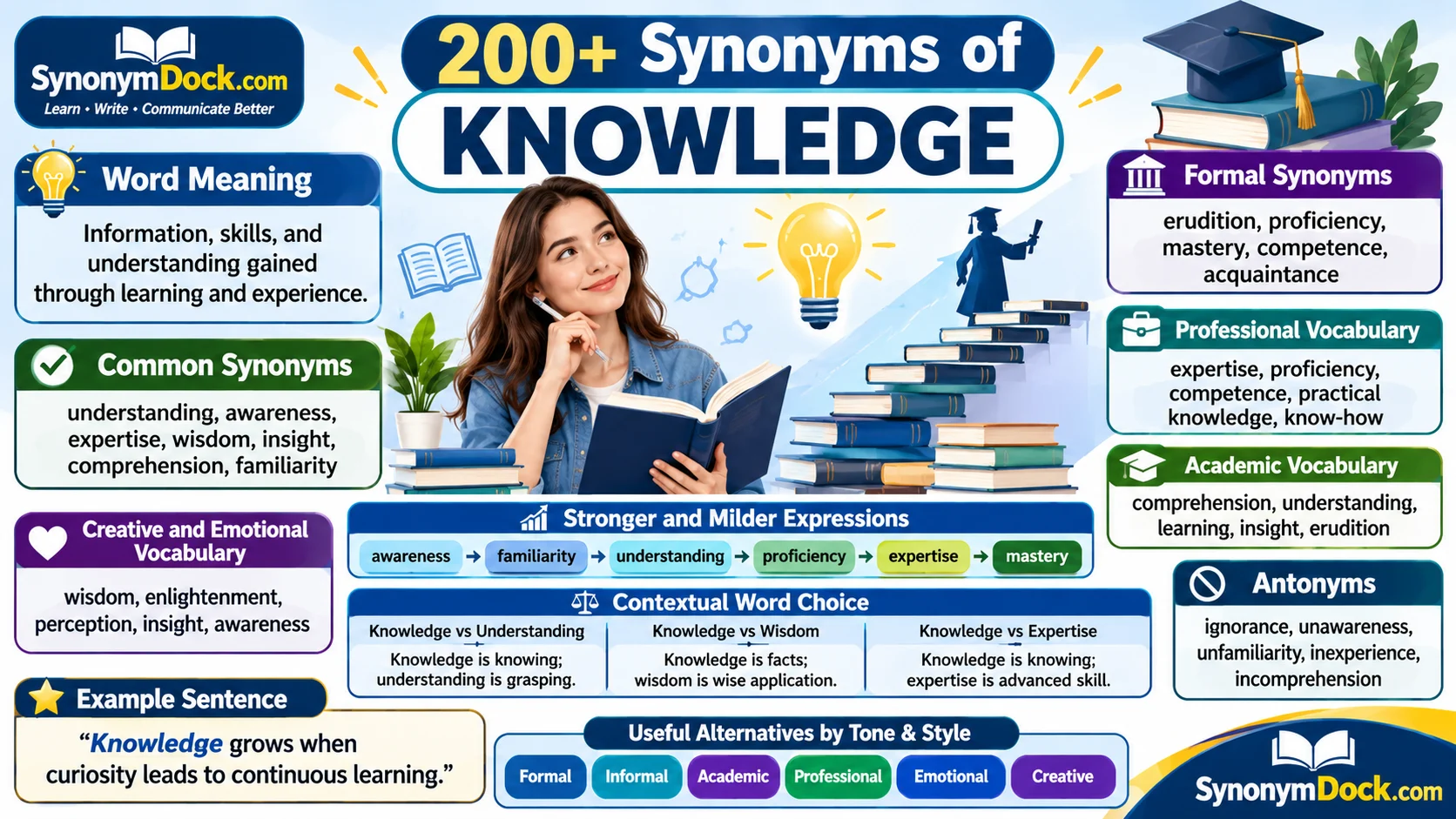
Finding the right synonym of knowledge helps you express different types of understanding, expertise, awareness, and intellectual ability. Words such as expertise, wisdom, proficiency, insight, and comprehension offer more specific meanings depending on your subject and audience.
However, these alternatives are not interchangeable. Understanding their differences will help you choose vocabulary that sounds natural, strengthens your message, and communicates exactly what you intend.
What Are the Best Synonyms of “Knowledge”?
The best synonyms of knowledge include understanding, awareness, expertise, wisdom, insight, comprehension, proficiency, familiarity, and erudition. Knowledge refers to information, facts, or understanding gained through learning and experience. Use expertise for professional ability, comprehension for understanding, and wisdom for sound judgment.
The most suitable alternatives depend on your communication purpose:
- Formal writing: Acumen, erudition, expertise, and proficiency.
- Casual conversation: Know-how, familiarity, and understanding.
- Academic writing: Comprehension, scholarship, and understanding.
- Professional communication: Expertise, competence, and proficiency.
- Emotional writing: Wisdom, insight, and awareness.
- Creative writing: Enlightenment, discernment, and perception.
Meaning, Tone, and Context of Knowledge
Simple Definition
Knowledge is the information, facts, skills, and understanding that someone gains through education, observation, study, research, or personal experience.
It can describe knowing something, understanding a particular subject, or having the ability to apply information in practical situations.
For example:
- Reading books develops knowledge.
- Practical experience builds professional knowledge.
- Scientific research expands human knowledge.
- Personal experiences can provide valuable knowledge about life.
Part of Speech
Knowledge is an uncountable noun.
It describes information or understanding rather than a person, action, or physical object.
Correct: She has extensive knowledge of English literature.
Incorrect: She has many knowledges of English literature.
Better: She has extensive knowledge of English literature.
Overall Tone
Knowledge generally has a positive and neutral tone.
It often suggests education, intelligence, understanding, experience, or professional ability. However, the emotional meaning depends on the sentence.
For example, lack of knowledge can suggest a limitation, while valuable knowledge communicates something beneficial.
Formality Level
Knowledge is a neutral to formal word.
It works naturally in:
- Academic essays.
- Professional reports.
- Business presentations.
- Educational materials.
- Research discussions.
- Everyday conversations.
- Job applications.
It is neither outdated nor overly complicated. Its flexibility makes it suitable for different communication styles.
Common Uses
Native English speakers commonly use knowledge when discussing:
- Education and learning.
- Professional qualifications.
- Technical subjects.
- Research and scientific discoveries.
- Personal experiences.
- Cultural and historical information.
- Practical abilities.
- General awareness of a subject.
Word Forms
| Word Form | Meaning | Example |
|---|---|---|
| Knowledge | Information or understanding | Her knowledge of history is impressive. |
| Know | To understand or be aware of something | I know the answer. |
| Knowledgeable | Having considerable knowledge | She is knowledgeable about technology. |
| Knowledgeably | In an informed manner | He spoke knowledgeably about literature. |
| Know-how | Practical knowledge or ability | The team has the technical know-how. |
Opposite concept: Ignorance refers to a lack of knowledge or information.
When and How to Use “Knowledge”
Choose knowledge when you want to communicate information, understanding, or familiarity gained through learning and experience.
The word works particularly well when discussing someone’s education, professional background, intellectual development, or understanding of a subject.
Here are seven realistic examples.
1. Professional Context
Her knowledge of digital marketing helped the company improve its online strategy.
2. Academic Context
Students need a strong knowledge of grammar to develop effective writing skills.
3. Workplace Context
Our new employees receive training to expand their knowledge of company policies.
4. Personal Context
Traveling to different countries increased my knowledge of other cultures.
5. Email Context
Thank you for sharing your knowledge and helping us understand the new process.
6. Resume Context
Demonstrated knowledge of Microsoft Office applications and administrative procedures.
7. Social Media Context
Never stop learning because knowledge opens doors to new opportunities.
Best Synonyms of Knowledge
No synonym communicates exactly the same meaning as knowledge in every situation. Some alternatives describe information, while others emphasize practical skills, intellectual understanding, or sound judgment.
Here are the best choices for different writing purposes.
| Context | Best Synonym | Why It Works |
|---|---|---|
| Professional writing | Expertise | Highlights advanced subject knowledge. |
| Academic writing | Scholarship | Emphasizes serious study and academic learning. |
| Business communication | Competence | Communicates the ability to perform effectively. |
| Casual conversation | Know-how | Sounds natural when discussing practical ability. |
| Emotional writing | Wisdom | Suggests understanding developed through experience. |
| Creative writing | Insight | Adds depth to observations and ideas. |
| Resume writing | Proficiency | Highlights an ability to perform specific tasks. |
| Workplace communication | Understanding | Describes familiarity with procedures and responsibilities. |
| Stronger meaning | Erudition | Suggests extensive learning and intellectual depth. |
| Softer meaning | Familiarity | Indicates basic awareness or experience with something. |
When Not to Use Knowledge
Although knowledge is a versatile word, it is not always the most effective choice. Sometimes a more specific alternative communicates your meaning more clearly.
1. When Knowledge Sounds Too General
Knowledge does not always explain what someone can actually do.
Less effective: She has knowledge of graphic design.
Better: She has expertise in graphic design.
Why: Expertise suggests advanced subject understanding and professional capability.
2. When You Mean Practical Ability
Knowledge can describe information without proving that someone can apply it.
Less effective: He has knowledge of repairing computers.
Better: He has the technical know-how to repair computers.
Why: Know-how emphasizes practical skills rather than theoretical information.
3. When You Mean Deep Understanding
Sometimes knowledge does not communicate how well someone understands a particular subject.
Less effective: Her knowledge of the novel is impressive.
Better: Her comprehension of the novel’s central themes is impressive.
Why: Comprehension emphasizes understanding rather than simply possessing information.
4. When You Mean Good Judgment
Knowledge and wisdom are related, but they are not identical.
Less effective: His knowledge helped him make a thoughtful decision.
Better: His wisdom helped him make a thoughtful decision.
Why: Wisdom emphasizes sound judgment developed through experience and reflection.
5. When You Mean Specialized Professional Ability
Knowledge can sound less specific when discussing someone’s qualifications.
Less effective: She has knowledge of financial management.
Better: She has proficiency in financial management.
Why: Proficiency communicates an ability to perform a particular activity effectively.
6. When You Mean Awareness of a Situation
Knowledge may sound too broad when describing recognition of a particular issue.
Less effective: The manager has knowledge of the problem.
Better: The manager has awareness of the problem.
Why: Awareness focuses on recognizing that something exists or is happening.
Words Commonly Confused With Knowledge
Several words are closely related to knowledge, but each communicates a different aspect of learning or understanding.
| Word | Difference | When to Use It | Example |
|---|---|---|---|
| Wisdom | Knowledge combined with sound judgment. | Discussing thoughtful decisions and life experience. | Her wisdom helped the team resolve the disagreement. |
| Intelligence | The ability to learn, reason, and solve problems. | Describing intellectual ability. | His intelligence helped him understand complex theories. |
| Information | Facts or details about a subject. | Discussing specific facts or data. | The report contains useful information. |
| Expertise | Advanced knowledge or skill in a particular area. | Professional and specialized contexts. | She has expertise in educational technology. |
| Awareness | Recognition or understanding of something. | Discussing issues, situations, or developments. | The campaign increased public awareness. |
| Understanding | The ability to grasp meaning, ideas, or concepts. | Explaining comprehension. | His understanding of the subject improved. |
Best Synonyms of Knowledge by Context
The most effective synonym depends on what you want to communicate. A word that works in an academic essay might sound unnecessarily complicated in a casual conversation.
| Context | Best Synonym | Why It Works | Example |
|---|---|---|---|
| Formal writing | Erudition | Highlights extensive learning. | Her erudition was evident in the discussion. |
| Academic writing | Scholarship | Connects learning with serious academic study. | His scholarship focuses on modern literature. |
| Professional communication | Expertise | Demonstrates specialized ability. | She offers expertise in project management. |
| Business emails | Understanding | Sounds clear and professional. | Thank you for your understanding of the process. |
| Resume writing | Proficiency | Communicates practical ability. | Proficiency in data analysis and reporting. |
| Workplace communication | Competence | Emphasizes effective performance. | His competence makes him a valuable team member. |
| Casual conversation | Know-how | Natural and conversational. | She has the know-how to fix the problem. |
| Everyday speaking | Familiarity | Indicates basic experience or awareness. | I have some familiarity with the software. |
| Creative writing | Insight | Communicates deeper perception. | Her insight revealed the character’s true intentions. |
| Storytelling | Wisdom | Adds experience and judgment. | The old teacher shared his wisdom with the children. |
| Emotional writing | Enlightenment | Suggests a deeper realization. | The experience brought her a new sense of enlightenment. |
| Strong emphasis | Erudition | Highlights extensive intellectual learning. | His erudition impressed the entire audience. |
| Mild tone | Familiarity | Avoids suggesting advanced expertise. | I have a basic familiarity with the subject. |
| Social media captions | Wisdom | Works well for reflective messages. | A little wisdom can change your perspective. |
| American English | Expertise | Widely suitable for professional contexts. | She has expertise in customer relations. |
| British English | Expertise | Equally natural in British professional writing. | He has expertise in environmental science. |
How to Choose the Best Synonym of Knowledge
Selecting the right alternative requires more than finding a word with a similar dictionary meaning. Consider the message, audience, and level of understanding you want to express.
1. Identify the Intended Meaning
Ask yourself what you actually mean.
- Information or facts: Use information.
- General understanding: Use comprehension or understanding.
- Advanced subject ability: Use expertise.
- Practical skills: Use know-how.
- Sound judgment: Use wisdom.
- Recognition of an issue: Use awareness.
2. Consider Your Audience
Think about who will read your writing.
For teachers, students, and academic readers, comprehension and scholarship may be appropriate. For colleagues and business clients, expertise, proficiency, and competence often communicate more effectively.
3. Match the Tone
Choose vocabulary that suits the situation.
- Formal: Erudition, expertise, scholarship.
- Neutral: Understanding, awareness, information.
- Conversational: Know-how, familiarity.
- Reflective: Wisdom, insight, enlightenment.
4. Consider Emotional Strength
Some alternatives suggest ordinary learning, while others communicate intellectual depth.
For example, familiarity suggests basic experience, whereas erudition suggests extensive learning.
5. Think About Your Writing Purpose
A resume should highlight relevant abilities. An academic essay should demonstrate accurate understanding. A creative story may benefit from expressive words such as insight and wisdom.
6. Read the Sentence Naturally
Replace knowledge with your preferred synonym and read the complete sentence.
If the sentence sounds unnatural or changes the original meaning, choose another word.
Practical tip: The most effective synonym is not necessarily the most sophisticated one. It is the word that expresses your intended meaning accurately.
Real Life Examples of Knowledge
The following examples demonstrate how knowledge and its alternatives work in everyday, educational, and professional communication.
1. School
Original: Students need knowledge of basic grammar.
Improved: Students need a solid understanding of basic grammar.
2. College
Original: The course increased my knowledge of English literature.
Improved: The course expanded my comprehension of major literary movements.
3. Workplace
Original: Her knowledge of office procedures is excellent.
Improved: Her familiarity with office procedures helps her work efficiently.
4. Business
Original: The consultant shared his knowledge of market trends.
Improved: The consultant contributed valuable market insight.
5. Email
Original: Thank you for your knowledge and support.
Improved: Thank you for sharing your expertise and providing valuable guidance.
6. Resume
Original: Good knowledge of Microsoft Excel.
Improved: Proficiency in Microsoft Excel, including spreadsheet organization and data analysis.
7. Conversation
Original: I have knowledge of this subject.
Improved: I know quite a bit about this subject.
8. Storytelling
Original: The old woman had great knowledge of life.
Improved: The old woman possessed remarkable wisdom gained through years of experience.
9. Blogging
Original: This article provides knowledge about effective writing.
Improved: This article offers practical insights into effective writing.
10. Social Media
Original: Knowledge makes people successful.
Improved: Understanding, curiosity, and wisdom can open new possibilities.
12 Best Synonyms of Knowledge
The following 12 alternatives cover different aspects of knowledge, including information, understanding, professional ability, academic learning, and intellectual judgment.
| Synonym | Simple Meaning | Best Used For | Example Sentence |
|---|---|---|---|
| 1. Understanding | Grasping the meaning of something. | General learning and education. | Her understanding of grammar has improved. |
| 2. Awareness | Recognition of a fact or situation. | Social issues and general information. | The program increased environmental awareness. |
| 3. Expertise | Advanced knowledge of a subject. | Professional qualifications. | He has expertise in cybersecurity. |
| 4. Wisdom | Knowledge combined with good judgment. | Life experiences and decisions. | Her wisdom helped us choose the right path. |
| 5. Insight | A deep understanding of an issue. | Analysis and creative thinking. | The research provides insight into human behavior. |
| 6. Comprehension | The ability to understand information. | Education and reading. | Reading improves language comprehension. |
| 7. Proficiency | A high level of skill or ability. | Professional and technical skills. | She demonstrated proficiency in data analysis. |
| 8. Familiarity | Basic knowledge or experience. | Everyday and workplace situations. | I have familiarity with the software. |
| 9. Erudition | Extensive academic learning. | Formal and intellectual writing. | His erudition impressed the researchers. |
| 10. Scholarship | Academic learning and serious study. | Research and higher education. | Her scholarship focuses on American literature. |
| 11. Competence | The ability to perform effectively. | Workplace performance. | His competence makes him a reliable employee. |
| 12. Acumen | Sharp judgment and intellectual ability. | Business and strategic decisions. | Her business acumen impressed the investors. |
Important usage distinction: These words are related to knowledge, but they are not perfect substitutes. For example, information describes facts, expertise describes advanced subject ability, and wisdom emphasizes judgment. Choose according to the exact meaning of your sentence.
Synonyms of Knowledge by Usage
Professional vs Personal Synonyms
Professional writing usually benefits from words that communicate specific qualifications or abilities. Personal communication can use more relaxed alternatives that emphasize experience and understanding.
Best professional alternatives:
- Expertise: Advanced subject knowledge.
- Proficiency: Demonstrated ability in a particular area.
- Competence: Effective performance.
- Acumen: Sharp professional judgment.
- Scholarship: Academic achievement and learning.
Best personal alternatives:
- Wisdom: Lessons gained through experience.
- Understanding: Grasping ideas or situations.
- Familiarity: Having experience with something.
- Insight: Recognizing deeper meaning.
- Know-how: Knowing how to accomplish a task.
Example:
Professional: Her expertise in human resources supports effective recruitment.
Personal: My grandmother’s wisdom has taught me valuable life lessons.
Formal vs Conversational Synonyms
Different communication settings require different vocabulary choices.
| Writing Style | Recommended Synonyms | Example |
|---|---|---|
| Formal reports | Expertise, erudition | The researcher demonstrated extensive expertise. |
| Academic essays | Comprehension, scholarship | The analysis demonstrates a strong comprehension of the subject. |
| Business writing | Competence, acumen | Her business acumen supports strategic planning. |
| Presentations | Insight, understanding | This research provides valuable insight. |
| Professional emails | Expertise, understanding | Thank you for sharing your expertise. |
| Casual conversations | Know-how, familiarity | He has the know-how to handle it. |
| Texting | Know-how, understanding | I have some idea of how it works. |
Avoid unnecessarily complicated vocabulary in casual communication. Clear language usually makes a stronger impression.
Academic Synonyms
Academic writing requires precise language that distinguishes between information, comprehension, research, and intellectual ability.
Consider these alternatives:
1. Comprehension
Best for describing the ability to understand written material, concepts, and academic subjects.
Example: The assignment evaluates students’ comprehension of the reading material.
2. Scholarship
Suitable for discussing serious academic study, research, and intellectual contributions.
Example: Her scholarship examines the development of modern American literature.
3. Understanding
A versatile alternative for explaining concepts and interpreting research.
Example: The experiment improved our understanding of environmental changes.
4. Cognition
Appropriate for discussions involving mental processes, learning, memory, and reasoning.
Example: The researchers examined the relationship between memory and cognition.
5. Insight
Useful when presenting an important observation or a deeper interpretation.
Example: The findings provide new insight into student learning patterns.
Why these words work: Each alternative communicates a specific intellectual activity. This makes academic arguments clearer and more precise than repeatedly using knowledge.
Professional and Business Synonyms
Professional communication should emphasize relevant qualifications, practical ability, and subject understanding.
Here are useful alternatives for different business situations.
| Situation | Recommended Word | Example |
|---|---|---|
| Resume | Proficiency | Proficiency in project management software. |
| Job interview | Expertise | My expertise includes content development and SEO. |
| Business meetings | Insight | Your insight into customer behavior is valuable. |
| Presentations | Understanding | We have a clear understanding of market requirements. |
| Performance reviews | Competence | She demonstrates strong professional competence. |
| Client communication | Familiarity | We have extensive familiarity with your industry. |
| Business emails | Expertise | Thank you for sharing your expertise. |
Resume recommendation: Avoid writing only “good knowledge of communication skills.” Instead, identify a relevant skill and describe your actual level of proficiency.
For example:
“Strong communication skills, with proficiency in professional correspondence and client relations.”
This communicates more useful information to potential employers.
Creative and Literary Synonyms
Creative writing often benefits from alternatives that communicate deeper meaning, experience, and intellectual development.
| Synonym | Creative Purpose | Example |
|---|---|---|
| Wisdom | Communicates life lessons. | Time had given her wisdom beyond her years. |
| Insight | Reveals hidden meanings. | His insight changed the direction of the story. |
| Enlightenment | Suggests a meaningful realization. | The journey became a path toward enlightenment. |
| Discernment | Shows careful judgment. | Her discernment helped her recognize the truth. |
| Perception | Describes personal interpretation. | His perception of the world gradually changed. |
| Understanding | Expresses emotional or intellectual awareness. | Their understanding of each other grew stronger. |
These alternatives make descriptions more expressive without requiring complicated vocabulary.
Slang or Modern Synonyms
Knowledge does not have many direct slang equivalents. However, informal expressions can communicate related meanings in relaxed conversations.
| Expression | Meaning | Where It Works | Where to Avoid It |
|---|---|---|---|
| Know-how | Practical ability. | Casual conversations. | Formal research papers. |
| The basics | Fundamental information. | Everyday explanations. | Academic definitions requiring precision. |
| A clue | Some understanding of something. | Informal conversations. | Professional reports. |
| The scoop | Useful or interesting information. | Casual discussions. | Formal business correspondence. |
Examples:
- She has the know-how to manage the project.
- I know the basics of photography.
- He doesn’t have a clue about the new software.
- Give me the scoop on the latest developments.
Remember that these expressions have different meanings. They should not automatically replace knowledge in every sentence.
Strongest to Mildest Synonyms
The following scale organizes related words according to the strength or specificity of the meaning they commonly communicate.
| Intensity | Synonyms | Meaning |
|---|---|---|
| Mild | Familiarity, awareness | Basic recognition or experience. |
| Moderate | Understanding, comprehension, information | A general grasp of a subject. |
| Strong | Expertise, proficiency, competence, insight | Developed ability or deeper understanding. |
| Very Strong | Erudition, scholarship, wisdom, discernment | Extensive learning, intellectual depth, or mature judgment. |
Important: This is a practical specificity scale, not a universal ranking. Wisdom, erudition, and expertise describe different qualities, so one is not automatically stronger than another.
Emotional vs Neutral Synonyms
Some alternatives communicate personal experience and deeper judgment. Others simply describe information or understanding.
Emotional and Reflective Synonyms
- Wisdom: Suggests lessons gained through experience.
- Insight: Communicates a meaningful realization.
- Enlightenment: Suggests a significant change in understanding.
- Discernment: Emphasizes thoughtful judgment.
Example: Her wisdom helped her understand the importance of patience.
Neutral Synonyms
- Information: Communicates facts and details.
- Understanding: Describes the ability to grasp meaning.
- Familiarity: Indicates experience with something.
- Comprehension: Refers to the ability to understand information.
- Awareness: Describes recognition of a situation.
Example: The training improved employees’ understanding of workplace policies.
Use reflective alternatives when the message involves personal growth or judgment. Choose neutral alternatives when presenting information objectively.
Antonyms of Knowledge
The opposite of knowledge is generally ignorance, meaning a lack of knowledge or information.
Unlike synonyms, knowledge has relatively few direct antonyms. Several other words describe related conditions, such as confusion, misunderstanding, or misinformation, but they are not exact opposites.
| Antonym or Contrasting Term | Meaning | Example Sentence |
|---|---|---|
| 1. Ignorance | Lack of knowledge. | Education helps reduce ignorance. |
| 2. Unawareness | Not knowing about something. | Her unawareness of the changes caused confusion. |
| 3. Unfamiliarity | Lack of experience with a subject. | His unfamiliarity with the system slowed the process. |
| 4. Inexperience | Lack of practical experience. | Inexperience made the task challenging. |
| 5. Misunderstanding | Incorrect interpretation of something. | A misunderstanding of the instructions caused a delay. |
| 6. Misconception | An incorrect belief or idea. | The lesson corrected a common misconception. |
| 7. Misinformation | False or inaccurate information. | Misinformation can confuse readers. |
| 8. Confusion | Lack of clarity or understanding. | Confusion about the rules affected the discussion. |
| 9. Uncertainty | Lack of confidence or definite understanding. | Uncertainty remained about the final result. |
| 10. Illiteracy | Inability to read or write effectively. | Educational programs help address illiteracy. |
| 11. Fallacy | A mistaken belief or flawed argument. | The researcher identified a fallacy in the argument. |
| 12. Error | A mistake in information or reasoning. | The report contained an important factual error. |
| 13. Falsehood | A statement that is untrue. | The article repeated a widely known falsehood. |
| 14. Incomprehension | Failure to understand something. | His incomprehension of the instructions required further explanation. |
| 15. Blindness | Failure to recognize or understand something, often figuratively. | The manager’s blindness to customer concerns affected the business. |
Note: Ignorance is the clearest direct antonym. The remaining entries represent related contrasts or situations in which knowledge is missing, inaccurate, or insufficient.
Comparison: Knowledge vs Similar Words
Understanding the differences between related vocabulary helps prevent incorrect word choices.
Knowledge vs Wisdom
Main Difference
Knowledge involves information and understanding, while wisdom involves applying understanding and experience to make sound decisions.
Which Is Stronger?
Wisdom suggests mature judgment. Knowledge emphasizes what someone knows.
Which Is More Formal?
Both are suitable for formal writing. Knowledge is more neutral, while wisdom often carries a reflective meaning.
When to Use Each
Use knowledge when discussing facts, education, or subject familiarity. Use wisdom when discussing thoughtful decisions or life experiences.
Examples
Knowledge: Her knowledge of literature is extensive.
Wisdom: Her wisdom helped her make a difficult decision.
Knowledge vs Information
Main Difference
Information consists of facts or details. Knowledge involves understanding those facts and potentially applying them.
Which Is Stronger?
Knowledge generally suggests a deeper level of understanding.
Which Is More Formal?
Both are appropriate for professional and academic communication.
When to Use Each
Use information when referring to specific facts, statistics, or details. Use knowledge when discussing accumulated understanding.
Examples
Knowledge: His knowledge of economics helped him interpret the results.
Information: The report contains updated economic information.
Knowledge vs Expertise
Main Difference
Knowledge describes what someone knows, while expertise indicates advanced knowledge and ability in a particular area.
Which Is Stronger?
Expertise suggests a higher level of specialization.
Which Is More Formal?
Both are formal enough for professional settings, but expertise is particularly useful for qualifications and professional achievements.
When to Use Each
Use knowledge for general subject understanding. Use expertise when describing specialized professional ability.
Examples
Knowledge: She has knowledge of digital marketing.
Expertise: She has expertise in search engine optimization.
Knowledge vs Intelligence
Main Difference
Knowledge is acquired through learning and experience. Intelligence refers to the ability to reason, learn, and solve problems.
Which Is Stronger?
Neither is universally stronger. They describe different intellectual qualities.
Which Is More Formal?
Both are appropriate in academic and professional contexts.
When to Use Each
Use knowledge when discussing learned information. Use intelligence when discussing reasoning and intellectual ability.
Examples
Knowledge: His knowledge of mathematics is impressive.
Intelligence: Her intelligence allows her to solve complex problems.
Knowledge vs Understanding
Main Difference
Knowledge can include facts and information, while understanding emphasizes grasping their meaning and relationships.
Which Is Stronger?
Understanding can suggest deeper comprehension, although the words depend on context.
Which Is More Formal?
Both are suitable for formal and everyday writing.
When to Use Each
Use knowledge when referring to accumulated information. Use understanding when emphasizing comprehension.
Examples
Knowledge: The course provides knowledge of environmental science.
Understanding: The course develops an understanding of environmental systems.
Knowledge vs Awareness
Main Difference
Knowledge often refers to information or developed understanding. Awareness focuses on recognizing the existence of something.
Which Is Stronger?
Knowledge can imply more developed understanding, while awareness may describe simple recognition.
Which Is More Formal?
Both are suitable for professional and academic writing.
When to Use Each
Use knowledge when describing learned information. Use awareness when discussing issues, changes, or situations.
Examples
Knowledge: The students gained knowledge of climate science.
Awareness: The campaign increased awareness of climate change.
Common Phrases and Expressions with Knowledge
Knowledge appears in several natural expressions used in education, business, professional writing, and everyday communication.
1. General Knowledge
Meaning: Information about a wide range of everyday subjects.
Example: Reading newspapers can improve your general knowledge.
2. Practical Knowledge
Meaning: Understanding that can be applied to real situations.
Example: The internship gave students practical knowledge of workplace responsibilities.
3. Working Knowledge
Meaning: Enough understanding of a subject or system to use it effectively.
Example: Applicants should have a working knowledge of Microsoft Excel.
4. Firsthand Knowledge
Meaning: Information gained through direct personal experience.
Example: The journalist had firsthand knowledge of the situation.
5. In-Depth Knowledge
Meaning: Detailed and extensive understanding of a particular subject.
Example: The position requires in-depth knowledge of financial regulations.
6. Specialized Knowledge
Meaning: Advanced information or expertise in a particular field.
Example: The company needs employees with specialized knowledge of cybersecurity.
7. Background Knowledge
Meaning: Existing information that helps someone understand a new subject.
Example: Students need background knowledge before studying advanced literature.
8. Knowledge Is Power
Meaning: Learning and understanding can help people make informed decisions and achieve their goals.
Example: Knowledge is power because education creates opportunities for personal and professional development.
Common Mistakes to Avoid
Choosing a synonym without understanding its exact meaning can make writing less accurate. Here are seven common mistakes and their improvements.
Mistake 1: Using Expertise When You Only Mean Basic Familiarity
Incorrect: I have expertise in basic computer operations.
Better: I have familiarity with basic computer operations.
Why: Expertise suggests advanced ability, while familiarity communicates a more general level of experience.
Mistake 2: Confusing Knowledge With Wisdom
Incorrect: She has great wisdom about computer programming languages.
Better: She has extensive knowledge of computer programming languages.
Why: Knowledge describes information about a technical subject. Wisdom emphasizes judgment and experience.
Mistake 3: Using Informal Vocabulary in Academic Writing
Incorrect: The researcher has great know-how about psychological theories.
Better: The researcher has extensive knowledge of psychological theories.
Why: Know-how is conversational. Knowledge is more appropriate for formal academic discussion.
Mistake 4: Using Erudition in Ordinary Conversations
Incorrect: I have considerable erudition about this mobile application.
Better: I have considerable knowledge of this mobile application.
Why: Erudition suggests extensive scholarly learning and sounds unnecessarily formal in everyday situations.
Mistake 5: Replacing Knowledge With Information Everywhere
Incorrect: Her information of English grammar is excellent.
Better: Her knowledge of English grammar is excellent.
Why: Information refers to facts or details. Knowledge refers to understanding or familiarity with a subject.
Mistake 6: Using a Synonym With the Wrong Emotional Meaning
Incorrect: The employee has great wisdom of company policies.
Better: The employee has a strong understanding of company policies.
Why: Wisdom emphasizes mature judgment, whereas understanding is more accurate for workplace procedures.
Mistake 7: Choosing an Impressive Word Instead of a Precise One
Incorrect: The beginner has remarkable expertise in photography after one lesson.
Better: The beginner has gained a basic understanding of photography.
Why: Expertise implies advanced ability. A basic understanding is more realistic and communicates the correct level.
Frequently Asked Questions
1. What are the best synonyms of knowledge?
The best synonyms of knowledge include understanding, expertise, wisdom, insight, comprehension, awareness, proficiency, familiarity, and erudition. The most appropriate choice depends on whether you mean information, practical ability, or deeper understanding.
2. What are the best formal synonyms of knowledge?
Formal alternatives include expertise, erudition, scholarship, proficiency, acumen, and discernment. Use expertise for specialized ability, scholarship for academic learning, and erudition when emphasizing extensive intellectual knowledge.
3. What are common informal synonyms of knowledge?
Common informal alternatives include know-how, familiarity, understanding, and knowing the basics. These expressions work well in everyday conversations when discussing practical skills, personal experience, or general understanding.
4. What is another word for knowledge in professional writing?
Expertise, proficiency, competence, and acumen are useful alternatives in professional writing. Choose expertise for specialized qualifications, proficiency for practical ability, and competence when describing effective workplace performance.
5. What is the difference between knowledge and wisdom?
Knowledge refers to information and understanding gained through learning or experience. Wisdom involves using that understanding and experience to make thoughtful decisions. Someone can have considerable knowledge without necessarily demonstrating wisdom.
6. What is the opposite of knowledge?
The clearest opposite of knowledge is ignorance, which means a lack of information or understanding. Other related contrasting terms include unawareness, unfamiliarity, misunderstanding, and confusion.
Conclusion
Choosing the right synonym of knowledge can make your writing more precise, meaningful, and engaging. Words such as expertise, comprehension, insight, wisdom, proficiency, and awareness each express a different aspect of learning and understanding.
The best alternative depends on your audience, communication purpose, and intended tone. Use expertise for professional ability, comprehension for academic understanding, know-how for practical skills, and wisdom for thoughtful judgment. Remember that no synonym works perfectly in every situation. A useful vocabulary improvement tip is to learn each new word through an original sentence so you understand not only its meaning but also when to use it.

Ethan Parker is an English language writer and vocabulary enthusiast at SynonymDock.com. He specializes in synonyms, word meanings, alternative expressions and practical English usage, creating clear and reliable content to help students, professionals, writers and English learners choose the right words with confidence.
3 thoughts on “200+Synonyms of Knowledge to Expand Your English Vocabulary”