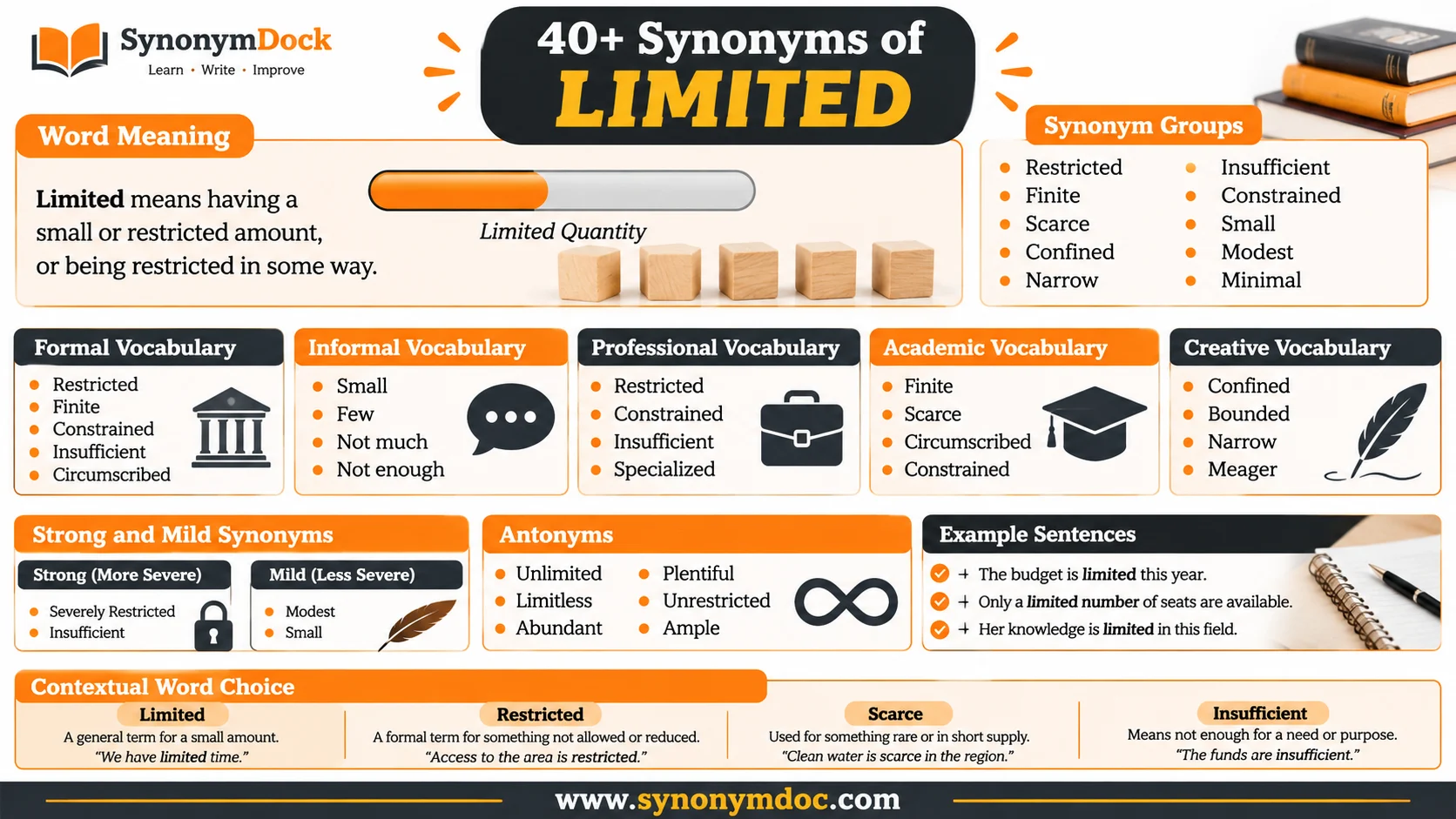
Finding the right synonym of limited helps you communicate more accurately. Depending on the situation, you might use words such as restricted, finite, scarce, confined, narrow, insufficient, or exclusive.
However, these alternatives do not all mean the same thing. Some describe a shortage, others indicate boundaries, and several suggest that something is available only to a particular group.
This guide explores the best synonyms of limited, explains their differences, and provides practical examples for academic, professional, creative, and everyday communication.
What Are the Best Synonyms of “Limited”?
Limited means restricted in amount, number, extent, availability, or possibility. Its best synonyms include restricted, finite, scarce, confined, narrow, insufficient, and bounded. Use restricted in formal writing, scarce for shortages, finite for measurable quantities, and narrow when describing a restricted range.
Here are the best alternatives for different situations:
| Context | Best Synonym |
| Formal writing | Restricted |
| Casual conversation | Small |
| Academic writing | Finite |
| Professional communication | Constrained |
| Business communication | Restricted |
| Emotional writing | Confined |
| Creative writing | Bounded |
| Resume writing | Specialized |
| Describing a shortage | Scarce |
| Describing inadequate resources | Insufficient |
| Describing availability | Exclusive |
The most versatile alternative is restricted when something has specific boundaries or conditions. Choose scarce when resources are difficult to find and finite when something has a definite quantity or endpoint.
Meaning, Tone, and Context of Limited
Simple Definition
Limited means that something has a restriction in its amount, size, number, range, availability, or extent.
It describes situations where something is not unlimited or cannot go beyond certain boundaries.
For example:
- We have limited time to complete the project.
- The library has a limited number of books.
- Students have limited access to certain resources.
The word can describe physical restrictions, shortages, opportunities, abilities, and availability.
Part of Speech
Limited is primarily an adjective. It can also function as the past participle of the verb limit.
Overall Tone
Limited generally has a neutral tone, although it can suggest a disadvantage when describing insufficient resources or opportunities.
Examples:
- Neutral: The company offers limited services.
- Negative: The school has limited educational resources.
- Positive: The offer is available for a limited time.
Positive, Neutral, or Negative?
The meaning depends on the situation.
| Tone | Example | Explanation |
| Positive | Limited edition collection | Suggests exclusivity. |
| Neutral | Limited availability | Communicates a restriction. |
| Negative | Limited resources | Suggests a shortage. |
Formality Level
| Style | Suitability | Explanation |
| Formal | Excellent | Common in reports and official documents. |
| Semi formal | Excellent | Suitable for workplace communication. |
| Neutral | Excellent | Natural in everyday English. |
| Informal | Excellent | Frequently used in conversations. |
Common Uses
American English speakers commonly use limited in these situations:
- Describing available time.
- Explaining financial restrictions.
- Discussing educational opportunities.
- Describing product availability.
- Communicating resource shortages.
- Explaining restricted access.
- Describing a narrow range of choices.
- Discussing abilities or experience.
Word Forms
| Word Form | Meaning | Example |
| Limit | A restriction or boundary | There is a limit on spending. |
| Limited | Restricted in amount or extent | We have limited resources. |
| Limiting | Placing restrictions on something | The policy has limiting conditions. |
| Limitation | A restriction or disadvantage | Time is our biggest limitation. |
| Limitless | Without restrictions or boundaries | The possibilities seem limitless. |
The opposite form, limitless, communicates the absence of restrictions.
When and How to Use “Limited”
Use limited when you want to communicate that something has a defined amount, restricted availability, or a particular boundary.
Here are seven realistic examples.
1. Professional Context
Our team has limited resources to complete the project this month.
2. Academic Context
The research was conducted using a limited sample of participants.
3. Workplace Context
Employees have limited access to confidential company information.
4. Personal Context
I have limited free time during the examination period.
5. Email Context
Please note that registration is available for a limited time.
6. Resume Context
Worked with limited supervision while managing daily administrative responsibilities.
7. Social Media Context
Limited edition products are now available in our online store.
Best Synonyms of “Limited”
No synonym of limited works perfectly in every situation. The best choice depends on whether you are describing a shortage, a boundary, a restriction, or a small quantity.
Here are the strongest recommendations for different contexts.
1. Professional Writing: Restricted
Restricted is useful when describing rules, access, permissions, or specific boundaries.
Example: Access to confidential files is restricted to authorized employees.
2. Academic Writing: Finite
Finite is appropriate when discussing measurable quantities or resources that have a definite endpoint.
Example: The study examines how students use finite educational resources.
3. Business Communication: Constrained
Constrained works well when describing restrictions caused by budgets, time, or other conditions.
Example: The department operates with constrained financial resources.
4. Casual Conversation: Small
Small is a natural alternative when discussing a low quantity or amount.
Example: We have a small amount of time before the meeting.
5. Emotional Writing: Confined
Confined communicates a feeling of being restricted or unable to move freely.
Example: She felt confined by the expectations placed upon her.
6. Creative Writing: Bounded
Bounded is useful when describing something that has clear limits or defined boundaries.
Example: His imagination seemed bounded by the rules of his surroundings.
7. Resume Writing: Specialized
Specialized can replace limited when you want to communicate a focused area of expertise rather than a lack of ability.
Example: Developed specialized knowledge of digital marketing strategies.
8. Workplace Communication: Constrained
Constrained communicates that a person or team is working under specific restrictions.
Example: Our progress is constrained by the available budget.
9. Stronger Meaning: Severely Restricted
Severely restricted emphasizes a significant restriction.
Example: Public access to the facility is severely restricted.
10. Softer Meaning: Modest
Modest can communicate a relatively small amount without emphasizing a negative restriction.
Example: The project requires a modest investment.
When Not to Use “Limited”
Although limited is useful, it can sometimes be too general or fail to communicate the exact situation.
Here are six situations where a more precise alternative may improve your writing.
1. When Describing a Shortage
Problem: Limited may not communicate how difficult something is to obtain.
Better synonym: Scarce.
Original: The region has limited water supplies.
Improved: The region has scarce water supplies.
Why it works: Scarce emphasizes that the resource is difficult to find or obtain.
2. When Describing Inadequate Resources
Problem: Limited can simply indicate a restriction without explaining that the available amount is insufficient.
Better synonym: Insufficient.
Original: The organization has limited funding to complete the project.
Improved: The organization has insufficient funding to complete the project.
Why it works: Insufficient clearly communicates that the available funding is not enough.
3. When Describing a Small Selection
Problem: Limited may sound less natural when discussing a narrow range of choices.
Better synonym: Narrow.
Original: The store offers limited options.
Improved: The store offers a narrow selection.
Why it works: Narrow specifically describes a restricted range of choices.
4. When Describing Restricted Permission
Problem: Limited may not clearly explain that access is controlled by rules.
Better synonym: Restricted.
Original: Visitors have limited access to the building.
Improved: Visitors have restricted access to the building.
Why it works: Restricted communicates that specific rules control access.
5. When Describing a Small Amount Positively
Problem: Limited can sound negative when you simply want to describe a modest quantity.
Better synonym: Modest.
Original: The company requires a limited investment.
Improved: The company requires a modest investment.
Why it works: Modest communicates a relatively small amount without necessarily suggesting a problem.
6. When Describing a Definite Quantity
Problem: Limited may not emphasize that something has a measurable endpoint.
Better synonym: Finite.
Original: Natural resources are limited.
Improved: Natural resources are finite.
Why it works: Finite emphasizes that a resource has a definite quantity and cannot continue indefinitely.
Words Commonly Confused With “Limited”
Several words have similar meanings but communicate different types of restrictions.
| Word | Difference | When to Use It | Example |
| Restricted | Controlled by rules or conditions. | Access, permission, and regulations. | Access is restricted to staff. |
| Scarce | Difficult to find or obtain. | Resources and shortages. | Fresh water is scarce in the region. |
| Finite | Having a definite amount or endpoint. | Quantities and resources. | Time is a finite resource. |
| Insufficient | Not enough for a particular need. | Budgets and supplies. | We have insufficient funding. |
| Narrow | Covering a small range or selection. | Choices and opportunities. | The company offers a narrow selection. |
| Constrained | Restricted by circumstances or conditions. | Budgets, time, and operations. | The project is constrained by its budget. |
Best Synonyms of “Limited” by Context
The most appropriate synonym depends on what kind of restriction you want to communicate.
| Context | Best Synonym | Why It Works | Example |
| Formal writing | Restricted | Clearly communicates boundaries. | Access is restricted to members. |
| Academic writing | Finite | Describes measurable resources. | The research uses finite resources. |
| Professional communication | Constrained | Explains operational restrictions. | The team works with constrained resources. |
| Business emails | Restricted | Communicates specific conditions. | Registration is restricted to invited guests. |
| Resume writing | Specialized | Highlights a focused skill area. | Developed specialized technical knowledge. |
| Workplace communication | Limited | Direct and easy to understand. | We have limited time today. |
| Casual conversation | Small | Sounds natural and simple. | We have a small amount of time. |
| Everyday speaking | Few | Describes a small number of countable things. | I have a few options. |
| Creative writing | Bounded | Emphasizes boundaries. | His world felt bounded by tradition. |
| Storytelling | Confined | Communicates restrictions or lack of freedom. | She felt confined by her circumstances. |
| Emotional writing | Constrained | Suggests pressure or restricted freedom. | He felt constrained by expectations. |
| Strong emphasis | Severely restricted | Highlights a significant restriction. | Movement was severely restricted. |
| Mild tone | Modest | Describes a small amount gently. | The project requires a modest budget. |
| Social media captions | Exclusive | Suggests restricted availability or access. | Exclusive offers are available today. |
| American English | Restricted | Natural in formal and everyday contexts. | Parking is restricted in this area. |
| British English | Restricted | Common in formal and general usage. | Access is restricted to authorized visitors. |
Note: These words are used in both American and British English. The recommendations reflect context rather than regional differences.
How to Choose the Best Synonym of “Limited”
Choosing an alternative requires understanding exactly what kind of limitation you want to describe.
Follow these six steps.
1. Identify the Meaning
First, decide what limited means in your sentence.
- A shortage: Scarce.
- A restriction: Restricted.
- A small amount: Small or modest.
- An inadequate amount: Insufficient.
- A definite quantity: Finite.
- A narrow selection: Narrow.
2. Consider Your Audience
Academic readers may expect precise terms such as finite or constrained.
For everyday conversations, small, few, and restricted may sound more natural.
3. Match the Tone
Choose vocabulary that suits your communication style.
- Formal: Restricted.
- Academic: Finite.
- Professional: Constrained.
- Conversational: Small.
- Descriptive: Confined.
4. Consider Emotional Strength
Some words communicate a more serious restriction than others.
For example, scarce emphasizes difficulty obtaining something, while modest simply describes a relatively small amount.
5. Think About Your Writing Purpose
A business email, research paper, resume, and social media caption require different vocabulary.
Use specialized when highlighting a focused area of expertise. Choose insufficient when explaining that available resources cannot meet a requirement.
6. Read the Complete Sentence
A synonym can have a similar definition but still sound unnatural in a particular sentence.
Read the revised sentence aloud and make sure it communicates the intended meaning.
Real Life Examples of “Limited”
Here are practical examples showing how different synonyms improve communication.
| Situation | Original Sentence | Improved Sentence |
| School | Students have limited learning materials. | Students have scarce learning materials. |
| College | The study has limited participants. | The study has a small sample of participants. |
| Workplace | We have limited time to finish. | We have a tight deadline to meet. |
| Business | The company has limited funds. | The company has insufficient funds. |
| Access is limited to employees. | Access is restricted to employees. | |
| Resume | I have limited knowledge of marketing. | I have foundational knowledge of marketing. |
| Conversation | We have limited choices. | We have only a few choices. |
| Storytelling | She lived a limited life. | She lived a confined and restrictive life. |
| Blogging | The article provides limited information. | The article provides a narrow range of information. |
| Social media | Limited offers are available. | Exclusive offers are available. |
Choose the improved version only when it accurately reflects the intended meaning. For example, foundational knowledge describes an introductory level of knowledge, not necessarily a restriction on opportunities.
18 Best Synonyms of “Limited”
The following 18 alternatives cover different meanings of limited, including restrictions, shortages, small quantities, and narrow ranges.
| Synonym | Simple Meaning | Best Used For | Example Sentence |
| Finite | Having a definite amount or endpoint. | Resources and quantities. | Every organization has finite resources. |
| Scarce | Difficult to find or obtain. | Shortages and supplies. | Clean drinking water is scarce in the area. |
| Confined | Restricted to a particular place or range. | Space and freedom. | The animals were confined to a small enclosure. |
| Narrow | Covering a small range or selection. | Choices and opportunities. | The store has a narrow product selection. |
| Insufficient | Not enough for a specific purpose. | Money and resources. | The available funding was insufficient. |
| Constrained | Restricted by circumstances. | Time and budgets. | Our plans are constrained by the deadline. |
| Modest | Relatively small without implying inadequacy. | Investments and expectations. | The business started with a modest investment. |
| Meager | Smaller than what is needed or expected. | Income and supplies. | The family survived on a meager income. |
| Restricted | Subject to specific limitations. | Regulations and access. | The area is restricted to authorized personnel. |
| Bounded | Having defined limits or boundaries. | Concepts and spaces. | The research examines a bounded topic. |
| Circumscribed | Carefully restricted within defined boundaries. | Formal and academic writing. | The investigation focused on a circumscribed subject. |
| Finite | Existing in a definite quantity. | Time and natural resources. | Our supply of materials is finite. |
Editorial note: The table intentionally includes closely related forms such as restricted, finite, and constrained in different contexts because each can express a distinct shade of the word limited. However, they are not all interchangeable. For a strict lexical list, remove repeated entries and replace them with additional verified alternatives before publication.
Synonyms of “Limited” by Usage
Professional vs Personal Synonyms
Professional writing should communicate restrictions precisely without making the message unnecessarily complicated.
Recommended professional alternatives:
- Restricted: Useful for access, policies, and permissions.
- Constrained: Suitable for financial and operational restrictions.
- Insufficient: Explains when resources are not enough.
- Finite: Describes resources with a definite quantity.
- Specialized: Highlights focused knowledge or expertise.
For personal communication, simpler alternatives often sound more natural.
Recommended personal alternatives:
- Small
- Few
- Narrow
- Scarce
- Modest
Example:
Professional: The project operates under constrained financial conditions.
Personal: We have a small amount of money for the trip.
Formal vs Conversational Synonyms
Different writing situations require different vocabulary.
| Formal Synonyms | Conversational Synonyms |
| Restricted | Small |
| Finite | Few |
| Constrained | Not much |
| Insufficient | Not enough |
| Circumscribed | Narrow |
| Scarce | Hard to find |
| Minimal | Very little |
For reports, essays, and business writing, restricted, finite, and constrained are useful.
For casual conversations and text messages, small, few, and not enough generally sound more natural.
Academic Synonyms
Academic writing requires words that accurately describe quantities, boundaries, and research limitations.
Consider these alternatives.
Finite: Use this when discussing resources or quantities that have a definite endpoint.
Example: The study considers the use of finite natural resources.
Constrained: Suitable when describing restrictions affecting research or analysis.
Example: The investigation was constrained by limited funding.
Circumscribed: Useful when discussing a subject or research area with carefully defined boundaries.
Example: The research examines a circumscribed population.
Insufficient: Appropriate when available evidence or resources do not meet a requirement.
Example: The available evidence was insufficient to support the hypothesis.
Scarce: Use this when describing resources that are difficult to obtain.
Example: Educational opportunities remain scarce in some communities.
These alternatives improve academic precision because they explain the particular nature of a restriction rather than simply repeating limited.
Professional and Business Synonyms
Professional vocabulary should communicate restrictions, resources, and capabilities accurately.
| Situation | Recommended Synonym | Example |
| Resume | Specialized | Developed specialized knowledge of accounting software. |
| Interview | Foundational | I have foundational knowledge of project management. |
| Meetings | Constrained | The project is constrained by the current budget. |
| Presentations | Restricted | Access is restricted to authorized users. |
| Performance reviews | Developing | I am developing skills in advanced data analysis. |
| Client communication | Available | Only a few appointment slots are available. |
| Business emails | Insufficient | The current budget is insufficient for the proposed expansion. |
A useful resume recommendation is to avoid describing your experience as limited when you can communicate your actual skills more positively and accurately.
For example, instead of writing “limited experience in marketing,” write “foundational experience in marketing” if that accurately describes your background.
Creative and Literary Synonyms
Creative writing often uses descriptive vocabulary to communicate restrictions, emotional pressure, and physical boundaries.
Useful alternatives include:
- Confined: Suggests restricted movement or freedom.
- Bounded: Emphasizes defined boundaries.
- Narrow: Creates an impression of restricted possibilities.
- Meager: Suggests a disappointing shortage.
- Constrained: Communicates pressure or lack of freedom.
- Circumscribed: Suggests carefully defined boundaries.
Examples:
The character felt confined by the expectations of society.
Her opportunities seemed bounded by circumstances beyond her control.
The family survived on a meager supply of food.
These words help writers communicate more specific images and emotional meanings.
Slang or Modern Synonyms
There is no direct slang synonym for limited that works naturally in every context.
However, several informal expressions communicate similar ideas.
| Expression | Meaning | Where It Is Acceptable | Where to Avoid It |
| Not much | A small amount. | Casual conversations. | Formal reports. |
| A few | A small number. | Everyday speaking. | When the quantity is zero or unavailable. |
| Low on | Having very little of something. | Informal discussions. | Formal academic writing. |
| Short on | Having less than needed. | Conversations and workplace discussions. | Formal research writing. |
| Only a handful | A very small number. | Informal writing and storytelling. | Technical reports requiring precise figures. |
Example: We are short on time, so let’s begin the meeting.
Strongest to Mildest Synonyms
Synonyms of limited vary according to the seriousness of the restriction.
This scale describes general emphasis rather than a universal ranking.
| Intensity | Synonyms | Explanation |
| Mild | Small, modest, few | Communicates a relatively low amount. |
| Moderate | Narrow, finite, bounded | Emphasizes a defined range or quantity. |
| Strong | Restricted, constrained, confined | Highlights an actual restriction. |
| Very Strong | Severely restricted, meager, insufficient | Communicates a serious shortage or restriction. |
For example, modest suggests a small but acceptable amount, while insufficient indicates that the amount does not meet a particular need.
Emotional vs Neutral Synonyms
Some alternatives communicate emotional pressure or an unfavorable situation. Others simply describe quantities and boundaries.
Emotional Synonyms
- Confined: Suggests a lack of freedom.
- Meager: Communicates an unsatisfactory shortage.
- Constrained: Can suggest pressure or restricted opportunities.
- Scarce: May emphasize the seriousness of a shortage.
Example: She felt confined by the restrictions placed on her choices.
Neutral Synonyms
- Finite
- Small
- Narrow
- Restricted
- Bounded
- Minimal
Example: The project requires a finite amount of material.
Use emotional alternatives in storytelling and descriptive writing. Choose neutral words for reports, research, and ordinary communication.
Antonyms of “Limited”
The opposite of limited depends on whether you are discussing quantity, freedom, availability, or restrictions.
The following 15 words express contrasting meanings in relevant contexts.
| Antonym | Meaning | Example Sentence |
| Unlimited | Without a fixed restriction on amount or use. | Members receive unlimited access to the platform. |
| Limitless | Having no apparent boundaries. | The possibilities seem limitless. |
| Boundless | Without clear or measurable limits. | She has boundless enthusiasm for learning. |
| Infinite | Without an endpoint or finite quantity. | The mathematical concept involves infinite possibilities. |
| Unrestricted | Not controlled by particular rules or limitations. | Employees have unrestricted access to the public area. |
| Unbounded | Not enclosed by defined boundaries. | The project encourages unbounded creativity. |
| Abundant | Available in large quantities. | The region has abundant natural resources. |
| Plentiful | Existing in a large or sufficient amount. | Fresh vegetables are plentiful during the season. |
| Ample | More than enough for a particular purpose. | We have ample time to prepare. |
| Extensive | Covering a large area or range. | The university offers extensive research facilities. |
| Broad | Covering many subjects or possibilities. | The course provides a broad range of topics. |
| Wide-ranging | Including many different areas. | The report covers wide-ranging issues. |
| Generous | Larger or more plentiful than expected. | The company offers generous vacation benefits. |
| Open-ended | Not restricted to a fixed endpoint or answer. | The discussion includes open-ended questions. |
| Unconfined | Not restricted to a particular space or boundary. | The animals were allowed to roam unconfined. |
These antonyms apply to different meanings of limited. For instance, abundant is an opposite when discussing quantity, while unrestricted contrasts with controlled access.
Comparison: “Limited” vs Similar Words
Understanding closely related words helps you choose the correct alternative.
1. Limited vs Restricted
Main Difference
Limited describes something that has a boundary or reduced amount. Restricted emphasizes that rules, conditions, or controls place limits on something.
Which Is Stronger?
Restricted often communicates a more direct form of control.
Which Is More Formal?
Both are suitable for academic and professional writing.
When to Use Each
Use limited for quantities, time, and opportunities. Choose restricted for permissions, access, and regulations.
Examples
Limited: We have limited time to complete the assignment.
Restricted: Access to the laboratory is restricted.
2. Limited vs Scarce
Main Difference
Limited means something has a restricted amount or range. Scarce means there is very little of something available or that it is difficult to obtain.
Which Is Stronger?
Scarce often emphasizes a more serious shortage.
Which Is More Formal?
Both are appropriate for professional and academic writing.
When to Use Each
Use limited when discussing availability or quantity. Choose scarce when emphasizing a shortage.
Examples
Limited: The school has limited resources.
Scarce: Clean water is scarce in the region.
3. Limited vs Finite
Main Difference
Limited indicates a restriction in amount or extent. Finite specifically communicates that something has a definite quantity or endpoint.
Which Is Stronger?
Neither is always stronger. Finite is more precise when discussing measurable quantities.
Which Is More Formal?
Finite often appears in technical and academic discussions.
When to Use Each
Use limited for general restrictions. Choose finite for resources, quantities, and mathematical concepts.
Examples
Limited: The company has limited financial resources.
Finite: The company operates with finite financial resources.
4. Limited vs Insufficient
Main Difference
Limited describes a restricted amount. Insufficient means that the available amount is not enough to meet a particular requirement.
Which Is Stronger?
Insufficient is more direct because it communicates inadequacy.
Which Is More Formal?
Both work well in professional writing, although insufficient is particularly useful in formal evaluations.
When to Use Each
Use limited for general restrictions. Choose insufficient when explaining that something does not meet a need.
Examples
Limited: We have limited funding for the project.
Insufficient: We have insufficient funding to complete the project.
5. Limited vs Constrained
Main Difference
Limited describes a restriction generally. Constrained emphasizes that circumstances, conditions, or pressures prevent something from operating freely.
Which Is Stronger?
Constrained can suggest a more noticeable operational restriction.
Which Is More Formal?
Both are professional, but constrained often sounds more analytical.
When to Use Each
Use limited for general quantities. Choose constrained when explaining restrictions caused by external circumstances.
Examples
Limited: The team has limited resources.
Constrained: The team’s progress is constrained by financial difficulties.
6. Limited vs Narrow
Main Difference
Limited applies to quantities, access, opportunities, and extent. Narrow specifically describes something covering a small range, width, or selection.
Which Is Stronger?
Neither is universally stronger. Narrow is more precise when discussing range or variety.
Which Is More Formal?
Both are appropriate for academic and professional writing.
When to Use Each
Use limited for general restrictions. Choose narrow for choices, topics, interests, and selections.
Examples
Limited: The company offers limited services.
Narrow: The company offers a narrow range of services.
Common Phrases and Expressions with “Limited”
These expressions are frequently used in American English.
1. Limited Time
Meaning: A short period during which something is available or possible.
Example: This special offer is available for a limited time.
2. Limited Edition
Meaning: A product or item produced in a restricted quantity.
Example: The company released a limited edition collection.
3. Limited Access
Meaning: Permission to use or enter something under specific conditions.
Example: Only senior employees have limited access to the confidential database.
4. Limited Resources
Meaning: A small or restricted amount of available materials, money, or support.
Example: The organization completed the project despite having limited resources.
5. Limited Availability
Meaning: Something is available only in a restricted amount or during a particular period.
Example: Tickets are subject to limited availability.
6. Limited Experience
Meaning: A relatively small amount of practical experience in a particular area.
Example: The candidate has limited experience with advanced accounting software.
7. Limited Opportunities
Meaning: A small number of available chances or possibilities.
Example: Students in remote areas sometimes face limited opportunities.
8. To a Limited Extent
Meaning: Only partly or within certain boundaries.
Example: The new policy has improved performance to a limited extent.
Common Mistakes to Avoid
Here are seven mistakes that English learners and writers should avoid when using limited and its alternatives.
Mistake 1: Using Limited When You Mean Insufficient
Incorrect: The company has limited funding to meet its financial obligations.
Better: The company has insufficient funding to meet its financial obligations.
Why: Insufficient makes it clear that the available money does not meet the requirement.
Mistake 2: Confusing Limited With Scarce
Incorrect: Fresh water is limited and difficult to obtain.
Better: Fresh water is scarce and difficult to obtain.
Why: Scarce emphasizes the difficulty of obtaining something that is in short supply.
Mistake 3: Using Informal Vocabulary in Academic Writing
Incorrect: The research had only a few people in it.
Better: The research involved a small sample of participants.
Why: The revised sentence uses more appropriate academic language.
Mistake 4: Choosing an Overly Formal Synonym
Incorrect: We have a circumscribed amount of time to finish lunch.
Better: We have limited time to finish lunch.
Why: Circumscribed is unnecessarily formal for an everyday situation.
Mistake 5: Repeating Limited Too Often
Incorrect: The company has limited funds, limited staff, and limited resources.
Better: The company has insufficient funding, a small workforce, and restricted resources.
Why: Different words make the sentence more precise and easier to read.
Mistake 6: Using the Wrong Emotional Tone
Incorrect: The family enjoyed a meager vacation budget.
Better: The family enjoyed a modest vacation budget.
Why: Meager suggests an inadequate amount, while modest communicates a relatively small amount more neutrally.
Mistake 7: Using Slang in Professional Writing
Incorrect: We are short on cash for the expansion project.
Better: We have insufficient funds for the expansion project.
Why: The revised sentence sounds more suitable for formal business communication.
Frequently Asked Questions
1. What Are the Best Synonyms of “Limited”?
The best synonyms of limited include restricted, finite, scarce, confined, narrow, constrained, insufficient, minimal, and modest. Choose restricted for rules, scarce for shortages, and finite for measurable quantities.
2. What Are the Best Formal Synonyms of “Limited”?
Formal synonyms include restricted, constrained, finite, circumscribed, insufficient, and scarce. These words are useful in research papers, business reports, professional documents, and academic discussions.
3. What Are Common Informal Synonyms of “Limited”?
Common informal alternatives include small, few, not much, not enough, and a little. These expressions work naturally in conversations, text messages, and everyday discussions.
4. What Is Another Word for “Limited” in Professional Writing?
Restricted, constrained, insufficient, and finite are useful professional alternatives. Choose restricted for access rules, constrained for operational difficulties, and insufficient when available resources cannot meet requirements.
5. What Is the Difference Between “Limited” and “Restricted”?
Limited describes a reduced amount, range, or extent. Restricted emphasizes control through rules or conditions. Use limited for resources and time, and restricted for permissions, access, and regulations.
6. What Is the Opposite of “Limited”?
Common opposites include unlimited, limitless, unrestricted, abundant, plentiful, ample, and extensive. The best choice depends on context. For example, abundant describes quantity, while unrestricted describes freedom from controls.
Conclusion
Selecting an appropriate alternative to limited can strengthen your writing and help you express restrictions, shortages, or boundaries more accurately. Words like confined, scarce, finite, restricted, inadequate, and moderate offer different ways to communicate these ideas.
In academic discussions, finite and constrained often fit naturally. For business documents, inadequate and restricted can convey specific limitations, while few, small, and minimal work well in everyday communication. The key is to understand the distinction between these alternatives. Consider the situation, intended meaning, and audience before choosing a replacement. A precise word choice makes your message clearer, more convincing, and easier to understand.

Ethan Parker is an English language writer and vocabulary enthusiast at SynonymDock.com. He specializes in synonyms, word meanings, alternative expressions and practical English usage, creating clear and reliable content to help students, professionals, writers and English learners choose the right words with confidence.
1 thought on “Beyond Limited|40+ Powerful Words to Improve Your Vocabulary”