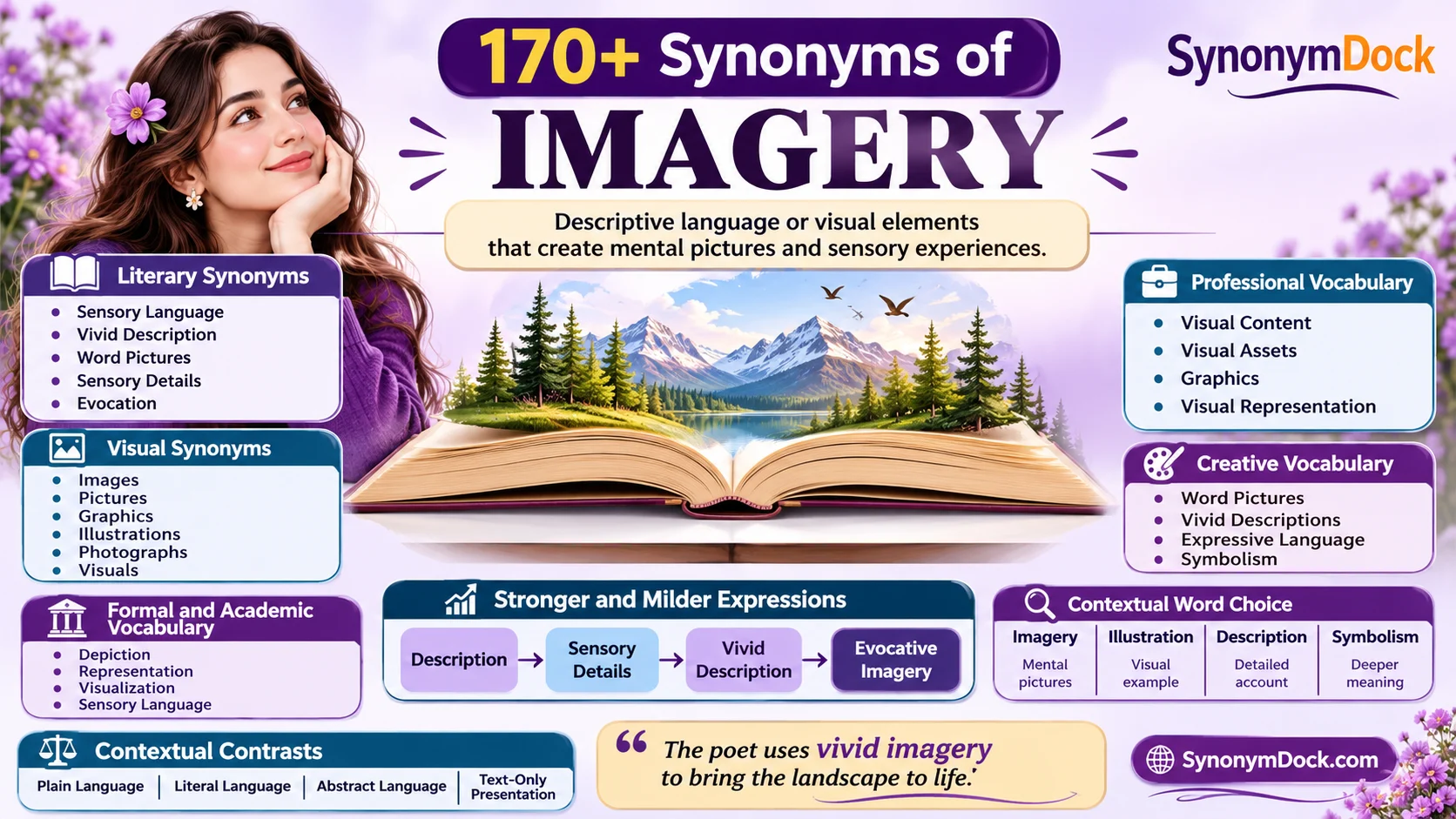
A suitable synonym of imagery depends on what you want to describe. You might mean descriptive language that creates mental pictures, visual representations, artistic images, or the overall visual impression of something. Understanding these differences helps you communicate more precisely.
In this guide, you will discover more than1750 synonyms of imagery, explore their meanings, compare similar words, and learn which alternatives work best in academic, professional, creative, and everyday writing.
What Are the Best Synonyms of Imagery?
Imagery refers to descriptive language that creates sensory experiences or mental pictures, as well as visual representations and collections of images. Its best synonyms include description, visualization, illustration, symbolism, visual representation, and word pictures, depending on context.
For different situations, consider these alternatives:
- Formal writing: Visual representation, depiction, illustration.
- Casual conversation: Pictures, visuals, descriptions.
- Academic writing: Sensory language, symbolism, visual representation.
- Professional communication: Visual content, graphics, illustrations.
- Emotional writing: Evocation, expression, word pictures.
- Creative writing: Descriptive language, word pictures, sensory details.
The most accurate alternative depends on whether imagery refers to literary language, mental pictures, or actual visual material.
Meaning, Tone, and Context
Simple Definition
Imagery is the use of descriptive words, expressions, or visual elements to help someone imagine how something looks, sounds, feels, tastes, or smells.
In literature, imagery helps readers experience a scene through sensory details. In design, marketing, and communication, the word can describe photographs, graphics, illustrations, and other visual material.
For example:
“The author uses vivid imagery to describe the peaceful countryside.”
Here, imagery refers to descriptive language that helps readers picture the setting.
“The website uses attractive imagery to present its products.”
In this sentence, imagery refers to visual content.
Part of Speech
Imagery is a noun.
It is generally an uncountable noun when discussing descriptive language or visual material collectively.
Overall Tone
Imagery is generally neutral and descriptive. However, its effect depends on the surrounding context.
In literature, it often suggests creativity, emotional expression, and sensory detail. In business and design, it usually refers to visual communication or presentation.
Formality Level
Imagery is a neutral to semi-formal word that also appears frequently in academic and professional writing.
It is particularly common in:
- Literary analysis.
- Academic essays.
- Creative writing.
- Advertising and marketing.
- Graphic design.
- Photography.
- Visual communication.
Common Uses
Native English speakers commonly use imagery when discussing:
- Literature: Descriptive language that creates sensory experiences.
- Poetry: Expressions that communicate feelings through sensory details.
- Storytelling: Descriptions that help readers imagine events and settings.
- Marketing: Photographs and graphics used to attract customers.
- Advertising: Visual elements that communicate a brand’s message.
- Design: Pictures, illustrations, and other visual components.
- Psychology: Mental pictures and representations formed in the mind.
Word Forms
- Imagery: Noun, descriptive or visual material.
- Image: Noun, a picture or mental representation.
- Imagine: Verb, to form a mental picture.
- Imaginary: Adjective, existing in the imagination rather than reality.
- Imaginative: Adjective, showing creativity or originality.
When and How to Use Imagery
Use imagery when you want to discuss descriptive language, sensory experiences, mental pictures, or visual material.
Here are seven practical examples.
1. Professional Context
“The marketing team selected compelling imagery for the company’s new advertising campaign.”
2. Academic Context
“The poet uses natural imagery to communicate the relationship between humanity and the environment.”
3. Workplace Context
“Our presentation needs stronger imagery to make the main findings easier to understand.”
4. Personal Context
“The beautiful imagery in the novel reminded me of my childhood home.”
5. Email Context
“Please review the imagery included in the presentation before we share it with the client.”
6. Resume Context
“Created engaging visual content and supporting graphics for digital marketing campaigns.”
7. Social Media Context
“The imagery in this travel post captures the beauty of the mountains perfectly.”
Best Synonyms of Imagery
No synonym of imagery works equally well in every situation. Some alternatives describe literary techniques, while others refer to pictures, illustrations, or mental representations.
Here are the best choices by context.
| Context | Best Synonym | Why It Works |
| Professional writing | Visual representation | Clearly describes information presented visually. |
| Academic writing | Sensory language | Emphasizes descriptions involving the senses. |
| Business communication | Visual content | Refers naturally to photographs, graphics, and other media. |
| Casual conversation | Pictures | Provides a simple alternative when discussing actual images. |
| Emotional writing | Evocation | Highlights the feelings or experiences created by descriptive language. |
| Creative writing | Word pictures | Emphasizes language that helps readers imagine scenes. |
| Resume writing | Visual assets | Describes photographs, graphics, and other design resources. |
| Workplace communication | Illustrations | Works when referring to explanatory drawings or visual examples. |
| Stronger meaning | Vivid description | Emphasizes detailed and expressive language. |
| Softer meaning | Description | Communicates information without necessarily suggesting strong sensory detail. |
When Not to Use Imagery
Although imagery is a useful word, certain situations call for a more precise alternative.
1. When the Meaning Is Too General
Less effective: “The report contains interesting imagery.”
Better: “The report contains informative charts and graphics.”
Why: Charts and graphics identify the actual visual elements instead of using a broad term.
2. When You Mean a Written Description
Less effective: “The author includes beautiful imagery of the garden.”
Better: “The author includes vivid descriptions of the garden.”
Why: Descriptions more directly identify the author’s use of language.
3. When You Mean a Single Picture
Less effective: “Please send me the imagery from the presentation.”
Better: “Please send me the images from the presentation.”
Why: Images is more natural when requesting specific pictures.
4. When You Mean a Mental Picture
Less effective: “She developed imagery of her future home.”
Better: “She developed a mental picture of her future home.”
Why: Mental picture communicates the intended meaning more clearly.
5. When You Mean an Explanatory Drawing
Less effective: “The manual includes useful imagery of the installation process.”
Better: “The manual includes useful diagrams of the installation process.”
Why: Diagrams specifically explain structures, processes, and relationships.
6. When You Mean a Literary Technique
Less effective: “The writer uses pictures to communicate the sadness of the scene.”
Better: “The writer uses sensory language to communicate the sadness of the scene.”
Why: Sensory language better describes the literary technique.
Words Commonly Confused With Imagery
Several words are closely related to imagery, but their meanings are not identical.
1. Imagery vs. Image
Difference: An image is an individual picture or mental representation. Imagery usually describes visual material collectively or the use of sensory language.
When to Use It: Use image for one picture and imagery for a broader collection or descriptive technique.
Example: The image shows a beautiful sunset, while the poem uses sunset imagery throughout.
2. Imagery vs. Imagination
Difference: Imagination is the ability to create ideas or mental pictures. Imagery refers to the descriptive language or representations that communicate those pictures.
When to Use It: Use imagination when discussing creativity and mental ability.
Example: Her imagination helped her create vivid imagery for the story.
3. Imagery vs. Illustration
Difference: An illustration is a drawing or visual explanation. Imagery can include illustrations, but it also refers to descriptive language.
When to Use It: Choose illustration when discussing a specific drawing or explanatory visual.
Example: The textbook includes an illustration of the human heart.
4. Imagery vs. Description
Difference: Description provides information about a person, object, place, or experience. Imagery specifically creates sensory impressions or visual representations.
When to Use It: Use description for general explanations and imagery when sensory or visual impact matters.
Example: The author’s description of the forest contains vivid natural imagery.
5. Imagery vs. Symbolism
Difference: Imagery creates sensory impressions, while symbolism uses objects, colors, or ideas to represent deeper meanings.
When to Use It: Choose symbolism when discussing hidden meanings or literary representations.
Example: The author uses dark imagery and symbolism to communicate fear and uncertainty.
Best Synonyms of Imagery by Context
The following table shows how to select an alternative according to your writing purpose.
| Context | Best Synonym | Why It Works | Example |
| Formal writing | Depiction | Describes how something is represented. | The novel offers a realistic depiction of rural life. |
| Academic writing | Sensory language | Identifies descriptive language involving the senses. | The poem uses sensory language to establish its atmosphere. |
| Professional communication | Visual content | Refers to media used in professional materials. | The website needs updated visual content. |
| Business emails | Graphics | Identifies visual elements in documents. | Please include the updated graphics in the email. |
| Resume writing | Visual assets | Describes design resources and media. | Managed visual assets for marketing campaigns. |
| Workplace communication | Illustrations | Helps explain ideas through drawings. | The training guide includes helpful illustrations. |
| Casual conversation | Pictures | Provides a familiar alternative. | I love the pictures in that travel magazine. |
| Everyday speaking | Images | Works naturally when referring to pictures. | The images in the presentation look great. |
| Creative writing | Word pictures | Emphasizes expressive descriptive language. | Her word pictures brought the setting to life. |
| Storytelling | Vivid descriptions | Creates a strong sense of place and experience. | Vivid descriptions made the journey memorable. |
| Emotional writing | Evocation | Highlights the feelings created by language. | The poem’s evocation of loss is powerful. |
| Strong emphasis | Vivid imagery | Emphasizes memorable sensory detail. | The author creates vivid imagery through precise language. |
| Mild tone | Description | Communicates details without strong emotional emphasis. | The report provides a clear description of the scene. |
| Social media captions | Visuals | Refers to photographs and other visual material. | The campaign combines engaging captions with appealing visuals. |
| American English | Visuals | A natural general term for visual material. | The presentation needs more visuals. |
| British English | Images | A widely understood and natural alternative. | The article includes several historical images. |
How to Choose the Best Synonym of Imagery
Choosing the right alternative requires more than finding a word with a similar dictionary meaning. Consider the specific message you want to communicate.
1. Consider the Meaning
First, identify what imagery represents in your sentence.
- If it means descriptive language, consider sensory language or vivid description.
- If it means photographs, consider images or pictures.
- If it means visual design material, consider graphics or visual content.
- If it means mental representations, consider mental pictures or visualization.
- If it means deeper literary meaning, consider symbolism when appropriate.
2. Consider the Tone
Different alternatives create different impressions.
For example, visual representation sounds technical and professional, while word pictures sounds more expressive and creative.
3. Consider Your Audience
Academic readers may expect precise literary terminology. Meanwhile, everyday readers usually respond better to straightforward words such as pictures, descriptions, and visuals.
4. Consider Emotional Strength
Use vivid descriptions when you want to create a strong sensory impression. Choose neutral terms such as depiction or representation when you simply want to explain how something appears.
5. Consider Your Writing Purpose
The best choice also depends on the type of content.
- Essays: Sensory language, symbolism, description.
- Reports: Visual representation, graphics, illustrations.
- Emails: Images, visuals, graphics.
- Stories: Word pictures, vivid descriptions, sensory details.
- Marketing: Visual content, photographs, creative assets.
6. Check Natural Usage
Read the complete sentence after replacing imagery. If the alternative sounds unnatural or changes the intended meaning, select a more accurate word.
The goal is clarity, not complexity.
Real Life Examples of Imagery
These examples demonstrate how imagery and its alternatives appear in everyday communication.
1. School
Original: “The author uses imagery to describe the ocean.”
Improved: “The author uses sensory language to describe the ocean.”
2. College
Original: “The poem contains beautiful imagery.”
Improved: “The poem contains vivid descriptions of nature.”
3. Workplace
Original: “We should improve the imagery in our training materials.”
Improved: “We should improve the illustrations in our training materials.”
4. Business
Original: “Our brand needs better imagery.”
Improved: “Our brand needs more consistent visual content.”
5. Email
Original: “I have attached the imagery for your review.”
Improved: “I have attached the images for your review.”
6. Resume
Original: “Responsible for creating imagery for promotional campaigns.”
Improved: “Created graphics and visual assets for promotional campaigns.”
7. Conversation
Original: “The imagery in that movie was incredible.”
Improved: “The visuals in that movie were incredible.”
8. Storytelling
Original: “The imagery made the forest seem mysterious.”
Improved: “The vivid descriptions made the forest seem mysterious.”
9. Blogging
Original: “Strong imagery helps readers understand the topic.”
Improved: “Relevant illustrations help readers understand the topic.”
10. Social Media
Original: “The imagery makes this travel post attractive.”
Improved: “The photographs make this travel post attractive.”
11 Best Synonyms of Imagery
The following 18 alternatives cover the most useful meanings of imagery. Some are especially suitable for literary descriptions, while others work better for visual communication.
| Synonym | Simple Meaning | Best Used For | Example Sentence |
| 1. Description | Words that explain how something looks or feels. | General and creative writing. | Her description of the village was detailed. |
| 2. Depiction | A representation of a person, place, or event. | Formal and academic writing. | The novel offers a powerful depiction of poverty. |
| 3. Illustration | A drawing or visual explanation. | Educational and professional content. | The illustration explains the process clearly. |
| 4. Representation | The way something is shown or presented. | Academic and formal writing. | The painting is a representation of urban life. |
| 5. Visualization | The process of forming a mental picture or presenting information visually. | Psychology, education, and design. | Visualization helped the students understand the concept. |
| 6. Pictures | Visual representations of people, objects, or scenes. | Everyday communication. | The book contains beautiful pictures of wildlife. |
| 7. Images | Individual pictures or visual representations. | General and professional writing. | The article includes historical images. |
| 8. Visuals | Photographs, graphics, and other visual elements. | Marketing and presentations. | The presentation needs more engaging visuals. |
| 9. Graphics | Designed visual elements used to communicate information. | Business and digital media. | The designer created new graphics for the website. |
| 10. Photographs | Pictures captured using a camera. | Journalism and photography. | The photographs show the beauty of the landscape. |
| 11. Sensory language | Words that describe experiences through the senses. | Literature and academic analysis. | The poet uses sensory language to describe the rain. |
Important usage note: These alternatives are related to different senses of imagery. For example, symbolism is not interchangeable with photographs, and sensory language is not interchangeable with graphics. Always select an alternative that preserves your intended meaning.
Synonyms of Imagery by Usage
Professional vs. Personal Synonyms
Professional alternatives:
- Visual content.
- Graphics.
- Illustrations.
- Visual assets.
- Visual representation.
- Depiction.
These terms work well in business documents, presentations, marketing reports, and workplace discussions.
Personal alternatives:
- Pictures.
- Images.
- Descriptions.
- Mental pictures.
- Word pictures.
- Visuals.
These choices generally sound natural in conversations, personal writing, and informal communication.
Formal vs. Conversational Synonyms
Formal vocabulary is particularly useful when accuracy and professional presentation matter.
| Writing Situation | Recommended Synonyms |
| Reports | Visual representation, depiction |
| Essays | Sensory language, symbolism |
| Business writing | Visual content, graphics |
| Presentations | Illustrations, visuals |
| Professional emails | Images, graphics |
| Casual conversations | Pictures, visuals |
| Texting | Pics, pictures |
| Creative discussions | Word pictures, vivid descriptions |
The best approach is to choose words that suit your audience rather than automatically using more complicated vocabulary.
Academic Synonyms
Academic writing often requires precise language to explain how authors communicate ideas through sensory descriptions and visual representations.
Consider these alternatives:
1. Sensory Language
Useful when analyzing how a writer appeals to sight, hearing, touch, taste, or smell.
Example: “The poet’s sensory language creates a vivid impression of the natural environment.”
2. Sensory Details
Suitable for explaining specific descriptive elements in literature.
Example: “The narrative uses sensory details to establish the atmosphere.”
3. Symbolism
Appropriate when discussing objects or images that communicate deeper meanings.
Example: “The repeated use of light represents hope through symbolism.”
4. Depiction
Useful when explaining how a writer represents a person, event, or setting.
Example: “The author’s depiction of urban life reflects social inequality.”
5. Representation
Suitable for academic discussions about how subjects, concepts, or experiences are presented.
Example: “The visual representation communicates the relationship between the variables.”
Professional and Business Synonyms
Business communication usually benefits from specific terms that explain what visual material is being discussed.
| Situation | Recommended Alternative | Example |
| Resume | Visual assets | Managed visual assets for marketing campaigns. |
| Interview | Visual content | I developed visual content for digital promotions. |
| Meetings | Graphics | The updated graphics explain the results. |
| Presentations | Visuals | We added visuals to improve the presentation. |
| Performance reviews | Illustrations | The illustrations made the training material clearer. |
| Client communication | Images | Please review the attached images. |
| Business emails | Graphics | The graphics are ready for approval. |
Creative and Literary Synonyms
Creative writing often benefits from expressive alternatives that help readers experience a scene.
1. Word Pictures
These are descriptive expressions that help readers form mental images.
2. Vivid Descriptions
These communicate scenes through detailed and memorable language.
3. Sensory Details
These bring writing to life through the five senses.
4. Evocation
This emphasizes the feelings, memories, or impressions created by descriptive language.
5. Symbolism
This communicates deeper ideas through objects, colors, images, or actions.
6. Descriptive Language
This is a broad term for words and expressions that provide details about a subject.
For example, a writer might use sensory details to describe a rainy evening, while symbolism could give that same rain a deeper meaning within the story.
Slang or Modern Synonyms
There is no single widely accepted slang synonym for imagery that works in every context.
However, some informal alternatives are common when discussing actual pictures and visual material.
| Informal Term | Meaning | Where It Is Acceptable |
| Pics | Informal word for pictures. | Texting and casual conversations. |
| Photos | Pictures captured with a camera. | Everyday and social media communication. |
| Vids | Informal abbreviation for videos, not a direct synonym for imagery. | Casual conversations about visual media. |
Avoid informal abbreviations such as pics in academic essays, formal reports, and professional documents.
Strongest to Mildest Synonyms
Imagery itself does not have one fixed intensity level. Its emotional strength depends on the descriptive details and the context.
However, when discussing descriptive language, the following approximate scale can help.
| Intensity | Related Expression | Effect |
| Mild | Description | Provides basic information. |
| Mild to moderate | Depiction | Presents a subject clearly. |
| Moderate | Sensory details | Adds specific sensory information. |
| Strong | Vivid description | Creates a memorable impression. |
| Very strong | Evocative imagery | Creates powerful emotional or sensory associations. |
This is a practical expressive scale, not a strict linguistic ranking. For visual material, terms such as photograph, illustration, and graphic describe the type of content rather than its emotional intensity.
Emotional vs. Neutral Synonyms
Emotional Alternatives
These words emphasize feelings, memories, and sensory experiences.
- Evocation.
- Word pictures.
- Vivid descriptions.
- Sensory details.
- Expressive language.
Use these alternatives when discussing poetry, fiction, speeches, and emotional storytelling.
Neutral Alternatives
These words communicate visual or descriptive information without necessarily creating an emotional effect.
- Images.
- Pictures.
- Graphics.
- Illustrations.
- Representation.
- Depiction.
- Visual content.
Use them in reports, presentations, professional communication, and general explanations.
Antonyms of Imagery
Imagery does not have a single direct antonym because it refers to different things, including sensory language, mental pictures, and visual material.
For example, the opposite of vivid descriptive language may be plain or literal language. Meanwhile, the opposite of visual presentation may be text-only or nonvisual communication.
Therefore, the following are contextual contrasts rather than universal dictionary antonyms.
| Opposing Term | Meaning | Example Sentence |
| 1. Plain language | Simple wording without elaborate description. | The report uses plain language instead of elaborate descriptions. |
| 2. Literal language | Language that communicates its direct meaning. | The instructions use literal language to avoid confusion. |
| 3. Abstract language | Language expressing general ideas rather than sensory details. | The essay relies on abstract language to discuss freedom. |
| 4. Factual language | Language focused on information and facts. | The report uses factual language throughout. |
| 5. Nonvisual content | Information presented without visual elements. | The document contains nonvisual content only. |
| 6. Text-only presentation | A presentation consisting exclusively of written text. | The original report used a text-only presentation. |
| 7. Verbal explanation | Information communicated through spoken or written words. | The instructor provided a verbal explanation instead of diagrams. |
| 8. Prose explanation | An explanation presented through ordinary written language. | The manual uses a prose explanation of the process. |
| 9. Minimal description | A brief account with very few descriptive details. | The writer provides a minimal description of the setting. |
| 10. Undetailed account | An account that provides little descriptive information. | The article gives an undetailed account of the event. |
These words should be used only when they express the intended contrast. They are not interchangeable with one another.
Comparison: Imagery vs. Similar Words
Understanding the differences between related terms helps prevent inaccurate word choices.
1. Imagery vs. Description
Main Difference
Imagery creates sensory impressions or mental pictures, while description provides details about a person, object, place, or event.
Which Is Stronger?
Imagery often creates a stronger sensory effect, although a description can also be vivid.
Which Is More Formal?
Both words are suitable for formal writing. Imagery is especially useful in literary analysis.
When to Use Each
Use imagery when discussing sensory effects. Choose description when discussing general details.
Examples
Imagery: “The poet uses imagery to bring the storm to life.”
Description: “The author provides a detailed description of the storm.”
2. Imagery vs. Illustration
Main Difference
Imagery can refer to descriptive language or visual material, while an illustration is a specific drawing or visual explanation.
Which Is Stronger?
Neither is inherently stronger. They refer to different types of communication.
Which Is More Formal?
Both are appropriate for academic and professional writing.
When to Use Each
Use imagery for a broader collection of sensory or visual elements. Use illustration for a specific visual example.
Examples
Imagery: “The novel contains powerful natural imagery.”
Illustration: “The textbook includes an illustration of the water cycle.”
3. Imagery vs. Visualization
Main Difference
Imagery can refer to sensory descriptions or visual representations. Visualization specifically refers to forming mental pictures or presenting information visually.
Which Is Stronger?
Neither word has a consistently stronger meaning.
Which Is More Formal?
Both work in formal contexts, particularly in psychology, education, and professional communication.
When to Use Each
Choose imagery for literary and visual descriptions. Choose visualization when emphasizing the process of mentally or visually representing something.
Examples
Imagery: “The author uses imagery to describe the landscape.”
Visualization: “The students used visualization to understand the scientific process.”
4. Imagery vs. Symbolism
Main Difference
Imagery appeals to the senses, while symbolism uses something to represent a deeper idea.
Which Is Stronger?
Symbolism may carry a deeper interpretive meaning, while imagery may create a stronger sensory impression.
Which Is More Formal?
Both are commonly used in academic literary analysis.
When to Use Each
Choose imagery when analyzing sensory language. Choose symbolism when explaining hidden or representative meanings.
Examples
Imagery: “The writer uses dark imagery to create an unsettling atmosphere.”
Symbolism: “The broken mirror represents the character’s damaged identity.”
5. Imagery vs. Image
Main Difference
An image is an individual picture or mental representation. Imagery refers to descriptive language or visual material collectively.
Which Is Stronger?
Neither is stronger because they serve different grammatical and semantic purposes.
Which Is More Formal?
Both are appropriate for professional and academic writing.
When to Use Each
Use image for a particular picture. Use imagery when discussing a broader visual or literary effect.
Examples
Imagery: “The poem contains striking natural imagery.”
Image: “The photographer captured a beautiful image of the mountains.”
6. Imagery vs. Representation
Main Difference
Imagery often creates sensory impressions or visual associations. Representation describes how an object, idea, person, or event is presented.
Which Is Stronger?
Imagery may be more expressive, while representation is generally more neutral and analytical.
Which Is More Formal?
Representation is particularly common in academic and technical writing. Imagery is also suitable for formal literary discussions.
When to Use Each
Use imagery to discuss descriptive or sensory effects. Choose representation to explain how something is portrayed.
Examples
Imagery: “The author uses vivid imagery to describe the countryside.”
Representation: “The painting is a representation of traditional rural life.”
Common Phrases and Expressions with Imagery
These expressions are useful in literature, academic writing, creative content, and visual communication.
1. Vivid Imagery
Meaning: Descriptive language that creates strong and memorable sensory impressions.
Example: “The novelist uses vivid imagery to describe the tropical forest.”
2. Visual Imagery
Meaning: Descriptions or representations that primarily appeal to the sense of sight.
Example: “The poem contains visual imagery of mountains and rivers.”
3. Sensory Imagery
Meaning: Descriptive language that appeals to one or more of the five senses.
Example: “The writer uses sensory imagery to make the kitchen scene realistic.”
4. Religious Imagery
Meaning: Visual or descriptive elements associated with religious beliefs, traditions, or ideas.
Example: “The artwork incorporates religious imagery throughout its composition.”
5. Natural Imagery
Meaning: Descriptions or representations involving nature and the natural environment.
Example: “The poet uses natural imagery to establish a peaceful atmosphere.”
6. Powerful Imagery
Meaning: Descriptive or visual material that creates a strong impression.
Example: “The documentary uses powerful imagery to communicate the effects of pollution.”
7. Figurative Imagery
Meaning: Descriptive expressions that use figurative language to communicate ideas or experiences.
Example: “The writer combines figurative imagery with symbolism to develop the poem’s central theme.”
8. Imagery in Literature
Meaning: The use of descriptive language to create sensory experiences for readers.
Example: “Imagery in literature helps readers connect with characters and settings.”
Common Mistakes to Avoid
Choosing an unsuitable synonym can change the meaning of an otherwise correct sentence. Understanding these common mistakes helps you use imagery and its alternatives more accurately.
Mistake 1: Using a Vague Synonym
Incorrect: “The company needs better pictures in its marketing strategy.”
Better: “The company needs more engaging visual content in its marketing strategy.”
Why: Visual content is more suitable when discussing a broader collection of marketing materials, including photographs, graphics, and illustrations.
Mistake 2: Confusing Imagery With Imagination
Incorrect: “The writer’s imagery helped her invent the entire story.”
Better: “The writer’s imagination helped her invent the entire story.”
Why: Imagination describes the ability to create ideas, while imagery refers to descriptive language or visual representations.
Mistake 3: Using Informal Words in Formal Writing
Incorrect: “The research paper includes some cool pics of the experiment.”
Better: “The research paper includes relevant photographs of the experiment.”
Why: Photographs sounds more professional and identifies the visual material precisely.
Mistake 4: Choosing an Overly Dramatic Alternative
Incorrect: “The report uses breathtaking word pictures to explain the financial results.”
Better: “The report uses clear visual representations to explain the financial results.”
Why: Breathtaking word pictures sounds unnecessarily emotional in a business context.
Mistake 5: Repeating the Same Word Too Often
Incorrect: “The imagery in the poem is beautiful. The imagery also creates emotion, and the imagery helps readers understand the theme.”
Better: “The poem’s imagery is beautiful. Its sensory details create emotion, while its symbolism helps readers understand the theme.”
Why: Using accurate alternatives improves sentence variety without changing the meaning.
Mistake 6: Choosing a Word With the Wrong Meaning
Incorrect: “The photograph uses symbolism to show the location of the building.”
Better: “The photograph provides a visual representation of the building’s location.”
Why: Symbolism suggests a deeper representative meaning, not simply the presentation of information.
Mistake 7: Using Slang in Academic or Professional Writing
Incorrect: “The presentation needs more pics to explain the results.”
Better: “The presentation needs more graphics to explain the results.”
Why: Graphics is a more appropriate choice for professional presentations and explanatory materials.
Frequently Asked Questions
1. What are the best synonyms of imagery?
The best synonyms of imagery include description, depiction, illustration, visualization, sensory language, visual representation, word pictures, and visual content. The right choice depends on whether you mean literary descriptions or actual visual material.
2. What are the best formal synonyms of imagery?
Formal alternatives include visual representation, depiction, illustration, sensory language, and representation. These terms work well in academic essays, professional reports, literary analysis, and business communication.
3. What are common informal synonyms of imagery?
Common informal alternatives include pictures, images, visuals, and photos. These words are particularly useful in everyday conversations, casual emails, and social media discussions about visual content.
4. What is another word for imagery in professional writing?
Visual content is a useful alternative in professional writing when discussing photographs, graphics, and other media. For literary or descriptive contexts, consider sensory language, depiction, or visual representation.
5. What is the difference between imagery and description?
Description provides information about a subject, while imagery creates sensory impressions or mental pictures. A description can be straightforward, whereas imagery often emphasizes how readers experience a scene.
6. What is the opposite of imagery?
Imagery has no single direct antonym. Depending on context, possible contrasts include plain language, literal language, abstract language, text-only presentation, and unembellished prose.
Conclusion
Imagery refers to descriptive language that creates sensory experiences and mental pictures, as well as visual material used to communicate ideas. Its best alternatives include description, depiction, illustration, sensory language, visualization, and visual representation. However, no synonym works perfectly in every situation. Choose your words according to their meaning, audience, tone, and purpose. For stronger writing, identify what imagery represents in your sentence before replacing it with another word.
A simple vocabulary improvement tip is to read your sentence after making a substitution. If the alternative communicates your intended meaning more clearly and naturally, it is probably the right choice. Understanding the differences between a synonym of imagery and related expressions will help you write with greater accuracy, confidence, and variety.

Ethan Parker is an English language writer and vocabulary enthusiast at SynonymDock.com. He specializes in synonyms, word meanings, alternative expressions and practical English usage, creating clear and reliable content to help students, professionals, writers and English learners choose the right words with confidence.
9 thoughts on “Synonyms of Imagery|170 + Words for Better Expression”