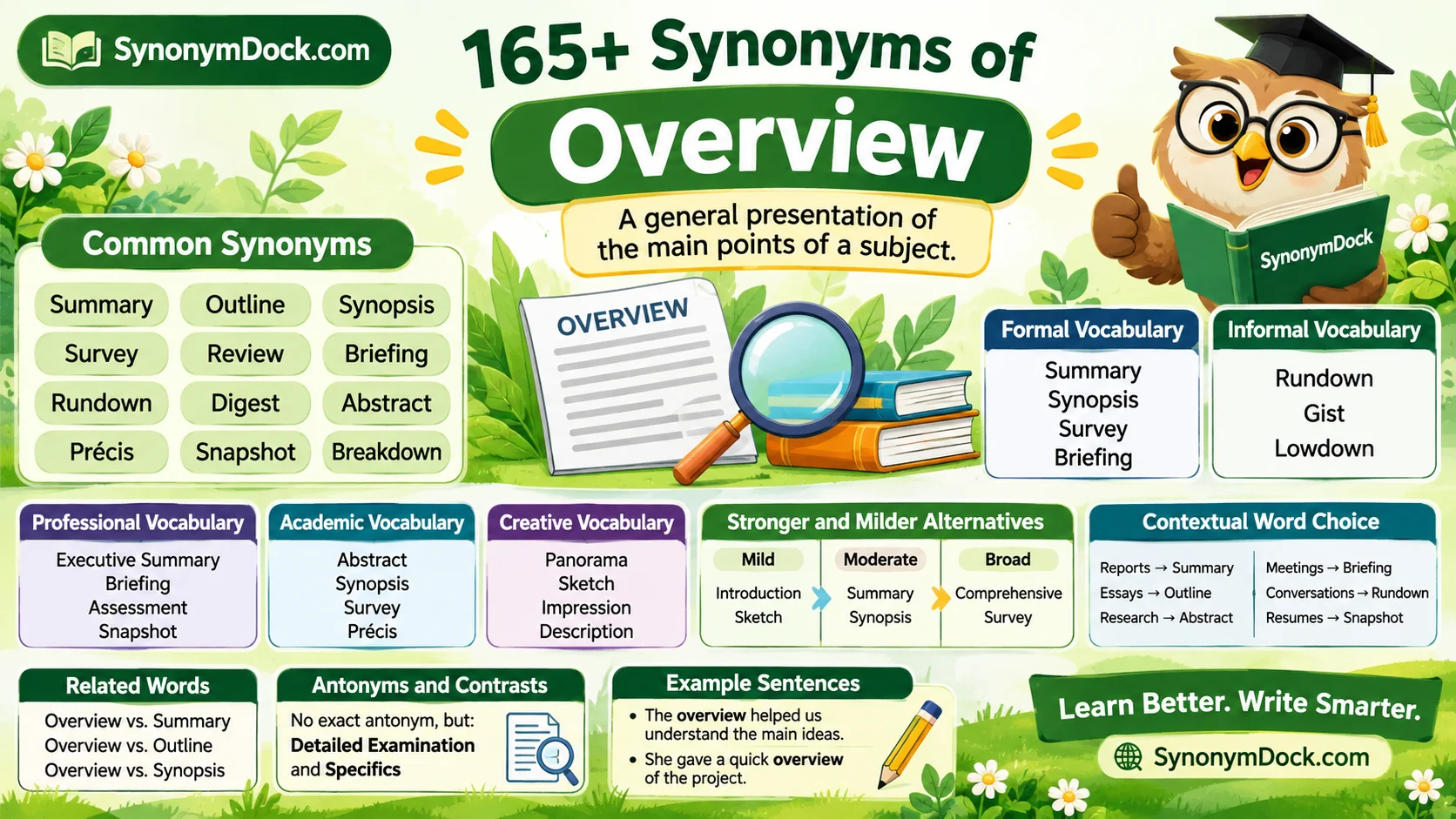
Finding the right synonym of overview can make your communication clearer, more natural, and more engaging. For example, summary works well when you want to present the main points of a subject, while outline is better when you want to show its structure.
However, these alternatives are not interchangeable in every situation. Understanding their differences helps you choose words that match your audience, purpose, and writing style.
This guide explores the meaning of overview, its most useful synonyms, contextual differences, real-world examples, and common mistakes. Whether you are a student, professional, writer, or English learner, you will discover how to select the most appropriate alternative confidently.
What Are the Best Synonyms of “Overview”?
An overview is a general explanation or presentation of the main points of a subject without discussing every detail. The best synonyms include summary, outline, synopsis, survey, review, briefing, and rundown. Use summary for concise writing, outline for structure, and briefing for professional communication.
Best Alternatives by Context
| Context | Best Synonym |
| Formal writing | Summary |
| Casual conversation | Rundown |
| Academic writing | Synopsis |
| Professional communication | Briefing |
| Business reports | Executive summary |
| Emotional writing | Impression |
| Creative writing | Panorama |
| Research papers | Abstract |
| Presentations | Snapshot |
| General explanations | Survey |
The best choice depends on what you want your reader to understand. Therefore, consider whether you are summarizing information, describing a structure, introducing a topic, or reviewing a situation.
Meaning, Tone, and Context of Overview
Simple Definition
An overview is a general explanation or description that presents the main features, important points, or overall picture of a subject.
It gives readers enough information to understand a topic without requiring them to examine every detail.
For example:
“The manager provided an overview of the company’s annual performance.”
This sentence means the manager explained the main aspects of the company’s performance rather than discussing every individual result.
Part of Speech
Overview is a noun.
It commonly appears as a singular or plural noun.
Examples:
- The report provides an overview of the project.
- We need an overview before discussing the details.
- The presentation includes several overviews of current business operations.
Overall Tone
Overview generally has a neutral, informative, and professional tone.
It does not normally express strong positive or negative emotions. Instead, it communicates that information is being presented at a general level.
Depending on the context, it can sound academic, professional, educational, or conversational.
Formality Level
Overview is a neutral to semi-formal word.
It works naturally in:
- Business reports.
- Academic assignments.
- Professional emails.
- Research presentations.
- Educational materials.
- Project documentation.
- Workplace discussions.
It is also common in everyday conversations, particularly when someone wants to understand a subject before exploring its details.
Is Overview Positive, Neutral, or Negative?
Overview is generally neutral.
It does not automatically suggest that something is good or bad. Its meaning depends on the information being presented.
For example:
“The report provides an overview of the successful campaign.”
Here, successful creates the positive meaning, not overview itself.
Common Uses of Overview
Native English speakers commonly use overview when introducing a subject or presenting its main features.
Typical expressions include:
- An overview of the project.
- A general overview of the situation.
- A brief overview of the findings.
- An overview of the company.
- A comprehensive overview of the process.
- A quick overview of the topic.
- An overview of current developments.
Word Forms and Related Expressions
| Word or Expression | Part of Speech | Meaning |
| Overview | Noun | A general presentation of a subject |
| Overviews | Plural noun | General presentations of multiple subjects |
| Overviewing | Rare or specialized usage | Presenting a general view, generally better expressed with another verb |
| Overview section | Noun phrase | A section introducing the main points |
| Overview page | Noun phrase | A page presenting general information |
There is no commonly used adjective or adverb directly derived from overview. In most situations, phrases such as general, comprehensive, and brief provide the necessary description.
When and How to Use “Overview”
Use overview when you want to introduce a subject, explain its main features, or help someone understand the bigger picture before examining specific information.
It is particularly useful when the reader needs context rather than an exhaustive explanation.
Here are seven realistic examples.
1. Professional Context
“The director presented an overview of the organization’s strategic objectives.”
This example introduces the main business goals without explaining every individual action.
2. Academic Context
“The first chapter provides an overview of the research methodology.”
Here, overview introduces the general research approach before the detailed discussion.
3. Workplace Context
“Let’s review the project overview before assigning responsibilities.”
The word helps team members understand the project’s scope before discussing individual tasks.
4. Personal Context
“Could you give me an overview of your travel plans?”
This sounds natural when asking someone to explain their plans generally.
5. Email Context
“Please find a brief overview of the proposed changes below.”
This is a polite and professional way to introduce important information in an email.
6. Resume Context
“Developed project overviews to communicate key objectives, timelines, and deliverables.”
This example demonstrates an ability to organize and communicate information clearly.
7. Social Media Context
“Here’s a quick overview of everything we accomplished this month.”
The phrase is suitable for an informative social media update.
Best Synonyms of “Overview”
No synonym of overview communicates exactly the same meaning in every situation. Some alternatives emphasize a short explanation, while others focus on organization, evaluation, or general coverage.
Therefore, choosing the right word requires understanding its specific purpose.
Best Synonyms by Writing Purpose
Professional writing: Summary
Summary is an excellent alternative when presenting the main points of a document, project, or discussion. It sounds clear, professional, and direct.
Academic writing: Synopsis
Synopsis works particularly well when briefly describing the central ideas or contents of a book, research project, or academic subject.
Business communication: Briefing
Briefing is suitable when communicating essential information to colleagues, managers, or decision-makers before an important discussion.
Casual conversation: Rundown
Rundown sounds natural when asking someone to explain what happened or provide the important details of a situation.
Emotional writing: Impression
Impression works when describing the general feeling or perception someone develops about a person, experience, or situation. However, it is not a direct replacement in factual reporting.
Creative writing: Panorama
Panorama can describe a broad or sweeping view of a subject, situation, or environment. It is particularly useful when expressive language is appropriate.
Resume writing: Snapshot
Snapshot communicates a concise picture of professional experience, qualifications, or achievements. It can work well in descriptions of professional profiles and business documents.
Workplace communication: Briefing
Briefing emphasizes the practical information employees need before beginning a task, meeting, or project.
Stronger meaning: Comprehensive survey
A comprehensive survey emphasizes broad coverage of a subject. It is suitable when the explanation examines multiple important aspects rather than merely introducing a topic.
Softer meaning: Introduction
Introduction works when the purpose is simply to familiarize readers with a subject. It suggests an initial explanation rather than a complete account.
When Not to Use “Overview”
Although overview is versatile, some situations require a more precise alternative.
1. When You Mean a Shortened Version
Less effective: The manager prepared an overview of the meeting.
Better: The manager prepared a summary of the meeting.
Why: Summary directly communicates that the main points have been condensed.
2. When You Mean a Structured Plan
Less effective: The document provides an overview of the presentation’s sections.
Better: The document provides an outline of the presentation’s sections.
Why: Outline emphasizes organization and structure rather than general explanation.
3. When You Mean an Evaluation
Less effective: The consultant provided an overview of the company’s performance.
Better: The consultant provided an assessment of the company’s performance.
Why: Assessment communicates evaluation and judgment, which overview does not necessarily imply.
4. When You Mean a Very Short Explanation
Less effective: Give me an overview of what happened yesterday.
Better: Give me a quick rundown of what happened yesterday.
Why: Rundown sounds more natural in casual conversations.
5. When You Mean a Research Summary
Less effective: The paper includes an overview of the study’s findings.
Better: The paper includes an abstract summarizing the study’s purpose and findings.
Why: Abstract is a recognized academic component with a specific purpose and format.
6. When You Mean a Detailed Examination
Less effective: The report provides an overview of the financial problems.
Better: The report provides a detailed analysis of the financial problems.
Why: Analysis indicates closer examination, whereas overview suggests a general presentation.
7. When You Mean the First Introduction to a Subject
Less effective: The course begins with an overview of digital marketing fundamentals.
Better: The course begins with an introduction to digital marketing fundamentals.
Why: Introduction emphasizes familiarizing learners with a new subject.
Words Commonly Confused With Overview
Several words have meanings close to overview. However, their differences become important when accuracy matters.
1. Overview vs. Summary
Difference: An overview presents the general picture of a subject, while a summary condenses its most important information.
When to Use It: Choose overview when introducing a topic. Choose summary when reducing longer material to its essential points.
Example:
Overview: The presentation begins with an overview of the company’s operations.
Summary: The manager distributed a summary of the meeting.
2. Overview vs. Outline
Difference: An overview explains the main aspects of a subject, whereas an outline organizes its main points into a structured format.
When to Use It: Use overview for general understanding and outline for showing sections, stages, or planned content.
Example:
Overview: The report provides an overview of the research.
Outline: The student submitted an outline of the research paper.
3. Overview vs. Synopsis
Difference: A synopsis is a condensed account of the main ideas or storyline. An overview offers a broader general introduction.
When to Use It: Choose synopsis when summarizing a book, film, or research project.
Example:
Overview: The teacher gave an overview of the historical period.
Synopsis: The publisher requested a synopsis of the novel.
4. Overview vs. Review
Difference: A review examines or evaluates something, while an overview primarily presents its general features.
When to Use It: Use review when opinions, judgments, or evaluations are important.
Example:
Overview: The report provides an overview of the new software.
Review: The analyst published a review of the software’s performance.
5. Overview vs. Survey
Difference: A survey provides a broad examination of a subject, often covering several aspects. It can also refer to a method of collecting information.
When to Use It: Use survey for a broad examination of a topic or a systematic collection of information.
Example:
Overview: The article gives an overview of renewable energy.
Survey: The researcher conducted a survey of renewable energy policies.
6. Overview vs. Briefing
Difference: A briefing communicates essential information to prepare someone for a particular activity or decision. An overview simply provides a general understanding.
When to Use It: Choose briefing for workplace updates, meetings, and decision-making situations.
Example:
Overview: The website contains an overview of the organization.
Briefing: The manager delivered a briefing before the client meeting.
Best Synonyms of Overview by Context
The following table matches useful alternatives with their most appropriate writing situations.
| Context | Best Synonym | Why It Works | Example |
| Formal writing | Summary | Communicates essential information clearly | The document includes a summary of the proposal. |
| Academic writing | Synopsis | Condenses the main ideas | The researcher prepared a synopsis of the study. |
| Professional communication | Briefing | Emphasizes essential information | The director scheduled a project briefing. |
| Business emails | Summary | Sounds direct and professional | Please review the summary below. |
| Resume writing | Snapshot | Presents a concise professional picture | The profile offers a snapshot of my experience. |
| Workplace communication | Rundown | Makes informal updates sound natural | Give me a quick rundown of the project. |
| Casual conversation | Rundown | Fits everyday spoken English | Here’s a rundown of what happened. |
| Everyday speaking | Summary | Clearly communicates the main points | Can you give me a quick summary? |
| Creative writing | Panorama | Suggests a broad or sweeping view | The novel presents a panorama of city life. |
| Storytelling | Synopsis | Introduces a storyline | The author shared a synopsis of the novel. |
| Emotional writing | Impression | Communicates a general perception | My first impression of the place was positive. |
| Strong emphasis | Comprehensive survey | Highlights broad coverage | The book offers a comprehensive survey of modern literature. |
| Mild tone | Introduction | Suggests an initial explanation | The lesson begins with an introduction to the topic. |
| Social media captions | Snapshot | Creates a concise, accessible description | A snapshot of our latest adventure. |
| American English | Rundown | Common in informal American conversation | Here’s a quick rundown of the schedule. |
| British English | Summary | Widely understood and natural in formal writing | The report includes a summary of the findings. |
These recommendations reflect differences in meaning and context, not simply differences in popularity. For example, briefing is not automatically better than summary. It is better when the communication is intended to prepare someone for a specific activity.
How to Choose the Best Synonym of Overview
Choosing the right synonym becomes easier when you consider six important factors.
1. Consider the Meaning
First, identify exactly what you want to communicate.
Are you presenting the main points, explaining a structure, evaluating something, or introducing a subject?
For instance, outline is appropriate for structure, while summary is better for condensed information.
2. Consider Your Audience
Different audiences respond to different vocabulary choices.
For example, academic readers may expect terms such as synopsis or abstract. However, colleagues discussing a routine task may prefer rundown or summary.
3. Match the Tone
Consider whether your writing should sound formal, neutral, conversational, or creative.
A business report generally benefits from summary or briefing, whereas a casual conversation sounds more natural with rundown.
4. Consider Emotional Strength
Overview is generally neutral. If you want to express an opinion or emotional reaction, consider words such as impression or assessment, depending on the intended meaning.
However, do not choose an emotional alternative when you simply need to communicate factual information.
5. Match Your Writing Purpose
Different documents have different vocabulary requirements.
- Essays: Overview, summary, or introduction.
- Research papers: Abstract or synopsis.
- Business reports: Executive summary.
- Presentations: Briefing or snapshot.
- Resumes: Professional snapshot.
- Casual conversations: Rundown.
6. Choose Natural-Sounding Language
A synonym should fit the entire sentence, not just replace one word.
For example:
Less natural: The manager provided a panorama of the weekly meeting.
More natural: The manager provided a summary of the weekly meeting.
Although panorama can describe a broad view, it sounds unnecessarily creative in this business context.
Real-Life Examples of Overview
Understanding synonyms becomes easier when you see how they work in everyday situations.
School
Original: The teacher gave an overview of the upcoming examination.
Improved: The teacher provided a summary of the examination topics.
College
Original: The professor presented an overview of the research findings.
Improved: The professor presented a synopsis of the research findings.
Workplace
Original: We need an overview of the new project.
Improved: We need a project briefing before assigning responsibilities.
Business
Original: The report contains an overview of our financial performance.
Improved: The report contains an executive summary of our financial performance.
Original: Please send me an overview of the completed tasks.
Improved: Please send me a summary of the completed tasks.
Resume
Original: My resume includes an overview of my professional experience.
Improved: My resume begins with a professional snapshot of my qualifications and experience.
Conversation
Original: Can you give me an overview of the situation?
Improved: Can you give me a quick rundown of the situation?
Storytelling
Original: The introduction provides an overview of the novel.
Improved: The introduction provides a synopsis of the novel’s central storyline.
Blogging
Original: This article provides an overview of healthy eating habits.
Improved: This article offers a practical introduction to healthy eating habits.
Social Media
Original: Here’s an overview of our weekend activities.
Improved: Here’s a snapshot of our weekend adventures.
Notice how the improved examples do more than replace a word. They make the intended message more specific and appropriate for each situation.
12 Best Synonyms of Overview
Here are 12 useful alternatives, including formal, conversational, academic, and professional expressions. The first 15 appear in the main comparison table, followed by three additional alternatives with more specialized meanings.
| Synonym | Simple Meaning | Best Used For | Example Sentence |
| 1. Summary | A shortened presentation of important information | Reports and general writing | The report includes a summary of the findings. |
| 2. Outline | A structured presentation of main points | Essays and planning | She prepared an outline of the presentation. |
| 3. Synopsis | A condensed account of the main ideas | Books, research, and films | The editor requested a synopsis of the novel. |
| 4. Survey | A broad examination of a subject | Academic and informational writing | The textbook provides a survey of modern history. |
| 5. Review | An examination or evaluation | Performance and product discussions | The consultant completed a review of the project. |
| 6. Rundown | A brief explanation of important details | Casual conversations and updates | He gave us a rundown of the schedule. |
| 7. Briefing | Essential information provided before an activity | Business and workplace communication | The team attended a project briefing. |
| 8. Digest | A condensed collection of important information | News and informational content | The newsletter includes a digest of industry updates. |
| 9. Abstract | A concise account of a research paper | Academic writing | The study begins with an abstract. |
| 10. Précis | A concise summary of a longer text | Formal and academic writing | The student wrote a précis of the article. |
| 11. Sketch | A general or preliminary description | Informal and creative writing | The author provided a sketch of the main character. |
| 12. Introduction | An initial explanation of a subject | Educational writing | The introduction explains the basic concepts. |
Three Additional Context-Specific Alternatives
16. Description
A description explains the characteristics or features of something.
Best used for: Introducing people, places, products, or situations.
Example: The website includes a description of the company’s services.
17. Panorama
Panorama suggests a broad or sweeping view of something, often with an expressive or literary tone.
Best used for: Creative writing, historical discussions, and broad descriptive presentations.
Example: The documentary presents a panorama of American cultural history.
18. Executive Summary
An executive summary is a concise presentation of the most important information in a longer business document.
Best used for: Business proposals, strategic plans, and corporate reports.
Example: The proposal begins with an executive summary of its recommendations.
Important usage note: These 18 alternatives are related to overview, but they are not interchangeable. For example, an abstract has a specific academic function, while an executive summary is designed to communicate the essential points of a longer business document.
Synonyms of Overview by Usage
Professional vs. Personal Synonyms
The best alternative depends on whether you are communicating in a professional or personal setting.
Professional alternatives:
- Summary.
- Briefing.
- Executive summary.
- Assessment.
- Survey.
- Snapshot.
These choices work well in reports, presentations, business emails, and workplace discussions.
Personal alternatives:
- Rundown.
- Summary.
- Impression.
- Introduction.
- Description.
For example, you might ask a colleague for a project briefing, but ask a friend for a quick rundown of their vacation.
Formal vs. Conversational Synonyms
Formal vocabulary is useful when clarity and professionalism matter. Conversely, conversational alternatives help make everyday communication sound relaxed.
| Formal Synonym | Conversational Synonym |
| Summary | Rundown |
| Synopsis | Quick summary |
| Briefing | Quick update |
| Survey | General look |
| Précis | Short version |
| Assessment | Take |
Use formal alternatives in reports, essays, presentations, and professional correspondence. Meanwhile, conversational choices are more appropriate for texting, informal meetings, and everyday discussions.
Academic Synonyms
Academic writing benefits from precise terminology.
Consider these alternatives:
Synopsis: Useful for summarizing the central ideas of a book, research project, or academic subject.
Abstract: Appropriate for presenting the purpose, methods, and important findings of a research paper.
Survey: Suitable for a broad examination of a field, topic, or body of knowledge.
Précis: Useful when producing a concise and faithful account of a longer text.
Outline: Appropriate when presenting the organization of an academic paper or research project.
These words sound authoritative because they communicate specific academic functions rather than relying on a general expression.
However, remember that an abstract and an overview are not necessarily the same thing. An abstract follows particular academic conventions, whereas an overview can be a much broader introduction.
Professional and Business Synonyms
Professional communication requires vocabulary that is clear, efficient, and appropriate for the audience.
Here are some useful recommendations.
| Professional Situation | Recommended Word | Why It Works |
| Resume | Snapshot | Quickly communicates professional qualifications |
| Interview | Summary | Helps explain experience clearly |
| Business meeting | Briefing | Prepares participants for discussion |
| Presentation | Executive summary | Highlights important business information |
| Performance review | Assessment | Communicates evaluation |
| Client communication | Summary | Presents important details efficiently |
| Business email | Brief summary | Introduces essential information politely |
| Project management | Outline | Organizes objectives and stages |
For example, instead of writing, “I prepared an overview of the project,” you could write, “I prepared a project briefing covering objectives, timelines, and deliverables.”
The second version provides more information about the purpose of the document.
Creative and Literary Synonyms
Creative writing often benefits from expressive alternatives that communicate more than basic information.
Panorama: Suggests a sweeping view of a subject or setting.
Impression: Describes the general feeling or perception created by an experience.
Sketch: Offers a preliminary or simplified description.
Portrait: Can describe a detailed representation of a person, group, or situation.
Account: Presents an explanation or narrative of events.
For example:
“The novel provides a panorama of life in a changing American city.”
This sounds more expressive than saying that the novel provides an overview of city life.
Slang or Modern Synonyms
There is no widely accepted slang word that directly replaces overview in every context.
However, some informal expressions are common in everyday American English.
The rundown: A casual expression for a brief explanation of important details.
Example: “Give me the rundown before the meeting starts.”
The gist: Refers to the central meaning or main point of something.
Example: “I didn’t read the entire email, but I understand the gist.”
The lowdown: An informal expression meaning the important or inside details of a situation.
Example: “What’s the lowdown on the new office policy?”
These expressions work well in casual conversations, but they are generally unsuitable for academic papers and formal business reports.
Strongest to Mildest Synonyms of Overview
Overview itself is relatively neutral. Therefore, the following scale reflects the strength, specificity, or scope of the alternatives rather than emotional intensity.
Mild
- Introduction.
- Sketch.
- Snapshot.
These words suggest an initial or limited presentation of information.
Moderate
- Summary.
- Synopsis.
- Rundown.
- Description.
These alternatives communicate a more developed explanation of a subject.
Strong
- Survey.
- Review.
- Assessment.
- Analysis.
These words suggest broader examination, evaluation, or closer consideration. They are not all direct synonyms because some introduce an analytical purpose.
Very Strong
- Comprehensive survey.
- Detailed analysis.
- Exhaustive account.
These expressions emphasize extensive coverage or examination rather than a simple general introduction.
Important: A detailed analysis is not interchangeable with an overview. Choose it only when the writing genuinely examines the subject in depth.
Emotional vs. Neutral Synonyms
Overview usually communicates information without expressing a strong emotional reaction. Nevertheless, some related alternatives can introduce a personal or evaluative perspective.
Emotional or Expressive Alternatives
Impression: Expresses a personal perception or feeling.
Portrait: Can create a vivid representation of a person or situation.
Panorama: Can add a sense of breadth and visual imagery.
Account: Can become emotionally expressive depending on the events being described.
Use these alternatives in personal reflections, storytelling, creative writing, and descriptive essays.
Neutral Alternatives
Summary: Communicates essential information.
Outline: Presents an organized structure.
Synopsis: Condenses central ideas.
Briefing: Communicates important information for a specific purpose.
Survey: Provides a broad examination.
Use neutral alternatives in professional reports, academic documents, presentations, and informational writing.
Antonyms of Overview
There is no universally accepted direct antonym of overview. The word describes a general presentation of information, rather than a specific quality with a single opposite.
However, certain expressions represent contrasting approaches to presenting information.
| Contrasting Term | Meaning | Example Sentence |
| Detail | A specific piece of information | The report includes every important detail. |
| Specifics | Exact information about something | Please explain the specifics of the agreement. |
| Particulars | Individual facts or features | The manager discussed the particulars of the contract. |
| Analysis | Detailed examination of a subject | The researcher completed an analysis of the results. |
| Examination | Careful inspection or investigation | The committee conducted an examination of the evidence. |
| Breakdown | Information separated into individual components | The accountant provided a breakdown of expenses. |
| Inspection | Close examination of something | The engineer performed an inspection of the equipment. |
| Investigation | Systematic examination to discover facts | The company began an investigation into the incident. |
These are contextual contrasts, not direct antonyms. For accurate writing, it is better to explain the difference between a general presentation and a detailed examination than to force an artificial opposite.
Comparison: Overview vs. Similar Words
Understanding closely related vocabulary helps prevent awkward substitutions.
Overview vs. Summary
Main Difference
Overview presents the general picture of a subject. Summary condenses its most important points.
Which Is Stronger?
Neither is inherently stronger. Summary emphasizes condensation, while overview emphasizes general coverage.
Which Is More Formal?
Both are appropriate for formal and professional writing.
When to Use Each
Use overview when introducing a topic. Choose summary when presenting the essential information from a longer document.
Examples
Overview: The presentation begins with an overview of the marketing strategy.
Summary: The manager prepared a summary of the marketing strategy.
Overview vs. Outline
Main Difference
Overview communicates general information. Outline shows how the information is organized.
Which Is Stronger?
Neither is inherently stronger. Outline is more specific about structure.
Which Is More Formal?
Both work in academic and professional settings.
When to Use Each
Use overview to introduce a subject. Use outline to organize its sections or main points.
Examples
Overview: The report provides an overview of the project.
Outline: The report includes an outline of the project stages.
Overview vs. Synopsis
Main Difference
Overview provides a general picture. Synopsis gives a condensed account of central ideas or a storyline.
Which Is Stronger?
Synopsis is more specifically focused on condensing content.
Which Is More Formal?
Both can be formal, but synopsis is especially common in academic, publishing, and literary contexts.
When to Use Each
Choose overview for general explanations. Choose synopsis when summarizing a book, film, or research project.
Examples
Overview: The professor presented an overview of the subject.
Synopsis: The writer submitted a synopsis of the manuscript.
Overview vs. Survey
Main Difference
Overview introduces the main features of a subject. Survey suggests broader examination or coverage of different aspects.
Which Is Stronger?
Survey often implies wider examination.
Which Is More Formal?
Both are suitable for academic and professional writing.
When to Use Each
Use overview for introductions. Use survey for broad examinations of a field or topic.
Examples
Overview: The article provides an overview of climate change.
Survey: The book offers a survey of environmental policies.
Overview vs. Review
Main Difference
Overview presents general information, while review often involves evaluation or judgment.
Which Is Stronger?
Review is stronger when evaluation is involved.
Which Is More Formal?
Both can be used professionally.
When to Use Each
Choose overview for general explanations. Choose review when examining quality, performance, or effectiveness.
Examples
Overview: The document includes an overview of the product.
Review: The analyst published a review of the product’s performance.
Overview vs. Briefing
Main Difference
Overview provides general understanding. Briefing prepares someone with essential information for a specific activity or decision.
Which Is Stronger?
Briefing is more purpose-driven and action-oriented.
Which Is More Formal?
Both are suitable for business communication, although briefing is especially common in professional and organizational settings.
When to Use Each
Use overview for general introductions. Use briefing before meetings, assignments, or important decisions.
Examples
Overview: The website provides an overview of the organization.
Briefing: The manager conducted a briefing before the client presentation.
Common Phrases and Expressions with Overview
Certain expressions containing overview appear frequently in professional, academic, and everyday communication.
1. A Brief Overview
Meaning: A short presentation of the main points.
Example: The teacher provided a brief overview of the upcoming lesson.
2. A General Overview
Meaning: A broad explanation without extensive details.
Example: The article gives a general overview of renewable energy.
3. A Comprehensive Overview
Meaning: A broad and relatively thorough presentation of a subject.
Example: The textbook provides a comprehensive overview of American history.
4. An Overview of Something
Meaning: A general presentation of a particular topic.
Example: The report contains an overview of the company’s financial performance.
5. Provide an Overview
Meaning: To explain the main features of a subject.
Example: The director will provide an overview of the new business strategy.
6. Get an Overview
Meaning: To develop a general understanding of a subject.
Example: Read the introduction to get an overview of the research.
7. High-Level Overview
Meaning: A general explanation that avoids technical or minor details.
Example: The consultant prepared a high-level overview of the proposed system.
8. Overview of Key Findings
Meaning: A general presentation of the most important research or investigation results.
Example: The final report includes an overview of key findings.
Common Mistakes to Avoid
Choosing an unsuitable synonym can change the meaning of an otherwise correct sentence. Therefore, understanding common usage mistakes is essential for accurate and effective writing.
Here are seven mistakes to avoid when using overview and its alternatives.
Mistake 1: Using a Vague Synonym
Incorrect: The company published a huge overview of its business activities.
Better: The company published a comprehensive summary of its business activities.
Why: Comprehensive communicates the extent of the coverage more clearly than huge.
Mistake 2: Confusing Overview With Outline
Incorrect: The manager requested an outline of the project’s overall performance.
Better: The manager requested a review of the project’s overall performance.
Why: An outline presents structure, whereas a review evaluates performance.
Mistake 3: Using Informal Language in Professional Writing
Incorrect: The director gave everyone the lowdown on the company’s financial position.
Better: The director provided everyone with a briefing on the company’s financial position.
Why: Briefing is more suitable for formal workplace communication.
Mistake 4: Choosing an Overly Dramatic Alternative
Incorrect: The report offers a breathtaking panorama of quarterly expenses.
Better: The report provides a detailed breakdown of quarterly expenses.
Why: Panorama is expressive, but breakdown communicates financial information more precisely.
Mistake 5: Repeating the Same Word Too Often
Incorrect: The overview explains the project. The overview also describes the objectives. Finally, the overview introduces the timeline.
Better: The overview explains the project. A separate outline describes its objectives and timeline.
Why: Using related terms reduces repetition while making the structure clearer.
Mistake 6: Selecting the Wrong Emotional Tone
Incorrect: The report presents my personal impression of the company’s financial results.
Better: The report presents an assessment of the company’s financial results.
Why: Impression suggests personal perception, while assessment is more appropriate for evaluating performance.
Mistake 7: Using Slang in Academic Writing
Incorrect: The research paper gives readers the lowdown on renewable energy.
Better: The research paper provides a comprehensive survey of renewable energy.
Why: Survey is more appropriate for academic writing and communicates broad subject coverage.
Frequently Asked Questions
1. What Are the Best Synonyms of Overview?
The best synonyms of overview include summary, outline, synopsis, survey, review, briefing, rundown, and snapshot. Choose summary for condensed information, outline for structure, and briefing for professional communication.
2. What Are the Best Formal Synonyms of Overview?
The best formal alternatives include summary, synopsis, survey, précis, and briefing. For academic research, abstract may also be appropriate when referring to a paper’s formal summary section.
3. What Are Common Informal Synonyms of Overview?
Common informal alternatives include rundown, gist, quick summary, and lowdown. These expressions work naturally in everyday American English, especially during casual conversations and informal workplace discussions.
4. What Is Another Word for Overview in Professional Writing?
Summary is an excellent alternative in professional writing. Depending on the situation, briefing, executive summary, assessment, and snapshot can also communicate information more precisely.
5. What Is the Difference Between Overview and Summary?
An overview presents the general picture of a subject, while a summary condenses its most important points. Use overview to introduce a topic and summary to communicate essential information from longer material.
6. What Is the Opposite of Overview?
Overview has no exact direct antonym. However, terms such as detail, specifics, particulars, and detailed examination describe approaches that focus on individual information rather than a general presentation.
Conclusion
An overview introduces readers to the main aspects of a subject without covering every detail. choosing suitable alternatives can make your writing clearer, more engaging, and better suited to different contexts. The most appropriate synonym depends on your intended meaning and purpose. Use summary for condensed information, outline to present key points or structure, synopsis for a brief account, briefing in professional settings, and rundown for informal conversations.
Keep in mind that synonyms are not always interchangeable. Consider your audience, context, intended message, and desired tone before selecting an alternative. The right word will help you communicate your ideas more naturally and accurately.

Ethan Parker is an English language writer and vocabulary enthusiast at SynonymDock.com. He specializes in synonyms, word meanings, alternative expressions and practical English usage, creating clear and reliable content to help students, professionals, writers and English learners choose the right words with confidence.
2 thoughts on “165+ Synonyms for Overview to Make Your Writing Stronger”