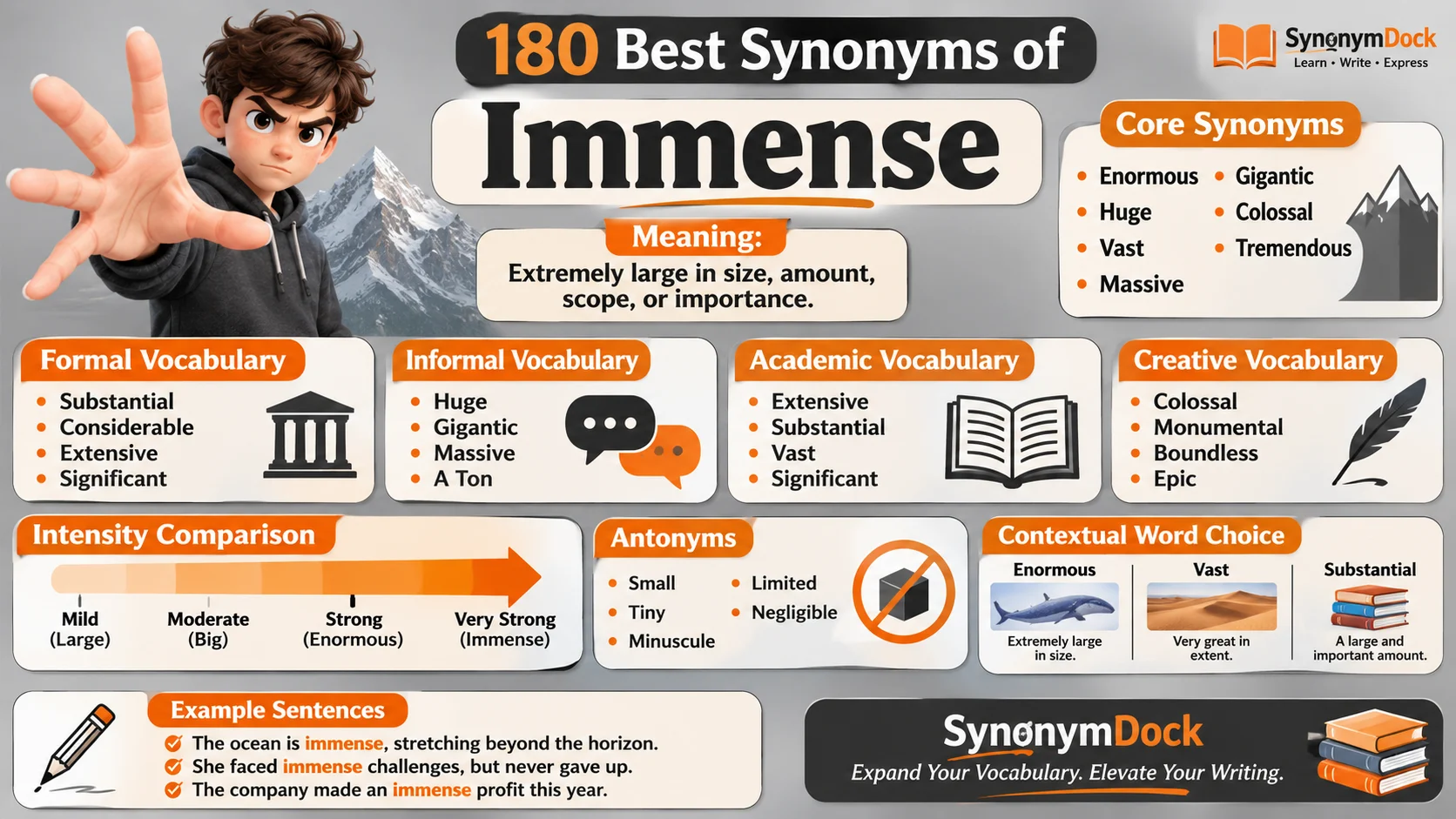
Exploring suitable synonyms of immense introduces greater variety, strengthens vocabulary, and helps you communicate ideas with greater accuracy and sophistication.
Finding the right synonym of immense helps you describe size, scale, importance, or intensity more precisely. For example, enormous emphasizes exceptional size, vast suggests an extensive area or range, and tremendous often highlights an impressive degree or effect. However, these alternatives are not interchangeable in every sentence. Understanding their differences helps you choose vocabulary that sounds natural, communicates the intended meaning, and suits your audience.
What Are the Best Synonyms of “Immense”?
Immense means extremely large in size, amount, degree, or extent. It generally has a neutral tone, although it can also express admiration or emphasize seriousness.
The best synonyms include enormous, vast, massive, gigantic, colossal, tremendous, substantial, and considerable. However, the most suitable alternative depends on what you want to describe.
For different writing situations, consider these choices:
- Formal writing: Substantial, considerable, extensive.
- Casual conversation: Huge, enormous, gigantic.
- Academic writing: Extensive, substantial, considerable.
- Professional communication: Significant, substantial, considerable.
- Emotional writing: Overwhelming, tremendous, immeasurable.
- Creative writing: Colossal, monumental, boundless.
In short, choose a synonym that communicates the intended meaning rather than simply replacing immense with a more complicated word.
Meaning, Tone, and Context of Immense
Simple Definition
Immense is an adjective that describes something extremely large, extensive, or great in degree.
It can refer to physical objects, geographical areas, quantities, responsibilities, achievements, and abstract ideas. Moreover, it can emphasize the intensity of feelings or experiences.
For example:
- The museum contains an immense collection of historical artifacts.
- The organization has immense potential for growth.
- She felt immense gratitude toward her teachers.
As these examples demonstrate, immense can describe both measurable quantities and abstract qualities. Its precise meaning depends on the noun it modifies.
Part of Speech
Immense functions as an adjective because it describes the size, extent, or degree of a noun.
Its related word forms include:
| Word | Part of Speech | Meaning |
|---|---|---|
| Immense | Adjective | Extremely large or great |
| Immensely | Adverb | To an extremely great degree |
| Immensity | Noun | The quality of being extremely large |
Usage note: Although immeasurable has a related meaning, it is not a direct grammatical form of immense. It describes something that cannot easily be measured.
Overall Tone
Immense generally has a neutral tone. Nevertheless, its emotional effect can change depending on the noun it describes.
Positive examples:
- Immense satisfaction
- Immense talent
- Immense potential
Neutral examples:
- Immense building
- Immense distance
- Immense quantity
Negative examples:
- Immense pressure
- Immense difficulty
- Immense damage
Consequently, immense can communicate admiration, describe physical scale, or emphasize a challenging situation without changing its basic grammatical function.
Formality Level
Immense is a neutral to slightly formal adjective. It works naturally in everyday conversations, academic discussions, business communication, and descriptive writing.
Although it sounds polished in formal contexts, it is not restricted to professional situations. For instance, saying “That was an immense achievement” is perfectly natural in ordinary conversation.
Common Uses
English speakers commonly use immense when describing the following:
- Physical size: An immense stadium or building.
- Geographical scale: An immense desert or ocean.
- Quantity: An immense amount of information.
- Importance: An immense contribution.
- Emotions: Immense happiness or gratitude.
- Responsibilities: Immense pressure or responsibility.
- Potential: Immense opportunities for development.
These different applications explain why choosing an appropriate synonym requires attention to context.
When and How to Use “Immense”
Choose immense when you want to emphasize unusually large size, quantity, degree, or extent without specifying an exact measurement.
To understand its practical applications, consider these seven examples from everyday and professional situations.
1. Professional Context
The company has immense potential to expand into international markets.
2. Academic Context
The research provides an immense amount of information about environmental changes.
3. Workplace Context
Managing the entire department comes with immense responsibility.
4. Personal Context
Her family has had an immense influence on her personal development.
5. Email Context
Thank you for your immense support throughout this project.
6. Resume Context
Contributed to a major organizational project with substantial operational impact.
Here, substantial is more appropriate because professional resumes benefit from precise descriptions of responsibilities and measurable achievements.
7. Social Media Context
An immense amount of creativity went into making this beautiful artwork.
As these examples illustrate, immense works across different situations. However, a more specific alternative can sometimes communicate the message more effectively.
Best Synonyms of Immense
No synonym communicates exactly the same meaning in every situation. While some alternatives emphasize physical dimensions, others describe quantity, scope, importance, or emotional intensity.
The following table highlights suitable choices for different writing purposes.
| Writing Situation | Recommended Synonym | Why It Works |
|---|---|---|
| Professional writing | Substantial | Communicates significant size or importance |
| Academic writing | Extensive | Highlights a broad range or scope |
| Business communication | Considerable | Sounds measured and professional |
| Casual conversation | Huge | Simple and natural in everyday speech |
| Emotional writing | Overwhelming | Expresses powerful feelings |
| Creative writing | Colossal | Creates a strong impression of physical size |
| Resume writing | Significant | Emphasizes meaningful contributions |
| Workplace communication | Substantial | Describes major responsibilities or resources |
| Strong emphasis | Colossal | Conveys exceptional scale |
| Softer emphasis | Considerable | Avoids unnecessary exaggeration |
However, these recommendations are not strict rules. The most appropriate alternative still depends on the sentence and the intended message.
When Not to Use Immense
Although immense is versatile, it is not always the most precise adjective. In certain situations, another word can communicate your meaning more naturally.
Consider the following examples before choosing it.
1. When You Need a Measurable Description
Immense can sound vague when readers need specific information.
Less effective: The company experienced immense growth.
Better: The company experienced substantial growth in annual revenue.
Why it works: Substantial is appropriate for describing business progress, particularly when actual figures support the statement.
2. When Describing a Broad Subject
Immense may not communicate the full scope of a topic.
Less effective: The report covers immense subjects.
Better: The report covers an extensive range of subjects.
Why it works: Extensive directly communicates breadth and coverage. Therefore, it is a more natural choice in this context.
3. When Writing Formal Business Reports
Immense can sound unnecessarily dramatic when discussing routine business matters.
Less effective: We experienced immense changes in our operating procedures.
Better: We implemented substantial changes to our operating procedures.
Why it works: Substantial communicates the significance of the changes without exaggerating their impact.
4. When Describing Something That Produces a Strong Effect
Sometimes, immense communicates scale but does not emphasize the importance of the result.
Less effective: The new policy created immense results.
Better: The new policy produced significant improvements.
Why it works: Significant highlights the importance of the improvements rather than simply suggesting a large scale.
5. When Describing Emotional Experiences
Although immense can describe feelings, another adjective may communicate their intensity more effectively.
Less effective: She experienced immense sadness.
Alternative: She experienced overwhelming sadness.
Why it works: Overwhelming emphasizes the strength of an emotion and suggests that it is difficult to manage.
6. When You Want a Simple Conversational Expression
Immense may sound slightly formal in a relaxed conversation.
Less effective: That was an immense amount of food.
Better: That was a huge amount of food.
Why it works: Huge is direct, familiar, and natural in everyday English.
Words Commonly Confused With Immense
Several adjectives communicate large size or degree. Nevertheless, each has a slightly different purpose.
| Word | Main Difference | When to Use It | Example |
|---|---|---|---|
| Enormous | Emphasizes exceptional size or amount | Physical objects and quantities | They built an enormous shopping center. |
| Huge | A common conversational expression for something very large | Everyday speaking | We have a huge opportunity ahead. |
| Vast | Emphasizes extensive space, range, or scope | Geography, knowledge, and resources | She has vast experience in education. |
| Massive | Suggests considerable physical size, weight, or scale | Structures, objects, and quantities | The project requires massive investment. |
| Tremendous | Often emphasizes an impressive degree or effect | Achievements, effort, and results | The team made tremendous progress. |
| Colossal | Describes something exceptionally large or impressive | Creative and descriptive writing | A colossal statue stood near the entrance. |
For example, enormous and huge are particularly useful for physical dimensions, whereas vast works better for extensive knowledge or geographical areas.
Similarly, tremendous often expresses admiration, while massive emphasizes considerable scale. Understanding these distinctions prevents inaccurate word choices.
Best Synonyms of Immense by Context
Choosing an alternative becomes easier when you first identify what you are describing. For instance, an academic discussion may require a different adjective from a casual conversation.
| Context | Best Synonym | Why It Works | Example |
|---|---|---|---|
| Formal writing | Considerable | Professional and measured | The project required considerable funding. |
| Academic writing | Extensive | Describes broad research or coverage | The study examines extensive historical records. |
| Professional communication | Substantial | Communicates meaningful scale | We made substantial progress this quarter. |
| Business emails | Significant | Highlights importance | Your feedback made a significant difference. |
| Resume writing | Significant | Emphasizes valuable contributions | Delivered significant improvements in workflow efficiency. |
| Workplace communication | Considerable | Describes major responsibilities | The position involves considerable planning. |
| Casual conversation | Huge | Sounds natural and familiar | That is a huge achievement! |
| Everyday speaking | Enormous | Clearly emphasizes size | Their house has an enormous backyard. |
| Creative writing | Colossal | Creates a strong visual impression | A colossal mountain dominated the landscape. |
| Storytelling | Gigantic | Makes physical size easy to imagine | A gigantic wave approached the shore. |
| Emotional writing | Overwhelming | Expresses powerful feelings | She felt overwhelming relief. |
| Strong emphasis | Tremendous | Highlights an impressive degree | The event received tremendous support. |
| Mild emphasis | Considerable | Avoids unnecessary exaggeration | We noticed considerable improvement. |
| Social media captions | Huge | Short and engaging | A huge milestone worth celebrating! |
Although some alternatives work in several contexts, their suitability changes with the subject. Therefore, always consider the meaning before selecting a replacement.
How to Choose the Best Synonym of Immense
The best alternative depends on the message you want to communicate. Instead of selecting an impressive-sounding word, consider these five practical factors.
1. Consider the Meaning
First, identify what immense describes. This will help you select a more accurate alternative.
- Physical size: Enormous, gigantic, colossal.
- Large quantities: Huge, massive, tremendous.
- Extensive coverage: Vast, extensive.
- Importance: Significant, substantial.
- Emotional intensity: Overwhelming, tremendous.
For example, vast is appropriate for describing an extensive geographical area, whereas overwhelming better communicates a powerful emotional experience.
2. Consider Your Audience
A word that sounds natural in conversation may not suit an academic paper.
For instance, huge works well when speaking with friends. By contrast, substantial is generally more appropriate in a professional report.
Similarly, academic readers usually benefit from precise vocabulary rather than unnecessarily complicated expressions.
3. Match the Emotional Strength
Avoid choosing an alternative simply because it sounds impressive.
Colossal creates a dramatic impression of physical size, whereas considerable communicates a large amount in a more measured way. Meanwhile, overwhelming introduces emotional intensity that ordinary size-related adjectives do not necessarily convey.
4. Match the Writing Purpose
Your writing purpose should also influence your vocabulary.
For a resume, choose significant or substantial when describing professional achievements. On the other hand, gigantic or colossal may create a more vivid picture in storytelling.
Likewise, extensive is particularly useful when describing research, knowledge, or professional experience.
5. Read the Sentence Naturally
Finally, replace immense with your preferred alternative and read the complete sentence.
If the meaning changes or the expression sounds unnatural, select another word. Remember that the best synonym is not necessarily the most complicated one. Instead, it is the word that communicates your intended meaning accurately.
Real-Life Examples of Immense
The following examples demonstrate how different alternatives can improve clarity and vocabulary variety.
| Situation | Original Sentence | Improved Sentence |
|---|---|---|
| School | The teacher has immense knowledge. | The teacher has extensive knowledge of English literature. |
| College | The assignment requires immense effort. | The assignment requires considerable effort. |
| Workplace | Our department has immense responsibilities. | Our department handles substantial responsibilities. |
| Business | The company has immense influence. | The company has significant influence in the industry. |
| Thank you for your immense help. | Thank you for your tremendous support. | |
| Resume | I made an immense contribution. | I made a significant contribution to improving team performance. |
| Conversation | That is an immense house. | That is an enormous house. |
| Storytelling | An immense creature appeared. | A gigantic creature emerged from the forest. |
| Blogging | The internet provides immense opportunities. | The internet offers vast opportunities for learning. |
| Social media | We received immense support. | We received overwhelming support from our community. |
Notice that the improved versions do more than replace a word. They make the intended meaning more specific and natural.
13 Best Synonyms of Immense
The following alternatives are useful in different contexts. However, their suitability depends on whether you are describing physical dimensions, quantity, scope, importance, or intensity.
| Synonym | Simple Meaning | Best Used For | Example Sentence |
|---|---|---|---|
| 1. Enormous | Extremely large | Physical objects and quantities | An enormous crowd gathered outside the stadium. |
| 2. Huge | Very large | Everyday conversations | We received a huge number of applications. |
| 3. Vast | Extremely extensive | Areas, knowledge, and resources | The university has a vast collection of research materials. |
| 4. Massive | Very large in scale | Structures and quantities | The construction project requires massive resources. |
| 5. Gigantic | Exceptionally large | Physical descriptions | A gigantic tree stood in the middle of the park. |
| 6. Colossal | Extremely large or impressive | Descriptive and creative writing | The company invested in a colossal development project. |
| 7. Tremendous | Very great in amount or degree | Effort, progress, and achievements | Her tremendous dedication inspired the entire team. |
| 8. Monumental | Exceptionally important or significant | Achievements and historical events | The discovery marked a monumental achievement. |
| 9. Mammoth | Extremely large or demanding | Large projects and tasks | The organization undertook a mammoth renovation project. |
| 10. Substantial | Considerable in size or amount | Business and professional writing | The organization received substantial financial support. |
| 11. Considerable | Large enough to be important | Formal and academic contexts | The research required considerable preparation. |
| 12. Extensive | Covering a large range or area | Studies, experience, and coverage | She has extensive experience in education. |
| 13. Expansive | Covering a wide area or scope | Landscapes, spaces, and ideas | The hotel offers an expansive view of the coastline. |
Important usage distinction: These words are not perfect substitutes in every sentence. For example, astronomical usually describes exceptionally high figures or amounts, whereas boundless suggests something without apparent limits. Therefore, choose an alternative according to the noun and intended meaning.
Synonyms of Immense by Usage
Professional vs Personal Synonyms
Professional writing benefits from measured vocabulary that communicates scale without unnecessary exaggeration.
Consider these alternatives:
- Substantial: Useful for describing resources, investments, and improvements.
- Significant: Appropriate when emphasizing importance or meaningful results.
- Considerable: Suitable for responsibilities, effort, and quantities.
- Extensive: Ideal for describing experience, knowledge, and research.
In personal conversations, simpler expressions often sound more natural. For example, huge, enormous, gigantic, and tremendous are common choices.
Compare the following sentences:
Professional: The department made substantial improvements to its reporting system.
Personal: We made huge improvements to our house.
Both sentences communicate considerable change. However, their vocabulary reflects different communication styles.
Formal vs Conversational Synonyms
The formality of your vocabulary should match the situation. While measured adjectives are generally preferable in formal writing, familiar expressions work better in relaxed conversations.
| Situation | Recommended Words |
|---|---|
| Research reports | Extensive, substantial |
| Academic essays | Considerable, extensive |
| Business writing | Significant, substantial |
| Presentations | Tremendous, considerable |
| Professional emails | Significant, substantial |
| Casual conversations | Huge, enormous |
| Text messages | Huge, gigantic |
Nevertheless, avoid unnecessarily complicated vocabulary when a familiar alternative communicates your message more clearly.
Academic Synonyms
Academic writing requires precise language rather than impressive-sounding adjectives. Therefore, the following alternatives are particularly useful.
1. Extensive
Use it when discussing research coverage, literature reviews, or available evidence.
Example: The researchers conducted an extensive review of existing studies.
2. Substantial
Choose it when describing a meaningful quantity, contribution, or difference.
Example: The findings provide substantial evidence supporting the proposed theory.
3. Considerable
Use it to describe significant amounts of time, effort, or resources.
Example: The investigation required considerable attention to detail.
4. Significant
Choose it when discussing meaningful results or important findings.
Example: The experiment revealed a significant difference between the two groups.
5. Vast
Use it when describing a broad body of knowledge or a large field of study.
Example: The subject involves a vast range of historical perspectives.
These alternatives make academic arguments more precise. Furthermore, they help avoid repetitive descriptions throughout longer assignments.
Professional and Business Synonyms
In professional communication, word choice should make your message clear and credible. Instead of using immense repeatedly, select an alternative that accurately describes the situation.
| Professional Situation | Recommended Alternative | Example |
|---|---|---|
| Resume | Significant | Achieved significant improvements in customer satisfaction. |
| Interview | Substantial | I made a substantial contribution to the project. |
| Meeting | Considerable | We have made considerable progress. |
| Presentation | Tremendous | The team achieved tremendous results. |
| Performance review | Significant | She demonstrated significant professional growth. |
| Client communication | Valuable | Your feedback is extremely valuable to our team. |
| Business email | Substantial | We appreciate your substantial contribution. |
One important recommendation for resume writers is to avoid using immense as a substitute for measurable achievements.
Instead of writing:
“I made an immense contribution to the company.”
Write:
“Improved customer retention by 18% through targeted communication strategies.”
Specific evidence makes professional writing more convincing. As a result, measurable achievements often communicate more than exaggerated adjectives.
Creative and Literary Synonyms
Creative writing benefits from alternatives that create strong images or express particular feelings.
- Colossal: Creates an impression of extraordinary physical size.Example: A colossal mountain towered above the quiet village.
- Gigantic: Helps readers imagine something physically enormous.Example: A gigantic ship appeared through the morning fog.
- Monumental: Adds importance and historical significance.Example: The discovery became a monumental moment in human history.
- Boundless: Suggests freedom from limitations.Example: His imagination seemed boundless.
- Overwhelming: Expresses an experience or feeling that is difficult to manage.Example: An overwhelming sense of relief filled the room.
By choosing these words carefully, writers can create more vivid descriptions rather than simply repeating a general adjective.
Slang or Modern Synonyms
There is no widely accepted slang expression that replaces immense in every context. Nevertheless, some informal words communicate similar ideas.
1. Mega
Meaning: Extremely large or impressive.
Example: That was a mega event!
Where it works: Casual conversations and informal promotional language.
Avoid it in academic papers, formal reports, and professional correspondence.
2. Ginormous
Meaning: Extremely large, often used humorously.
Example: They ordered a ginormous pizza for the party.
Where it works: Jokes, informal conversations, and playful descriptions.
Avoid it when writing formal business documents.
Although both expressions add variety to informal English, neither is a universal replacement for immense.
Strongest to Mildest Synonyms
Different alternatives communicate different levels of intensity. However, their strength depends on the subject and context rather than a fixed linguistic ranking.
The following scale provides a practical comparison.
| Intensity | Synonyms | Typical Effect |
|---|---|---|
| Mild | Considerable, substantial | Suggests a large or meaningful amount |
| Moderate | Extensive, enormous, huge | Emphasizes considerable size or scope |
| Strong | Massive, gigantic, colossal | Creates a powerful impression of size |
| Very strong | Astronomical, staggering, prodigious | Emphasizes exceptional scale, quantity, or degree |
For example, astronomical is particularly effective when discussing exceptionally high figures. However, it would sound unnatural when describing an ordinary-sized building.
Therefore, consider the subject before choosing an adjective based on intensity.
Emotional vs Neutral Synonyms
Immense can describe both feelings and measurable characteristics. Consequently, the best alternative depends on whether you want to express emotion or simply communicate scale.
Emotional Synonyms
These alternatives introduce stronger feelings or reactions.
- Overwhelming: An intensity that is difficult to manage.
- Tremendous: A powerful degree of something, often positive.
- Boundless: A feeling or quality with no apparent limits.
- Immeasurable: Something whose value or extent cannot easily be measured.
- Staggering: Something so great that it causes surprise.
Example: Her family provided overwhelming support during a difficult period.
Neutral Synonyms
These alternatives focus more directly on size, scope, or quantity.
- Enormous: Extremely large.
- Vast: Very extensive.
- Substantial: Considerable in amount.
- Extensive: Covering a broad range.
- Considerable: Large enough to matter.
Example: The university maintains an extensive research library.
In general, choose emotional vocabulary when the feeling matters. Conversely, use neutral vocabulary when accuracy and clarity are more important.
Antonyms of Immense
Antonyms describe the opposite idea. Since immense can refer to physical size, quantity, or extent, its opposites also depend on context.
The following 15 words are useful opposites across those meanings.
| Antonym | Meaning | Example Sentence |
|---|---|---|
| 1. Tiny | Extremely small | A tiny bird sat on the branch. |
| 2. Small | Limited in physical size | They purchased a small apartment. |
| 3. Little | Small in size or amount | We have little space available. |
| 4. Minute | Extremely small | A minute detail changed the final design. |
| 5. Microscopic | Too small to see clearly without magnification | The sample contained microscopic organisms. |
| 6. Minuscule | Extremely tiny in size or quantity | The difference between the figures was minuscule. |
| 7. Miniature | Much smaller than the usual size | She collected miniature models of famous buildings. |
| 8. Diminutive | Unusually small in physical size | A diminutive cottage stood beside the river. |
| 9. Compact | Small and efficiently arranged | The apartment has a compact kitchen. |
| 10. Narrow | Limited in width or range | The research focused on a narrow topic. |
| 11. Limited | Restricted in amount or extent | The organization has limited financial resources. |
| 12. Slight | Small in degree or amount | We noticed a slight improvement. |
| 13. Modest | Relatively small or moderate | The company reported modest growth. |
| 14. Insignificant | Too small or unimportant to matter | The difference was insignificant. |
| 15. Negligible | So small that it can almost be ignored | The additional cost was negligible. |
Usage note: These are context-specific opposites, not interchangeable antonyms. For instance, narrow contrasts with vast when describing scope, whereas negligible contrasts with immense when discussing amounts or effects.
Comparison: Immense vs Similar Words
Understanding the differences between related adjectives helps prevent inaccurate word choices. Although these words share similar meanings, their applications are not always identical.
1. Immense vs Enormous
Main Difference
Both adjectives describe something extremely large. However, immense can also emphasize abstract qualities such as importance, responsibility, or potential.
Which Is Stronger?
Neither is consistently stronger. Their intensity depends on the noun and context.
Which Is More Formal?
Both work in formal and conversational English. Nevertheless, immense can sound slightly more elevated in some descriptions.
When to Use Each
Use immense for physical scale, abstract importance, or degree. By comparison, choose enormous when emphasizing exceptional physical size or quantity.
Examples
- Immense: The organization has immense potential for future development.
- Enormous: An enormous building occupies the entire block.
2. Immense vs Vast
Main Difference
Vast emphasizes extensive space, range, or scope. Immense has a broader application and can describe both physical dimensions and abstract qualities.
Which Is Stronger?
Neither is universally stronger. However, vast is especially effective when describing breadth.
Which Is More Formal?
Both are appropriate for academic and professional writing.
When to Use Each
Choose vast for landscapes, knowledge, resources, and collections. In contrast, use immense for extraordinary size, degree, or importance.
Examples
- Immense: The project required immense effort.
- Vast: The researcher explored a vast collection of historical documents.
3. Immense vs Huge
Main Difference
Huge is a common everyday adjective. Immense often sounds more descriptive or slightly more formal.
Which Is Stronger?
Neither has a fixed intensity advantage. However, huge can sound more emphatic in casual speech.
Which Is More Formal?
Immense is generally more suitable for polished descriptive writing, although both are acceptable.
When to Use Each
Choose huge for conversations and informal communication. Meanwhile, use immense when describing an exceptional scale or degree in more formal writing.
Examples
- Immense: The university has immense educational resources.
- Huge: We had a huge audience at the event.
4. Immense vs Massive
Main Difference
Massive often suggests considerable physical size, weight, or scale. Immense, on the other hand, can describe both physical and abstract qualities.
Which Is Stronger?
Massive can create a stronger impression of physical weight or bulk. Conversely, immense can emphasize broader scale.
Which Is More Formal?
Both work in professional writing, depending on the subject.
When to Use Each
Use massive for structures, investments, and large quantities. Choose immense for responsibilities, influence, and extraordinary size.
Examples
- Immense: She carries immense responsibility.
- Massive: The construction company built a massive warehouse.
5. Immense vs Tremendous
Main Difference
Tremendous often emphasizes an impressive amount, degree, or effect. Immense focuses more directly on extraordinary size or scale.
Which Is Stronger?
Tremendous can communicate enthusiasm or admiration, whereas immense can sound more neutral.
Which Is More Formal?
Both are acceptable in professional writing, although tremendous may sound more expressive.
When to Use Each
Choose tremendous for achievements, progress, and effort. By contrast, use immense for size, resources, potential, or responsibilities.
Examples
- Immense: The organization has immense financial resources.
- Tremendous: The volunteers made tremendous progress.
6. Immense vs Colossal
Main Difference
Colossal emphasizes exceptionally large physical dimensions or an extraordinarily significant undertaking. Immense is more versatile.
Which Is Stronger?
Colossal often creates a more dramatic impression.
Which Is More Formal?
Immense is generally more neutral. Meanwhile, colossal is appropriate in descriptive, journalistic, and creative writing.
When to Use Each
Use colossal for impressive physical structures or unusually large projects. Choose immense for a wider range of subjects.
Examples
- Immense: The country faces immense economic challenges.
- Colossal: A colossal monument stands in the city center.
Common Phrases and Expressions with Immense
Certain word combinations sound particularly natural in English. Learning these expressions can help you improve both vocabulary and sentence construction.
1. Immense Pressure
Meaning: An extremely high level of stress or responsibility.
Example: The manager faced immense pressure to complete the project before the deadline.
2. Immense Potential
Meaning: An exceptional ability or opportunity for future development.
Example: The new technology has immense potential to improve education.
3. Immense Relief
Meaning: A very strong feeling of comfort after worry or difficulty.
Example: We felt immense relief when the final results were announced.
4. Immense Gratitude
Meaning: A very strong feeling of appreciation.
Example: I have immense gratitude for everyone who supported my education.
5. Immense Responsibility
Meaning: A very large or important duty.
Example: Leading an international organization involves immense responsibility.
6. Immense Impact
Meaning: An exceptionally significant influence or effect.
Example: Digital technology has had an immense impact on modern communication.
7. Immense Amount
Meaning: A very large quantity.
Example: The researchers collected an immense amount of information.
8. Immense Contribution
Meaning: A very valuable or significant contribution.
Example: Her work made an immense contribution to the development of the community.
These collocations demonstrate how immense works with different nouns. Furthermore, learning them can help you produce more natural English without relying on isolated vocabulary lists.
Common Mistakes to Avoid
Choosing the wrong alternative can change the meaning of an otherwise correct sentence. Therefore, understanding common usage mistakes is essential for accurate writing.
Here are seven mistakes worth avoiding.
Mistake 1: Using a Vague Synonym
Incorrect: The organization achieved huge improvements in every area.
Better: The organization achieved substantial improvements in customer service and operational efficiency.
Why: The revised sentence provides clearer information about the nature of the improvements.
Mistake 2: Confusing Vast With Enormous
Incorrect: The researcher has an enormous knowledge of history.
Better: The researcher has extensive knowledge of history.
Why: Extensive is a more natural choice when describing broad knowledge or experience.
Mistake 3: Using Informal Vocabulary in Academic Writing
Less suitable: The study collected a huge amount of evidence.
Better: The study collected a substantial amount of evidence.
Why: Substantial is a measured choice for academic discussion, although huge is not grammatically incorrect.
Mistake 4: Choosing an Overly Dramatic Word
Less suitable: The meeting required colossal preparation.
Better: The meeting required considerable preparation.
Why: Colossal can sound exaggerated when describing ordinary professional activities.
Mistake 5: Repeating Immense Too Often
Repetitive: The immense building has immense rooms and immense facilities.
Better: The enormous building contains spacious rooms and extensive facilities.
Why: The revised sentence uses alternatives that describe different features more accurately.
Mistake 6: Selecting the Wrong Emotional Tone
Incorrect: She felt astronomical happiness after receiving the award.
Better: She felt immense happiness after receiving the award.
Why: Astronomical generally describes exceptionally high quantities, costs, or figures. Therefore, it does not naturally describe happiness.
Mistake 7: Using Slang in Professional Communication
Less suitable: Our company completed a ginormous project.
Better: Our company completed a substantial project.
Why: Substantial communicates scale in a professional and measured manner.
Frequently Asked Questions
1. What Are the Best Synonyms of Immense?
The best synonyms of immense include enormous, huge, vast, massive, gigantic, colossal, and tremendous. Use extensive for broad coverage, substantial for significant quantities, and monumental for exceptionally important achievements.
2. What Are the Best Formal Synonyms of Immense?
The best formal alternatives are substantial, considerable, extensive, significant, and vast. These words work well in academic papers, professional reports, business communication, and formal descriptions. However, the most appropriate choice depends on the subject.
3. What Are Common Informal Synonyms of Immense?
Huge, enormous, gigantic, and tremendous are common conversational alternatives. Huge is especially natural in everyday English, while ginormous is a playful informal expression rather than a suitable choice for formal writing.
4. What Is Another Word for Immense in Professional Writing?
Substantial is an excellent alternative when describing resources, effort, or improvements. Significant works better when emphasizing importance, whereas extensive is suitable for broad experience, research, or coverage.
5. What Is the Difference Between Immense and Enormous?
Immense and enormous both describe exceptionally large size or degree. However, immense also works naturally with abstract ideas such as potential and responsibility, while enormous often emphasizes physical dimensions or large quantities.
6. What Is the Opposite of Immense?
The opposite of immense depends on context. Small, tiny, and minuscule describe limited physical size, whereas negligible and insignificant describe very small amounts or effects. Similarly, limited and narrow can contrast with immense in terms of scope.
Conclusion
Choosing the right synonym of immense can make your writing clearer, more precise, and more expressive. Although words such as enormous, huge, vast, massive, substantial, and tremendous share similar meanings, each conveys a distinct shade of meaning.
For describing physical size, enormous or gigantic may be more appropriate. By contrast, vast and extensive effectively communicate breadth, range, or coverage. In professional and academic writing, substantial often conveys considerable importance or quantity. Meanwhile, overwhelming is particularly useful when describing an exceptionally powerful emotional response or effect.
Furthermore, selecting an appropriate alternative depends on context rather than vocabulary complexity. A sophisticated word is not necessarily the most effective choice if it changes your intended meaning. Therefore, consider your audience, writing purpose, and intended message before replacing immense. Ultimately, precise word choice strengthens your communication and makes your English more natural, varied, and effective.

Ethan Parker is an English language writer and vocabulary enthusiast at SynonymDock.com. He specializes in synonyms, word meanings, alternative expressions and practical English usage, creating clear and reliable content to help students, professionals, writers and English learners choose the right words with confidence.