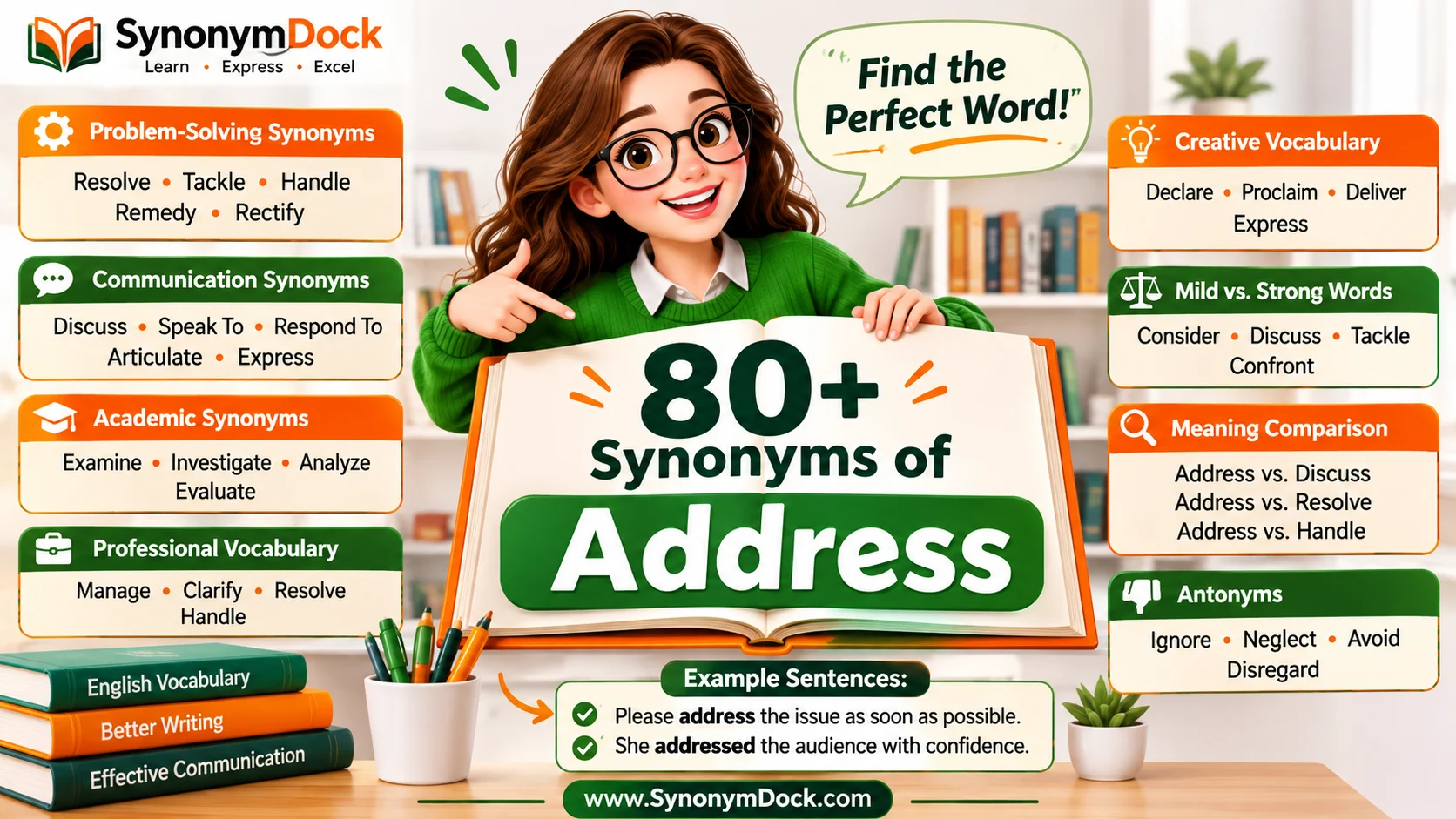
Have you ever found yourself using the word address repeatedly in an essay, email, or professional conversation? While it is a versatile English word, relying on it too often can make your writing sound repetitive and limit the precision of your expression.
Exploring the right synonym of address can enrich your vocabulary and help you convey your ideas more effectively. Depending on the context, tackle or deal with can refer to addressing an issue. Moreover, discuss and approach are suitable when referring to communication. Similarly, speak to can describe directly addressing someone. Each alternative, therefore, conveys a slightly different meaning. The key is to understand how each alternative functions. Some are appropriate for resolving problems, others for discussing important matters, and some for communicating with individuals or audiences. Choosing the most suitable expression will make your English more fluent, precise, and sophisticated.
What Are the Best Synonyms of “Address”?
The best synonyms of address depend on its intended meaning and context. For example, when address refers to dealing with an issue, suitable alternatives include tackle, resolve, manage, and confront. Moreover, when it describes communicating with someone, consider speak to, approach, appeal to, or engage with. Similarly, when address refers to a physical place, alternatives such as residence, location, and premises may be more appropriate. Therefore, choosing the right synonym helps maintain clarity, precision, and natural expression.
Best alternatives by context
| Context | Recommended alternatives |
| Formal writing | Discuss, examine, consider |
| Casual conversation | Talk to, speak to |
| Academic writing | Investigate, analyze, examine |
| Professional communication | Handle, resolve, discuss |
| Emotional writing | Confront, acknowledge |
| Creative writing | Declare, deliver, articulate |
| Dealing with problems | Tackle, remedy, rectify |
| Referring to a location | Residence, location, premises |
Important: Address is a polysemous word, meaning it has several related but distinct meanings. Always identify its intended meaning before replacing it.
Meaning, Tone, and Context of Address
Simple Definition
The word address can function as both a noun and a verb. As a verb, it can mean speaking to someone, dealing with a particular matter, or writing information on an envelope. As a noun, it can refer to someone’s location or a formal speech.
For example:
- The manager will address the employees. (Speak to)
- We must address the complaint. (Deal with)
- Please address the envelope correctly. (Write recipient information)
- She delivered an inspiring address. (Formal speech)
- What is your current address? (Location)
Part of Speech
| Part of speech | Meaning | Example |
| Verb | To deal with something | We need to address the issue. |
| Verb | To speak to someone | The principal addressed the students. |
| Verb | To write recipient details | Address the package carefully. |
| Noun | A place where someone lives | I changed my home address. |
| Noun | A formal speech | She delivered the opening address. |
Overall Tone
Address generally has a neutral tone. Its formality depends on the context.
- Positive: Address a concern constructively.
- Neutral: Address a question during a meeting.
- Negative: Address a serious failure in the system.
Formality Level
Neutral to Formal
Address works in everyday conversation, academic writing, business communication, and official documents.
Common Uses
English speakers commonly use address when:
- Discussing workplace problems.
- Responding to customer complaints.
- Speaking to an audience.
- Communicating with students.
- Writing postal information.
- Referring to residential or business locations.
- Delivering formal speeches.
Word Forms
| Word form | Example |
| Address | We must address the concern. |
| Addresses | The report addresses several questions. |
| Addressed | She addressed the audience. |
| Addressing | They are addressing the problem. |
Other related forms include addressable and addressee.
When and How to Use “Address”
Choose address when you want to communicate that someone is dealing with an issue, directing words toward another person, or identifying a location.
Here are seven examples from everyday situations.
- Professional: The director will address the department’s performance concerns.
- Academic: This research addresses an important question in modern education.
- Workplace: We should address the communication gap before starting the project.
- Personal: I finally addressed the misunderstanding with my friend.
- Email: I am writing to address your concerns about the recent changes.
- Resume: Led initiatives to address operational challenges and improve team coordination.
- Social Media: Let’s address the questions people have been asking about this update.
Notice how the same word communicates different actions depending on its object and surrounding sentence.
Best Synonyms of “Address”
No synonym replaces address perfectly in every situation. The most effective alternative depends on whether you mean discussing a subject, resolving a problem, speaking to someone, or identifying a place.
Here are the strongest recommendations for different writing purposes.
| Writing context | Best synonym | Why it works |
| Professional writing | Discuss | Communicates a subject clearly and formally. |
| Academic writing | Examine | Suggests careful intellectual consideration. |
| Business communication | Handle | Emphasizes practical responsibility. |
| Casual conversation | Talk about | Sounds natural and approachable. |
| Emotional writing | Confront | Expresses direct engagement with a difficult matter. |
| Creative writing | Articulate | Highlights clear and expressive communication. |
| Resume writing | Resolve | Demonstrates problem-solving ability. |
| Workplace communication | Tackle | Suggests taking action. |
| Stronger meaning | Confront | Indicates direct engagement with a challenging issue. |
| Softer meaning | Consider | Sounds thoughtful and less forceful. |
When Not to Use “Address”
Although address is versatile, it sometimes sounds too broad or fails to explain exactly what action someone is taking.
Choosing a more specific alternative can make your sentences stronger.
1. When Address Sounds Too General
Less effective: We need to address the situation.
Better: We need to resolve the scheduling conflict.
Why: Resolve identifies the intended outcome instead of describing a general action.
2. When Address Sounds Too Vague
Less effective: The report addresses several matters.
Better: The report examines several financial concerns.
Why: Examine tells readers what the report actually does.
3. When Address Sounds Too Formal
Less effective: I would like to address something with you.
Better: I would like to talk something over with you.
Why: Talk something over sounds more conversational and friendly.
4. When Address Sounds Too Weak
Less effective: We should address the ongoing misconduct.
Better: We should confront the ongoing misconduct.
Why: Confront communicates a more direct response to a serious issue.
5. When Address Does Not Describe a Solution
Less effective: The company addressed the technical failure.
Better: The company corrected the technical failure.
Why: Corrected confirms that an actual change was made.
6. When Address Refers to a Person
Less effective: I addressed my colleague about the problem.
Better: I spoke to my colleague about the problem.
Why: Spoke to is more natural when describing an ordinary conversation.
7. When Address Refers to a Speech
Less effective: The president gave an address to the audience.
Better: The president delivered a speech to the audience.
Why: Speech is a straightforward alternative that makes the meaning immediately clear.
Words Commonly Confused With “Address”
Several words have overlapping meanings with address, but their applications are different.
| Word | Difference | When to use it | Example |
| Discuss | Focuses on exchanging ideas about a subject. | Conversations, meetings, and reports. | We discussed the proposed changes. |
| Resolve | Emphasizes finding a solution. | Problems, disputes, and complaints. | The team resolved the disagreement. |
| Handle | Focuses on managing a responsibility or situation. | Workplace and everyday situations. | She handled the customer complaint. |
| Approach | Emphasizes a method or way of dealing with something. | Strategies and problem-solving. | We approached the issue carefully. |
| Mention | Means referring to something briefly. | Conversations and written communication. | He mentioned the budget concerns. |
| Confront | Suggests facing a difficult issue directly. | Serious disagreements and challenges. | They confronted the problem immediately. |
Best Synonyms of “Address” by Context
Different situations require different vocabulary. A word that sounds appropriate in a research paper may feel unnecessarily complicated in an everyday conversation.
Use this table to identify the most suitable alternative.
| Context | Best synonym | Why it works | Example |
| Formal writing | Examine | Communicates careful consideration. | The report examines the issue. |
| Academic writing | Investigate | Suggests systematic research. | Researchers investigated the question. |
| Professional communication | Handle | Shows responsibility. | I will handle the request. |
| Business emails | Discuss | Keeps communication clear. | We can discuss this matter tomorrow. |
| Resume writing | Resolve | Highlights practical achievements. | Resolved customer service challenges. |
| Workplace communication | Tackle | Emphasizes taking action. | Let’s tackle the problem together. |
| Casual conversation | Talk about | Sounds natural. | We should talk about this. |
| Everyday speaking | Speak to | Describes direct communication. | I need to speak to the manager. |
| Creative writing | Articulate | Emphasizes expressive language. | She articulated her feelings. |
| Storytelling | Declare | Expresses something openly. | He declared his intentions. |
| Emotional writing | Confront | Conveys direct engagement. | She confronted her fears. |
| Strong emphasis | Challenge | Suggests questioning or opposing something. | We must challenge this assumption. |
| Mild tone | Consider | Sounds thoughtful and diplomatic. | We should consider the concern. |
| Social media captions | Discuss | Introduces a topic clearly. | Today, let’s discuss personal growth. |
| American English | Deal with | Natural in everyday usage. | We need to deal with this issue. |
| British English | Tackle | Common and natural in many contexts. | We need to tackle the problem. |
Note: American and British English share most of these alternatives. The differences are not strict regional rules.
How to Choose the Best Synonym of “Address”
Selecting an appropriate alternative requires more than finding a word with a similar dictionary definition. Consider the actual message you want to communicate.
1. Identify the Intended Meaning
First, determine what address means in your sentence.
- Discussing a topic: Discuss or examine.
- Solving a problem: Resolve or remedy.
- Managing a situation: Handle or manage.
- Speaking to someone: Speak to or approach.
- Referring to a location: Residence or location.
- Delivering a speech: Present or deliver.
2. Consider Your Audience
A message to a company director may require more formal vocabulary than a conversation with a friend.
For business communication, consider resolve, discuss, and examine. For everyday speaking, talk about and deal with are often more natural.
3. Match the Emotional Strength
Some alternatives communicate more urgency than others.
For example, consider sounds gentle, while confront suggests direct engagement with a difficult matter.
Choose the intensity that accurately reflects your message.
4. Think About Your Writing Purpose
The best alternative depends on what your sentence needs to accomplish.
- Reports need precision.
- Essays need analytical vocabulary.
- Emails need clarity.
- Resumes need action-oriented language.
- Creative writing benefits from expressive choices.
5. Read the Sentence Naturally
A synonym might be technically correct but sound awkward in a particular sentence.
Always read the complete sentence after replacing address. If the meaning becomes less clear, return to the original word or choose another alternative.
Real-Life Examples of “Address” and Its Alternatives
Here are practical examples showing how to improve sentences by selecting more precise vocabulary.
| Situation | Original sentence | Improved sentence |
| School | The teacher addressed the question. | The teacher explained the question. |
| College | The essay addresses social inequality. | The essay examines social inequality. |
| Workplace | We need to address this problem. | We need to resolve this problem. |
| Business | The manager addressed the complaint. | The manager handled the complaint. |
| I am writing to address your concern. | I am writing to clarify your concern. | |
| Resume | Addressed operational challenges. | Resolved operational challenges. |
| Conversation | I want to address something with you. | I want to talk something over with you. |
| Storytelling | She addressed her deepest fears. | She confronted her deepest fears. |
| Blogging | This article addresses common writing mistakes. | This article explores common writing mistakes. |
| Social media | Let’s address this important topic. | Let’s discuss this important topic. |
15 Best Synonyms of “Address”
The following 15 alternatives cover the most useful meanings of address as a verb. They are organized around practical communication, problem-solving, and formal expression.
Not every word is interchangeable with every meaning of address.
| Synonym | Simple meaning | Best used for | Example sentence |
| 1. Discuss | Talk about a subject | Meetings and conversations | We should discuss the proposal. |
| 2. Examine | Study something carefully | Reports and academic writing | The researchers examined the evidence. |
| 3. Tackle | Take action against a problem | Workplace challenges | Our team tackled the issue immediately. |
| 4. Resolve | Find a solution | Conflicts and problems | They resolved the disagreement peacefully. |
| 5. Handle | Manage a situation | Business and everyday tasks | She handled the complaint professionally. |
| 6. Approach | Deal with something in a particular way | Strategies and decisions | We approached the matter cautiously. |
| 7. Manage | Control or organize a situation | Workplace responsibilities | He managed the situation effectively. |
| 8. Confront | Face something directly | Difficult problems | We must confront the underlying issue. |
| 9. Consider | Think carefully about something | Formal and diplomatic writing | Please consider our recommendation. |
| 10. Investigate | Examine to discover facts | Research and inquiries | The committee investigated the allegations. |
| 11. Analyze | Study details to understand something | Academic and technical writing | The paper analyzes economic trends. |
| 12. Respond to | Give an answer or reaction | Questions and complaints | The company responded to the inquiry. |
| 13. Acknowledge | Recognize or accept something | Personal and professional communication | The manager acknowledged the concern. |
| 14. Remedy | Correct or improve a problem | Formal problem-solving | The new policy remedies the weakness. |
| 15. Rectify | Correct something that is wrong | Official and professional writing | The department rectified the error. |
.
Synonyms of “Address” by Usage
The same alternative does not work equally well in every communication setting. Understanding the difference between professional, personal, academic, and creative vocabulary helps you avoid awkward word choices.
Professional vs. Personal Synonyms
Professional communication benefits from precise, action-oriented vocabulary.
Best professional alternatives:
- Resolve: Demonstrates the ability to find solutions.
- Handle: Shows responsibility for a task.
- Examine: Communicates careful evaluation.
- Discuss: Introduces a subject for consideration.
- Rectify: Emphasizes correcting an error.
Best personal alternatives:
- Talk about: Makes conversations sound natural.
- Speak to: Describes direct communication.
- Confront: Expresses willingness to face a difficult matter.
- Consider: Communicates thoughtful attention.
- Acknowledge: Shows recognition of someone’s feelings or concerns.
For example:
Professional: “We need to resolve the client’s concerns.”
Personal: “I want to talk about what happened yesterday.”
Formal vs. Conversational Synonyms
Formal and conversational alternatives differ in tone and suitability.
| Formal alternatives | Conversational alternatives |
| Examine | Look into |
| Investigate | Check out |
| Discuss | Talk about |
| Resolve | Fix |
| Rectify | Correct |
| Respond to | Answer |
| Consider | Think about |
Use formal alternatives in reports, academic assignments, presentations, and business correspondence.
Conversational alternatives are better suited to everyday conversations, informal messages, and friendly discussions.
Academic Synonyms
Academic writing requires precise language that communicates the purpose of an argument or investigation.
These alternatives work particularly well:
- Examine: Use when studying a subject carefully.
- Investigate: Choose when exploring a research question.
- Analyze: Use when examining evidence and relationships.
- Explore: Suitable for discussing a broad or developing subject.
- Evaluate: Choose when judging the quality or significance of something.
- Consider: Appropriate when examining a particular perspective.
Examples:
- The study investigates the effects of environmental changes.
- This chapter examines the relationship between education and employment.
- The research evaluates different approaches to language learning.
These words improve academic precision because they describe the specific intellectual activity being performed.
Professional and Business Synonyms
| Situation | Recommended word | Example |
| Resume | Resolve | Resolved complex customer complaints. |
| Interview | Handle | I can handle challenging responsibilities. |
| Meeting | Discuss | We should discuss the proposed strategy. |
| Presentation | Examine | Let’s examine the available options. |
| Performance review | Improve | We need to improve team communication. |
| Client communication | Respond to | We will respond to your concerns shortly. |
| Business email | Clarify | I am writing to clarify the recent changes. |
High professional recommendation: Prefer words that explain the action and its outcome. For example, “resolved customer complaints” communicates a clearer achievement than “addressed customer complaints.”
Creative and Literary Synonyms
Creative writing often needs expressive vocabulary that communicates emotion, intention, and atmosphere.
Consider these alternatives:
- Declare: To express something openly or confidently.
- Proclaim: To announce something publicly or emphatically.
- Articulate: To express thoughts clearly.
- Confront: To face a difficult reality.
- Express: To communicate feelings or ideas.
- Deliver: To present a speech or message.
Examples:
- She articulated her thoughts with remarkable clarity.
- The character confronted the truth about his past.
- The speaker proclaimed his vision for the future.
These choices help writers create more specific and engaging sentences.
Slang or Modern Synonyms
There is no single widely accepted slang equivalent for every meaning of address. However, several informal expressions work in particular situations.
| Expression | Meaning | Where it works |
| Talk about | Discuss something | Everyday conversations |
| Deal with | Manage a situation | Casual and professional speech |
| Bring up | Introduce a topic | Informal discussions |
| Look into | Investigate something | Conversations and workplace messages |
| Sort out | Resolve a problem | Informal British and some American usage |
Avoid using highly casual expressions such as “sort out” in formal academic writing when a more precise alternative is available.
Strongest to Mildest Synonyms
The intensity of an alternative depends on the meaning of address.
The following scale focuses specifically on dealing with an issue.
Mild
Mild expressions
Consider, acknowledge, recognize
These words suggest thoughtful attention or recognition without necessarily indicating action.
Moderate
Moderate expressions
Discuss, examine, explore, handle
These words communicate active engagement with a subject or situation.
Strong
Strong expressions
Tackle, confront, investigate, challenge
These suggest more direct involvement, investigation, or opposition.
Very strong
Very strong expressions
Rectify, remedy, overcome
These emphasize correcting a problem or achieving a meaningful result. Their strength comes from the intended action, not simply emotional intensity.
Emotional vs. Neutral Synonyms
The emotional effect of a synonym can change the way readers interpret your message.
Emotional alternatives
- Confront: Suggests facing something difficult.
- Challenge: Communicates disagreement or resistance.
- Acknowledge: Can convey empathy and recognition.
- Appeal to: Suggests an emotional or persuasive request.
- Proclaim: Can communicate strong conviction.
Neutral alternatives
- Discuss: Introduces a subject.
- Examine: Communicates careful study.
- Consider: Suggests thoughtful attention.
- Analyze: Focuses on detailed examination.
- Respond to: Describes a reaction or answer.
Choose emotional alternatives when the situation requires stronger expression. Neutral vocabulary is usually more appropriate for objective reports, academic explanations, and routine business messages.
Antonyms of “Address”
The opposite of address depends on its intended meaning. For example, if address means dealing with a problem, ignore may be an appropriate opposite. If it means speaking to someone, remain silent communicates the contrasting action.
There is no universal antonym for every meaning of address. The following 15 expressions represent contextual opposites rather than interchangeable dictionary opposites.
| Antonym or opposite expression | Meaning | Example sentence |
| 1. Ignore | Pay no attention to something | The manager ignored the complaint. |
| 2. Neglect | Fail to give necessary attention | The company neglected employee concerns. |
| 3. Avoid | Stay away from an issue | He avoided the difficult discussion. |
| 4. Overlook | Fail to notice something | They overlooked an important detail. |
| 5. Disregard | Treat something as unimportant | The committee disregarded the warning. |
| 6. Dismiss | Reject without serious consideration | She dismissed the suggestion. |
| 7. Evade | Avoid dealing with a question or responsibility | The official evaded the question. |
| 8. Sidestep | Avoid confronting a difficult matter | The speaker sidestepped the controversy. |
| 9. Suppress | Prevent something from being expressed or discussed | The organization suppressed criticism. |
| 10. Conceal | Keep something hidden | He concealed the underlying problem. |
| 11. Withhold | Refuse to provide information | They withheld important details. |
| 12. Remain silent | Choose not to speak | She remained silent during the discussion. |
| 13. Abstain | Refrain from doing something | He abstained from commenting. |
| 14. Withdraw | Remove oneself from participation | The representative withdrew from the discussion. |
| 15. Misaddress | Direct something to the wrong recipient or location | The letter was misaddressed. |
Important distinction: Some entries are opposite expressions rather than direct one-word antonyms. For example, remain silent contrasts with speaking to an audience, while misaddress contrasts with correctly addressing correspondence.
Comparison: “Address” vs. Similar Words
Understanding subtle differences between related words helps you avoid replacing a word simply because it appears in a synonym list.
Address vs. Discuss
Main Difference: Address can mean dealing with a matter or speaking to someone. Discuss specifically means talking about a subject with someone.
Which Is Stronger? Address can suggest taking responsibility for an issue, while discuss mainly describes exchanging ideas.
Which Is More Formal? Both work in formal and professional writing.
When to Use Each:
- Address: When describing a response to a concern.
- Discuss: When describing a conversation about a topic.
Examples:
Address: The director addressed the employees’ concerns.
Discuss: The director discussed the new company policy.
Address vs. Resolve
Main Difference: Address means dealing with a problem, while resolve means finding a solution to it.
Which Is Stronger? Resolve communicates a more definite outcome.
Which Is More Formal? Both are suitable for professional and academic writing.
When to Use Each:
- Address: When action or attention is required.
- Resolve: When a problem has been settled.
Examples:
Address: We need to address the complaint.
Resolve: We need to resolve the complaint.
Address vs. Handle
Main Difference: Address emphasizes giving attention to a matter, while handle emphasizes managing it.
Which Is Stronger? Handle often suggests practical responsibility and action.
Which Is More Formal? Address is slightly more formal in some contexts, but both are professional.
When to Use Each:
- Address: When discussing a concern or issue.
- Handle: When managing a task, responsibility, or situation.
Examples:
Address: The manager addressed the employee’s concerns.
Handle: The manager handled the employee’s request.
Address vs. Approach
Main Difference: Address means dealing with or speaking about something. Approach often describes the method used to deal with it.
Which Is Stronger? Neither is inherently stronger. Their meanings are different.
Which Is More Formal? Both work well in academic and professional communication.
When to Use Each:
- Address: When discussing the issue itself.
- Approach: When explaining the method or strategy.
Examples:
Address: The report addresses workplace challenges.
Approach: The report describes a new approach to workplace challenges.
Address vs. Examine
Main Difference: Address can involve discussing or responding to a subject. Examine specifically means studying something carefully.
Which Is Stronger? Examine is more precise when detailed investigation is intended.
Which Is More Formal? Both are appropriate in academic writing.
When to Use Each:
- Address: When introducing or discussing a subject.
- Examine: When evaluating its details.
Examples:
Address: This article addresses the importance of communication.
Examine: This article examines the effects of communication barriers.
Address vs. Confront
Main Difference: Address can communicate neutral engagement with a matter. Confront suggests facing something directly, often when it is difficult or uncomfortable.
Which Is Stronger? Confront generally conveys greater intensity.
Which Is More Formal? Both can appear in formal writing, although confront creates a stronger tone.
When to Use Each:
- Address: For ordinary concerns and professional matters.
- Confront: For serious disagreements or difficult situations.
Examples:
Address: We must address the communication problem.
Confront: We must confront the underlying disagreement.
Common Phrases and Expressions with “Address”
Certain expressions containing address appear frequently in professional correspondence, everyday conversations, and formal writing.
Here are eight useful combinations.
1. Address an Issue
Meaning: To give attention to a particular problem or matter.
Example: The management team will address the issue during tomorrow’s meeting.
2. Address a Concern
Meaning: To respond to something that makes someone worried.
Example: Please contact our support team if you would like us to address your concern.
3. Address the Problem
Meaning: To take action regarding an existing difficulty.
Example: We must address the problem before it affects other departments.
4. Address an Audience
Meaning: To speak formally to a group of people.
Example: The guest speaker addressed an audience of more than 500 students.
5. Address a Question
Meaning: To respond to or discuss a particular question.
Example: The professor addressed an important question during the lecture.
6. Address Someone Directly
Meaning: To speak to a particular person rather than communicating indirectly.
Example: If you disagree with the decision, address the manager directly.
7. Address the Situation
Meaning: To deal with the circumstances or difficulties surrounding an event.
Example: The school administration took immediate steps to address the situation.
8. Address an Envelope
Meaning: To write the recipient’s name and mailing information on an envelope.
Example: Please address the envelope before sending the invitation.
Common Mistakes to Avoid When Using “Address”
Even advanced English learners sometimes choose synonyms that change the intended meaning. These mistakes can make otherwise good writing sound unnatural.
Mistake 1: Using a Vague Synonym
Incorrect: We need to look at the problem.
Better: We need to resolve the problem.
Why: Look at simply describes examining something. Resolve communicates the intention to find a solution.
Mistake 2: Confusing Address With Discuss
Incorrect: The manager discussed the complaint by correcting the error.
Better: The manager addressed the complaint by correcting the error.
Why: Discuss describes talking about something. Address can describe taking action regarding a concern.
Mistake 3: Using Informal Vocabulary in Academic Writing
Incorrect: The research looks into the effects of pollution.
Better: The research investigates the effects of pollution.
Why: Investigates is more suitable for academic research because it describes a systematic examination.
Mistake 4: Choosing an Overly Dramatic Alternative
Incorrect: The teacher confronted a simple question.
Better: The teacher answered a simple question.
Why: Confront suggests facing a challenge or difficult matter. Answer is more appropriate for an ordinary question.
Mistake 5: Repeating Address Too Often
Incorrect: The report addresses education. It also addresses employment and addresses economic development.
Better: The report examines education, explores employment opportunities, and evaluates economic development.
Why: Using different precise verbs improves sentence flow and makes the writing more informative.
Mistake 6: Choosing the Wrong Emotional Tone
Incorrect: We must confront your suggestion.
Better: We should consider your suggestion.
Why: Confront sounds unnecessarily aggressive when the intention is simply to evaluate an idea.
Mistake 7: Confusing a Speech With an Action
Incorrect: The principal gave an important address about the examination schedule. (Incorrect only if you mean an ordinary discussion rather than a formal speech.)
Better: The principal discussed the examination schedule with the students.
Why: An address as a noun means a formal speech. Discussed is more appropriate for an ordinary exchange of information.
Frequently Asked Questions
1. What are the best synonyms of address?
The best synonyms of address include discuss, examine, handle, tackle, resolve, investigate, and confront. Choose discuss for conversations, resolve for problems, and examine for academic or analytical writing.
2. What are the best formal synonyms of address?
Formal alternatives include examine, investigate, analyze, evaluate, rectify, and resolve. These words are useful in academic assignments, professional reports, official correspondence, and business presentations.
3. What are common informal synonyms of address?
Common informal alternatives include talk about, speak to, bring up, deal with, and look into. They work well in everyday conversations, friendly messages, and informal workplace communication.
4. What is another word for address in professional writing?
Resolve, handle, examine, discuss, and rectify are useful professional alternatives. For example, use resolved customer complaints instead of addressed customer complaints when you want to emphasize successful problem-solving.
5. What is the difference between address and discuss?
Address can mean dealing with an issue or speaking to someone, while discuss specifically means talking about a subject. You can discuss a problem without necessarily resolving or addressing it.
6. What is the opposite of address?
There is no single opposite of address because the word has several meanings. Depending on context, opposites include ignore, neglect, avoid, disregard, and remain silent.
Conclusion
Mastering the synonym of address involves understanding how its meaning shifts according to context. When referring to problems or challenges, words such as resolve, tackle, and manage convey purposeful action. In academic and analytical writing, alternatives like examine, investigate, and scrutinize offer greater precision and depth.
When communicating with individuals, expressions such as speak to, approach, and consult may be more appropriate. Similarly, when address refers to a formal speech or a physical location, choose an alternative that retains its original sense rather than forcing an unrelated replacement. Ultimately, effective vocabulary is not about choosing the most sophisticated word; it is about selecting the most accurate expression. Consider the context, intended meaning, audience, and tone before making a substitution. To make new vocabulary part of your active English, practise using each unfamiliar synonym in an original sentence. Consistent practice will strengthen your command of language and enable you to communicate with greater clarity, fluency, and confidence.

Ethan Parker is an English language writer and vocabulary enthusiast at SynonymDock.com. He specializes in synonyms, word meanings, alternative expressions and practical English usage, creating clear and reliable content to help students, professionals, writers and English learners choose the right words with confidence.