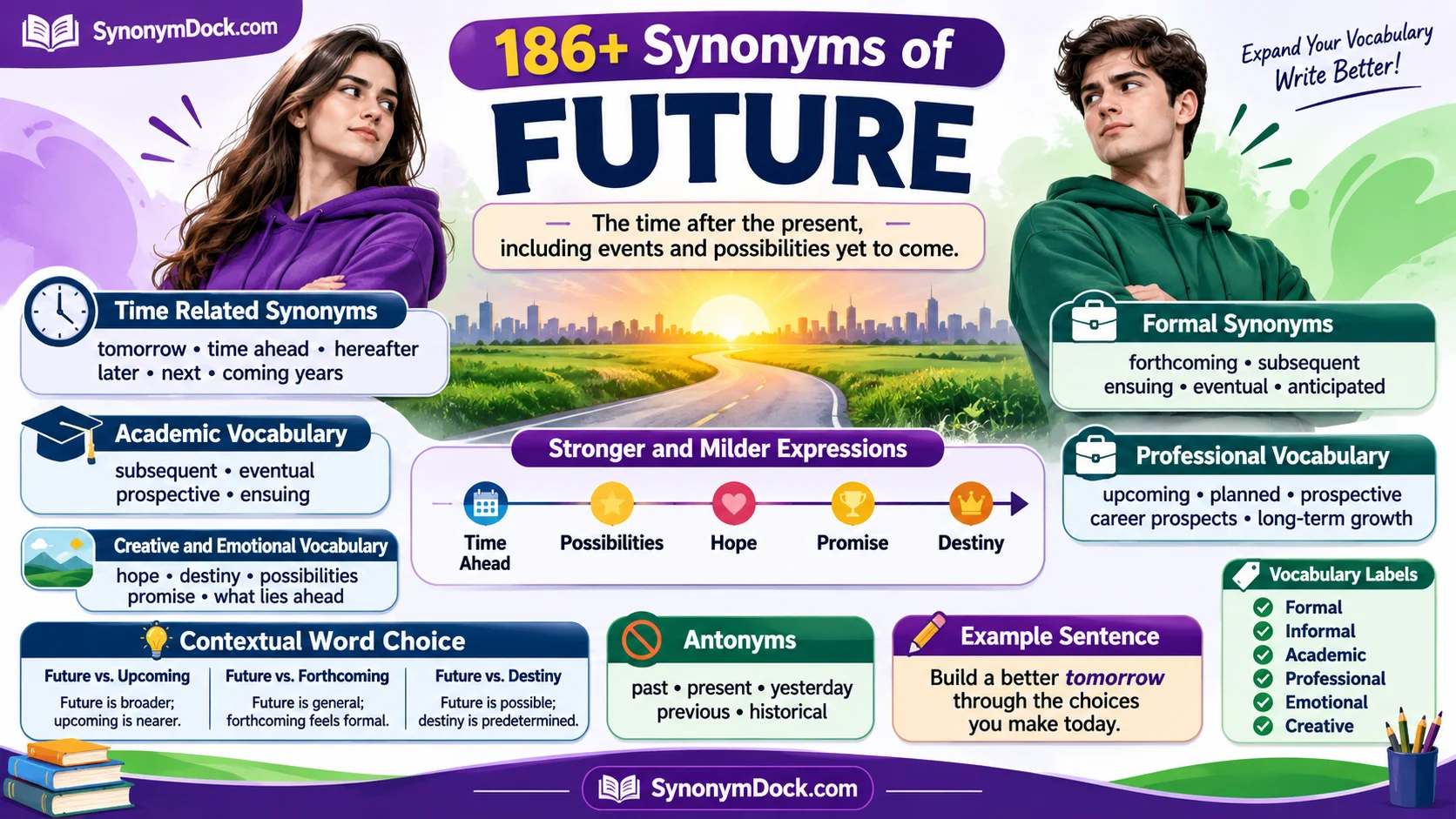
Choosing the most suitable synonym of future requires more than finding another word for time ahead. The right expression depends on the context, whether you are describing approaching events, anticipated developments, future opportunities, or possibilities that may unfold over time.
Alternatives such as forthcoming, impending, prospective, eventual, and outlook offer distinct shades of meaning, helping you communicate your ideas with greater precision and variety. In this guide, you will discover more than 186+ synonyms of future, understand their differences, explore practical examples, and learn which alternatives work best in professional, academic, creative, and everyday communication.
What Are the Best Synonyms of “Future”?
The future refers to the time that has not yet happened or events expected to occur later. Its best synonyms include tomorrow, time ahead, coming years, forthcoming, upcoming, prospective, eventual, and prospects. The right alternative depends on whether you mean time, possibility, or something planned.
Here are the best choices for different situations:
- Formal writing: Forthcoming, subsequent, ensuing, prospective.
- Casual conversation: Tomorrow, later, coming days, down the road.
- Academic writing: Subsequent, prospective, eventual, long-term.
- Professional communication: Upcoming, forthcoming, anticipated, planned.
- Emotional writing: Hope, promise, possibilities, destiny.
- Creative writing: Tomorrow, the days ahead, what lies ahead, the unknown.
Remember that some alternatives are nouns, while others are adjectives. For example, prospects can replace future when discussing opportunities, but upcoming works when describing an event that will happen soon.
Meaning, Tone, and Context
Simple Definition
The word future refers to the period of time that comes after the present. It can also describe something that is expected, planned, or likely to happen later.
For example:
“I am excited about my future.”
Here, future refers to the time ahead and the possibilities it may bring.
“We are preparing for an upcoming meeting.”
In this sentence, upcoming describes an event scheduled to happen later.
The word can communicate plans, expectations, opportunities, predictions, ambitions, and possibilities.
Part of Speech
Future is commonly used as a noun and an adjective.
1. Noun
As a noun, future refers to the time after the present or the possibilities associated with that time.
Example: “She is working hard to build a successful future.”
2. Adjective
As an adjective, future describes something that will exist, happen, or become relevant later.
Example: “The company is preparing its future business strategy.”
Overall Tone
Future is generally neutral. However, the emotional impression depends on the surrounding sentence.
- Positive: “She looks forward to a bright future.”
- Neutral: “The future of the project remains uncertain.”
- Negative: “The company faces an uncertain future.”
The word itself does not automatically express optimism or pessimism.
Formality Level
Future is a neutral word that works in formal, semi-formal, and informal communication.
It is common in:
- Academic essays.
- Business reports.
- Professional emails.
- Career discussions.
- Financial planning.
- Personal conversations.
- Creative writing.
- News articles and presentations.
More specialized alternatives, such as prospective, subsequent, and forthcoming, may be preferable when a particular meaning needs to be emphasized.
Common Uses
Native English speakers commonly use future when discussing:
1. Personal Goals: Plans, ambitions, and long-term aspirations.
2. Education: Career choices, academic opportunities, and professional development.
3. Business: Company growth, strategic planning, and market expectations.
4. Technology: New developments, innovations, and technological possibilities.
5. Finance: Investments, financial projections, and economic expectations.
6. Relationships: Long-term commitments and shared plans.
7. General Time: Events and situations that will occur after the present.
Word Forms
Here are the most useful related forms:
| Word | Part of Speech | Meaning |
| Future | Noun and adjective | Time ahead or something expected later. |
| Futuristic | Adjective | Suggesting an advanced or imagined future. |
| Futurism | Noun | A movement or approach emphasizing future developments and ideas. |
| Futurist | Noun | A person who studies or predicts possible future developments. |
| Futuristically | Adverb | In a style suggesting the future. |
Opposite: Past is the most common opposite of future when discussing time.
When and How to Use “Future”
Use future when discussing events, plans, opportunities, or periods of time that have not yet occurred.
It is particularly useful when you want to communicate something broad without specifying exactly when it will happen.
Here are seven realistic examples.
1. Professional Context
“The organization is investing in new technologies to strengthen its future operations.”
2. Academic Context
“Researchers are exploring how artificial intelligence may influence the future of education.”
3. Workplace Context
“Our team will discuss the future direction of the project during Monday’s meeting.”
4. Personal Context
“I want to make better decisions for my future.”
5. Email Context
“Thank you for considering my application. I look forward to discussing potential opportunities in the future.”
6. Resume Context
“Seeking professional development opportunities that support long-term career growth.”
7. Social Media Context
“Working hard today to create a better tomorrow.”
Best Synonyms of “Future”
No synonym of future is identical in every situation. Some alternatives describe time, others communicate upcoming events, and several emphasize expectations or opportunities.
Here are the best recommendations according to context.
| Context | Best Synonym | Why It Works |
| Professional writing | Forthcoming | Sounds polished when describing expected developments. |
| Academic writing | Subsequent | Identifies something that happens later in a sequence. |
| Business communication | Upcoming | Clearly communicates events or activities that will happen soon. |
| Casual conversation | Tomorrow | Provides a simple expression for the immediate future. |
| Emotional writing | Hope | Emphasizes positive expectations and possibilities. |
| Creative writing | The days ahead | Creates a natural and expressive sense of time. |
| Resume writing | Career prospects | Highlights potential professional opportunities. |
| Workplace communication | Planned | Communicates intended future activities. |
| Stronger meaning | Destiny | Suggests a powerful sense of what may lie ahead. |
| Softer meaning | Possibilities | Expresses potential outcomes without making definite predictions. |
When Not to Use “Future”
Although future is a useful word, certain situations require a more specific alternative.
1. When You Mean Something Happening Soon
Less effective: “The future company meeting will take place on Friday.”
Better: “The upcoming company meeting will take place on Friday.”
Why: Upcoming clearly indicates that the meeting is scheduled to happen soon.
2. When You Mean a Later Stage in a Sequence
Less effective: “The future chapter explains the results.”
Better: “The subsequent chapter explains the results.”
Why: Subsequent establishes a clear relationship between two stages or sections.
3. When You Mean a Potential Customer
Less effective: “We contacted several future clients.”
Better: “We contacted several prospective clients.”
Why: Prospective describes people who may become clients.
4. When You Mean Career Opportunities
Less effective: “This degree will improve my future.”
Better: “This degree will improve my career prospects.”
Why: Career prospects specifically refers to potential professional opportunities.
5. When You Mean a Planned Event
Less effective: “The future training session is scheduled for Tuesday.”
Better: “The planned training session is scheduled for Tuesday.”
Why: Planned communicates that the activity has been arranged.
6. When You Mean a Long Period Ahead
Less effective: “The company expects growth in the future.”
Better: “The company expects growth over the coming decades.”
Why: Coming decades gives readers a clearer idea of the expected time frame.
7. When You Mean a Desired Outcome
Less effective: “She wants a successful future.”
Better: “She hopes to build a successful career.”
Why: This version explains the specific outcome she wants rather than relying on a broad expression.
Words Commonly Confused With Future
Several words are closely related to future, but they do not always have the same meaning.
1. Future vs. Tomorrow
Difference: Future refers to any time after the present, while tomorrow specifically means the day after today.
When to Use It: Use future for general or long-term time and tomorrow for the next calendar day.
Example: “She is planning for her future.” / “She will start her new job tomorrow.”
2. Future vs. Upcoming
Difference: Future describes time ahead broadly. Upcoming usually refers to an event or situation expected to happen soon.
When to Use It: Choose upcoming when discussing scheduled events, meetings, launches, or activities.
Example: “We are planning for the future.” / “We are preparing for the upcoming conference.”
3. Future vs. Forthcoming
Difference: Future refers to all time ahead, while forthcoming often describes something expected, announced, or about to happen.
When to Use It: Use forthcoming in formal announcements, professional writing, and discussions about expected developments.
Example: “The future of the industry looks promising.” / “The forthcoming report will explain the changes.”
4. Future vs. Destiny
Difference: Future refers to time and possible events, while destiny suggests a predetermined or seemingly inevitable outcome.
When to Use It: Choose destiny when discussing fate, purpose, or a person’s perceived life direction.
Example: “She is excited about her future.” / “He believes his destiny is to become a leader.”
5. Future vs. Prospect
Difference: Future refers to time ahead, while prospect describes a possibility, opportunity, or expected outcome.
When to Use It: Use prospect when discussing potential success, opportunities, or possible developments.
Example: “The future of the business is promising.” / “The prospect of expansion attracts new investors.”
6. Future vs. Subsequent
Difference: Future refers to any time after the present, while subsequent identifies something that follows an earlier event or stage.
When to Use It: Use subsequent in academic writing, reports, and explanations involving sequences.
Example: “We are planning for the future.” / “The subsequent analysis revealed additional findings.”
Best Synonyms of Future by Context
Choosing a synonym becomes easier when you consider the specific situation.
| Context | Best Synonym | Why It Works | Example |
| Formal writing | Forthcoming | Communicates expected developments professionally. | The forthcoming announcement will provide further details. |
| Academic writing | Subsequent | Describes a later stage in a sequence. | Subsequent research may provide additional evidence. |
| Professional communication | Upcoming | Clearly identifies something scheduled to happen. | We are preparing for the upcoming review. |
| Business emails | Planned | Communicates intended activities. | The planned discussion will address our priorities. |
| Resume writing | Career prospects | Highlights professional opportunities. | Developed skills to improve long-term career prospects. |
| Workplace communication | Next | Identifies the immediate following step or period. | We will discuss this during our next meeting. |
| Casual conversation | Tomorrow | Refers naturally to the immediate future. | Tomorrow is another opportunity to improve. |
| Everyday speaking | Later | Communicates a time after the present. | I will think about it later. |
| Creative writing | The days ahead | Creates an expressive sense of time. | She wondered what the days ahead would bring. |
| Storytelling | What lies ahead | Builds curiosity about coming events. | Nobody knew what lay ahead. |
| Emotional writing | Hope | Emphasizes positive expectations. | Hope gave him the courage to face tomorrow. |
| Strong emphasis | Destiny | Suggests a powerful or seemingly predetermined outcome. | She believed her destiny was waiting beyond the mountains. |
| Mild tone | Possibilities | Expresses potential without certainty. | There are many possibilities worth exploring. |
| Social media captions | Tomorrow | Creates a short, memorable expression. | Building a better tomorrow, one step at a time. |
| American English | Upcoming | Natural for scheduled events and activities. | We are excited about the upcoming season. |
| British English | Forthcoming | Common in formal discussions of expected events. | The forthcoming changes will affect several departments. |
The American and British recommendations are not exclusive. Both varieties use upcoming and forthcoming, although preferences can vary by context.
How to Choose the Best Synonym of Future
Selecting the right synonym requires understanding what you want to communicate. Follow these practical steps.
1. Identify the Meaning
First, determine whether future refers to time, an upcoming event, a possibility, or a planned outcome.
- Time ahead: Tomorrow, the coming years, time ahead.
- Upcoming events: Forthcoming, upcoming, next.
- Potential opportunities: Prospects, possibilities.
- Expected outcomes: Eventual, anticipated.
- Personal direction: Destiny, career prospects.
2. Consider the Tone
Different words create different impressions.
For example, forthcoming sounds more formal than tomorrow, while hope communicates optimism rather than simply describing time.
Choose a word that matches the emotional effect you want.
3. Consider Your Audience
Academic readers generally expect precise terminology. Professional audiences appreciate direct expressions such as upcoming, planned, and anticipated.
For everyday conversations, simple words such as later and tomorrow are usually more natural.
4. Consider Emotional Strength
Some alternatives communicate more than a time reference.
- Neutral: Time ahead, subsequent, upcoming.
- Positive: Hope, promise, possibilities.
- Strongly expressive: Destiny, fate.
Avoid using emotionally powerful words when you only want to communicate a schedule.
5. Consider Your Writing Purpose
Your writing format also influences the best choice.
| Writing Purpose | Recommended Alternatives |
| Essays | Subsequent, eventual, prospective |
| Reports | Forthcoming, anticipated, subsequent |
| Business emails | Upcoming, planned, next |
| Resumes | Career prospects, long-term growth |
| Creative stories | What lies ahead, destiny |
| Social media | Tomorrow, possibilities |
| Academic research | Subsequent, prospective, eventual |
6. Check Natural Usage
Read the complete sentence after replacing future.
For example, “The subsequent meeting is tomorrow” may sound awkward if you simply mean the next scheduled meeting. “The upcoming meeting is tomorrow” is more natural.
The best synonym communicates the intended meaning without making the sentence unnecessarily complicated.
Real Life Examples of Future
The following examples demonstrate how future and its alternatives appear in different situations.
1. School
Original: “Students should think about their future before selecting a subject.”
Improved: “Students should consider their long-term academic goals before selecting a subject.”
2. College
Original: “The future of scientific research depends on innovation.”
Improved: “The next generation of scientific research will depend on innovation.”
3. Workplace
Original: “We need to discuss the future of this department.”
Improved: “We need to discuss the department’s long-term direction.”
4. Business
Original: “The future of the company looks promising.”
Improved: “The company’s growth prospects look promising.”
5. Email
Original: “I look forward to working with you in the future.”
Improved: “I look forward to working with you on upcoming projects.”
6. Resume
Original: “Looking for opportunities to improve my future.”
Improved: “Seeking opportunities for long-term career development.”
7. Conversation
Original: “I am worried about my future.”
Improved: “I am worried about what lies ahead.”
8. Storytelling
Original: “Nobody knew what the future would bring.”
Improved: “Nobody knew what awaited them beyond the mountains.”
9. Blogging
Original: “The future of digital marketing is changing rapidly.”
Improved: “The next phase of digital marketing is evolving rapidly.”
10. Social Media
Original: “Work hard today for a better future.”
Improved: “Work hard today to build a brighter tomorrow.”
18 Best Synonyms of Future
The following 18 alternatives represent different meanings and uses of future. Some refer directly to time, while others describe upcoming events, potential opportunities, or expected outcomes.
| Synonym | Simple Meaning | Best Used For | Example Sentence |
| 1. Tomorrow | The day after today, or a symbolic reference to the future. | Everyday and creative writing. | Tomorrow brings another chance to succeed. |
| 2. Hereafter | The period following the present. | Formal and literary writing. | The organization will follow a different policy hereafter. |
| 3. Forthcoming | Expected or scheduled to happen soon. | Formal and professional communication. | The forthcoming announcement will explain the changes. |
| 4. Upcoming | Expected to happen in the near future. | Meetings, events, and activities. | We are preparing for the upcoming conference. |
| 5. Prospective | Expected or possible in the future. | Business, education, and employment. | The company interviewed several prospective employees. |
| 6. Subsequent | Happening after something else. | Academic writing and reports. | Subsequent studies confirmed the initial findings. |
| 7. Ensuing | Following as a result of an event. | Storytelling and formal writing. | The ensuing discussion lasted several hours. |
| 8. Eventual | Happening at a later time, often after a process. | Academic and professional writing. | Their eventual success came after years of effort. |
| 9. Later | At a time after the present. | Casual and everyday communication. | We can discuss the proposal later. |
| 10. Next | Coming immediately after the present item or stage. | Workplace and everyday communication. | Our next meeting is scheduled for Tuesday. |
Important usage note: These words are not interchangeable in every sentence. For example, forthcoming and upcoming describe expected events, while prospects and possibilities describe potential outcomes. Destiny and fate add ideas about life’s direction that the neutral word future does not necessarily express.
Synonyms of Future by Usage
Professional vs. Personal Synonyms
Professional alternatives:
- Forthcoming.
- Upcoming.
- Anticipated.
- Planned.
- Subsequent.
- Prospective.
- Long-term.
- Career prospects.
These choices are useful in business reports, workplace communication, presentations, resumes, and formal emails.
Personal alternatives:
- Tomorrow.
- Hope.
- Possibilities.
- What lies ahead.
- The days to come.
- Destiny.
- Time ahead.
These words are more suitable for personal conversations, motivational writing, and discussions about life goals.
Formal vs. Conversational Synonyms
The right word depends on the communication setting.
| Situation | Recommended Synonyms |
| Reports | Forthcoming, anticipated, subsequent |
| Essays | Subsequent, eventual, prospective |
| Business writing | Planned, upcoming, anticipated |
| Presentations | Upcoming, next, forthcoming |
| Emails | Upcoming, planned, later |
| Casual conversations | Tomorrow, later, down the road |
| Texting | Tomorrow, later, next time |
| Motivational writing | Hope, possibilities, brighter tomorrow |
Formal language is useful when precision matters, while conversational expressions help communication sound natural and approachable.
Academic Synonyms
Academic writing often requires specific words that explain when something happens or how it relates to earlier events.
Consider these alternatives:
1. Subsequent
Useful when discussing a later stage in a research process or sequence.
Example: “Subsequent experiments produced consistent results.”
2. Prospective
Suitable for discussing possible participants, research subjects, or expected developments.
Example: “The researchers identified prospective participants for the study.”
3. Eventual
Useful when describing an outcome that occurs after a period of development.
Example: “The eventual findings supported the original hypothesis.”
4. Ensuing
Appropriate when describing events that follow an earlier development.
Example: “The ensuing analysis revealed several important patterns.”
5. Long-term
Useful when discussing effects, goals, and developments over an extended period.
Example: “The study examines the long-term effects of environmental changes.”
These alternatives improve academic precision because they explain timing, sequence, and expectations more clearly than a broad reference to the future.
Professional and Business Synonyms
Professional communication often requires language that identifies plans, opportunities, and expected developments.
| Situation | Recommended Alternative | Example |
| Resume | Career prospects | Developing technical skills to strengthen career prospects. |
| Interview | Long-term goals | My long-term goals include developing leadership skills. |
| Meetings | Upcoming | We will discuss the upcoming changes. |
| Presentations | Anticipated | The anticipated results will be presented next month. |
| Performance reviews | Development goals | We identified several professional development goals. |
| Client communication | Planned | The planned improvements will be introduced next quarter. |
| Business emails | Forthcoming | Further details will be provided in a forthcoming update. |
These terms sound professional because they describe specific expectations rather than relying on general statements.
Creative and Literary Synonyms
Creative writing often benefits from expressive alternatives that create anticipation, hope, or uncertainty.
1. Tomorrow
Can symbolize new opportunities, change, and a fresh beginning.
Example: “Tomorrow carried the promise of a different life.”
2. What Lies Ahead
Creates suspense about unknown events.
Example: “She was curious about what lay ahead.”
3. The Days to Come
Provides a reflective way to describe coming experiences.
Example: “He hoped the days to come would bring peace.”
4. Destiny
Suggests a powerful or predetermined life direction.
Example: “She believed destiny had brought them together.”
5. Possibilities
Highlights different paths and potential outcomes.
Example: “The open road represented endless possibilities.”
6. Hope
Expresses positive expectations during uncertain circumstances.
Example: “Hope gave him the strength to continue.”
These expressions add emotional depth and help readers connect with characters, decisions, and possible outcomes.
Slang or Modern Synonyms
There is no single slang word that directly replaces future in every context. However, several informal expressions are widely used when talking about time ahead.
| Expression | Meaning | Where It Is Acceptable | Where to Avoid It |
| Down the road | At some later time. | Conversations and informal writing. | Formal academic reports. |
| Down the line | At a later stage. | Workplace conversations and casual communication. | Highly formal documents. |
| Someday | At an unspecified time in the future. | Personal conversations and creative writing. | Precise scheduling. |
| One day | At some point in the future. | Everyday speech and motivational writing. | Formal timelines. |
| Later on | At a time after the present. | Casual conversations and emails. | Technical descriptions requiring exact dates. |
For example, “We may expand the business down the road” sounds natural in conversation. In a formal report, “The company may expand its operations in the coming years” is more appropriate.
Strongest to Mildest Synonyms
The word future does not have a fixed emotional intensity. However, its alternatives can communicate different levels of certainty, optimism, and emotional emphasis.
The following scale focuses on expressive strength rather than literal time.
| Intensity | Expression | Emotional Effect |
| Mild | Time ahead | Neutral and straightforward. |
| Mild | Later | Simple and conversational. |
| Moderate | Possibilities | Suggests potential opportunities. |
| Moderate | Prospects | Emphasizes expected opportunities or outcomes. |
| Strong | Promise | Suggests encouraging potential. |
| Strong | Hope | Communicates positive expectations. |
| Very Strong | Destiny | Suggests a powerful sense of purpose or fate. |
This is a contextual expressive scale, not a strict synonym ranking. For precise time references, upcoming, forthcoming, and subsequent should be selected according to timing rather than emotional intensity.
Emotional vs. Neutral Synonyms
Emotional Synonyms
These words communicate feelings, expectations, and personal beliefs.
- Hope.
- Promise.
- Destiny.
- Fate.
- Tomorrow.
- Possibilities.
- What lies ahead.
Use these alternatives in motivational speeches, personal writing, storytelling, and discussions about ambitions.
Neutral Synonyms
These alternatives communicate time, sequence, and expected activities without adding strong emotions.
- Upcoming.
- Forthcoming.
- Subsequent.
- Later.
- Next.
- Eventual.
- Time ahead.
- Planned.
Use them in academic writing, business communication, professional reports, and everyday explanations.
Antonyms of Future
The most direct antonym of future is past because the two words refer to opposite directions in time.
However, the exact opposite depends on the context. When discussing time, past is appropriate. When discussing something planned or expected, present, current, or existing may provide a more suitable contrast.
The following table contains 12 contextual opposites and contrasting expressions. They should not all be treated as exact dictionary antonyms.
| Antonym or Contrast | Meaning | Example Sentence |
| 1. Past | Time that has already happened. | We cannot change the past, but we can learn from it. |
| 2. Present | The time happening now. | The present requires our immediate attention. |
| 3. History | Events and experiences from earlier times. | History provides valuable lessons for future generations. |
| 4. Yesterday | The day before today. | Yesterday’s problems should not determine tomorrow’s decisions. |
| 5. Former times | An earlier period. | The building reflects the traditions of former times. |
| 6. Previous | Existing or occurring before something else. | The previous arrangement is no longer valid. |
| 7. Earlier | At a time before the present or another event. | We discussed this issue earlier. |
| 8. Bygone days | A period that has passed. | She often remembered the bygone days of her childhood. |
| 9. Yesteryear | A time in the past, often remembered fondly. | The museum preserves photographs from yesteryear. |
| 10. Antiquity | The distant past, especially ancient history. | The artifact dates back to antiquity. |
| 11. Retrospect | Looking back at past events. | In retrospect, the decision was beneficial. |
| 12. Existing | Already present or in existence. | The existing system needs immediate improvement. |
Comparison: Future vs. Similar Words
Understanding closely related words makes it easier to choose the correct alternative.
1. Future vs. Upcoming
Main Difference
Future describes all time after the present. Upcoming generally describes something expected to happen relatively soon.
Which Is Stronger?
Neither is inherently stronger. Upcoming communicates a more immediate expectation.
Which Is More Formal?
Both are appropriate for professional writing. Upcoming is especially natural in announcements and schedules.
When to Use Each
Use future for long-term possibilities and upcoming for scheduled events.
Examples
Future: “The future of renewable energy looks promising.”
Upcoming: “The upcoming energy conference will attract industry experts.”
2. Future vs. Forthcoming
Main Difference
Future refers broadly to time ahead. Forthcoming describes something expected or about to be made available.
Which Is Stronger?
Forthcoming communicates a more specific expectation.
Which Is More Formal?
Forthcoming often sounds more formal, especially in reports and announcements.
When to Use Each
Use future for general time references and forthcoming for expected publications, announcements, or developments.
Examples
Future: “The future of the project remains uncertain.”
Forthcoming: “The forthcoming report will explain the project’s progress.”
3. Future vs. Prospective
Main Difference
Future refers to time ahead. Prospective describes someone or something being considered for a possible future role, position, or situation.
Which Is Stronger?
Prospective is more specific about potential participation or development.
Which Is More Formal?
Prospective is particularly suitable for professional and academic writing.
When to Use Each
Use future when discussing time and prospective when describing potential customers, students, employees, or developments.
Examples
Future: “The company is planning its future operations.”
Prospective: “The company is interviewing prospective employees.”
4. Future vs. Destiny
Main Difference
Future refers to events and possibilities that lie ahead. Destiny suggests that a person’s life or outcome follows a predetermined course.
Which Is Stronger?
Destiny has a stronger emotional and philosophical meaning.
Which Is More Formal?
Future is more neutral and widely suitable for formal writing. Destiny is appropriate in philosophical and literary contexts.
When to Use Each
Choose future for general planning and destiny when discussing fate or perceived life purpose.
Examples
Future: “She is planning a career in medicine.”
Destiny: “She believes becoming a doctor is her destiny.”
5. Future vs. Subsequent
Main Difference
Future refers to any time after the present. Subsequent describes something that occurs after a specific earlier event.
Which Is Stronger?
Neither is stronger. Subsequent establishes a more precise chronological relationship.
Which Is More Formal?
Subsequent is more common in academic, technical, and formal writing.
When to Use Each
Use future for general expectations and subsequent for events that follow another event.
Examples
Future: “The future research will explore additional possibilities.”
Subsequent: “Subsequent research confirmed the original findings.”
6. Future vs. Prospects
Main Difference
Future describes time ahead or what may happen. Prospects refers to potential opportunities or expected outcomes.
Which Is Stronger?
Prospects places greater emphasis on opportunity and potential success.
Which Is More Formal?
Both are appropriate for professional communication. Prospects is particularly useful in career and business discussions.
When to Use Each
Use future for general plans and prospects for opportunities, employment, and business growth.
Examples
Future: “He wants to improve his future.”
Prospects: “He wants to improve his career prospects.”
Common Phrases and Expressions with Future
These expressions are widely used in American English and are useful in everyday, academic, professional, and creative communication.
1. In the Future
Meaning: At some time after the present.
Example Sentence: “We hope to work together again in the future.”
2. In the Near Future
Meaning: Within a relatively short period from now.
Example Sentence: “The company plans to introduce new products in the near future.”
3. Looking to the Future
Meaning: Thinking about upcoming possibilities, goals, or developments.
Example Sentence: “The organization is looking to the future by investing in renewable energy.”
4. Future Generations
Meaning: People who will live in later generations.
Example Sentence: “We must protect natural resources for future generations.”
5. A Bright Future
Meaning: A future expected to include success, happiness, or positive opportunities.
Example Sentence: “Her dedication and talent suggest a bright future.”
6. Future Plans
Meaning: Activities or goals someone intends to pursue later.
Example Sentence: “We discussed our future plans during the family meeting.”
7. For Future Reference
Meaning: To keep information available for use later.
Example Sentence: “Please save this document for future reference.”
8. What the Future Holds
Meaning: The events or possibilities that may happen later.
Example Sentence: “Nobody knows what the future holds, but preparation can make a difference.”
Common Mistakes to Avoid
Choosing an inaccurate synonym can make a sentence confusing or change its intended meaning. Here are seven common mistakes to avoid when using future and its alternatives.
Mistake 1: Using a Vague Synonym Instead of a Precise One
Incorrect: “We are preparing for the future meeting.”
Better: “We are preparing for the upcoming meeting.”
Why: Upcoming identifies an event that will happen soon, making the sentence more specific.
Mistake 2: Confusing Future With Destiny
Incorrect: “The company’s destiny includes several scheduled product launches.”
Better: “The company’s future includes several scheduled product launches.”
Why: Destiny suggests fate or a predetermined outcome. Future is more appropriate for planned business activities.
Mistake 3: Using an Informal Expression in Formal Writing
Incorrect: “The company might expand down the road.”
Better: “The company may expand in the coming years.”
Why: In the coming years sounds more professional and provides a clearer time reference.
Mistake 4: Choosing an Overly Dramatic Synonym
Incorrect: “Our destiny is to complete the quarterly financial report.”
Better: “Our goal is to complete the quarterly financial report.”
Why: Destiny adds unnecessary emotional significance. Goal directly communicates the intended objective.
Mistake 5: Repeating the Same Word Too Often
Incorrect: “The future of education depends on technology. The future of learning will also depend on innovation, and the future of classrooms may change.”
Better: “The future of education depends on technology. New learning methods will also rely on innovation, while classroom environments may change significantly.”
Why: Using related expressions improves readability without forcing unnecessary synonyms.
Mistake 6: Choosing a Word With the Wrong Meaning
Incorrect: “The subsequent applicants are interested in joining the company.”
Better: “The prospective applicants are interested in joining the company.”
Why: Prospective describes people who may apply or join. Subsequent refers to something occurring later in a sequence.
Mistake 7: Using Slang in Academic or Professional Writing
Incorrect: “We will figure everything out down the road in our research report.”
Better: “Further details will be established during subsequent research.”
Why: The revised sentence uses more appropriate academic language and communicates the intended meaning clearly.
Frequently Asked Questions
1. What are the best synonyms of future?
The best synonyms of future include tomorrow, forthcoming, upcoming, subsequent, eventual, prospective, possibilities, prospects, and time ahead. Choose an alternative based on whether you mean time, an upcoming event, or a potential opportunity.
2. What are the best formal synonyms of future?
Formal synonyms include forthcoming, subsequent, prospective, eventual, anticipated, and ensuing. These words work well in academic papers, business reports, professional emails, and discussions involving planned or expected developments.
3. What are common informal synonyms of future?
Common informal alternatives include tomorrow, later, down the road, someday, and the days ahead. These expressions work naturally in everyday conversations, personal messages, motivational writing, and casual discussions about upcoming possibilities.
4. What is another word for future in professional writing?
Forthcoming, upcoming, anticipated, planned, and subsequent are useful professional alternatives. For career discussions, career prospects and long-term growth communicate specific opportunities more clearly than the general word future.
5. What is the difference between future and upcoming?
Future refers to any time after the present, while upcoming usually describes an event or activity expected to happen soon. For example, future opportunities are broad, but an upcoming meeting is scheduled.
6. What is the opposite of future?
The direct opposite of future is past because it refers to time that has already happened. Present is another important contrast because it describes the time happening now.
Conclusion
Future describes the period that lies ahead of the present, encompassing anticipated events, emerging opportunities, and possibilities yet to unfold. Depending on the context, effective alternatives include forthcoming, impending, subsequent, prospective, eventual, prospects, and the time ahead.
Each alternative carries a distinct meaning. Use forthcoming for expected developments, impending for events approaching soon, subsequent for later stages, prospective for potential opportunities, and prospects when discussing future possibilities. For a more conversational or expressive tone, tomorrow and the days ahead offer natural ways to refer to what lies beyond the present.

Ethan Parker is an English language writer and vocabulary enthusiast at SynonymDock.com. He specializes in synonyms, word meanings, alternative expressions and practical English usage, creating clear and reliable content to help students, professionals, writers and English learners choose the right words with confidence.
8 thoughts on “186+ Alternatives to Future|Unique Words for Smarter Writing”