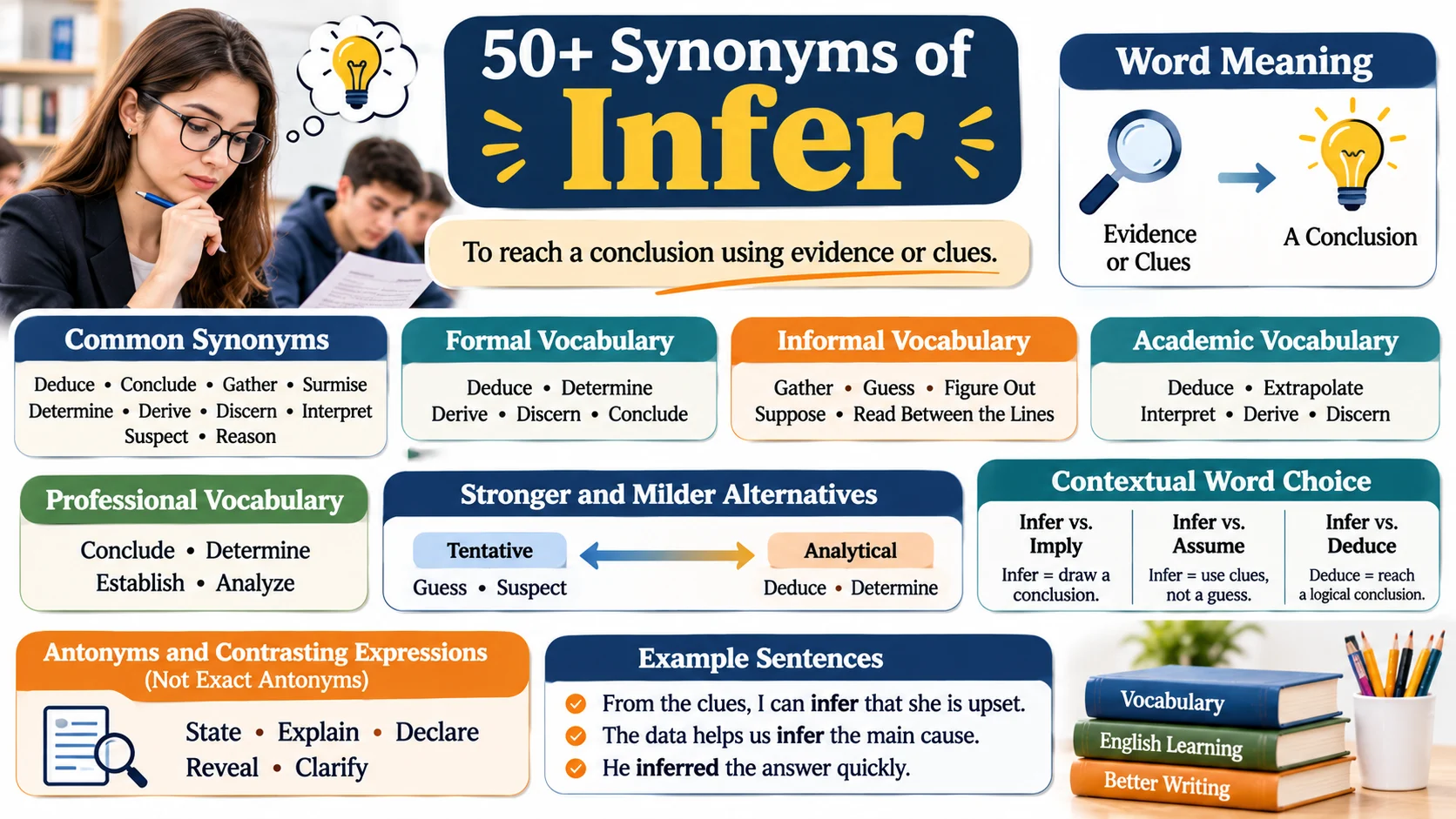
Have you ever used the word infer repeatedly in an essay, email, research paper, or professional report? Although it communicates an important idea, using the same word too often can make your writing sound repetitive.
Finding the right synonym of infer helps you communicate conclusions, interpretations, and assumptions more precisely. Words such as deduce, conclude, gather, and surmise offer different ways to express an idea based on available information.
However, these alternatives are not interchangeable in every situation. Some work better in academic writing, while others sound more natural in conversations or professional communication.
This guide explores the meaning of infer, its best synonyms, contextual differences, examples, antonyms, and common mistakes. You will learn how to choose the most accurate alternative for your writing and speaking.
What Are the Best Synonyms of “Infer”?
To infer means to form an opinion, reach a conclusion, or understand something using available evidence, information, or clues rather than being told directly. The best synonyms include deduce, conclude, gather, determine, surmise, and reason. Formal writing favors deduce and conclude, while gather and figure out suit everyday communication.
Here are the best alternatives by context:
| Context | Best Synonym |
| Formal writing | Deduce |
| Casual conversation | Gather |
| Academic writing | Deduce |
| Professional communication | Conclude |
| Business writing | Determine |
| Emotional writing | Sense |
| Creative writing | Surmise |
| Research papers | Derive |
| Everyday speaking | Figure out |
| Analytical writing | Reason |
Meaning, Tone, and Context of Infer
Simple Definition
Infer means to reach a conclusion based on facts, clues, observations, or information that is available.
When someone infers something, they do not necessarily receive a direct explanation. Instead, they use what they know to understand something that has not been explicitly stated.
Example:
The teacher inferred from the students’ expressions that they had not understood the lesson.
In this sentence, the teacher uses the students’ expressions as evidence to reach a conclusion.
Part of Speech
Infer is a verb.
It describes the mental process of reaching a conclusion from available information.
Overall Tone
The word infer generally has a neutral and analytical tone.
It does not automatically express positive or negative feelings. Its emotional meaning depends on the situation.
For example:
- Positive: I inferred that the team appreciated my contribution.
- Neutral: We inferred the answer from the available evidence.
- Negative: She inferred that her colleagues were unhappy with the decision.
Formality Level
Neutral to formal
Infer is appropriate for:
- Academic essays
- Research papers
- Professional reports
- Business communication
- Educational discussions
- Everyday conversations
It sounds particularly natural when discussing evidence, reasoning, and interpretation.
Common Uses
Native English speakers commonly use infer when discussing:
- Understanding an indirect message.
- Drawing conclusions from evidence.
- Interpreting someone’s behavior.
- Analyzing information.
- Understanding the meaning of a situation.
- Making logical judgments.
- Reading between the lines.
Word Forms
| Word Form | Meaning | Example |
| Infer | Base verb | We infer the meaning from context. |
| Infers | Present tense | She infers the answer correctly. |
| Inferred | Past tense | They inferred the truth. |
| Inferring | Present participle | He is inferring too much. |
| Inference | Noun | Her inference was reasonable. |
| Inferential | Adjective | The study uses inferential reasoning. |
Important distinction: Infer and inference are related, but infer is the action of reaching a conclusion, while inference is the conclusion or reasoning itself.
When and How to Use “Infer”
Use infer when you reach a conclusion from clues, evidence, observations, or indirect information.
It is especially useful when the information is not directly communicated.
Here are seven practical examples.
1. Professional Context
The manager inferred that the project needed additional support from the team’s progress report.
2. Academic Context
Students can infer the author’s central message by examining the main arguments.
3. Workplace Context
I inferred from the discussion that the deadline might change.
4. Personal Context
She inferred from his silence that he disagreed with the decision.
5. Email Context
From your previous message, I infer that you would prefer to reschedule our meeting.
6. Resume Context
The hiring manager could infer my leadership abilities from my previous project responsibilities.
7. Social Media Context
You can infer a person’s interests from the topics they frequently share online.
Best Synonyms of “Infer”
No synonym of infer communicates exactly the same meaning in every situation. The best alternative depends on whether you are emphasizing evidence, logical reasoning, personal understanding, or an uncertain conclusion.
Here are the strongest recommendations.
| Writing Context | Best Synonym | Why It Works |
| Professional writing | Conclude | Communicates a reasoned final judgment. |
| Academic writing | Deduce | Emphasizes logical reasoning from evidence. |
| Business communication | Determine | Suggests reaching a decision after examining information. |
| Casual conversation | Gather | Sounds natural when understanding indirect information. |
| Emotional writing | Sense | Expresses an impression based on feelings or subtle clues. |
| Creative writing | Surmise | Adds a thoughtful or uncertain interpretation. |
| Resume writing | Derive | Highlights conclusions drawn from information or experience. |
| Workplace communication | Reason | Emphasizes the thinking process. |
| Stronger meaning | Deduce | Suggests a logical conclusion supported by evidence. |
| Softer meaning | Suspect | Communicates a tentative belief rather than certainty. |
When Not to Use “Infer”
Although infer is useful, it is not always the clearest word. Sometimes another alternative communicates the intended meaning more naturally.
1. When You Need a More Specific Word
Infer can sound general when you want to emphasize a logical conclusion.
- Less precise: I inferred the answer from the evidence.
- Better: I deduced the answer from the evidence.
Why: Deduce emphasizes the logical process behind reaching the answer.
2. When You Are Making a Final Judgment
Infer describes the reasoning process, while conclude emphasizes the resulting judgment.
- Less direct: We inferred that the project was successful.
- Better: We concluded that the project was successful.
3. When You Are Speaking Casually
Infer can sound slightly formal in an everyday conversation.
- Less conversational: I inferred that you were busy.
- Better: I gathered that you were busy.
4. When You Are Expressing Uncertainty
Infer may sound more definite than your actual level of confidence.
- Less suitable: I inferred that he was upset.
- Better: I suspected that he was upset.
5. When You Are Describing an Emotional Impression
Infer is not always the best choice for describing feelings or subtle emotional signals.
- Less expressive: I inferred that she was uncomfortable.
- Better: I sensed that she was uncomfortable.
6. When You Are Describing a Decision
Infer does not necessarily mean making a final decision.
- Less suitable: The committee inferred the final budget.
- Better: The committee determined the final budget.
7. When You Want to Describe a Direct Statement
Infer is unnecessary when someone communicates information explicitly.
- Less suitable: The principal inferred that the meeting was canceled after reading the announcement.
- Better: The principal learned that the meeting was canceled after reading the announcement.
Words Commonly Confused With Infer
Several words are closely related to infer, but their meanings are different.
| Word | Difference | When to Use It | Example |
| Imply | Suggest something indirectly rather than stating it directly. | When communicating an indirect message. | His response implied disagreement. |
| Assume | Accept something as true without sufficient proof. | When expressing an unverified belief. | I assumed the office was closed. |
| Deduce | Reach a logical conclusion using evidence. | When explaining logical reasoning. | We deduced the answer from the clues. |
| Conclude | Reach a final judgment after considering information. | When presenting a result. | The researchers concluded that the method worked. |
| Presume | Believe something is probably true without complete confirmation. | When making a reasonable but unconfirmed belief. | I presume everyone has received the notice. |
| Suspect | Believe something may be true, often with uncertainty. | When expressing doubt or a possible explanation. | I suspect the information is incorrect. |
Important grammar tip:
The difference between infer and imply is particularly important.
- A speaker implies something through their words.
- A listener infers something from those words.
Example:
The teacher implied that the assignment needed improvement, so the students inferred that they should revise their work.
Best Synonyms of Infer by Context
Choosing the right synonym improves clarity and makes your writing sound more natural.
| Context | Best Synonym | Why It Works | Example |
| Formal writing | Deduce | Communicates evidence based reasoning. | We deduced the underlying cause. |
| Academic writing | Derive | Emphasizes obtaining a conclusion from information. | The researchers derived a conclusion from the findings. |
| Professional communication | Conclude | Presents a reasoned judgment. | We concluded that the strategy was effective. |
| Business emails | Gather | Sounds polite and natural. | I gather that the schedule has changed. |
| Resume writing | Determine | Highlights analytical judgment. | Determined project requirements through data analysis. |
| Workplace communication | Establish | Emphasizes reaching a supported finding. | The team established the likely cause. |
| Casual conversation | Figure out | Uses everyday conversational language. | I figured out what happened. |
| Everyday speaking | Gather | Expresses understanding from indirect information. | I gather you are leaving soon. |
| Creative writing | Surmise | Adds an element of uncertainty. | She surmised that something was wrong. |
| Storytelling | Sense | Communicates an intuitive impression. | He sensed that danger was approaching. |
| Emotional writing | Suspect | Expresses a personal belief with uncertainty. | I suspected she was disappointed. |
| Strong emphasis | Deduce | Highlights a logical conclusion. | We deduced the truth from the evidence. |
| Mild tone | Suppose | Communicates a tentative belief. | I suppose he misunderstood the message. |
| Social media captions | Guess | Sounds relaxed and conversational. | I guess everyone has their own story. |
| American English | Figure out | Common, natural everyday expression. | I figured out the answer. |
| British English | Gather | Natural in both British and American English. | I gather that the meeting is postponed. |
How to Choose the Best Synonym of Infer
Choosing an alternative is not simply about finding another word with a similar dictionary definition. You should consider the message you want to communicate.
Use these six steps.
1. Consider the Meaning
Ask yourself what you are trying to express.
- Use deduce for logical reasoning.
- Use conclude for a final judgment.
- Use gather for understanding indirect information.
- Use suspect for an uncertain belief.
2. Consider Your Audience
A word that works in a casual conversation may not suit an academic research paper.
For example, figure out is natural in everyday speaking, while deduce is more appropriate for formal analytical writing.
3. Check the Emotional Strength
Some synonyms communicate certainty, while others suggest uncertainty.
- Suspect suggests uncertainty.
- Surmise suggests a tentative conclusion.
- Deduce emphasizes logical reasoning.
- Determine suggests reaching a decision or finding.
4. Match the Level of Formality
Choose vocabulary that fits your communication setting.
For professional reports, consider conclude, deduce, or determine. For casual conversations, gather and figure out sound more natural.
5. Consider Your Writing Purpose
A research paper requires precise language. A creative story may benefit from expressive vocabulary.
Choose words that support the purpose of your writing rather than simply replacing infer.
6. Read the Sentence Again
After replacing infer, read the complete sentence.
If the alternative changes the original meaning, choose another word. Accuracy is more important than using complicated vocabulary.
Real Life Examples of Infer
The following examples show how infer and its alternatives work in everyday situations.
1. School
Original: Students can infer the meaning of unfamiliar words from surrounding sentences.
Improved: Students can deduce the meaning of unfamiliar words from contextual clues.
2. College
Original: The professor inferred that the students needed additional explanation.
Improved: The professor concluded that the students needed additional explanation.
3. Workplace
Original: I inferred that the manager was dissatisfied with the results.
Improved: I gathered that the manager was dissatisfied with the results.
4. Business
Original: We inferred that customers preferred the updated service.
Improved: We determined that customers preferred the updated service.
5. Email
Original: I infer from your message that you are unavailable tomorrow.
Improved: I gather from your message that you are unavailable tomorrow.
6. Resume
Original: The employer inferred my analytical abilities from my work history.
Improved: My work history demonstrated my analytical abilities.
7. Conversation
Original: I inferred that you wanted to leave early.
Improved: I guessed that you wanted to leave early.
8. Storytelling
Original: She inferred that something unusual had happened.
Improved: She sensed that something unusual had happened.
9. Blogging
Original: Readers can infer the author’s main message from the discussion.
Improved: Readers can identify the author’s main message through the discussion.
10. Social Media
Original: I inferred that everyone enjoyed the event.
Improved: I guessed that everyone enjoyed the event.
18 Best Synonyms of Infer
Here are 18 useful synonyms and closely related alternatives. Each word has a slightly different meaning, so choose according to the context.
| Synonym | Simple Meaning | Best Used For | Example Sentence |
| 1. Deduce | Reach a logical conclusion from evidence. | Academic and analytical writing. | We deduced the answer from the available clues. |
| 9. Presume | Believe something is probably true. | Formal communication. | I presume the documents are ready. |
| 11. Guess | Form an opinion without complete information. | Casual conversation. | I guessed that she was running late. |
| 13. Sense | Become aware of something through intuition or subtle clues. | Emotional and descriptive writing. | She sensed that something was wrong. |
| 14. Discern | Recognize something that may not be immediately obvious. | Formal and literary writing. | He discerned a pattern in the results. |
| 16. Glean | Gather information gradually from available sources. | Research and reading. | We gleaned useful details from the interview. |
| 17. Extrapolate | Estimate or predict using existing information. | Research and data analysis. | Analysts extrapolated future trends from previous results. |
Vocabulary note: These alternatives are context dependent. For example, assume does not require the same evidence as deduce, and extrapolate involves extending known information to make an estimate or prediction.
Synonyms of Infer by Usage
Professional vs Personal Synonyms
Professional communication requires precise and appropriate vocabulary.
Use these alternatives in workplace discussions, reports, and business communication:
- Deduce: When reaching a logical conclusion from evidence.
- Conclude: When presenting the result of an analysis.
- Determine: When identifying a result or making a decision.
- Establish: When demonstrating or confirming a finding.
For personal communication, simpler expressions often sound more natural.
- Gather: When understanding an indirect message.
- Guess: When making an uncertain judgment.
- Sense: When describing an intuitive impression.
- Suppose: When expressing a tentative belief.
Formal vs Conversational Synonyms
Your vocabulary should match your communication style.
| Formal Alternatives | Conversational Alternatives |
| Deduce | Figure out |
| Conclude | Gather |
| Determine | Guess |
| Discern | Sense |
| Surmise | Suppose |
| Derive | Read between the lines |
Use formal alternatives in research papers, essays, reports, and presentations.
Conversational alternatives work better in texting, personal discussions, and everyday conversations.
Academic Synonyms
Academic writing requires words that accurately describe reasoning and interpretation.
The following alternatives are particularly useful:
1. Deduce
Use deduce when explaining a conclusion reached through logical reasoning.
Example: The researchers deduced the possible cause from the experimental results.
2. Derive
Use derive when obtaining a conclusion, value, or idea from a source.
Example: The study derived its conclusions from collected observations.
3. Discern
Use discern when identifying a pattern, distinction, or meaning that is not immediately obvious.
Example: The analysis discerned differences between the two approaches.
4. Extrapolate
Use extrapolate when estimating or predicting something using existing information.
Example: Researchers extrapolated future outcomes from historical data.
5. Interpret
Use interpret when explaining the meaning of evidence, language, or findings.
Example: The students interpreted the results in different ways.
These words make academic arguments more precise because each identifies a different reasoning process.
Professional and Business Synonyms
Professional writing benefits from direct, clear vocabulary.
Here are useful alternatives for different workplace situations.
| Situation | Recommended Word | Example |
| Resume | Determine | Determined operational priorities through data analysis. |
| Interview | Conclude | I concluded that the position matched my experience. |
| Meeting | Gather | I gather that we need additional resources. |
| Presentation | Establish | The findings establish a clear connection. |
| Performance review | Discern | We discerned opportunities for improvement. |
| Client communication | Understand | I understand that your requirements have changed. |
| Business email | Conclude | We concluded that the revised proposal was suitable. |
Professional recommendation: Prefer words that communicate the actual action you performed. For example, use analyzed when you examined information, determined when you reached a finding, and established when you demonstrated something.
Creative and Literary Synonyms
Creative writing often requires words that communicate subtle meanings and emotions.
Consider these alternatives:
- Surmise: Suggests a thoughtful but uncertain conclusion.
- Sense: Communicates an intuitive impression.
- Discern: Suggests recognizing something hidden or difficult to notice.
- Suspect: Creates uncertainty or anticipation.
- Glean: Suggests gradually collecting information.
- Read between the lines: Communicates an unstated meaning.
Example:
Original: She inferred that the stranger was hiding something.
Creative alternative: She sensed that the stranger was concealing a secret.
The second sentence creates a stronger atmosphere of mystery.
Slang or Modern Synonyms
Infer does not have a widely accepted direct slang equivalent. However, some informal expressions communicate a similar idea.
| Expression | Meaning | Where It Works | Where to Avoid It |
| Figure out | Understand through thinking. | Everyday conversations. | Formal research papers. |
| Pick up on | Notice a subtle message or signal. | Informal discussions. | Highly formal reports. |
| Read between the lines | Understand an indirect message. | Personal conversations. | Technical definitions. |
| Take it that | Understand something as being true. | Casual and semi formal communication. | Precise scientific writing. |
Example: I picked up on the fact that she was uncomfortable.
These expressions are useful when you want natural conversational English without making your sentence sound overly formal.
Strongest to Mildest Synonyms of Infer
The intensity of a synonym depends on the certainty of the conclusion and the type of reasoning involved.
The following scale is a practical guide, not a strict linguistic ranking.
| Level | Words | Explanation |
| Mild | Guess, suppose, suspect | Suggest a tentative or uncertain belief. |
| Moderate | Gather, surmise, sense | Communicate an impression based on clues. |
| Strong | Deduce, conclude, discern | Emphasize reasoning or a supported judgment. |
| Very Strong | Establish, determine | Suggest a more definite finding or decision. |
Important: Stronger does not always mean more accurate. A conclusion based on weak evidence should not be described with language that suggests certainty.
Emotional vs Neutral Synonyms
Different alternatives communicate different emotional impressions.
Emotional Synonyms
These words can express personal impressions, uncertainty, or intuition.
- Sense: Suggests an intuitive feeling.
- Suspect: Communicates doubt or concern.
- Guess: Suggests uncertainty.
- Surmise: Expresses a thoughtful but tentative belief.
- Suppose: Communicates a personal assumption.
Example: I sensed that something was troubling her.
Neutral Synonyms
These words generally emphasize information, reasoning, or analysis.
- Deduce: Reach a logical conclusion.
- Determine: Establish a result.
- Conclude: Reach a judgment.
- Derive: Obtain information from a source.
- Discern: Recognize a distinction or pattern.
- Interpret: Explain the meaning of something.
Example: The researchers deduced the cause from the experimental results.
Choose emotional words for personal expression and neutral alternatives for objective communication.
Antonyms of Infer
There is no single exact antonym of infer because it describes a process of reaching a conclusion from indirect evidence.
However, certain verbs express contrasting actions. For example, instead of working out unstated information, someone might state, explain, disclose, or demonstrate information directly.
The following are contextual opposites, not exact dictionary antonyms.
| Contrasting Word | Meaning | Example Sentence |
| 1. State | Express something directly. | Please state your opinion clearly. |
| 2. Declare | Announce something openly. | The committee declared its decision. |
| 3. Explain | Make information understandable. | The teacher explained the answer. |
| 4. Specify | Identify something precisely. | The instructions specify the required materials. |
| 5. Disclose | Reveal previously hidden information. | The company disclosed the results. |
| 6. Reveal | Make something known. | The report revealed the actual figures. |
| 7. Announce | Make information public. | The principal announced the new schedule. |
| 8. Demonstrate | Show how something works or is true. | The experiment demonstrated the theory. |
| 9. Prove | Establish something with sufficient evidence. | The evidence proved the claim. |
| 10. Confirm | Establish that something is correct. | The manager confirmed the appointment. |
| 11. Verify | Check whether information is accurate. | Researchers verified the information. |
| 12. Clarify | Make something easier to understand. | She clarified the misunderstanding. |
| 13. Describe | Explain the features of something. | He described the situation in detail. |
| 14. Explicitly communicate | Express information without leaving it unstated. | The principal explicitly communicated the new policy. |
| 15. Present | Put information forward for consideration. | The researcher presented the findings. |
Which is the closest opposite?
For the specific contrast between indirect understanding and direct communication, state, explain, and explicitly communicate are especially useful.
Comparison: Infer vs Similar Words
Understanding the differences between related words helps prevent mistakes in academic and professional writing.
1. Infer vs Imply
Main Difference
Infer means to reach a conclusion from information. Imply means to suggest something without expressing it directly.
Which Is Stronger?
Neither word is automatically stronger. They describe different sides of communication.
Which Is More Formal?
Both are suitable for academic and professional writing.
When to Use Each
Use infer for understanding an indirect message. Use imply when describing what a speaker or writer suggests.
Examples
- Infer: I inferred that she disagreed with the proposal.
- Imply: Her response implied that she disagreed with the proposal.
2. Infer vs Deduce
Main Difference
Infer is a broad term for reaching a conclusion from information. Deduce emphasizes a logical conclusion based on evidence or reasoning.
Which Is Stronger?
Deduce often suggests a more structured reasoning process.
Which Is More Formal?
Both work in formal writing, although deduce is particularly useful in analytical discussions.
When to Use Each
Use infer for general conclusions and deduce when emphasizing logical evidence.
Examples
- Infer: We inferred that the road was closed.
- Deduce: We deduced that the road was closed from the warning signs.
3. Infer vs Assume
Main Difference
Infer involves drawing a conclusion from available information. Assume means accepting something as true without necessarily having enough evidence.
Which Is Stronger?
Neither is inherently stronger. Infer emphasizes reasoning, while assume may communicate an unsupported belief.
Which Is More Formal?
Both are suitable for formal writing.
When to Use Each
Use infer when evidence supports your conclusion. Use assume when describing an unverified belief.
Examples
- Infer: I inferred that the meeting had been canceled from the announcement.
- Assume: I assumed that the meeting had been canceled.
4. Infer vs Conclude
Main Difference
Infer emphasizes reaching an understanding from indirect evidence. Conclude emphasizes the final judgment after considering information.
Which Is Stronger?
Conclude can sound more definite because it often presents the outcome of reasoning.
Which Is More Formal?
Both are appropriate for academic and professional writing.
When to Use Each
Use infer to describe the reasoning process. Use conclude to present the resulting judgment.
Examples
- Infer: The students inferred the author’s intention.
- Conclude: The students concluded that the author’s intention was to criticize the policy.
5. Infer vs Presume
Main Difference
Infer means reaching a conclusion from clues or evidence. Presume means believing something is probably true without complete confirmation.
Which Is Stronger?
Neither always carries greater certainty. Both can communicate a tentative belief.
Which Is More Formal?
Presume can sound slightly more formal in some contexts.
When to Use Each
Use infer when discussing evidence based reasoning. Use presume when expressing an expectation or assumption.
Examples
- Infer: We inferred that the students needed more time.
- Presume: We presume that the students will complete the assignment.
6. Infer vs Suspect
Main Difference
Infer emphasizes reaching a conclusion through information or reasoning. Suspect communicates a belief that something may be true, often with uncertainty.
Which Is Stronger?
Infer can sound more analytical. Suspect often conveys greater doubt.
Which Is More Formal?
Both can be used in professional writing, but infer is generally more suitable for objective analysis.
When to Use Each
Use infer for evidence based conclusions. Use suspect when expressing uncertainty or a possible explanation.
Examples
- Infer: The investigators inferred that the information was incomplete.
- Suspect: The investigators suspected that the information was incomplete.
Common Phrases and Expressions with Infer
Here are seven useful expressions involving infer that can improve your vocabulary.
1. Infer From
Meaning: Reach a conclusion using particular information or evidence.
Example: We can infer from the results that the new method was effective.
2. Infer That
Meaning: Reach a particular conclusion from available information.
Example: I infer that you have already completed the assignment.
3. Infer Something From Context
Meaning: Understand an unstated meaning by examining surrounding information.
Example: Students should infer the meaning of unfamiliar words from context.
4. Reasonably Infer
Meaning: Reach a conclusion that is sensible based on available evidence.
Example: We can reasonably infer that the changes improved productivity.
5. Correctly Infer
Meaning: Reach an accurate conclusion from the information provided.
Example: She correctly inferred the author’s intention.
6. Safely Infer
Meaning: Reach a conclusion without going beyond what the evidence supports.
Example: We can safely infer that the experiment produced consistent results.
7. Infer the Meaning
Meaning: Understand an unstated idea or message.
Example: Readers can infer the meaning of the passage through its examples.
Common Mistakes to Avoid When Using Infer
Even advanced English learners sometimes confuse infer with related vocabulary.
Here are seven mistakes to avoid.
Mistake 1: Confusing Infer With Imply
Incorrect: The speaker inferred that the deadline was changing.
Better: The speaker implied that the deadline was changing.
Why: The speaker communicates or implies a message. The listener infers its meaning.
Mistake 2: Using Infer Without Evidence
Incorrect: I inferred that the answer was correct, although I had no information.
Better: I guessed that the answer was correct.
Why: Infer generally involves using available information, while guess can describe an opinion without sufficient evidence.
Mistake 3: Using Informal Vocabulary in Academic Writing
Incorrect: The researchers figured out the cause of the problem.
Better: The researchers deduced the cause of the problem.
Why: Deduced communicates analytical reasoning more appropriately in formal academic writing.
Mistake 4: Using an Overly Dramatic Synonym
Incorrect: I deciphered that my friend was unhappy.
Better: I inferred that my friend was unhappy.
Why: Decipher generally suggests interpreting something difficult to understand, such as a code or unclear message. Infer is more natural here.
Mistake 5: Repeating Infer Too Often
Incorrect: The students inferred the message. They inferred the author’s intention. They inferred the central idea.
Better: The students interpreted the message, identified the author’s intention, and deduced the central idea.
Why: Using accurate alternatives improves readability and reduces repetition.
Mistake 6: Using a Synonym With the Wrong Emotional Tone
Incorrect: I deduced that she was feeling sad.
Better: I sensed that she was feeling sad.
Why: Sensed communicates an emotional impression more naturally than deduced.
Mistake 7: Confusing Inference With Information
Incorrect: The inference clearly explains the author’s argument.
Better: The interpretation clearly explains the author’s argument.
Why: An inference is a conclusion reached from information. An interpretation explains the meaning of something.
Frequently Asked Questions
1. What are the best synonyms of infer?
The best synonyms of infer include deduce, conclude, gather, surmise, determine, discern, and derive. Deduce is particularly useful for logical reasoning, while gather and surmise work well when interpreting indirect information.
2. What are the best formal synonyms of infer?
The best formal synonyms of infer are deduce, conclude, determine, discern, derive, and extrapolate. These alternatives are useful in academic essays, research papers, analytical reports, and professional documents.
3. What are common informal synonyms of infer?
Common informal alternatives include guess, figure out, gather, suppose, and read between the lines. These expressions are suitable for everyday conversations, personal messages, and informal discussions.
4. What is another word for infer in professional writing?
Conclude, deduce, determine, and establish are useful alternatives in professional writing. Choose conclude for a final judgment, deduce for evidence based reasoning, and determine when identifying a specific result.
5. What is the difference between infer and imply?
Infer means reaching a conclusion from information, while imply means suggesting something indirectly. A speaker implies a message, and a listener infers its meaning from the speaker’s words or behavior.
6. What is the opposite of infer?
Infer has no exact opposite because it describes a reasoning process. However, words such as state, explain, declare, disclose, and explicitly communicate describe the contrasting action of expressing information directly.
Conclusion
Choosing the right synonym of infer can make your writing more accurate, natural, and effective. Words such as deduce, conclude, determine, gather, and surmise provide useful alternatives, but each communicates a slightly different type of reasoning or understanding.
For academic writing, deduce and derive are valuable choices. Professional communication often benefits from conclude and determine, while gather, guess, and figure out sound more natural in everyday conversations.
Remember that no synonym works perfectly in every situation. Consider your audience, intended meaning, tone, and purpose before replacing a word.
Vocabulary improvement tip: Whenever you learn a new synonym, write one original sentence with it and compare its meaning with the original word. This simple habit will help you build a more accurate and flexible vocabulary.
The following vocabulary topics are semantically related and can help readers expand their understanding of reasoning, interpretation, and communication.

Ethan Parker is an English language writer and vocabulary enthusiast at SynonymDock.com. He specializes in synonyms, word meanings, alternative expressions and practical English usage, creating clear and reliable content to help students, professionals, writers and English learners choose the right words with confidence.
4 thoughts on “28+ Synonyms for Infer| Clear, Smart & Easy-to-Use Alternatives”