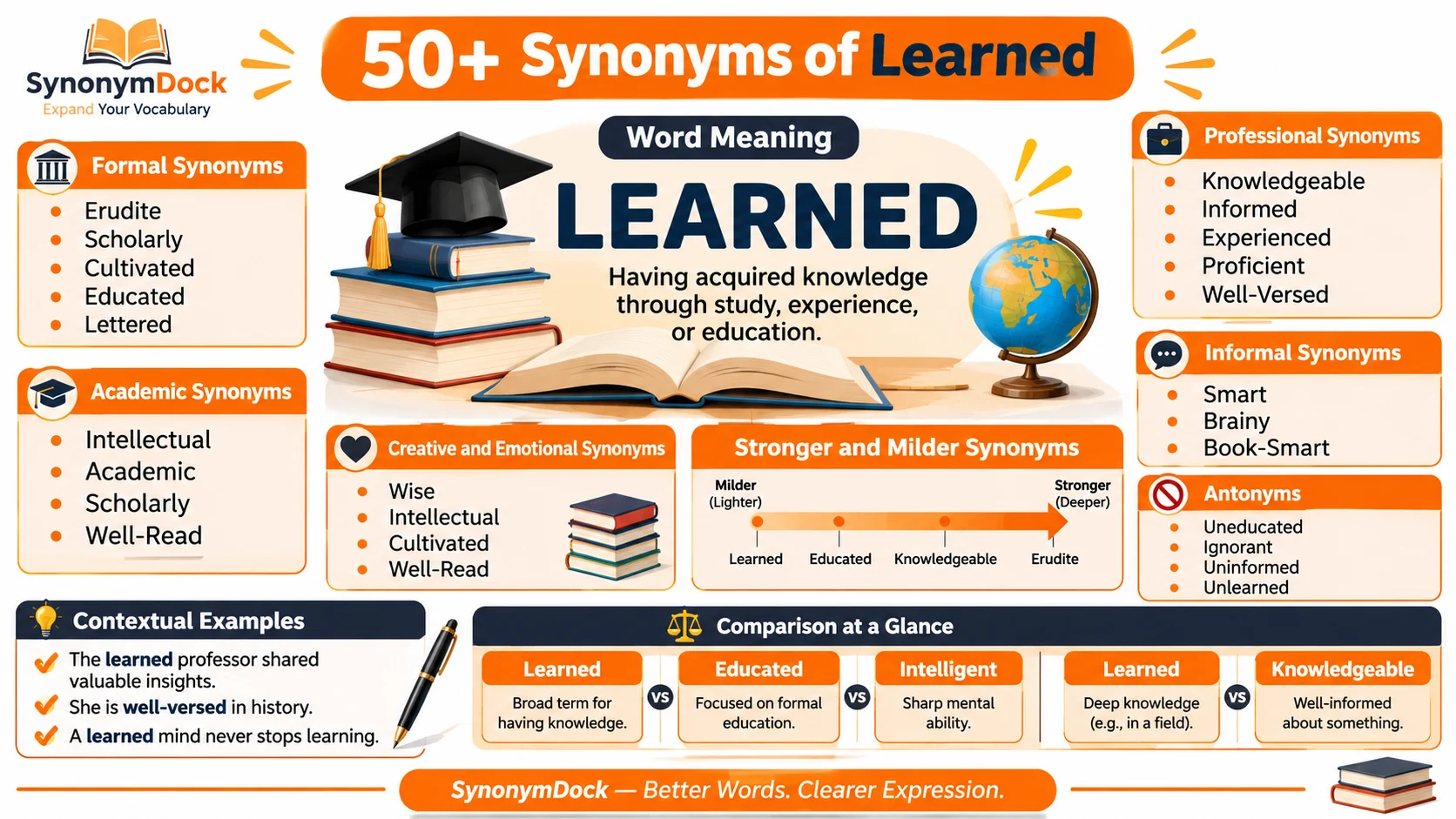
Finding the right synonym of learned depends on what you want to communicate. You might describe someone with extensive education, a person with deep knowledge, or someone who has developed expertise through experience.
Words such as educated, knowledgeable, scholarly, erudite, and well-read offer different meanings and levels of formality.
Understanding these differences helps you choose vocabulary that sounds natural in academic writing, workplace communication, everyday conversations, and creative work.
What Are the Best Synonyms of “Learned”?
The best synonyms of learned include educated, knowledgeable, scholarly, erudite, well-read, intellectual, informed, and accomplished. Learned generally describes someone who has gained considerable knowledge through education or study. Use scholarly or erudite in formal writing, knowledgeable in professional communication, and well-read in everyday conversation.
Here are the best alternatives for different situations:
| Context | Best Synonym |
| Formal writing | Erudite |
| Casual conversation | Well-read |
| Academic writing | Scholarly |
| Professional communication | Knowledgeable |
| Emotional writing | Wise |
| Creative writing | Intellectual |
| Resume writing | Educated |
| Business communication | Informed |
| Strong emphasis | Highly knowledgeable |
| Describing expertise | Accomplished |
Important distinction: This article primarily discusses learned as an adjective describing someone who has considerable knowledge. The word can also be the past tense of learn, meaning that someone acquired information or a skill. These two meanings require different synonyms.
Meaning, Tone, and Context of “Learned”
Simple Definition
Learned describes someone who has gained extensive knowledge through education, reading, research, or serious study.
It often suggests intellectual development, academic understanding, and familiarity with a particular subject.
For example:
- She is a learned professor with decades of research experience.
- His learned observations impressed the audience.
- The author is known for her learned discussions of literature.
When used as a past tense verb, learned means that someone acquired knowledge or developed a skill.
For example:
- I learned English at school.
- She learned an important lesson from the experience.
Part of Speech
The word learned has two common grammatical uses.
| Part of Speech | Meaning | Example |
| Adjective | Having extensive knowledge | He is a learned scholar. |
| Verb, past tense | Acquired knowledge or a skill | She learned French. |
| Verb, past participle | Having acquired knowledge | We have learned a great deal. |
Overall Tone
The adjective learned generally has a positive or neutral tone.
It communicates intellectual ability, education, and familiarity with a subject. However, in certain contexts, it can sound overly formal or slightly old-fashioned.
Tone classification:
- Positive: When praising someone’s knowledge.
- Neutral: When describing academic qualifications or expertise.
- Negative: Rarely, when used sarcastically to suggest unnecessary intellectual complexity.
Formality Level
Formal to neutral
Learned is generally more formal than everyday alternatives such as smart or well-informed.
It is particularly appropriate in:
- Academic discussions.
- Literary criticism.
- Research writing.
- Formal presentations.
- Intellectual conversations.
- Professional descriptions.
Common Uses
American English speakers commonly use learned when describing:
- Professors and researchers.
- Academic scholars.
- Authors and literary critics.
- People with extensive subject knowledge.
- Intellectual discussions.
- Educational achievements.
- Expert opinions and observations.
Word Forms
| Word Form | Meaning | Example |
| Learn | To gain knowledge | Children learn quickly. |
| Learned | Past tense of learn | She learned mathematics. |
| Learned | Adjective meaning knowledgeable | He is a learned historian. |
| Learning | The process of gaining knowledge | Learning requires patience. |
| Learner | Someone who is learning | She is an enthusiastic learner. |
| Unlearn | To discard previously acquired knowledge or habits | We must unlearn outdated assumptions. |
Pronunciation note: As an adjective, learned is usually pronounced LUR-nid, with two syllables. As a regular past tense verb, it is pronounced LURND, with one syllable.
When and How to Use “Learned”
Choose learned when you want to describe someone who has developed considerable knowledge through serious study, education, or intellectual effort.
It works especially well when discussing academic subjects, professional expertise, and intellectual achievements.
Here are seven realistic examples.
1. Professional Context
The company invited a learned consultant to review its research findings.
2. Academic Context
The learned professor explained the relationship between language and culture.
3. Workplace Context
Our team benefited from the learned advice of an experienced researcher.
4. Personal Context
My grandfather was a learned man who enjoyed discussing history and philosophy.
5. Email Context
We appreciate your learned perspective on this important subject.
6. Resume Context
Developed strong subject knowledge through advanced academic study and independent research.
7. Social Media Context
Surround yourself with learned people who encourage curiosity and personal growth.
Best Synonyms of “Learned”
No synonym of learned communicates exactly the same meaning in every situation. Some alternatives emphasize formal education, while others highlight practical knowledge, intellectual ability, or extensive reading.
Here are the strongest recommendations by context.
| Context | Best Synonym | Why It Works |
| Professional writing | Knowledgeable | Clearly communicates subject expertise. |
| Academic writing | Scholarly | Emphasizes serious academic study. |
| Business communication | Informed | Suggests awareness and understanding. |
| Casual conversation | Well-read | Sounds natural and approachable. |
| Emotional writing | Wise | Highlights thoughtful judgment. |
| Creative writing | Intellectual | Emphasizes mental ability and thought. |
| Resume writing | Educated | Communicates formal educational background. |
| Workplace communication | Experienced | Highlights knowledge gained through practice. |
| Stronger meaning | Erudite | Suggests exceptionally extensive knowledge. |
| Softer meaning | Informed | Communicates awareness without sounding overly formal. |
When Not to Use “Learned”
Although learned is a useful word, it is not always the clearest choice.
Consider these situations.
1. When the Meaning Is Too General
The word learned may not explain what someone actually knows.
Less effective: She is a learned employee.
Better: She is knowledgeable about financial management.
Why it works: The alternative identifies the person’s actual area of knowledge.
2. When You Mean Practical Experience
Learned often emphasizes education rather than hands on experience.
Less effective: He is a learned mechanic.
Better: He is an experienced mechanic.
Why it works: Experienced highlights practical skills developed through work.
3. When You Mean Academic Expertise
Learned is suitable, but scholarly can communicate academic involvement more precisely.
Less effective: She wrote a learned article about literature.
Better: She wrote a scholarly article about literature.
Why it works: Scholarly directly connects the article with academic research and study.
4. When You Mean Intelligence
Learned describes acquired knowledge, not necessarily natural intelligence.
Less effective: He is a learned child who solves puzzles quickly.
Better: He is an intelligent child who solves puzzles quickly.
Why it works: Intelligent describes mental ability rather than accumulated knowledge.
5. When You Mean Awareness of Current Events
Learned can sound unnecessarily formal.
Less effective: I need a learned employee who understands current market conditions.
Better: I need an informed employee who understands current market conditions.
Why it works: Informed is more natural when discussing current information.
Words Commonly Confused With “Learned”
Several English words are closely related to learned but communicate different ideas.
| Word | Difference | When to Use It | Example |
| Educated | Emphasizes formal schooling and education. | Discussing qualifications. | She is an educated professional. |
| Intelligent | Describes mental ability rather than acquired knowledge. | Discussing problem solving. | He is an intelligent student. |
| Knowledgeable | Emphasizes strong understanding of a subject. | Discussing expertise. | She is knowledgeable about literature. |
| Wise | Emphasizes good judgment and life experience. | Discussing decisions. | My grandmother is a wise woman. |
| Experienced | Highlights practical knowledge gained through activities. | Discussing professional skills. | He is an experienced teacher. |
| Scholarly | Emphasizes academic research and serious study. | Discussing academic work. | She published a scholarly article. |
Best Synonyms of “Learned” by Context
The right alternative depends on the situation, audience, and intended meaning.
| Context | Best Synonym | Why It Works | Example |
| Formal writing | Erudite | Communicates extensive intellectual knowledge. | The erudite author discussed philosophy. |
| Academic writing | Scholarly | Reflects serious academic study. | She presented a scholarly argument. |
| Professional communication | Knowledgeable | Demonstrates subject understanding. | He is knowledgeable about marketing. |
| Business emails | Informed | Sounds professional and direct. | Thank you for your informed feedback. |
| Resume writing | Educated | Highlights academic background. | Educated professional with research experience. |
| Workplace communication | Experienced | Connects knowledge with practical work. | We hired an experienced manager. |
| Casual conversation | Well-read | Sounds natural and friendly. | My uncle is very well-read. |
| Everyday speaking | Smart | Offers a familiar conversational alternative. | She is a smart student. |
| Creative writing | Intellectual | Describes an interest in ideas and thinking. | He was an intellectual character. |
| Storytelling | Wise | Adds depth and thoughtful judgment. | The wise traveler offered advice. |
| Emotional writing | Wise | Connects knowledge with meaningful understanding. | She became wiser with time. |
| Strong emphasis | Erudite | Suggests exceptional intellectual learning. | The erudite scholar impressed everyone. |
| Mild tone | Informed | Communicates knowledge without exaggeration. | He is an informed reader. |
| Social media captions | Well-read | Sounds accessible and engaging. | Celebrating curious, well-read minds. |
| American English | Knowledgeable | Natural in professional and everyday American English. | She is knowledgeable about technology. |
| British English | Well-educated | Commonly communicates formal educational background. | He is a well-educated historian. |
How to Choose the Best Synonym of “Learned”
Selecting the right alternative requires more than finding a word with a similar dictionary meaning.
Consider these six factors.
1. Identify the Meaning
First, decide whether you mean formal education, intellectual ability, subject knowledge, or practical experience.
For example, educated describes formal learning, while experienced emphasizes practical knowledge.
2. Consider Your Audience
Choose vocabulary that your readers can easily understand.
For everyday communication, knowledgeable or well-read may be more natural than erudite.
3. Match the Tone
Formal documents often benefit from scholarly or erudite.
Casual conversations usually sound better with smart or knowledgeable.
4. Consider Emotional Strength
Words such as wise communicate thoughtful judgment, while informed simply suggests awareness.
Choose based on the impression you want to create.
5. Understand Your Writing Purpose
A resume needs professional language, an academic essay needs precision, and creative writing may benefit from expressive vocabulary.
6. Check Natural Usage
Read your sentence aloud. If the alternative sounds unnatural or changes your intended meaning, choose another word.
The best synonym is always the one that communicates your message clearly.
Real Life Examples of “Learned”
These examples demonstrate how to use learned and its alternatives in different situations.
| Situation | Example |
| School | Our teacher invited a learned historian to discuss ancient civilizations. |
| College | The university recognized her as a knowledgeable researcher. |
| Workplace | We consulted an experienced professional before making the decision. |
| Business | The company hired an informed consultant to evaluate the proposal. |
| Thank you for sharing your insightful observations. | |
| Resume | An educated professional with strong research and analytical skills. |
| Conversation | My father is very well-read and enjoys discussing history. |
| Storytelling | The wise old traveler shared valuable lessons with the young boy. |
| Blogging | A knowledgeable writer can explain difficult topics in simple language. |
| Social Media | Keep learning, stay curious, and become more knowledgeable every day. |
18 Best Synonyms of “Learned”
The following table focuses on 15 especially useful alternatives, following the requested 15 row limit. These words are selected for their relevance to the adjective meaning knowledgeable or intellectually educated.
Vocabulary note: These alternatives are not interchangeable. For example, literate describes a specific ability, while erudite suggests extensive intellectual knowledge. Always consider the exact meaning before replacing learned.
Synonyms of “Learned” by Usage
Professional vs Personal Synonyms
Professional writing generally benefits from words that communicate specific expertise without sounding exaggerated.
Best professional alternatives:
- Knowledgeable: Someone with strong subject understanding.
- Experienced: Someone with practical workplace knowledge.
- Educated: Someone with formal academic qualifications.
- Informed: Someone who understands relevant information.
- Proficient: Someone with a developed skill.
Best personal alternatives:
- Wise: Someone with good judgment.
- Well-read: Someone who reads extensively.
- Intelligent: Someone with strong mental abilities.
- Cultivated: Someone with developed intellectual and cultural interests.
Example:
Professional: She is a knowledgeable financial analyst.
Personal: She is a wise and thoughtful person.
Formal vs Conversational Synonyms
Different communication settings require different vocabulary choices.
| Formal Alternatives | Conversational Alternatives |
| Erudite | Smart |
| Scholarly | Knowledgeable |
| Cultivated | Well-read |
| Academic | Informed |
| Educated | Experienced |
| Lettered | Wise |
For reports, essays, presentations, and research papers, scholarly and erudite can be appropriate.
For casual conversations, well-read, smart, and knowledgeable usually sound more natural.
Academic Synonyms
Academic writing requires precise vocabulary that communicates the nature of someone’s knowledge.
Consider these alternatives:
1. Scholarly
Best for researchers, academic publications, and serious intellectual discussions.
Example: The researcher published a scholarly examination of modern literature.
2. Erudite
Suitable when describing someone with extensive knowledge across academic subjects.
Example: The erudite historian presented a detailed analysis of ancient civilizations.
3. Educated
Useful when emphasizing formal education and academic qualifications.
Example: An educated population can contribute to social development.
4. Well-versed
Appropriate when describing detailed knowledge of a particular subject.
Example: The professor is well-versed in comparative literature.
5. Knowledgeable
Useful for communicating subject expertise without excessive formality.
Example: The knowledgeable researcher answered every question.
Professional and Business Synonyms
Professional communication should sound confident, clear, and relevant.
Here are suitable alternatives for different workplace situations.
| Situation | Recommended Word | Example |
| Resume | Educated | Educated professional with advanced research skills. |
| Interview | Knowledgeable | I am knowledgeable about digital marketing. |
| Meetings | Informed | We need an informed discussion. |
| Presentations | Experienced | Our experienced manager presented the findings. |
| Performance reviews | Proficient | She is proficient in project management. |
| Client communication | Well-versed | Our consultant is well-versed in industry regulations. |
| Business emails | Insightful | Thank you for your insightful recommendations. |
Professional recommendation: Use knowledgeable when discussing subject expertise, experienced when describing practical abilities, and proficient when highlighting a particular skill.
Creative and Literary Synonyms
Creative writing often requires vocabulary that communicates more than academic knowledge.
These alternatives can help create richer descriptions.
| Synonym | Creative Effect | Example |
| Wise | Suggests thoughtful judgment. | The wise woman understood the difficulties of life. |
| Intellectual | Highlights deep thinking. | He was an intellectual with an unusual curiosity. |
| Cultivated | Suggests refined interests. | Her cultivated personality impressed the visitors. |
| Erudite | Creates an academic and sophisticated impression. | The erudite narrator explored complex ideas. |
| Well-read | Suggests familiarity with literature. | The well-read detective recognized the historical reference. |
These alternatives are particularly useful in novels, character descriptions, speeches, and literary essays.
Slang or Modern Synonyms
There is no widely accepted slang word that directly replaces learned in every situation.
However, some informal expressions communicate related meanings.
| Expression | Meaning | Where It Works | Where to Avoid It |
| Brainy | Very intelligent. | Friendly conversations. | Academic reports. |
| Book-smart | Knowledgeable through formal study or books. | Informal discussions. | Formal resumes. |
| Smart | Intelligent or quick to understand. | Everyday conversation. | When specific academic expertise is required. |
| A walking encyclopedia | Someone with an enormous amount of information. | Humorous conversations. | Formal business documents. |
Example: My brother is book-smart and enjoys discussing science.
Strongest to Mildest Synonyms
The intensity of learned depends on whether you are emphasizing extensive education, intellectual ability, or general knowledge.
The following scale is approximate, not an absolute ranking.
Mild
Informed
Awareness
Educated
Education
Moderate
- Knowledgeable
- Well-read
- Experienced
- Proficient
Strong - Scholarly
- Cultivated
- Intellectual
- Well-versed
Very Strong - Erudite
- Exceptionally knowledgeable
The distinction is important. Educated does not necessarily mean more knowledgeable than informed. The scale reflects the impression of intellectual depth in suitable contexts, not a universal measurement of ability.
Emotional vs Neutral Synonyms
Some alternatives emphasize personal qualities, while others simply describe someone’s knowledge.
Emotional Synonyms
- Wise
- Cultivated
- Intelligent
- Intellectual
These words can communicate admiration, respect, or appreciation.
Example: Her wise guidance helped the entire family.
Neutral Synonyms
- Educated
- Knowledgeable
- Informed
- Scholarly
- Proficient
These alternatives communicate knowledge or ability without necessarily expressing personal admiration.
Example: The knowledgeable employee explained the new policy.
Antonyms of “Learned”
The opposite of learned depends on the intended meaning.
When learned describes an educated or knowledgeable person, suitable antonyms include uneducated, ignorant, uninformed, and unlearned.
Some alternatives describe a lack of experience rather than a lack of education, so context matters.
| Antonym | Meaning | Example Sentence |
| Uneducated | Having little or no formal education. | He grew up in an uneducated environment. |
| Ignorant | Lacking knowledge about something. | She was ignorant of the new regulations. |
| Uninformed | Not having enough relevant information. | The uninformed customer misunderstood the offer. |
| Unlearned | Not educated or lacking learning. | The unlearned speaker struggled with the academic discussion. |
| Illiterate | Unable to read or write. | The literacy program supports illiterate adults. |
| Untutored | Not formally taught or trained. | The untutored artist developed skills independently. |
| Unschooled | Not formally educated in a subject. | He was unschooled in classical philosophy. |
| Untrained | Not having received appropriate training. | The untrained assistant needed additional guidance. |
| Inexperienced | Lacking practical experience. | The inexperienced employee requested support. |
| Unskilled | Lacking a particular skill. | The unskilled worker received additional instruction. |
| Unaware | Not knowing about something. | She was unaware of the historical background. |
| Naive | Lacking experience or mature judgment. | His naive assumptions affected the discussion. |
| Unacquainted | Not familiar with a subject or person. | I am unacquainted with this literary theory. |
| Unversed | Not knowledgeable about a particular subject. | He is unversed in modern economics. |
| Uncultivated | Lacking refinement or developed intellectual interests. | The character was portrayed as uncultivated. |
Important: These words are not perfect opposites in every context. For example, an inexperienced person may still be highly educated, and an illiterate person may possess considerable practical wisdom.
Comparison: “Learned” vs Similar Words
Understanding the differences between closely related words helps prevent inaccurate vocabulary choices.
Learned vs Educated
Main Difference: Learned emphasizes extensive knowledge gained through study, while educated emphasizes formal schooling or academic instruction.
Which Is Stronger? Learned often suggests deeper intellectual knowledge. Educated focuses more directly on formal education.
Which Is More Formal? Both are suitable for formal writing.
When to Use Each:
Use learned when describing intellectual knowledge. Use educated when discussing someone’s academic background.
Examples:
Learned: The learned professor discussed classical literature.
Educated: She is an educated professional with a university degree.
Learned vs Knowledgeable
Main Difference: Learned often suggests extensive academic or intellectual study. Knowledgeable emphasizes a strong understanding of a particular subject.
Which Is Stronger? Learned can suggest extensive scholarship, while knowledgeable is more flexible in everyday and professional contexts.
Which Is More Formal? Learned is generally more formal.
When to Use Each:
Use learned for academic descriptions. Use knowledgeable when discussing expertise or subject understanding.
Examples:
Learned: The learned historian studied ancient civilizations.
Knowledgeable: She is knowledgeable about digital technology.
Learned vs Intelligent
Main Difference: Learned describes acquired knowledge. Intelligent describes the ability to understand, reason, and solve problems.
Which Is Stronger? Neither is universally stronger because they describe different qualities.
Which Is More Formal? Both work in academic and professional writing.
When to Use Each:
Use learned when emphasizing education and knowledge. Use intelligent when describing mental ability.
Examples:
Learned: He is a learned scholar of philosophy.
Intelligent: She is an intelligent student who solves complex problems.
Learned vs Wise
Main Difference: Learned emphasizes knowledge gained through study, while wise emphasizes good judgment and understanding.
Which Is Stronger? Wise can communicate greater maturity and practical judgment.
Which Is More Formal? Both can be used formally, although wise is common in everyday English.
When to Use Each:
Use learned for academic knowledge. Use wise when describing someone’s decisions or advice.
Examples:
Learned: The learned professor explained the theory.
Wise: My grandfather gave me wise advice.
Learned vs Scholarly
Main Difference: Learned describes a knowledgeable person or an intellectually sophisticated subject. Scholarly specifically relates to academic study and research.
Which Is Stronger? Learned can suggest broad intellectual knowledge, while scholarly emphasizes academic seriousness.
Which Is More Formal? Both are formal, but scholarly is especially associated with academic writing.
When to Use Each:
Use learned to describe an educated individual. Use scholarly for research, academic publications, and serious study.
Examples:
Learned: She was a learned woman with extensive knowledge.
Scholarly: He published a scholarly article about language development.
Learned vs Experienced
Main Difference: Learned highlights knowledge acquired through study. Experienced emphasizes practical knowledge gained through activities or work.
Which Is Stronger? Neither is universally stronger. Each describes a different kind of knowledge.
Which Is More Formal? Both are suitable for professional writing.
When to Use Each:
Use learned for intellectual education. Use experienced for practical skills and workplace knowledge.
Examples:
Learned: The learned researcher presented his findings.
Experienced: The experienced teacher managed the classroom effectively.
Common Phrases and Expressions with “Learned”
The following expressions are useful in everyday, academic, and professional English.
1. A Learned Person
Meaning: Someone who has extensive knowledge or education.
Example: Everyone admired the learned person for his understanding of history.
2. A Learned Scholar
Meaning: An academically educated person with considerable subject knowledge.
Example: The university invited a learned scholar to deliver the lecture.
3. A Learned Professor
Meaning: A professor with extensive academic knowledge.
Example: Students appreciated the learned professor’s explanations.
4. A Learned Opinion
Meaning: An opinion based on substantial knowledge or study.
Example: The committee respected her learned opinion on the matter.
5. A Learned Discussion
Meaning: An intellectual discussion involving detailed knowledge.
Example: The conference included a learned discussion of modern literature.
6. A Learned Audience
Meaning: An audience with considerable knowledge of a subject.
Example: The speaker prepared an advanced presentation for a learned audience.
7. A Learned Man or Woman
Meaning: A person recognized for extensive education or intellectual knowledge.
Example: She was remembered as a learned woman who encouraged education.
Common Mistakes to Avoid
Even advanced English learners sometimes choose synonyms that change the original meaning.
Here are seven mistakes worth avoiding.
Mistake 1: Confusing Learned With Intelligent
Incorrect: She is learned because she solves every puzzle quickly.
Better: She is intelligent because she solves every puzzle quickly.
Why: Intelligence describes mental ability. Learned describes knowledge gained through study.
Mistake 2: Using an Overly Formal Synonym
Incorrect: My friend is an erudite person who enjoys watching movies.
Better: My friend is knowledgeable and enjoys watching movies.
Why: Erudite can sound unnecessarily formal in ordinary conversation.
Mistake 3: Confusing Educated With Experienced
Incorrect: We need an educated mechanic with ten years of practical work.
Better: We need an experienced mechanic with ten years of practical work.
Why: Experienced directly communicates practical workplace knowledge.
Mistake 4: Using Learned When You Mean Informed
Incorrect: The manager is learned about the latest company policy.
Better: The manager is informed about the latest company policy.
Why: Informed is more natural when discussing awareness of specific information.
Mistake 5: Confusing Wise With Knowledgeable
Incorrect: The scientist is wise about chemical formulas.
Better: The scientist is knowledgeable about chemical formulas.
Why: Knowledgeable describes subject understanding, while wise emphasizes judgment.
Mistake 6: Repeating the Same Word
Incorrect: The learned professor gave a learned lecture to a learned audience.
Better: The knowledgeable professor gave an insightful lecture to an educated audience.
Why: Appropriate alternatives make the sentence more varied and natural.
Mistake 7: Using a Synonym That Changes the Meaning
Incorrect: She is proficient in philosophy because she has read several books.
Better: She is well-read in philosophy because she has read several books.
Why: Proficient usually suggests practical competence or skill. Well-read better communicates extensive reading.
Frequently Asked Questions
1. What are the best synonyms of “learned”?
The best synonyms of learned include educated, knowledgeable, scholarly, erudite, well-read, intellectual, wise, and informed. The most suitable choice depends on whether you mean formal education, subject expertise, or intellectual ability.
2. What are the best formal synonyms of “learned”?
The strongest formal synonyms include erudite, scholarly, cultivated, lettered, and well-versed. These alternatives are particularly appropriate for academic essays, literary discussions, research papers, and professional descriptions.
3. What are common informal synonyms of “learned”?
Common informal alternatives include smart, knowledgeable, well-read, and book-smart. These words work well in everyday conversations when describing someone who has considerable knowledge or enjoys learning.
4. What is another word for “learned” in professional writing?
Knowledgeable is an excellent alternative when describing subject expertise. Experienced highlights practical abilities, educated emphasizes formal qualifications, and proficient communicates competence in a particular professional skill.
5. What is the difference between “learned” and “educated”?
Learned emphasizes extensive knowledge gained through study and intellectual development. Educated generally emphasizes formal schooling and academic instruction. A person can be educated without being an expert in every subject.
6. What is the opposite of “learned”?
Common antonyms of learned include uneducated, ignorant, uninformed, unlearned, and unschooled. The best opposite depends on whether you are discussing formal education, subject knowledge, or intellectual understanding.
Conclusion
Choosing the right synonym of learned can make your English more precise, natural, and effective.
Words such as educated, knowledgeable, scholarly, erudite, and well-read offer useful alternatives for different situations. Use experienced when discussing practical skills, informed when describing awareness, and wise when emphasizing good judgment.

Ethan Parker is an English language writer and vocabulary enthusiast at SynonymDock.com. He specializes in synonyms, word meanings, alternative expressions and practical English usage, creating clear and reliable content to help students, professionals, writers and English learners choose the right words with confidence.
2 thoughts on “40+ Synonyms of Learned| Meanings and Best Alternatives”