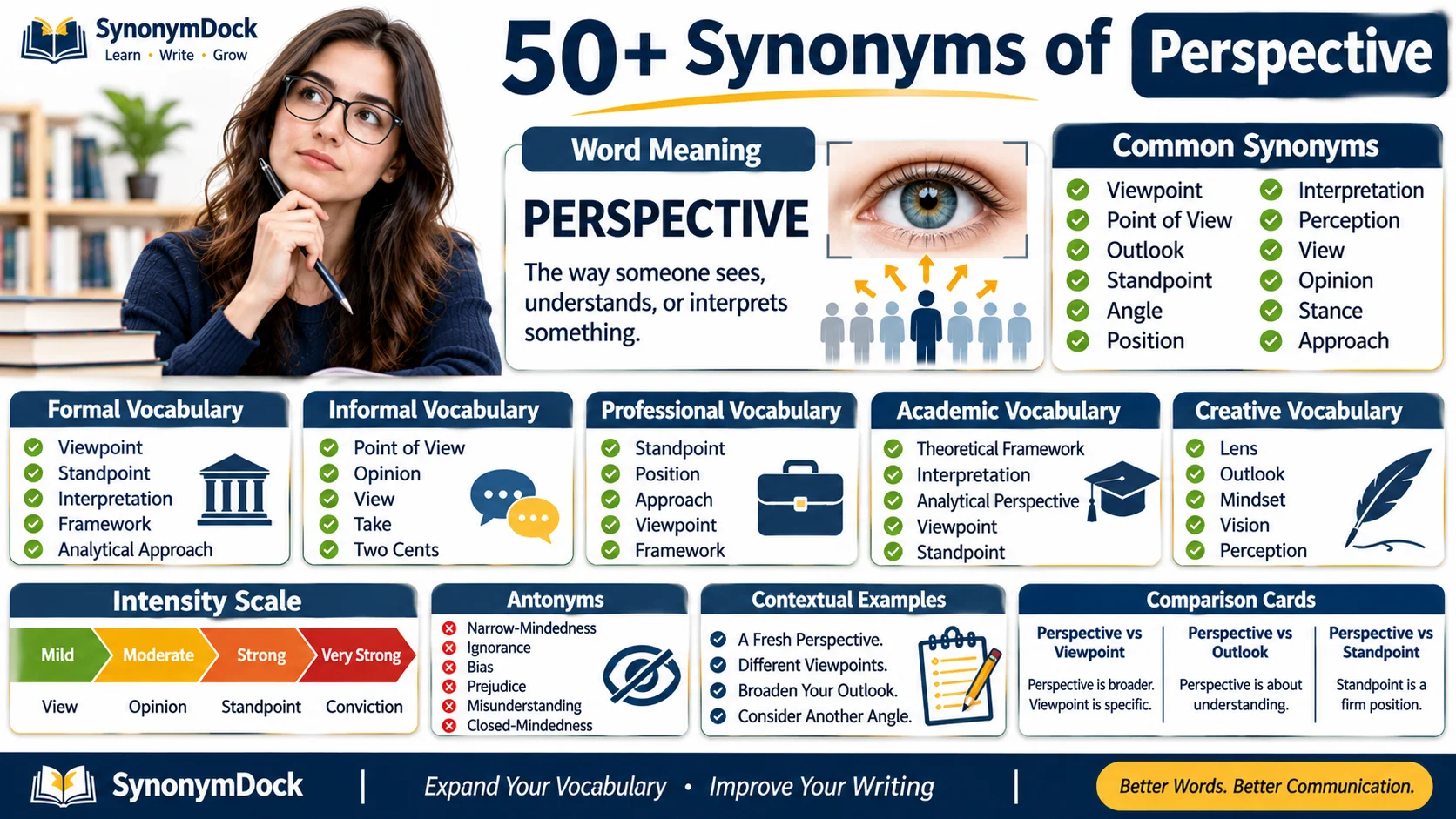
Finding the right synonym of perspective can help you communicate ideas more clearly, express different viewpoints, and make your writing more engaging. Depending on the context, words such as viewpoint, outlook, standpoint, angle, position, interpretation, and point of view can be effective alternatives.
However, these words do not always mean exactly the same thing. A person’s perspective may describe their personal outlook, while a researcher’s perspective may represent an analytical viewpoint or theoretical approach.
This guide explores more than 50 alternatives, explains their differences, and provides practical examples to help you choose the most accurate word for academic, professional, personal, and creative writing.
What Are the Best Synonyms of “Perspective”?
The best synonyms of perspective include viewpoint, point of view, outlook, standpoint, angle, position, interpretation, approach, perception, and stance. Perspective describes how someone sees, understands, or interprets a situation. Use viewpoint for opinions, outlook for general attitudes, standpoint for positions, and angle for a particular way of examining something.
Best alternatives by context
| Context | Best Synonym |
| Formal writing | Viewpoint |
| Academic writing | Theoretical framework |
| Professional communication | Standpoint |
| Business writing | Approach |
| Casual conversation | Point of view |
| Emotional writing | Outlook |
| Creative writing | Lens |
| Research | Analytical perspective |
| Debate | Position |
| Personal opinions | Stance |
| Visual description | View |
| Different interpretations | Angle |
Meaning, Tone, and Context of Perspective
Simple Definition
The word perspective describes the way someone sees, understands, or interprets something. It can refer to an individual’s opinion, attitude, experience, or the particular way a subject is examined.
For example:
- Everyone has a different perspective on education.
- From my perspective, the decision was reasonable.
- The research offers a new perspective on climate change.
Perspective can also describe the appearance of objects in relation to distance and position, particularly in art, photography, and visual design.
Part of Speech
Perspective is primarily a noun.
It can refer to:
- A particular opinion or viewpoint.
- A person’s general attitude or outlook.
- A way of interpreting information.
- A method of examining a subject.
- The representation of depth and distance in visual art.
Overall Tone
Perspective is generally a neutral word. Its emotional meaning depends on the surrounding sentence.
| Tone | Example |
| Positive | Her perspective helped us find a solution. |
| Neutral | Everyone shared their perspective. |
| Negative | His perspective was influenced by personal bias. |
Formality Level
Perspective is a neutral to moderately formal word. It works naturally in academic writing, business communication, everyday conversations, essays, and professional presentations.
Common Uses
English speakers commonly use perspective when discussing:
- Personal opinions.
- Different viewpoints.
- Academic research.
- Business decisions.
- Cultural differences.
- Social issues.
- Personal experiences.
- Art and visual representation.
- Problem-solving.
- Communication and debates.
Word Forms
| Word Form | Example |
| Perspective | She offered a fresh perspective. |
| Perspectives | Different perspectives can improve discussions. |
| Perspectival | The artist used a perspectival approach. |
| Perspective-taking | Perspective-taking helps people understand others. |
The plural form is perspectives. The adjective perspectival is used in specialized academic and visual contexts.
When and How to Use Perspective
Use perspective when describing how someone understands a situation, expresses an opinion, or examines a particular subject.
Here are seven realistic examples.
1. Professional
From a business perspective, customer satisfaction should remain our priority.
2. Academic
The researcher examined the issue from a historical perspective.
3. Workplace
Listening to different perspectives can help the team make better decisions.
4. Personal
Traveling abroad completely changed my perspective on life.
5. Email
I would appreciate hearing your perspective on the proposed changes.
6. Resume
Demonstrated the ability to evaluate challenges from multiple perspectives and develop practical solutions.
7. Social Media
Sometimes, a new perspective is all you need to see an opportunity differently.
Best Synonyms of Perspective
No synonym communicates exactly the same meaning in every situation. Some alternatives emphasize personal opinions, while others describe attitudes, positions, interpretations, or methods of analysis.
Here are the best recommendations for different writing purposes.
| Writing Context | Best Synonym | Why It Works |
| Professional writing | Viewpoint | Communicates a clear way of seeing an issue. |
| Academic writing | Framework | Describes the structure used to examine a subject. |
| Business communication | Approach | Emphasizes a method of handling a situation. |
| Casual conversation | Point of view | Sounds natural and familiar. |
| Emotional writing | Outlook | Communicates someone’s general attitude toward life. |
| Creative writing | Lens | Provides an expressive way to describe interpretation. |
| Resume writing | Analytical viewpoint | Highlights the ability to examine different situations. |
| Workplace communication | Standpoint | Expresses a particular position or opinion. |
| Stronger emphasis | Stance | Communicates a clearly held position. |
| Softer meaning | View | Offers a simple and neutral alternative. |
When Not to Use Perspective
Although perspective is versatile, it is not always the most precise choice.
1. When describing a specific opinion
Less effective: I would like to understand your perspective about the meeting.
Better: I would like to understand your viewpoint about the meeting.
Why: Viewpoint directly emphasizes someone’s opinion.
2. When discussing someone’s general attitude
Less effective: She has a positive perspective on life.
Better: She has a positive outlook on life.
Why: Outlook more naturally describes someone’s general attitude toward life.
3. When explaining a firm opinion
Less effective: The manager explained his perspective on the new policy.
Better: The manager explained his stance on the new policy.
Why: Stance emphasizes a particular position or opinion.
4. When discussing a method
Less effective: The company adopted a new perspective to solve the problem.
Better: The company adopted a new approach to solve the problem.
Why: Approach describes a method or way of handling something.
5. When discussing a specific aspect
Less effective: We examined the perspective of customer satisfaction.
Better: We examined the customer satisfaction angle.
Why: Angle highlights a particular aspect of a larger subject.
6. When describing visual appearance
Less effective: The photograph uses an interesting perspective of the building.
Alternative: The photograph uses an interesting viewpoint of the building.
Why: Viewpoint can describe the position from which something is viewed. In technical art contexts, perspective may still be the more accurate term.
Words Commonly Confused With Perspective
Several English words overlap with perspective but communicate different ideas.
1. Perspective vs Viewpoint
Difference: Perspective describes a broader way of seeing or interpreting something. Viewpoint usually refers to a particular opinion or position.
When to use: Use perspective for broader interpretations and viewpoint for a specific opinion.
Example:
- Perspective: Her perspective on education has changed.
- Viewpoint: She explained her viewpoint during the discussion.
2. Perspective vs Outlook
Difference: Outlook describes someone’s general attitude or expectations, while perspective emphasizes how someone interprets a particular subject or situation.
When to use: Use outlook when discussing optimism, expectations, or attitudes toward life.
Example:
- Perspective: His perspective on success is different from mine.
- Outlook: She has an optimistic outlook on the future.
3. Perspective vs Standpoint
Difference: Standpoint refers to the position or circumstances from which someone forms an opinion. Perspective is broader and includes interpretations and ways of understanding.
When to use: Use standpoint in discussions, arguments, and professional communication.
Example:
- Perspective: The report presents a fresh perspective on the issue.
- Standpoint: From a financial standpoint, the proposal is reasonable.
4. Perspective vs Position
Difference: Position often communicates a clearly stated opinion, belief, or stance. Perspective describes the broader way someone sees or interprets an issue.
When to use: Use position when explaining someone’s side in an argument or debate.
Example:
- Perspective: The discussion introduced a different perspective.
- Position: The organization maintained its position on the policy.
5. Perspective vs Interpretation
Difference: Interpretation refers to the meaning someone assigns to information, events, or ideas. Perspective describes the broader viewpoint influencing that interpretation.
When to use: Use interpretation when discussing how someone understands a particular message or event.
Example:
- Perspective: Her perspective influenced the research.
- Interpretation: His interpretation of the results was different.
6. Perspective vs Angle
Difference: Angle emphasizes one particular aspect or way of examining a subject. Perspective generally refers to a broader viewpoint.
When to use: Use angle when exploring different aspects of a topic.
Example:
- Perspective: The article offers a fresh perspective on education.
- Angle: The journalist explored the economic angle of the issue.
Best Synonyms of Perspective by Context
The right alternative depends on the audience, subject, and intended meaning.
| Context | Best Synonym | Why It Works | Example |
| Formal writing | Viewpoint | Communicates an identifiable opinion | The report presents an alternative viewpoint. |
| Academic writing | Framework | Describes a structured way of examining a subject | The research uses a theoretical framework. |
| Professional communication | Standpoint | Expresses a professional position | From our standpoint, the proposal is practical. |
| Business emails | View | Sounds direct and professional | I would value your view on this matter. |
| Resume writing | Analytical approach | Highlights problem-solving ability | Applied an analytical approach to business challenges. |
| Workplace communication | Viewpoint | Encourages discussion of opinions | We considered every employee’s viewpoint. |
| Casual conversation | Point of view | Natural in everyday English | I understand your point of view. |
| Everyday speaking | Opinion | Communicates a personal belief | That’s an interesting opinion. |
| Creative writing | Lens | Creates expressive language | The story explores childhood through a different lens. |
| Storytelling | Outlook | Describes a character’s attitude | His outlook changed after the journey. |
| Emotional writing | Outlook | Expresses feelings and attitudes | Her outlook became more positive. |
| Strong emphasis | Stance | Highlights a firm position | The organization maintained its stance. |
| Mild tone | View | Communicates an opinion simply | I respect your view. |
| Social media captions | Point of view | Familiar and conversational | A new point of view can change everything. |
| American English | Viewpoint | Common in professional and everyday communication | We need another viewpoint. |
| British English | Viewpoint | Equally natural in British usage | The author presents an alternative viewpoint. |
How to Choose the Best Synonym of Perspective
Choosing the right alternative becomes easier when you consider six important factors.
1. Identify the Intended Meaning
Ask yourself what you want to communicate.
- Personal opinion: Viewpoint, opinion.
- General attitude: Outlook, attitude.
- Firm belief: Stance, position.
- Method of examining something: Approach, framework.
- Particular aspect: Angle, aspect.
- Way of understanding information: Interpretation, perception.
2. Consider Your Audience
Academic readers may expect precise terms such as framework, viewpoint, or interpretation.
Business professionals may prefer standpoint, approach, or position. In casual conversations, point of view and opinion usually sound more natural.
3. Check the Emotional Strength
Some words communicate a neutral opinion, while others suggest strong personal beliefs.
Use view or viewpoint for neutral communication. Choose stance when you want to emphasize a firm position.
4. Match the Writing Purpose
Different writing formats require different vocabulary.
For research papers, framework and theoretical approach can be appropriate. For personal blogs, outlook and point of view may communicate ideas more naturally.
5. Consider the Level of Formality
Use viewpoint, standpoint, and interpretation in formal discussions.
For everyday speaking, view, opinion, and point of view are usually more accessible.
6. Read the Sentence Naturally
A synonym can have a similar meaning but still sound awkward in a particular sentence.
Always read the complete sentence after replacing perspective.
Real Life Examples of Perspective
The following examples demonstrate how perspective and its alternatives work across different situations.
1. School
The teacher encouraged students to consider the topic from different perspectives.
2. College
The professor introduced a new theoretical framework for understanding social behavior.
3. Workplace
Listening to every employee’s viewpoint can improve team communication.
4. Business
From a financial standpoint, the investment carries considerable risk.
5. Email
I would appreciate your opinion on the proposed marketing strategy.
6. Resume
Evaluated business challenges from multiple viewpoints to support strategic decision-making.
7. Conversation
I understand your point of view, but I see the situation differently.
8. Storytelling
The story presents the events through the eyes of a young child, offering a fresh lens on family relationships.
9. Blogging
A different angle can make an ordinary topic more interesting to readers.
10. Social Media
Changing your outlook can change the way you experience everyday life.
18 Best Synonyms of Perspective
Here are 18 useful alternatives with simple meanings, recommended contexts, and natural examples.
| Synonym | Simple Meaning | Best Used For | Example Sentence |
| Viewpoint | A particular way of seeing something | Opinions and discussions | Her viewpoint helped us understand the issue. |
| Outlook | A general attitude or expectation | Personal and emotional writing | He has a positive outlook on life. |
| Standpoint | The position from which someone considers an issue | Professional discussions | From a legal standpoint, the agreement is valid. |
| Angle | A particular aspect of a subject | Analysis and journalism | The article explores an interesting angle. |
| Perception | The way something is understood or noticed | Psychology and communication | Public perception changed after the announcement. |
| View | An opinion or way of seeing something | Everyday and professional writing | I would like to hear your view. |
| Stance | A firm position on an issue | Debates and formal communication | The organization maintained its stance. |
| Approach | A particular method of handling something | Business and problem-solving | We need a different approach. |
| Framework | A structured system for understanding a subject | Academic research | The study uses a theoretical framework. |
| Lens | A way of interpreting or examining something | Creative and analytical writing | The novel explores history through a cultural lens. |
| Attitude | A person’s feelings or way of thinking | Personal communication | Her attitude toward learning is positive. |
| Mindset | A person’s established way of thinking | Personal development | A growth mindset encourages learning. |
Synonyms of Perspective by Usage
Professional vs Personal Synonyms
Professional alternatives:
- Viewpoint
- Standpoint
- Position
- Approach
- Framework
- Interpretation
Example: From a strategic standpoint, the company should reconsider its expansion plans.
Personal alternatives:
- Point of view
- Outlook
- Opinion
- Attitude
- Mindset
- Perception
Example: My outlook on life changed after traveling abroad.
Use professional alternatives when communicating with colleagues, clients, managers, or academic audiences. Personal alternatives are generally more natural when discussing feelings, beliefs, and everyday experiences.
Formal vs Conversational Synonyms
Different writing situations call for different vocabulary.
| Writing Situation | Recommended Words |
| Reports | Viewpoint, framework |
| Essays | Interpretation, standpoint |
| Business writing | Position, approach |
| Presentations | Perspective, viewpoint |
| Emails | View, opinion |
| Casual conversations | Point of view, outlook |
| Texting | View, opinion |
Formal alternatives add precision, while conversational alternatives make communication feel more natural.
Academic Synonyms
Academic writing often requires words that describe how researchers examine, interpret, and understand subjects.
Recommended alternatives include:
Theoretical Framework: Describes the theories and concepts used to guide research.
Example: The study is based on a theoretical framework of social behavior.
Analytical Perspective: Emphasizes a method of examining information carefully.
Example: The researchers adopted an analytical perspective when evaluating the results.
Interpretation: Describes the meaning assigned to research findings.
Example: The author’s interpretation of the evidence differs from previous studies.
Viewpoint: Expresses a particular academic opinion.
Example: The article presents a different viewpoint on educational inequality.
Standpoint: Identifies the position from which an argument is developed.
Example: From a sociological standpoint, the issue requires further investigation.
These alternatives help academic writers explain their methods, arguments, and interpretations more precisely.
Professional and Business Synonyms
The following alternatives work particularly well in business environments.
| Word | Best Application | Example |
| Standpoint | Professional positions | From our standpoint, the project is achievable. |
| Approach | Problem-solving methods | We need a more practical approach. |
| Position | Business decisions | The company clarified its position. |
| Viewpoint | Team discussions | Every employee’s viewpoint matters. |
| Framework | Strategic planning | We developed a new evaluation framework. |
| Interpretation | Data analysis | Her interpretation of the figures was accurate. |
For resumes, phrases such as analytical approach, strategic mindset, and multiple viewpoints can help describe professional capabilities without relying on vague language.
Creative and Literary Synonyms
Creative writing benefits from alternatives that communicate feelings, imagination, and different ways of understanding the world.
| Word | Creative Effect | Example |
| Lens | Suggests a particular way of seeing | The story unfolds through a child’s lens. |
| Outlook | Describes personal attitudes | Her outlook changed after the experience. |
| Mindset | Reveals a character’s thinking | His mindset shaped every decision. |
| Angle | Introduces a different aspect | The writer explored an unusual angle. |
| Perception | Highlights subjective experience | His perception of reality slowly changed. |
| Interpretation | Shows personal understanding | Each reader offered a different interpretation. |
| Vision | Suggests imagination or a future-oriented view | The artist expressed a unique vision. |
These words are especially useful in storytelling, poetry, personal essays, and descriptive writing.
Slang or Modern Synonyms
Perspective does not have many exact slang replacements. However, several informal expressions can communicate a similar idea.
| Expression | Meaning | Where It Works |
| Take | A personal opinion | Casual conversations and social media |
| Hot take | A bold or controversial opinion | Online discussions |
| Vibe | A general feeling or impression | Informal communication |
| Two cents | A person’s personal opinion | Casual conversation |
| Where someone is coming from | The reasons behind someone’s viewpoint | Everyday speaking |
Examples:
- What’s your take on the new policy?
- Here’s my two cents about the situation.
- I understand where you’re coming from.
Avoid these expressions in formal research papers, academic reports, and most professional documents.
Strongest to Mildest Synonyms of Perspective
The strength of a synonym depends on whether you want to communicate a simple observation, a personal opinion, or a firmly held position.
The following is a practical guide to emphasis rather than a universal ranking.
| Intensity | Synonyms | Example |
| Mild | View, opinion, outlook | I understand your view. |
| Moderate | Viewpoint, angle, interpretation | The report offers another viewpoint. |
| Strong | Standpoint, position, perception | She explained her position clearly. |
| Very Strong | Stance, conviction, firmly held position | The organization maintained its firm stance. |
How the Intensity Changes
Mild alternatives communicate an opinion without suggesting strong disagreement.
Moderate words indicate a particular way of examining or understanding something.
Strong alternatives communicate a clearly defined position.
Very strong expressions suggest deeply held beliefs or firm commitments.
Choose the intensity that accurately reflects the speaker’s actual position.
Emotional vs Neutral Synonyms
Emotional Synonyms
These alternatives can communicate personal feelings, attitudes, or deeply held beliefs.
- Outlook
- Mindset
- Attitude
- Perception
- Conviction
- Vision
- Point of view
Example: Her optimistic outlook helped her overcome difficult circumstances.
Use these words in personal writing, storytelling, speeches, and reflective essays.
Neutral Synonyms
These alternatives communicate an opinion or method of examining a subject without adding strong emotional emphasis.
- Viewpoint
- Standpoint
- Angle
- Position
- Framework
- Interpretation
- View
Example: The report examines the issue from an economic standpoint.
Use neutral alternatives in academic papers, professional communication, business reports, and analytical writing.
Antonyms of Perspective
Perspective does not have one exact opposite in every context. Its antonyms depend on whether it refers to understanding, awareness, an opinion, or a way of seeing something.
The following words and expressions can function as contextual opposites.
| Antonym | Meaning | Example Sentence |
| Narrow-mindedness | An unwillingness to consider other ideas | Narrow-mindedness can prevent productive discussion. |
| Ignorance | Lack of knowledge or awareness | Ignorance of the issue created confusion. |
| Misunderstanding | An incorrect understanding | A misunderstanding affected their relationship. |
| Misconception | A mistaken belief or idea | The article corrected a common misconception. |
| Bias | An unfair preference or judgment | Personal bias influenced the decision. |
| Prejudice | An unfair opinion formed without sufficient knowledge | Prejudice can damage social relationships. |
| Blindness | Failure to recognize an important issue | His blindness to the risks caused problems. |
| Incomprehension | Failure to understand something | Her incomprehension made the discussion difficult. |
| Confusion | A lack of clear understanding | Confusion surrounded the new policy. |
| Misinterpretation | An incorrect explanation or understanding | A misinterpretation changed the meaning of the statement. |
| Dogmatism | Refusal to reconsider firmly held beliefs | Dogmatism can limit intellectual discussion. |
| Intolerance | Unwillingness to accept different ideas | Intolerance prevents meaningful dialogue. |
| Myopia | A narrow way of thinking that overlooks wider consequences | Short-term myopia weakened the strategy. |
| Subjectivity | Dependence on personal feelings or opinions rather than objective facts | Excessive subjectivity affected the evaluation. |
| Closed-mindedness | Unwillingness to consider alternative opinions | Closed-mindedness makes collaboration difficult. |
Important distinction: These words are contextual opposites, not interchangeable dictionary antonyms. For example, bias opposes an objective perspective, while ignorance opposes an informed perspective.
Comparison: Perspective vs Similar Words
Understanding the differences between related words helps you avoid awkward substitutions.
Perspective vs Viewpoint
Main Difference
Perspective describes a broader way of understanding a subject, while viewpoint generally refers to a particular opinion or position.
Which Is Stronger?
Neither is universally stronger. Viewpoint is more specific when expressing an opinion.
Which Is More Formal?
Both are appropriate for professional and academic writing.
When to Use Each
Use perspective for broader interpretations and viewpoint for specific opinions.
Examples
Perspective: Travel gave her a new perspective on life.
Viewpoint: The manager explained her viewpoint during the meeting.
Perspective vs Outlook
Main Difference
Outlook describes a person’s general attitude or expectations, while perspective describes how someone sees or interprets a situation.
Which Is Stronger?
Outlook can communicate a more consistent emotional attitude. Perspective is broader.
Which Is More Formal?
Both are suitable for professional and academic communication.
When to Use Each
Use outlook for optimism, expectations, and attitudes. Use perspective for opinions and interpretations.
Examples
Perspective: His perspective on education has changed.
Outlook: She has a positive outlook on the future.
Perspective vs Standpoint
Main Difference
Standpoint emphasizes the position or circumstances from which someone forms an opinion. Perspective includes a wider range of interpretations.
Which Is Stronger?
Standpoint can sound more definite when expressing a particular position.
Which Is More Formal?
Both are formal enough for professional and academic writing.
When to Use Each
Use standpoint for arguments and professional positions. Use perspective for general interpretations.
Examples
Perspective: The article offers a new perspective on technology.
Standpoint: From an economic standpoint, the proposal is practical.
Perspective vs Position
Main Difference
Position usually expresses a clearly defined opinion or side in a disagreement. Perspective focuses on the broader way something is viewed.
Which Is Stronger?
Position generally sounds more definite.
Which Is More Formal?
Both work well in formal discussions and business writing.
When to Use Each
Use position for official opinions, arguments, and decisions. Use perspective for broader understanding.
Examples
Perspective: The discussion introduced a different perspective.
Position: The organization maintained its position on the issue.
Perspective vs Interpretation
Main Difference
Interpretation describes the meaning someone gives to information or events. Perspective describes the broader viewpoint influencing that understanding.
Which Is Stronger?
Neither is inherently stronger. Interpretation is more specific to understanding meaning.
Which Is More Formal?
Interpretation is particularly common in academic and analytical writing.
When to Use Each
Use perspective for a general way of seeing something. Use interpretation for a specific explanation or understanding.
Examples
Perspective: The research offers a fresh perspective on social behavior.
Interpretation: Her interpretation of the findings was convincing.
Perspective vs Angle
Main Difference
Angle focuses on a particular aspect of a subject, while perspective can describe a broader viewpoint or way of understanding something.
Which Is Stronger?
Neither is inherently stronger. Angle is narrower and more specific.
Which Is More Formal?
Perspective is generally more versatile in formal writing, although angle is also appropriate.
When to Use Each
Use angle when discussing one aspect of a larger issue. Use perspective when discussing the overall viewpoint.
Examples
Perspective: The report examines the issue from a global perspective.
Angle: The journalist explored the environmental angle of the story.
Common Phrases and Expressions with Perspective
These expressions are widely useful in academic, professional, and everyday English.
1. From My Perspective
Meaning: Based on how I personally understand or see something.
Example: From my perspective, the new policy is reasonable.
2. From a Different Perspective
Meaning: Considering something in another way.
Example: We should examine the problem from a different perspective.
3. Broaden Your Perspective
Meaning: Develop a wider understanding by considering more ideas or experiences.
Example: Reading different books can broaden your perspective.
4. Put Things Into Perspective
Meaning: Understand the relative importance of something by considering the bigger picture.
Example: The experience helped me put my problems into perspective.
5. Gain Perspective
Meaning: Develop a clearer or more balanced understanding.
Example: Taking a short break helped her gain perspective.
6. A Fresh Perspective
Meaning: A new or different way of understanding something.
Example: The new employee brought a fresh perspective to the team.
7. In Perspective
Meaning: Considered in relation to other relevant facts or circumstances.
Example: We need to keep the recent setback in perspective.
8. Multiple Perspectives
Meaning: Different ways of understanding or examining the same subject.
Example: Effective decision-making requires considering multiple perspectives.
Common Mistakes to Avoid
Using a synonym incorrectly can change the intended meaning. Here are seven common mistakes worth avoiding.
1. Confusing Perspective With Opinion
Incorrect: The research offers a personal opinion on the entire historical period.
Better: The research offers a historical perspective on the period.
Why: Perspective can describe a broader way of examining a subject, while opinion usually expresses a personal belief or judgment.
2. Using Outlook When You Mean Viewpoint
Incorrect: The manager asked for my positive outlook on the proposal.
Better: The manager asked for my viewpoint on the proposal.
Why: Viewpoint is more appropriate when someone wants a specific opinion about a business proposal.
3. Confusing Standpoint With Approach
Incorrect: We need a different standpoint to solve this technical problem.
Better: We need a different approach to solve this technical problem.
Why: Approach describes a method of solving a problem, while standpoint describes the position from which someone considers an issue.
4. Using Informal Language in Academic Writing
Incorrect: The author’s take on the issue is interesting.
Better: The author’s interpretation of the issue is interesting.
Why: Take is informal. Interpretation sounds more appropriate in academic analysis.
5. Choosing an Overly Formal Synonym
Incorrect: What’s your theoretical framework on this movie?
Better: What’s your opinion about this movie?
Why: Theoretical framework has a specialized academic meaning and sounds unnatural in casual conversations.
6. Repeating Perspective Too Often
Incorrect: My perspective is different from your perspective because our perspectives are based on different experiences.
Better: My viewpoint differs from yours because we have different life experiences.
Why: Replacing repeated words with accurate alternatives improves readability.
7. Using Stance When You Mean General Understanding
Incorrect: Her stance on life became more positive after traveling.
Better: Her outlook on life became more positive after traveling.
Why: Outlook describes a general attitude toward life, while stance usually refers to a particular position or issue.
Frequently Asked Questions
1. What are the best synonyms of perspective?
The best synonyms of perspective include viewpoint, point of view, outlook, standpoint, angle, position, interpretation, perception, and stance. Choose based on whether you mean an opinion, general attitude, or analytical position.
2. What are the best formal synonyms of perspective?
Formal alternatives include viewpoint, standpoint, interpretation, framework, and analytical approach. These words work well in academic essays, professional reports, research papers, and business communication.
3. What are common informal synonyms of perspective?
Common informal alternatives include point of view, opinion, view, and take. Expressions such as two cents and hot take also work in casual conversations and social media discussions.
4. What is another word for perspective in professional writing?
Viewpoint, standpoint, position, approach, and analytical framework are useful professional alternatives. Choose viewpoint for opinions, standpoint for business positions, and approach when discussing methods or solutions.
5. What is the difference between perspective and viewpoint?
Perspective describes a broader way of seeing or interpreting something, while viewpoint usually refers to a particular opinion or position. Both words are suitable for everyday, academic, and professional communication.
6. What is the opposite of perspective?
There is no single universal opposite of perspective. Depending on context, alternatives include narrow-mindedness, ignorance, bias, prejudice, misunderstanding, and closed-mindedness. These describe different failures of understanding or objectivity.
Conclusion
Perspective describes how someone sees, understands, or interprets a situation, subject, or experience. Its best alternatives include viewpoint, point of view, outlook, standpoint, angle, interpretation, position, and approach.
For academic writing, consider framework and interpretation. For professional communication, use standpoint and viewpoint. In everyday conversations, point of view and opinion often sound more natural, while outlook works particularly well for personal attitudes.
Remember that no synonym works perfectly in every situation. Choose your words according to the audience, tone, meaning, and purpose of your writing.
One practical vocabulary tip: Learn synonyms through complete sentences instead of memorizing isolated words. This makes it easier to understand subtle differences and use the right expression naturally.
Finding the best synonym of perspective is not about choosing the most complicated word. It is about communicating your intended meaning clearly and accurately.

Ethan Parker is an English language writer and vocabulary enthusiast at SynonymDock.com. He specializes in synonyms, word meanings, alternative expressions and practical English usage, creating clear and reliable content to help students, professionals, writers and English learners choose the right words with confidence.