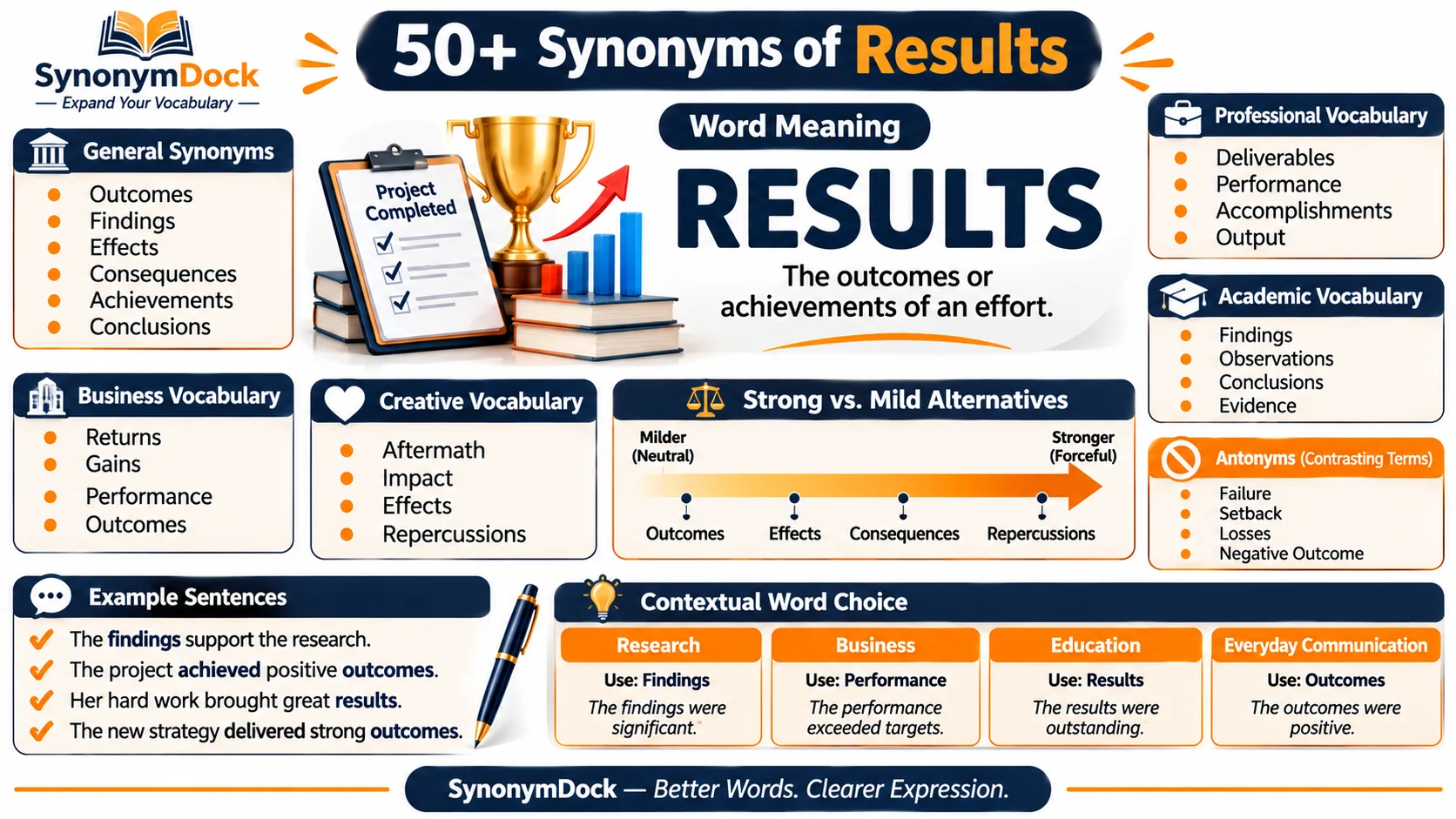
Finding the right synonym of results depends on what you want to describe. You might mean an outcome, a research finding, a test score, a business return, or the consequence of an action. Each situation calls for a slightly different word.
This guide explains useful alternatives, their meanings, and how to use them naturally in everyday, academic, and professional communication.
What Are the Best Synonyms of “Results”?
The best synonyms of results include outcomes, findings, consequences, effects, conclusions, achievements, gains, scores, returns, and products. Use findings for research, outcomes for general situations, scores for tests, and returns for financial or business performance.
Meaning, Tone, and Context
Simple Definition
Results is the plural form of result. As a noun, it refers to things that happen because of an action, situation, or process. It can also describe information discovered through research, marks received in an examination, or the performance of an activity.
For example:
- The results of the experiment were surprising.
- The team achieved excellent results this year.
- The school announced the examination results.
Part of Speech
Results is commonly used as a plural noun. It can also be the third-person singular form of the verb result, as in: “The delay results from poor planning.”
Overall Tone
The word is generally neutral. It works in academic writing, workplace reports, business discussions, news articles, and everyday conversations.
Formality Level
Results is a standard word suitable for both formal and informal communication. It does not sound unusually technical or overly casual.
Common Uses
People commonly use results when discussing:
- Research: information discovered through a study.
- Education: examination marks or academic performance.
- Business: sales figures, profits, or performance.
- Workplace: the outcomes of tasks and projects.
- Personal goals: progress or achievements.
- Everyday situations: what happened because of an action.
Word Forms
| Word form | Example |
| Result (noun) | The result was unexpected. |
| Results (plural noun) | The results were encouraging. |
| Result (verb) | Mistakes can result from carelessness. |
| Resulted (past verb) | The discussion resulted in an agreement. |
| Resulting (participle/adjective) | The resulting changes improved the process. |
When and How to Use “Results”
Use results when you want to communicate what happened, what was discovered, or how well something performed. The surrounding context helps readers understand the exact meaning.
7 Realistic Examples
- Professional: The results of the quarterly review will be shared with the management team.
- Academic: The research results support the main argument of the paper.
- Workplace: Our team achieved positive results after improving its communication process.
- Personal: Her consistent efforts produced excellent results.
- Email: I am writing to ask whether the final results are available.
- Resume: Delivered measurable results by improving customer response times.
- Social media: Small steps can lead to meaningful results over time.
Best Synonyms of “Results”
No single synonym works in every sentence. The best alternative depends on whether results refers to what happened, what research discovered, how someone performed, or what a process produced.
Best Choices by Situation
- Professional writing: outcomes or achievements. These sound clear and appropriate in reports.
- Academic writing: findings. This is especially suitable for information obtained through research.
- Business communication: outcomes or returns. Choose returns when discussing financial performance.
- Casual conversation: outcomes or effects. Both are easy to understand.
- Emotional writing: consequences or effects. These can communicate personal impact.
- Creative writing: consequences, effects, or aftermath. The best choice depends on the scene.
- Resume writing: achievements or accomplishments. These emphasize completed work.
- Workplace communication: outcomes or deliverables. Use deliverables for completed work products.
- Stronger meaning: consequences. This can emphasize important or serious effects.
- Softer meaning: outcomes. This is a neutral way to describe what happened.
When Not to Use “Results”
The word results is useful, but sometimes it is too broad. A more specific term can make your meaning clearer.
| Situation | Why “results” may not work | Better choice | Improved sentence |
| Research report | It may not identify the type of information | Findings | The findings support our hypothesis. |
| Examination | It may not specify marks | Scores | Her scores improved this semester. |
| Business investment | It may be unclear whether money is involved | Returns | The investment generated strong returns. |
| Project report | It may not identify completed work | Deliverables | The team submitted all project deliverables. |
| Serious incident | It may sound too neutral | Consequences | The decision had serious consequences. |
| Personal progress | It may sound general | Achievements | Her achievements reflect years of effort. |
Words Commonly Confused With “Results”
Some words are closely related to results, but they do not always communicate the same idea.
| Word | Difference | When to use it | Example |
| Outcomes | Describes what happens at the end of an activity or process | Projects, decisions, and plans | The outcomes of the program were positive. |
| Findings | Refers to information discovered through investigation | Research and studies | The findings revealed a significant difference. |
| Consequences | Emphasizes what happens because of an action, often with a serious tone | Decisions and behavior | His actions had unexpected consequences. |
| Effects | Focuses on changes caused by something | Health, education, and everyday situations | The policy had several effects on students. |
| Achievements | Highlights successful things someone has accomplished | Personal and professional progress | Her achievements earned recognition. |
| Conclusions | Refers to judgments reached after considering information | Essays, reports, and research | The conclusions were based on the available evidence. |
Best Synonyms of “Results” by Context
The following table shows which alternatives fit different writing situations. Some words overlap in meaning, but their best uses are different.
| Context | Best synonym | Why it works | Example |
| Formal writing | Outcomes | Clear and professional | The outcomes were reviewed by the committee. |
| Academic writing | Findings | Refers to discovered information | The findings support the research question. |
| Professional communication | Achievements | Highlights successful work | The achievements reflect the team’s dedication. |
| Business emails | Outcomes | Communicates what happened | We will discuss the outcomes during the meeting. |
| Resume writing | Accomplishments | Emphasizes completed successes | Listed key accomplishments on the resume. |
| Workplace communication | Deliverables | Refers to completed work products | The project deliverables were submitted on time. |
| Casual conversation | Effects | Easy to understand | The changes had good effects. |
| Everyday speaking | Outcomes | Describes what happened | We are happy with the outcomes. |
| Creative writing | Consequences | Adds weight to an action | She could not escape the consequences of her choice. |
| Storytelling | Aftermath | Describes what follows an event, often a difficult one | The town struggled in the aftermath of the storm. |
| Emotional writing | Impact | Highlights influence or effect | Her words had a lasting impact. |
| Strong emphasis | Consequences | Can suggest serious effects | The decision brought serious consequences. |
| Mild tone | Outcomes | Neutral and balanced | The outcomes were different from what we expected. |
| Social media captions | Achievements | Celebrates success | Celebrating this year’s achievements! |
| American English | Findings | Common in research and reporting | The findings were published yesterday. |
| British English | Results | Standard in education and general use | The examination results were announced. |
How to Choose the Best Synonym of “Results”
Choosing a suitable alternative is easier when you identify what the word represents in your sentence.
- Check the meaning. Are you describing discovered information, a final outcome, a score, or a consequence? Choose a word that expresses that exact idea.
- Consider your audience. Academic readers may expect findings, while colleagues may prefer outcomes.
- Match the tone. Use achievements to highlight success and consequences to emphasize the effects of an action.
- Think about intensity. Effects is generally neutral, while serious consequences communicates greater importance.
- Consider the purpose. A resume should highlight accomplishments. A research paper should usually describe its findings.
- Read the sentence aloud. If the alternative sounds unnatural, the original word may be the better choice.
The most accurate synonym is not necessarily the most sophisticated one. Choose the word that communicates your intended meaning clearly.
Real Life Examples of “Results”
Here are examples showing how different alternatives can improve clarity in common situations.
| Situation | Original sentence | Improved sentence |
| School | The results of the test were good. | The test scores were good. |
| College | The results of the study were interesting. | The findings of the study were interesting. |
| Workplace | We need to discuss the results of the project. | We need to discuss the project outcomes. |
| Business | The results of the investment were positive. | The returns on the investment were positive. |
| Please share the results when available. | Please share the findings when available. | |
| Resume | I achieved good results in sales. | I achieved strong sales performance. |
| Conversation | What were the results? | How did things turn out? |
| Storytelling | The results of his decision were unexpected. | The consequences of his decision were unexpected. |
| Blogging | The results show that the method works. | The findings suggest that the method works. |
| Social media | Proud of the results! | Proud of these achievements! |
18 Best Synonyms of “Results”
These 18 alternatives cover several common meanings of results. They are not interchangeable in every situation, so check the context before replacing the original word.
Synonyms of “Results” by Usage
Professional vs. Personal Synonyms
In professional settings, choose words that communicate measurable work, progress, and completed tasks.
Professional choices:
- Outcomes: useful for describing project or business developments.
- Achievements: highlights successful performance.
- Accomplishments: suitable for resumes and evaluations.
- Deliverables: identifies specific completed project items.
- Performance: describes how well a person, team, or system worked.
Personal choices:
- Effects: describes how something influenced your life.
- Achievements: celebrates personal success.
- Consequences: explains what happened because of a choice.
- Gains: communicates personal improvement.
Example:
- Professional: The project outcomes exceeded expectations.
- Personal: Her achievements made her family proud.
Formal vs. Conversational Synonyms
The right word depends on the setting and the relationship between the speakers.
| Setting | Recommended word | Example |
| Reports | Findings | The findings are presented in section three. |
| Essays | Consequences | The consequences of pollution affect communities. |
| Business writing | Outcomes | The outcomes will guide future planning. |
| Presentations | Achievements | These achievements demonstrate our progress. |
| Emails | Results or outcomes | I will share the outcomes tomorrow. |
| Casual conversations | Effects | What effects did the changes have? |
| Texting | Results | Did you get your results yet? |
Academic Synonyms
Academic writing benefits from precise words that explain what research, analysis, or assessment has produced.
- Findings: best for information discovered through research.
- Conclusions: useful for judgments based on evidence.
- Outcomes: appropriate for the final effects of a study or program.
- Observations: suitable for details noticed during research.
- Data: refers to collected information, not necessarily the interpretation of that information.
- Evidence: refers to information that supports a claim, not the final result itself.
Example: Instead of writing, “The results show a difference,” you could write, “The findings indicate a difference between the two groups.”
Professional and Business Synonyms
Different workplace situations require different vocabulary.
| Situation | Recommended word | Example |
| Resume | Accomplishments | Highlighted key accomplishments in the annual review. |
| Interview | Achievements | One of my achievements was improving team communication. |
| Meeting | Outcomes | We will review the meeting outcomes. |
| Presentation | Performance | The presentation summarizes our sales performance. |
| Performance review | Achievements | The review recognizes her achievements. |
| Client communication | Deliverables | The agreed deliverables are ready for review. |
| Business email | Outcomes | We will communicate the outcomes next week. |
Creative and Literary Synonyms
Creative writing often benefits from alternatives that communicate emotion, influence, or the events that follow an action.
- Aftermath: describes what remains after a major event.
- Consequences: highlights what follows from a decision.
- Impact: emphasizes the influence of an experience.
- Effects: describes changes caused by an event.
- Repercussions: suggests serious or far-reaching consequences.
Example: “The results of the betrayal changed their lives” could become “The aftermath of the betrayal changed their lives.”
Slang or Modern Synonyms
There is no single slang word that replaces results in every situation. Informal expressions are more natural in conversation than in formal reports.
- How it turned out: asks about the final outcome.
- The score: refers to points in a game or competition.
- The payoff: describes a benefit or reward after effort.
Examples:
- “How did the interview turn out?”
- “What’s the final score?”
- “All that hard work finally had a payoff.”
Avoid using these expressions in academic research papers or formal business reports.
Strongest to Mildest Synonyms
This is a context-based scale, not a universal ranking. The strength of each word depends on the sentence.
| Intensity | Word | Effect |
| Mild | Effects | Neutral description of changes |
| Mild | Outcomes | Balanced description of what happened |
| Moderate | Findings | Specific information discovered |
| Moderate | Impact | Emphasizes influence |
| Strong | Consequences | Highlights important effects |
| Strong | Repercussions | Suggests serious or far-reaching effects |
Emotional vs. Neutral Synonyms
Emotional or expressive alternatives
- Achievements: communicates pride and success.
- Impact: emphasizes how deeply something influenced a person or situation.
- Consequences: can suggest serious personal or social effects.
- Repercussions: often communicates concern about negative effects.
Use these when the emotional importance of an event matters.
Neutral alternatives
- Outcomes: describes what happened without strong emotion.
- Findings: communicates discovered information.
- Effects: explains changes caused by something.
- Scores: reports measured performance.
- Output: describes the amount produced.
Use these in reports, explanations, and factual discussions.
Antonyms of “Results”
The noun results does not have one direct opposite that works in every context. For example, the opposite of successful results might be failure, while the opposite of a positive outcome might be a negative outcome.
For accuracy, it is better not to present 15 unrelated words as exact antonyms. These are useful contrasting terms for particular meanings:
| Contrasting word or phrase | Meaning | Example sentence |
| Failure | Lack of success | The project ended in failure. |
| Setback | A problem that delays progress | The team experienced a major setback. |
| Losses | Money, points, or advantages lost | The company reported financial losses. |
| Defeat | Losing a competition or struggle | The team accepted its defeat. |
| Disappointment | An outcome that does not meet expectations | The announcement was a disappointment. |
| Negative outcome | An unfavorable final situation | The decision led to a negative outcome. |
| Lack of progress | No meaningful improvement | The report showed a lack of progress. |
| Decline | A decrease in quality, amount, or performance | The business experienced a decline in sales. |
| Regression | A return to a less developed state | The latest assessment showed regression. |
| Error | A mistake that affects an outcome | An error changed the final calculation. |
| Inaccuracy | Lack of correctness | The report contained several inaccuracies. |
| Uncertainty | A condition in which the outcome is unknown | There is still uncertainty about the final decision. |
| Ineffectiveness | Failure to produce the intended effect | The review exposed the ineffectiveness of the method. |
| Unsuccessful attempt | An effort that does not achieve its goal | It was an unsuccessful attempt to solve the problem. |
| Nonachievement | Failure to accomplish a goal | The evaluation focused on the nonachievement of the target. |
Note: These are contextual contrasts, not interchangeable dictionary antonyms. Choose one according to the meaning of results in your sentence.
Comparison: “Results” vs. Similar Words
Results vs. Outcomes
Main difference: Results is a broad term for what happens or what is discovered. Outcomes usually emphasizes the final situation produced by an action or process.
Which is stronger? Neither is automatically stronger. Outcomes often draws more attention to the final state.
Which is more formal? Both are suitable for formal and professional writing.
When to use each: Use results for general information, scores, and findings. Use outcomes when discussing the final effects of a plan, decision, or activity.
Examples:
- Results: The results of the test were announced.
- Outcomes: The outcomes of the training program were encouraging.
Results vs. Findings
Main difference: Findings refers specifically to information discovered through investigation or research. Results has a wider range of meanings.
Which is stronger? Neither is stronger, but findings is more specific in research contexts.
Which is more formal? Both are common in academic writing. Findings is especially useful in research reports.
When to use each: Use findings for discoveries and observations. Use results for broader information, including measurements and scores.
Examples:
- Results: The results were included in the report.
- Findings: The findings revealed a connection between the two factors.
Results vs. Consequences
Main difference: Consequences emphasizes what happens because of an action or decision. Results can describe positive, negative, or neutral information.
Which is stronger? Consequences often sounds stronger because it can suggest serious effects.
Which is more formal? Both work in formal writing.
When to use each: Use results for general outcomes. Choose consequences when explaining the effects of someone’s behavior or a particular decision.
Examples:
- Results: The results of the decision were unexpected.
- Consequences: The consequences of the decision were serious.
Results vs. Effects
Main difference: Effects describes changes or influences caused by something. Results can also refer to discoveries, scores, and completed outcomes.
Which is stronger? Neither is inherently stronger. The word effects focuses more directly on influence.
Which is more formal? Both are suitable for academic and professional writing.
When to use each: Use effects when explaining how something changes a situation. Use results when describing what happened or what was achieved.
Examples:
- Results: The results of the experiment were recorded.
- Effects: The effects of the treatment were monitored.
Results vs. Achievements
Main difference: Achievements refers to successful accomplishments. Results can include success, failure, or neutral findings.
Which is stronger? Achievements has a more positive meaning.
Which is more formal? Both are appropriate in professional writing, although achievements is especially useful in resumes and performance reviews.
When to use each: Use achievements to highlight success. Use results when you want to remain neutral.
Examples:
- Results: The results of the project were reviewed.
- Achievements: The team’s achievements were recognized by management.
Results vs. Returns
Main difference: Returns usually refers to money or benefits gained from an investment. Results is more general.
Which is stronger? Neither is stronger. Returns is more financially specific.
Which is more formal? Both are suitable for business communication.
When to use each: Use returns for investment performance. Use results for general business performance, research, or activities.
Examples:
- Results: The business results improved this quarter.
- Returns: The investment generated higher returns.
Common Phrases and Expressions With “Results”
These expressions are useful in everyday communication, academic writing, and professional reports.
1. As a result
Meaning: Used to introduce something that happened because of an earlier event.
Example: The school improved its teaching methods. As a result, student performance increased.
2. Result in
Meaning: To cause or produce a particular outcome.
Example: Poor communication can result in unnecessary delays.
3. Result from
Meaning: To happen because of a particular cause.
Example: The improvement resulted from regular practice.
4. Achieve results
Meaning: To accomplish something through effort or action.
Example: Consistent teamwork helps an organization achieve results.
5. Get results
Meaning: To obtain the outcome you want.
Example: This approach may help students get better results.
6. Positive results
Meaning: Favorable or successful outcomes.
Example: The new learning program produced positive results.
7. Mixed results
Meaning: A combination of positive and negative outcomes.
Example: The campaign received mixed results across different regions.
8. Results-driven
Meaning: Focused on achieving measurable goals.
Example: The company is looking for a results-driven project manager.
Common Mistakes to Avoid
Choosing a synonym simply because it sounds impressive can change the meaning of a sentence. These examples show how to make more accurate choices.
1. Using “Findings” for Every Type of Result
Incorrect: The football team’s findings were excellent.
Better: The football team’s results were excellent.
Why: Findings usually refers to information discovered through research or investigation. For a team’s performance, results or scores is more natural.
2. Confusing “Outcomes” With “Achievements”
Incorrect: The outcomes on her resume include managing five successful projects.
Better: Her achievements include managing five successful projects.
Why: Achievements highlights what someone successfully accomplished. Outcomes describes the final effects of an activity.
3. Using “Consequences” for Every Positive Result
Incorrect: The consequences of her hard work were wonderful.
Better: The results of her hard work were wonderful.
Why: Consequences can suggest serious or unwanted effects. Results is more neutral and natural for a positive situation.
4. Using “Returns” Outside a Financial Context
Incorrect: The returns of the classroom experiment were interesting.
Better: The findings of the classroom experiment were interesting.
Why: Returns commonly refers to financial gains or benefits. Findings is more suitable for information discovered through an experiment.
5. Choosing a Dramatic Word for a Neutral Situation
Incorrect: The repercussions of the spelling test were announced.
Better: The results of the spelling test were announced.
Why: Repercussions suggests significant effects, often negative. It is too dramatic for an ordinary test announcement.
6. Repeating “Results” Too Often
Incorrect: The results were positive. These results show good progress, and the results were shared with the team.
Better: The outcomes were positive. These findings show good progress and were shared with the team.
Why: Carefully selected alternatives improve readability. However, keep results when repeating it makes the meaning clearer.
7. Using “Output” When You Mean Success
Incorrect: The student’s output in the examination was excellent.
Better: The student’s performance in the examination was excellent.
Why: Output usually describes the amount of work or production. Performance is more natural when evaluating how well a student did.
Frequently Asked Questions
1. What are the best synonyms of “results”?
The best synonyms of results include outcomes, findings, effects, consequences, achievements, scores, and returns. Choose findings for research, scores for examinations, and outcomes for general situations.
2. What are the best formal synonyms of “results”?
Formal alternatives include outcomes, findings, conclusions, consequences, and achievements. In academic or professional writing, choose the word that describes your meaning precisely rather than selecting an alternative simply because it sounds more sophisticated.
3. What are common informal synonyms of “results”?
Common conversational alternatives include outcomes, effects, scores, and achievements. You can also say “how things turned out” when discussing the final outcome of an event or situation in everyday conversation.
4. What is another word for “results” in professional writing?
Outcomes is an excellent general alternative in professional writing. Use achievements for successful work, deliverables for completed project items, and performance when discussing how well a person or team worked.
5. What is the difference between “results” and “outcomes”?
Results is a broad word that can describe scores, discoveries, or effects. Outcomes usually emphasizes the final situation produced by a decision, activity, or process.
6. What is the opposite of “results”?
There is no single direct opposite of results in every context. Depending on the sentence, useful contrasts include failure, setbacks, losses, defeat, and negative outcomes.
Conclusion
The word results can describe outcomes, research findings, examination scores, business performance, or the effects of an action. Its best alternatives include outcomes, findings, consequences, effects, achievements, and accomplishments. Understanding the synonym of results helps you communicate more clearly in academic assignments, professional reports, resumes, and everyday conversations.

Ethan Parker is an English language writer and vocabulary enthusiast at SynonymDock.com. He specializes in synonyms, word meanings, alternative expressions and practical English usage, creating clear and reliable content to help students, professionals, writers and English learners choose the right words with confidence.
9 thoughts on “65+ Synonyms of Results| Meanings, Uses,and Best Alternatives”