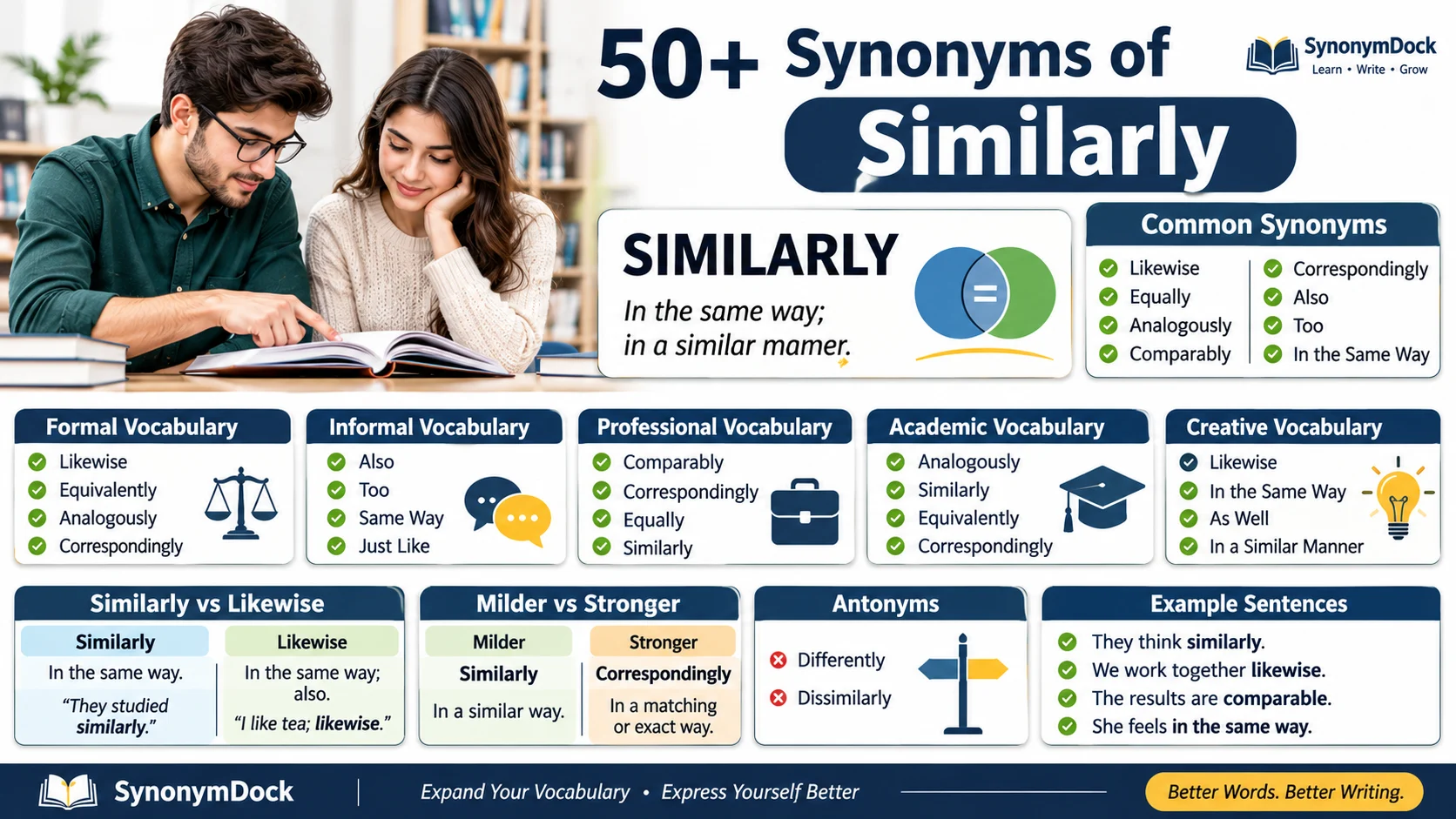
Finding the right synonym of similarly helps you communicate comparisons more naturally. Words such as likewise, equally, comparably, and in the same way can make your sentences clearer, depending on the context.
However, these alternatives are not always interchangeable. Some introduce another related point, while others emphasize equal qualities, comparable results, or similar methods.
This guide explores the best synonyms of similarly, their meanings, examples, grammatical differences, and practical applications. You will also learn which alternatives work best in academic writing, professional communication, everyday conversations, and creative writing.
What Are the Best Synonyms of “Similarly”?
Similarly means in a way that resembles something else or shares comparable characteristics. It is a neutral adverb commonly used to establish comparisons. The best alternatives include likewise for formal writing, in the same way for clarity, equally for equal emphasis, and comparably for academic discussions.
Best Alternatives by Context
| Context | Best Synonym |
| Formal writing | Likewise |
| Casual conversation | In the same way |
| Academic writing | Analogously |
| Professional communication | Likewise |
| Business communication | Correspondingly |
| Emotional writing | Just as |
| Creative writing | In a similar fashion |
| Resume writing | Equally |
| Research reports | Comparably |
| Everyday speaking | Also |
Meaning, Tone, and Context of Similarly
Simple Definition
Similarly is an adverb that describes something happening or being done in a way that resembles another action, situation, or condition.
It helps readers recognize connections between two ideas, experiences, behaviors, or results.
Example:
- Sarah enjoys reading historical novels. Similarly, her brother prefers books about the past.
The word connects two related preferences without repeating the entire idea.
Part of Speech
Similarly is an adverb.
It modifies an action, statement, or comparison by showing that something resembles another thing.
Example:
The two students approached the assignment similarly.
Overall Tone
Similarly generally has a neutral, informative, and explanatory tone.
It does not automatically communicate positive or negative feelings. Its meaning depends on the ideas being compared.
Formality Level
| Style | Suitability |
| Formal | Highly suitable |
| Semi-formal | Suitable |
| Neutral | Highly suitable |
| Informal | Suitable, but other expressions may sound more conversational |
Common Uses
Native English speakers commonly use similarly in:
- Academic essays to connect related arguments.
- Research papers to compare findings.
- Business reports to identify comparable results.
- Professional emails to introduce related information.
- Everyday conversations to explain shared experiences.
- Blog posts to connect related topics.
- Presentations to establish relationships between ideas.
Word Forms
| Word | Part of Speech | Meaning |
| Similar | Adjective | Having qualities in common |
| Similarly | Adverb | In a similar way |
| Similarity | Noun | A shared quality or characteristic |
| Similarities | Plural noun | Shared characteristics |
| Dissimilar | Adjective | Not similar |
| Dissimilarly | Adverb | In a dissimilar way |
When and How to Use “Similarly”
Use similarly when you want to connect two ideas that share a characteristic, action, result, or pattern.
It works particularly well when comparing information without repeating unnecessary details.
7 Practical Examples
1. Professional Context
The marketing team improved customer engagement. Similarly, the sales department reported better conversion rates.
2. Academic Context
The first study identified a connection between sleep and memory. Similarly, the second study reported related findings.
3. Workplace Context
James prefers working independently. Similarly, his colleague performs better when given individual responsibilities.
4. Personal Context
My sister enjoys visiting historical places. Similarly, I love exploring museums and ancient buildings.
5. Email Context
We appreciate your interest in our services. Similarly, we look forward to developing a productive relationship.
6. Resume Context
I have experience managing customer relationships. Similarly, I have developed strong communication and problem-solving abilities.
7. Social Media Context
Some people enjoy traveling to peaceful destinations. Similarly, others prefer exploring exciting cities.
Best Synonyms of Similarly
No synonym of similarly works perfectly in every sentence. The best alternative depends on whether you want to express resemblance, equal importance, a parallel situation, or a related idea.
Here are the strongest recommendations for different writing situations.
| Context | Best Synonym | Why It Works |
| Professional writing | Likewise | Connects related professional points naturally |
| Academic writing | Analogously | Establishes a meaningful comparison |
| Business communication | Correspondingly | Shows a relationship between developments |
| Casual conversation | In the same way | Sounds natural and understandable |
| Emotional writing | Just as | Creates a connection between experiences |
| Creative writing | In a similar fashion | Adds variety to descriptive writing |
| Resume writing | Equally | Highlights comparable skills or qualities |
| Workplace communication | Likewise | Connects related actions or observations |
| Stronger emphasis | Equally | Emphasizes the same degree or importance |
| Softer meaning | Also | Introduces additional information naturally |
When Not to Use Similarly
Although similarly is versatile, certain situations call for a more precise alternative.
1. When the Sentence Sounds Too General
Similarly may not explain the exact relationship between two things.
Less effective: The company improved its services. Similarly, customer satisfaction increased.
Better: The company improved its services. Consequently, customer satisfaction increased.
Why it works: Consequently communicates a cause and effect relationship rather than simple resemblance.
2. When You Need a More Precise Comparison
Less effective: The two research methods worked similarly.
Better: The two research methods produced comparable results.
Why it works: Comparable specifically emphasizes the relationship between results.
3. When You Want a Conversational Expression
Less effective: Similarly, I enjoyed the movie.
Better: I enjoyed the movie, too.
Why it works: Too sounds more natural in ordinary conversation.
4. When You Need to Express Equal Importance
Less effective: Communication and teamwork are similarly important.
Better: Communication and teamwork are equally important.
Why it works: Equally directly expresses the same degree of importance.
5. When You Need to Show a Parallel Situation
Less effective: The first department changed its policy. Similarly, the second department changed its policy.
Better: The first department changed its policy. Likewise, the second department changed its policy.
Why it works: Likewise provides a natural connection between parallel actions.
6. When You Need to Show a Direct Correspondence
Less effective: Employee responsibilities increased. Similarly, their compensation changed.
Better: Employee responsibilities increased. Correspondingly, their compensation changed.
Why it works: Correspondingly highlights a relationship between two developments.
Words Commonly Confused With Similarly
Several English words have meanings close to similarly, but their grammatical functions and usage differ.
1. Similarly vs Likewise
Difference: Both words introduce related ideas or comparable situations. Likewise often works as a sentence connector, while similarly emphasizes resemblance in manner or nature.
When to Use It: Use likewise when connecting two parallel statements in formal or professional writing.
Example:
The first department achieved its targets. Likewise, the second department exceeded expectations.
2. Similarly vs Equally
Difference: Similarly expresses resemblance, while equally emphasizes the same degree, amount, or importance.
When to Use It: Use equally when two things deserve the same level of consideration.
Example:
Both communication and experience are equally important for this position.
3. Similarly vs Analogously
Difference: Similarly is a general comparison word. Analogously introduces a comparison based on a corresponding relationship between two situations.
When to Use It: Use analogously in academic explanations and analytical discussions.
Example:
Analogously, the researchers applied the same framework to the second experiment.
4. Similarly vs Comparably
Difference: Similarly indicates resemblance, while comparably emphasizes that two things can be evaluated against one another or have comparable qualities.
When to Use It: Use comparably when discussing measurable qualities, performance, or results.
Example:
Both companies performed comparably during the financial year.
5. Similarly vs Also
Difference: Similarly establishes a relationship between ideas, whereas also simply adds another piece of information.
When to Use It: Use also when introducing an additional fact without necessarily making a comparison.
Example:
She speaks English fluently and also understands Spanish.
6. Similarly vs Correspondingly
Difference: Similarly highlights resemblance, while correspondingly indicates that one development or feature is related to another.
When to Use It: Use correspondingly when explaining connected changes, developments, or results.
Example:
Production increased, and employee demand rose correspondingly.
Best Synonyms of Similarly by Context
Choosing an appropriate synonym makes your writing more natural and meaningful.
The following table provides practical recommendations for different communication situations.
| Context | Best Synonym | Why It Works | Example |
| Formal writing | Likewise | Connects related statements | Likewise, the findings support the proposal. |
| Academic writing | Analogously | Establishes a logical comparison | Analogously, the second model explains the process. |
| Professional communication | Likewise | Sounds polished and natural | Likewise, we appreciate your contribution. |
| Business emails | Correspondingly | Connects related developments | Costs increased correspondingly. |
| Resume writing | Equally | Emphasizes comparable abilities | I am equally comfortable working independently. |
| Workplace communication | In the same way | Explains similar approaches | Both teams approached the challenge in the same way. |
| Casual conversation | Too | Adds a related thought | I enjoyed the presentation, too. |
| Everyday speaking | Also | Introduces additional information | I also enjoy reading. |
| Creative writing | In a similar fashion | Adds descriptive variety | The trees moved in a similar fashion. |
| Storytelling | Just as | Connects parallel experiences | Just as her mother loved music, she enjoyed singing. |
| Emotional writing | Just as | Creates a meaningful connection | Just as you supported me, I will support you. |
| Strong emphasis | Equally | Highlights equal importance | Both decisions are equally significant. |
| Mild tone | Also | Adds information without strong emphasis | The report also includes recommendations. |
| Social media captions | Too | Sounds conversational | Loving the little moments, too. |
| American English | Likewise | Natural in formal and everyday writing | Likewise, we enjoyed meeting you. |
| British English | Likewise | Commonly understood and appropriate | Likewise, the results were encouraging. |
How to Choose the Best Synonym of Similarly
Selecting the right alternative requires more than finding a word with a similar dictionary meaning.
Consider these six factors before replacing similarly.
1. Consider the Meaning
Ask yourself what relationship you want to communicate.
- Resemblance: Similarity
- Equal importance: Equally
- Additional information: Also
- Parallel situations: Likewise
- Comparable results: Comparably
2. Consider Your Audience
Professional readers generally appreciate precise and straightforward vocabulary.
For everyday conversations, shorter expressions such as too and also often sound more natural.
3. Match the Tone
Use likewise or correspondingly in formal communication. Choose in the same way when you want an explanation that is easy to understand.
4. Consider Emotional Strength
Expressions such as just as can establish a stronger connection between personal experiences.
Equally is more suitable when emphasizing importance rather than emotion.
5. Identify Your Writing Purpose
An academic comparison may require analogously, while a business report may benefit from correspondingly.
A social media caption usually needs a simpler expression.
6. Read the Sentence Naturally
Always read the complete sentence after replacing similarly.
If the alternative changes the intended relationship, choose another expression.
Real Life Examples of Similarly
The following examples demonstrate how different alternatives can improve everyday and professional communication.
| Situation | Original Sentence | Improved Sentence |
| School | Similarly, students should complete their assignments. | Likewise, students should complete their assignments. |
| College | Similarly, the second theory explains human behavior. | Analogously, the second theory explains human behavior. |
| Workplace | The first team improved performance. Similarly, the second team did. | The first team improved performance. Likewise, the second team did. |
| Business | Revenue increased. Similarly, expenses increased. | Revenue increased. Correspondingly, expenses increased. |
| Similarly, we appreciate your cooperation. | Likewise, we appreciate your cooperation. | |
| Resume | Similarly, I can manage multiple responsibilities. | Equally, I can manage multiple responsibilities. |
| Conversation | I like reading. Similarly, my brother does. | I like reading. My brother does, too. |
| Storytelling | Similarly, the old man remembered his childhood. | Just as his sister remembered their childhood, the old man recalled his early years. |
| Blogging | Similarly, readers benefit from regular practice. | In the same way, readers benefit from regular practice. |
| Social Media | Similarly, we enjoy peaceful weekends. | We enjoy peaceful weekends, too. |
15 Best Synonyms of Similarly
The following 15 alternatives are useful for different types of communication. Each has a slightly different meaning, so consider the sentence before choosing a replacement.
| Synonym | Simple Meaning | Best Used For | Example Sentence |
| Likewise | In the same way | Formal and professional writing | Likewise, our team supports the recommendation. |
| Equally | To the same degree | Equal importance | Both candidates are equally qualified. |
| Analogously | By a comparable relationship | Academic writing | Analogously, the second experiment follows the same principle. |
| Comparably | In a similar or comparable way | Reports and research | The two products performed comparably. |
| Correspondingly | In a related or matching way | Business communication | Expenses increased correspondingly. |
| Also | In addition | Everyday writing | She also teaches mathematics. |
| Too | In addition or as well | Casual conversation | I would like to attend, too. |
| In the same way | Using a similar method | General explanations | The second group completed the task in the same way. |
| Just as | In the same manner or to a matching extent | Comparisons and emotional writing | Just as her father encouraged her, she motivated her brother. |
| In a similar fashion | Through a comparable approach | Creative and formal writing | The second artist worked in a similar fashion. |
| Alike | In a similar manner or condition | Descriptive comparisons | The two brothers think alike. |
| Equivalently | In an equal or equivalent way | Technical and mathematical writing | The values can be expressed equivalently. |
| In like manner | In a similar manner | Formal and literary writing | The second committee responded in like manner. |
| In parallel | Alongside or in a corresponding way | Technical and professional contexts | Both projects developed in parallel. |
| By the same token | For the same reason or by the same principle | Argumentative writing | By the same token, employees deserve clear expectations. |
Important usage note: These expressions are not interchangeable in every sentence. For example, also and too add information, whereas likewise and analogously establish a relationship between ideas.
Synonyms of Similarly by Usage
Professional vs Personal Synonyms
Professional communication requires vocabulary that sounds clear, respectful, and appropriate.
Best professional alternatives:
- Likewise
- Correspondingly
- Comparably
- Equally
- In the same way
Best personal alternatives:
- Too
- Also
- Just as
- In the same way
- Alike
Example:
Professional: Likewise, we appreciate your continued cooperation.
Personal: I enjoy spending time outdoors, too.
Formal vs Conversational Synonyms
Different writing situations require different vocabulary choices.
| Writing Situation | Recommended Synonym |
| Formal reports | Likewise |
| Academic essays | Analogously |
| Business writing | Correspondingly |
| Presentations | Similarly or likewise |
| Professional emails | Likewise |
| Casual conversations | Too |
| Texting | Also |
| Everyday discussions | In the same way |
Formal alternatives help organize complex information, while conversational expressions keep communication simple.
Academic Synonyms
Academic writing benefits from precise comparison words.
Consider these useful alternatives:
1. Analogously
Useful when comparing two theories, processes, or systems that share a corresponding relationship.
Example: Analogously, the second model explains the same underlying principle.
2. Comparably
Useful when discussing research findings, measurements, or performance.
Example: Both experimental groups performed comparably.
3. Equivalently
Useful when expressing an equivalent relationship, particularly in mathematical or technical discussions.
Example: The equation can be expressed equivalently using another mathematical form.
4. Likewise
Useful when introducing a related research finding or argument.
Example: Likewise, previous research identified similar patterns.
5. Correspondingly
Useful when explaining related changes or developments.
Example: The demand for qualified employees increased correspondingly.
Professional and Business Synonyms
Business communication requires alternatives that express relationships clearly without making sentences unnecessarily complicated.
| Situation | Recommended Word | Example |
| Resume | Equally | I am equally capable of managing individual and team projects. |
| Interview | Likewise | Likewise, I value collaboration and accountability. |
| Meetings | Similarly | Similarly, our department supports the proposed changes. |
| Presentations | Correspondingly | Customer demand increased correspondingly. |
| Performance reviews | Equally | Both achievements are equally valuable. |
| Client communication | Likewise | Likewise, we appreciate your feedback. |
| Business emails | In the same way | We will address the remaining concerns in the same way. |
Creative and Literary Synonyms
Creative writing sometimes needs expressions that establish comparisons without repeating the same transition.
Consider these alternatives:
- Just as: Creates a connection between experiences or emotions.
- Alike: Describes shared qualities between people or things.
- In a similar fashion: Adds variety to descriptive passages.
- In like manner: Provides a formal or literary tone.
- In the same way: Makes narrative comparisons easy to understand.
Example:
Just as the morning sun brightened the village, hope returned to the hearts of its residents.
This construction connects two ideas through a meaningful comparison.
Slang or Modern Synonyms
Similarly does not have a widely accepted direct slang replacement.
However, informal expressions can communicate related ideas.
| Expression | Meaning | Suitable Context |
| Me too | I share that feeling or experience | Casual conversations |
| Same here | I feel or think the same way | Friendly discussions |
| Same | I agree or have a similar experience | Informal texting |
| Right back at you | Returning a similar comment or sentiment | Friendly exchanges |
Avoid these expressions in academic papers, formal reports, and professional documents.
Strongest to Mildest Synonyms
The word similarly does not have a strong emotional intensity by itself. Its alternatives differ mainly in emphasis and the relationship they communicate.
The following scale represents communicative emphasis, not an exact ranking of synonym strength.
| Level | Expressions | Purpose |
| Mild | Also, too | Add information |
| Moderate | Likewise, in the same way | Establish resemblance |
| Strong | Equally, comparably | Emphasize matching qualities |
| More technical | Analogously, correspondingly | Explain structured relationships |
Choose the level that accurately represents your intended comparison.
Emotional vs Neutral Synonyms
Not every alternative communicates the same emotional tone.
Emotional or Expressive Alternatives
- Just as
- Alike
- In the same way
These expressions can create a connection between personal experiences, feelings, or relationships.
Example: Just as you believed in me, I will always believe in you.
Neutral Alternatives
- Likewise
- Also
- Comparably
- Equally
- Correspondingly
- Analogously
These expressions communicate relationships without necessarily introducing emotional meaning.
Example: Likewise, the second department achieved its objectives.
Antonyms of Similarly
Similarly has relatively few direct antonyms because it describes a relationship of resemblance rather than a specific action or quality.
The most accurate direct opposites are differently and dissimilarly.
Other expressions can communicate contrast, but they are not exact dictionary antonyms.
| Antonym | Meaning | Example Sentence |
| Differently | In another way | The two students approached the problem differently. |
| Dissimilarly | In a way that is not alike | The two systems operate dissimilarly. |
Other Expressions That Communicate Contrast
These expressions can help writers show opposing ideas or different situations.
- Conversely: In an opposite or contrasting way.
- Otherwise: In a different way or under different conditions.
- In contrast: Showing an important difference.
- By contrast: Introducing a contrasting situation.
- On the contrary: Expressing an opposing statement.
- Inversely: In the opposite relationship or direction.
- Oppositely: In an opposing manner.
- Instead: In place of something else.
- Unlike: Showing that two things are different.
- In a different way: Using another method or approach.
- In a contrasting manner: Demonstrating a difference.
- Divergently: Moving or developing in different directions.
- Distinctly: In a clearly different or separate way.
These 13 expressions are contextual contrasts, not all direct antonyms of similarly. Using them accurately is more valuable than presenting unrelated vocabulary as exact opposites.
Comparison: Similarly vs Similar Words
Understanding the differences between related words helps you select vocabulary more confidently.
Similarly vs Likewise
Main Difference
Similarly emphasizes resemblance, while likewise commonly introduces another related statement or action.
Which Is Stronger?
Neither is inherently stronger. Both communicate a comparable relationship.
Which Is More Formal?
Both are suitable for professional and academic writing.
When to Use Each
Use similarly when describing resemblance. Use likewise when connecting parallel statements.
Examples
Similarly: The two departments follow similar procedures.
Likewise: The first department improved its results. Likewise, the second department made progress.
Similarly vs Equally
Main Difference
Similarly means in a comparable way. Equally means to the same degree or extent.
Which Is Stronger?
Equally places greater emphasis on matching levels or importance.
Which Is More Formal?
Both are appropriate for formal writing.
When to Use Each
Use similarly to compare approaches. Use equally to emphasize matching importance.
Examples
Similarly: Both students approached the assignment similarly.
Equally: Both students are equally talented.
Similarly vs Analogously
Main Difference
Similarly is a general comparison word. Analogously establishes a corresponding relationship between different situations.
Which Is Stronger?
Analogously can communicate a more structured comparison.
Which Is More Formal?
Analogously is generally more specialized and formal.
When to Use Each
Use similarly for general comparisons. Use analogously for academic reasoning and technical explanations.
Examples
Similarly: The second team used a similar strategy.
Analogously: The second mathematical model explains the relationship analogously.
Similarly vs Comparably
Main Difference
Similarly describes resemblance, while comparably emphasizes a relationship that allows meaningful comparison.
Which Is Stronger?
Comparably can make the comparative nature more explicit.
Which Is More Formal?
Both work in professional and academic writing.
When to Use Each
Use similarly for general observations. Use comparably when discussing performance, results, or measurable characteristics.
Examples
Similarly: Both companies adopted similar policies.
Comparably: Both companies performed comparably during the year.
Similarly vs Also
Main Difference
Similarly introduces a related comparison. Also simply adds information.
Which Is Stronger?
Neither is inherently stronger. They serve different purposes.
Which Is More Formal?
Both are acceptable in formal writing, although their grammatical positions differ.
When to Use Each
Use similarly when connecting comparable ideas. Use also when adding another fact.
Examples
Similarly: The second researcher reached a similar conclusion.
Also: The researcher also published another study.
Similarly vs Correspondingly
Main Difference
Similarly communicates resemblance, whereas correspondingly emphasizes a related or matching development.
Which Is Stronger?
Correspondingly makes the relationship between developments more explicit.
Which Is More Formal?
Correspondingly generally sounds more technical and formal.
When to Use Each
Use similarly for general resemblance. Use correspondingly when describing related changes or results.
Examples
Similarly: Both departments experienced comparable challenges.
Correspondingly: Production increased, and demand rose correspondingly.
Common Phrases and Expressions with Similarly
Here are seven useful expressions that native English speakers use when discussing resemblance and comparisons.
1. Similarly to
Meaning: In a way that resembles something else.
Example: Similarly to previous studies, this research identifies a connection between education and employment.
2. Similarly,
Meaning: Introduces another related statement.
Example: The first team completed the project successfully. Similarly, the second team met its deadline.
3. Very similarly
Meaning: In a way that closely resembles something.
Example: Both children responded very similarly to the situation.
4. Similarly situated
Meaning: In comparable circumstances or conditions.
Example: Employees in similarly situated positions should receive consistent treatment.
5. Similarly structured
Meaning: Organized or arranged in a comparable way.
Example: Both reports are similarly structured.
6. Similarly designed
Meaning: Created using comparable design features.
Example: The two websites are similarly designed.
7. Similarly affected
Meaning: Experiencing comparable effects or consequences.
Example: Both communities were similarly affected by the economic changes.
Common Mistakes to Avoid
Even advanced English learners sometimes use similarly and its alternatives incorrectly.
Here are seven mistakes worth avoiding.
Mistake 1: Confusing Similarly With Equally
Incorrect: Both students are similarly talented.
Better: Both students are equally talented.
Why: Equally emphasizes the same level of ability. Similarly only indicates resemblance.
Mistake 2: Using Also When You Mean Likewise
Incorrect: The first department improved its performance. Also, the second department achieved similar results.
Better: The first department improved its performance. Likewise, the second department achieved similar results.
Why: Likewise creates a clearer connection between parallel developments.
Mistake 3: Using Informal Expressions in Academic Writing
Incorrect: The second researcher found the same thing, too.
Better: Likewise, the second researcher identified a similar pattern.
Why: The revised version sounds more appropriate for academic discussion.
Mistake 4: Using an Overly Technical Synonym
Incorrect: Similarly, I enjoyed spending time with my family.
Better: I enjoyed spending time with my family, too.
Why: A simple conversational expression sounds more natural in personal communication.
Mistake 5: Repeating Similarly Too Often
Incorrect: Similarly, the results improved. Similarly, the second group performed better.
Better: Likewise, the results improved. The second group also performed better.
Why: Varying transitions makes writing easier to read.
Mistake 6: Confusing Resemblance With Cause and Effect
Incorrect: The company improved its services. Similarly, customer satisfaction increased.
Better: The company improved its services. Consequently, customer satisfaction increased.
Why: Consequently expresses a cause and effect relationship. Similarly only establishes resemblance.
Mistake 7: Using Analogously Without a Clear Comparison
Incorrect: Analogously, I went shopping yesterday.
Better: I also went shopping yesterday.
Why: Analogously is most useful when explaining a meaningful relationship between two situations, models, or ideas.
Frequently Asked Questions
1. What Are the Best Synonyms of Similarly?
The best synonyms of similarly include likewise, equally, analogously, comparably, correspondingly, and in the same way. Likewise works particularly well in formal writing, while also and too are more natural for everyday conversations.
2. What Are the Best Formal Synonyms of Similarly?
The best formal alternatives include likewise, analogously, correspondingly, comparably, and equivalently. Choose analogously for academic comparisons and correspondingly when describing related developments or changes.
3. What Are Common Informal Synonyms of Similarly?
Common informal alternatives include also, too, same here, and in the same way. These expressions work well in everyday conversations, friendly messages, and informal discussions.
4. What Is Another Word for Similarly in Professional Writing?
Likewise is an excellent alternative in professional writing. Correspondingly and comparably are also useful when discussing related business developments, performance results, and workplace comparisons.
5. What Is the Difference Between Similarly and Likewise?
Similarly emphasizes resemblance between actions, ideas, or situations. Likewise commonly introduces another related statement or action. Both words are appropriate for professional and academic communication, although their sentence structures may differ.
6. What Is the Opposite of Similarly?
The most direct antonyms of similarly are differently and dissimilarly. Both describe something happening in a way that is not alike. Other expressions, such as conversely and in contrast, communicate opposing or contrasting ideas.
Conclusion
Choosing the right synonym of similarly can make your writing clearer, more natural, and more effective. Words such as likewise, equally, analogously, comparably, and correspondingly provide useful alternatives for different communication situations.
For professional writing, likewise is a reliable choice. Academic writers can use analogously, while equally works when emphasizing matching importance. In everyday conversations, also and too often sound more natural.
Remember that no synonym works perfectly in every situation. Always consider your audience, intended meaning, tone, and writing purpose before replacing a word.

Ethan Parker is an English language writer and vocabulary enthusiast at SynonymDock.com. He specializes in synonyms, word meanings, alternative expressions and practical English usage, creating clear and reliable content to help students, professionals, writers and English learners choose the right words with confidence.
1 thought on “Synonym of Similarly|70+ Best Alternatives For 2026”