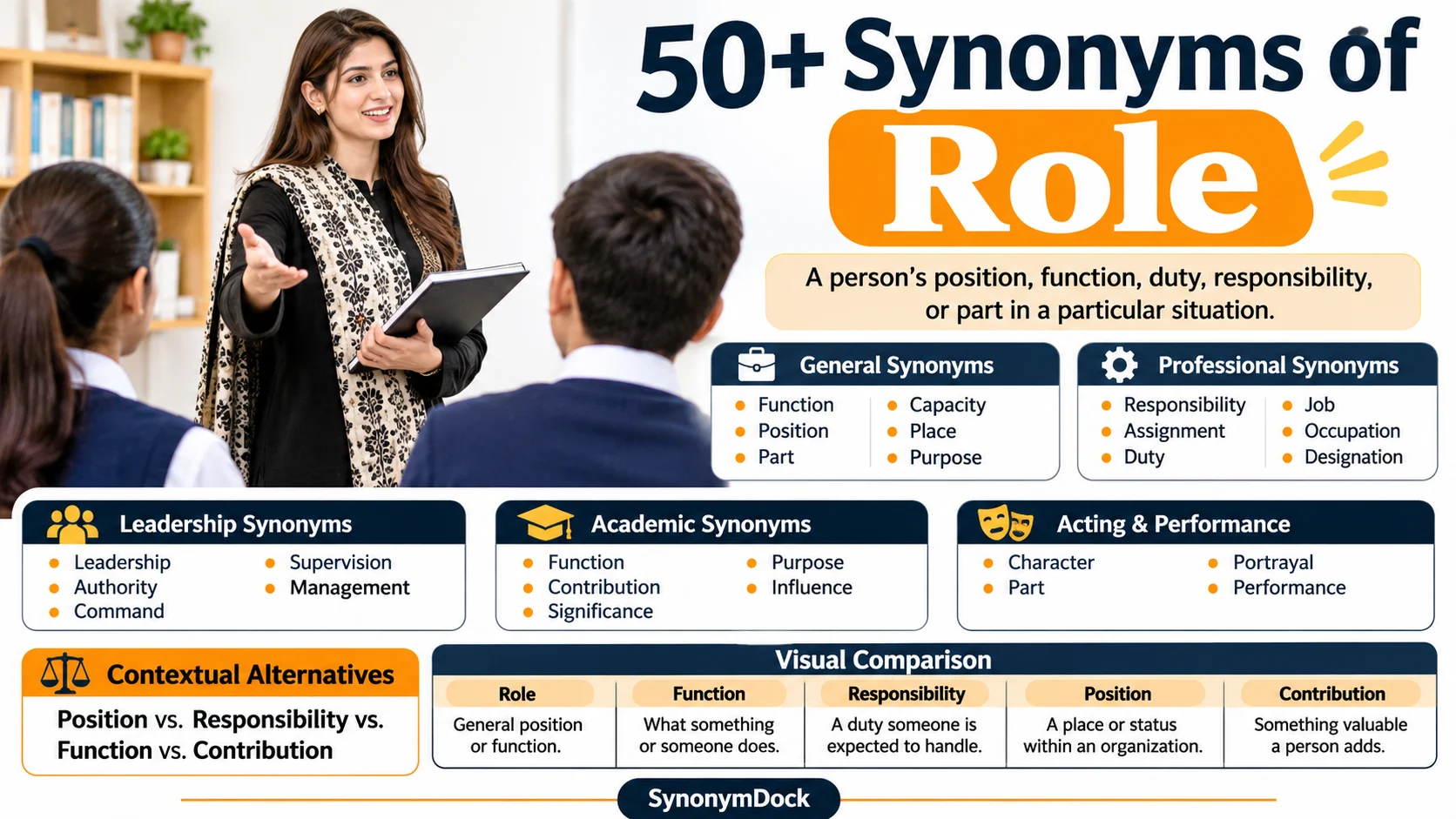
Finding the right synonym of role can make your communication clearer, more natural, and more professional. Depending on the context, words such as position, function, responsibility, duty, part, and capacity can communicate your intended meaning more precisely.
However, these alternatives are not interchangeable. A word that works perfectly in a business email might sound unnatural in an academic essay or creative story.
This guide explores more than 50 synonyms of role, including their meanings, differences, examples, formality levels, and practical applications. You will learn how to select the right alternative for professional communication, academic writing, resumes, everyday conversations, and creative expression.
What Are the Best Synonyms of “Role”?
A role is the function, position, responsibility, or character someone or something has in a particular situation. The best synonyms include position, function, responsibility, duty, part, capacity, assignment, and contribution. For professional writing, use position or responsibility. We can use for academic writing, consider function and also for creative writing, use part or character.
The most appropriate alternative depends on what you want to communicate.
| Context | Best synonym | Example |
| Formal writing | Position | Her position requires strong leadership skills. |
| Casual conversation | Part | I played a major part in the event. |
| Academic writing | Function | The function of this component is essential. |
| Professional communication | Responsibility | Managing the team is her responsibility. |
| Emotional writing | Contribution | Your contribution means a lot to us. |
| Creative writing | Character | He played an important character in the story. |
Meaning, Tone, and Context of Role
Simple Definition
The word role refers to the part someone or something plays in a particular situation, organization, activity, or relationship.
It can describe a person’s job, responsibilities, expected behavior, contribution, or character in a performance.
For example:
- A teacher has an important role in education.
- A manager’s role includes supervising employees.
- An actor plays the role of a detective.
- Technology plays an important role in modern communication.
Each example uses the same word differently. Understanding the context helps you select a more accurate synonym.
Part of Speech
Role is a noun.
It is commonly used to describe:
- A person’s position or job.
- A particular responsibility or duty.
- The function of something.
- A character portrayed in a performance.
- Someone’s contribution to an activity or situation.
Overall Tone
The word role generally has a neutral tone.
It does not automatically express positive or negative feelings. Its meaning depends on the surrounding sentence.
| Tone | Explanation | Example |
| Positive | Highlights an important contribution | She played a valuable role in the project. |
| Neutral | Simply identifies a function | His role involves organizing meetings. |
| Negative | Describes an undesirable responsibility or influence | His role in the incident raised concerns. |
Formality Level
Neutral and widely appropriate
Role is suitable for formal, semi formal, professional, academic, and everyday communication.
It is especially common in workplaces, education, business discussions, entertainment, and social relationships.
Common Uses
Native English speakers commonly use role in:
- Workplaces: Job responsibilities and professional positions.
- Education: Teachers, students, and educational responsibilities.
- Business: Leadership, management, and organizational structures.
- Entertainment: Characters and acting performances.
- Society: People’s contributions and social responsibilities.
- Technology: The function of tools, systems, and components.
- Relationships: The responsibilities people have toward one another.
Word Forms
| Word | Part of speech | Meaning |
| Role | Noun | A function, position, or responsibility |
| Roles | Plural noun | More than one function or position |
| Roleplay | Noun or verb | Acting out an imagined situation |
| Role player | Noun | Someone who performs a particular role |
There is no standard opposite adjective or verb form of role.
When and How to Use “Role”
Use role when describing what someone does, what is expected of them, or how something contributes to a particular situation.
Here are seven realistic examples.
1. Professional Context
Her role as a department manager involves supervising employees and improving team performance.
2. Academic Context
The research examines the role of technology in modern education.
3. Workplace Context
My role includes coordinating meetings and preparing monthly reports.
4. Personal Context
Parents play an important role in shaping their children’s values.
5. Email Context
I would appreciate some clarification about my role in the upcoming project.
6. Resume Context
Demonstrated leadership in a role involving team coordination and project management.
7. Social Media Context
Teachers play an incredible role in shaping future generations.
Best Synonyms of Role
No synonym of role works perfectly in every situation. Some alternatives describe employment, while others emphasize responsibilities, functions, contributions, or fictional characters.
Here are the best choices according to context.
| Context | Best synonym | Why it works |
| Professional writing | Position | Clearly communicates someone’s place in an organization. |
| Academic writing | Function | Explains what something does within a system. |
| Business communication | Responsibility | Highlights expected work and accountability. |
| Casual conversation | Part | Sounds natural and conversational. |
| Emotional writing | Contribution | Emphasizes someone’s positive involvement. |
| Creative writing | Character | Identifies a person portrayed in a story. |
| Resume writing | Position | Communicates employment and professional standing. |
| Workplace communication | Responsibility | Identifies specific duties and expectations. |
| Stronger meaning | Responsibility | Places greater emphasis on accountability. |
| Softer meaning | Part | Describes involvement without emphasizing obligation. |
Why These Synonyms Work
- Position: Best when discussing employment, organizational hierarchy, or professional standing.
- Function: Appropriate when explaining the purpose of a person, object, or system.
- Responsibility: Stronger when accountability and expected duties matter.
- Part: Useful for describing involvement in an activity or situation.
- Contribution: Focuses on the value someone adds.
- Character: Appropriate for fictional or theatrical performances.
When Not to Use Role
Although role is a flexible word, certain situations require a more specific alternative.
1. When Role Sounds Too General
The word does not always explain what someone actually does.
Less specific: Her role is important in the organization.
Better: Her responsibility is to supervise the organization’s daily operations.
2. When Role Sounds Too Vague
Readers may not understand the exact purpose of an object or system.
Less specific: The role of this feature is important.
Better: The function of this feature is to protect user information.
3. When Discussing Employment
Role can describe a job, but position or occupation may provide greater clarity.
Less specific: She applied for a new role.
Better: She applied for a new management position.
4. When Describing Accountability
Role does not always communicate personal responsibility clearly.
Less specific: His role includes completing the report.
Better: His responsibility is to complete the report before Friday.
5. When Describing an Actor
Role is appropriate, but character can be more precise when discussing a fictional person.
Less specific: She played an interesting role in the movie.
Better: She portrayed an interesting character in the movie.
6. When Highlighting Someone’s Achievement
Role can understate the value of someone’s actual involvement.
Less specific: He had a role in the project’s success.
Better: He made a significant contribution to the project’s success.
7. When Describing a Specific Assignment
A particular task may communicate the meaning more directly.
Less specific: My role is preparing the presentation.
Better: My assignment is to prepare the presentation.
Words Commonly Confused With Role
Several words have meanings close to role, but their usage differs depending on the situation.
| Word | Difference | When to use it | Example |
| Position | Describes someone’s place in an organization or hierarchy. | Employment and professional settings. | She accepted a senior position. |
| Function | Describes what someone or something does. | Systems, organizations, and academic explanations. | The function of the committee is to review applications. |
| Responsibility | Emphasizes accountability for particular duties. | Workplace and personal obligations. | Training new employees is his responsibility. |
| Duty | Refers to an expected task or obligation. | Formal and professional communication. | It is the officer’s duty to maintain order. |
| Part | Describes someone’s involvement in an activity or situation. | Everyday conversations and storytelling. | Everyone played a part in the celebration. |
| Character | Describes a person in a fictional story or performance. | Literature, theater, and entertainment. | The main character drives the story forward. |
Best Synonyms of Role by Context
The following table identifies practical alternatives for different writing situations.
| Context | Best synonym | Why it works | Example |
| Formal writing | Position | Sounds professional and precise. | She holds an important position. |
| Academic writing | Function | Explains purpose within a system. | The function of education extends beyond examinations. |
| Professional communication | Responsibility | Highlights accountability. | My responsibility includes team supervision. |
| Business emails | Assignment | Identifies specific allocated work. | My assignment involves preparing the proposal. |
| Resume writing | Position | Clearly communicates employment. | Held a senior management position. |
| Workplace communication | Duty | Identifies expected work. | It is my duty to assist the team. |
| Casual conversation | Part | Sounds natural and relaxed. | I played a small part in the event. |
| Everyday speaking | Job | Communicates someone’s work or task. | My job is to help customers. |
| Creative writing | Character | Describes a fictional personality. | The character changes throughout the novel. |
| Storytelling | Part | Describes involvement in events. | She played a central part in the story. |
| Emotional writing | Contribution | Recognizes someone’s involvement. | Your contribution made a difference. |
| Strong emphasis | Responsibility | Emphasizes accountability. | Leadership is a major responsibility. |
| Mild tone | Part | Communicates involvement without pressure. | He played a small part in the decision. |
| Social media captions | Contribution | Appreciates someone’s efforts. | Celebrating everyone’s contribution to our success. |
| American English | Position | Commonly used for employment and organizational standing. | She accepted a new position. |
| British English | Post | Common in employment and official appointment contexts. | He was offered a teaching post. |
The American and British English recommendations are tendencies, not strict rules. Both varieties commonly use role, position, job, and function.
How to Choose the Best Synonym of Role
Choosing the right synonym requires more than finding a word with a similar dictionary meaning. You should consider the message, audience, and situation.
Follow these six steps.
1. Identify the Intended Meaning
Ask yourself what role actually describes.
- Employment: Position or job.
- Expected work: Responsibility or duty.
- Purpose: Function.
- Participation: Part or contribution.
- Fictional identity: Character.
2. Consider Your Audience
A professional email requires clear and respectful language. A conversation with friends can use simpler expressions such as part or job.
3. Match the Tone
Use responsibility when accountability matters. Choose contribution when you want to recognize someone’s positive involvement.
4. Consider Emotional Strength
Some words communicate obligation, while others emphasize appreciation or participation.
For example, responsibility sounds more demanding than part.
5. Understand Your Writing Purpose
- Essays: Function, responsibility, and contribution.
- Resumes: Position, responsibility, and assignment.
- Business emails: Position, responsibility, and function.
- Stories: Character, part, and portrayal.
- Conversations: Job, part, and responsibility.
6. Read the Sentence Naturally
A synonym should fit the complete sentence, not just replace the original word.
The best alternative is always the one that communicates your intended meaning clearly.
Real Life Examples of Role
Here are ten practical examples showing how role and its alternatives work in different situations.
| Situation | Example sentence |
| School | Teachers play an important part in students’ development. |
| College | The function of the student council is to represent students. |
| Workplace | Her responsibilities include managing schedules and supervising staff. |
| Business | He holds a senior position in the company. |
| Please clarify my responsibilities for the upcoming meeting. | |
| Resume | Managed daily operations in a leadership position. |
| Conversation | What is your job at the company? |
| Storytelling | The main character plays a central part in the story. |
| Blogging | Social media has an influential function in digital marketing. |
| Social media | Every team member made a valuable contribution. |
18 Best Synonyms of Role
The following 18 alternatives represent different meanings and contexts of role. They are not all interchangeable, so consider the explanation and example before using one.
| Synonym | Simple meaning | Best used for | Example sentence |
| 1. Position | A place in an organization | Employment | She accepted a senior position at the company. |
| 3. Responsibility | Something a person must manage | Professional communication | Employee training is her responsibility. |
| 4. Duty | An expected obligation | Formal writing | It is our duty to follow the safety guidelines. |
| 7. Task | A specific piece of work | Workplace communication | Her task is to organize the documents. |
| 9. Contribution | Something valuable someone adds | Appreciation | Your contribution helped the team succeed. |
| 10. Capacity | A particular position or responsibility | Formal communication | She attended the meeting in her capacity as director. |
| 11. Occupation | A person’s regular profession | General and professional writing | Teaching is her chosen occupation. |
| 13. Office | An official position or authority | Government and organizations | She was elected to public office. |
| 15. Participation | Taking part in an activity | Education and events | Her participation improved the discussion. |
| 17. Character | A person represented in a story | Literature and entertainment | The character faces several difficult choices. |
Important distinction: Position, job, and post are especially suitable for employment. Function is best for purpose. Character and portrayal belong mainly to entertainment and literature.
Synonyms of Role by Usage
Professional vs. Personal Synonyms
Professional writing often needs words that communicate accountability, authority, and organizational standing.
Best professional alternatives:
- Position: Describes someone’s place within an organization.
- Responsibility: Explains what someone is accountable for.
- Function: Identifies a professional or organizational purpose.
- Duty: Communicates an expected obligation.
- Assignment: Describes allocated work.
Best personal alternatives:
- Part: Describes someone’s involvement.
- Contribution: Recognizes someone’s efforts.
- Responsibility: Explains personal obligations.
- Involvement: Highlights participation in a situation.
For example:
Professional: Her position requires strong organizational skills.
Personal: She played an important part in our family’s success.
Formal vs. Conversational Synonyms
The level of formality changes how natural a sentence sounds.
| Writing style | Recommended alternatives |
| Reports | Function, responsibility, position |
| Academic essays | Function, contribution, part |
| Business writing | Position, responsibility, assignment |
| Presentations | Function, responsibility, contribution |
| Formal emails | Position, responsibility, duty |
| Casual conversations | Job, part, involvement |
| Texting | Part, job, responsibility |
For formal communication, choose precise and professional vocabulary. In everyday conversations, simple words usually communicate ideas more naturally.
Academic Synonyms
Academic writing benefits from vocabulary that explains relationships, purposes, and contributions accurately.
Recommended alternatives include:
Function: Explains what a component, institution, or process does.
Example: The function of language is central to human communication.
Contribution: Highlights how a person, theory, or factor adds value to a particular subject.
Example: The study examines the contribution of education to economic development.
Part: Describes how one element relates to a larger process.
Example: Parental support plays an important part in children’s learning.
Responsibility: Identifies an obligation or accountability.
Example: Educational institutions have a responsibility to provide equal learning opportunities.
Purpose: Explains the intended objective of something.
Example: The purpose of this research is to examine social behavior.
Choose function when discussing operations, contribution when discussing impact, and purpose when explaining objectives.
Professional and Business Synonyms
Business communication requires vocabulary that makes expectations and responsibilities easy to understand.
| Alternative | Best situation | Example |
| Position | Resumes and interviews | I am interested in the marketing position. |
| Responsibility | Performance reviews | My responsibilities include managing client accounts. |
| Assignment | Project management | My current assignment involves market research. |
| Duty | Workplace expectations | One of my duties is reviewing reports. |
| Function | Business operations | The finance department’s function is budget management. |
| Contribution | Presentations and reviews | Her contribution improved team performance. |
Resume recommendation: Use position when identifying employment and responsibility when describing what you accomplished or managed.
For example:
Instead of: Played an important role in business development.
Write: Contributed to business development by identifying new client opportunities.
This version communicates a more specific contribution.
Creative and Literary Synonyms
Creative writing requires vocabulary that communicates identity, participation, and representation.
Consider these alternatives:
- Character: A person in a fictional story.
- Part: Someone’s involvement in a story or event.
- Portrayal: The way an actor or writer represents someone.
- Performance: The way someone presents a character on stage or screen.
- Persona: A particular identity or personality presented to others.
Examples:
- The protagonist became the most memorable character in the novel.
- Her portrayal of the queen received considerable attention.
- His performance brought the fictional personality to life.
- The narrator adopts a mysterious persona throughout the story.
- Every character has a meaningful part in the plot.
These words help writers avoid repetition while making descriptions more precise.
Slang or Modern Synonyms
There are no widely accepted slang words that directly replace role in every context.
However, informal expressions can communicate related meanings.
| Expression | Meaning | Appropriate use |
| Part to play | Someone’s involvement | Everyday conversation |
| What someone does | A person’s work or responsibilities | Casual speaking |
| Gig | A temporary job or paid engagement | Informal employment conversations |
| The job | The work someone is expected to perform | Everyday communication |
Example: Everyone has a part to play in making the event successful.
Avoid using gig as a replacement for role in formal academic papers or professional reports. It usually refers to a particular job or engagement rather than a person’s broader responsibilities.
Strongest to Mildest Synonyms
The strength of a synonym depends on what it emphasizes. The following scale measures the emphasis on obligation and accountability, not the importance of someone’s contribution.
| Intensity | Synonym | Explanation |
| Mild | Part | Simply describes involvement. |
| Mild | Involvement | Indicates participation. |
| Moderate | Function | Emphasizes purpose. |
| Moderate | Contribution | Highlights added value. |
| Moderate | Assignment | Indicates allocated work. |
| Strong | Duty | Communicates obligation. |
| Strong | Responsibility | Emphasizes accountability. |
| Very strong | Obligation | Highlights a binding expectation or commitment. |
Example comparison:
- Mild: I played a part in the project.
- Moderate: I made a valuable contribution to the project.
- Strong: I had responsibility for managing the project.
- Very strong: I had an obligation to complete the project.
These words describe different aspects of involvement, so select them according to the intended meaning rather than intensity alone.
Emotional vs. Neutral Synonyms
Some alternatives emphasize appreciation, while others simply describe a function or position.
Emotional Synonyms
| Word | Emotional meaning | Example |
| Contribution | Appreciation of someone’s efforts | Your contribution made our success possible. |
| Part | Personal involvement | You have a special part in my journey. |
| Influence | Effect on someone or something | Her influence changed my perspective. |
| Impact | Significant effect | His efforts had a lasting impact. |
Neutral Synonyms
| Word | Neutral meaning | Example |
| Position | Organizational standing | She holds a management position. |
| Function | Purpose or operation | The function of this tool is simple. |
| Assignment | Allocated work | His assignment is due tomorrow. |
| Task | A specific activity | My task is to review the document. |
Use emotional alternatives when expressing appreciation or influence. Choose neutral vocabulary when communicating facts, expectations, and organizational information.
50+ Synonyms of Role: Additional Contextual Alternatives
Beyond the 18 main alternatives, several other expressions can replace role in particular situations.
The following vocabulary is grouped by meaning. Some expressions are broader than role, so use them only when the surrounding sentence supports the meaning.
| Meaning or context | Additional alternatives |
| Employment | Occupation, profession, career, employment, post, appointment |
| Organizational standing | Office, rank, status, standing, position |
| Responsibility | Obligation, charge, remit, brief, accountability |
| Assigned work | Task, assignment, commission, undertaking, project |
| Purpose and operation | Purpose, use, operation, objective, responsibility |
| Participation | Involvement, participation, engagement, contribution, influence |
| Storytelling and acting | Persona, portrayal, performance, character, impersonation |
| Involvement in a situation | Place, part, share, stake, contribution |
These alternatives are context dependent. For example, career describes a person’s professional journey, while occupation identifies their type of work. Neither automatically replaces role in every sentence.
Similarly, rank describes hierarchical standing, while accountability emphasizes responsibility for outcomes.
Comparison: Role vs. Similar Words
Understanding the difference between role and related vocabulary helps prevent inaccurate word choices.
Role vs. Position
Main Difference: Role describes someone’s responsibilities or involvement, while position identifies their place within an organization.
Which Is Stronger? Role emphasizes what someone does. Position emphasizes organizational standing.
Which Is More Formal? Both are appropriate for professional and academic communication.
When to Use Each:
- Use role when discussing responsibilities.
- Use position when discussing employment or hierarchy.
Examples:
Role: Her role involves supervising the marketing team.
Position: She holds a senior position in the marketing department.
Role vs. Function
Main Difference: Role describes the part someone or something plays, while function emphasizes its specific purpose or operation.
Which Is Stronger? Function is more precise when explaining how something operates.
Which Is More Formal? Function is particularly useful in academic and technical writing.
When to Use Each:
- Use role when discussing involvement.
- Use function when explaining purpose or operation.
Examples:
Role: Technology plays an important role in education.
Function: The function of this software is to organize educational resources.
Role vs. Responsibility
Main Difference: Role describes a broader position or set of expectations. Responsibility identifies what someone is accountable for.
Which Is Stronger? Responsibility usually communicates greater accountability.
Which Is More Formal? Both work well in professional communication.
When to Use Each:
- Use role to describe an overall position.
- Use responsibility to identify specific obligations.
Examples:
Role: Her role includes managing the department.
Responsibility: Her responsibility is to supervise the department’s employees.
Role vs. Duty
Main Difference: Role describes someone’s broader involvement, while duty refers to a specific obligation or expected action.
Which Is Stronger? Duty can sound more obligatory.
Which Is More Formal? Both are suitable for formal writing, although duty can sound more official.
When to Use Each:
- Use role to explain someone’s overall involvement.
- Use duty to describe an expected obligation.
Examples:
Role: His role involves maintaining workplace safety.
Duty: It is his duty to report safety concerns.
Role vs. Part
Main Difference: Role can describe responsibilities, employment, or character. Part usually emphasizes participation in something larger.
Which Is Stronger? Role can sound more substantial when discussing formal responsibilities.
Which Is More Formal? Role is generally more suitable for professional writing.
When to Use Each:
- Use role for professional responsibilities.
- Use part for general involvement or storytelling.
Examples:
Role: She played a leading role in the campaign.
Part: She played an important part in organizing the campaign.
Role vs. Character
Main Difference: Role can describe someone’s responsibilities or a fictional character. Character specifically identifies a fictional person or someone’s personality.
Which Is Stronger? Neither is universally stronger. Character is more specific when discussing fiction.
Which Is More Formal? Both are appropriate in literary and academic writing.
When to Use Each:
- Use role when discussing an actor’s assignment or responsibilities.
- Use character when discussing a fictional individual.
Examples:
Role: The actor accepted the role of a detective.
Character: The detective is the most interesting character in the novel.
Common Phrases and Expressions with Role
English speakers frequently use role in established expressions. Learning these phrases can make your writing and conversations more natural.
1. Play an Important Role
Meaning: To have a significant influence or contribution to something.
Example: Parents play an important role in children’s education.
2. Take on a Role
Meaning: To accept a particular responsibility or position.
Example: She agreed to take on a leadership role in the project.
3. Play a Supporting Role
Meaning: To provide assistance or support rather than lead.
Example: Several volunteers played a supporting role in the event.
4. Role Model
Meaning: Someone whose behavior or achievements others admire and may want to follow.
Example: My English teacher has always been a positive role model.
5. In the Role of
Meaning: Performing a particular responsibility or acting as someone.
Example: She attended the conference in the role of a team representative.
6. Role Reversal
Meaning: A situation in which people exchange their usual responsibilities or positions.
Example: The activity encouraged role reversal between teachers and students.
7. Leading Role
Meaning: The most important position in a performance or activity.
Example: The young actor received the leading role in the school play.
8. Role to Play
Meaning: A particular contribution or responsibility someone has in a situation.
Example: Every employee has a role to play in achieving company goals.
Common Mistakes to Avoid When Using Role and Its Synonyms
Even though role is a common English word, selecting an inaccurate alternative can change the meaning of a sentence.
Here are seven mistakes worth avoiding.
Mistake 1: Using a Vague Synonym
Incorrect: She has an important part in the company.
Better: She holds an important position in the company.
Why: Position communicates organizational standing more clearly than part.
Mistake 2: Confusing Role With Function
Incorrect: The function of the teacher is to guide students, when discussing the teacher’s broader responsibilities.
Better: The teacher’s role is to guide, support, and educate students.
Why: Role describes broader responsibilities, while function generally emphasizes purpose or operation.
Mistake 3: Using Informal Language in Professional Writing
Incorrect: My gig is handling customer complaints.
Better: My responsibility is handling customer complaints.
Why: Gig is informal and usually describes temporary work or an engagement. Responsibility is more appropriate for professional communication.
Mistake 4: Choosing an Overly Dramatic Synonym
Incorrect: Her obligation in the school event was organizing the decorations.
Better: Her responsibility in the school event was organizing the decorations.
Why: Obligation emphasizes a binding expectation. Responsibility sounds more natural for an ordinary assigned duty.
Mistake 5: Repeating Role Too Often
Incorrect: My role includes teaching. My role also includes checking assignments. My role involves helping students.
Better: My position involves teaching, checking assignments, and supporting students.
Why: Combining related responsibilities makes the sentence more concise and avoids unnecessary repetition.
Mistake 6: Using the Wrong Emotional Tone
Incorrect: Your responsibility means so much to me.
Better: Your contribution means so much to me.
Why: Contribution expresses appreciation, while responsibility emphasizes accountability.
Mistake 7: Using Slang in Academic Writing
Incorrect: Technology has a huge gig in modern education.
Better: Technology plays an important role in modern education.
Why: Gig does not communicate the intended meaning. Role is the natural expression in this academic context.
Antonyms of Role
Does role have direct antonyms?
No. Role does not have a universally accepted direct antonym. It describes a position, function, responsibility, or character rather than a single quality with an opposite meaning.
For example, the opposite of a person’s participation might be nonparticipation, but that is not the opposite of every meaning of role.
Similarly, an absence of responsibility may contrast with responsibility in a particular sentence, but it does not provide a universal antonym for role.
The following context-specific contrasts can help communicate opposite ideas.
| Contrasting word | Meaning | Example sentence |
| Nonparticipation | Not taking part | His nonparticipation affected the group activity. |
| Inactivity | Lack of activity | The department’s inactivity delayed the project. |
| Exclusion | Being left out | Her exclusion from the discussion was unexpected. |
| Withdrawal | Removal from involvement | His withdrawal changed the team’s plans. |
| Absence | Not being present | Her absence left the team without a supervisor. |
| Disengagement | Lack of involvement | Employee disengagement affected productivity. |
| Unemployment | Not having paid employment | Unemployment created financial difficulties for the family. |
| Inaction | Failure to take action | Management’s inaction delayed the decision. |
| Irrelevance | Lack of importance to a particular matter | That detail has little relevance to the discussion. |
| Neglect | Failure to provide necessary attention | Neglect of assigned responsibilities caused problems. |
| Disconnection | Lack of connection | His disconnection from the project became noticeable. |
| Disinterest | Lack of interest | Her disinterest in the activity surprised everyone. |
| Removal | Taking someone out of a position or situation | His removal from the committee was announced. |
| Resignation | Voluntarily leaving a position | Her resignation created a vacancy. |
| Dismissal | Being removed from employment or a position | His dismissal followed an internal review. |
Important: These are contextual contrasts, not interchangeable antonyms of role. Choose the word that expresses the precise opposite of the meaning in your sentence.
Frequently Asked Questions
1. What are the best synonyms of role?
The best synonyms of role include position, function, responsibility, duty, part, job, assignment, and contribution. Position suits employment, function explains purpose, and responsibility emphasizes accountability.
2. What are the best formal synonyms of role?
The best formal synonyms include position, responsibility, function, duty, appointment, and capacity. These alternatives work well in business reports, professional documents, academic writing, and official communication.
3. What are common informal synonyms of role?
Common informal alternatives include part, job, and involvement. These words sound natural in everyday conversations, especially when discussing someone’s participation, work, or contribution to an activity.
4. What is another word for role in professional writing?
Position, responsibility, assignment, and function are useful professional alternatives. Choose position for employment, responsibility for accountability, assignment for allocated work, and function for organizational purpose.
5. What is the difference between role and position?
Role describes someone’s responsibilities or involvement, whereas position identifies their place within an organization. For example, a manager’s position may be department head, while their role involves supervising employees.
6. What is the opposite of role?
Role has no universal antonym because its meaning changes with context. Words such as nonparticipation, inactivity, and exclusion can express contrasting ideas when discussing involvement or participation.
Conclusion
Choosing the right synonym of role can improve your vocabulary, strengthen your writing, and make communication more effective.
Words such as position, function, responsibility, duty, part, and contribution offer useful alternatives, but each communicates a slightly different meaning. Position works particularly well in professional settings, function suits academic explanations, and contribution is effective when recognizing someone’s efforts.
Remember that no synonym is perfect for every situation. Consider your audience, writing purpose, intended meaning, and level of formality before replacing a word.

Ethan Parker is an English language writer and vocabulary enthusiast at SynonymDock.com. He specializes in synonyms, word meanings, alternative expressions and practical English usage, creating clear and reliable content to help students, professionals, writers and English learners choose the right words with confidence.
8 thoughts on “Synonym of Role|60+Examples With Best Alternatives”