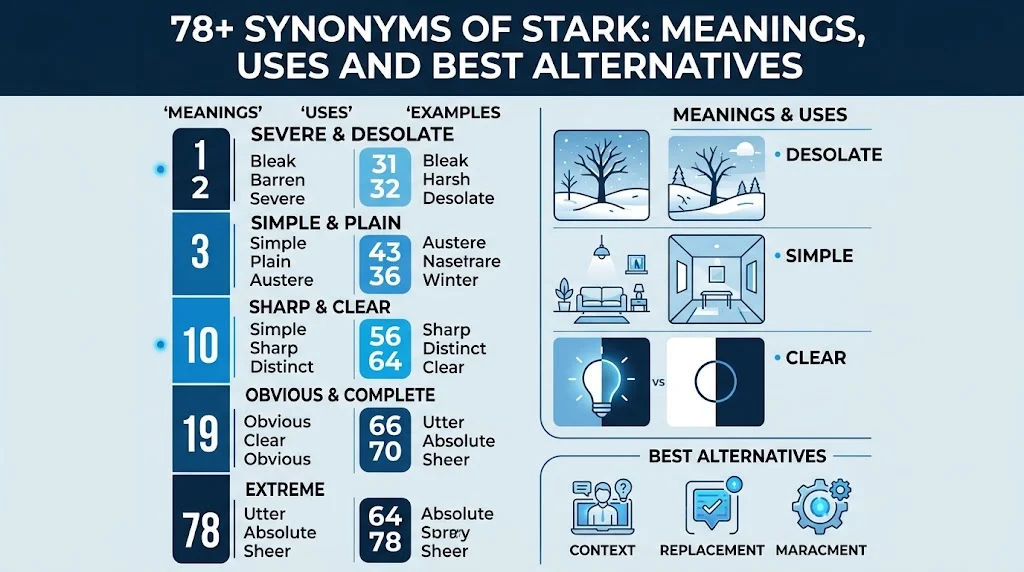
“Stark” means sharply clear, harsh, or barren in appearance. The best synonyms depend on your context. For formal writing, use “austere” or “desolate.” For casual conversation, try “bleak” or “bare.” In academic work, “unadorned” or “stringent” work well. For emotional writing, choose “grim” or “forbidding.” Creative writers often prefer “severe” or “harsh” to convey stark imagery.
You are writing an important email, a college essay, or a social media caption. You want to describe something clear, harsh, or obvious, but the same word keeps appearing in every sentence. You need a synonym of stark to add variety and precision to your writing. Choosing the right alternative helps you communicate more effectively, whether you are describing a landscape, a contrast, or a difficult truth. The English language offers many powerful options, but not every synonym fits every situation. This guide will help you understand the word “stark” and select the perfect substitute for your specific context.
Meaning, Tone, and Context
Simple Definition
Stark describes something that is severe, plain, or completely clear. It often refers to visual emptiness, harsh truth, or obvious contrast.
Part of Speech
Adjective.
Overall Tone
Neutral to negative. Stark can describe factual clarity without emotion, but it frequently carries a sense of harshness or unpleasantness.
Formality Level
Semi-formal. Stark appears in both professional writing and everyday conversation. It is more formal than casual slang but less formal than highly academic vocabulary.
Common Uses
Native English speakers use stark to describe:
- Visual landscapes that are barren or empty
- Clear and unpleasant truths
- Sharp contrasts between two things
- Simple, unadorned designs or interiors
- Severe situations or conditions
Word Forms
- Starkly (adverb): The two options differed starkly.
- Starkness (noun): The starkness of the room was unsettling.
- Starker (comparative): The contrast grew starker.
- Starkest (superlative): This is the starkest example.
When and How to Use “Stark”
Choose “stark” when you want to emphasize clarity, severity, or simplicity. The word works best when describing something that is undeniably clear or unpleasantly plain.
Examples by Context
Professional
The quarterly report presented a stark picture of declining revenue.
Academic
The study revealed stark differences in educational outcomes between the two groups.
Workplace
Her email offered a stark assessment of the project’s challenges.
Personal
After the fire, the house stood as a stark reminder of what was lost.
Email
The data provides stark evidence that we need to change our approach.
Resume
Led the team through a stark budget reduction while maintaining productivity.
Social Media
The contrast between the two neighborhoods is stark.
Best Synonyms of “Stark”
No synonym is identical to “stark” in every situation. Each alternative carries its own shade of meaning, emotional weight, and level of formality. Here are the best choices for specific contexts.
Professional Writing
Austere. This synonym emphasizes simplicity and seriousness. It sounds more sophisticated and measured, making it ideal for business reports and official documents.
Academic Writing
Unadorned. This word suggests plainness without decoration. It works well in research papers when describing data, findings, or straightforward evidence.
Business Communication
Stringent. This synonym highlights strictness and severity. Use it when discussing regulations, requirements, or standards.
Casual Conversation
Bare. This is a simpler, more conversational alternative. It describes minimal or exposed conditions in everyday language.
Emotional Writing
Grim. This word conveys a sense of despair or seriousness. It adds emotional weight without becoming overly dramatic.
Creative Writing
Forbidding. This synonym suggests something that appears threatening or unwelcoming. It adds imagery and atmosphere.
Resume Writing
Severe. This word demonstrates seriousness and intensity. Use it to describe challenges you overcame or significant achievements.
Workplace Communication
Blunt. This alternative emphasizes directness and lack of politeness. It works for feedback that is honest and straightforward.
Stronger Meaning
Fierce. This intensified synonym emphasizes brutality or extremeness. Use it when the situation is exceptionally harsh.
Softer Meaning
Plain. This milder alternative simply means ordinary or unadorned. Use it when the harshness is not the main point.
When Not to Use “Stark”
Too General
Sometimes “stark” is too vague. It does not specify what kind of clarity or harshness you mean.
Better synonym: Specific description.
Rewrite: “The stark lighting” becomes “The harsh fluorescent lighting.”
Too Formal
In casual conversations, “stark” can sound overly serious.
Better synonym: “Bare.”
Rewrite: “The stark apartment” becomes “The bare apartment.”
Too Informal
“Stark” can sometimes sound too ordinary for academic papers.
Better synonym: “Unadorned.”
Rewrite: “The stark presentation” becomes “The unadorned presentation.”
Too Weak
“Stark” may not convey enough intensity in extreme situations.
Better synonym: “fierce.”
Rewrite: “The stark criticism” becomes “The fierce criticism.”
Too Strong
Using “stark” for mildly plain situations exaggerates the description.
Better synonym: “Simple.”
Rewrite: “The stark design” becomes “The simple design.”
Outdated
“Stark” remains current in modern English. However, in some contexts, newer alternatives like “minimal” may sound more contemporary.
Words Commonly Confused With “Stark”
Stark vs Bleak
Difference: Stark emphasizes clarity and plainness. Bleak emphasizes hopelessness and depression.
When to Use Each: Use “stark” for clear, harsh facts. Use “bleak” for situations that feel hopeless.
Example for Stark: The stark numbers showed no improvement.
Example for Bleak: The bleak forecast predicted more losses.
Stark vs Severe
Difference: Stark describes clarity and simplicity. Severe describes extreme intensity or seriousness.
When to Use Each: Use “stark” for plain, obvious things. Use “severe” for intense, difficult situations.
Example for Stark: The stark contrast was obvious.
Example for Severe: The severe weather caused damage.
Stark vs Austere
Difference: Stark focuses on bareness and clarity. Austere focuses on strict simplicity and seriousness.
When to Use Each: Use “stark” for visual plainness. Use “austere” for lifestyles, designs, or personalities.
Example for Stark: The stark landscape stretched for miles.
Example for Austere: The austere room had only a bed and a desk.
Stark vs Grim
Difference: Stark is neutral or harsh. Grim is dark and hopeless.
When to Use Each: Use “stark” for factual clarity. Use “grim” for emotionally dark situations.
Example for Stark: The stark truth was undeniable.
Example for Grim: The grim reality of war was devastating.
Stark vs Bare
Difference: Stark implies harshness. Bare simply means uncovered or minimal.
When to Use Each: Use “stark” for harsh emptiness. Use “bare” for neutral minimalism.
Example for Stark: The stark room felt cold and unwelcoming.
Example for Bare: The bare walls needed decoration.
Best Synonyms of “Stark” by Context
| Context | Best Synonym | Why It Works | Example |
| Formal writing | Austere | Conveys seriousness and simplicity | The austere design of the memorial honored the fallen. |
| Academic writing | Unadorned | Suggests plain, factual presentation | The unadorned data revealed significant trends. |
| Professional communication | Stringent | Emphasizes strict standards | The stringent requirements eliminated most applicants. |
| Business emails | Blunt | Direct and honest without rudeness | His blunt assessment saved us time. |
| Resume writing | Severe | Demonstrates seriousness and impact | Managed severe budget cuts without reducing quality. |
| Workplace communication | Frank | Honest and straightforward | Her frank feedback improved our process. |
| Casual conversation | Bare | Simple and conversational | The bare apartment was surprisingly charming. |
| Everyday speaking | Plain | Ordinary and uncomplicated | The plain truth was hard to accept. |
| Creative writing | Forbidding | Adds atmosphere and imagery | The forbidding castle loomed on the hill. |
| Storytelling | Harsh | Creates vivid, intense descriptions | The harsh wind howled through the canyon. |
| Emotional writing | Grim | Adds emotional weight and seriousness | The grim news spread quickly through the office. |
| Mild tone | Simple | Minimal and easy to understand | The simple explanation cleared up confusion. |
| Social media captions | Clear | Modern, direct, and engaging | The clear before and after photos speak for themselves. |
| American English | Stark | Standard American usage | The stark difference was impossible to ignore. |
How to Choose the Best Synonym of “Stark”
Consider Your Meaning
Ask yourself what you truly want to communicate. Are you describing emptiness, harshness, clarity, or severity? Each synonym emphasizes a different aspect.
Evaluate Your Tone
Think about the emotional weight you want to carry. “Grim” and “fierce” are heavy and negative. “Plain” and “simple” are light and neutral. Choose accordingly.
Know Your Audience
Professional audiences appreciate “austere” and “stringent.” Casual readers connect better with “bare” and “plain.” Academic readers expect “unadorned” and “severe.”
Assess Emotional Strength
How intense should your description be? For mild situations, use “simple” or “plain.” For extreme cases, choose “fierce” or “grim.” Match the intensity to the reality.
Define Your Writing Purpose
Are you informing, persuading, describing, or entertaining? Informative writing prefers clear synonyms. Persuasive writing benefits from stronger words. Descriptive writing needs vivid alternatives.
Match Formality
Business reports require formal synonyms. Social media posts can use modern, casual words. Emails can balance formality with conversational ease.
Sound Natural
The best synonym flows naturally within your sentence. Read it aloud. If it sounds forced or unnatural, choose a different word.
Real Life Examples of “Stark”
School
The stark contrast between the two historical accounts confused the students.
College
Her research paper highlighted the stark differences in healthcare access between urban and rural areas.
Workplace
The CEO presented a stark overview of the company’s financial challenges.
Business
The quarterly earnings report painted a stark picture of declining profits.
The data provides stark evidence that our marketing strategy needs revision.
Resume
Successfully navigated stark market changes while maintaining team morale.
Conversation
“His explanation was stark and left no room for doubt,” she said.
Storytelling
The stark silhouette of the tree stood alone against the gray sky.
Blogging
The stark reality of climate change is visible in these photographs.
Social Media
The stark before and after photos show the power of small changes.
18 Best Synonyms of “Stark”
| Synonym | Simple Meaning | Best Used For | Example Sentence |
| Austere | Simple and serious without decoration | Formal descriptions of design or lifestyle | The austere monastery reflected the monks’ dedication. |
| Bleak | Cold, empty, and hopeless | Describing depressing situations | The bleak winter landscape felt endless. |
| Severe | Very serious and intense | Extreme situations or strict conditions | The severe drought devastated the crops. |
| Harsh | Rough and unpleasant | Describing weather, sounds, or treatment | The harsh sunlight made it difficult to see. |
| Bare | Uncovered and minimal | Describing empty spaces | The bare branches reached toward the sky. |
| Grim | Serious and hopeless | Emotionally dark situations | The grim reality of poverty was hard to ignore. |
| Unadorned | Plain without decoration | Academic and factual descriptions | The unadorned facts spoke for themselves. |
| Forbidding | Unwelcoming and threatening | Creating atmosphere in descriptive writing | The forbidding fortress discouraged visitors. |
| Plain | Ordinary and uncomplicated | Everyday neutral descriptions | The plain design appealed to minimalist tastes. |
| Stringent | Strict and demanding | Standards, rules, and requirements | The stringent safety protocols prevented accidents. |
| Blunt | Direct and honest | Honest communication and feedback | His blunt advice helped us improve. |
| Frank | Open and honest | Honest but polite communication | Her frank discussion cleared up the misunderstanding. |
| Clear | Easy to understand | Describing obvious things | The clear evidence convinced everyone. |
| Simple | Basic and uncomplicated | Mild and neutral descriptions | The simple answer was the correct one. |
| Desolate | Empty and depressing | Describing barren places | The desolate desert stretched for miles. |
| Barren | Unproductive and empty | Describing land or effort | The barren field produced no crops. |
| Evident | Clearly visible and obvious | Describing obvious facts or truths | The evident conclusion was hard to dispute. |
Synonyms of “Stark” by Usage
Professional vs Personal Synonyms
Professional settings benefit from precise, serious vocabulary. “Austere,” “stringent,” and “blunt” project competence and clarity. These words demonstrate that you understand business communication. Personal conversations allow for simpler, more conversational choices. “Bare” and “plain” sound natural when talking with friends or family.
Formal vs Conversational Synonyms
Formal writing includes reports, essays, and business presentations. Use “unadorned,” “austere,” and “stringent” in these contexts. These words sound authoritative and precise. Conversational settings include texting, talking, and casual emails. “Bare,” “plain,” and “clear” work well in everyday situations. They communicate effectively without sounding pretentious.
Academic Synonyms
Academic writing demands authoritative vocabulary. “Unadorned” suggests factual presentation without bias. “Stringent” describes strict academic standards. “Severe” indicates significant findings. These words add credibility to research papers, essays, and academic discussions. They sound precise and professional.
Professional and Business Synonyms
Resumes and interviews require impactful vocabulary. “Severe” shows you handled difficult challenges. “Stringent” demonstrates your ability to meet high standards. “Blunt” indicates honest communication skills. These words help you stand out in competitive professional environments.
Creative and Literary Synonyms
Writers and storytellers need vivid alternatives. “Forbidding” creates atmosphere and tension. “Desolate” paints emotional landscapes. “Grim” adds weight to serious scenes. These words enrich narratives and engage readers. They add depth to fiction, poetry, and speeches.
Slang or Modern Synonyms
“Stark” does not have widely used slang equivalents. Modern English favors “minimal” or “clean” in design contexts. These words sound contemporary without being informal.
Strongest to Mildest Synonyms
Mild
- Simple
- Plain
- Clear
Moderate
- Bare
- Unadorned
- Evident
Strong
- Severe
- Harsh
- Stringent
Very Strong
- Grim
- Fierce
- Forbidding
Emotional intensity increases significantly from mild to very strong. “Plain” simply means ordinary. “Severe” indicates serious intensity. “Fierce” suggests extreme harshness.
Emotional vs Neutral Synonyms
Emotional Synonyms
These words express stronger feelings:
- Grim: Expresses hopelessness and seriousness.
- Forbidding: Suggests fear and threat.
- Fierce: Conveys brutality and extremeness.
Use emotional synonyms when you want to evoke strong reactions. They work well in persuasive writing, storytelling, and emotional communication.
Neutral Synonyms
These words communicate facts without emotion:
- Plain: Simply ordinary.
- Clear: Easy to understand.
- Evident: Obviously true.
Use neutral synonyms when you want to inform without adding emotional weight. They are ideal for academic writing, business reports, and objective descriptions.
Antonyms of “Stark”
| Antonym | Meaning | Example Sentence |
| Gentle | Mild and kind | The gentle breeze calmed everyone. |
| Lush | Rich and abundant | The lush forest was full of life. |
| Ornate | Highly decorated | The ornate room featured gold accents. |
| Comfortable | Pleasant and relaxing | The comfortable space made us feel at home. |
| Mild | Not severe or harsh | The mild weather was perfect for a walk. |
| Warm | Friendly and inviting | Her warm welcome made us feel appreciated. |
| Inviting | Attractive and welcoming | The inviting garden drew visitors. |
| Lavish | Rich and luxurious | The lavish banquet amazed the guests. |
| Pleasant | Agreeable and enjoyable | The pleasant surprise delighted everyone. |
| Bright | Full of light and hope | The bright future looked promising. |
| Beautiful | Visually attractive | The beautiful landscape inspired the artist. |
| Comforting | Providing comfort and reassurance | The comforting words helped her relax. |
| Soft | Not harsh or intense | The soft lighting created a romantic mood. |
| Gentle | Kind and mild in manner | His gentle nature made him easy to work with. |
| Hopeful | Feeling or inspiring hope | The hopeful news lifted everyone’s spirits. |
Comparison: “Stark” vs Similar Words
Stark vs Austere
Main Difference: Stark describes harsh clarity or empty visual simplicity. Austere suggests strict simplicity combined with seriousness.
Which Is Stronger? Austere feels more intellectual and serious. Stark feels more visual and immediate.
Which Is More Formal? Austere is more formal and sophisticated.
When to Use Each: Use “stark” for visual descriptions. Use “austere” for design, lifestyle, or personality descriptions.
Examples:
Stark: The stark desert stretched endlessly.
Austere: The austere design reflected his minimalist philosophy.
Stark vs Bleak
Main Difference: Stark emphasizes clarity and obviousness. Bleak emphasizes hopelessness and depression.
Which Is Stronger? Bleak carries stronger emotional weight.
Which Is More Formal? Both are semi-formal, but stark is slightly more versatile.
When to Use Each: Use “stark” for clear, harsh facts. Use “bleak” for situations that feel hopeless.
Examples:
Stark: The stark data showed no progress.
Bleak: The bleak outlook discouraged the team.
Stark vs Harsh
Main Difference: Stark focuses on clarity and plainness. Harsh focuses on roughness and unpleasantness.
Which Is Stronger? Harsh feels more directly unpleasant.
Which Is More Formal? Harsh is slightly less formal.
When to Use Each: Use “stark” for visual clarity. Use “harsh” for sensory experiences like sound, weather, or treatment.
Examples:
Stark: The stark contrast was obvious.
Harsh: The harsh criticism hurt her feelings.
Stark vs Bare
Main Difference: Stark suggests harsh or severe emptiness. Bare simply means uncovered or minimal.
Which Is Stronger? Stark is stronger and more negative.
Which Is More Formal? Both are similar in formality.
When to Use Each: Use “stark” for emotionally charged descriptions. Use “bare” for neutral descriptions of emptiness.
Examples:
Stark: The stark room felt depressing.
Bare: The bare room needed furniture.
Stark vs Grim
Main Difference: Stark is factual and clear. Grim is emotional and dark.
Which Is Stronger? Grim is more emotional and intense.
Which Is More Formal? Both are semi-formal.
When to Use Each: Use “stark” for factual descriptions. Use “grim” for emotionally dark situations.
Examples:
Stark: The stark truth was hard to accept.
Grim: The grim news devastated the community.
Stark vs Severe
Main Difference: Stark emphasizes plainness and clarity. Severe emphasizes extreme intensity or seriousness.
Which Is Stronger? Severe suggests greater intensity.
Which Is More Formal? Both are equally formal.
When to Use Each: Use “stark” for obvious visual descriptions. Use “severe” for extreme conditions or strict situations.
Examples:
Stark: The stark landscape was beautiful in its simplicity.
Severe: The severe storm caused widespread damage.
Common Phrases and Expressions with “Stark”
In stark contrast
Meaning: Describing a very obvious difference between two things.
Example Sentence: The peaceful countryside stood in stark contrast to the busy city.
Stark reality
Meaning: An unpleasant but undeniable truth.
Example Sentence: The stark reality of the situation finally sank in.
Stark warning
Meaning: A clear and serious caution.
Example Sentence: The government issued a stark warning about the coming storm.
Stark choice
Meaning: A clear and often difficult decision between two options.
Example Sentence: Voters faced a stark choice between two very different candidates.
Stark reminder
Meaning: Something that clearly brings back an unpleasant memory.
Example Sentence: The monument served as a stark reminder of the war.
Stark naked
Meaning: Completely naked. (This phrase specifically uses “stark” as an intensifier.)
Example Sentence: He ran out of the bathroom stark naked.
Common Mistakes to Avoid
Mistake 1: Using “Stark” When You Mean “Bare”
Incorrect: The stark kitchen had no appliances.
Better: The bare kitchen had no appliances.
Explanation: “Bare” simply means empty or uncovered. “Stark” implies harshness or severity that may not be appropriate for a neutral description.
Mistake 2: Confusing “Stark” with “Bleak”
Incorrect: The stark future looked hopeless.
Better: The bleak future looked hopeless.
Explanation: “Bleak” specifically describes hopeless situations. “Stark” describes clarity and plainness.
Mistake 3: Using “Stark” Too Casually
Incorrect: I had a stark breakfast this morning.
Better: I had a simple breakfast this morning.
Explanation: “Stark” sounds overly dramatic for ordinary, everyday situations.
Mistake 4: Overusing “Stark”
Incorrect: The stark report showed stark differences and stark warnings.
Better: The report showed sharp differences and urgent warnings.
Explanation: Repeating “stark” makes writing repetitive and dull. Use synonyms to add variety.
Mistake 5: Using “Stark” in Academic Writing Without Precision
Incorrect: The stark results shocked the researchers.
Better: The unadorned results presented a clear picture.
Explanation: Academic writing benefits from more measured language like “unadorned” or “clear” rather than emotionally charged words.
Mistake 6: Choosing “Fierce” for Mild Situations
Incorrect: The Fierce criticism was actually helpful.
Better: The blunt criticism was actually helpful.
Explanation: “Fierce” implies extreme brutality. “Blunt” means honest and direct without being overly harsh.
Mistake 7: Using Informal Synonyms in Professional Writing
Incorrect: The bare truth was hard to accept.
Better: The stark truth was hard to accept.
Explanation: “Bare” sounds too casual for professional communication. “Stark” maintains appropriate formality.
Frequently Asked Questions
1. What are the best synonyms of stark?
The best synonyms of stark depend on your context. For formal writing, use “austere.” For casual conversation, try “bare.” For academic work, choose “unadorned.” For emotional writing, “grim” works well.
2. What are the best formal synonyms of stark?
The best formal synonyms of stark include “austere,” “stringent,” and “unadorned.” These words project professionalism and sophistication in business, academic, and official communication.
3. What are common informal synonyms of stark?
Common informal synonyms of stark include “bare,” “plain,” and “clear.” These words sound natural in everyday conversation and casual writing without being overly dramatic.
4. What is another word for stark in professional writing?
In professional writing, “stringent,” “austere,” and “blunt” serve as excellent alternatives. These words convey seriousness and clarity while maintaining appropriate professionalism.
5. What is the difference between stark and bleak?
Stark emphasizes clarity and harsh plainness. Bleak emphasizes hopelessness and depression. Stark describes obvious facts. Bleak describes situations that feel dark and without hope.
6. What is the opposite of stark?
Opposites of stark include gentle, lush, ornate, warm, inviting, pleasant, and beautiful. These words describe comfort, abundance, and attractiveness rather than harsh simplicity.
Conclusion
“Stark” describes clear, harsh, or barren situations. The best synonym depends on your audience, tone, and purpose. Formal writing calls for “austere” or “stringent.” Casual conversations prefer “bare” or “plain.” Creative writing benefits from “forbidding” or “grim.” Remember that no single synonym works perfectly in every context. Choose words that match your message and resonate with your readers. The right word transforms ordinary writing into something memorable and effective.
