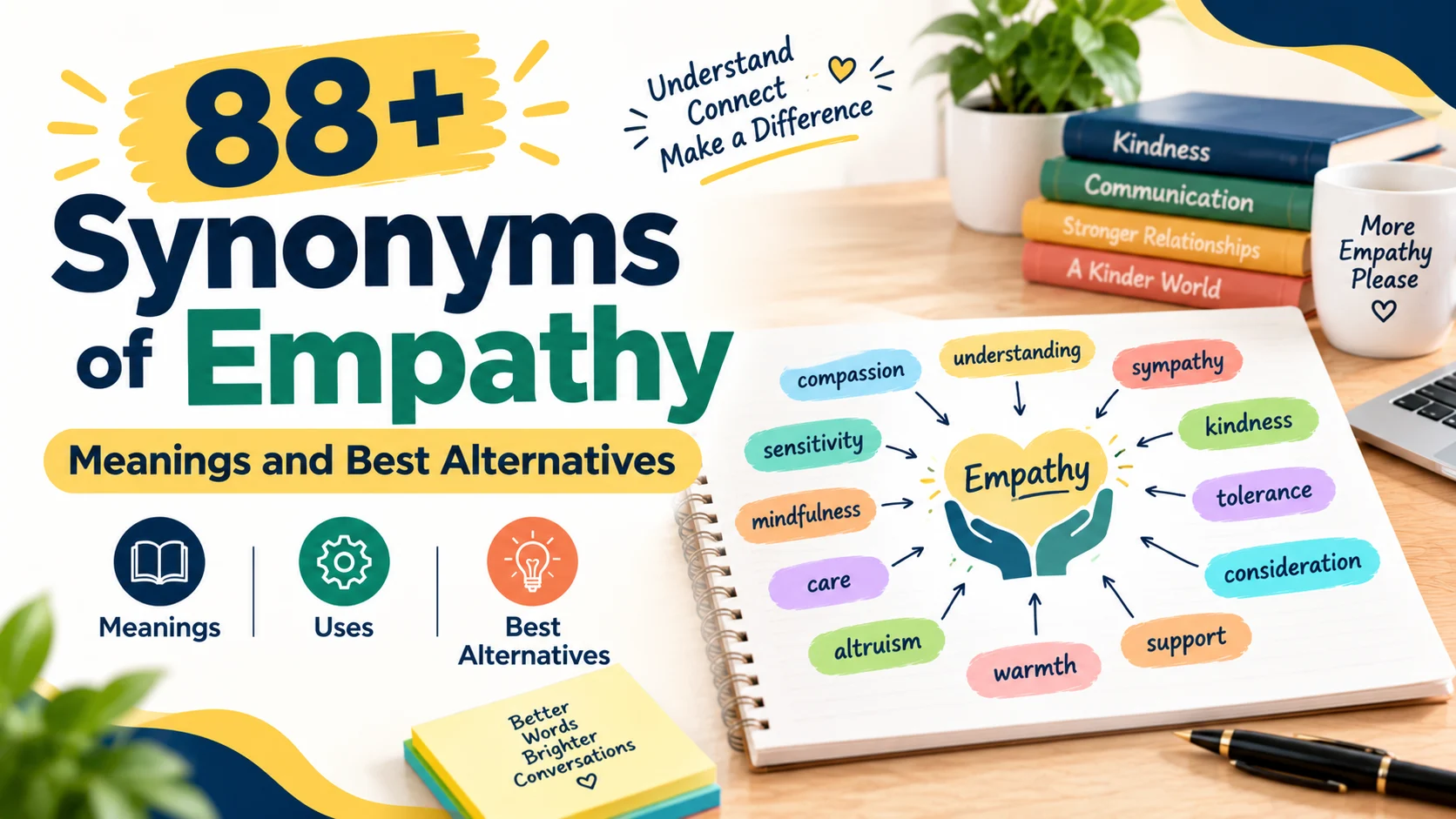
Empathy means understanding and sharing another person’s feelings or experiences from their perspective. The best synonyms depend on context. For formal writing, choose compassion or understanding. For casual conversation, try relating to someone. In professional settings, use sensitivity or awareness. For emotional writing, consider sympathy or connectedness. Each synonym carries its own tone and intensity, so selecting the right one matters greatly for effective communication.
Have you ever found yourself writing an email, an essay, or a social media caption and realized you keep using the same word over and over? You want to express understanding and connection, but you cannot seem to find the right alternative for empathy. Many writers, students, and professionals struggle with this exact problem. Choosing the correct synonym of empathy can transform your writing from repetitive to precise and emotionally intelligent. The right word choice helps you communicate with clarity, build stronger relationships, and connect more deeply with your audience.
Meaning, Tone, and Context
Simple Definition
Empathy is the ability to recognize, understand, and share the thoughts and feelings of another person. It involves putting yourself in someone else’s situation and experiencing their emotions as if they were your own.
Part of Speech
Noun
Overall Tone
Positive and neutral. Empathy suggests emotional intelligence, human connection, and interpersonal awareness. It carries a warm, constructive connotation without being overly sentimental.
Formality Level
Neutral to semi-formal. Empathy works in professional settings, academic writing, casual conversations, and emotional discussions. It is widely accepted across all communication contexts in American English.
Common Uses
Native English speakers use empathy frequently in workplace conversations, mental health discussions, leadership training, conflict resolution, parenting advice, and personal relationships. It appears in job descriptions, performance reviews, psychological literature, and everyday conversations about understanding others.
Word Forms
- Noun: empathy
- Adjective: empathetic, empathic
- Adverb: empathetically
- Verb: empathize (to show or feel empathy)
- Related noun: empathizer (one who shows empathy)
- Opposite: apathy (lack of feeling or concern)
When and How to Use “Empathy”
Choose empathy when you want to express genuine understanding of another person’s emotional experience. It works best when you want to acknowledge someone’s feelings while maintaining a respectful, caring tone. Empathy implies both cognitive understanding and emotional sharing, making it richer than simple acknowledgment.
Professional Context
The manager demonstrated empathy by adjusting the team’s deadlines after learning about their workloads.
Academic Context
Research shows that empathy plays a crucial role in effective therapeutic relationships.
Workplace Context
Our company values empathy as a core leadership competency.
Personal Context
She showed me real empathy when I shared my struggles with the transition.
Email Context
I want to approach this situation with empathy and understand your perspective fully.
Resume Context
Demonstrated empathy and active listening skills while managing client relationships.
Social Media Context
Empathy costs nothing but means everything. Let us remember to lead with kindness today.
Best Synonyms of Empathy
No synonym is identical to empathy in every situation. Each alternative carries its own emotional weight, formality level, and appropriate context. Here are the strongest synonyms for specific writing needs.
Professional Writing
Understanding is the best professional alternative. It sounds formal and respectable while maintaining precision.
Academic Writing
Compassion works well in academic contexts, especially in psychology, healthcare, and social sciences.
Business Communication
Awareness fits business settings perfectly. It suggests emotional intelligence without excessive sentimentality.
Casual Conversation
Relating to is the most natural choice for everyday speech among friends and family.
Emotional Writing
Sympathy captures the emotional warmth of empathy, especially in personal narratives.
Creative Writing
Connectedness adds depth and nuance to descriptive passages about relationships.
Resume Writing
Interpersonal sensitivity is a strong, professional phrase for job applications.
Workplace Communication
Active listening demonstrates empathy in action, making it practical for team settings.
Stronger Meaning
Compassion implies empathy combined with a desire to help or take action.
Softer Meaning
Understanding is gentler and less intense than compassion or sympathy.
When Not to Use Empathy
When the Word Sounds Too General
Empathy sometimes feels vague when you need to describe a specific action or behavior. Saying “I have empathy for you” may sound hollow without concrete follow-up.
Better Alternative: Compassion
Rewrite: I feel compassion for your situation and want to help however I can.
When the Word Sounds Too Formal
In casual text messages or quick conversations, empathy might feel overly serious or clinical.
Better Alternative: Get it
Rewrite: I totally get what you are going through.
When the Word Sounds Too Weak
Empathy sometimes lacks the urgency needed in crisis situations or when describing deep emotional connection.
Better Alternative: Compassion
Rewrite: Her compassion for the victims moved everyone in the room.
When the Word Sounds Too Strong
In brief professional exchanges, empathy can feel too emotionally charged.
Better Alternative: Awareness
Rewrite: I appreciate your awareness of the team’s challenges.
When the Word Sounds Outdated
Empathy remains current and relevant, but overusing it can make your writing feel stale.
Better Alternative: Resonance
Rewrite: I feel a strong resonance with what you are describing.
Words Commonly Confused With Empathy
Empathy vs Sympathy
Difference: Empathy involves sharing and understanding another’s feelings from their perspective. Sympathy involves feeling pity or sorrow for someone without necessarily sharing their experience. Empathy is “feeling with,” while sympathy is “feeling for.”
When to Use It: Use empathy when you want to express shared understanding. Use sympathy when offering comfort from a more external position.
Example: Empathy: I truly understand your frustration. Sympathy: I am sorry you are going through this.
Empathy vs Compassion
Difference: Empathy is the ability to feel what others feel. Compassion includes empathy but adds a motivation to help or take action.
When to Use It: Use empathy when describing emotional understanding. Use compassion when describing understanding combined with a desire to relieve suffering.
Example: Empathy: She understood his pain. Compassion: She understood his pain and immediately offered assistance.
Empathy vs Understanding
Difference: Understanding is broader and more cognitive. It means grasping a concept or situation intellectually. Empathy specifically involves emotional connection and perspective taking.
When to Use It: Use understanding when you primarily mean intellectual comprehension. Use empathy when you mean emotional and cognitive recognition combined.
Example: Understanding: I understand the policy changes. Empathy: I understand how the policy changes affect your daily work.
Empathy vs Pity
Difference: Pity implies a sense of superiority or distance, while empathy involves equality and shared experience. Pity can feel condescending.
When to Use It: Avoid pity in most professional and personal contexts. Choose empathy to maintain dignity and respect.
Example: Pity: I feel sorry for him. Empathy: I recognize how challenging this must be for him.
Empathy vs Concern
Difference: Concern is broader and less emotional. It means caring about an outcome or situation. Empathy requires deeper emotional engagement.
When to Use It: Use concern for general interest or care. Use empathy when you want to convey deeper emotional understanding.
Example: Concern: I am concerned about the deadline. Empathy: I understand the pressure you are feeling about the deadline.
Empathy vs Apathy
Difference: Apathy is the complete absence of interest, emotion, or concern. It is the direct opposite of empathy.
When to Use It: Use apathy to describe emotional disconnect or indifference. Use empathy to describe emotional engagement.
Example: Apathy: He showed complete apathy toward the team’s struggles. Empathy: She showed deep empathy for the team’s challenges.
Best Synonyms of Empathy by Context
| Context | Best Synonym | Why It Works | Example |
| Formal writing | Compassion | Adds gravitas and warmth without being casual | The organization operates with compassion for all communities |
| Academic writing | Understanding | Precisely describes cognitive and emotional recognition | The study measured understanding in interpersonal relationships |
| Professional communication | Awareness | Shows emotional intelligence without overstatement | Her awareness of team dynamics improved collaboration |
| Business emails | Sensitivity | Professional yet personal enough for client relationships | We approach this matter with sensitivity to your concerns |
| Resume writing | Interpersonal skills | Sounds professional and measurable | Developed strong interpersonal skills through patient advocacy |
| Workplace communication | Active listening | Describes empathy in action | Her active listening skills helped resolve team conflicts |
| Casual conversation | Relating to | Natural and conversational | I can really relate to what you are saying |
| Everyday speaking | Get it | Quick and authentic | I completely get where you are coming from |
| Creative writing | Connectedness | Adds depth and literary quality | Their connectedness transcended words |
| Storytelling | Resonance | Evokes emotional harmony between characters | The story struck a resonance with every reader |
| Emotional writing | Sympathy | Carries familiar emotional warmth | Her sympathy for the character made the novel unforgettable |
| Mild tone | Understanding | Gentle and nonjudgmental | I have understanding for your position |
| Social media captions | Kindness | Simple, accessible, and shareable | Kindness and empathy make the world better |
| American English | Empathy | Standard and widely recognized | Empathy is essential for good leadership |
How to Choose the Best Synonym of Empathy
Choosing the right synonym depends on several factors that shape how your message lands.
First, consider your audience. Professional colleagues, academic readers, and business clients respond better to formal choices like compassion, understanding, or awareness. Friends and family appreciate conversational alternatives like relating to or getting it.
Second, evaluate your emotional intensity. If you need to communicate strong emotional engagement, compassion or sympathy work well. If you need a lighter touch, understanding orzzzzz sensitivity are better options.
Third, think about your writing purpose. Job applications require professional, measurable alternatives like interpersonal sensitivity. Creative writing benefits from emotional depth using connectedness or resonance. Social media needs accessible, shareable choices like kindness.
Finally, consider natural sounding usage. Read your sentence aloud with each alternative. The word that flows most naturally in your specific context is usually the right choice. Trust your ear and prioritize clarity over complexity.
Real Life Examples of Empathy
School Context
During group projects, Maria showed empathy by adjusting her expectations when a teammate fell ill and needed extra time.
Improved with stronger synonym: During group projects, Maria showed compassion by adjusting her expectations when a teammate fell ill and needed extra time.
College Context
The professor’s empathy for struggling students led her to offer more office hours and flexible deadlines.
Workplace Context
James demonstrated empathy by sitting with his colleague during a difficult performance review and offering constructive support.
Improved with stronger synonym: James demonstrated compassion by sitting with his colleague during a difficult performance review and offering constructive support.
Business Context
Our customer service training emphasizes empathy as the foundation of every client interaction.
Email Context
I want to approach our discussion with empathy for your position while also expressing my own concerns.
Resume Context
Managed diverse teams with empathy and cultural awareness, improving retention by fifteen percent.
Conversation Context
I really appreciate your empathy about this situation. Not everyone understands what I am going through.
Storytelling Context
The novel’s protagonist displayed remarkable empathy for characters on both sides of the conflict.
Blogging Context
Developing empathy is one of the most valuable skills you can cultivate for personal and professional growth.
Social Media Context
Empathy is the superpower we all possess. Use it generously today.
18 Best Synonyms of Empathy
| Synonym | Simple Meaning | Best Used For | Example Sentence |
| Compassion | Deep awareness of suffering with a desire to help | Emotional and action-oriented writing | Her compassion for refugees drove her to volunteer weekly |
| Understanding | Intellectual and emotional recognition | Academic and professional contexts | The mediator showed remarkable understanding of both sides |
| Sympathy | Feeling sorrow for another’s situation | Comforting others and emotional support | I offer my deepest sympathy for your loss |
| Sensitivity | Awareness and responsiveness to feelings | Professional and interpersonal settings | His sensitivity to employee needs improved workplace morale |
| Awareness | Conscious recognition of emotions | Business and leadership contexts | Cultural awareness helps teams collaborate more effectively |
| Concern | Interest and care for well-being | General and professional use | Her concern for student safety was evident in every decision |
| Consideration | Thoughtful regard for others’ feelings | Workplace and personal interactions | The manager showed consideration by rescheduling the meeting |
| Kinship | Shared experience or connection | Creative and relationship writing | Their shared history created a deep kinship between them |
| Connectedness | Emotional bonds and shared experience | Creative and therapeutic contexts | The retreat focused on building connectedness among participants |
| Resonance | Emotional harmony and understanding | Literary and artistic descriptions | The speech found resonance with everyone in the audience |
| Rapport | Harmonious and understanding relationship | Professional and business contexts | Building rapport with clients is essential for success |
| Insight | Deep understanding of feelings | Academic and analytical writing | Her insight into human behavior made her an excellent therapist |
| Caring | Concern and consideration for others | Personal and casual contexts | His caring nature makes him a wonderful friend |
| Warmth | Emotional kindness and openness | Descriptive and creative writing | Her warmth put everyone at ease during the tense meeting |
| Relationship | Connection and understanding between people | General and professional contexts | Healthy relationships require mutual understanding and respect |
| Attunement | Sensitive awareness and adjustment | Psychological and therapeutic contexts | The therapist’s attunement to her client’s needs was remarkable |
| Community | Shared identity and mutual support | Social and organizational contexts | The company built community through transparent communication |
| Humanity | Kindness and consideration for others | Moral and ethical discussions | His humanity shone through in every interaction with patients |
Synonyms of Empathy by Usage
Professional vs Personal Synonyms
Professional settings benefit from words like understanding, awareness, sensitivity, and rapport. These alternatives sound polished and maintain appropriate boundaries while still conveying emotional intelligence. Workplace teams respond well to active listening and interpersonal skills, which describe empathy in measurable behavioral terms.
Personal conversations call for warmer, more intimate alternatives. Relating to, getting it, and caring sound natural among friends and family. These choices prioritize emotional connection over professional distance. Use kinship and connectedness when describing close relationships or shared experiences.
Formal vs Conversational Synonyms
Formal writing requires precision and sophistication. Reports, essays, business proposals, and presentations work better with compassion, understanding, insight, and attunement. These words convey depth and intellectual rigor. Academic papers should favor understanding, compassion, and awareness to meet scholarly standards.
Conversational speaking thrives on accessibility. Texting and casual conversations benefit from get it, relate to, or care about. These alternatives sound genuine and spontaneous. Emails to coworkers can use understanding, sensitivity, or concern without sounding stiff or overly emotional.
Academic Synonyms
Research papers, essays, and academic discussions require precise vocabulary. Consider using understanding to describe cognitive recognition of others’ experiences. Attunement works well in psychology and therapy contexts. Compassion appears frequently in healthcare and social science research. Insight adds intellectual depth. These terms demonstrate scholarly precision while maintaining clarity. They sound more authoritative because they have established meanings in academic literature.
Professional and Business Synonyms
Resumes and interviews demand strong, professional alternatives. Use interpersonal skills to describe workplace empathy. Communication skills emphasizes empathy in action. Cultural awareness shows global competence. Relationship management demonstrates leadership ability. In meetings and presentations, favor sensitivity, understanding, and active listening. Client communication benefits from rapport and concern. Performance reviews work best with empathy, understanding, and responsiveness. Each choice sounds competent and career-focused.
Creative and Literary Synonyms
Storytelling and descriptive writing need expressive alternatives that add emotional texture. Connectedness describes deep bonds between characters. Kinship suggests shared heritage or experience. Resonance evokes emotional echoes and harmony. Warmth paints a picture of emotional openness. Humanity adds moral weight. Poetry and fiction welcome sympathetic, compassionate, and understanding in rich narrative contexts. Speeches benefit from humanity and compassion to inspire audiences.
Slang or Modern Synonyms
Empathy has limited slang equivalents in American English. “Get it” functions informally to express understanding. “Feel you” appears in casual conversations. “Pick up what you are putting down” communicates understanding in very informal settings. These expressions work in texts, social media, and close friendships. Avoid them in professional writing, academic papers, and formal communications where clarity and respect matter more.
Strongest to Mildest Synonyms
Mild
- Awareness (basic recognition without emotional engagement)
- Consideration (thoughtful regard without deep feeling)
- Concern (general interest in well-being)
Moderate
- Understanding (intellectual and emotional recognition)
- Sensitivity (responsive awareness of feelings)
- Rapport (harmonious connection between people)
Strong
- Sympathy (emotional sorrow for another’s situation)
- Compassion (deep empathy combined with desire to help)
- Kinship (deep feeling of shared identity or experience)
Very Strong
- Connectedness (profound emotional bond)
- Resonance (deep, almost physical emotional harmony)
- Attunement (complete emotional alignment and responsiveness)
Emotional intensity changes as you move up this scale. Mild choices communicate simple recognition. Moderate alternatives add emotional dimension. Strong synonyms express deep caring and shared experience. Very strong words describe profound connection and complete emotional alignment. Choose your intensity level based on your relationship with the reader and the depth of emotion you want to convey.
Emotional vs Neutral Synonyms
Emotional Synonyms
Compassion, sympathy, warmth, kinship, connectedness, resonance, and humanity express stronger feelings. These words carry emotional weight and create deeper connections with readers. Use them in personal writing, creative work, therapeutic contexts, and situations where you want to convey genuine care. They work especially well when discussing relationships, mental health, caregiving, and moral issues.
Neutral Synonyms
Understanding, awareness, sensitivity, consideration, insight, and rapport simply communicate information without adding much emotion. These choices sound professional, balanced, and appropriate for most workplace and academic settings. They acknowledge emotions without becoming sentimental or overly personal. Use them in business communications, academic papers, news articles, and professional contexts where emotional neutrality is valued.
Antonyms of Empathy
| Antonym | Meaning | Example Sentence |
| Apathy | Complete lack of interest or concern | His apathy toward his colleagues’ struggles was disappointing |
| Indifference | Lack of caring or attention | The manager’s indifference to employee burnout damaged morale |
| Callousness | Insensitive and unsympathetic behavior | Her callousness during the crisis alienated the entire team |
| Cruelty | Deliberate indifference to suffering | Cruelty has no place in a compassionate organization |
| Detachment | Emotional separation from others | His detachment from team members hindered collaboration |
| Disregard | Showing little or no care | The company’s disregard for customer concerns hurt its reputation |
| Unconcern | Lack of worry or care | His unconcern about others’ safety was troubling |
| Coldness | Emotionally distant behavior | The boss’s coldness made employees afraid to share concerns |
| Heartlessness | Complete lack of compassion | Heartlessness is rarely seen in effective leaders |
| Inhumanity | Cruel or uncaring behavior | The inhumanity of the policies sparked public outrage |
| Insensitivity | Lack of awareness of others’ feelings | His insensitivity made the situation worse |
| Aloofness | Emotionally distant and uninvolved | Her aloofness prevented meaningful team connections |
| Disinterest | Lack of curiosity or concern | His disinterest in team welfare was evident |
| Self-centeredness | Focus only on one’s own needs | Self-centeredness undermines collaborative work environments |
| Antipathy | Strong dislike or hostility | The antipathy between departments prevented effective cooperation |
Comparison: Empathy vs Similar Words
Empathy vs Sympathy
Main Difference
Empathy involves sharing someone’s feelings from their perspective. Sympathy involves feeling sorry for someone without sharing their emotional experience.
Which Is Stronger?
Empathy is emotionally stronger because it requires active participation in another’s emotional state.
Which Is More Formal?
Both are formal enough for professional use. Sympathy may appear slightly more traditional.
When to Use Each
Use empathy when you share the same feelings as another person. Use sympathy when offering comfort from a more external position.
Examples
Empathy: I truly understand your grief because I have experienced similar loss.
Sympathy: I am so sorry for what you are going through. You have my deepest condolences.
Empathy vs Compassion
Main Difference
Empathy is understanding and sharing feelings. Compassion adds a desire to help or relieve suffering.
Which Is Stronger?
Compassion is stronger because it includes action and motivation.
Which Is More Formal?
Both are formal enough. Compassion may sound more actively caring.
When to Use Each
Use empathy when describing emotional understanding. Use compassion when describing understanding combined with helpful action.
Examples
Empathy: She recognized his fear of public speaking.
Compassion: She recognized his fear and offered to help him prepare for the presentation.
Empathy vs Understanding
Main Difference
Understanding is primarily intellectual. Empathy involves both intellectual and emotional recognition.
Which Is Stronger?
Empathy is stronger because it adds emotional dimension.
Which Is More Formal?
Understanding is more formal and academic.
When to Use Each
Use understanding for intellectual comprehension. Use empathy for emotional and intellectual recognition combined.
Examples
Understanding: I understand the mathematical concept.
Empathy: I understand how challenging this assignment must be for you.
Empathy vs Pity
Main Difference
Empathy involves equality and shared experience. Pity involves looking down on someone from a position of advantage.
Which Is Stronger?
Empathy is stronger and more respectful.
Which Is More Formal?
Pity appears less frequently in formal writing due to its negative connotations.
When to Use Each
Use empathy to maintain dignity and connection. Avoid pity in most professional and personal contexts.
Examples
Empathy: I understand your frustration with this process.
Pity: I feel sorry that you cannot handle this better.
Empathy vs Concern
Main Difference
Concern is general care for outcomes. Empathy requires deeper emotional engagement with another’s feelings.
Which Is Stronger?
Empathy is stronger because it involves emotional sharing.
Which Is More Formal?
Both are appropriate for formal contexts. Concern sounds more neutral.
When to Use Each
Use concern for general care about situations. Use empathy for deeper emotional understanding of people.
Examples
Concern: I am concerned about the project timeline.
Empathy: I understand the stress this timeline is causing you.
Empathy vs Sensitivity
Main Difference
Empathy focuses on understanding and sharing feelings. Sensitivity focuses on being aware of and responsive to others’ emotions.
Which Is Stronger?
Empathy is stronger because it involves shared emotional experience.
Which Is More Formal?
Sensitivity sounds more professional and measured.
When to Use Each
Use sensitivity in professional contexts where you want to acknowledge emotions without overstating connection. Use empathy when you want to convey deeper emotional engagement.
Examples
Sensitivity: She approached the topic with cultural sensitivity.
Empathy: She truly understood why the topic mattered so much to him.
Common Phrases and Expressions with Empathy
Show Empathy
Meaning: Demonstrate understanding and care for another person’s feelings.
Example Sentence: Effective leaders know how to show empathy during difficult conversations.
Lack Empathy
Meaning: Fail to understand or care about others’ feelings.
Example Sentence: Some managers lack empathy and struggle with team morale.
Empathy for
Meaning: Feel or express understanding toward someone.
Example Sentence: I have deep empathy for anyone experiencing job loss during this time.
Empathy Training
Meaning: Educational programs designed to develop empathetic skills.
Example Sentence: The hospital implemented empathy training for all nursing staff.
Empathy Gap
Meaning: A disconnect between understanding and action.
Example Sentence: The empathy gap between management and employees affected productivity.
Empathy Fatigue
Meaning: Emotional exhaustion from constantly caring for others.
Example Sentence: Social workers often experience empathy fatigue from their demanding workloads.
Genuine Empathy
Meaning: Authentic understanding rather than performative concern.
Example Sentence: Her genuine empathy made her the most trusted member of the team.
Empathy Quotient
Meaning: A measure of empathetic ability.
Example Sentence: The empathy quotient test helps identify candidates with strong interpersonal skills.
Common Mistakes to Avoid
Using a Vague Synonym Instead of a Precise One
Incorrect: I have good feelings about your situation.
Better: I have empathy for your situation.
Why: Good feelings is vague and unprofessional. Empathy communicates specific, meaningful understanding.
Confusing Empathy with Sympathy
Incorrect: I feel empathy for you even though I have never experienced something similar.
Better: I offer my sympathy for what you are going through.
Why: Empathy requires shared experience. Sympathy works when you want to express care without claiming to understand exactly.
Using an Informal Synonym in Formal Writing
Incorrect: I totally get where you are coming from regarding the policy changes.
Better: I have understanding regarding the concerns about policy changes.
Why: Get it is too casual for academic or professional writing. Understanding maintains formality and respect.
Selecting an Overly Dramatic Synonym
Incorrect: I feel bound to you through cosmic resonance about this minor issue.
Better: I understand your perspective on this minor issue.
Why: Resonance is too powerful for trivial matters. Proportion your word choice to the situation.
Repeating the Same Word Too Often
Incorrect: Empathy is important. Empathy helps us connect. We need more empathy.
Better: Empathy is important. Understanding helps us connect. We need more compassion.
Why: Variation keeps writing fresh and engaging while expanding vocabulary.
Using Slang in Professional Writing
Incorrect: I feel you on the project timeline changes.
Better: I understand the concerns about the project timeline changes.
Why: Feel you is casual slang that undermines professional credibility in formal contexts.
Choosing a Synonym with the Wrong Emotional Tone
Incorrect: I have pity for your difficult situation.
Better: I have empathy for your difficult situation.
Why: Pity sounds condescending. Empathy maintains dignity and connection.
Frequently Asked Questions
What are the best synonyms of empathy?
The best synonyms of empathy are compassion, understanding, sympathy, and sensitivity. The right choice depends on your context, audience, and the emotional intensity you want to convey.
What are the best formal synonyms of empathy?
The best formal synonyms of empathy include compassion, understanding, sensitivity, and awareness. These words sound professional and appropriate for academic writing, business communications, and official documents.
What are common informal synonyms of empathy?
Common informal synonyms of empathy include get it, relate to, feel you, and understand where you are coming from. These alternatives work well in casual conversations, texts, and social media interactions.
What is another word for empathy in professional writing?
In professional writing, use understanding, sensitivity, or awareness as alternatives for empathy. These words sound competent and professional while maintaining emotional intelligence.
What is the difference between empathy and sympathy?
Empathy means sharing and understanding another person’s feelings from their perspective. Sympathy means feeling sorry for someone without sharing their experience. Empathy connects emotionally, while sympathy offers compassion from a distance.
What is the opposite of empathy?
The opposite of empathy is apathy, which means complete lack of interest or concern. Other antonyms include indifference, callousness, detachment, and insensitivity.
Conclusion
Empathy is the ability to understand and share another person’s emotional experience. It remains one of the most valuable communication skills in personal relationships, professional settings, and social interactions. The best synonyms of empathy include compassion for deeper emotional engagement, understanding for formal contexts, sympathy for offering comfort, sensitivity for workplace communication, and relating to casual conversations. No synonym works perfectly in every situation. Choose your words based on your audience, your tone, and your purpose. Strong communication requires matching the right word to the right moment. Keep expanding your vocabulary and remember that precise word choice transforms good writing into excellent communication.
Definitions, meanings, and usage recommendations should be verified with trusted language references before publication. Recommended sources include Cambridge Dictionary, Oxford English Dictionary, Merriam Webster, Collins Dictionary, and Britannica.

2 thoughts on “88+ Synonyms of Empathy| Meanings and Best Alternatives”