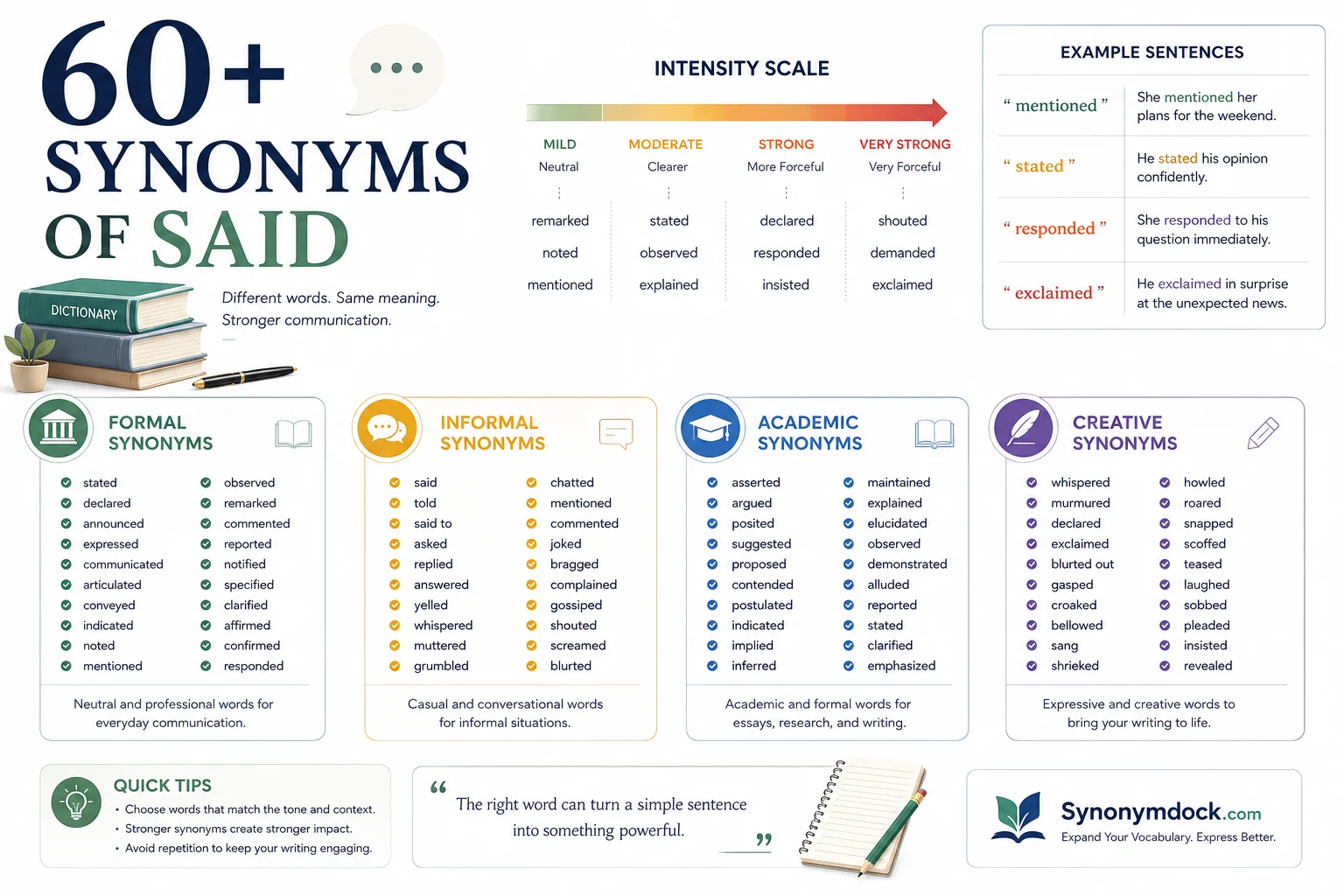
“Said” is the past tense of “say,” meaning to utter words or express an opinion. It is a neutral reporting verb. For formal writing, choose “stated” or “declared.” For casual conversation, use “mentioned” or “added.” In academic contexts, “asserted” or “contended” work well. For professional emails, “advised” or “noted” are often best. Emotional writing benefits from “exclaimed” or “whispered,” while creative writing can use “murmured” or “insisted.”
Have you ever read through an email, essay, or story and noticed the same word appearing over and over again? Many writers fall into the habit of using “said” repeatedly. While “said” is a reliable word, overusing it can make your writing feel flat and repetitive. Finding the right synonym of said can transform your communication, adding clarity, emotion, and precision. This guide will help you understand the meaning of “said,” explore the best alternatives for every situation, and avoid common mistakes. Whether you are writing a professional email, a school essay, or a creative story, choosing the right word makes a difference.
Meaning, Tone, and Context
Simple Definition
“Said” is the past tense and past participle of the verb “say.” It means to utter words, express a thought, or report someone’s speech . It is one of the most common verbs in the English language.
Part of Speech
- Verb (past tense): “He said he would be late.”
- Adjective: In legal or formal contexts, it can mean “aforementioned” . For example, “The said contract is now void.”
Overall Tone
The tone of “said” is neutral . It does not convey any strong emotion, opinion, or attitude from the speaker or the writer. This is its greatest strength and its biggest weakness. Because it is neutral, it can be used in almost any situation without adding unintended meaning.
Formality Level
“Said” is neutral in formality. It works in casual conversation, formal reports, and everything in between. This versatility makes it a go-to word, but it is also why writers often seek alternatives to add specificity.
Common Uses
Native English speakers use “said” to:
- Report dialogue or conversation.
- Relay information from another person or source.
- Express a thought or opinion.
- Indicate the words in a text (e.g., “The sign said…”).
Word Forms
- Verb: say (present), said (past)
- Noun: saying (a well-known phrase or proverb)
When and How to Use “Said”
Choose “said” when you need a neutral, invisible reporting verb. It is the default choice for attributing dialogue and conveying information without adding extra meaning. Overusing it is safe, but it is also boring.
Here are realistic examples labeled by context.
Professional:
“The CEO said the company’s quarterly results were encouraging.”
Academic:
“The researcher said the findings were preliminary and required further study.”
Workplace:
“The project manager said the deadline had been moved to Friday.”
Personal:
“My mother said she would call me tomorrow.”
Email:
“Thank you for your email. As I said in my previous message, I am available for a meeting next Tuesday.”
Resume:
In my previous role, my manager said I consistently exceeded sales targets.” (A stronger synonym would be better here, like “praised” or “commended.”)
Social Media:
“The review said the new restaurant has the best pasta in town.”
Best Synonyms of “Said”
No synonym is identical to “said” in every situation. The best choice always depends on your context, audience, and intended meaning. Here are the most effective synonyms for common scenarios.
Professional writing:
Use “stated” or “noted.” They are formal and authoritative without being overly emotional. They sound more definitive and professional than “said.”
Academic writing:
Use “asserted,” “contended,” or “argued.” These words show a position or a point of view, which is common in academic discourse. They signal to the reader that the author is making a claim .
Business communication:
Use “advised,” “informed,” or “recommended.” These words are action-oriented and imply a transfer of valuable information or guidance .
Casual conversation:
Use “mentioned” or “added.” These words sound natural and unforced, perfect for everyday chatter where you are sharing information without drama.
Emotional writing:
Use “exclaimed,” “pleaded,” or “sobbed.” These words convey strong feelings like surprise, desperation, or sadness, making the character’s emotion tangible to the reader .
Creative writing:
Use “murmured,” “whispered,” “insisted,” or “retorted.” These words not only report speech but also describe how it was said, building a richer scene and revealing character.
Resume writing:
Use “commended,” “recognized,” or “praised” when referring to a former manager’s words about your performance. It shifts the focus from a neutral report to a positive endorsement.
Workplace communication:
Use “emphasized,” “stressed,” or “highlighted.” These words show you are drawing attention to a key point.
Stronger meaning:
Use “declared,” “proclaimed,” or “insisted.” These synonyms imply conviction and certainty.
Softer meaning:
Use “suggested” or “hinted.” These words imply a less direct or more tentative form of communication.
When Not to Use “Said”
Sometimes, “said” is the wrong choice. Here are situations where it falls short and what to use instead.
When “said” sounds too general:
The word is a blank slate. When you need to describe how something was said, “said” fails to provide the necessary detail.
- Sentence: “He said he was angry.”
- Problem: The words tell us he is angry, but “said” doesn’t show it. The sentence lacks impact.
- Better Synonym: “He thundered he was angry.”
- Why It Works: “Thundered” conveys volume and intensity, matching the emotion.
When “said” sounds too weak:
Sometimes, the act of speaking carries great authority or finality.
- Sentence: “The judge said the sentence was life in prison.”
- Problem: This is a critical, authoritative statement, but “said” does not convey that gravity.
- Better Synonym: “The judge pronounced the sentence was life in prison.”
- Why It Works: “Pronounced” is formal and decisive, fitting a judge’s role.
When “said” sounds too informal:
In formal legal, academic, or official contexts, “said” can feel too plain or conversational.
- Sentence: “The witness said the defendant was at the scene.”
- Problem: In a court of law, the word “said” lacks the necessary gravitas.
- Better Synonym: “The witness testified that the defendant was at the scene.”
- Why It Works: “Testified” is the precise legal term for a witness’s statement.
Words Commonly Confused With “Said”
Many verbs are near-synonyms of “said,” but they have different meanings. Here is how to tell them apart.
Said vs. Told
- Difference: “Said” focuses on the words spoken, while “told” focuses on the act of conveying information to someone. “Told” requires an indirect object (the person being told), whereas “said” does not.
- When to Use It:
- Use “said” when you are simply reporting speech without specifying the recipient.
- Use “told” when you want to emphasize the transmission of information to a specific person.
- Example:
- Said: “She said she was tired.”
- Told: “She told me she was tired.”
Said vs. Stated
- Difference: “Stated” is more formal and deliberate. It implies that the speaker has prepared the information or is making an official announcement.
- Which Is Stronger? “Stated” is stronger and more definitive.
- Which Is More Formal? “Stated” is more formal.
- When to Use Each:
- Use “said” for general reporting.
- Use “stated” for official comments or formal declarations.
- Examples:
- Said: “He said he would be here.”
- Stated: “The company stated its intention to merge.”
Said vs. Claimed
- Difference: “Claimed” implies that the statement may be true or false. It often introduces a controversial or unverified assertion.
- Which Is Stronger? “Said” is neutral; “claimed” is less reliable and implies doubt.
- Which Is More Formal? “Claimed” is not necessarily more formal, but it is more critical.
- When to Use Each:
- Use “said” for reporting known or reliable facts.
- Use “claimed” when you are skeptical or want to distance yourself from the assertion.
- Examples:
- Said: “The witness said the car was red.”
- Claimed: “The suspect claimed he was at home.”
Said vs. Asserted
- Difference: “Asserted” means to state something with confidence and force. It implies the speaker is defending or promoting a point of view.
- Which Is Stronger? “Asserted” is much stronger.
- Which Is More Formal? “Asserted” is more formal and often found in academic or legal writing.
- When to Use Each:
- Use “said” for a neutral statement.
- Use “asserted” for a confident, forceful statement, often made in the face of opposition.
- Examples:
- Said: “The author said the book was based on a true story.”
- Asserted: “The professor asserted the historical importance of the document.”
Said vs. Mentioned
- Difference: “Mentioned” suggests the information was brought up briefly or as an aside, rather than being the main focus of the conversation.
- Which Is Stronger? “Said” is stronger in this context.
- Which Is More Formal? Both are informal, but “mentioned” can be used in formal contexts if the intent is to be brief.
- When to Use Each:
- Use “said” for direct or primary statements.
- Use “mentioned” for brief references or asides.
- Examples:
- Said: “She said she was leaving.”
- Mentioned: “She mentioned she would be late for dinner.”
Said vs. Replied
- Difference: “Replied” specifically means to answer or respond to something that was previously said or asked.
- Which Is Stronger? “Replied” is more specific.
- Which Is More Formal? Both are neutral in formality.
- When to Use Each:
- Use “said” for any statement.
- Use “replied” only for a direct response to another person.
- Examples:
- Said: “He said he was hungry.”
- Replied: “‘I am hungry,’ he replied to her question.”
Best Synonyms of “Said” by Context
| Context | Best Synonym | Why It Works | Example |
|---|---|---|---|
| Formal writing | Stated | Conveys official, deliberate language. | The committee stated its decision. |
| Academic writing | Argued | Implies a position supported by reasoning. | The paper argued for a new economic model. |
| Professional communication | Advised | Shows guidance and expertise. | The consultant advised caution. |
| Business emails | Noted | Professional and direct. | As noted in my last email… |
| Resume writing | Commended | Indicates positive recognition. | My supervisor commended my work. |
| Workplace communication | Emphasized | Highlights critical information. | The manager emphasized the need for safety. |
| Casual conversation | Mentioned | Low-key, natural way to report speech. | She mentioned she was getting a new dog. |
| Everyday speaking | Added | Shows extra information. | He added that he would be late. |
| Creative writing | Murmured | Adds description and an intimate, quiet tone. | She murmured her agreement. |
| Storytelling | Exclaimed | Expresses sudden surprise or strong emotion. | “I won!” he exclaimed. |
| Emotional writing | Pleaded | Shows desperation or strong emotional appeal. | He pleaded for her to stay. |
| Strong emphasis | Declared | Shows firm, deliberate, and public statements. | She declared her intentions. |
| Mild tone | Suggested | Indicates a tentative or gentle proposal. | He suggested we go home. |
| Social media captions | Announced | Formal enough for a public statement. | The band announced a new tour. |
How to Choose the Best Synonym of “Said”
Choosing the right synonym is about matching the word to your purpose. Ask yourself these questions.
1. What is the exact meaning?
Do you want to show a character is speaking softly, angrily, or with authority? Be specific. A synonym like “whispered” has a very different effect than “thundered.”
2. What is the tone?
The tone of your piece matters. A formal report needs “stated” or “noted,” not “blurted out.” A playful story might benefit from “teased” or “joked.”
3. Who is the audience?
Your audience determines acceptable language. For a professional audience, choose neutral, formal synonyms. For young adult readers, you can be more creative.
4. What is the emotional strength?
How intense is the speech? For neutral reporting, use “said” or “mentioned.” For intense emotion, use words like “cried,” “screamed,” or “sobbed.”
5. What is the writing purpose?
Are you telling a story, writing a report, or sending an email? If you want to draw the reader in, choose vivid synonyms. If your goal is to communicate information clearly, choose direct, neutral ones.
6. Does it sound natural?
Read the sentence aloud. Does the synonym sound awkward or forced? If so, choose a different word. The best choice is the one that sounds the most natural in the context.
Real Life Examples of “Said”
School:
“My teacher said my essay was well-organized.” (Weak)
“My teacher remarked that my essay was well-organized.” (Improved)
College:
“The lecture said there would be a test next week.” (Weak)
“The lecture announced there would be a test next week.” (Improved)
Workplace:
“The client said they were happy with the progress.” (Weak)
“The client reported they were happy with the progress.” (Improved)
Business:
“The contract said the payment was due on the first.” (Weak)
“The contract stipulated the payment was due on the first.” (Improved)
Email:
“Thank you. As I said, I am available Friday.” (Weak)
“Thank you. As I mentioned, I am available Friday.” (Improved)
Resume:
“I was said to have excellent leadership skills.” (Weak)
“I was praised for my excellent leadership skills.” (Improved)
Conversation:
“He said he was happy for us.” (Weak)
“He beamed he was happy for us.” (Improved)
Storytelling:
“‘Don’t go,’ she said.” (Weak)
“‘Don’t go,’ she pleaded.” (Improved)
Blogging:
“The expert said that this is the best strategy.” (Weak)
“The expert recommended this strategy.” (Improved)
Social media:
“The post said the sale starts today.” (Weak)
“The post announced the sale starts today.” (Improved)
18 Best Synonyms of “Said”
Here is a curated list of 18 powerful synonyms for “said.” Each word is unique and has a specific place in your writing.
| Synonym | Simple Meaning | Best Used For | Example Sentence |
|---|---|---|---|
| 1. Announced | To make a public or official statement. | Public statements, news, events. | The mayor announced the new park would open in June. |
| 2. Stated | To express clearly and formally. | Formal reports, official comments. | The expert stated the data was conclusive. |
| 3. Mentioned | To refer to something briefly. | Casual references, asides. | She mentioned we should bring an umbrella. |
| 4. Claimed | To assert a fact, often without proof. | Controversial or unverified statements. | The athlete claimed he had not used steroids. |
| 5. Argued | To provide reasons for or against something. | Academic writing, debates. | The lawyer argued for her client’s innocence. |
| 6. Insisted | To maintain a position firmly. | Showing conviction, standing your ground. | He insisted he was right about the route. |
| 7. Remarked | To say something as an observation. | Casual but thoughtful comments. | She remarked that the weather was pleasant. |
| 8. Noted | To observe and state. | Emails, meetings, noting facts. | The manager noted the team’s success. |
| 9. Added | To say something extra. | Providing additional information. | He added that the deadline was moved. |
| 10. Exclaimed | To cry out suddenly in surprise. | Surprise, strong emotion. | “I can’t believe it!” she exclaimed. |
| 11. Whispered | To speak very softly. | Secrets, intimacy, quiet scenes. | He whispered the password in her ear. |
| 12. Murmured | To speak quietly and indistinctly. | Low, often affectionate, speech. | She murmured her love for him. |
| 13. Retorted | To reply sharply or angrily. | Arguments, witty comebacks. | “That’s not funny,” he retorted. |
| 14. Implied | To strongly suggest without stating. | Subtle communication, insinuation. | Her tone implied she was disappointed. |
| 15. Affirmed | To state with confidence and validity. | Offering support or validation. | The board affirmed their decision. |
| 16. Declared | To announce officially and clearly. | Official proclamations. | She declared her intentions to run for office. |
| 17. Revealed | To make previously unknown info known. | Disclosing secrets or surprises. | He revealed he was moving to London. |
| 18. Advised | To offer counsel or recommendation. | Professional guidance, warnings. | The doctor advised him to get more rest. |
Synonyms of “Said” by Usage
Professional vs Personal Synonyms
In professional settings, you should use words like stated, noted, reported, advised, or informed to convey information clearly and authoritatively. In personal conversations, choose words like mentioned, added, said, or remarked for a more natural, informal tone.
Formal vs Conversational Synonyms
Formal: Use stated, declared, announced, asserted, affirmed, or testified. These words are standard in reports, academic essays, business presentations, and emails to clients or superiors .
Conversational: Use mentioned, added, said, told, asked, or answered. These are safe for everyday conversations and texting.
Academic Synonyms
Words like argued, asserted, contended, hypothesized, and theorized are excellent for academic writing. They signal that the author is making a specific claim supported by evidence or reasoning . They sound more authoritative than “said” and are a standard part of scholarly vocabulary.
Professional and Business Synonyms
For resumes, interviews, meetings, and client communication, choose action-oriented synonyms that show leadership and confidence . Use advised, recommended, authorized, confirmed, negotiated, resolved, or initiated. For performance reviews, choose commended or recognized.
Creative and Literary Synonyms
Creative writing thrives on variety and imagery . Use whispered, murmured, bellowed, howled, pleaded, taunted, teased, crooned, hissed, or drawled. These words add emotion, describe the manner of speaking, and bring characters to life.
Slang or Modern Synonyms
There are no widely recognized standard slang synonyms for “said.” In very casual speech or text, you might use “go” in the present tense (“So I go…”) or “was like” (“He was like…”). Avoid these in any form of professional, academic, or formal writing.
Strongest to Mildest Synonyms
Mild:
Said, mentioned, added
Moderate:
Stated, noted, remarked, replied
Strong:
Declared, insisted, announced, affirmed
Very Strong:
Exclaimed, proclaimed, demanded, thundered
Emotional vs Neutral Synonyms
Emotional Synonyms:
These words express strong feelings or attitudes. Exclaimed, pleaded, sobbed, howled, thundered, growled, whimpered, and rejoiced all convey intense emotion. Use them to show a character’s state of mind.
Neutral Synonyms:
These words convey information simply and effectively without adding emotion. Said, stated, noted, mentioned, reported, observed, and added are useful for reporting facts, in professional communication, and in academic contexts where objectivity is key .
Antonyms of “Said”
Antonyms for “said” are more about the absence of speech or the act of listening.
| Antonym | Meaning | Example Sentence |
|---|---|---|
| 1. Listened | To hear and pay attention. | He listened carefully to the instructions. |
| 2. Heard | To perceive sound. | She heard the news and was shocked. |
| 3. Asked | To make a request or inquire. | He asked where the bathroom was. |
| 4. Questioned | To ask someone questions. | The police questioned the suspect. |
| 5. Remained silent | To not speak. | She remained silent during the argument. |
| 6. Refrained | To hold back from doing something. | He refrained from commenting. |
| 7. Withheld | To keep back or hold back. | The witness withheld the information. |
Comparison: “Said” vs Similar Words
Said vs. Stated
- Main Difference: “Said” is the general word for speech. “Stated” is specific to formal, deliberate communication.
- Which Is Stronger? “Stated.”
- Which Is More Formal? “Stated.”
- When to Use Each: Use “said” for everyday conversation. Use “stated” in reports or for making an official position known.
- Examples:
- Said: “He said hello.”
- Stated: “She stated her conditions.”
Said vs. Spoke
- Main Difference: “Said” focuses on the words or information. “Spoke” focuses on the act of using one’s voice.
- Which Is Stronger? Both are neutral.
- Which Is More Formal? Both are neutral.
- When to Use Each: Use “said” to attribute dialogue. Use “spoke” to indicate someone used their voice, often about a specific topic or to an audience.
- Examples:
- Said: “She said she was hungry.”
- Spoke: “He spoke for over an hour.”
Said vs. Told
- Main Difference: “Told” requires a recipient of the information. “Said” does not.
- Which Is Stronger? Neither is inherently stronger, but “told” often implies a transfer of information.
- Which Is More Formal? Both are neutral.
- When to Use Each: Use “told” when you want to emphasize the act of informing someone else.
- Examples:
- Said: “He said he was tired.”
- Told: “He told his boss he was tired.”
Said vs. Claimed
- Main Difference: “Claimed” introduces doubt or the possibility of falsehood. “Said” is neutral and implies the information is accurate.
- Which Is Stronger? “Said” is more neutral; “claimed” carries a skeptical tone.
- Which Is More Formal? Both are neutral in formality.
- When to Use Each: Use “said” for reliable information. Use “claimed” for disputed or unverified statements.
- Examples:
- Said: “He said he has a degree.”
- Claimed: “He claimed he has a degree, but I have my doubts.”
Said vs. Asserted
- Main Difference: “Asserted” means to state something with confidence, often in the face of opposition.
- Which Is Stronger? “Asserted.”
- Which Is More Formal? “Asserted.”
- When to Use Each: Use “said” for any statement. Use “asserted” to show a speaker is defending a position with confidence.
- Examples:
- Said: “The student said the answer was wrong.”
- Asserted: “The student asserted the answer was wrong.”
Said vs. Mentioned
- Main Difference: “Mentioned” suggests a brief or casual reference, while “said” can be for any statement, including a major one.
- Which Is Stronger? “Said.”
- Which Is More Formal? Both are neutral.
- When to Use Each: Use “mentioned” for asides or brief references. Use “said” for main statements.
- Examples:
- Said: “He said he was quitting.”
- Mentioned: “He mentioned he was thinking about quitting.”
Common Phrases and Expressions with “Said”
“When all is said and done”
- Meaning: After everything has been considered; ultimately .
- Example: “When all is said and done, we had a wonderful trip.”
“You said it!”
- Meaning: An expression of strong agreement .
- Example: “‘That was the best movie ever!’ ‘You said it!'”
“Easier said than done”
- Meaning: Something seems simple in theory but is difficult in practice.
- Example: “I know I should exercise more, but it’s easier said than done.”
“Said the same thing”
- Meaning: To agree with someone’s point.
- Example: “He said the same thing about the new policy.”
“Having said that”
- Meaning: Used to introduce a statement that makes the previous one seem less important.
- Example: “The restaurant is great. Having said that, the service was a bit slow.”
“No sooner said than done”
- Meaning: Something that was requested was done very quickly.
- Example: “He asked for coffee, and no sooner said than done, a cup appeared.”
Common Mistakes to Avoid
1: Choosing a vague synonym instead of a precise one.
- Incorrect: “He said he was angry.” (Vague, boring)
- Better: “He thundered he was angry.” (Specific, descriptive)
- Why It’s Better: The second version paints a picture and shows the emotion.
2: Confusing “said” with “told.”
- Incorrect: “He said me he was leaving.” (Grammatically wrong)
- Better: “He told me he was leaving.”
- Why It’s Better: It’s correct English.
3: Using an informal synonym in formal writing.
- Incorrect: “The witness let slip the defendant’s alibi.” (Too casual)
- Better: “The witness testified to the defendant’s alibi.”
- Why It’s Better: “Testified” is the appropriate, formal legal term.
4: Selecting an overly dramatic synonym.
- Incorrect: “She said the pasta was good.” (Should be neutral)
- Overly Dramatic: “She screamed the pasta was good.” (Inappropriate for the context)
- Why It’s Better: Not every line of dialogue is said with high emotion. Use strong synonyms only when the scene calls for it.
5: Repeating the same synonym too often.
- Incorrect: “She whispered hello. He whispered back. They whispered goodbye.” (Repetitive)
- Better: “She whispered hello. He murmured back. They said goodbye.”
- Why It’s Better: Variation keeps the writing fresh and interesting.
6: Choosing a synonym with the wrong emotional tone.
- Incorrect: “I’m sorry,” he grinned. (Wrong, as grinning is a facial expression, not a way to speak)
- Better: “I’m sorry,” he mumbled.
- Why It’s Better: “Mumbled” fits the apologetic tone.
7: Using slang in academic or professional writing.
- Incorrect: “The report was like, the economy is growing.” (Too casual)
- Better: “The report stated the economy is growing.”
- Why It’s Better: “Stated” is professional and appropriate for the context.
Frequently Asked Questions
1. What are the best synonyms of “said”?
The best synonyms depend on the context. For formal writing, use “stated” or “declared.” For creative writing, use “whispered,” “murmured,” or “exclaimed.” For professional emails, “noted” or “advised” are excellent choices .
2. What are the best formal synonyms of “said”?
The best formal synonyms include “stated,” “declared,” “announced,” “asserted,” and “affirmed.” These words imply authority and are common in reports, academic papers, and official statements .
3. What are common informal synonyms of “said”?
Common informal synonyms include “mentioned,” “added,” and “remarked.” In very casual speech, people also use “go” (present tense) or “was like,” but these should be avoided in writing .
4. What is another word for “said” in professional writing?
In professional writing, use synonyms like “stated,” “noted,” “advised,” “reported,” or “informed.” These words are more authoritative and specific than “said” .
5. What is the difference between “said” and “stated”?
“Said” is the general term for reporting speech, while “stated” is more formal and implies a deliberate, official, or authoritative statement. You “say” hello, but you “state” a position.
6. What is the opposite of “said”?
There is no direct antonym because “said” is a verb of speaking. Opposite concepts include actions like “listened,” “heard,” “asked,” or “remained silent.”
Conclusion
“Said” is an essential and neutral word, but relying on it too much makes your writing feel repetitive. By expanding your vocabulary with precise synonyms, you can add clarity, emotion, and professionalism to your communication. Remember, no single synonym works perfectly in every situation. The best choice depends on your audience, your purpose, and the tone you want to create. When you find yourself reaching for “said,” consider if another word would communicate your message more powerfully. With the guidance in this article, you can make a more informed choice about which synonym to use and be confident in your decision.
Definitions, meanings, and usage recommendations should be verified with trusted language references before publication. Recommended sources include Cambridge Dictionary, Oxford English Dictionary, Merriam Webster, Collins Dictionary, and Britannica.
Internal Link Suggestions
- Synonyms of Important
- Synonyms of Good
- Synonyms of Happy
- Synonyms of Strong
- Synonyms of Different
- Synonyms of Amazing
- Synonyms of Beautiful
Feature Image Prompt
