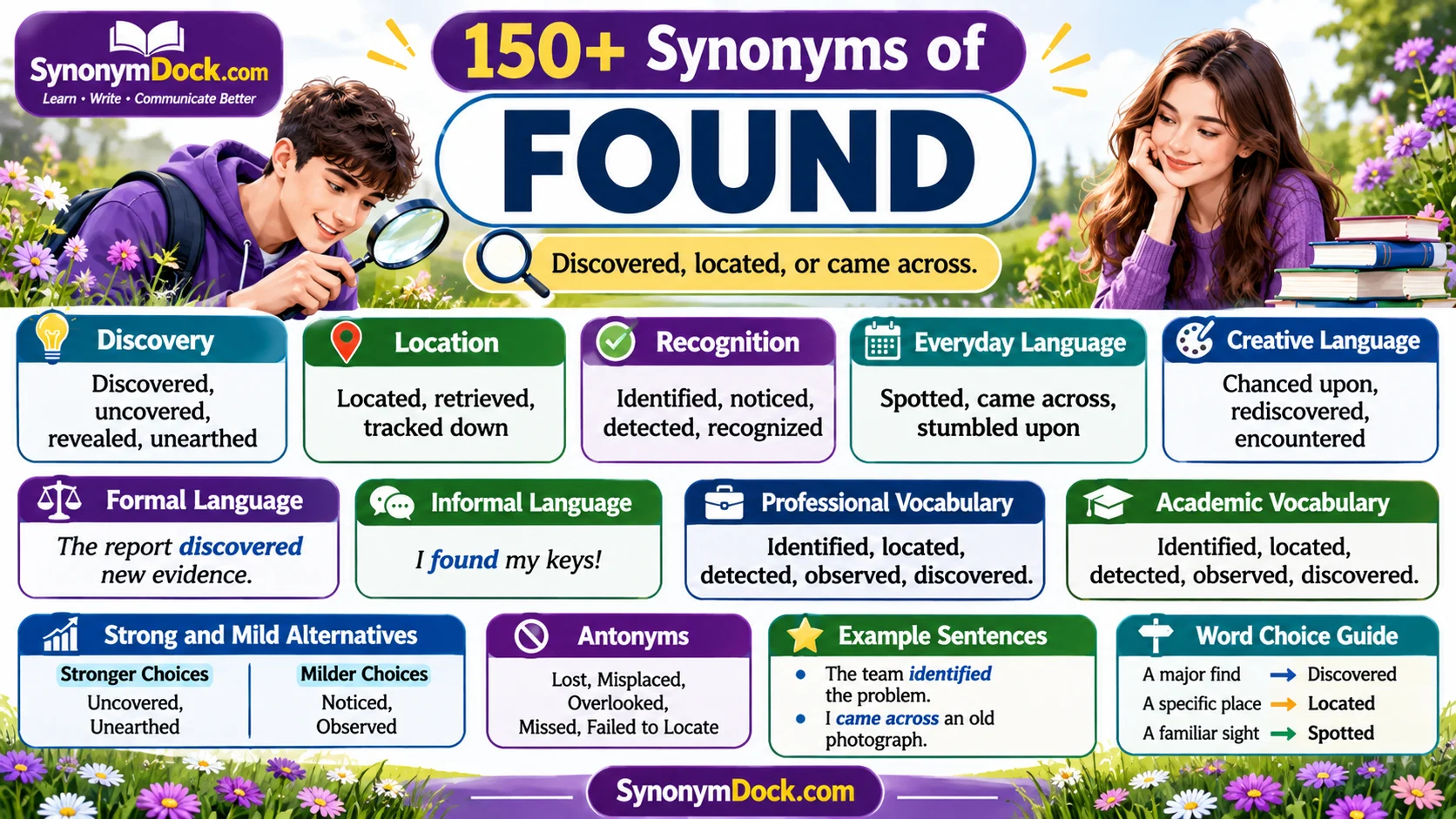
Choosing the right synonym of found helps you communicate the exact meaning while improving clarity, tone, and variety. Have you ever written an email, essay, resume, or social media caption and noticed that you keep using the word found? Repeating the same word can make your writing sound less precise, especially when you want to explain a discovery, report a result, or describe something you came across.
However, not every alternative works in every sentence. Discovered can suggest learning something new, while located emphasizes finding a specific place or object. Similarly, uncovered often suggests revealing information that was hidden.
This guide explains the meaning of found, presents useful synonyms by context, and shows how to choose the most natural alternative. You will also learn the differences between similar words, explore common expressions, and avoid mistakes that can change your intended meaning.
What Are the Best Synonyms of “Found”?
The best synonyms of found include discovered, located, identified, uncovered, encountered, noticed, detected, retrieved, and came across. Found is usually neutral and conversational. Use discovered in academic writing, located in professional reports, identified for specific results, and came across in casual conversation.
The best choice depends on what happened:
- Formal writing: discovered, identified, established
- Academic writing: discovered, identified, observed
- Professional communication: located, identified, detected
- Business communication: identified, uncovered, retrieved
- Casual conversation: came across, spotted, noticed
- Emotional writing: stumbled upon, encountered, rediscovered
- Creative writing: uncovered, chanced upon, stumbled upon
Meaning, Tone, and Context
Simple Definition
Found is the past tense and past participle of the verb find. It generally means that someone discovered, located, noticed, or came across a person, object, fact, answer, or situation.
For example:
- I found my keys under the sofa.
- The researchers found evidence of a connection.
- We found a better way to organize the project.
The meaning changes slightly with the object. Finding a missing item means locating it, while finding evidence means discovering or identifying information.
Important distinction: Found can also be the past tense of the separate verb found, meaning to establish or create an organization or institution. For example, “The scientist founded a research center.” This article mainly covers found as the past tense of find, which is the meaning most relevant to synonym searches.
Part of Speech
Found is a verb form.
- Base verb: find
- Past tense: found
- Past participle: found
- Present participle: finding
Examples:
- Present: I find the instructions helpful.
- Past: I found the instructions helpful.
- Present perfect: I have found the instructions helpful.
- Continuous: I am finding the instructions easier to follow.
Overall Tone
Found generally has a neutral tone. It communicates that someone discovered, located, or encountered something without automatically expressing excitement, criticism, or surprise.
However, the surrounding sentence can add emotion. For example, “I found an old photograph” is neutral, while “I finally found my childhood photograph” may express relief or happiness.
Formality Level
Found is suitable for formal, semi-formal, and informal communication. It appears naturally in academic papers, business reports, emails, conversations, and everyday writing.
Its alternatives can be more specific or formal. For example, identified may sound more precise in a research report, while came across usually feels more conversational.
Common Uses
Native English speakers commonly use found when describing:
- Discovering a fact, answer, or solution
- Locating a missing object or person
- Finding information during research
- Noticing a problem or opportunity
- Encountering someone or something unexpectedly
- Reaching an opinion after considering evidence
- Experiencing a particular condition or situation
Word Forms
| Form | Word | Example |
| Base verb | Find | I need to find the document. |
| Past tense | Found | She found the document. |
| Past participle | Found | The document has been found. |
| Present participle | Finding | They are finding new evidence. |
| Related noun | Finder | The finder returned the wallet. |
| Related noun | Finding | The study reported an important finding. |
When and How to Use “Found”
Use found when you want to describe the result of looking for something, discovering information, noticing a detail, or encountering a person or situation. It is a flexible word, but a more specific alternative can make your sentence clearer.
Here are seven realistic examples.
1. Professional Context
Example: The quality control team found several errors in the final report.
Alternative: The quality control team identified several errors in the final report.
Why it works: Identified sounds precise because it emphasizes recognizing and specifying the errors.
2. Academic Context
Example: The researchers found a connection between sleep quality and concentration.
Alternative: The researchers discovered a connection between sleep quality and concentration.
Why it works: Discovered emphasizes learning something through investigation.
3. Workplace Context
Example: We found a more efficient way to manage customer requests.
Alternative: We developed a more efficient way to manage customer requests.
Why it works: Use developed only when the team created the method. It is not interchangeable with found when the method already existed.
4. Personal Context
Example: I found my old school photographs in a storage box.
Alternative: I came across my old school photographs in a storage box.
Why it works: Came across suggests an unexpected discovery.
5. Email Context
Example: I found the information you requested.
Alternative: I located the information you requested.
Why it works: Located sounds direct and professional when reporting that specific information has been retrieved or identified.
6. Resume Context
Example: Found ways to improve the team’s daily workflow.
Alternative: Identified opportunities to improve the team’s daily workflow.
Why it works: Identified opportunities communicates a specific professional contribution. If you also put the improvements into practice, describe that action separately.
7. Social Media Context
Example: Found a beautiful little café while exploring the city.
Alternative: Stumbled upon a beautiful little café while exploring the city.
Why it works: Stumbled upon adds a sense of surprise and makes the caption more expressive.
Best Synonyms of “Found”
No synonym of found works perfectly in every situation. The best alternative depends on whether you discovered new information, located something specific, noticed a detail, or encountered something unexpectedly.
Here are practical recommendations for different writing situations.
| Context | Best synonym | Why it works |
| Professional writing | Identified | Communicates a specific result or issue. |
| Academic writing | Discovered | Emphasizes learning something through investigation. |
| Business communication | Located | Clearly reports that information or an item was found. |
| Casual conversation | Came across | Sounds natural when describing an unexpected discovery. |
| Emotional writing | Rediscovered | Suggests finding something meaningful again. |
| Creative writing | Stumbled upon | Adds surprise and narrative interest. |
| Resume writing | Identified | Highlights recognizing problems or opportunities. |
| Workplace communication | Detected | Works well for discovering errors, risks, or changes. |
| Stronger meaning | Uncovered | Suggests revealing something previously hidden. |
| Softer meaning | Noticed | Describes becoming aware of something without strong emphasis. |
When Not to Use “Found”
Although found is versatile, it can become too general when a sentence needs a more exact verb. Replacing it with a specific alternative helps readers understand what happened.
1. When “Found” Sounds Too General
Less effective: The team found several problems in the system.
Better: The team identified several problems in the system.
Why: Identified communicates that the team recognized and specified the problems.
2. When You Need to Emphasize a New Discovery
Less effective: Scientists found a new species.
Better: Scientists discovered a new species.
Why: Discovered highlights the importance of learning about something previously unknown.
3. When You Need to Describe a Physical Location
Less effective: The technician found the missing equipment.
Better: The technician located the missing equipment.
Why: Located emphasizes determining where the equipment was.
4. When You Need to Reveal Hidden Information
Less effective: The investigation found evidence of financial misconduct.
Better: The investigation uncovered evidence of financial misconduct.
Why: Uncovered suggests bringing previously hidden information to light.
5. When You Need a More Natural Conversational Expression
Less effective: I found an interesting article while browsing online.
Better: I came across an interesting article while browsing online.
Why: Came across sounds relaxed and natural when the discovery was unexpected.
6. When You Need to Describe a Measured Result
Less effective: The experiment found a significant difference between the groups.
Better: The experiment revealed a significant difference between the groups.
Why: Revealed emphasizes what the results showed. In scientific writing, make sure the verb accurately reflects the study’s method and findings.
7. When You Need to Describe Something Created
Less effective: The organization found a new department in 2024.
Better: The organization established a new department in 2024.
Why: Found in this sentence could be confused with the past tense of find. Use established when you mean created or set up.
Words Commonly Confused With “Found”
Some words have similar meanings but describe different parts of the discovery process.
| Word | Difference | When to use it | Example |
| Discovered | Emphasizes learning about something previously unknown. | New facts, places, or information. | The team discovered a new opportunity. |
| Located | Emphasizes identifying a specific position or place. | Missing objects, files, or people. | The officer located the missing vehicle. |
| Identified | Emphasizes recognizing or naming something accurately. | Problems, causes, patterns, or candidates. | The analyst identified the main cause. |
| Noticed | Means becoming aware of something through observation. | Details, changes, or behavior. | She noticed a spelling error. |
| Uncovered | Suggests revealing something hidden or concealed. | Evidence, problems, or hidden facts. | The audit uncovered several errors. |
| Encountered | Means coming across or experiencing someone or something. | Unexpected situations, people, or difficulties. | We encountered a delay during the project. |
Best Synonyms of “Found” by Context
The most useful synonym depends on the object of the verb and the purpose of the sentence. Use this table as a quick guide when writing for different audiences.
| Context | Best synonym | Why it works | Example |
| Formal writing | Identified | Provides a precise, professional tone. | The review identified several concerns. |
| Academic writing | Discovered | Highlights a new research observation. | Researchers discovered a new pattern. |
| Professional communication | Located | Clearly reports where something was found. | I located the requested document. |
| Business emails | Retrieved | Emphasizes obtaining specific information or an item. | I retrieved the requested records. |
| Resume writing | Identified | Highlights recognizing an opportunity or problem. | Identified process improvements. |
| Workplace communication | Detected | Works for errors, changes, and risks. | The team detected a technical issue. |
| Casual conversation | Came across | Sounds relaxed and natural. | I came across an old picture. |
| Everyday speaking | Spotted | Suggests noticing or seeing something. | I spotted your car outside. |
| Creative writing | Stumbled upon | Adds surprise to a discovery. | She stumbled upon a hidden garden. |
| Storytelling | Encountered | Describes meeting or experiencing something. | They encountered an unexpected obstacle. |
| Emotional writing | Rediscovered | Adds personal meaning to finding something again. | He rediscovered his love of music. |
| Strong emphasis | Uncovered | Suggests revealing hidden information. | The report uncovered serious problems. |
| Mild tone | Noticed | Communicates awareness without strong emphasis. | I noticed a small change. |
| Social media captions | Came across | Feels natural and conversational. | Came across this lovely little shop. |
| American English | Found | Remains natural and widely understood. | I found the address online. |
| British English | Found | Also natural and widely understood in British English. | I found the address online. |
How to Choose the Best Synonym of “Found”
Choosing the right alternative is easier when you consider what happened and what you want the reader to understand.
1. Start With the Meaning
Ask yourself what found describes in your sentence.
- Did you learn something new? Use discovered.
- Did you determine where something was? Use located.
- Did you recognize a problem? Use identified.
- Did you become aware of a detail? Use noticed.
- Did you reveal something hidden? Use uncovered.
- Did you meet or experience something? Use encountered.
2. Consider Your Audience
A synonym that works in a conversation may sound too casual in a formal report. For example, came across is natural in everyday speech, while identified is often more suitable for a business document.
3. Match the Emotional Strength
Choose a neutral word when you only need to report information. Use a more expressive alternative when the sentence should communicate surprise, excitement, or the importance of a discovery.
4. Check the Level of Formality
For reports, essays, and presentations, consider identified, discovered, or located. For conversations and informal captions, spotted and came across may sound more natural.
5. Make Sure the Word Fits the Object
You can locate a missing file, discover a new fact, and uncover hidden evidence. However, these verbs are not interchangeable simply because they can replace found in some sentences.
6. Read the Sentence Aloud
A synonym should sound natural in the complete sentence. If it makes the sentence unnecessarily complicated, the original word may be the better choice.
Real-Life Examples of “Found”
These examples show how to replace found with more specific alternatives in different situations.
| Situation | Original sentence | Improved sentence |
| School | I found the answer in the textbook. | I located the answer in the textbook. |
| College | The students found a connection between the two topics. | The students identified a connection between the two topics. |
| Workplace | We found an error in the monthly report. | We detected an error in the monthly report. |
| Business | The company found a new market opportunity. | The company identified a new market opportunity. |
| I found the file you requested. | I located the file you requested. | |
| Resume | Found ways to reduce unnecessary expenses. | Identified opportunities to reduce unnecessary expenses. |
| Conversation | I found a great restaurant nearby. | I came across a great restaurant nearby. |
| Storytelling | She found a mysterious letter in the attic. | She uncovered a mysterious letter in the attic. |
| Blogging | I found several useful writing resources. | I discovered several useful writing resources. |
| Social media | Found this beautiful place during my trip. | Stumbled upon this beautiful place during my trip. |
18 Best Synonyms of “Found”
The following 18 alternatives cover the most common meanings of found. Some emphasize discovery, while others describe locating, noticing, identifying, or encountering something.
| Synonym | Simple meaning | Best used for | Example sentence |
| Discovered | Learned about something previously unknown. | Research and new information. | The team discovered a more efficient method. |
| Located | Determined the position of something. | Missing items, files, and places. | We located the missing document. |
| Identified | Recognized or established what something was. | Problems, causes, and patterns. | The analyst identified the source of the error. |
| Uncovered | Revealed something hidden. | Evidence and concealed information. | The investigation uncovered important evidence. |
| Detected | Noticed or recognized something, often through examination. | Errors, changes, and signals. | The software detected an unusual activity pattern. |
| Noticed | Became aware of something. | Everyday observations. | I noticed a change in the schedule. |
| Spotted | Saw or recognized something, often quickly. | Visible objects and details. | She spotted her friend across the street. |
| Encountered | Came across or experienced something. | People, situations, and difficulties. | We encountered an unexpected problem. |
| Retrieved | Got something back or obtained stored information. | Files, records, and objects. | He retrieved the report from the archive. |
| Unearthed | Brought something hidden or buried to light. | Historical objects and forgotten information. | The researchers unearthed an old document. |
| Revealed | Made something known or visible. | Results, facts, and information. | The survey revealed a clear preference. |
| Observed | Noticed something through careful attention. | Research and detailed examination. | The students observed a change in behavior. |
| Came across | Found or encountered something, often unexpectedly. | Casual conversation. | I came across an interesting article. |
Synonyms of “Found” by Usage
Professional vs. Personal Synonyms
Professional writing usually benefits from precise verbs that explain the result of an action. Use identified for a problem, located for a missing item, detected for an error, and uncovered for hidden information.
Personal writing can be more expressive. Alternatives such as came across, stumbled upon, and rediscovered help communicate surprise, memory, and personal meaning.
Recommendation: Choose identified or located for workplace documents. Choose came across or stumbled upon when describing an unexpected personal discovery.
Formal vs. Conversational Synonyms
Different situations call for different levels of formality.
| Writing situation | Recommended alternatives |
| Reports | Identified, detected, uncovered |
| Essays | Discovered, observed, identified |
| Business writing | Located, identified, retrieved |
| Presentations | Discovered, revealed, identified |
| Emails | Located, retrieved, found |
| Casual conversations | Came across, spotted, noticed |
| Texting | Found, spotted, came across |
The original word found is not inherently informal. It works in professional writing too. Use a more specific synonym when it communicates the result more clearly.
Academic Synonyms
Academic writing often describes research results, observations, and conclusions. The following alternatives help make those distinctions clear.
- Discovered: Use when research reveals something previously unknown.
- Identified: Use when researchers recognize a particular factor, pattern, or issue.
- Observed: Use when describing something noticed during a study.
- Detected: Use when a method or instrument reveals a signal, change, or effect.
- Revealed: Use when results show information that was not previously apparent.
For example, “The researchers found a relationship between the variables” can become “The researchers identified a relationship between the variables.”
Do not choose a more formal verb simply to sound academic. The alternative must accurately describe the research process.
Professional and Business Synonyms
Professional communication benefits from clear, action-focused vocabulary.
| Situation | Recommended word | Example |
| Resume | Identified | Identified opportunities to improve workflow efficiency. |
| Interview | Discovered | I discovered that clear communication improved team coordination. |
| Meeting | Noticed | I noticed a difference in the latest results. |
| Presentation | Revealed | The analysis revealed three areas for improvement. |
| Performance review | Identified | She identified recurring customer service issues. |
| Client communication | Located | I located the information you requested. |
| Business email | Retrieved | I retrieved the relevant records for your review. |
On a resume, explain the action and result rather than simply replacing found with a longer word. For example, “Identified process delays and helped reduce response times” communicates more than “Found process delays.”
Creative and Literary Synonyms
Creative writing often needs words that create atmosphere or show how a discovery happened.
- Stumbled upon: Suggests an unexpected discovery.
- Chanced upon: Adds a literary or chance-based feeling.
- Unearthed: Suggests bringing something hidden or forgotten to light.
- Rediscovered: Connects a discovery with memory or renewed appreciation.
- Uncovered: Creates a sense of revealing a secret or hidden truth.
- Encountered: Works when a character meets or experiences something unexpected.
Compare these examples:
- Neutral: She found an old letter.
- Expressive: She stumbled upon an old letter.
- Mysterious: She uncovered an old letter hidden beneath the floorboards.
The best choice depends on the mood and the role of the discovery in the story.
Slang or Modern Synonyms
There is no single modern slang word that replaces found naturally in every situation. However, some casual expressions can work in specific contexts.
- Spotted: Informal and common when someone sees something. “I spotted your car outside.”
- Came across: Conversational and widely understood. “I came across a useful video.”
- Tracked down: Casual but direct, especially after a search. “I finally tracked down that old song.”
Avoid casual expressions in formal research papers, official reports, and professional documents unless the writing style specifically allows them.
Strongest to Mildest Synonyms
Synonyms of found do not all express the same intensity. The following guide ranks them by how strongly they suggest discovery or revelation, rather than by the certainty of the result.
| Intensity | Words | Effect |
| Mild | Noticed, observed, spotted | Suggests becoming aware of something. |
| Moderate | Located, identified, encountered | Communicates a clear discovery or recognition. |
| Strong | Discovered, detected, revealed | Emphasizes learning or recognizing something important. |
| Very strong | Uncovered, unearthed, tracked down | Suggests revealing hidden information or finding something after considerable effort. |
This is a practical writing guide, not a fixed linguistic ranking. For example, tracked down emphasizes effort, while uncovered emphasizes revealing something hidden.
Emotional vs. Neutral Synonyms
Some alternatives communicate discovery without adding much emotion. Others suggest surprise, excitement, or a meaningful personal experience.
Emotional or expressive alternatives
- Stumbled upon
- Chanced upon
- Rediscovered
- Unearthed
- Uncovered
These words can make a sentence feel more personal, surprising, or dramatic.
Neutral alternatives
- Located
- Identified
- Detected
- Observed
- Retrieved
- Noticed
Use neutral words in reports, instructions, and factual communication. Choose expressive alternatives when the discovery itself contributes to the mood or meaning of the sentence.
Antonyms of “Found”
The opposite of found depends on the meaning of the sentence. When found means successfully locating something, its clearest opposites describe losing something, failing to locate it, or overlooking it.
The following table provides 15 contextual opposites. Some are verb phrases because English does not have 15 single-word antonyms that work naturally across every meaning of found.
| Antonym or opposite expression | Meaning | Example sentence |
| Lost | No longer able to locate or keep something. | I lost my house keys yesterday. |
| Misplaced | Put something somewhere and forgotten its location. | She misplaced the meeting notes. |
| Overlooked | Failed to notice something. | The reviewer overlooked an important detail. |
| Missed | Failed to see, notice, or locate something. | We missed the sign near the entrance. |
| Failed to locate | Was unable to determine where something was. | The team failed to locate the missing file. |
| Searched unsuccessfully | Looked for something without finding it. | They searched unsuccessfully for the document. |
| Went unnoticed | Was not noticed by anyone. | The small error went unnoticed. |
| Ignored | Deliberately paid no attention to something. | He ignored the warning signs. |
| Passed over | Did not select or consider something. | The committee passed over the stronger proposal. |
| Left undiscovered | Remained unknown or unrecognized. | The issue was left undiscovered for months. |
| Remained hidden | Continued to stay concealed. | The evidence remained hidden. |
| Concealed | Deliberately kept something out of sight. | Someone concealed the original records. |
These opposites are contextual, not interchangeable in every sentence. For example, concealed is the opposite of revealing something, while lost is the opposite of successfully locating an object.
Comparison: “Found” vs. Similar Words
The following comparisons explain how found differs from six common alternatives.
Found vs. Discovered
Main Difference: Found is a general word for locating or discovering something. Discovered emphasizes learning about something previously unknown.
Which Is Stronger? Discovered often suggests a more meaningful or important discovery.
Which Is More Formal? Both work in formal writing, but discovered can be more precise when describing new knowledge.
When to Use Each: Use found for general results and discovered for new information or previously unknown things.
Examples:
- Found: We found a useful source for the assignment.
- Discovered: We discovered a new connection between the two ideas.
Found vs. Located
Main Difference: Found can describe discovering information or locating an object. Located specifically emphasizes determining where something is.
Which Is Stronger? Neither is universally stronger. Located is more specific about position.
Which Is More Formal? Located often sounds more precise in technical and professional communication.
When to Use Each: Use found in general situations and located when the position of an object, person, or file matters.
Examples:
- Found: I found the missing folder.
- Located: I located the missing folder in the archive.
Found vs. Identified
Main Difference: Found describes a broad result. Identified emphasizes recognizing, naming, or determining exactly what something is.
Which Is Stronger? Identified is more specific, especially when describing a problem or cause.
Which Is More Formal? Identified often fits professional and academic writing particularly well.
When to Use Each: Use found for a general discovery and identified when the result requires recognition or classification.
Examples:
- Found: The team found a problem in the process.
- Identified: The team identified the main cause of the problem.
Found vs. Noticed
Main Difference: Found can involve searching or discovering. Noticed means becoming aware of something, often without looking for it.
Which Is Stronger? Found can imply a completed search, while noticed often describes a simple observation.
Which Is More Formal? Both are suitable for everyday and professional writing, depending on the sentence.
When to Use Each: Use found when something was discovered or located. Use noticed when someone became aware of a detail.
Examples:
- Found: I found an error in the document.
- Noticed: I noticed an error in the document.
Found vs. Uncovered
Main Difference: Found is neutral. Uncovered suggests revealing something hidden, concealed, or previously unknown.
Which Is Stronger? Uncovered usually carries greater emphasis.
Which Is More Formal? Both work in formal writing. Uncovered can be especially effective in investigative and analytical contexts.
When to Use Each: Use found for ordinary discoveries and uncovered when something hidden comes to light.
Examples:
- Found: The audit found several problems.
- Uncovered: The audit uncovered several hidden problems.
Found vs. Encountered
Main Difference: Found can describe locating an object or discovering information. Encountered usually describes meeting, facing, or experiencing someone or something.
Which Is Stronger? Encountered can make an experience sound more significant, but it does not necessarily mean the same thing as found.
Which Is More Formal? Encountered is often suitable for formal, academic, and professional writing.
When to Use Each: Use found when something is discovered or located. Use encountered when describing an experience, obstacle, or unexpected meeting.
Examples:
- Found: We found a problem during testing.
- Encountered: We encountered a problem during testing.
Common Phrases and Expressions With “Found”
The word found appears in many natural English expressions. These phrases can help you communicate more specific meanings.
1. Found Out
Meaning: Learned information that was previously unknown.
Example: I found out that the meeting had been rescheduled.
2. Found Something Useful
Meaning: Discovered something that provides practical help or value.
Example: I found something useful in the research report.
3. Found a Way
Meaning: Discovered or developed a method for achieving something.
Example: The team found a way to reduce unnecessary delays.
4. Found Common Ground
Meaning: Discovered shared interests, opinions, or areas of agreement.
Example: The two departments found common ground during the discussion.
5. Found It Difficult
Meaning: Experienced difficulty doing or understanding something.
Example: She found it difficult to explain the technical process.
6. Found Evidence
Meaning: Discovered information or material that supports a claim.
Example: Investigators found evidence that supported the report.
7. Found Someone or Something Missing
Meaning: Discovered that a person or object was absent.
Example: The manager found two documents missing from the folder.
8. Found Yourself
Meaning: Realized that you were in a particular situation or condition, sometimes unexpectedly.
Example: After the move, I found myself working with a completely new team.
Common Mistakes to Avoid
Choosing the wrong synonym can change the meaning of a sentence. These common mistakes show how to make more accurate word choices.
Mistake 1: Using a General Word When a Precise One Is Better
Incorrect: The researchers found the main cause of the problem.
Better: The researchers identified the main cause of the problem.
Why: Identified makes it clear that the researchers determined the specific cause.
Mistake 2: Confusing “Found” With “Founded”
Incorrect: The company found a new office in 2022.
Better: The company established a new office in 2022.
Why: Found is the past tense of find, while founded is the past tense of the verb meaning to establish an organization or institution.
Mistake 3: Using an Informal Expression in Formal Writing
Incorrect: The researchers came across an important pattern during the study.
Better: The researchers identified an important pattern during the study.
Why: Came across is conversational. Identified is often more appropriate when reporting a specific research result.
Mistake 4: Choosing an Overly Dramatic Synonym
Incorrect: The team unearthed the meeting schedule in the shared folder.
Better: The team located the meeting schedule in the shared folder.
Why: Unearthed suggests revealing something hidden or buried. Located is more natural for a routine file search.
Mistake 5: Using “Discovered” When You Only Mean “Noticed”
Incorrect: I discovered a small spelling error while reading the email.
Better: I noticed a small spelling error while reading the email.
Why: Noticed is more natural for a minor detail that catches your attention.
Mistake 6: Repeating “Found” Too Often
Incorrect: We found several issues, found a possible solution, and found that the process needed improvement.
Better: We identified several issues, discovered a possible solution, and determined that the process needed improvement.
Why: Using different precise verbs improves flow without making the writing unnecessarily complicated.
Mistake 7: Choosing a Synonym With the Wrong Meaning
Incorrect: The technician encountered the missing file in the archive.
Better: The technician located the missing file in the archive.
Why: Encountered usually describes experiencing or coming across something. Located is clearer when the sentence emphasizes where a file was found.
Frequently Asked Questions
1. What are the best synonyms of “found”?
The best synonyms of found include discovered, located, identified, uncovered, detected, noticed, and encountered. Choose based on whether you discovered information, located an object, or became aware of something.
2. What are the best formal synonyms of “found”?
Formal alternatives include identified, discovered, located, detected, observed, and revealed. Use identified for specific problems, located for positions or records, and discovered for new information.
3. What are common informal synonyms of “found”?
Common conversational alternatives include came across, spotted, noticed, and stumbled upon. For example, “I came across an interesting article” sounds natural when describing an unexpected discovery.
4. What is another word for “found” in professional writing?
Identified is often an effective professional alternative when describing a problem, opportunity, or cause. Use located for missing information and detected for errors, risks, or unusual changes.
5. What is the difference between “found” and “discovered”?
Found is a general term for locating or discovering something. Discovered emphasizes learning about something previously unknown, making it especially useful for research, new information, and important observations.
6. What is the opposite of “found”?
The opposite of found depends on the sentence. Common opposites include lost, misplaced, overlooked, and missed. For example, “I found my keys” becomes “I lost my keys.”
Conclusion
Found is a versatile verb used to describe discovering, locating, recognizing, or encountering something. However, choosing a more specific alternative can make your writing clearer, more expressive, and precise. For example, use discovered when uncovering new information, located when finding a particular object or place, identified when recognizing a problem or cause, and encountered when coming across someone or something.
The most suitable synonym of found depends on the context, intended meaning, and tone of your writing. In academic and professional communication, alternatives such as uncovered, detected, established, and determined may be more appropriate. For everyday English, came across, spotted, and noticed sound more natural. Always choose a replacement that preserves your original meaning rather than using a sophisticated word simply for variety.

Ethan Parker is an English language writer and vocabulary enthusiast at SynonymDock.com. He specializes in synonyms, word meanings, alternative expressions and practical English usage, creating clear and reliable content to help students, professionals, writers and English learners choose the right words with confidence.
5 thoughts on “150+ Words to Use Instead of Found in Different Contexts”