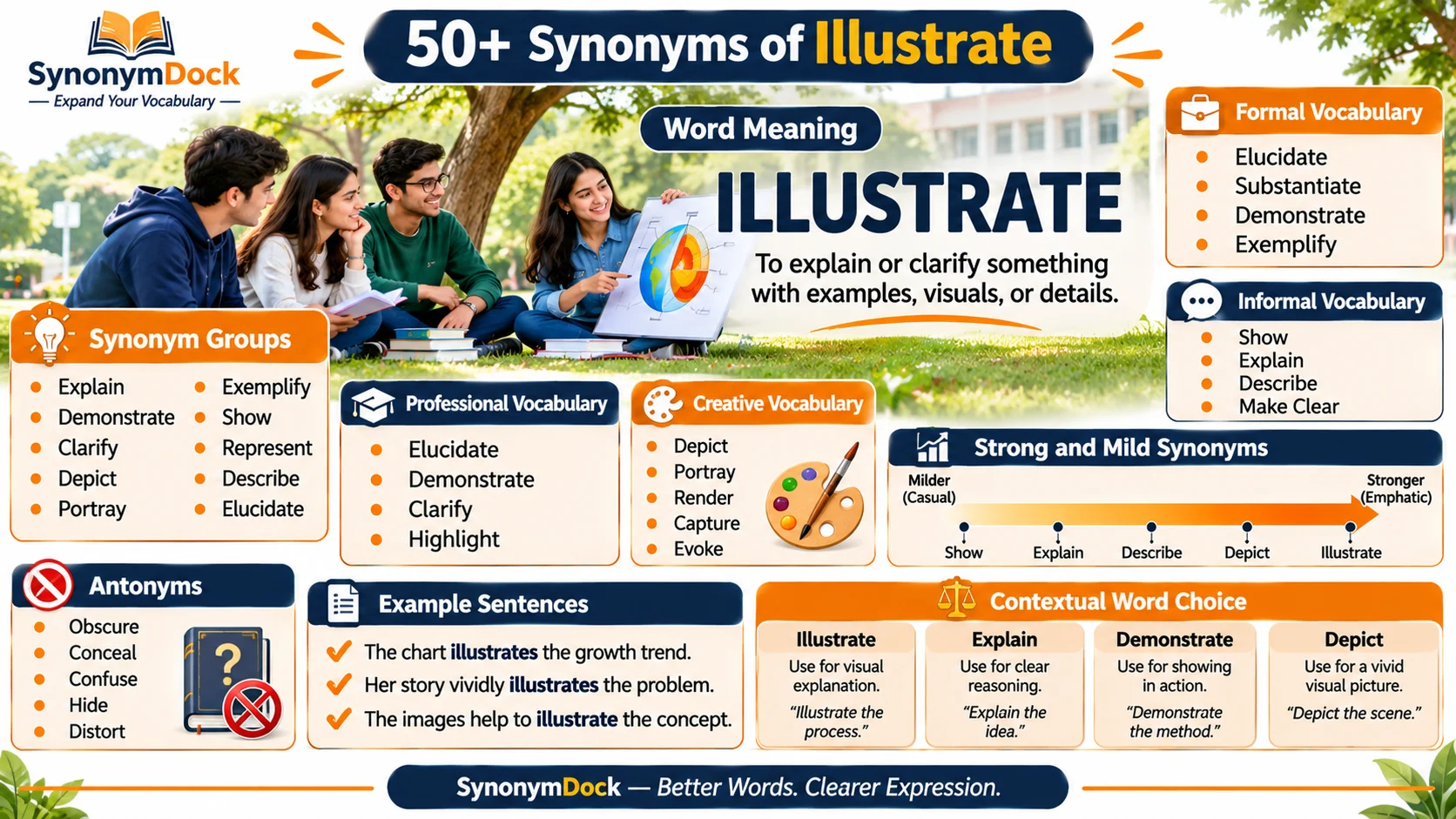
Finding the right synonym of illustrate helps you express ideas more precisely. Depending on your message, you might use words such as explain, demonstrate, clarify, depict, portray, or exemplify.
However, these alternatives are not interchangeable in every situation. Some describe explaining an idea, while others focus on showing something through pictures, examples, or descriptions.
This guide explores the best synonyms of illustrate, their meanings, differences, tones, and practical applications. You will also learn how to select the most natural alternative for academic, professional, creative, and everyday communication.
What Are the Best Synonyms of “Illustrate”?
To illustrate means to explain, clarify, or demonstrate something using examples, descriptions, pictures, or other visual representations. The best alternatives include explain, demonstrate, clarify, depict, portray, exemplify, show, and represent, depending on the context.
Here are the strongest choices for different situations:
| Context | Best Synonym |
| Formal writing | Elucidate |
| Casual conversation | Show |
| Academic writing | Demonstrate |
| Professional communication | Explain |
| Business communication | Clarify |
| Emotional writing | Portray |
| Creative writing | Depict |
| Resume writing | Demonstrate |
| Giving examples | Exemplify |
| Visual representation | Depict |
The most versatile alternative is demonstrate when you want to provide evidence or show how something works. Choose explain when your primary purpose is to make an idea understandable.
Meaning, Tone, and Context of Illustrate
Simple Definition
Illustrate means to make an idea, situation, or concept easier to understand by providing examples, explanations, descriptions, or pictures.
It can also mean representing something visually through drawings, photographs, diagrams, or other artwork.
For example:
- The teacher used an example to illustrate the lesson.
- The artist illustrated the children’s book.
- The report illustrates the company’s recent progress.
These examples demonstrate the different ways the word can be used.
Part of Speech
Illustrate is primarily a verb.
Overall Tone
Illustrate generally has a neutral, informative, and educational tone. It can sound formal or professional depending on the sentence.
Positive, Neutral, or Negative?
Neutral: The word itself does not communicate a positive or negative feeling. Its meaning depends on the surrounding context.
For example:
- Positive: The results illustrate significant improvements.
- Neutral: This diagram illustrates the process.
- Negative: The incident illustrates the consequences of poor planning.
Formality Level
Illustrate is appropriate for several communication styles.
| Style | Suitability | Explanation |
| Formal | Excellent | Common in reports and official documents |
| Semi formal | Excellent | Suitable for presentations and professional discussions |
| Neutral | Excellent | Works in everyday explanations |
| Informal | Good | Understandable, although simpler words may sound more natural |
Common Uses
Native English speakers commonly use illustrate when:
- Explaining complicated ideas.
- Supporting arguments with examples.
- Presenting research findings.
- Describing situations through stories.
- Showing information through charts and diagrams.
- Creating visual artwork.
- Making abstract concepts easier to understand.
Word Forms
| Word Form | Meaning | Example |
| Illustrate | To explain or represent visually | The diagram illustrates the process. |
| Illustration | A picture or explanatory example | The book contains a useful illustration. |
| Illustrated | Shown through pictures or examples | She purchased an illustrated guide. |
| Illustrative | Helping explain something | The teacher provided an illustrative example. |
| Illustrator | A person who creates illustrations | The illustrator designed the book cover. |
When and How to Use “Illustrate”
Use illustrate when you want to make an idea easier to understand through examples, visual material, or descriptive explanations.
Here are seven realistic examples from different situations.
1. Professional Context
The presentation illustrates how our new strategy can improve customer satisfaction.
2. Academic Context
The research findings illustrate the relationship between education and economic development.
3. Workplace Context
This chart illustrates the team’s progress over the last three months.
4. Personal Context
My experience illustrates why patience is important when learning something new.
5. Email Context
I have attached a document to illustrate the proposed changes.
6. Resume Context
My previous projects illustrate my ability to manage multiple responsibilities.
7. Social Media Context
This photograph illustrates the beauty of exploring new places.
Best Synonyms of “Illustrate”
No synonym of illustrate communicates exactly the same meaning in every situation. The best alternative depends on whether you want to explain an idea, provide evidence, describe something, or represent it visually.
Here are the most useful recommendations.
1. Professional Writing: Demonstrate
Demonstrate works particularly well when presenting evidence, abilities, or results. It sounds confident and objective.
Example: The report demonstrates the effectiveness of the new approach.
2. Academic Writing: Elucidate
Elucidate means to make something clearer through detailed explanation. It is especially suitable for academic discussions and formal analysis.
Example: The study elucidates the relationship between language and culture.
3. Business Communication: Clarify
Clarify is useful when explaining information that might otherwise cause confusion.
Example: The manager clarified the company’s expectations.
4. Casual Conversation: Show
Show is a simple and natural alternative when explaining something informally.
Example: Let me show you how this application works.
5. Emotional Writing: Portray
Portray works when describing someone’s personality, feelings, experiences, or behavior.
Example: The novel portrays the emotional struggles of a young student.
6. Creative Writing: Depict
Depict is particularly useful when describing scenes, characters, or events through words or images.
Example: The artist depicted a peaceful village at sunset.
7. Resume Writing: Demonstrate
Demonstrate communicates abilities and achievements effectively.
Example: Demonstrated strong leadership and problem solving skills.
8. Workplace Communication: Explain
Explain is appropriate when making instructions, procedures, or ideas understandable.
Example: The supervisor explained the new safety procedures.
9. Stronger Meaning: Substantiate
Substantiate is useful when supporting a statement with evidence or facts. It is stronger and more specific than illustrate when proof is required.
Example: The findings substantiate the researcher’s argument.
10. Softer Meaning: Show
Show sounds simple, friendly, and conversational. It works when you do not need a particularly formal expression.
Example: This example shows why teamwork matters.
When Not to Use “Illustrate”
Although illustrate is versatile, some situations require a more precise alternative.
1. When You Need to Prove Something
Illustrate can provide an example without necessarily proving a claim.
Better synonym: Substantiate.
Original: The evidence illustrates his argument.
Improved: The evidence substantiates his argument.
Why it works: Substantiate communicates stronger support through evidence.
2. When You Need a Simple Explanation
Illustrate can sound unnecessarily formal in ordinary conversations.
Better synonym: Explain.
Original: Can you illustrate this rule?
Improved: Can you explain this rule?
Why it works: Explain sounds more natural when requesting a straightforward answer.
3. When You Want to Remove Confusion
Illustrate does not always communicate the idea of resolving uncertainty.
Better synonym: Clarify.
Original: Please illustrate the instructions.
Improved: Please clarify the instructions.
Why it works: Clarify directly communicates the need for understandable information.
4. When Describing a Person or Character
Illustrate may sound less natural when discussing someone’s personality or behavior.
Better synonym: Portray.
Original: The author illustrates a lonely character.
Improved: The author portrays a lonely character.
Why it works: Portray focuses on how a character is presented to readers.
5. When Describing a Visual Scene
Illustrate can sometimes sound too general when discussing a specific visual representation.
Better synonym: Depict.
Original: The painting illustrates a beautiful garden.
Improved: The painting depicts a beautiful garden.
Why it works: Depict directly communicates visual representation.
6. When Presenting Research Findings
Illustrate may be less precise when describing what research establishes.
Better synonym: Demonstrate.
Original: The experiment illustrates the effectiveness of the treatment.
Improved: The experiment demonstrates the effectiveness of the treatment.
Why it works: Demonstrate emphasizes what the evidence shows.
Words Commonly Confused With “Illustrate”
Several words have similar meanings but serve different purposes.
| Word | Difference | When to Use It | Example |
| Explain | Focuses on making information understandable. | Instructions and explanations. | Please explain the process. |
| Demonstrate | Shows something through evidence or action. | Research and practical examples. | The experiment demonstrates the result. |
| Depict | Represents something visually or descriptively. | Art and storytelling. | The painting depicts a mountain. |
| Describe | Provides details about something. | People, places, and situations. | She described the building. |
| Clarify | Removes confusion or uncertainty. | Instructions and communication. | Please clarify your response. |
| Exemplify | Provides a specific example of something. | Academic and explanatory writing. | Her achievements exemplify dedication. |
Best Synonyms of “Illustrate” by Context
Choosing an alternative becomes easier when you consider your audience and writing purpose.
| Context | Best Synonym | Why It Works | Example |
| Formal writing | Elucidate | Adds precision to explanations. | The report elucidates the issue. |
| Academic writing | Demonstrate | Emphasizes evidence and findings. | The study demonstrates the results. |
| Professional communication | Explain | Communicates ideas clearly. | Let me explain the proposal. |
| Business emails | Clarify | Removes uncertainty. | I would like to clarify the details. |
| Resume writing | Demonstrate | Highlights professional abilities. | Demonstrated strong organizational skills. |
| Workplace communication | Show | Sounds direct and natural. | The chart shows our progress. |
| Casual conversation | Show | Easy to understand. | Let me show you something. |
| Everyday speaking | Explain | Works in ordinary discussions. | Can you explain that again? |
| Creative writing | Depict | Creates a visual impression. | The story depicts a distant kingdom. |
| Storytelling | Portray | Develops characters and experiences. | The novel portrays family relationships. |
| Emotional writing | Portray | Communicates feelings and experiences. | The poem portrays deep sadness. |
| Strong emphasis | Substantiate | Supports claims with evidence. | The findings substantiate the claim. |
| Mild tone | Show | Keeps the message simple. | This example shows the difference. |
| Social media captions | Capture | Communicates a moment or feeling. | This picture captures a beautiful memory. |
| American English | Show | Natural in everyday American communication. | The example shows the problem. |
| British English | Demonstrate | Common in formal and educational contexts. | The results demonstrate the benefits. |
Note: Illustrate, demonstrate, and show are all used in American and British English. These recommendations reflect context and style, not exclusive regional differences.
How to Choose the Best Synonym of “Illustrate”
Selecting the right alternative requires more than finding a word with a similar dictionary meaning.
Use these six considerations.
1. Consider the Meaning
Ask yourself what you want to communicate.
- To explain something, choose explain.
- To provide evidence, choose demonstrate.
- To present a picture, choose depict.
- To give an example, choose exemplify.
2. Consider Your Audience
Academic readers may expect more precise vocabulary, while everyday readers generally appreciate straightforward language.
For example, elucidate may suit a research discussion, but explain is often better in a casual conversation.
3. Consider the Tone
Think about how your sentence should sound.
- Professional: Demonstrate.
- Friendly: Show.
- Academic: Elucidate.
- Descriptive: Portray.
4. Consider Emotional Strength
Some alternatives communicate stronger feelings or greater certainty.
For example, substantiate suggests stronger evidential support than simply illustrate.
5. Consider Your Writing Purpose
A resume, research paper, email, and creative story have different vocabulary requirements.
Choose a word that supports the purpose of your writing.
6. Read the Sentence Naturally
A synonym might have a similar definition but still sound awkward in a particular sentence.
Always read the complete sentence before replacing the original word.
Real Life Examples of “Illustrate”
The following examples demonstrate how to use stronger alternatives in everyday communication.
| Situation | Original Sentence | Improved Sentence |
| School | The teacher illustrated the lesson. | The teacher explained the lesson. |
| College | The study illustrates the relationship. | The study demonstrates the relationship. |
| Workplace | This chart illustrates our progress. | This chart shows our progress. |
| Business | The report illustrates the problem. | The report highlights the problem. |
| Please illustrate your concern. | Please clarify your concern. | |
| Resume | Illustrated leadership abilities. | Demonstrated leadership abilities. |
| Conversation | Can you illustrate your point? | Can you explain your point? |
| Storytelling | The novel illustrates a difficult childhood. | The novel portrays a difficult childhood. |
| Blogging | This example illustrates the benefits. | This example demonstrates the benefits. |
| Social media | The photograph illustrates happiness. | The photograph captures a joyful moment. |
Notice how the improved sentences communicate more specific meanings without unnecessarily complicated vocabulary.
18 Best Synonyms of “Illustrate”
Here are 18 useful alternatives with their meanings, recommended contexts, and practical examples.
These alternatives overlap with different meanings of illustrate. Always select the word that matches the specific action in your sentence.
Synonyms of “Illustrate” by Usage
Professional vs Personal Synonyms
Professional writing benefits from direct and precise vocabulary.
Recommended professional alternatives:
- Demonstrate: Useful for presenting results and achievements.
- Clarify: Suitable for resolving misunderstandings.
- Explain: Appropriate for communicating instructions.
- Substantiate: Useful when supporting claims with evidence.
- Highlight: Effective when drawing attention to important findings.
Personal communication generally benefits from simpler expressions.
Recommended personal alternatives:
- Show
- Explain
- Describe
- Picture
- Tell
For example:
Professional: The data demonstrates the effectiveness of the strategy.
Personal: Let me show you how it works.
Formal vs Conversational Synonyms
Different communication situations require different vocabulary.
| Formal Synonyms | Conversational Synonyms |
| Elucidate | Explain |
| Demonstrate | Show |
| Exemplify | Give an example |
| Substantiate | Support |
| Depict | Picture |
| Illuminate | Make clear |
For reports, academic essays, and presentations, demonstrate and elucidate can communicate ideas precisely.
For texting and casual conversations, show and explain are generally more natural.
Academic Synonyms
Academic writing requires clear explanations and accurate descriptions.
The following alternatives work particularly well:
Demonstrate: Use this word when research findings or evidence show something.
Example: The findings demonstrate a significant relationship between the variables.
Elucidate: Use it when explaining a complicated concept.
Example: The discussion elucidates the theoretical framework.
Exemplify: Choose it when a particular case represents a broader idea.
Example: This case exemplifies the challenges of modern education.
Substantiate: Use it when supporting an argument with evidence.
Example: The collected data substantiates the research hypothesis.
Clarify: Choose it when removing uncertainty from an explanation.
Example: The additional analysis clarifies the research findings.
Professional and Business Synonyms
Professional communication should be accurate, direct, and easy to understand.
Here are useful alternatives for different workplace situations.
| Situation | Recommended Synonym | Example |
| Resume | Demonstrate | Demonstrated strong leadership abilities. |
| Interview | Explain | Let me explain my previous experience. |
| Meeting | Outline | The director outlined the new objectives. |
| Presentation | Highlight | The presentation highlights important findings. |
| Performance review | Demonstrate | She demonstrated excellent communication skills. |
| Client communication | Clarify | I would like to clarify the proposed timeline. |
| Business email | Explain | Please explain the changes to the document. |
These words help communicate information without making professional writing unnecessarily complicated.
Creative and Literary Synonyms
Creative writing often requires words that create images, develop characters, and communicate feelings.
Consider these alternatives:
- Depict: Represents a scene or event through words or images.
- Portray: Presents a character or situation in a particular way.
- Picture: Creates a mental image.
- Render: Expresses something in a particular artistic form.
- Evoke: Brings a feeling, memory, or image to mind.
- Capture: Communicates the essential quality of a moment.
Examples:
The poet depicts the beauty of nature.
The novel portrays the struggles of ordinary families.
The description evokes memories of childhood.
The photograph captures the peaceful atmosphere of the countryside.
Slang or Modern Synonyms
There is no widely accepted slang word that directly replaces illustrate in every situation.
However, several casual expressions can perform similar functions.
| Expression | Meaning | Acceptable Usage |
| Break it down | Explain something in simple steps. | Informal conversations and tutorials. |
| Spell it out | Explain something very clearly. | Casual conversations. |
| Walk someone through | Explain a process step by step. | Workplace conversations and tutorials. |
| Give an example | Make an idea clearer through an example. | Everyday discussions and education. |
Avoid using these expressions as replacements in formal research papers unless the writing context supports an informal tone.
Strongest to Mildest Synonyms
Synonyms of illustrate differ in emphasis and the type of information they communicate. The following scale is based on rhetorical emphasis, not a universal ranking of strength.
| Intensity | Synonyms | Explanation |
| Mild | Show, describe, explain | Communicate information directly. |
| Moderate | Clarify, outline, present | Make information more organized or understandable. |
| Strong | Demonstrate, exemplify, highlight | Emphasize evidence or important features. |
| Very Strong | Substantiate, elucidate | Provide substantial support or detailed explanation. |
Choose stronger words when your sentence requires evidence, detailed explanation, or emphasis.
Use milder alternatives when simple communication is more important than formality.
Emotional vs Neutral Synonyms
Some alternatives communicate feelings, while others simply present information.
Emotional Synonyms
- Portray: Communicates how someone or something is presented.
- Evoke: Suggests an emotional response or memory.
- Capture: Communicates the essential feeling of a moment.
- Picture: Can create an imaginative or emotional impression.
Example: The novel portrays the emotional struggles of a young woman.
Neutral Synonyms
- Explain
- Demonstrate
- Clarify
- Show
- Outline
- Present
Example: The report demonstrates the effectiveness of the new system.
Choose emotional alternatives for literature, storytelling, and descriptive writing. Use neutral words for reports, instructions, and factual communication.
Antonyms of “Illustrate”
Illustrate does not have one universal opposite because it can mean explaining something or representing it visually.
However, the following 15 words express contrasting meanings in relevant contexts.
| Antonym | Meaning | Example Sentence |
| Obscure | Make something difficult to understand. | The unclear explanation obscured the main idea. |
| Confuse | Make information difficult to understand. | The complicated instructions confused the students. |
| Conceal | Keep something hidden. | The company concealed important information. |
| Hide | Prevent something from being seen. | The clouds hid the mountain. |
| Misrepresent | Present something inaccurately. | The advertisement misrepresented the product. |
| Distort | Change something so it becomes inaccurate. | The report distorted the original findings. |
| Muddle | Make an explanation confusing. | The speaker muddled the discussion. |
| Obfuscate | Deliberately make something unclear. | The writer obfuscated the central argument. |
| Suppress | Prevent information from being expressed or revealed. | The organization suppressed the findings. |
| Disguise | Make something appear different. | The statement disguised the real problem. |
| Camouflage | Hide something by making it blend in. | The design camouflaged the damaged area. |
| Veil | Cover or conceal something. | The vague statement veiled the truth. |
| Omit | Leave information out. | The summary omitted an important example. |
| Falsify | Change information to make it untrue. | Someone falsified the research records. |
| Withhold | Keep information from being shared. | The manager withheld the relevant details. |
Some of these are contextual opposites rather than direct dictionary antonyms. For example, conceal contrasts with visual illustration, while confuse contrasts with explaining clearly.
Comparison: “Illustrate” vs Similar Words
Understanding the differences between related words helps you avoid awkward sentences.
1. Illustrate vs Explain
Main Difference
Illustrate makes an idea clearer through examples, pictures, or descriptions. Explain focuses on communicating the meaning or details of something.
Which Is Stronger?
Neither is universally stronger. Illustrate emphasizes supporting examples or visual representation, while explain emphasizes understanding.
Which Is More Formal?
Illustrate generally sounds more formal than explain in everyday communication.
When to Use Each
Use illustrate when providing an example or visual aid. Choose explain when giving instructions or answering a question.
Examples
Illustrate: The diagram illustrates how the machine works.
Explain: The instructor explained how the machine works.
2. Illustrate vs Demonstrate
Main Difference
Illustrate helps communicate an idea through examples or representations. Demonstrate shows something through evidence, action, or a practical display.
Which Is Stronger?
Demonstrate often communicates stronger evidence or practical proof.
Which Is More Formal?
Both work well in academic and professional writing.
When to Use Each
Use illustrate for examples and visual explanations. Choose demonstrate for experiments, abilities, and measurable results.
Examples
Illustrate: The example illustrates the importance of teamwork.
Demonstrate: The experiment demonstrates the importance of teamwork.
3. Illustrate vs Depict
Main Difference
Illustrate can mean explaining an idea or creating visual artwork. Depict specifically emphasizes representing something through images or descriptions.
Which Is Stronger?
Neither is automatically stronger. Depict is more specific when visual representation is intended.
Which Is More Formal?
Both are appropriate for formal and creative writing.
When to Use Each
Choose illustrate for educational explanations. Use depict when discussing pictures, paintings, scenes, or characters.
Examples
Illustrate: The diagram illustrates the process.
Depict: The painting depicts a beautiful forest.
4. Illustrate vs Describe
Main Difference
Illustrate makes an idea clearer through examples or visual representations. Describe provides information about the features or qualities of something.
Which Is Stronger?
Illustrate can provide more explanatory support, while describe focuses on details.
Which Is More Formal?
Both are suitable for professional and academic writing.
When to Use Each
Use illustrate when supporting an explanation. Choose describe when communicating what something looks, feels, or sounds like.
Examples
Illustrate: This example illustrates the problem.
Describe: Please describe the problem.
5. Illustrate vs Clarify
Main Difference
Illustrate provides examples or representations to explain something. Clarify removes confusion or makes information more understandable.
Which Is Stronger?
Clarify is more direct when the specific goal is resolving confusion.
Which Is More Formal?
Both are suitable for professional communication.
When to Use Each
Use illustrate to provide supporting examples. Choose clarify when someone needs additional information.
Examples
Illustrate: The chart illustrates the company’s performance.
Clarify: The manager clarified the company’s expectations.
6. Illustrate vs Exemplify
Main Difference
Illustrate can explain an idea through different methods. Exemplify means to serve as a particular example of something.
Which Is Stronger?
Exemplify is more specific when showing how an example represents a broader quality or principle.
Which Is More Formal?
Exemplify generally sounds more formal and academic.
When to Use Each
Use illustrate for general explanations and visual representations. Choose exemplify when a person, action, or situation represents a particular quality.
Examples
Illustrate: The story illustrates the importance of honesty.
Exemplify: Her actions exemplify honesty.
Common Phrases and Expressions with “Illustrate”
The following expressions are useful in academic, professional, and everyday communication.
1. Illustrate a Point
Meaning: Make an argument or idea clearer through an example.
Example: The professor used a historical event to illustrate a point.
2. Illustrate an Idea
Meaning: Explain or represent a concept through examples or visuals.
Example: The designer created a diagram to illustrate the idea.
3. Illustrate the Difference
Meaning: Show how two or more things are different.
Example: These examples illustrate the difference between formal and informal language.
4. Illustrate a Concept
Meaning: Make an abstract or complicated idea easier to understand.
Example: The teacher used a simple experiment to illustrate the concept.
5. Illustrate a Problem
Meaning: Provide an example that helps explain a particular difficulty.
Example: The customer complaint illustrates a problem with the current system.
6. Illustrate Through Examples
Meaning: Explain something by providing specific instances.
Example: The author illustrates the argument through examples from everyday life.
7. Illustrate the Importance
Meaning: Demonstrate why something matters.
Example: The research illustrates the importance of early education.
Common Mistakes to Avoid
Using synonyms without understanding their exact meanings can weaken your writing.
Here are seven common mistakes and their corrections.
Mistake 1: Using a Vague Synonym
Incorrect: The report tells the company’s performance.
Better: The report demonstrates the company’s performance.
Why: Demonstrates communicates how the report presents evidence of performance.
Mistake 2: Confusing Illustrate With Prove
Incorrect: This example proves that the method is always successful.
Better: This example illustrates how the method can work.
Why: An illustration provides an example, but it does not necessarily establish a claim as true.
Mistake 3: Using Informal Vocabulary in Academic Writing
Incorrect: The research shows us what’s happening.
Better: The research demonstrates the observed pattern.
Why: The improved sentence uses more precise academic language.
Mistake 4: Choosing an Overly Formal Synonym
Incorrect: Let me elucidate how this website works.
Better: Let me explain how this website works.
Why: Explain sounds more natural in everyday conversation.
Mistake 5: Using the Wrong Visual Synonym
Incorrect: The painting explains a beautiful sunset.
Better: The painting depicts a beautiful sunset.
Why: Depict is more appropriate when describing a visual representation.
Mistake 6: Repeating the Same Word
Incorrect: The chart illustrates the results, and the diagram illustrates the process.
Better: The chart presents the results, while the diagram explains the process.
Why: Different words make the sentence more varied and communicate each function clearly.
Mistake 7: Choosing a Synonym With the Wrong Meaning
Incorrect: The documents elucidate the manager’s claim with statistical evidence.
Better: The documents substantiate the manager’s claim with statistical evidence.
Why: Substantiate specifically communicates support through evidence. Elucidate focuses on explanation.
Frequently Asked Questions
1. What Are the Best Synonyms of “Illustrate”?
The best synonyms of illustrate include explain, demonstrate, clarify, depict, portray, exemplify, show, and represent. Demonstrate works well for evidence, while depict is particularly suitable for visual descriptions.
2. What Are the Best Formal Synonyms of “Illustrate”?
The best formal alternatives include elucidate, demonstrate, exemplify, substantiate, and illuminate. These words are useful in academic papers, professional reports, research discussions, and formal presentations.
3. What Are Common Informal Synonyms of “Illustrate”?
Common informal alternatives include show, explain, describe, and give an example. These expressions sound natural in everyday conversations, classroom discussions, friendly emails, and informal instructions.
4. What Is Another Word for “Illustrate” in Professional Writing?
Demonstrate is an excellent alternative in professional writing, particularly when discussing results, achievements, and abilities. Clarify, explain, outline, and highlight are also useful depending on the intended message.
5. What Is the Difference Between “Illustrate” and “Explain”?
Illustrate makes an idea clearer through examples, descriptions, or visual representations. Explain focuses on communicating information so someone understands its meaning. Use illustrate for supporting examples and explain for direct instructions.
6. What Is the Opposite of “Illustrate”?
There is no single opposite for every meaning of illustrate. Depending on context, suitable antonyms include obscure, conceal, confuse, misrepresent, distort, and hide. These words communicate different forms of hiding or weakening information.
Conclusion
Understanding the best synonym of illustrate can make your writing clearer, more precise, and more engaging. Words such as demonstrate, explain, clarify, depict, exemplify, and portray offer useful alternatives for different communication situations. For academic writing, consider elucidate and demonstrate. For professional communication, choose clarify and explain. And also for creative writing, depict and portray can provide more descriptive expression.

Ethan Parker is an English language writer and vocabulary enthusiast at SynonymDock.com. He specializes in synonyms, word meanings, alternative expressions and practical English usage, creating clear and reliable content to help students, professionals, writers and English learners choose the right words with confidence.
2 thoughts on “Synonym of Illustrate|54+ Best Alternatives and Examples”