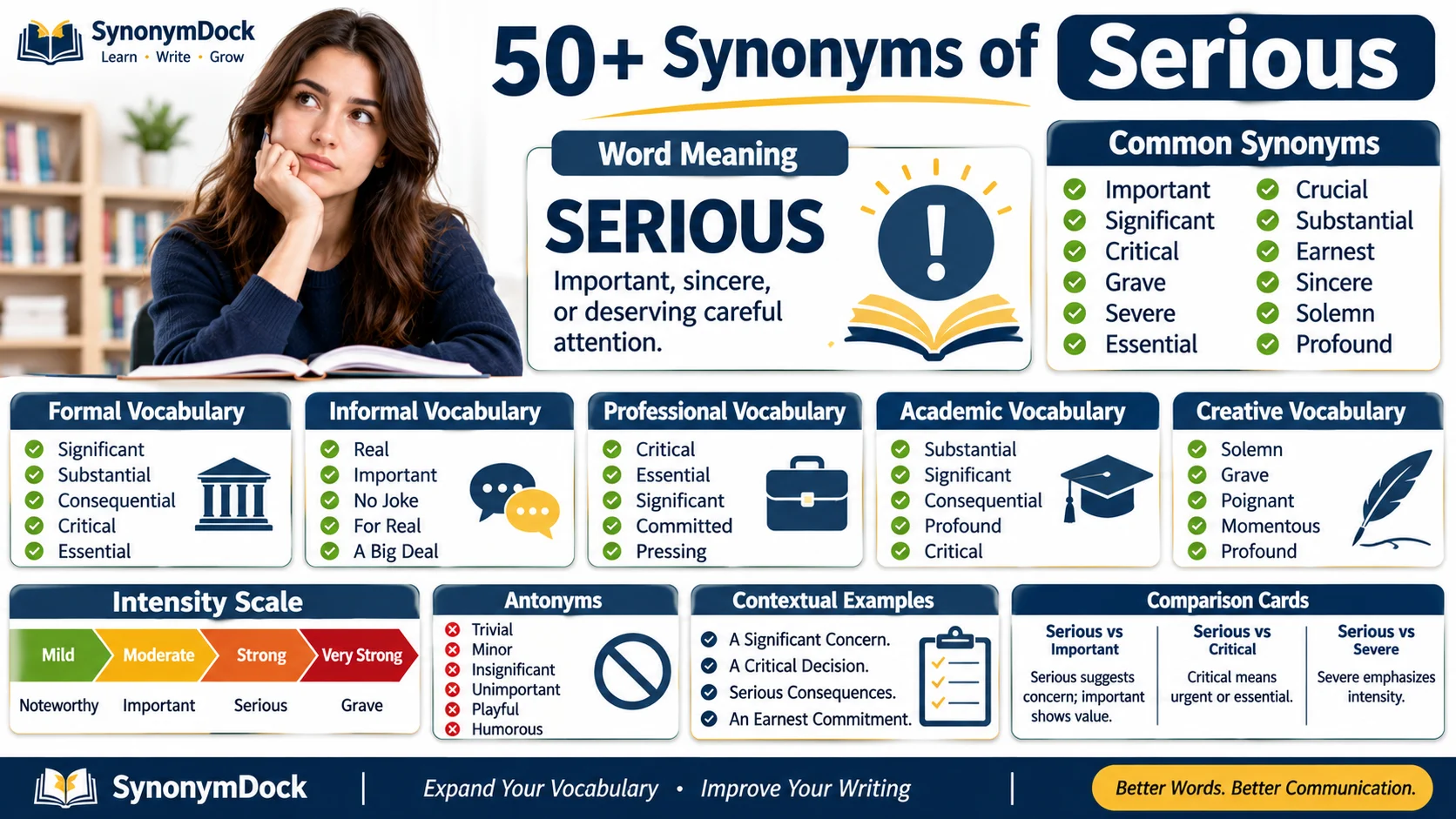
Finding the right synonym of serious can make your message more precise, professional, and engaging. Depending on the situation, words such as significant, grave, earnest, important, critical, and solemn can communicate different levels of concern, importance, and emotional intensity.
However, these alternatives are not interchangeable. A serious problem may be critical, a serious student may be dedicated, and a serious conversation may be earnest or solemn.
This guide explores more than 50 alternatives, explains their differences, and shows you how to choose the most natural word for academic, professional, personal, and creative writing.
What Are the Best Synonyms of “Serious”?
A serious person, situation, problem, or matter involves importance, concern, sincerity, or a lack of humor. The best synonyms include important, significant, grave, critical, earnest, severe, substantial, and solemn. Choose based on whether you mean importance, danger, sincerity, or emotional seriousness.
Best alternatives by context
| Context | Best Synonym |
| Formal writing | Significant |
| Academic writing | Substantial |
| Casual conversation | Important |
| Professional communication | Critical |
| Business writing | Essential |
| Emotional writing | Solemn |
| Serious problems | Grave |
| Serious intentions | Sincere |
| Dedicated individuals | Committed |
| Strong emphasis | Crucial |
| Mild importance | Noteworthy |
| Creative writing | Profound |
Meaning, Tone, and Context of Serious
Simple Definition
The word serious describes something important, meaningful, concerning, or deserving careful attention. It can also describe a person who behaves thoughtfully rather than joking or treating everything lightly.
For example:
- This is a serious issue that requires attention.
- She is serious about her education.
- We need to have a serious conversation.
The exact meaning depends on the subject and situation.
Part of Speech
Serious is an adjective.
It describes people, situations, problems, decisions, conversations, responsibilities, and intentions.
Overall Tone
Serious is generally neutral, but it can carry positive or negative associations depending on context.
| Tone | Example |
| Positive | He is serious about achieving his goals. |
| Neutral | This is a serious discussion. |
| Negative | The accident caused serious injuries. |
Formality Level
Serious is a neutral word suitable for formal, informal, academic, and professional communication.
It works naturally in conversations, reports, business emails, essays, and presentations.
Common Uses
Native English speakers commonly use serious when discussing:
- Important decisions.
- Health and safety concerns.
- Professional responsibilities.
- Personal commitments.
- Academic goals.
- Difficult situations.
- Emotional conversations.
- Significant consequences.
Word Forms
| Word Form | Example |
| Serious | A serious problem |
| Seriously | She seriously considered the offer. |
| Seriousness | We understand the seriousness of the situation. |
The related noun is seriousness, while seriously is the adverb.
When and How to Use Serious
Use serious when you want to communicate importance, sincerity, concern, or a situation that deserves attention.
Here are seven realistic examples.
1. Professional
The company is facing a serious financial challenge.
2. Academic
Students should take their research assignments seriously.
3. Workplace
We need a serious discussion about the project’s progress.
4. Personal
She is serious about improving her communication skills.
5. Email
I would like to discuss a serious concern regarding the current schedule.
6. Resume
Demonstrated a serious commitment to professional development and continuous learning.
7. Social Media
Sometimes, serious conversations lead to the most meaningful changes.
Best Synonyms of Serious
No synonym communicates exactly the same meaning in every situation. Some alternatives emphasize importance, while others express danger, commitment, sincerity, or emotional depth.
Here are the best recommendations for different writing purposes.
| Writing Context | Best Synonym | Why It Works |
| Professional writing | Significant | Communicates importance clearly. |
| Academic writing | Substantial | Emphasizes considerable importance or extent. |
| Business communication | Critical | Highlights something requiring immediate attention. |
| Casual conversation | Important | Sounds natural and straightforward. |
| Emotional writing | Solemn | Communicates a thoughtful, serious mood. |
| Creative writing | Profound | Suggests emotional or intellectual depth. |
| Resume writing | Committed | Highlights dedication and responsibility. |
| Workplace communication | Essential | Shows that something is necessary. |
| Stronger meaning | Grave | Expresses a particularly serious or concerning situation. |
| Softer meaning | Noteworthy | Indicates importance without suggesting danger. |
When Not to Use Serious
Although serious is versatile, it is not always the most precise choice.
1. When the meaning is too general
Less effective: We have a serious improvement in customer satisfaction.
Better: We have a significant improvement in customer satisfaction.
Why: Significant communicates the importance of the improvement more naturally.
2. When describing an urgent problem
Less effective: The organization has a serious security concern.
Better: The organization has a critical security concern.
Why: Critical emphasizes the importance of addressing the issue.
3. When discussing danger
Less effective: The patient has a serious medical condition.
Alternative: The patient has a severe medical condition.
Why: Severe emphasizes the intensity of the condition. However, the two words are not always interchangeable in medical contexts.
4. When describing personal dedication
Less effective: She is serious about her career.
Alternative: She is committed to her career.
Why: Committed directly expresses dedication and willingness to work toward a goal.
5. When describing a thoughtful atmosphere
Less effective: The ceremony had a serious atmosphere.
Alternative: The ceremony had a solemn atmosphere.
Why: Solemn captures the respectful and emotionally restrained mood.
6. When describing deep meaning
Less effective: The book explores serious philosophical questions.
Alternative: The book explores profound philosophical questions.
Why: Profound emphasizes intellectual depth rather than general importance.
Words Commonly Confused With Serious
Several English words overlap with serious but communicate different ideas.
1. Serious vs Important
Difference: Serious often suggests concern, sincerity, or importance. Important simply describes something that matters.
When to use: Use important when discussing priorities or value. Use serious when the situation deserves careful attention.
Example:
- Serious: This is a serious safety concern.
- Important: Education is important for personal development.
2. Serious vs Severe
Difference: Severe emphasizes the intensity or extent of something unpleasant. Serious has a broader meaning.
When to use: Use severe for intense weather, pain, damage, or symptoms.
Example:
- Serious: The company faces a serious challenge.
- Severe: The region experienced severe flooding.
3. Serious vs Critical
Difference: Critical can describe something extremely important, urgent, or essential. Serious does not always suggest urgency.
When to use: Use critical when immediate attention or a key decision is involved.
Example:
- Serious: We discussed a serious business concern.
- Critical: The team identified a critical security vulnerability.
4. Serious vs Earnest
Difference: Earnest emphasizes genuine intention and sincerity. Serious can also describe important or concerning situations.
When to use: Use earnest when describing honest effort, sincere promises, or meaningful intentions.
Example:
- Serious: He is serious about his education.
- Earnest: She made an earnest effort to improve.
5. Serious vs Solemn
Difference: Solemn describes a respectful, grave, or emotionally restrained mood. Serious has a wider range of meanings.
When to use: Use solemn for ceremonies, memorials, promises, and formal occasions.
Example:
- Serious: We had a serious discussion.
- Solemn: Everyone observed a solemn moment of silence.
6. Serious vs Significant
Difference: Significant emphasizes importance, impact, or measurable change. Serious often communicates concern or importance more generally.
When to use: Use significant in research, reports, and business communication.
Example:
- Serious: The organization faces a serious challenge.
- Significant: The research revealed a significant difference.
Best Synonyms of Serious by Context
The best alternative depends on the message, audience, and intended tone.
| Context | Best Synonym | Why It Works | Example |
| Formal writing | Significant | Communicates importance | This is a significant concern. |
| Academic writing | Substantial | Highlights considerable scope | The study identified substantial challenges. |
| Professional communication | Critical | Emphasizes priority | This is a critical matter. |
| Business emails | Important | Clear and respectful | I have an important update. |
| Resume writing | Committed | Shows dedication | A committed professional with strong organizational skills. |
| Workplace communication | Essential | Highlights necessity | Clear communication is essential. |
| Casual conversation | Important | Natural everyday vocabulary | This is important to me. |
| Everyday speaking | Real | Emphasizes genuine concern | We have a real problem. |
| Creative writing | Profound | Adds emotional depth | His words had a profound impact. |
| Storytelling | Grave | Creates tension | A grave silence filled the room. |
| Emotional writing | Solemn | Creates a thoughtful mood | The farewell was solemn. |
| Strong emphasis | Crucial | Highlights great importance | Timing is crucial. |
| Mild tone | Noteworthy | Suggests relevance without alarm | Her progress was noteworthy. |
| Social media captions | Meaningful | Communicates personal value | Meaningful changes begin with small steps. |
| American English | Significant | Natural in formal and everyday contexts | The decision had significant consequences. |
| British English | Important | Equally natural in British usage | It is an important matter. |
How to Choose the Best Synonym of Serious
Choosing the right word becomes easier when you consider five important factors.
1. Identify the Intended Meaning
Ask yourself what you mean by serious.
- Importance: Important, significant.
- Danger: Grave, severe.
- Urgency: Critical, pressing.
- Sincerity: Earnest, genuine.
- Dedication: Committed, devoted.
- Emotional depth: Profound, solemn.
2. Consider Your Audience
A business report requires different vocabulary from a casual conversation.
For professional readers, significant, critical, and essential may be appropriate. In everyday conversation, important and real often sound more natural.
3. Check the Emotional Strength
Do you want to communicate mild importance or an alarming situation?
Use noteworthy for a softer impression and grave for a much stronger warning.
4. Match the Writing Purpose
Academic essays benefit from precise vocabulary such as substantial and significant.
Personal writing may benefit from meaningful, sincere, or profound.
5. Read the Sentence Naturally
A synonym may have a similar definition but still sound awkward in a particular sentence.
Always check the complete sentence before replacing serious.
Real Life Examples of Serious
The following examples show how serious and its alternatives work across everyday situations.
1. School
The teacher explained that missing the examination was a serious matter.
2. College
The professor discussed the significant implications of the research findings.
3. Workplace
The manager identified a critical problem in the production process.
4. Business
The company is dealing with substantial financial pressure.
5. Email
I would like to bring an important matter to your attention.
6. Resume
Demonstrated a committed approach to teamwork and professional development.
7. Conversation
I am serious about learning English this year.
8. Storytelling
A grave expression appeared on his face as he entered the room.
9. Blogging
Choosing precise vocabulary has a significant impact on writing quality.
10. Social Media
Real growth begins when you take your goals seriously.
18 Best Synonyms of Serious
Here are 18 useful alternatives with simple meanings, recommended contexts, and natural examples.
| Synonym | Simple Meaning | Best Used For | Example Sentence |
| Important | Having considerable value | Everyday communication | This is an important decision. |
| Significant | Having meaningful impact | Reports and essays | The results show significant progress. |
| Critical | Extremely important or urgent | Business and safety | We identified a critical issue. |
| Grave | Extremely concerning | Difficult situations | The situation has become grave. |
| Severe | Very intense or serious | Conditions and problems | The storm caused severe damage. |
| Essential | Absolutely necessary | Professional writing | Trust is essential in leadership. |
| Crucial | Necessary for success | Decisions and planning | Preparation is crucial for success. |
| Substantial | Considerable in amount or degree | Academic writing | The project requires substantial investment. |
| Earnest | Genuine and sincere | Personal intentions | He made an earnest promise. |
| Sincere | Honest and genuine | Communication | Please accept my sincere apology. |
| Solemn | Respectful and emotionally serious | Ceremonies and occasions | They shared a solemn moment. |
| Profound | Deep and meaningful | Literature and reflection | Her words had a profound effect. |
| Committed | Dedicated to a goal | Careers and personal goals | She is committed to her studies. |
| Devoted | Deeply dedicated | Relationships and responsibilities | He is devoted to his family. |
| Pressing | Requiring immediate attention | Workplace situations | We must address this pressing concern. |
| Urgent | Needing immediate action | Emergencies and deadlines | The matter requires urgent attention. |
| Meaningful | Having personal or emotional value | Personal writing | It was a meaningful conversation. |
| Consequential | Producing important results | Decisions and analysis | This is a consequential decision. |
Synonyms of Serious by Usage
Professional vs Personal Synonyms
Professional alternatives:
- Significant
- Critical
- Essential
- Substantial
- Consequential
- Committed
Example: The team identified a significant operational concern.
Personal alternatives:
- Important
- Sincere
- Meaningful
- Earnest
- Devoted
- Genuine
Example: I am sincere about making positive changes in my life.
Formal vs Conversational Synonyms
Different writing situations call for different vocabulary.
| Writing Situation | Recommended Words |
| Reports | Significant, substantial |
| Essays | Critical, profound |
| Business writing | Essential, consequential |
| Presentations | Important, crucial |
| Professional emails | Important, pressing |
| Casual conversations | Real, important |
| Texting | Serious, real, important |
Formal alternatives add precision, while conversational choices help communication sound natural.
Academic Synonyms
Academic writing often requires words that describe importance, impact, and intellectual depth.
Recommended alternatives include:
Significant: Useful for describing meaningful results or differences.
Example: The researchers identified a significant relationship between the variables.
Substantial: Appropriate when discussing considerable evidence, resources, or changes.
Example: The experiment produced substantial improvements.
Critical: Useful for analyzing essential factors or important arguments.
Example: Critical analysis is necessary for evaluating the findings.
Profound: Appropriate for describing deep intellectual or social effects.
Example: Technology has had a profound influence on modern education.
Consequential: Useful when discussing decisions or developments with important outcomes.
Example: The policy introduced several consequential changes.
Professional and Business Synonyms
The following alternatives work particularly well in business environments.
| Word | Best Application | Example |
| Critical | Urgent issues | This is a critical operational matter. |
| Essential | Necessary requirements | Customer trust is essential. |
| Significant | Business impact | We observed significant growth. |
| Pressing | Immediate concerns | We have a pressing deadline. |
| Committed | Professional dedication | She is committed to quality. |
| Consequential | Important decisions | The board made a consequential decision. |
For resumes, committed and dedicated are especially useful when describing work ethic and professional responsibility.
Creative and Literary Synonyms
Creative writing benefits from alternatives that communicate atmosphere, emotion, and depth.
| Word | Creative Effect | Example |
| Grave | Creates tension | A grave silence followed the announcement. |
| Solemn | Creates a respectful mood | The room remained solemn. |
| Profound | Suggests deep meaning | It was a profound realization. |
| Poignant | Creates emotional impact | She recalled a poignant memory. |
| Momentous | Suggests great importance | It was a momentous occasion. |
| Weighty | Suggests significance | He considered the weighty decision. |
| Sombre | Creates a dark or serious mood | A sombre atmosphere filled the hall. |
These words should be selected carefully because they carry different emotional associations.
Slang or Modern Synonyms
There is no exact slang replacement for serious that works in every context. However, some informal expressions communicate similar ideas.
| Expression | Meaning | Where It Works |
| No joke | Not something to laugh about | Casual conversation |
| For real | Genuine or sincere | Informal speech |
| Legit | Genuine or authentic | Casual conversations |
| A big deal | Something important | Everyday English |
| Not messing around | Taking something seriously | Informal situations |
Avoid these expressions in academic essays, formal reports, and professional documents unless the context specifically calls for informal language.
Strongest to Mildest Synonyms of Serious
The intensity of a synonym depends on what it describes. The following scale is a practical guide to perceived emphasis, not a universal ranking.
| Intensity | Synonyms | Example |
| Mild | Noteworthy, meaningful, important | It is an important issue. |
| Moderate | Significant, substantial, consequential | This is a significant concern. |
| Strong | Critical, severe, pressing, crucial | We face a critical challenge. |
| Very Strong | Grave, dire, momentous | The situation has become grave. |
How the Intensity Changes
Mild alternatives communicate importance without creating unnecessary alarm.
Moderate words suggest a meaningful impact or considerable consequence.
Strong alternatives indicate urgency, intensity, or major importance.
Very strong words communicate exceptional concern or far-reaching consequences.
Choose the intensity that accurately reflects the situation rather than exaggerating it.
Emotional vs Neutral Synonyms
Emotional Synonyms
These words add feeling, sincerity, or depth to communication.
- Solemn
- Profound
- Poignant
- Earnest
- Devoted
- Sincere
- Momentous
Example: Their final conversation was deeply poignant.
Use emotional alternatives in storytelling, personal writing, speeches, and reflective essays.
Neutral Synonyms
These words communicate importance without adding much emotional emphasis.
- Important
- Significant
- Substantial
- Critical
- Essential
- Consequential
- Noteworthy
Example: The report identified a significant change in performance.
Use neutral alternatives in professional communication, academic writing, research, and business reports.
Antonyms of Serious
Antonyms of serious depend on its intended meaning. When serious means important or concerning, minor and insignificant may work. When it describes a person’s manner, playful or humorous may be more appropriate.
Here are 15 useful opposites.
| Antonym | Meaning | Example Sentence |
| Trivial | Having little importance | The disagreement was trivial. |
| Minor | Small in importance or extent | It was only a minor issue. |
| Insignificant | Having little impact | The difference was insignificant. |
| Unimportant | Not deserving much attention | The detail was unimportant. |
| Superficial | Lacking depth or substance | Their discussion remained superficial. |
| Carefree | Free from worry | She enjoyed a carefree afternoon. |
| Playful | Full of fun and humor | His playful attitude made everyone smile. |
| Humorous | Intended to entertain or amuse | The speaker delivered a humorous remark. |
| Lighthearted | Relaxed and cheerful | They enjoyed a lighthearted conversation. |
| Casual | Informal and relaxed | We had a casual discussion. |
| Frivolous | Lacking proper seriousness | The committee rejected the frivolous request. |
| Flippant | Showing inappropriate lack of respect | His flippant response upset the audience. |
| Silly | Lacking good judgment or seriousness | It was a silly argument. |
| Superficial | Concerned only with appearances or surface details | The analysis was superficial. |
| Playful | Showing a fun rather than solemn manner | The ceremony ended with a playful moment. |
Note: Superficial and playful have repeated entries above because they can oppose different senses of serious. For a strictly unique vocabulary list, use light, insignificant, minor, trivial, frivolous, humorous, and carefree as alternatives according to context.
Comparison: Serious vs Similar Words
Understanding the differences between related words helps you avoid awkward substitutions.
Serious vs Important
Main Difference: Serious can suggest concern or sincerity, while important focuses on value or significance.
Which Is Stronger? Serious may communicate greater concern, but important may carry greater emphasis in certain contexts.
Which Is More Formal? Both are appropriate in formal writing.
When to Use Each:
- Serious for concerns, responsibilities, and difficult situations.
- Important for priorities, decisions, and valuable information.
Examples:
Serious: The company faces a serious challenge.
Important: Customer satisfaction is important to our business.
Serious vs Critical
Main Difference: Critical emphasizes urgency or essential importance, while serious has a wider range of meanings.
Which Is Stronger? Critical generally conveys greater urgency.
Which Is More Formal? Both work well professionally.
When to Use Each:
- Serious for general concerns.
- Critical for urgent matters or essential factors.
Examples:
Serious: The issue requires further investigation.
Critical: The security vulnerability requires critical attention.
Serious vs Severe
Main Difference: Severe describes the intensity of an unpleasant condition. Serious can describe importance, sincerity, or danger.
Which Is Stronger? Severe often emphasizes greater intensity.
Which Is More Formal? Both are suitable for professional and academic use.
When to Use Each:
- Serious for important matters.
- Severe for intense damage, pain, weather, or symptoms.
Examples:
Serious: The incident caused a serious concern.
Severe: The storm caused severe destruction.
Serious vs Earnest
Main Difference: Earnest focuses on sincerity and genuine intention. Serious can describe both people and situations.
Which Is Stronger? Neither is universally stronger. Earnest emphasizes sincerity.
Which Is More Formal? Earnest is somewhat more literary or formal.
When to Use Each:
- Serious for responsibility and importance.
- Earnest for sincere effort and intention.
Examples:
Serious: He is serious about his career.
Earnest: She made an earnest attempt to resolve the issue.
Serious vs Solemn
Main Difference: Solemn describes a respectful, restrained, or emotionally serious atmosphere.
Which Is Stronger? Solemn is more specific in emotional tone.
Which Is More Formal? Solemn often sounds more formal.
When to Use Each:
- Serious for general concerns.
- Solemn for ceremonies, promises, and respectful occasions.
Examples:
Serious: We need to discuss this matter.
Solemn: The audience observed a solemn silence.
Serious vs Significant
Main Difference: Significant highlights impact or importance. Serious may additionally communicate concern or sincerity.
Which Is Stronger? Serious can sound more concerning, while significant emphasizes measurable importance.
Which Is More Formal? Significant is especially useful in academic and analytical writing.
When to Use Each:
- Serious for concerning situations.
- Significant for meaningful results or changes.
Examples:
Serious: The organization faces a serious problem.
Significant: The study revealed a significant improvement.
Common Phrases and Expressions with Serious
These expressions are widely useful in everyday and professional English.
1. Take Something Seriously
Meaning: Treat something as important rather than casually.
Example: Students should take their responsibilities seriously.
2. A Serious Matter
Meaning: An issue that deserves careful attention.
Example: Workplace safety is a serious matter.
3. Serious Consequences
Meaning: Important or potentially harmful results.
Example: Ignoring the warning could have serious consequences.
4. Serious Concern
Meaning: A worry about something important or potentially harmful.
Example: The manager expressed serious concern about the delay.
5. Dead Serious
Meaning: Completely sincere, without joking.
Example: I am dead serious about starting my own business.
6. Serious About Something
Meaning: Genuinely committed to a particular goal or activity.
Example: She is serious about becoming a professional writer.
7. Get Serious
Meaning: Begin treating something with greater attention or commitment.
Example: It is time to get serious about our study schedule.
8. Nothing Serious
Meaning: Something that is not particularly concerning or harmful.
Example: The doctor said the injury was nothing serious.
Common Mistakes to Avoid
Using a synonym incorrectly can change the intended meaning. Here are seven mistakes worth avoiding.
1. Using Severe When You Mean Important
Incorrect: This is a severe opportunity for our business.
Better: This is an important opportunity for our business.
Why: Severe usually describes the intensity of something unpleasant, not a valuable opportunity.
2. Using Grave for Everyday Situations
Incorrect: We have a grave question about tomorrow’s meeting.
Better: We have an important question about tomorrow’s meeting.
Why: Grave sounds unusually alarming for an ordinary question.
3. Confusing Critical With Negative
Incorrect: Your critical contribution helped the team succeed.
Better: Your valuable contribution helped the team succeed.
Why: Critical can describe importance, but it can also suggest criticism. Valuable communicates appreciation more clearly.
4. Using Slang in Formal Writing
Incorrect: The company has a legit problem with its finances.
Better: The company has a significant financial problem.
Why: Legit is informal and may weaken the professional tone.
5. Choosing an Overly Dramatic Word
Incorrect: The small scheduling mistake was a catastrophic event.
Better: The scheduling mistake was a minor issue.
Why: Catastrophic exaggerates the importance of a small mistake.
6. Repeating Serious Too Often
Incorrect: This is a serious issue with serious consequences that requires serious attention.
Better: This is a significant issue with potentially harmful consequences that requires immediate attention.
Why: Replacing repeated words with accurate alternatives improves readability.
7. Using Earnest When You Mean Urgent
Incorrect: We need an earnest response to the security problem.
Better: We need an urgent response to the security problem.
Why: Earnest describes sincerity, whereas urgent communicates the need for immediate action.
Frequently Asked Questions
1. What are the best synonyms of serious?
The best synonyms of serious include important, significant, critical, grave, severe, earnest, solemn, substantial, and crucial. The right choice depends on whether you are describing importance, danger, sincerity, or emotional depth.
2. What are the best formal synonyms of serious?
Formal alternatives include significant, substantial, critical, consequential, essential, and grave. These words are useful in academic papers, professional reports, business documents, and formal presentations when their meanings fit the context.
3. What are common informal synonyms of serious?
Common informal alternatives include important, real, genuine, and a big deal. Expressions such as dead serious and no joke are also used in casual American English, but they are unsuitable for most formal documents.
4. What is another word for serious in professional writing?
Significant, critical, essential, substantial, and consequential are useful professional alternatives. For example, significant describes business impact, while critical highlights an issue that requires immediate attention.
5. What is the difference between serious and important?
Serious often communicates concern, responsibility, or sincerity, while important simply means something has considerable value or relevance. A serious problem may require urgent attention, but an important task may simply deserve priority.
6. What is the opposite of serious?
Common opposites include trivial, minor, insignificant, playful, humorous, carefree, and lighthearted. Choose based on meaning. Use minor for low importance and playful for a person’s fun or humorous behavior.
Conclusion
The word serious has several meanings, including important, concerning, sincere, and deserving careful attention. Its best alternatives include significant, critical, grave, earnest, substantial, solemn, and important.
For professional writing, consider significant or critical. And for academic work, substantial and consequential can add precision. For personal communication, sincere and meaningful may express your intended message more naturally.
Remember that no synonym works perfectly in every situation. Always consider your audience, tone, and purpose before choosing a replacement.

Ethan Parker is an English language writer and vocabulary enthusiast at SynonymDock.com. He specializes in synonyms, word meanings, alternative expressions and practical English usage, creating clear and reliable content to help students, professionals, writers and English learners choose the right words with confidence.
9 thoughts on “Synonym of Serious|55+ Words and Examples For 2026”