Have you ever used the word concern several times in an email, essay, report, or conversation and felt that your writing sounded repetitive? You are not alone. Synonym of concern searches often lead to lists, but choosing the right alternative requires more than replacing one word with another.
The word concern has several meanings. It can describe worry, an important issue, personal interest, involvement, or something that affects someone.The best synonym depends on what you mean, your audience, and how strong or formal you want your message to sound.
What Are the Best Synonyms of “Concern”?
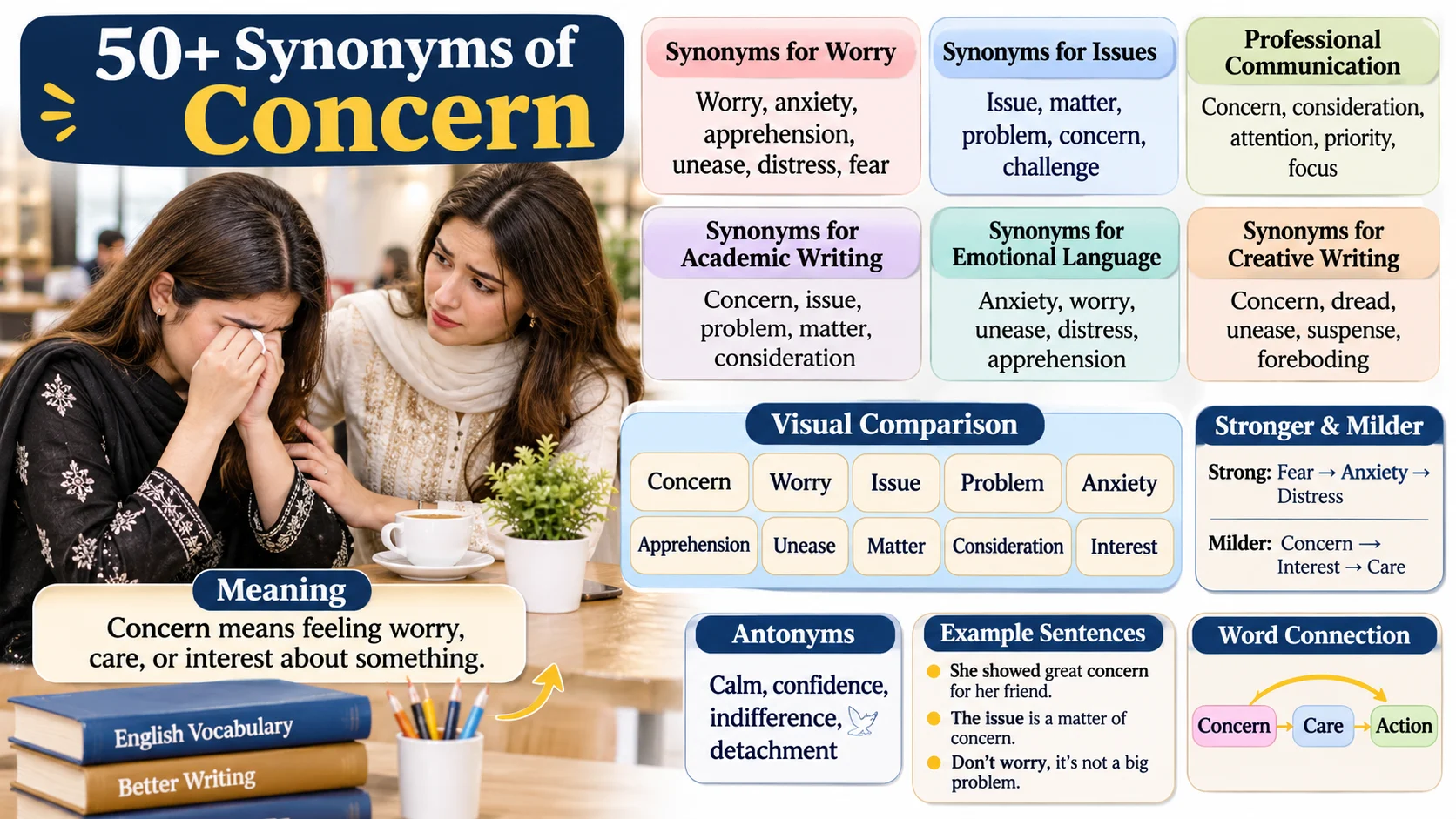
The best synonym of concern depends on its meaning. For worry, use worry, anxiety, apprehension, or unease. For an issue, use matter, issue, or problem. In professional writing, matter, issue, consideration, or regard can work well. In emotional contexts, anxiety or apprehension may be more precise.
Meaning, Tone, and Context
Simple Definition
Concern can mean a feeling of worry, something important that needs attention, or an interest or involvement in something. As a verb, it can also mean to affect, involve, or relate to someone or something.
For example:
The safety of the students is our main concern.
Here, concern means an important matter that requires attention.
In another sentence:
I am concerned about the deadline.
Here, concerned means worried.
Part of Speech
Concern can function as:
- Noun: a worry, issue, matter, or interest
- Verb: to worry someone, affect someone, involve someone, or relate to something
- Adjective form: concerned
- Related forms: concerning, concerned
Overall Tone
Concern is generally neutral. It can become positive, negative, or serious depending on the context.
For example:
- Neutral: The report addresses several concerns.
- Negative: She expressed concern about the safety issue.
- Positive: His concern for others shows compassion.
Formality Level
Concern is a neutral to semi formal word. It works naturally in:
- Everyday conversations
- Business emails
- Academic writing
- Reports
- Presentations
- Professional communication
- News writing
- Personal messages
It is especially useful because it does not automatically sound dramatic or overly casual.
Common Uses
Native English speakers commonly use concern when discussing:
- Worries or fears
- Problems
- Important issues
- Public matters
- Safety
- Health
- Business risks
- Personal interests
- Responsibilities
- Effects on people
- Topics that require attention
When and How to Use “Concern”
Choose concern when you want to communicate an issue, worry, interest, or relationship without necessarily sounding dramatic.
Professional
Employee safety remains a major concern for the company.
This sounds appropriate in a workplace report or presentation.
Academic
One major concern raised by the study is the lack of reliable data.
Here, concern refers to an important issue that deserves attention.
Workplace
I have some concerns about the proposed schedule.
This is a professional way to express reservations without sounding unnecessarily confrontational.
Personal
Her biggest concern was whether everyone would arrive safely.
Here, concern describes personal worry.
Thank you for bringing this concern to my attention.
This is a polite and professional way to acknowledge an issue.
Resume
Addressed customer concerns and resolved service issues efficiently.
In a resume, concerns refers to problems or questions raised by customers.
Social Media
My biggest concern is how this change will affect small businesses.
This works when discussing a public or personal issue.
Best Synonyms of “Concern”
There is no single perfect synonym for concern because the word has several meanings.
For Professional Writing: Issue
Use issue when you mean a problem, topic, or matter requiring attention.
The report identifies several key issues affecting productivity.
For Academic Writing: Consideration
Use consideration when you mean something that must be carefully thought about.
Cost is an important consideration when selecting the research method.
For Business Communication: Matter
Matter is useful when discussing a situation or subject in a neutral professional tone.
We will discuss the matter during tomorrow’s meeting.
For Casual Conversation: Worry
Use worry when concern specifically means feeling troubled or anxious.
My biggest worry is missing the last train.
For Emotional Writing: Anxiety
Use anxiety when the feeling involves significant nervousness or apprehension.
Her anxiety about the upcoming interview was understandable.
For Creative Writing: Unease
Unease creates a subtle emotional effect and works well in storytelling.
A growing sense of unease filled the room.
For Resume Writing: Issue
In resumes, issue often works better than concern when describing problems you solved.
Resolved customer issues while maintaining high satisfaction levels.
For Workplace Communication: Matter
Matter can sound calm and professional when discussing a sensitive situation.
Let’s address the matter before it affects the rest of the team.
For a Stronger Meaning: Anxiety
When concern means serious worry, anxiety communicates greater emotional intensity.
For a Softer Meaning: Consideration
When you want to mention something that deserves attention without implying a serious problem, consideration can be more measured.
When Not to Use “Concern”
When “Concern” Is Too General
If you mean a specific problem, concern may be less precise.
Less precise:
We need to solve this concern.
Better:
We need to solve this issue.
Issue identifies the situation more directly.
When “Concern” Is Too Vague
Consider replacing it when readers cannot tell whether you mean a worry, problem, or interest.
Vague:
This is a serious concern.
More precise:
This is a serious safety risk.
The second version tells readers exactly what the problem is.
When You Mean Strong Anxiety
Concern can sound too mild if someone is experiencing intense nervousness.
Mild:
She felt concern before the procedure.
Stronger:
She felt considerable anxiety before the procedure.
When You Mean a Specific Problem
In technical or professional writing, issue or problem may communicate more clearly.
General:
The team discussed several concerns.
Precise:
The team discussed several technical issues.
When You Mean Personal Interest
Sometimes interest is a better choice.
Less natural:
Environmental concern led him to study renewable energy.
Clearer:
His interest in environmental issues led him to study renewable energy.
Words Commonly Confused With “Concern”
Concern vs Worry
Difference: Worry specifically describes anxiety or troubled thoughts. Concern can mean worry, but it can also mean an issue, matter, or interest.
When to use: Use worry for personal anxiety and concern when you need a broader or more neutral word.
Example:
My main concern is the deadline.
My biggest worry is that we will miss the deadline.
Concern vs Issue
Difference: An issue is a subject, problem, or matter requiring attention. A concern can be an issue, but it can also be a feeling of worry.
When to use: Use issue when discussing a specific matter or problem.
Example:
Safety is a major concern.
The company needs to address the safety issue.
Concern vs Problem
Difference: A problem normally identifies something that needs solving. Concern can sound less direct.
When to use: Use problem when something is clearly causing difficulty.
Example:
We have concerns about the system.
The system has a serious technical problem.
Concern vs Anxiety
Difference: Anxiety describes a stronger emotional state involving nervousness or apprehension. Concern is broader and often milder.
When to use: Use anxiety when emotional intensity matters.
Example:
She expressed concern about the exam.
She experienced anxiety before the exam.
Concern vs Interest
Difference: Interest describes curiosity, attention, or involvement. Concern may describe worry or responsibility.
When to use: Use interest when you mean someone cares about or wants to know more about something.
Example:
The issue is a concern for residents.
The subject is of great interest to researchers.
Concern vs Consideration
Difference: A consideration is something taken into account during a decision. A concern often suggests worry or an issue requiring attention.
When to use: Use consideration when discussing decision making.
Example:
Cost is a concern.
Cost is an important consideration when choosing a supplier.
Best Synonyms of “Concern” by Context
| Context | Best Synonym | Why It Works | Example |
| Formal writing | Matter | Neutral and professional | The matter requires further review. |
| Academic writing | Consideration | Fits analytical discussion | Cost is an important consideration. |
| Professional communication | Issue | Clear and practical | We need to address this issue. |
| Business emails | Matter | Polite and measured | We will review the matter shortly. |
| Resume writing | Issue | Shows problem solving | Resolved customer issues promptly. |
| Workplace communication | Concern | Neutral and familiar | I have a concern about the schedule. |
| Casual conversation | Worry | Natural for personal anxiety | My biggest worry is the weather. |
| Everyday speaking | Worry | Direct and familiar | Don’t worry about it. |
| Creative writing | Unease | Adds emotional atmosphere | A feeling of unease spread through the room. |
| Storytelling | Apprehension | Creates suspense | He entered the room with apprehension. |
| Emotional writing | Anxiety | Expresses stronger worry | Her anxiety grew as the hour approached. |
| Strong emphasis | Problem | Clearly identifies difficulty | The delay is a serious problem. |
| Mild tone | Consideration | Less alarming | Timing is one consideration. |
| Social media captions | Worry | Conversational and accessible | My biggest worry right now is traffic. |
| American English | Concern | Common and flexible | I have some concerns about the plan. |
| British English | Concern | Also standard and widely used | The issue raised considerable concern. |
How to Choose the Best Synonym of “Concern”
Use this simple decision guide.
1. What do you mean?
If you mean worry, consider worry, anxiety, apprehension, or unease.
If you mean problem or issue, consider issue, problem, or matter.
If you mean something to think about, consider consideration.
If you mean interest or involvement, consider interest or involvement.
2. Who is reading?
For a manager, client, professor, or employer, choose a precise and professional word.
For friends and everyday conversations, worry is often more natural.
3. How strong is the feeling?
For mild worry, use concern or unease.
For stronger emotional distress, anxiety may be more accurate.
4. What is your purpose?
A business report may benefit from issue or matter. A personal story may sound more expressive with unease or apprehension.
5. Does the replacement preserve the original meaning?
Never choose a synonym simply because it sounds more sophisticated. The best synonym is the one that communicates your exact idea.
Real Life Examples of “Concern”
School
One concern among students is the limited time available for the project.
A more precise version could be:
One major issue among students is the limited time available for the project.
College
Financial concerns can affect a student’s academic performance.
Here, concerns appropriately refers to worries about money.
Workplace
Several employees expressed concerns about the new policy.
This sounds professional and appropriately measured.
Business
Rising operating costs are becoming a major concern for the company.
A stronger version could be:
Rising operating costs are becoming a major financial problem for the company.
I understand your concern and will review the matter carefully.
This is polite and suitable for professional communication.
Resume
Addressed customer concerns and provided timely solutions.
A more results focused version could be:
Resolved customer issues and provided timely solutions.
Conversation
Don’t worry. It’s not a major concern.
Here, worry is more conversational than concern.
Storytelling
A quiet sense of unease settled over the village.
Unease adds atmosphere that the neutral word concern would not create.
Blogging
One major concern for remote workers is maintaining a healthy work life balance.
The word works well because the sentence discusses a broader issue rather than intense personal anxiety.
Social Media
My biggest concern is whether small businesses can afford these changes.
The word sounds natural while keeping the statement neutral.
15 Best Synonyms of “Concern”
Because concern has multiple meanings, these alternatives represent its major senses rather than pretending every synonym works in every sentence.
| Synonym | Simple Meaning | Best Used For | Example Sentence |
| Worry | A troubled feeling | Everyday anxiety | My biggest worry is the deadline. |
| Anxiety | Strong nervousness or worry | Emotional writing | She felt anxiety before the interview. |
| Apprehension | Uneasy expectation about something | Formal or literary writing | He approached the meeting with apprehension. |
| Unease | A mild but noticeable feeling of discomfort | Creative writing | A sense of unease filled the room. |
| Fear | A strong response to danger or threat | Serious emotional situations | Fear about the storm kept residents indoors. |
| Issue | A matter or problem requiring attention | Professional writing | The team discussed the issue yesterday. |
| Problem | Something difficult that needs solving | Direct communication | The delay created a serious problem. |
| Matter | A subject or situation being discussed | Business communication | We will address the matter tomorrow. |
| Consideration | Something that should be taken into account | Academic and professional writing | Cost is an important consideration. |
| Interest | Attention, curiosity, or involvement | Personal and academic contexts | She has a strong interest in literature. |
| Involvement | Participation or connection | Workplace contexts | His involvement in the project was valuable. |
| Regard | Respect, attention, or consideration | Formal writing | The policy was created with regard for safety. |
| Affect | To have an influence on something | Formal verb usage | The changes may affect local businesses. |
| Involve | To include or affect someone | General and professional usage | The decision will involve several departments. |
| Pertain to | To relate directly to something | Formal and academic writing | The rules pertain to all employees. |
Synonyms of “Concern” by Usage
Professional vs Personal Synonyms
In professional settings, issue, matter, consideration, and concern are especially useful.
For personal conversations, worry, anxiety, fear, and unease may better communicate emotional meaning.
The distinction is important because professional communication often benefits from measured language, while personal writing can express feelings more directly.
Formal vs Conversational Synonyms
Formal writing can use:
- Consideration
- Matter
- Regard
- Apprehension
- Pertain to
Conversational English commonly uses:
- Worry
- Problem
- Issue
- Fear
Texting and casual speech usually favor familiar words such as worry and problem rather than more formal expressions such as regard.
Academic Synonyms
Academic writing benefits from precision.
Instead of repeatedly using concern, writers can choose:
- Issue
- Consideration
- Problem
- Apprehension
- Interest
- Regard
For example:
One concern associated with the theory is its limited evidence.
A more precise academic version is:
One limitation associated with the theory is its limited evidence.
The second sentence identifies the type of concern more clearly.
Professional and Business Synonyms
Resumes
Use issue when describing problems you solved.
Resolved customer issues efficiently.
Interviews
Use concern when discussing risks or reservations.
One concern I would consider is the effect on customer experience.
Meetings
Use matter for a neutral subject.
We should address this matter before moving forward.
Presentations
Use issue when introducing a challenge.
The presentation focuses on three major issues.
Performance Reviews
Use consideration when discussing factors.
Communication style should be an important consideration.
Client Communication
Use concern when acknowledging a client’s worry.
I understand your concern and appreciate you bringing it to our attention.
Business Emails
Use matter when you want a calm, professional tone.
We are currently reviewing the matter.
Creative and Literary Synonyms
Creative writing often benefits from alternatives that carry emotional texture.
Unease suggests a subtle feeling that something is wrong.
An unfamiliar unease followed him down the empty street.
Apprehension suggests nervous anticipation.
She opened the letter with quiet apprehension.
Fear is stronger and more direct.
Fear took hold when the lights suddenly went out.
Anxiety focuses on internal emotional tension.
His anxiety grew with every unanswered message.
These words should not be treated as interchangeable. The emotional effect changes with each choice.
Slang or Modern Synonyms
There is no single slang replacement for concern that works across all meanings.
Expressions such as worry and stress can sound informal in certain contexts, but they are standard English words rather than direct slang synonyms.
For professional, academic, and formal writing, avoid forcing slang into sentences simply to sound modern.
Strongest to Mildest Synonyms
The intensity depends heavily on context, but a useful emotional scale is:
Mild: unease → concern → worry → apprehension → anxiety → fear
These words should not be treated as a fixed universal ranking.
- Unease often suggests a subtle discomfort.
- Concern can describe moderate worry or an issue.
- Worry is a direct expression of troubled thought.
- Apprehension suggests nervous anticipation.
- Anxiety can describe stronger or more persistent nervousness.
- Fear generally communicates a stronger response to perceived danger.
Emotional vs Neutral Synonyms
Emotional Synonyms
These emphasize feelings:
- Worry
- Anxiety
- Fear
- Apprehension
- Unease
Use them when the emotional state is important.
Neutral Synonyms
These focus more on information or circumstances:
- Issue
- Matter
- Consideration
- Interest
- Involvement
Use them in reports, essays, workplace communication, and analytical writing when you want to reduce emotional emphasis.
Antonyms of “Concern”
Because concern has several meanings, there is no single set of opposites that works for every sense. The following alternatives cover opposite ideas such as calm instead of worry, and indifference instead of interest or involvement.
| Antonym | Meaning | Example Sentence |
| Calm | A state without worry or agitation | She remained calm during the discussion. |
| Reassurance | Something that reduces worry | His explanation provided reassurance. |
| Confidence | A belief that something will go well | Her confidence replaced her earlier doubts. |
| Certainty | Freedom from doubt | The decision gave the team certainty. |
| Unconcern | Lack of worry | His unconcern surprised everyone. |
| Indifference | Lack of interest or care | She showed indifference toward the criticism. |
| Apathy | Lack of interest or enthusiasm | Public apathy made the campaign difficult. |
| Disinterest | Lack of personal interest | His disinterest was clear from his response. |
| Detachment | Lack of emotional involvement | She discussed the subject with professional detachment. |
| Disregard | Lack of attention or consideration | The company was criticized for its disregard of safety rules. |
| Exclusion | The act of leaving something out | The exclusion of this group affected the results. |
| Irrelevance | Lack of connection to the matter | The detail was dismissed because of its irrelevance. |
| Unrelatedness | Lack of connection | The unrelatedness of the examples weakened the argument. |
| Disassociation | Separation or lack of connection | His disassociation from the project was confirmed. |
| Neglect | Failure to give necessary attention | The neglect of maintenance caused further problems. |
Comparison: “Concern” vs Similar Words
Concern vs Worry
Main Difference: Concern has several meanings, while worry specifically emphasizes troubled thoughts.
Which Is Stronger?
Worry often sounds more directly emotional.
Which Is More Formal?
Concern is generally more suitable for professional communication.
When to Use Each:
Use concern for professional issues and worry for personal anxiety.
Examples:
Concern:
I have some concerns about the proposal.
Worry:
I worry that the proposal may be too expensive.
Concern vs Issue
Main Difference: Issue usually identifies a topic, matter, or problem. Concern can identify the same thing or express worry.
Which Is Stronger?
Neither is universally stronger. Issue is more direct when describing a problem.
Which Is More Formal?
Both are appropriate in professional and academic writing.
When to Use Each:
Use issue for a specific matter and concern when emphasizing attention or worry.
Examples:
Concern:
Cost is a major concern.
Issue:
Cost is a major issue for the company.
Concern vs Problem
Main Difference: Problem clearly identifies something that needs to be solved.
Which Is Stronger?
Problem often sounds more direct and definite.
Which Is More Formal?
Both can work professionally, depending on context.
When to Use Each:
Use concern for a measured observation and problem for a clearly defined difficulty.
Examples:
Concern:
We have concerns about the schedule.
Problem:
The schedule creates a serious problem.
Concern vs Anxiety
Main Difference: Anxiety describes a stronger emotional condition or feeling of nervousness. Concern is much broader.
Which Is Stronger?
Anxiety is generally more emotionally intense.
Which Is More Formal?
Both can appear in formal writing, but they communicate different meanings.
When to Use Each:
Use anxiety when describing emotional distress or nervous anticipation.
Examples:
Concern:
She expressed concern about the results.
Anxiety:
She felt anxiety while waiting for the results.
Concern vs Interest
Main Difference: Interest describes attention, curiosity, or involvement. Concern can describe worry or responsibility.
Which Is Stronger?
They measure different ideas rather than different levels of intensity.
Which Is More Formal?
Both work in formal contexts.
When to Use Each:
Use interest when someone is curious about or engaged with a subject.
Examples:
Concern:
The environmental impact is a major concern.
Interest:
The environmental impact is an important area of interest.
Concern vs Consideration
Main Difference: A consideration is something included in decision making. A concern often suggests an issue or worry.
Which Is Stronger?
Concern can sound more urgent or negative.
Which Is More Formal?
Consideration is particularly useful in formal and academic writing.
When to Use Each:
Use consideration when describing a factor that should be evaluated.
Examples:
Concern:
Safety is our primary concern.
Consideration:
Safety is our primary consideration when selecting equipment.
Common Phrases and Expressions with “Concern”
1. Major concern
Meaning: An important worry or issue.
Example:
Data security is a major concern for online businesses.
2. Growing concern
Meaning: A worry or issue that is becoming more important.
Example:
Rising costs are a growing concern for local companies.
3. Serious concern
Meaning: A significant problem or worry.
Example:
The findings raise a serious concern about data quality.
4. Express concern
Meaning: To openly communicate worry or reservations.
Example:
Several employees expressed concern about the new schedule.
5. Raise concerns
Meaning: To cause people to notice or discuss possible problems.
Example:
The results raised concerns about the accuracy of the survey.
6. Address a concern
Meaning: To respond to or deal with a worry or issue.
Example:
The manager addressed the customer’s concern immediately.
7. Cause for concern
Meaning: A reason to feel worried or cautious.
Example:
The sudden drop in sales is a cause for concern.
8. Of concern
Meaning: Important or worrying to a particular person or group.
Example:
The changes are of particular concern to small businesses.
Common Mistakes to Avoid
Mistake 1: Using “Concern” When You Mean “Problem”
Incorrect:
The software has several concerns.
Better:
The software has several problems.
Why: If you are identifying actual faults that need fixing, problems is more precise.
Mistake 2: Using “Anxiety” for Every Type of Concern
Incorrect:
Cost is a major anxiety for the company.
Better:
Cost is a major concern for the company.
Why: Anxiety normally describes an emotional state. A business cost is better described as a concern or issue.
Mistake 3: Using “Worry” in Highly Formal Contexts Without Considering Tone
Incorrect:
The report discusses employee worries regarding compliance.
Better:
The report discusses employee concerns regarding compliance.
Why: Concern sounds more professional and neutral in formal reports.
Mistake 4: Choosing an Overly Dramatic Synonym
Incorrect:
The meeting schedule caused tremendous fear among employees.
Better:
The meeting schedule caused some concern among employees.
Why: Fear is much stronger and may exaggerate the actual situation.
Mistake 5: Repeating “Concern” Too Often
Incorrect:
The concern was discussed because the concern affected customers and the concern was reported by staff.
Better:
The issue was discussed because it affected customers and had been reported by staff.
Why: Replacing unnecessary repetitions makes the sentence cleaner.
Mistake 6: Using an Informal Word in Academic Writing
Incorrect:
The biggest worry in the study is the small sample size.
Better:
A major concern in the study is the small sample size.
Why: Concern provides a more suitable academic tone.
Mistake 7: Using a Synonym That Changes the Meaning
Incorrect:
His interest about the accident was obvious.
Better:
His concern about the accident was obvious.
Why: If he was worried about the accident, concern is more accurate than interest.
Frequently Asked Questions
1. What are the best synonyms of “concern”?
The best synonym depends on meaning. Use worry for personal anxiety, issue for a problem, matter for a situation, consideration for a decision factor, and anxiety for stronger emotional worry.
2. What are the best formal synonyms of “concern”?
Useful formal synonyms include matter, issue, consideration, regard, apprehension, and pertain to, depending on the sentence. In academic writing, choose the word that expresses the exact relationship rather than simply choosing the most formal option.
3. What are common informal synonyms of “concern”?
Worry is the most natural everyday alternative when concern means anxiety. Problem and issue can also work in casual conversation when you are discussing something that needs attention.
4. What is another word for “concern” in professional writing?
Issue, matter, consideration, and regard can work in professional writing. The best choice depends on whether you mean a problem, subject, decision factor, or respectful attention to something.
5. What is the difference between “concern” and “worry”?
Concern has several meanings and can sound neutral or professional. Worry specifically describes troubled thoughts or anxiety, so it is usually more emotional and conversational when the two words overlap.
6. What is the opposite of “concern”?
The opposite depends on the meaning. For worry, possible opposites include calm, reassurance, confidence, and certainty. For interest or involvement, indifference, apathy, and detachment can express opposite ideas.
Conclusion
The word concern is useful because it can describe worry, an issue, a matter, interest, involvement, or something that affects someone. However, its flexibility can also make it less precise when a more specific word would communicate your meaning better.
Use worry for everyday anxiety, issue for a problem, matter for a neutral professional situation, consideration for decision making, and anxiety when stronger emotional meaning is intended.
The best synonym depends on your audience, tone, purpose, and intended meaning. Before replacing concern, ask yourself exactly what you are trying to communicate.
Vocabulary tip: When learning a new synonym, learn it with a sentence and a context, not as an isolated word. This makes it much easier to choose the right synonym of concern naturally.

Ethan Parker is an English language writer and vocabulary enthusiast at SynonymDock.com. He specializes in synonyms, word meanings, alternative expressions and practical English usage, creating clear and reliable content to help students, professionals, writers and English learners choose the right words with confidence.
1 thought on “Synonyms of Concern|53+ Examples and Best Alternatives”