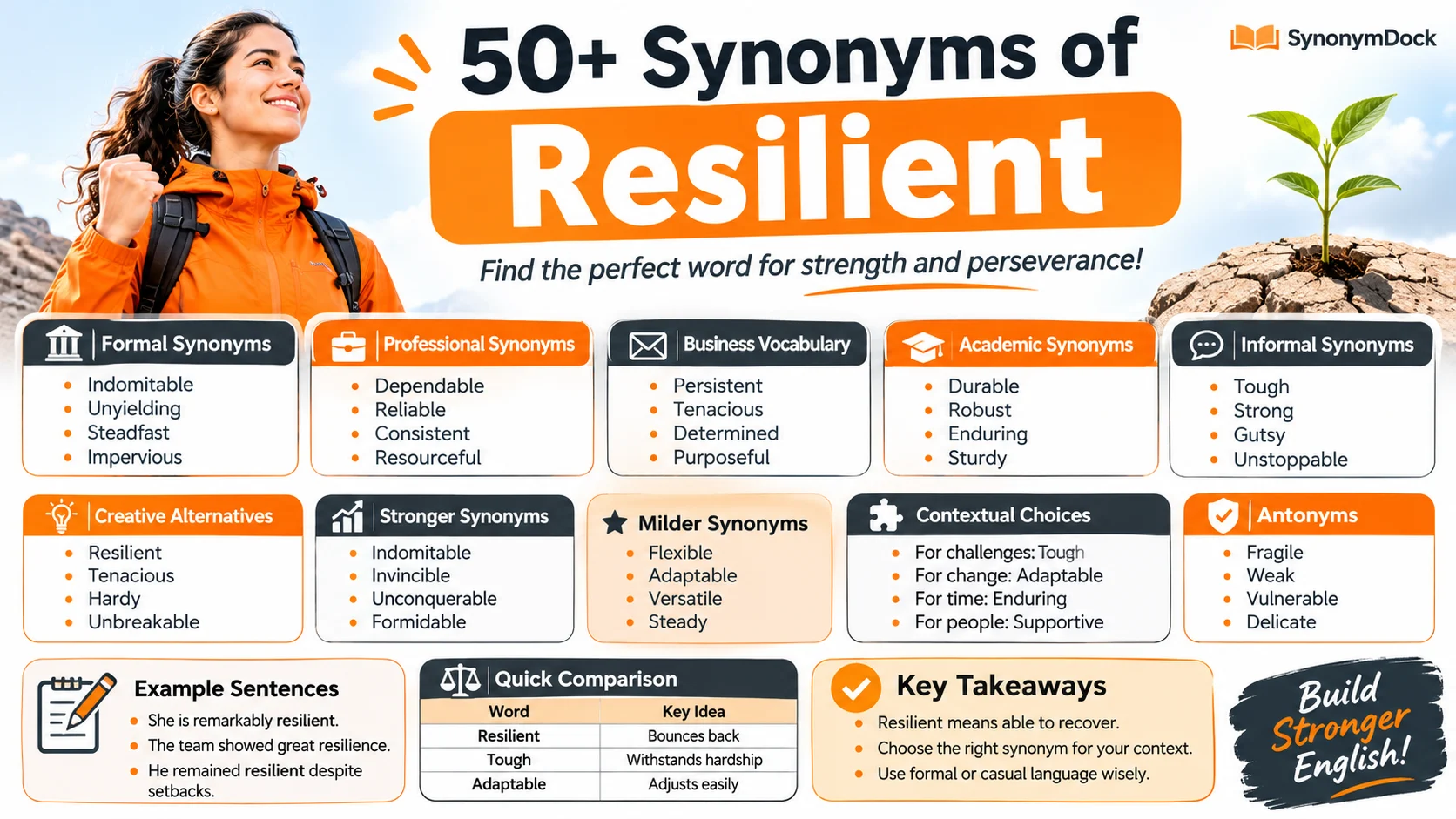
You may use the word resilient repeatedly in emails, essays, resumes, captions, reports, or professional conversations. While it is a strong and useful word, repeating it can make your writing feel less precise.
Knowing the right synonym of resilient helps you describe people, organizations, materials, or systems more accurately. Some alternatives emphasize recovery, while others focus on strength, flexibility, endurance, or the ability to adapt.
The best synonym depends on what you actually want to communicate.
What Are the Best Synonyms of “Resilient”?
Resilient describes someone or something that can recover, adapt, or continue functioning after difficulty, pressure, damage, or change. Strong alternatives include strong, tough, durable, adaptable, flexible, hardy, robust, persistent, tenacious, and enduring. For professional writing, adaptable, robust, and durable are especially useful.
Meaning, Tone, and Context
Simple Definition
Resilient means able to recover from difficulties, adjust to change, or continue working effectively despite pressure or damage.
For example:
She remained resilient after several setbacks.
The sentence suggests that she experienced difficulties but recovered and continued moving forward.
Part of Speech
Resilient is an adjective.
Related forms include:
- Resilience, noun
- Resiliently, adverb
Example:
The team’s resilience helped it recover after the project failed.
Overall Tone
Resilient is generally positive.
It often communicates strength, determination, adaptability, and recovery. However, the emotional effect depends on the context.
Calling a person resilient can recognize their ability to handle adversity. Calling a material resilient usually describes its ability to return to its original condition or withstand stress.
Formality Level
Resilient is neutral to moderately formal.
It works naturally in:
- Academic writing
- Professional communication
- Business reports
- Resumes
- Interviews
- Everyday conversation
- Personal writing
It is not considered slang or overly formal.
Common Uses
Native English speakers commonly use resilient to describe:
- People
- Communities
- Businesses
- Organizations
- Economies
- Systems
- Materials
- Structures
- Plants
- Processes
The meaning changes slightly depending on the noun.
She is resilient.
This focuses on emotional or psychological recovery.
The material is resilient.
This focuses on physical durability or its ability to recover after stress.
When and How to Use “Resilient”
Choose resilient when you want to emphasize recovery, adaptation, or continued strength after difficulty.
1. Professional
Our team remained resilient despite the unexpected changes to the project.
This works well in workplace communication because it highlights adaptability and continued performance.
2. Academic
Resilient communities often develop effective strategies for responding to environmental challenges.
Academic writing can use resilient when discussing people, communities, institutions, or systems.
3. Workplace
She has shown that she is resilient under pressure.
This is useful when discussing an employee’s response to challenging situations.
4. Personal
He is remarkably resilient after everything he has experienced.
Here, the word emphasizes emotional recovery and strength.
5. Email
Thank you for remaining resilient and focused throughout this challenging project.
This sounds professional and encouraging.
6. Resume
Built resilient customer support processes that continued operating during periods of rapid growth.
In a resume, resilient can describe systems, processes, teams, or organizations.
7. Social Media
Life can be difficult, but staying resilient helps us keep moving forward.
The word works naturally in motivational or reflective posts.
Best Synonyms of “Resilient”
No synonym of resilient has exactly the same meaning in every situation. The important distinction is what aspect of resilience you want to emphasize.
| Situation | Recommended Word | Why It Works |
| Professional writing | Adaptable | Emphasizes adjusting to change |
| Academic writing | Robust | Works well for systems, methods, and structures |
| Business communication | Durable | Highlights lasting performance |
| Casual conversation | Tough | Natural and conversational |
| Emotional writing | Strong | Emphasizes personal strength |
| Creative writing | Hardy | Suggests strength despite difficult conditions |
| Resume writing | Adaptable | Shows the ability to respond effectively to change |
| Workplace communication | Flexible | Highlights adjustment to changing circumstances |
| Stronger meaning | Tenacious | Emphasizes determination and persistence |
| Softer meaning | Steady | Suggests calm consistency rather than intense struggle |
When Not to Use “Resilient”
When the Word Is Too General
Sometimes resilient does not tell the reader exactly what kind of strength you mean.
Instead of:
She is resilient.
You might write:
She remained determined despite repeated setbacks.
Determined makes the person’s persistence more specific.
When You Mean Physical Strength
If you are talking about an object that simply lasts a long time, durable may be more precise.
Instead of:
This backpack is resilient.
Write:
This backpack is durable and designed for frequent use.
When You Mean Flexibility
If the main idea is the ability to adjust to change, adaptable or flexible may be better.
Instead of:
Our employees are resilient.
Write:
Our employees are adaptable and comfortable with changing priorities.
When You Mean Persistence
If someone refuses to give up, tenacious or persistent may communicate the idea more clearly.
Instead of:
She is resilient in pursuing her goals.
Write:
She is tenacious in pursuing her goals.
When You Mean Physical Hardness
Resilient does not always mean hard or rigid.
Instead of:
The surface is resilient against scratches.
Consider:
The surface is durable and resistant to scratches.
The second sentence provides more specific information.
When the Word Sounds Too Strong
In a simple everyday situation, resilient can sometimes sound more serious than necessary.
Instead of:
He was resilient after missing the bus.
You could simply say:
He stayed calm and found another way to get there.
Words Commonly Confused With “Resilient”
Resilient vs Strong
Main Difference: Strong can describe physical, emotional, or general power. Resilient specifically emphasizes recovery or continued functioning after difficulty.
Which Is Stronger?
Strong is broader. Resilient is more specific about responding to adversity.
Which Is More Formal?
Both are widely accepted, but resilient often sounds more precise in professional and academic writing.
When to Use Each:
Use strong for general strength. Use resilient when recovery or adaptation matters.
Examples:
Resilient:
The community remained resilient after the storm.
Strong:
The community showed strong leadership during the crisis.
Resilient vs Tough
Main Difference: Tough often describes the ability to withstand hardship, pressure, or difficult conditions. Resilient emphasizes recovery and adaptation.
Which Is Stronger?
Tough can sound more forceful and conversational.
Which Is More Formal?
Resilient is generally more suitable for formal writing.
When to Use Each:
Use tough in everyday conversation. Use resilient in professional, academic, or analytical contexts.
Examples:
Resilient:
The team remained resilient after losing an important client.
Tough:
She is tough enough to handle difficult situations.
Resilient vs Durable
Main Difference: Durable usually describes something that lasts or withstands wear. Resilient can describe recovery after stress or damage.
Which Is Stronger?
Neither is universally stronger. The words describe different qualities.
Which Is More Formal?
Both are suitable for formal writing.
When to Use Each:
Use durable for products, materials, and objects. Use resilient for people, organizations, systems, and recovery.
Examples:
Resilient:
The organization proved resilient during the economic downturn.
Durable:
The equipment is durable enough for daily use.
Resilient vs Adaptable
Main Difference: Adaptable focuses on adjusting to new conditions. Resilient focuses on recovering and continuing after difficulty.
Which Is Stronger?
Resilient often carries a stronger connection to adversity.
Which Is More Formal?
Both are professional and academic.
When to Use Each:
Use adaptable when change is the main idea. Use resilient when hardship or recovery is central.
Examples:
Resilient:
The company remained resilient during the crisis.
Adaptable:
The company is adaptable when market conditions change.
Resilient vs Persistent
Main Difference: Persistent means continuing despite difficulty or opposition. Resilient emphasizes recovery and the ability to keep functioning.
Which Is Stronger?
Persistent focuses more directly on continued effort.
Which Is More Formal?
Both work well in professional writing.
When to Use Each:
Use persistent for goals and repeated effort. Use resilient for recovery from setbacks.
Examples:
Resilient:
She was resilient after several professional setbacks.
Persistent:
She was persistent in pursuing the position.
Resilient vs Robust
Main Difference: Robust usually means strong, healthy, reliable, or capable of handling demanding conditions. Resilient often emphasizes recovery.
Which Is Stronger?
Robust can suggest strong overall performance. Resilient specifically highlights response to stress.
Which Is More Formal?
Both are common in professional and academic writing.
When to Use Each:
Use robust for systems, methods, businesses, and processes. Use resilient when recovery is important.
Examples:
Resilient:
The organization remained resilient during the disruption.
Robust:
The company developed a robust security system.
Best Synonyms of “Resilient” by Context
| Context | Best Synonym | Why It Works | Example |
| Formal writing | Robust | Sounds precise and professional | The institution has a robust support system. |
| Academic writing | Adaptable | Clearly communicates adjustment | Adaptable communities respond effectively to change. |
| Professional communication | Adaptable | Highlights workplace flexibility | She is highly adaptable in changing environments. |
| Business emails | Flexible | Sounds natural and practical | We need a flexible approach to the revised schedule. |
| Resume writing | Adaptable | Shows an employable skill | Adaptable professional with experience across changing environments. |
| Workplace communication | Flexible | Focuses on adjustment | Our team remains flexible when priorities shift. |
| Casual conversation | Tough | Natural and familiar | She’s tough and handles setbacks well. |
| Everyday speaking | Strong | Simple and widely understood | He’s strong enough to keep going. |
| Creative writing | Hardy | Suggests survival under difficult conditions | The hardy plant survived the harsh season. |
| Storytelling | Enduring | Creates a sense of lasting strength | Their enduring friendship survived years of separation. |
| Emotional writing | Strong | Highlights inner strength | She remained strong through a difficult period. |
| Strong emphasis | Tenacious | Emphasizes determination | He is a tenacious competitor. |
| Mild tone | Steady | Avoids dramatic language | She remained steady during the transition. |
| Social media captions | Tough | Short and conversational | Stay tough when things get difficult. |
| American English | Resilient | Common and natural | The community remained resilient after the disaster. |
| British English | Resilient | Also natural in British English | The industry has remained resilient. |
How to Choose the Best Synonym of “Resilient”
Use this simple decision guide.
If You Mean “Able to Adjust”
Choose adaptable.
She is adaptable when circumstances change.
If You Mean “Able to Change Easily”
Choose flexible.
He has a flexible approach to problem solving.
If You Mean “Able to Last”
Choose durable.
The material is durable enough for everyday use.
If You Mean “Strong Under Pressure”
Choose tough or robust, depending on context.
The system is robust enough to handle heavy demand.
If You Mean “Does Not Give Up”
Choose persistent or tenacious.
She is tenacious when pursuing difficult goals.
If You Mean “Recovers After Difficulty”
Choose resilient.
The team was resilient after the unexpected setback.
If You Mean “Survives Difficult Conditions”
Choose hardy.
These plants are hardy enough to survive cold weather.
The best synonym should match the meaning, tone, audience, emotional strength, and purpose of your sentence.
Real Life Examples of “Resilient”
School
Students can become more resilient when they learn how to respond constructively to setbacks.
College
College students often need to be resilient when balancing academic pressure and personal responsibilities.
Workplace
Our team stayed resilient during a period of major organizational change.
Business
The company developed a resilient business model that could respond to changing market conditions.
Your resilient approach to the project helped the team stay focused.
Resume
Developed resilient operational processes during a period of rapid organizational growth.
Conversation
She’s incredibly resilient. She always finds a way to move forward.
Storytelling
Despite years of hardship, the resilient character continued rebuilding her life.
Blogging
Building a resilient mindset can help you respond more effectively to unexpected challenges.
Social Media
Being resilient does not mean life is always easy. It means you keep adapting when things change.
18 Best Synonyms of “Resilient”
| Synonym | Simple Meaning | Best Used For | Example Sentence |
| Strong | Having physical or emotional strength | General communication | She stayed strong during the difficult period. |
| Tough | Able to handle difficult conditions | Casual conversation | He is tough enough to handle setbacks. |
| Durable | Able to last without easily being damaged | Products and materials | The boots are durable enough for regular use. |
| Adaptable | Able to adjust to new conditions | Work and academic contexts | She is highly adaptable in changing environments. |
| Flexible | Able to change or adjust easily | Workplace communication | We need a flexible approach to the new schedule. |
| Hardy | Able to survive difficult conditions | Plants, people, environments | The hardy plants survived the cold winter. |
| Robust | Strong and able to function under demanding conditions | Systems and organizations | The company has a robust recovery plan. |
| Persistent | Continuing despite difficulty | Goals and effort | His persistent efforts eventually paid off. |
| Tenacious | Very determined and unwilling to give up | Professional and strong writing | She is a tenacious advocate for her team. |
| Enduring | Continuing for a long time | Emotional and creative writing | Their enduring friendship survived many challenges. |
| Steady | Calm and consistent | Mild descriptions | She remained steady during the transition. |
| Sturdy | Strong and physically solid | Objects and structures | The sturdy table can support heavy equipment. |
| Unyielding | Refusing to weaken or change | Strong descriptive writing | His unyielding determination impressed the entire team. |
| Persistent | Continuing with sustained effort | Academic and professional contexts | The persistent researcher continued investigating the problem. |
| Determined | Firmly committed to achieving something | Personal and professional writing | She remained determined despite the setback. |
| Gritty | Showing courage and determination during hardship | Informal and expressive writing | His gritty approach helped him overcome repeated obstacles. |
Synonyms of “Resilient” by Usage
Professional vs Personal Synonyms
In professional writing, adaptable, robust, durable, flexible, capable, and resourceful are often more precise.
In personal writing, strong, tough, determined, enduring, and hardy can sound more natural.
For example:
She is an adaptable employee.
This sounds professional.
She’s tough.
This sounds more conversational.
Formal vs Conversational Synonyms
For reports, essays, presentations, and formal emails, consider:
- Adaptable
- Robust
- Durable
- Persistent
- Tenacious
- Resourceful
For casual conversations, consider:
- Strong
- Tough
- Steady
- Determined
Avoid choosing a sophisticated synonym simply because it sounds impressive. Precision is more valuable than complexity.
Academic Synonyms
Academic writing often benefits from words that identify the exact quality being discussed.
Adaptable
Use when discussing how people or systems respond to changing circumstances.
Adaptable institutions can respond more effectively to changing social conditions.
Robust
Use for systems, methods, frameworks, or evidence that can withstand demanding conditions.
The researchers developed a robust analytical framework.
Persistent
Use when repeated effort is central to the meaning.
Persistent investigation produced additional evidence.
Enduring
Use when discussing something that continues over a long period.
The study examines the enduring effects of social change.
Professional and Business Synonyms
Adaptable
Useful for resumes, interviews, and performance reviews.
Adaptable professional who works effectively in changing environments.
Resourceful
Useful when someone finds practical solutions to difficult problems.
She is a resourceful team member who consistently identifies practical solutions.
Robust
Useful for systems, strategies, processes, and business models.
The company implemented a robust quality control process.
Flexible
Useful when describing a willingness or ability to adjust.
He takes a flexible approach to changing client requirements.
Tenacious
Useful when strong determination is important.
Her tenacious approach helped the team complete the project.
Creative and Literary Synonyms
Creative writing often benefits from more expressive alternatives.
Hardy
Suggests survival despite harsh conditions.
The hardy little tree continued growing between the stones.
Enduring
Creates a sense of lasting strength.
Their enduring bond survived years of separation.
Tenacious
Emphasizes powerful determination.
Her tenacious spirit refused to disappear.
Gritty
Adds a more informal and vivid feeling.
The gritty character kept fighting for a better future.
Unyielding
Creates a strong sense of firmness.
His unyielding resolve carried him through the darkest chapter of his journey.
Slang or Modern Synonyms
There is no single slang word that perfectly replaces resilient in every situation.
Words such as tough and gritty can work in informal American English, but they should not automatically replace resilient in academic papers, formal reports, or professional documents.
For example:
She’s tough.
This is natural in casual conversation.
She demonstrated resilience during organizational change.
This is more appropriate for a professional report.
Strongest to Mildest Synonyms
The following scale is contextual rather than absolute.
Mild
Steady, capable
These words communicate competence or consistency without strong emotional emphasis.
Moderate
Strong, flexible, adaptable, durable
These emphasize useful strength or adjustment.
Strong
Persistent, hardy, robust, determined
These suggest greater ability to withstand difficulty or continue despite challenges.
Very Strong
Tenacious, unyielding
These can suggest particularly strong determination or refusal to give up.
The right intensity depends on the subject. A word that sounds appropriate for a person may sound unnatural for a physical object.
Emotional vs Neutral Synonyms
Emotional Synonyms
These can carry stronger feelings or personal meaning:
- Strong
- Tough
- Determined
- Tenacious
- Gritty
- Enduring
- Unyielding
Example:
Her tenacious spirit inspired everyone around her.
Neutral Synonyms
These communicate information with less emotional emphasis:
- Adaptable
- Flexible
- Durable
- Robust
- Capable
- Steady
- Persistent
Example:
The system is robust enough to handle increased demand.
Choose emotional vocabulary when the human experience matters. Choose neutral vocabulary when clarity and precision matter more.
Antonyms of “Resilient”
The opposite of resilient depends on whether you mean emotional recovery, physical durability, or adaptability.
| Antonym | Meaning | Example Sentence |
| Fragile | Easily damaged or weakened | The fragile material broke under pressure. |
| Vulnerable | Easily harmed or affected | The community was vulnerable to flooding. |
| Brittle | Likely to break rather than bend | The brittle surface cracked under stress. |
| Frail | Physically weak or delicate | The frail structure could not withstand the storm. |
| Delicate | Easily damaged or affected | The delicate equipment requires careful handling. |
| Weak | Lacking strength | The weak structure needed additional support. |
| Susceptible | Easily affected by something harmful | The crop is susceptible to disease. |
| Breakable | Capable of being easily broken | The package contains breakable items. |
| Defenseless | Unable to protect itself | The isolated system was defenseless against the attack. |
| Powerless | Lacking the ability to control or resist | The workers felt powerless during the sudden change. |
| Unstable | Not steady or reliable | The unstable structure required immediate repairs. |
| Inflexible | Unable or unwilling to adjust | The inflexible policy created problems for employees. |
| Unadaptable | Unable to adjust to new conditions | An unadaptable system may struggle during rapid change. |
| Sensitive | Easily affected by external conditions | The sensitive equipment reacts to temperature changes. |
| Incapable | Unable to handle or perform something | The incapable system could not recover after failure. |
Some of these are direct opposites in particular contexts rather than universal opposites. For example, fragile is especially useful as the opposite of resilient when discussing physical strength, while inflexible or unadaptable works better when the focus is adjustment to change.
Common Phrases and Expressions With “Resilient”
1. Resilient people
Meaning: People who recover or continue after difficult experiences.
Example:
Resilient people often learn from challenging experiences.
2. Resilient community
Meaning: A community capable of responding to and recovering from difficulties.
Example:
The city is working to build a more resilient community.
3. Resilient mindset
Meaning: A way of thinking that supports adaptation and recovery.
Example:
Developing a resilient mindset can help people respond to setbacks.
4. Resilient system
Meaning: A system designed to continue functioning or recover after disruption.
Example:
The company needs a resilient system for handling unexpected outages.
5. Resilient business
Meaning: A business capable of adapting to difficult or changing conditions.
Example:
A resilient business can respond effectively to changing customer needs.
6. Resilient economy
Meaning: An economy capable of recovering from disruption.
Example:
Analysts examined how the resilient economy responded to the downturn.
7. Resilient material
Meaning: A material that can withstand stress or recover after deformation.
Example:
The manufacturer selected a resilient material for the product.
Common Mistakes to Avoid
Mistake 1: Treating Every Synonym as Identical
Incorrect:
The durable employee recovered quickly after the setback.
Better:
The resilient employee recovered quickly after the setback.
Why: Durable usually describes things that last, while resilient can describe a person’s ability to recover.
Mistake 2: Using “Resilient” When You Mean “Persistent”
Incorrect:
She was resilient in sending applications every day.
Better:
She was persistent in sending applications every day.
Why: Persistent focuses on continued effort. Resilient focuses more on recovery or adaptation.
Mistake 3: Using Casual Language in Formal Writing
Incorrect:
The employee is really tough when things go wrong.
Better:
The employee is resilient when facing challenging circumstances.
Why: Tough is natural but more conversational.
Mistake 4: Choosing an Overly Dramatic Synonym
Incorrect:
The adaptable team displayed unyielding strength after a minor schedule change.
Better:
The flexible team adjusted easily to the schedule change.
Why: The second sentence matches the seriousness of the situation more naturally.
Mistake 5: Repeating “Resilient” Too Often
Incorrect:
The resilient team built a resilient system for resilient business operations.
Better:
The adaptable team built a robust system for reliable business operations.
Why: Strategic variation makes professional writing clearer and less repetitive.
Mistake 6: Choosing the Wrong Emotional Tone
Incorrect:
The fragile employee handled the challenge effectively.
Better:
The resilient employee handled the challenge effectively.
Why: Fragile suggests vulnerability, while resilient communicates the ability to cope and recover.
Mistake 7: Assuming “Resilient” Always Means “Strong”
Incorrect:
The resilient chair is extremely heavy.
Better:
The sturdy chair is extremely strong.
Why: Resilience and physical strength are related but not identical concepts.
Comparison: “Resilient” vs Similar Words
Resilient vs Strong
Main Difference: Strong is broad. Resilient specifically suggests recovery or continued effectiveness after difficulty.
Which Is Stronger?
Strong can describe greater physical or emotional power, but resilient is more specific.
Which Is More Formal?
Both are suitable for formal writing.
When to Use Each:
Use strong for general strength. Use resilient for recovery and adaptation.
Examples:
Resilient:
The organization remained resilient after the crisis.
Strong:
The organization has strong leadership.
Resilient vs Tough
Main Difference: Tough emphasizes the ability to handle difficulty. Resilient emphasizes recovery and adaptation.
Which Is Stronger?
Tough often sounds more forceful in casual speech.
Which Is More Formal?
Resilient.
When to Use Each:
Use tough in everyday conversation and resilient in formal or professional contexts.
Examples:
Resilient:
She remained resilient throughout the transition.
Tough:
She is tough enough to handle the pressure.
Resilient vs Durable
Main Difference: Durable usually describes lasting physical quality. Resilient can describe recovery or continued functioning.
Which Is Stronger?
Neither is universally stronger.
Which Is More Formal?
Both are appropriate in professional writing.
When to Use Each:
Use durable for products and materials. Use resilient for people, organizations, and systems.
Examples:
Resilient:
The company proved resilient during the downturn.
Durable:
The equipment is durable and reliable.
Resilient vs Adaptable
Main Difference: Adaptable focuses on adjustment. Resilient focuses on recovery and continued strength.
Which Is Stronger?
Resilient often suggests that something has already faced adversity.
Which Is More Formal?
Both are formal enough for professional and academic contexts.
When to Use Each:
Use adaptable when change is central. Use resilient when recovery is central.
Examples:
Resilient:
The team remained resilient after the setback.
Adaptable:
The team is adaptable when priorities change.
Resilient vs Persistent
Main Difference: Persistent describes continuing an effort. Resilient describes recovering or remaining effective after difficulty.
Which Is Stronger?
Persistent is stronger when repeated effort is the main idea.
Which Is More Formal?
Both are suitable for professional writing.
When to Use Each:
Use persistent for effort. Use resilient for recovery.
Examples:
Resilient:
She remained resilient after repeated disappointments.
Persistent:
She remained persistent in pursuing her goal.
Resilient vs Robust
Main Difference: Robust suggests strength, reliability, or resistance to demanding conditions. Resilient emphasizes recovery.
Which Is Stronger?
Robust can suggest broad operational strength. Resilient suggests recovery capability.
Which Is More Formal?
Both are highly suitable for professional and academic writing.
When to Use Each:
Use robust for systems and processes. Use resilient for recovery and adaptation.
Examples:
Resilient:
The organization was resilient during the disruption.
Robust:
The organization developed a robust security framework.
Frequently Asked Questions
1. What are the best synonyms of “resilient”?
The best synonym depends on context. Adaptable works well for changing conditions, durable for physical objects, tough for casual speech, robust for systems, and tenacious when strong determination is the main idea.
2. What are the best formal synonyms of “resilient”?
Strong formal alternatives include adaptable, robust, durable, persistent, tenacious, and resourceful. The best choice depends on whether you are describing recovery, flexibility, reliability, or determination.
3. What are common informal synonyms of “resilient”?
Common informal alternatives include tough, strong, gritty, and hardy. These words can sound natural in conversations, personal writing, and informal social media, but some are less appropriate for academic or business writing.
4. What is another word for “resilient” in professional writing?
Adaptable is often an excellent professional alternative when describing a person’s ability to adjust to changing circumstances. Robust and durable can work better when describing systems, processes, or products.
5. What is the difference between “resilient” and “adaptable”?
Resilient emphasizes recovering or continuing after difficulty, while adaptable emphasizes adjusting to change. A resilient employee recovers after a setback, while an adaptable employee adjusts effectively when circumstances change.
6. What is the opposite of “resilient”?
Common contextual opposites include fragile, vulnerable, brittle, frail, weak, susceptible, unstable, inflexible, and unadaptable. The most accurate opposite depends on whether you mean physical durability, emotional recovery, or adaptability.
Conclusion
Being resilient means having the strength to face challenges, overcome difficulties, and recover from setbacks. Words such as strong, tough, adaptable, determined, persistent, hardy, and persevering can help express this quality in different ways. Each synonym adds a slightly different meaning, making your communication more natural, meaningful, and effective. Whether you are writing an academic essay, a professional email, or having an everyday conversation, choosing the right alternative can make your message more powerful. Remember, resilience is not about avoiding difficulties; it is about learning from challenges, maintaining a positive attitude, and continuing to move forward despite obstacles. By understanding these alternatives, you can enrich your vocabulary and express strength, courage, and determination with greater confidence.

Ethan Parker is an English language writer and vocabulary enthusiast at SynonymDock.com. He specializes in synonyms, word meanings, alternative expressions and practical English usage, creating clear and reliable content to help students, professionals, writers and English learners choose the right words with confidence.
11 thoughts on “50+ Synonyms for Resilient| Powerful Words to Describe Strength”