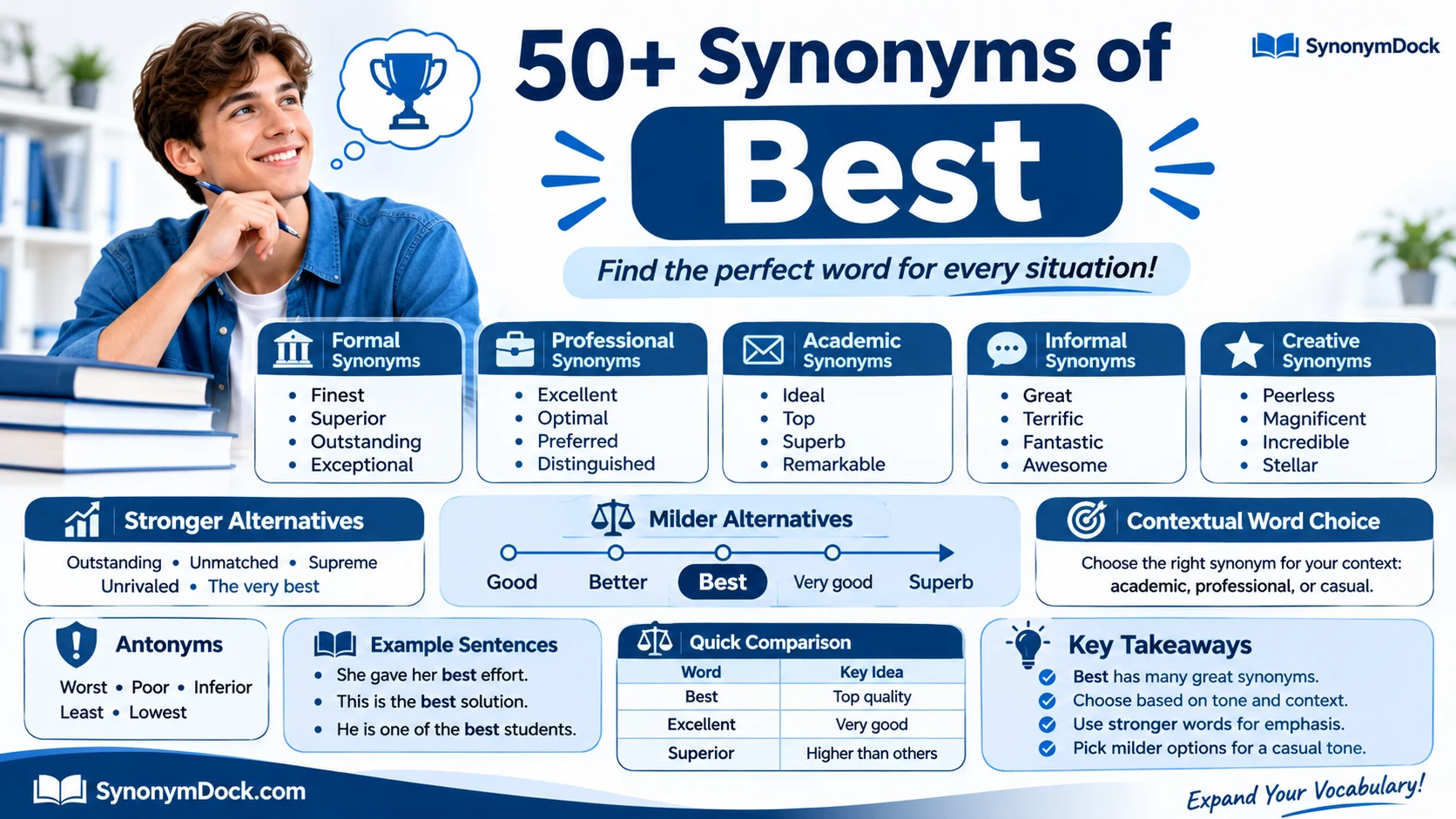
When you use the word best repeatedly in emails, essays, resumes, captions, blog posts, or everyday conversations, your writing can start to sound repetitive. The right alternative can make your message more precise, professional, or expressive.
Finding the right synonym of best is not simply about replacing one word with another. Words such as finest, excellent, ideal, superior, and outstanding have different meanings, tones, and levels of emphasis.
This guide explains those differences so you can choose the word that fits your audience, purpose, and context.
What Are the Best Synonyms of “Best”?
The word best usually describes the highest quality, most suitable choice, or most favorable result among available options. Common alternatives include finest, excellent, ideal, superior, outstanding, exceptional, optimal, preferred, prime, first rate, top, leading, remarkable, superb, exemplary, unparalleled, unrivaled, and preeminent. The best choice depends on context and tone.
Meaning, Tone, and Context
Simple Definition
Best means better than all other choices, or the most suitable, effective, desirable, or excellent option in a particular situation.
For example:
This is the best solution for our team.
Here, best means the solution is considered more suitable or effective than the alternatives.
Part of Speech
Best can function as:
- An adjective: She chose the best option.
- A noun: We want the best for our customers.
- An adverb: This method works best.
- A verb: The champion bested his opponent.
The synonym you choose should match the grammatical role of the original word.
Overall Tone
The tone of best is generally positive and neutral.
It is one of the most common English words for expressing high quality, preference, or superiority. It works in casual speech, professional communication, academic writing, advertising, and personal writing.
Formality Level
Best is primarily neutral.
It is not overly formal or informal, which makes it highly versatile. However, a more specific alternative may sound more polished in formal or academic writing.
Common Uses
Native English speakers commonly use best when discussing:
- Quality
- Choices
- Performance
- Recommendations
- Results
- Personal preferences
- Professional performance
- Solutions
- Products and services
- Achievements
- Personal wishes
Word Forms
Related forms include:
- Better, comparative form
- Best, superlative form
- Bested, verb form meaning defeated
The related adjective excellent and noun excellence can sometimes express a similar idea, but they are not grammatical replacements in every sentence.
When and How to Use “Best”
The word best is useful when you want to express the highest degree of quality, suitability, or preference.
Professional
Best:
We need to determine the best approach before moving forward.
This is natural in workplace communication because best is clear without sounding excessively formal.
Academic
Best:
The researchers selected the best method for analyzing the available data.
In academic writing, a more precise term such as most appropriate may sometimes be preferable if the evidence does not establish absolute superiority.
Workplace
Best:
Let’s discuss the best way to handle the issue.
This sounds natural in meetings and team discussions.
Personal
Best:
I hope you have the best birthday ever.
Here, best expresses a positive personal wish.
Best:
Thank you for your help. Best regards,
Jordan
In email writing, Best is also commonly used as a professional sign off.
Resume
Best:
Selected as the best performer on the regional sales team.
For a resume, a more specific achievement such as top performer can be stronger when it is supported by measurable evidence.
Social Media
Best:
One of the best weekends I’ve had in years!
The word works naturally in informal and enthusiastic posts.
Best Synonyms of “Best”
No synonym of best works perfectly in every sentence. The most accurate choice depends on what you mean by best.
For Professional Writing: Excellent
Excellent works well when you want to describe very high quality without necessarily claiming that something is number one.
She delivered an excellent presentation.
For Academic Writing: Most Appropriate
Most appropriate is useful when the meaning is about suitability rather than absolute superiority.
This method is the most appropriate for the research question.
For Business Communication: Optimal
Optimal works when discussing the most effective condition, strategy, or solution.
We are looking for the optimal pricing strategy.
For Casual Conversation: Top
Top is concise and natural in informal contexts.
This is one of my top choices.
For Emotional Writing: Finest
Finest can add warmth or admiration.
She gave us her finest performance.
For Creative Writing: Superb
Superb creates a stronger expressive effect than ordinary best.
The chef prepared a superb meal.
For Resume Writing: Outstanding
Outstanding can describe performance that clearly stands above expectations.
Recognized for outstanding customer service.
For Workplace Communication: Superior
Superior can describe something that performs better than another option, especially when making a comparison.
The new system offers superior security.
Use it carefully because it explicitly suggests comparison.
For a Stronger Meaning: Exceptional
Exceptional suggests that something stands noticeably above the ordinary.
She demonstrated exceptional leadership.
For a Softer Meaning: Preferred
Preferred is useful when you want to express a choice without making an absolute claim.
The preferred method is to submit the form online.
When Not to Use “Best”
When “Best” Is Too General
The word can be vague when readers need to know why something is considered best.
General:
We need the best solution.
More precise:
We need the most cost effective solution.
The second version tells the reader what standard matters.
When “Best” Is Too Vague
In professional writing, best may hide useful information.
Less precise:
She used the best strategy.
Better:
She used the most efficient strategy for reducing processing time.
When “Best” Is Too Informal
This is uncommon because best is generally neutral, but highly technical or academic contexts may require a more precise term.
General:
This is the best method.
Academic:
This is the most appropriate method for the study.
When “Best” Is Too Weak
If something clearly exceeds expectations, outstanding or exceptional may communicate the achievement more effectively.
Before:
He gave his best performance.
Stronger:
He delivered an outstanding performance.
When “Best” Is Too Strong
If you cannot prove that something is superior to every alternative, avoid an absolute claim.
Too strong:
This is the best treatment available.
More cautious:
This is a highly effective treatment option.
This distinction is especially important in professional, academic, and evidence based writing.
When “Best” Is Repetitive
Repeatedly using best can make writing feel predictable.
Repetitive:
We selected the best product, the best method, and the best supplier.
Improved:
We selected the most reliable product, the most efficient method, and the preferred supplier.
Words Commonly Confused With “Best”
Best vs Better
Difference:
Better compares two things or groups, while best identifies the highest level among three or more possibilities or within a broader group.
When to use:
Use better for a comparison and best for the highest option.
Example:
This option is better than the first one.
This is the best option available.
Best vs Excellent
Difference:
Excellent means very high quality. Best can mean the highest quality among alternatives.
When to use:
Use excellent when praising quality without necessarily making a ranking claim.
Example:
She did an excellent job.
She was the best performer on the team.
Best vs Ideal
Difference:
Ideal means perfectly suitable for a particular purpose or situation. It does not always mean objectively superior.
When to use:
Use ideal when suitability is the main idea.
Example:
This location is ideal for a family vacation.
Best vs Superior
Difference:
Superior explicitly suggests that something is better than another thing.
When to use:
Use it when a direct or implied comparison matters.
Example:
The updated model offers superior performance.
Best vs Perfect
Difference:
Perfect means without flaws or faults. Best means the highest or most favorable among alternatives.
When to use:
Use perfect when flawlessness matters.
Example:
This is the best option for our budget.
This room is perfect for a small meeting.
Best vs Optimal
Difference:
Optimal refers to the most effective or favorable condition for a particular goal.
When to use:
Use it especially in technical, professional, scientific, and analytical contexts.
Example:
We need the optimal temperature for the experiment.
Best Synonyms of “Best” by Context
| Context | Best Synonym | Why It Works | Example |
| Formal writing | Finest | Polished and positive | She presented her finest work. |
| Academic writing | Most appropriate | Focuses on suitability | This is the most appropriate method. |
| Professional communication | Excellent | Positive without excessive emphasis | He delivered excellent results. |
| Business emails | Preferred | Clear and diplomatic | The preferred option is listed below. |
| Resume writing | Outstanding | Highlights strong performance | Received recognition for outstanding service. |
| Workplace communication | Optimal | Focuses on effectiveness | We need the optimal solution. |
| Casual conversation | Top | Natural and concise | It’s one of my top choices. |
| Everyday speaking | Favorite | Useful when preference is personal | This is my favorite restaurant. |
| Creative writing | Superb | Adds expressive praise | The performance was superb. |
| Storytelling | Finest | Creates a polished descriptive tone | It was his finest hour. |
| Emotional writing | Exceptional | Conveys strong admiration | She showed exceptional courage. |
| Strong emphasis | Unparalleled | Suggests no equal | The company offers unparalleled service. |
| Mild tone | Preferred | Avoids an absolute claim | This is my preferred option. |
| Social media captions | Amazing | Natural and enthusiastic | One of the most amazing days ever. |
| American English | Excellent | Common and versatile | The results were excellent. |
| British English | Superb | Natural in both varieties | The performance was superb. |
How to Choose the Best Synonym of “Best”
Choosing an alternative should start with meaning, not with the desire to use a more complicated word.
1. Consider the Meaning
Ask what best means in your sentence.
Does it mean:
- Highest quality?
- Most suitable?
- Most effective?
- Personal favorite?
- Most impressive?
- Most successful?
For example, ideal is better than finest when the main idea is suitability.
2. Consider the Tone
Your synonym should match the emotional tone.
For neutral writing, consider excellent or preferred.
For stronger praise, consider outstanding or exceptional.
3. Consider Your Audience
A business executive, professor, customer, friend, and social media audience may expect different vocabulary.
Optimal may fit a technical report better than a casual conversation.
4. Consider Emotional Strength
Some words are stronger than best.
Exceptional, unparalleled, and unrivaled make stronger claims than ordinary best.
5. Consider Your Purpose
A resume needs achievement focused vocabulary.
An academic essay needs precision.
A personal message may benefit from warmth and simplicity.
6. Consider Formality
Use professional vocabulary when the setting requires it, but do not choose a complicated word simply because it sounds sophisticated.
Clear English is usually more effective than unnecessarily elaborate English.
7. Check Natural Usage
A synonym can be grammatically correct but still sound unnatural in a particular sentence.
Always consider the complete sentence rather than replacing words mechanically.
Real Life Examples of “Best”
School
This is the best explanation of the concept in our textbook.
A more precise version might be:
This is the clearest explanation of the concept in our textbook.
College
She chose the best topic for her research paper.
More precise:
She chose the most suitable topic for her research paper.
Workplace
We need to find the best way to improve customer support.
More specific:
We need to find the most effective way to improve customer support.
Business
The company wants the best solution for its customers.
More precise:
The company wants the most effective solution for its customers.
Please let me know which option you think is best.
This is natural and professional.
Resume
Recognized as the best salesperson in the department.
If the claim is supported by company records, a stronger specific version could be:
Recognized as the top salesperson in the department.
Conversation
What’s the best restaurant around here?
This is completely natural in everyday American English.
Storytelling
He knew this was his best chance to escape.
A more dramatic alternative could be:
He knew this was his only real opportunity to escape.
Blogging
Here are some of the best ways to improve your writing.
A more specific version:
Here are some of the most effective ways to improve your writing.
Social Media
One of the best trips I’ve ever taken!
For a more expressive caption:
One of the most unforgettable trips I’ve ever taken!
18 Best Synonyms of “Best”
| Synonym | Simple Meaning | Best Used For | Example Sentence |
| Finest | Highest quality | Formal and descriptive writing | She produced her finest work. |
| Excellent | Very high quality | General and professional writing | The team achieved excellent results. |
| Ideal | Most suitable | Situations involving suitability | This room is ideal for meetings. |
| Superior | Better in quality or performance | Comparisons and professional writing | The new model has superior performance. |
| Outstanding | Exceptionally good | Resumes and professional praise | She provided outstanding service. |
| Exceptional | Unusually excellent | Strong praise | He showed exceptional leadership. |
| Optimal | Most effective or favorable | Technical and professional contexts | We need the optimal solution. |
| Preferred | Chosen over alternatives | Business and formal communication | Email is the preferred contact method. |
| Prime | Of the highest importance or quality | Business and descriptive contexts | The company has a prime location. |
| First rate | Extremely good quality | Informal and professional praise | The hotel provides first rate service. |
| Top | Among the highest ranked | Casual and professional contexts | She is a top candidate. |
| Leading | Among the most prominent | Business and industry writing | It is a leading technology company. |
| Remarkable | Unusually impressive | General and expressive writing | She made remarkable progress. |
| Superb | Extremely good | Praise and creative writing | The performance was superb. |
| Exemplary | Worthy of being an example | Formal and professional writing | His conduct was exemplary. |
| Unparalleled | Having no equal | Strong promotional or descriptive writing | The region offers unparalleled views. |
| Unrivaled | Without an equal competitor | Competitive contexts | The brand has an unrivaled reputation. |
| Preeminent | More prominent or important than others | Very formal writing | She is a preeminent scholar in the field. |
Synonyms of “Best” by Usage
Professional vs Personal Synonyms
For professional settings, excellent, outstanding, optimal, preferred, superior, and exemplary can be useful.
For personal communication, favorite, top, amazing, finest, and superb may sound more natural depending on the situation.
The important point is not to choose the most sophisticated synonym. Choose the word that communicates the intended meaning naturally.
Formal vs Conversational Synonyms
Formal writing can benefit from terms such as:
- Optimal
- Preferred
- Superior
- Exemplary
- Preeminent
Conversational English often favors:
- Top
- Great
- Favorite
- Amazing
- Excellent
For emails and presentations, best itself is often perfectly appropriate.
Academic Synonyms
Academic writing benefits from precise language.
Useful alternatives include:
- Most appropriate
- Optimal
- Superior
- Preferred
- Exemplary
- Excellent
Instead of writing:
This is the best method.
Consider:
This is the most appropriate method for the study.
The revised sentence makes the evaluation criterion clearer.
Professional and Business Synonyms
Resumes
Use outstanding, exceptional, top, leading, or exemplary when the claim can be supported.
Delivered outstanding customer service.
Interviews
Excellent and strong are often more natural than overly dramatic vocabulary.
I have a strong record of meeting deadlines.
Meetings
Optimal and preferred can work well when discussing options.
The preferred approach is to begin with the pilot project.
Presentations
Leading, effective, excellent, and optimal are useful depending on the claim.
Performance Reviews
Outstanding, exceptional, and exemplary can communicate high performance.
Client Communication
Preferred, ideal, and most suitable can sound professional and diplomatic.
Business Emails
Best remains highly useful because it is concise, neutral, and familiar.
Creative and Literary Synonyms
Creative writing often benefits from alternatives that add emotional or descriptive force.
Finest can suggest a meaningful peak in someone’s life or work.
It was the finest moment of her career.
Superb communicates admiration.
The musician delivered a superb performance.
Remarkable emphasizes something unusual or memorable.
The old building had a remarkable history.
Unparalleled creates a stronger sense of uniqueness.
The valley offered unparalleled beauty.
Use strong words carefully. If every character, scene, or event is described as unparalleled, the writing can lose its impact.
Slang or Modern Synonyms
There is no single slang equivalent that universally replaces best.
In casual American English, expressions such as top, number one, the GOAT, and the best ever can appear in informal contexts.
GOAT means “greatest of all time.” It is highly informal and should generally be avoided in academic writing, formal business documents, and professional resumes.
Strongest to Mildest Synonyms
There is no universal intensity ranking because context changes how strongly a word is interpreted. A useful practical grouping is:
Mild
- Preferred
- Good
- Suitable
- Top
Moderate
- Excellent
- Finest
- Ideal
- Superb
Strong
- Outstanding
- Exceptional
- Exemplary
- Superior
Very Strong
- Unparalleled
- Unrivaled
- Preeminent
Words in the final group can make broad or powerful claims, so use them when the context supports that level of emphasis.
Emotional vs Neutral Synonyms
Emotional Synonyms
These can communicate stronger admiration or enthusiasm:
- Superb
- Exceptional
- Outstanding
- Remarkable
- Unparalleled
- Unrivaled
They work well in praise, storytelling, reviews, and expressive writing.
Neutral Synonyms
These focus more on information than emotion:
- Preferred
- Optimal
- Ideal
- Excellent
- Superior
- Most appropriate
They are particularly useful in professional, academic, and analytical contexts.
Antonyms of “Best”
The opposite of best is usually worst, but context can produce other contrasting expressions. Some alternatives describe low quality, poor suitability, or an inferior position rather than functioning as a perfect dictionary opposite in every sentence.
| Antonym or Contrast | Meaning | Example Sentence |
| Worst | Lowest quality or degree | That was the worst decision we made. |
| Poorest | Lowest in quality | The poorest result came from the final trial. |
| Inferior | Lower in quality | This material is inferior to the original. |
| Least suitable | Lowest suitability | This is the least suitable option for beginners. |
| Least effective | Lowest effectiveness | This was the least effective method tested. |
| Unfavorable | Not advantageous or desirable | The decision produced an unfavorable result. |
| Unsatisfactory | Not good enough | The final report was unsatisfactory. |
| Inadequate | Not sufficient or suitable | The current system is inadequate. |
| Substandard | Below an expected standard | The inspection found substandard materials. |
| Poor | Low in quality | The product received poor reviews. |
| Weak | Lacking strength or effectiveness | The proposal had a weak argument. |
| Deficient | Lacking something necessary | The system was deficient in several areas. |
| Unsuccessful | Failing to achieve the intended result | The first attempt was unsuccessful. |
| Unacceptable | Not meeting required standards | The quality level was unacceptable. |
| Least desirable | The least wanted or preferred | That was the least desirable option. |
Comparison: “Best” vs Similar Words
Best vs Better
Main Difference:
Better expresses improvement or superiority in a comparison. Best expresses the highest level or most favorable choice.
Which Is Stronger?
Best is stronger because it represents the highest degree.
Which Is More Formal?
Neither is particularly formal. Both are standard English words.
When to Use Each:
Use better when comparing two choices.
Use best when identifying the highest choice among a group.
Examples:
Best:
This is the best option for our needs.
Better:
This option is better than the previous one.
Best vs Excellent
Main Difference:
Excellent describes very high quality. Best can imply a ranking or comparison.
Which Is Stronger?
In a ranking context, best can be stronger because it identifies the highest option.
Which Is More Formal?
Both are neutral and work in professional writing.
When to Use Each:
Use excellent for praise.
Use best when discussing preference or ranking.
Examples:
Best:
She was selected as the best candidate.
Excellent:
She gave an excellent interview.
Best vs Ideal
Main Difference:
Ideal focuses on suitability. Best can focus on superiority, quality, or preference.
Which Is Stronger?
Neither is universally stronger.
Which Is More Formal?
Ideal can sound slightly more polished in analytical contexts.
When to Use Each:
Use ideal when something perfectly suits a particular purpose.
Use best for broader comparisons.
Examples:
Best:
This is the best option available.
Ideal:
This option is ideal for small teams.
Best vs Superior
Main Difference:
Superior explicitly suggests that something is higher in quality or performance than another thing.
Which Is Stronger?
Superior can sound stronger because it emphasizes comparative advantage.
Which Is More Formal?
Superior is more formal in many professional and technical contexts.
When to Use Each:
Use superior when a comparison is important.
Use best when you want a general statement of preference or quality.
Examples:
Best:
This is the best model for our needs.
Superior:
This model provides superior battery life.
Best vs Optimal
Main Difference:
Optimal means most effective or favorable for a particular objective.
Which Is Stronger?
Neither is inherently stronger. Optimal is more specific.
Which Is More Formal?
Optimal is more common in technical, academic, and analytical writing.
When to Use Each:
Use optimal when effectiveness can be evaluated against a defined goal.
Use best for general communication.
Examples:
Best:
What is the best approach?
Optimal:
What is the optimal approach for minimizing costs?
Best vs Perfect
Main Difference:
Perfect means without flaws, while best means highest or most favorable among alternatives.
Which Is Stronger?
Perfect can sound stronger because it suggests the absence of flaws.
Which Is More Formal?
Both are neutral.
When to Use Each:
Use perfect when something exactly meets the requirements.
Use best when comparing alternatives.
Examples:
Best:
This is the best solution we have found.
Perfect:
This solution is perfect for our current needs.
Common Phrases and Expressions with “Best”
1. Best of all
Meaning:
Used to highlight the most appealing feature of several positive things.
Example:
The apartment is affordable, spacious, and, best of all, close to work.
2. At best
Meaning:
Describes the most favorable possible result, often with some uncertainty.
Example:
At best, we can finish the project by Friday.
3. At your best
Meaning:
Performing or appearing at your highest level.
Example:
You are at your best when you have enough time to prepare.
4. Do your best
Meaning:
Make your strongest effort.
Example:
Just do your best and focus on the process.
5. Make the best of something
Meaning:
Use a difficult or imperfect situation as effectively as possible.
Example:
We made the best of the unexpected delay.
6. For the best
Meaning:
In a way that ultimately produces a good result.
Example:
Leaving the position turned out to be for the best.
7. All the best
Meaning:
A friendly expression used to wish someone well.
Example:
All the best with your new job.
8. Best of luck
Meaning:
A common expression used to wish someone success.
Example:
Best of luck with your interview tomorrow.
Common Mistakes to Avoid
Mistake 1: Using a Vague Synonym
Incorrect:
We need the best plan.
Better:
We need the most cost effective plan.
Why:
The improved version tells the reader what makes the plan preferable.
Mistake 2: Confusing “Best” With “Better”
Incorrect:
Of these two options, this is the best.
Better:
Of these two options, this is better.
Why:
When directly comparing two things, better is normally the appropriate comparative form.
Mistake 3: Using Informal Language in Formal Writing
Incorrect:
This is the GOAT approach to the problem.
Better:
This is the most effective approach to the problem.
Why:
GOAT is highly informal and does not suit academic or professional writing.
Mistake 4: Making an Overly Dramatic Claim
Incorrect:
Our service provides unparalleled results for everyone.
Better:
Our service provides consistently strong results for many customers.
Why:
The revised statement avoids an unnecessarily absolute claim.
Mistake 5: Repeating “Best” Too Often
Incorrect:
We offer the best products, the best prices, and the best service.
Better:
We offer high quality products, competitive prices, and reliable service.
Why:
Specific descriptions make the writing more informative and credible.
Mistake 6: Choosing the Wrong Emotional Tone
Incorrect:
This was the optimal birthday gift for my sister.
Better:
This was the perfect birthday gift for my sister.
Why:
Optimal sounds analytical, while perfect fits the personal and emotional context better.
Mistake 7: Using a Strong Synonym Without Evidence
Incorrect:
We provide unrivaled customer service.
Better:
We provide responsive customer service.
Why:
Unrivaled makes a very strong comparative claim. A more specific description is often more credible.
Frequently Asked Questions
1. What are the best synonyms of “best”?
Common synonyms of best include finest, excellent, ideal, superior, outstanding, exceptional, optimal, preferred, and top. The right synonym depends on whether you mean quality, suitability, effectiveness, personal preference, or strong praise.
2. What are the best formal synonyms of “best”?
Formal synonyms of best include optimal, superior, exemplary, preeminent, preferred, and most appropriate. These words work particularly well when precision, comparison, or suitability matters in academic or professional writing.
3. What are common informal synonyms of “best”?
Common informal alternatives include top, favorite, amazing, great, and number one. In highly casual contexts, expressions such as GOAT can also appear, but they should generally be avoided in formal writing.
4. What is another word for “best” in professional writing?
In professional writing, useful alternatives include excellent, optimal, outstanding, preferred, superior, and most appropriate. Choose based on whether you are describing quality, performance, suitability, or a specific business preference.
5. What is the difference between “best” and “better”?
Better is normally comparative and describes one thing as superior to another. Best is superlative and identifies the highest or most favorable option within a larger group or range of possibilities.
6. What is the opposite of “best”?
The most direct opposite of best is worst. Depending on context, alternatives such as poorest, inferior, inadequate, unsatisfactory, substandard, and least suitable can express specific forms of contrast.
Conclusion
The word best is flexible, natural, and useful, but it is not always the most precise choice. Depending on your meaning, alternatives such as excellent, ideal, optimal, outstanding, superior, preferred, or finest can make your writing clearer and more effective.
The right synonym of best depends on your audience, purpose, tone, and intended level of emphasis. Academic writing may favor most appropriate, while professional communication may benefit from optimal or preferred. Casual conversation often works perfectly well with top or favorite.
Do not replace a familiar word simply to sound more sophisticated. First identify what you actually mean, then choose the synonym that expresses that meaning naturally.
Practical vocabulary tip: When learning a new synonym, write three sentences using it in different contexts. This helps you learn its real usage rather than memorizing it as a simple replacement.

Ethan Parker is an English language writer and vocabulary enthusiast at SynonymDock.com. He specializes in synonyms, word meanings, alternative expressions and practical English usage, creating clear and reliable content to help students, professionals, writers and English learners choose the right words with confidence.
7 thoughts on “51+ Synonym of Best| Meanings and Best Alternatives”