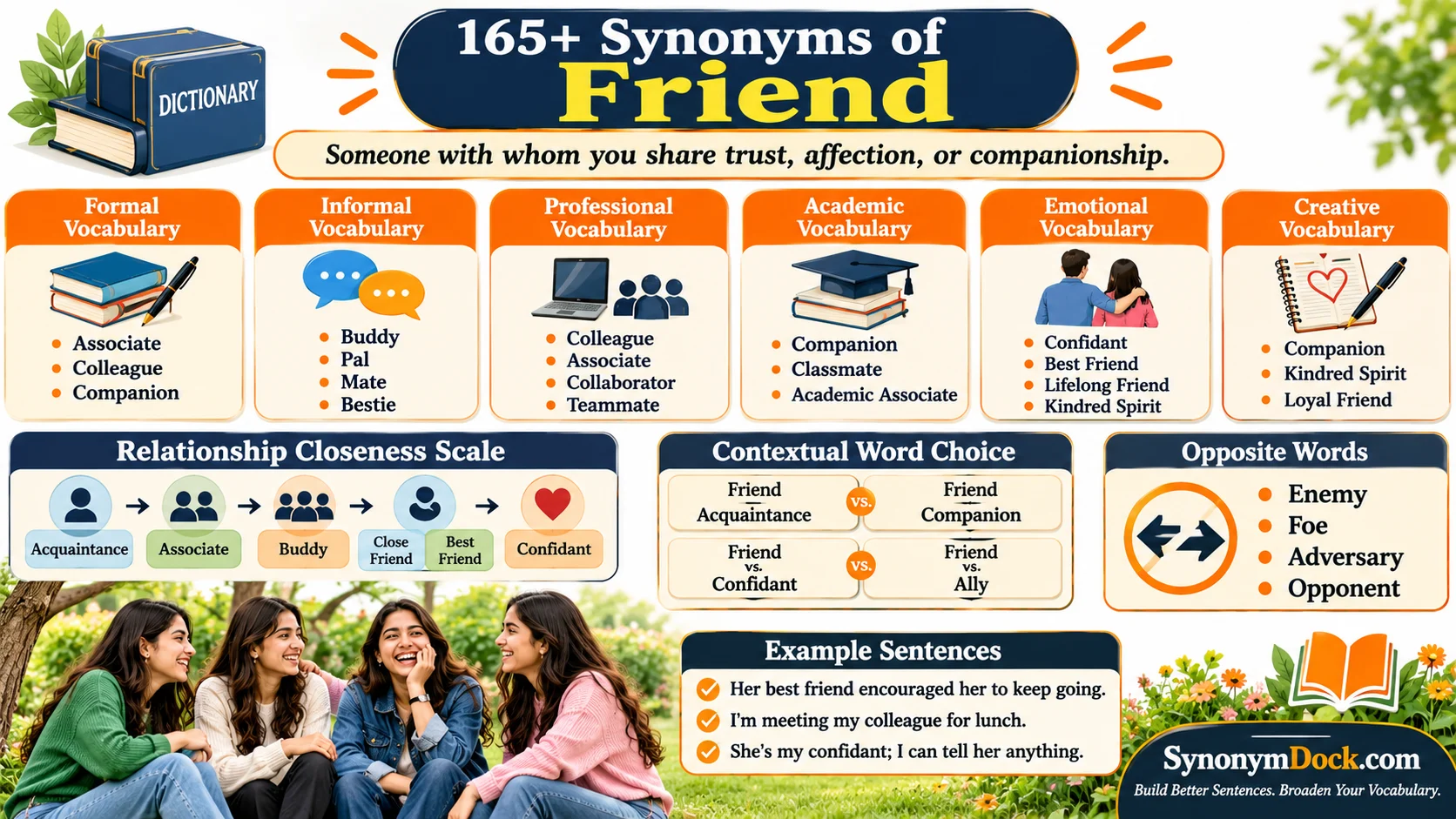
Have you ever used the word friend repeatedly in an essay, email, social media caption, personal message, or blog post? Although it is a simple and familiar word, repeating it can make your writing sound less expressive. Finding the right synonym of friend can help you describe different relationships more accurately.
Words such as companion, confidant, ally, buddy, associate, and close friend communicate different levels of connection. Some describe emotional trust, others suggest shared experiences, professional relationships, or casual friendship. The best alternative depends on how well you know someone, the nature of your relationship, and the message you want to communicate. This guide explores useful friend synonyms, explains their differences, and provides practical examples for academic, professional, personal, and creative writing.
What Are the Best Synonyms of “Friend”?
A friend is someone with whom you share mutual affection, trust, goodwill, or companionship. The best alternatives include companion for shared experiences, confidant for personal trust, ally for mutual support, buddy for casual relationships, and pal for informal conversations.
| Context | Best Synonym |
| Formal writing | Companion |
| Casual conversation | Buddy |
| Academic writing | Companion |
| Professional communication | Ally |
| Emotional writing | Confidant |
| Creative writing | Kindred spirit |
| Close personal relationship | Best friend |
| Longstanding friendship | Lifelong companion |
The word friend is generally positive, familiar, and suitable for nearly every communication setting. However, its alternatives can communicate more specific relationship qualities.
Meaning, Tone, and Context of Friend
Simple Definition
A friend is someone you know and like, with whom you share mutual goodwill, affection, trust, or companionship.
Friendship can develop through shared interests, personal experiences, school, work, family connections, or common values.
For example:
Sarah has been my friend since college.
This sentence communicates an established personal relationship without specifying how close the two people are.
Part of Speech
Friend is primarily a noun.
It refers to a person with whom someone has a friendly or affectionate relationship.
Example: My friend helped me prepare for the interview.
It can also appear in the verb form befriend, which means to become friendly with someone or offer friendship.
Example: The new student befriended several classmates.
Overall Tone
Friend has a positive and generally neutral tone.
It communicates goodwill, trust, companionship, and social connection. Its emotional strength depends on the context.
For example:
- Friend: A general personal connection.
- Close friend: A stronger personal relationship.
- Confidant: Someone trusted with private thoughts.
- Best friend: Someone especially important in your life.
- Ally: Someone who supports you or shares your interests.
Formality Level
| Level | Suitability |
| Formal | Suitable, although companion may be preferable in some contexts |
| Semiformal | Very suitable |
| Neutral | Very suitable |
| Informal | Very suitable |
Friend is widely understood and does not sound outdated or unnecessarily complicated.
Common Uses
English speakers commonly use friend when discussing:
- Personal relationships and social connections.
- Childhood and school friendships.
- Longstanding relationships.
- Shared interests and activities.
- Emotional support and companionship.
- Social media connections.
- Professional relationships involving genuine personal friendship.
Word Forms
| Word Form | Meaning | Example |
| Friend | A person with whom someone shares friendship | She is my friend. |
| Friends | More than one friend | My friends are visiting. |
| Friendship | The relationship between friends | Their friendship lasted for years. |
| Friendly | Kind and pleasant toward others | The staff were friendly. |
| Friendliness | The quality of being friendly | Her friendliness made everyone comfortable. |
| Befriend | To become friendly with someone | He befriended his new neighbor. |
Opposite-related words: Enemy and foe can describe someone who is hostile toward another person. These are contextual opposites rather than grammatical opposites of every meaning of friend.
When and How to Use “Friend”
Choose friend when describing a person with whom you share a positive personal relationship. It is appropriate when the exact level of closeness does not need further explanation.
Here are seven realistic examples.
1. Professional
My friend recommended a reliable company for our upcoming project.
2. Academic
A friend from my university helped me understand the research assignment.
3. Workplace
I became good friends with several colleagues during my first year at the company.
4. Personal
My closest friend always encourages me to pursue my goals.
5. Email
Hi Emily,
I hope you are doing well. A mutual friend suggested that I contact you regarding the upcoming event.
6. Resume
Developed strong professional relationships with colleagues and supported a collaborative working environment.
For a resume, friend is generally unsuitable when describing workplace achievements. Words such as colleague, collaborator, and team member are more precise.
7. Social Media
Grateful for the friends who make ordinary moments unforgettable.
Best Synonyms of Friend
No synonym communicates exactly the same relationship in every situation. Some alternatives suggest emotional closeness, while others describe companionship, loyalty, support, or casual familiarity.
Here are the best recommendations for different communication settings.
Professional Writing: Associate
Associate describes someone connected with you through professional, social, or organizational activities.
Example: She is a trusted associate who has supported several business initiatives.
Use this word when the relationship is professional rather than deeply personal.
Academic Writing: Companion
Companion is useful when describing people who spend time together or share experiences.
Example: My college companion helped me prepare for the final examination.
It is appropriate for descriptive and narrative writing, although friend may sound more natural in ordinary academic prose.
Business Communication: Ally
Ally describes someone who supports your interests, goals, or position.
Example: We consider the organization an important ally in our community development efforts.
It communicates cooperation and mutual support rather than necessarily indicating personal friendship.
Casual Conversation: Buddy
Buddy is a relaxed and friendly alternative commonly used in American English.
Example: My buddy and I enjoy playing basketball on weekends.
It works well in informal conversations and personal messages.
Emotional Writing: Confidant
A confidant is someone you trust with private thoughts, feelings, or personal information.
Example: Throughout her difficult years, her sister remained her closest confidant.
It is particularly useful when describing emotional trust.
Creative Writing: Kindred Spirit
A kindred spirit is someone who shares your interests, outlook, values, or personality.
Example: She finally found a kindred spirit who understood her love of literature.
This expression adds warmth and emotional depth to storytelling.
Resume Writing: Colleague
Colleague is appropriate when discussing workplace relationships.
Example: Collaborated with colleagues across departments to improve project delivery.
It is more precise than friend when describing professional connections.
Workplace Communication: Teammate
Teammate describes someone who works with you toward a shared objective.
Example: My teammate provided valuable feedback during the presentation.
It emphasizes cooperation and shared responsibility.
Stronger Meaning: Confidant
Confidant communicates a deeper level of trust than the general word friend.
Example: She considers her older brother her most trusted confidant.
Choose it when someone is more than simply a social companion.
Softer Meaning: Acquaintance
Acquaintance describes someone you know but with whom you do not necessarily share a close relationship.
Example: I met an acquaintance at the conference.
It is useful when you want to avoid suggesting a strong personal connection.
When Not to Use Friend
Although friend is a versatile word, it can become too general or inaccurate when a more specific relationship needs to be described.
1. When You Need to Describe a Professional Relationship
Less precise: My friend helped me complete the business proposal.
Better: My colleague helped me complete the business proposal.
Why: Colleague clearly identifies a workplace relationship without suggesting personal closeness.
2. When You Want to Express Deep Trust
Less precise: She is my friend, and I share all my secrets with her.
Better: She is my confidant, and I share all my secrets with her.
Why: Confidant emphasizes trust and the sharing of private information.
3. When Describing a Casual Relationship
Less suitable: My companion and I went to watch a movie.
Better: My buddy and I went to watch a movie.
Why: Buddy sounds more natural in relaxed American conversation.
4. When Describing Someone Who Supports Your Goals
Less precise: The organization is our friend in this campaign.
Better: The organization is our ally in this campaign.
Why: Ally emphasizes cooperation and shared interests.
5. When Describing Someone You Barely Know
Incorrectly specific: My close friend attended the conference.
Better: An acquaintance attended the conference.
Why: Acquaintance avoids suggesting a personal relationship that may not exist.
6. When Describing a Shared Activity
Less precise: My friend accompanied me throughout the journey.
Alternative: My travel companion accompanied me throughout the journey.
Why: Travel companion identifies the shared experience more clearly.
7. When Writing a Formal Report
Less suitable: Our friends in the organization provided valuable information.
Better: Our professional associates provided valuable information.
Why: Professional associates is more appropriate when discussing formal business relationships.
Words Commonly Confused With Friend
Several words describe relationships, but they communicate different levels of closeness, trust, and social connection.
1. Friend vs. Acquaintance
Difference: A friend generally shares a personal relationship with you, whereas an acquaintance is someone you know without necessarily having a close connection.
When to Use It: Use acquaintance for someone you have met or know casually.
Example:
Friend: My friend invited me to her birthday celebration.
Acquaintance: An acquaintance from university greeted me at the library.
2. Friend vs. Companion
Difference: A friend involves personal affection or goodwill, while a companion emphasizes spending time together or sharing activities.
When to Use It: Use companion when highlighting shared experiences, journeys, or activities.
Example:
Friend: My friend encouraged me to apply for the scholarship.
Companion: My hiking companion helped me navigate the trail.
3. Friend vs. Buddy
Difference: Both describe friendly relationships, but buddy is more casual and conversational.
When to Use It: Use buddy in relaxed American English, especially when referring to someone you enjoy spending time with.
Example:
Friend: She is a close friend from college.
Buddy: My buddy and I play tennis every Saturday.
4. Friend vs. Confidant
Difference: A friend is someone you like and trust, whereas a confidant is specifically someone trusted with private matters.
When to Use It: Choose confidant when emotional trust and personal disclosure are important.
Example:
Friend: He has been my friend for ten years.
Confidant: He is the person I trust with my deepest concerns.
5. Friend vs. Ally
Difference: A friend suggests a personal relationship, while an ally is someone who supports your position, goals, or interests.
When to Use It: Use ally in professional, political, organizational, or collaborative settings.
Example:
Friend: My friend supported me during a difficult period.
Ally: The organization became an important ally in our campaign.
6. Friend vs. Colleague
Difference: A friend is a personal connection, while a colleague is someone you work with.
When to Use It: Use colleague when discussing professional relationships, regardless of whether you are personally close.
Example:
Friend: My friend helped me prepare for the interview.
Colleague: My colleague reviewed the presentation before the meeting.
Best Synonyms of Friend by Context
The following recommendations show which alternatives fit different communication situations.
| Context | Best Synonym | Why It Works | Example |
| Formal writing | Companion | Describes a personal connection or shared experience | Her companion supported her throughout the journey. |
| Academic writing | Companion | Works in descriptive and narrative contexts | His college companion helped him study. |
| Professional communication | Associate | Communicates a professional connection | She is a respected associate. |
| Business emails | Colleague | Identifies a workplace relationship | A colleague recommended your services. |
| Resume writing | Collaborator | Highlights teamwork and shared contributions | Worked with collaborators across departments. |
| Workplace communication | Teammate | Emphasizes shared responsibilities | My teammate completed the analysis. |
| Casual conversation | Buddy | Sounds relaxed and friendly | My buddy is coming over tonight. |
| Everyday speaking | Pal | Offers a familiar, informal expression | He has been my pal since childhood. |
| Creative writing | Kindred spirit | Adds emotional and personal meaning | She found a kindred spirit in the village. |
| Storytelling | Companion | Highlights shared experiences | His companion stayed beside him throughout the journey. |
| Emotional writing | Confidant | Communicates deep personal trust | Her mother was her closest confidant. |
| Strong emphasis | Best friend | Highlights an especially close relationship | My best friend understands me completely. |
| Mild tone | Acquaintance | Describes a less intimate connection | I met an acquaintance at the seminar. |
| Social media captions | Bestie | Creates a playful, affectionate tone | Celebrating another year with my bestie. |
| American English | Buddy | A natural informal American expression | My buddy and I went fishing. |
| British English | Mate | A familiar conversational alternative | My mate invited me to dinner. |
American and British English share many friendship terms. However, mate is especially common in British and Australian conversational English, while buddy is strongly associated with informal American English.
How to Choose the Best Synonym of Friend
Choosing an appropriate alternative requires understanding the relationship rather than simply replacing one word with another.
1. Identify the Relationship
First, consider how you know the person.
- A close personal relationship: Best friend.
- Someone you trust deeply: Confidant.
- Someone you spend time with: Companion.
- Someone you know casually: Acquaintance.
- Someone who supports your interests: Ally.
- Someone you work with: Colleague.
2. Consider Your Audience
A word that sounds natural in a text message may not suit an academic paper or professional report.
For example, bestie is appropriate for casual social media content, while associate may suit a business discussion.
3. Match the Emotional Strength
Different friendship words suggest different levels of emotional connection.
Buddy sounds relaxed, while confidant communicates personal trust. Kindred spirit suggests a deeper connection through shared values or interests.
4. Think About Your Writing Purpose
Your writing goal should influence your vocabulary.
- Essays: Companion or friend.
- Business documents: Associate or colleague.
- Personal messages: Buddy or pal.
- Emotional stories: Confidant or kindred spirit.
- Social media: Bestie or best friend.
5. Check the Formality Level
Avoid using overly casual words in professional documents.
Similarly, words such as associate can sound distant when you are describing a close personal relationship.
6. Make Sure the Meaning Remains Accurate
A sophisticated word is not automatically a better replacement.
For example, calling a casual acquaintance a confidant exaggerates the level of trust. Always choose the word that describes the actual relationship.
7. Read the Sentence Naturally
After replacing friend, read the complete sentence.
Ask whether the new word sounds natural and whether it communicates the same relationship. If it changes the meaning, choose another alternative.
Real Life Examples of Friend
These examples demonstrate how different friendship words improve communication in practical situations.
School
Original: My friend helped me complete the science assignment.
Improved: My classmate helped me complete the science assignment.
Classmate is more precise when describing someone who studies in the same class.
College
Original: My friend and I participated in the research competition.
Improved: My college companion and I participated in the research competition.
Companion highlights the shared experience.
Workplace
Original: My friend reviewed my presentation.
Improved: My colleague reviewed my presentation.
Colleague identifies the professional relationship.
Business
Original: Our friend helped us establish the partnership.
Improved: Our business associate helped us establish the partnership.
Business associate sounds more appropriate in a professional context.
Original: My friend suggested that I contact you.
Improved: A mutual acquaintance suggested that I contact you.
Mutual acquaintance works when the person making the introduction is not necessarily a close friend.
Resume
Original: I worked successfully with my friends on several projects.
Improved: I collaborated effectively with team members on several projects.
Team members and collaborated communicate professional teamwork more clearly.
Conversation
Original: My friend is coming to visit me this weekend.
Improved: My buddy is coming to visit me this weekend.
Buddy gives the sentence a relaxed, conversational tone.
Storytelling
Original: The friend stayed with him throughout the journey.
Improved: His loyal companion stayed beside him throughout the journey.
Loyal companion creates a stronger descriptive effect.
Blogging
Original: A good friend can make difficult experiences easier.
Improved: A trusted confidant can make difficult experiences easier.
Confidant is appropriate when the article discusses emotional support and trust.
Social Media
Original: Spending another beautiful day with my friend.
Improved: Making unforgettable memories with my bestie.
Bestie creates a playful, affectionate caption.
15 Best Synonyms of Friend
There are many words related to friendship, but they are not all interchangeable. The following 15 alternatives cover personal, professional, emotional, conversational, and creative situations.
| Synonym | Simple Meaning | Best Used For | Example Sentence |
| Companion | Someone who shares activities or experiences | General and descriptive writing | My companion joined me on the journey. |
| Buddy | A casual friend | American conversations | My buddy helped me move apartments. |
| Pal | An informal friend | Relaxed communication | My childhood pal visited last weekend. |
| Mate | A friend or companion | British and Australian conversation | My mate invited me to dinner. |
| Chum | A familiar or informal friend | Informal and literary contexts | He met an old school chum at the reunion. |
| Confidant | Someone trusted with personal information | Emotional writing | Her sister remained her closest confidant. |
| Ally | Someone who supports your interests | Professional and organizational settings | The nonprofit became our strongest ally. |
| Associate | Someone connected through work or other activities | Business communication | She introduced me to a business associate. |
| Acquaintance | Someone you know casually | Formal and everyday contexts | An acquaintance recommended the restaurant. |
| Colleague | Someone you work with | Workplace communication | My colleague helped review the report. |
| Teammate | Someone working toward a shared goal | Sports and professional settings | Every teammate contributed to the project. |
| Supporter | Someone who encourages or backs you | Personal and public contexts | Her supporters celebrated the achievement. |
Vocabulary accuracy: These words describe different kinds or degrees of relationships. For example, a colleague is not automatically a friend, and an acquaintance does not necessarily share a close emotional connection.
Synonyms of Friend by Usage
Professional vs. Personal Synonyms
Professional and personal relationships require different vocabulary.
Best professional alternatives:
- Colleague: Someone you work with.
- Associate: Someone connected through business or professional activities.
- Teammate: Someone who shares workplace responsibilities.
- Collaborator: Someone who works with you on a common project.
- Ally: Someone who supports your professional interests.
Best personal alternatives:
- Buddy: A casual friend.
- Pal: A familiar friend.
- Best friend: Someone especially close to you.
- Confidant: Someone you trust with personal matters.
- Kindred spirit: Someone who shares your outlook or interests.
For workplace writing, choose terms that describe the actual professional relationship. For personal communication, select words that reflect emotional closeness.
Formal vs. Conversational Synonyms
Different writing environments require different levels of familiarity.
| Writing Situation | Recommended Word |
| Formal reports | Associate |
| Academic essays | Companion |
| Business writing | Associate |
| Presentations | Colleague |
| Professional emails | Colleague |
| Casual conversations | Buddy |
| Personal messages | Pal |
| Texting | Bestie |
| Informal social media | Bestie |
| Descriptive storytelling | Companion |
Do not use formal vocabulary simply to sound sophisticated. The best expression is the one that accurately represents the relationship.
Academic Synonyms
Academic writing often discusses social connections, group relationships, and human behavior.
The following words can help communicate these ideas precisely.
Companion: Useful when describing shared experiences, journeys, or activities.
Example: The participant was accompanied by a longtime companion.
Associate: Suitable when discussing professional or organizational relationships.
Example: The researcher collaborated with several academic associates.
Acquaintance: Useful when describing social familiarity without close personal involvement.
Example: The study examined interactions between acquaintances and close friends.
Confidant: Appropriate when discussing trust and personal disclosure.
Example: Participants were more likely to share sensitive information with a trusted confidant.
These words are useful because they describe specific relationship qualities rather than treating every social connection as a friendship.
Professional and Business Synonyms
Different workplace situations call for different relationship terms.
| Situation | Recommended Word | Example |
| Resume | Collaborator | Worked with collaborators to complete major projects. |
| Interview | Colleague | My colleague helped me develop my communication skills. |
| Meetings | Teammate | Every teammate contributed to the discussion. |
| Presentations | Associate | Our associate presented the updated strategy. |
| Performance reviews | Team member | The team member consistently supported project goals. |
| Client communication | Business associate | A business associate introduced us to the client. |
| Business emails | Colleague | A colleague recommended your services. |
These alternatives sound professional because they describe work relationships and responsibilities more accurately.
Creative and Literary Synonyms
Creative writing often benefits from relationship words that communicate emotion, loyalty, or shared experiences.
Consider these expressions:
Kindred spirit: Someone who shares your personality, interests, or values.
Example: She discovered a kindred spirit who understood her unusual dreams.
Companion: Someone who accompanies another person through an experience.
Example: His faithful companion never left his side.
Confidant: Someone who receives personal thoughts and secrets.
Example: The old librarian became her trusted confidant.
Lifelong friend: Someone with whom a person maintains a friendship over many years.
Example: Her lifelong friend remembered every important moment of their childhood.
Ally: Someone who provides support during a difficult situation.
Example: The young leader found an unexpected ally in the neighboring village.
These expressions add more specific emotional and descriptive meaning to stories, speeches, and personal essays.
Slang or Modern Synonyms
Some informal friendship terms are especially common in contemporary conversations and social media.
| Expression | Meaning | Where It Is Acceptable | Where to Avoid It |
| Bestie | A very close friend | Texting and social media | Formal reports |
| BFF | Best friend forever | Informal messages | Academic essays |
| Buddy | A casual friend | Everyday American English | Highly formal documents |
| Pal | An informal friend | Conversations and personal writing | Formal business communication |
| Bro | A male friend or familiar form of address | Casual conversations | Professional correspondence |
| Homie | A close friend, often associated with shared community or background | Informal speech | Academic and formal writing |
These expressions are not equally appropriate for every audience. Consider regional usage, familiarity, and context before including them.
Strongest to Mildest Synonyms of Friend
Friendship words can communicate different degrees of emotional closeness. This scale is approximate because the relationship depends on personal context.
| Intensity | Word | Meaning |
| Mild | Acquaintance | Someone you know casually |
| Mild | Associate | Someone connected through work or activities |
| Moderate | Companion | Someone who shares experiences |
| Moderate | Buddy | A familiar informal friend |
| Moderate | Pal | A friendly personal connection |
| Strong | Close friend | Someone with a meaningful personal relationship |
| Strong | Confidant | Someone trusted with private matters |
| Strong | Best friend | Someone especially important to you |
| Very strong | Lifelong friend | Someone who remains a friend over many years |
| Very strong | Kindred spirit | Someone with a deep sense of shared understanding |
A word’s emotional strength is not fixed. For example, companion can describe a close relationship or simply someone sharing a journey.
Emotional vs. Neutral Synonyms
Friendship vocabulary can communicate either strong feelings or a straightforward social connection.
Emotional Synonyms
- Best friend: Communicates a particularly close relationship.
- Confidant: Emphasizes trust and emotional openness.
- Kindred spirit: Suggests shared values and understanding.
- Lifelong friend: Highlights a lasting relationship.
- Beloved friend: Expresses affection and appreciation.
These words work well in personal letters, speeches, storytelling, and emotional writing.
Neutral Synonyms
- Companion: Describes someone who shares activities or experiences.
- Associate: Identifies a professional or social connection.
- Acquaintance: Describes someone known casually.
- Colleague: Identifies a workplace relationship.
- Teammate: Emphasizes shared responsibilities.
Neutral alternatives are especially useful in reports, professional communication, and factual descriptions.
Antonyms of Friend
The most direct opposite of friend is enemy or foe. Other words describe hostility, opposition, rivalry, or a lack of goodwill.
However, these expressions are not perfect substitutes in every context. The following 15 terms represent different kinds of opposing relationships.
| Antonym or Contrasting Term | Meaning | Example Sentence |
| Enemy | Someone who is hostile toward another person | The two leaders regarded each other as enemies. |
| Foe | An enemy or opponent | The knight faced his greatest foe. |
| Adversary | Someone who opposes another person | Her strongest adversary challenged the proposal. |
| Opponent | Someone competing against another person | He defeated his opponent in the final round. |
| Antagonist | Someone who opposes another person or character | The antagonist challenged the hero throughout the story. |
| Rival | Someone competing for the same goal | Her rival received the scholarship. |
| Nemesis | A particularly formidable opponent | The detective finally confronted his longtime nemesis. |
| Oppressor | Someone who uses power to control or mistreat others | The novel portrays a community resisting its oppressor. |
| Persecutor | Someone who repeatedly mistreats another person | The persecutor tried to silence the activist. |
| Tormentor | Someone who causes repeated distress | The character finally confronted his childhood tormentor. |
| Betrayer | Someone who breaks another person’s trust | The betrayer revealed their private agreement. |
| Traitor | Someone who betrays a person, group, or cause | The traitor abandoned his former allies. |
| Backstabber | Someone who secretly betrays another person | She avoided the backstabber after the incident. |
| Detractor | Someone who publicly criticizes another person or idea | The author responded calmly to her detractors. |
| Ill-wisher | Someone who hopes another person experiences difficulties | Despite her success, she ignored her ill-wishers. |
Important distinction: Words such as enemy and foe are direct relational opposites of friend. Terms such as rival, critic, and opponent describe more specific forms of opposition and do not necessarily indicate personal hostility.
Comparison: Friend vs. Similar Words
Friend vs. Companion
Main Difference
A friend shares a personal relationship with you, while a companion emphasizes shared activities or experiences.
Which Is Stronger?
Friend generally communicates personal affection more directly. However, a companion can also be a close friend.
Which Is More Formal?
Companion can sound more descriptive or literary.
When to Use Each
Use friend for personal relationships and companion when describing someone who accompanies you.
Examples
Friend: My friend encouraged me to pursue my education.
Companion: My companion joined me on the journey.
Friend vs. Acquaintance
Main Difference
A friend usually involves personal affection or trust, whereas an acquaintance is someone you know without necessarily sharing a close relationship.
Which Is Stronger?
Friend communicates a closer relationship.
Which Is More Formal?
Acquaintance is often more suitable for formal descriptions of casual social connections.
When to Use Each
Use friend for a personal relationship and acquaintance when describing someone you know casually.
Examples
Friend: My friend invited me to the celebration.
Acquaintance: An acquaintance introduced me to the manager.
Friend vs. Buddy
Main Difference
Both describe friendly relationships, but buddy is more casual and informal.
Which Is Stronger?
Neither necessarily communicates greater emotional closeness. Context determines the relationship.
Which Is More Formal?
Friend is more appropriate for formal and general communication.
When to Use Each
Use buddy in relaxed conversations and friend in almost any communication setting.
Examples
Friend: She is a friend from my university.
Buddy: My buddy and I enjoy weekend cycling.
Friend vs. Confidant
Main Difference
A friend is someone you share a personal relationship with, while a confidant is specifically someone you trust with private thoughts.
Which Is Stronger?
Confidant communicates a more specific level of personal trust.
Which Is More Formal?
Confidant sounds more formal and descriptive.
When to Use Each
Use friend for general relationships and confidant for personal trust and emotional openness.
Examples
Friend: My friend helped me through a difficult semester.
Confidant: She became my most trusted confidant.
Friend vs. Ally
Main Difference
A friend suggests personal affection, while an ally supports your goals, interests, or position.
Which Is Stronger?
Neither is universally stronger. An ally may offer strong support without having a personal friendship.
Which Is More Formal?
Ally is common in professional, political, and organizational discussions.
When to Use Each
Use friend for personal connections and ally for cooperation or mutual support.
Examples
Friend: My friend supported my decision.
Ally: The organization became an important ally in our campaign.
Friend vs. Colleague
Main Difference
A friend is a personal connection, while a colleague is someone you work with.
Which Is Stronger?
Friend generally suggests more personal affection.
Which Is More Formal?
Colleague is more suitable for workplace and business communication.
When to Use Each
Use colleague when discussing professional relationships, whether or not the people involved are personally close.
Examples
Friend: My friend helped me prepare for the presentation.
Colleague: My colleague reviewed the presentation before the meeting.
Common Phrases and Expressions With Friend
These expressions are frequently used in everyday communication, personal writing, and descriptions of relationships.
1. Best Friend
Meaning: Someone with whom you share an especially close personal relationship.
Example Sentence: My best friend has supported me through every important stage of my life.
2. Close Friend
Meaning: Someone with whom you share trust, affection, and a meaningful relationship.
Example Sentence: A close friend helped me prepare for my university interview.
3. Old Friend
Meaning: Someone you have known for a long time.
Example Sentence: I was delighted to reconnect with an old friend from school.
4. Childhood Friend
Meaning: Someone you became friends with when you were young.
Example Sentence: My childhood friend still remembers our favorite games.
5. Mutual Friend
Meaning: Someone who is a friend of two or more people.
Example Sentence: We met through a mutual friend at a birthday celebration.
6. Friend in Need
Meaning: A friend who provides support when someone faces difficulties. The expression is often associated with the saying, “A friend in need is a friend indeed.”
Example Sentence: She proved to be a true friend in need when I faced a difficult situation.
7. Make Friends
Meaning: To develop friendly relationships with other people.
Example Sentence: Moving to a new city gave him an opportunity to make friends.
8. Friends for Life
Meaning: People who expect to maintain their friendship throughout their lives.
Example Sentence: We may live in different countries, but we will always be friends for life.
Common Mistakes to Avoid
Choosing the right synonym requires understanding the relationship, formality, and emotional meaning of each word.
Here are seven common mistakes to avoid.
Mistake 1: Using Friend for Every Relationship
Incorrect: My friend from the office reviewed my performance report.
Better: My colleague from the office reviewed my performance report.
Why: Colleague identifies a workplace connection more precisely. The person may be a friend, but the professional relationship is the relevant detail.
Mistake 2: Confusing Friend With Acquaintance
Incorrect: My close friend from the conference greeted me.
Better: An acquaintance from the conference greeted me.
Why: An acquaintance is someone you know casually. Calling that person a close friend exaggerates the relationship.
Mistake 3: Using Informal Vocabulary in Formal Writing
Less suitable: My buddy helped me complete the research project.
Better: My research partner helped me complete the project.
Why: Research partner is more appropriate when describing academic collaboration.
Mistake 4: Choosing a Dramatic Synonym Unnecessarily
Less suitable: My confidant accompanied me to the grocery store.
Better: My friend accompanied me to the grocery store.
Why: A confidant is someone trusted with personal information. The word adds unnecessary emotional meaning to an ordinary activity.
Mistake 5: Repeating Friend Too Often
Less effective: My friend visited me. My friend brought a gift. My friend stayed for dinner.
Better: My friend visited me with a thoughtful gift and stayed for dinner.
Why: Combining related information creates smoother writing without repeatedly using the same noun.
Mistake 6: Confusing Ally With Friend
Incorrect: The organization became our best friend during the negotiations.
Better: The organization became our strongest ally during the negotiations.
Why: Ally describes someone who supports your goals or interests. It is more accurate in business and organizational settings.
Mistake 7: Using Slang in Academic or Professional Writing
Less suitable: My bestie helped me prepare the university report.
Better: My classmate helped me prepare the university report.
Why: Bestie is an informal expression. Classmate provides a clearer and more appropriate description in academic writing.
Frequently Asked Questions
1. What Are the Best Synonyms of Friend?
The best synonyms of friend include companion, buddy, pal, confidant, ally, associate, acquaintance, and kindred spirit. Choose companion for shared experiences and confidant for deep personal trust.
2. What Are the Best Formal Synonyms of Friend?
Formal alternatives include associate, companion, colleague, and confidant. Use associate for professional connections, colleague for workplace relationships, and companion when describing someone who shares experiences.
3. What Are Common Informal Synonyms of Friend?
Common informal alternatives include buddy, pal, mate, bestie, and chum. These expressions suit conversations, personal messages, and casual social media content, although some have stronger regional associations.
4. What Is Another Word for Friend in Professional Writing?
Colleague, associate, collaborator, and teammate are useful professional alternatives. Each describes a different working relationship, so choose the term that accurately reflects the person’s role and connection.
5. What Is the Difference Between Friend and Companion?
A friend shares a personal relationship involving affection or goodwill, while a companion is someone who accompanies another person or shares activities. A companion can also be a friend.
6. What Is the Opposite of Friend?
The most direct opposites of friend are enemy and foe. Other contrasting terms include adversary, opponent, antagonist, and rival, although each communicates a different kind of opposition.
Conclusion
Choosing the right synonym of friend can make your writing more accurate, natural, and expressive. Words such as companion, buddy, confidant, ally, associate, and kindred spirit describe different types of relationships, from casual familiarity to deep personal trust.
The best alternative depends on your audience, purpose, and intended emotional tone. Use professional terms when discussing workplace connections and conversational expressions when describing personal relationships. A practical vocabulary tip is to identify the level of closeness before replacing friend with another word. The most effective synonym is the one that describes the relationship honestly.

Ethan Parker is an English language writer and vocabulary enthusiast at SynonymDock.com. He specializes in synonyms, word meanings, alternative expressions and practical English usage, creating clear and reliable content to help students, professionals, writers and English learners choose the right words with confidence.
2 thoughts on “Other Words for Friend|165+ From Casual to Sophisticated”