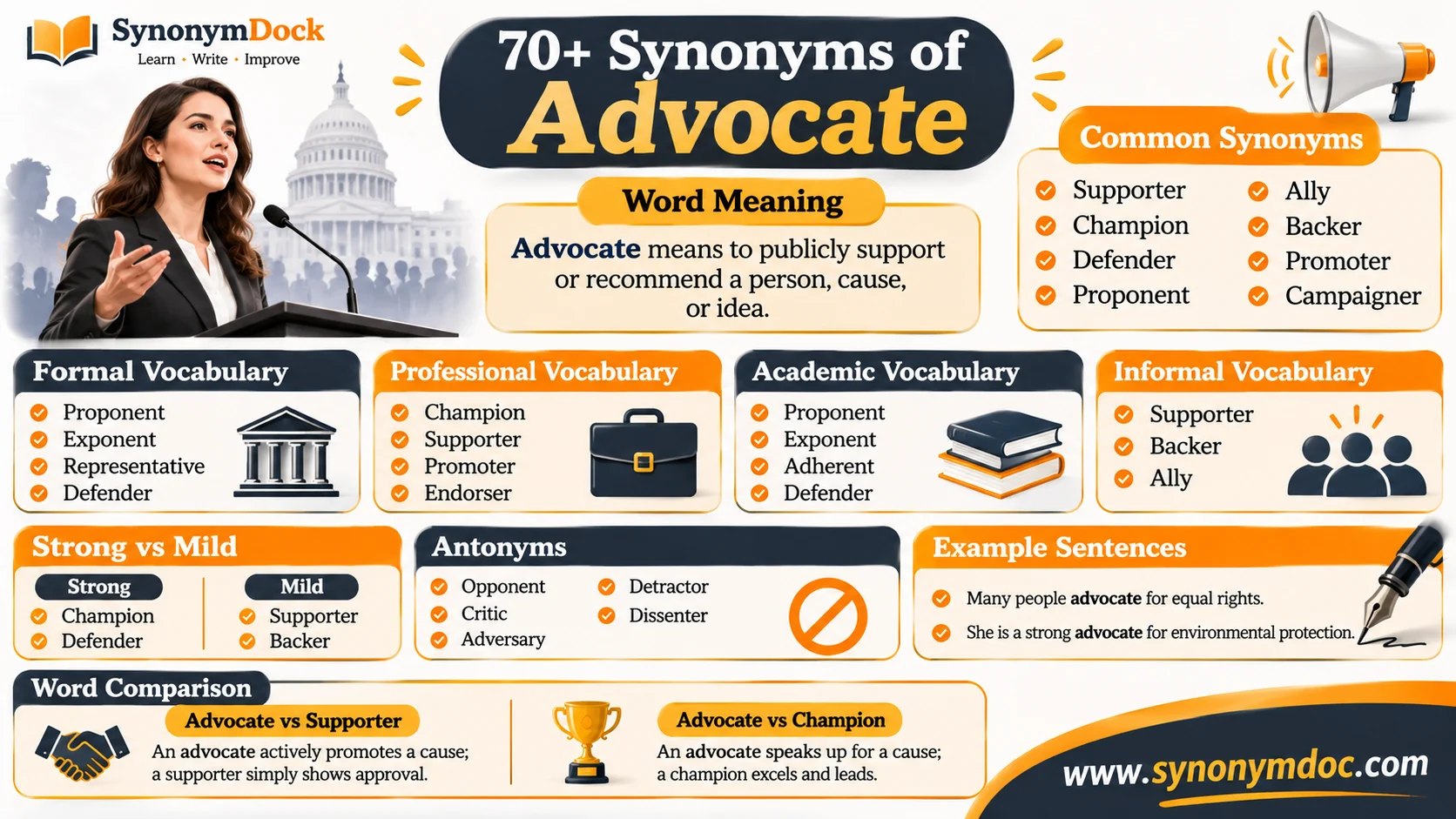
Uncovering the right synonym of advocate allows you to communicate support, defend a position, recommend an idea, or represent someone’s interests more precisely. However, choosing an alternative requires understanding what each word actually means.
For example, a proponent supports a particular idea, an ally stands alongside someone, and a champion actively promotes a cause. Meanwhile, an endorser publicly approves a person, product, or proposal.
This guide explores more than 30 useful alternatives, including their meanings, differences, grammatical forms, and real-world applications. You will discover which words work best in academic writing, professional communication, resumes, everyday conversations, and persuasive writing.
What Are the Best Synonyms of Advocate?
An advocate is a person who actively supports, promotes, or defends a particular cause, principle, individual, or course of action. Depending on the context, suitable alternatives include proponent, champion, exponent, adherent, partisan, defender, patron, ally, and supporter. Each word conveys a slightly different shade of meaning. For example, proponent refers to someone who argues in favour of an idea, while champion suggests someone who supports a cause with conviction. Exponent describes a person who explains or promotes a particular theory or belief, whereas adherent refers to someone who firmly follows a doctrine or principle.
For the verb advocate, more precise alternatives include espouse, endorse, champion, uphold, advance, promote, and vindicate. In academic writing, espouse and proponent can express support for an argument or position. In formal and professional contexts, endorse and uphold may be more appropriate. Choose an alternative according to the intended meaning rather than treating every synonym as interchangeable.
Meaning, Tone, and Context of Advocate
What Does Advocate Mean?
Advocate has two main meanings depending on how it appears in a sentence.
As a noun, it describes someone who supports a person, cause, belief, or policy.
As a verb, it means publicly recommending, supporting, or arguing in favor of something.
Examples:
- She is an advocate for equal educational opportunities.
- The organization advocates stronger environmental protections.
The first sentence identifies a person who supports a cause. The second describes an action.
Part of Speech
| Form | Meaning | Example |
| Noun | Someone who supports a cause or person | He is an advocate for students. |
| Verb | To recommend or support something | She advocates educational reform. |
| Advocacy | The activity of supporting a cause | Her advocacy raised public awareness. |
| Advocated | Past-tense form | They advocated better working conditions. |
| Advocating | Continuing action | We are advocating equal opportunities. |
Tone and Formality
Advocate generally has a positive or neutral tone. It communicates commitment, persuasion, support, and public involvement.
Its formality level is neutral to formal, making it suitable for:
- Academic essays and research papers.
- Business reports and presentations.
- Professional emails.
- Public speeches.
- Social campaigns.
- Everyday conversations.
Common Uses
Advocate frequently appears in discussions about:
- Human rights and social justice.
- Educational improvement.
- Environmental protection.
- Healthcare awareness.
- Workplace equality.
- Government policies.
- Community development.
- Personal beliefs and social causes.
When and How to Use Advocate
Use advocate when someone actively supports a particular position or recommends an idea.
Here are seven examples from different situations.
1. Professional
Our director advocates transparent communication across all departments.
2. Academic
The researcher advocates a more inclusive approach to education.
3. Workplace
Employees should advocate fair treatment and equal opportunities.
4. Personal
My parents have always advocated the importance of education.
5. Email
I strongly advocate considering alternative solutions before reaching a final decision.
6. Resume
Championed collaborative initiatives that improved communication between departments.
7. Social Media
Be an advocate for kindness, equality, and positive change.
Best Synonyms of Advocate
Not every synonym communicates the same type of support. Some describe people, others emphasize protection, and some refer to recommending or promoting an idea.
The most useful alternatives should therefore be selected according to meaning and grammatical structure.
Best Synonyms for the Noun Form
| Synonym | Meaning | Best Context |
| Supporter | Someone who agrees with or backs a cause. | Everyday communication |
| Champion | Someone who actively and enthusiastically supports something. | Persuasive writing |
| Proponent | Someone who supports a particular idea or proposal. | Academic writing |
| Defender | Someone who protects or argues in favor of something. | Rights and justice |
| Ally | Someone who supports another person or group. | Personal and social contexts |
| Backer | Someone who provides support or approval. | Business and casual writing |
| Spokesperson | Someone authorized to speak for a group. | Official communication |
| Representative | Someone who acts or speaks on behalf of others. | Organizations |
| Campaigner | Someone who actively works for a cause. | Social change |
| Activist | Someone who takes action to bring about change. | Social and political issues |
| Endorser | Someone who publicly expresses approval. | Marketing and public relations |
| Patron | Someone who provides financial or other support. | Arts and charitable organizations |
| Benefactor | Someone who provides financial assistance or benefits. | Charities and institutions |
| Adherent | Someone who strongly believes in or follows an idea. | Beliefs and ideologies |
| Exponent | Someone who promotes or advocates a particular idea or principle. | Formal and academic writing |
| Protagonist | A person who leads or supports a particular cause in a particular context, though not a direct synonym. | Literary and narrative contexts |
Important distinction: Proponent and exponent are especially useful when discussing ideas, theories, and principles. Ally is more appropriate when describing support for people or groups.
Best Synonyms for the Verb Form
| Synonym | Meaning | Example |
| Support | To agree with or help something. | We support educational reform. |
| Champion | To actively promote a cause. | She champions equal opportunities. |
| Defend | To protect or argue in favor of something. | He defends the rights of workers. |
| Endorse | To publicly approve or recommend something. | The committee endorsed the proposal. |
| Promote | To encourage the development or acceptance of something. | They promote environmental awareness. |
| Recommend | To suggest something as a suitable choice. | I recommend a different approach. |
| Urge | To strongly encourage an action. | Experts urge immediate improvements. |
| Encourage | To give someone confidence or motivation. | Teachers encourage independent learning. |
| Espouse | To openly support an idea or belief. | She espouses democratic principles. |
| Uphold | To maintain or defend a principle or standard. | We must uphold professional ethics. |
| Advance | To help develop or promote an idea or cause. | The organization advances educational opportunities. |
| Lobby for | To seek support for a policy or decision. | They lobby for stronger environmental laws. |
| Campaign for | To actively work toward achieving something. | Residents campaign for safer roads. |
| Stand up for | To defend someone or something. | She stands up for disadvantaged students. |
| Speak up for | To publicly express support for someone. | He speaks up for his colleagues. |
These alternatives are not interchangeable in every sentence. Choose the one that preserves the original meaning.
Best Synonyms of Advocate by Context
| Context | Best Alternative | Why It Works | Example |
| Formal writing | Proponent | Expresses support for a defined position. | She is a proponent of educational reform. |
| Academic writing | Exponent | Describes someone who promotes an idea or principle. | He is an exponent of modern literary criticism. |
| Professional communication | Supporter | Communicates constructive agreement. | I am a supporter of this initiative. |
| Business emails | Recommend | Clearly introduces a suggestion. | I recommend reviewing the proposal. |
| Resume writing | Champion | Demonstrates leadership and commitment. | Championed cross-functional collaboration. |
| Workplace communication | Promote | Emphasizes encouraging improvement. | We promote inclusive workplace practices. |
| Casual conversation | Backer | Sounds natural and conversational. | She is a big backer of the project. |
| Personal relationships | Ally | Expresses solidarity and support. | He has always been my ally. |
| Creative writing | Defender | Creates a sense of protection. | She became a defender of the innocent. |
| Social campaigns | Campaigner | Shows active involvement. | He is a campaigner for equality. |
| Marketing | Endorser | Expresses public approval. | The athlete is an endorser of the brand. |
| Strong emphasis | Champion | Communicates passionate commitment. | She champions educational equality. |
| Mild emphasis | Supporter | Expresses general approval. | They support the proposal. |
| Legal representation | Attorney | Identifies a qualified legal professional in American English. | The attorney represented the client. |
When Not to Use Advocate
Advocate is useful, but sometimes another word communicates your message more accurately.
1. When You Simply Mean Agree
Less precise: She is an advocate of my decision.
Better: She supports my decision.
Support is more natural when expressing agreement without suggesting public campaigning or active defense.
2. When You Mean Someone Who Protects Others
General: He is an advocate for vulnerable children.
More specific: He is a defender of vulnerable children.
Defender emphasizes protection and standing up against threats or unfair treatment.
3. When Someone Officially Speaks for an Organization
Less precise: She is the advocate of our organization.
Better: She is the spokesperson for our organization.
Spokesperson identifies someone responsible for communicating an official position.
4. When You Mean a Legal Professional
Less precise: We hired an advocate to represent us in court.
Better: We hired an attorney to represent us in court.
In American English, attorney is the usual professional term for a qualified lawyer. Advocate has a broader meaning.
5. When You Mean Advertising a Product
Less precise: She advocates our new product to customers.
Better: She promotes our new product to customers.
Promote is more appropriate when encouraging people to notice, consider, or purchase a product.
6. When You Are Giving a Recommendation
Less precise: I advocate this particular solution.
Better: I recommend this particular solution.
Recommend is direct and natural when suggesting a specific choice.
Words Commonly Confused With Advocate
1. Advocate vs Supporter
Main difference: An advocate often actively promotes or defends a cause. A supporter may simply agree with it.
When to use: Choose advocate for active involvement and supporter for general agreement.
Example: She is an advocate for educational equality.
2. Advocate vs Proponent
Main difference: A proponent specifically supports an idea, argument, or proposal. Advocate has a wider range of applications.
When to use: Use proponent in academic and analytical discussions.
Example: He is a proponent of renewable energy.
3. Advocate vs Champion
Main difference: Champion communicates enthusiastic and determined support. Advocate is more neutral.
When to use: Choose champion when emphasizing passion and commitment.
Example: She champions equal opportunities for everyone.
4. Advocate vs Defender
Main difference: Defender emphasizes protection, while advocate emphasizes support and recommendation.
When to use: Use defender when someone protects a person, right, or principle.
Example: He is a defender of human rights.
5. Advocate vs Endorser
Main difference: An endorser publicly approves or recommends something. An advocate may actively campaign for a cause.
When to use: Choose endorser for products, public figures, brands, and official recommendations.
Example: The athlete is an endorser of the campaign.
6. Advocate vs Spokesperson
Main difference: A spokesperson communicates an official position on behalf of a group. An advocate does not necessarily have official authority.
When to use: Use spokesperson when someone represents an organization publicly.
Example: The spokesperson addressed the media.
How to Choose the Best Synonym of Advocate
Use this simple decision guide before replacing advocate.
| Your Intended Meaning | Recommended Word |
| Someone agrees with an idea | Supporter |
| Someone passionately supports a cause | Champion |
| Someone supports a theory | Proponent |
| Someone protects a right | Defender |
| Someone supports another person | Ally |
| Someone publicly approves a product | Endorser |
| Someone speaks officially for a group | Spokesperson |
| Someone actively works for change | Campaigner |
| Someone recommends an idea | Recommend |
| Someone promotes a policy | Promote |
| Someone publicly supports a belief | Espouse |
Remember that a good synonym preserves the meaning of your sentence. A sophisticated word is not always the most appropriate choice if it alters the intended meaning.
Real-Life Examples of Advocate and Its Alternatives
School: The teacher champions creative learning strategies to improve student participation.
College: The professor is a proponent of independent research.
Workplace: Our supervisor promotes transparency and teamwork.
Business: The organization endorses sustainable business practices.
Email: I would advocate a thorough evaluation of the alternative proposal before reaching a definitive decision.
Resume: Championed employee development initiatives across multiple departments.
Interview: I strongly support collaborative leadership and continuous improvement.
Conversation: My brother is a big supporter of the new project.
Storytelling: She became a fearless defender of those who had no voice.
Blogging: Writers should champion accuracy and originality.
Social Media: Be an ally to people who need your support.
15 Best Synonyms of Advocate: Meanings and Examples
The following list combines useful noun and verb alternatives. The grammatical differences are included to prevent incorrect substitutions.
| No. | Synonym | Meaning | Example |
| 1 | Supporter | Someone who backs a cause. | She is a supporter of equal education. |
| 2 | Champion | Someone who passionately promotes something. | He is a champion of human rights. |
| 3 | Proponent | Someone who supports an idea. | She is a proponent of educational reform. |
| 4 | Defender | Someone who protects a person or principle. | He is a defender of civil liberties. |
| 5 | Ally | Someone who stands alongside another person. | We need to be allies of vulnerable communities. |
| 6 | Backer | Someone who provides support. | Several investors are backers of the initiative. |
| 7 | Spokesperson | An authorized speaker for a group. | The spokesperson explained the policy. |
| 8 | Representative | Someone who acts on behalf of others. | She is a representative of the student council. |
| 9 | Campaigner | Someone who works actively for a cause. | She is a campaigner for equal opportunities. |
| 10 | Activist | Someone who takes action to promote change. | The activist supports environmental protection. |
| 11 | Endorser | Someone who publicly approves something. | The athlete is an endorser of the brand. |
| 12 | Patron | Someone who supports an institution or activity. | He is a patron of the local arts center. |
| 13 | Benefactor | Someone who provides financial assistance. | The benefactor funded a new library. |
| 14 | Adherent | Someone who follows a belief or principle. | She is an adherent of democratic values. |
| 15 | Exponent | Someone who promotes an idea or principle. | He is an exponent of modern education. |
Professional and Academic Synonyms of Advocate
Best Alternatives for Academic Writing
Academic writing requires precision, particularly when presenting arguments, research positions, and theoretical perspectives.
Consider these words:
Proponent: Someone who supports a particular theory or proposal.
Example: The researcher is a proponent of inclusive education.
Exponent: Someone who promotes or develops a particular idea or principle.
Example: The scholar is an exponent of modern literary criticism.
Defender: Someone who argues in favor of a position against criticism.
Example: The author is a defender of democratic principles.
Adherent: Someone who follows a particular belief or school of thought.
Example: The philosopher was an adherent of rationalism.
Supporter: Someone who agrees with a particular position.
Example: Several researchers are supporters of this approach.
Best Alternatives for Professional Writing
| Professional Situation | Recommended Vocabulary | Example |
| Resume | Champion, promoted, advanced | Championed employee development initiatives. |
| Interview | Support, endorse, recommend | I support collaborative leadership. |
| Business meeting | Proponent, supporter | I am a proponent of this strategy. |
| Presentation | Champion, promote | We promote innovation across our organization. |
| Performance review | Advanced, promoted | Advanced initiatives to improve team communication. |
| Client communication | Representative, spokesperson | Our representative will address your concerns. |
| Business email | Recommend, endorse | I recommend adopting this approach. |
Resume tip: Avoid forcing advocate into every achievement statement. Use measurable action verbs such as championed, promoted, advanced, represented, and supported when they accurately describe your contribution.
Creative and Literary Alternatives
Creative writing requires words that communicate personality, commitment, and emotional depth.
Here are useful choices:
- Champion: Emphasizes passionate support.
- Defender: Suggests courage and protection.
- Ally: Expresses loyalty and solidarity.
- Guardian: Suggests responsibility and protection.
- Protector: Emphasizes keeping someone safe.
- Campaigner: Describes someone actively working for change.
- Voice for: Emphasizes speaking on behalf of people who may not be heard.
Example: She became a fearless champion of those whose voices were ignored.
Strongest to Mildest Synonyms of Advocate
This scale describes the general strength of commitment suggested by each word. It is contextual, not an absolute ranking.
| Level | Word | Explanation |
| Mild | Supporter | Shows general agreement. |
| Mild | Backer | Communicates approval or practical support. |
| Moderate | Proponent | Expresses support for a specific position. |
| Moderate | Endorser | Shows public approval. |
| Strong | Defender | Emphasizes protection and resistance to criticism. |
| Strong | Champion | Suggests enthusiastic commitment. |
| Very strong | Campaigner | Indicates sustained involvement in a cause. |
| Very strong | Activist | Suggests active efforts to bring about change. |
Emotional vs Neutral Synonyms
Emotional Alternatives
These words can communicate personal commitment or strong feelings.
- Champion
- Ally
- Defender
- Protector
- Guardian
Example: She has always been a passionate champion of children’s education.
Neutral Alternatives
These words communicate support without necessarily adding strong emotion.
- Supporter
- Proponent
- Representative
- Spokesperson
- Endorser
Example: He is a proponent of the proposed policy.
Use emotional alternatives in persuasive writing and neutral words in reports, academic discussions, and professional communication.
Antonyms of Advocate
The opposite of advocate depends on whether you are describing a person or an action.
Antonyms for the Noun Form
| Antonym | Meaning | Example |
| Opponent | Someone who disagrees with a position. | She is an opponent of the proposed policy. |
| Adversary | Someone who actively opposes another person. | They faced a powerful adversary. |
| Detractor | Someone who expresses negative opinions. | Detractors criticized the campaign. |
| Critic | Someone who evaluates or expresses disapproval. | The critic questioned the proposal. |
| Dissenter | Someone who disagrees with the majority. | The dissenter challenged the decision. |
| Objector | Someone who formally expresses disagreement. | One objector rejected the recommendation. |
| Antagonist | Someone who opposes another person or character. | The antagonist opposed the reform. |
Antonyms for the Verb Form
| Antonym | Meaning | Example |
| Oppose | To disagree with or resist something. | They oppose the new regulations. |
| Reject | To refuse to accept something. | The committee rejected the proposal. |
| Resist | To oppose or refuse to accept something. | Residents resisted the proposed changes. |
| Condemn | To express strong disapproval. | The organization condemned the decision. |
| Criticize | To express disapproval or identify weaknesses. | Experts criticized the policy. |
| Discourage | To advise against or reduce enthusiasm for something. | The report discourages unnecessary spending. |
| Disapprove of | To consider something unacceptable. | She disapproves of the proposed changes. |
| Challenge | To question or dispute a position. | The researcher challenged the established theory. |
These are contextual opposites rather than exact substitutes for every meaning of advocate.
Advocate vs Similar Words: Important Differences
Advocate can describe active public support, while support has a broader meaning that includes help, approval, and assistance.
Which is stronger? Advocate can suggest more active involvement.
Which is more formal? Both work in professional writing.
Advocate: Teachers advocate better learning opportunities.
Support: Teachers support better learning opportunities.
Advocate vs Recommend
Advocate emphasizes supporting a position or cause. Recommend means suggesting something as a suitable choice.
Which is stronger? Advocate can communicate broader commitment.
Which is more formal? Both are appropriate for professional communication.
Advocate: The organization advocates environmental protection.
Recommend: The organization recommends environmentally responsible practices.
Advocate vs Promote
Advocate means supporting a position, while promote emphasizes encouraging awareness, development, or acceptance.
Which is stronger? Advocate may communicate stronger personal commitment.
Which is more formal? Both are suitable for business communication.
Advocate: She advocates equal opportunities.
Promote: She promotes educational awareness.
Advocate vs Defend
Advocate emphasizes support or recommendation. Defend focuses on protecting something against criticism or opposition.
Which is stronger? Defend can sound stronger when protection is involved.
Advocate: He advocates equal rights.
Defend: He defends the rights of vulnerable people.
Advocate vs Champion
Advocate is a broad term for supporting a cause. Champion suggests enthusiastic and committed support.
Which is stronger? Champion generally communicates more passion.
Advocate: She advocates workplace equality.
Champion: She champions workplace equality.
Advocate vs Represent
Advocate means supporting or recommending something. Represent means speaking or acting on behalf of another person or organization.
Neither is inherently stronger. Their meanings are different.
Advocate: She advocates better working conditions.
Represent: She represents employees during negotiations.
Common Phrases and Expressions with Advocate
1. Advocate for Change
Meaning: Publicly support improvements or new developments.
Example: Young people should advocate for positive change in their communities.
2. Advocate for Equality
Meaning: Support equal rights and opportunities.
Example: The organization advocates for equality in education.
3. Advocate on Behalf of Someone
Meaning: Speak or act in support of another person’s interests.
Example: The lawyer advocated on behalf of the client.
4. Strong Advocate
Meaning: Someone who provides enthusiastic support for a cause.
Example: She is a strong advocate for environmental protection.
5. Advocate a Policy
Meaning: Recommend or publicly support a particular policy.
Example: The committee advocates a new educational policy.
6. Advocate for Human Rights
Meaning: Support and defend fundamental human rights.
Example: The organization advocates for human rights worldwide.
7. Advocate a Position
Meaning: Publicly support a particular viewpoint.
Example: The researcher advocates a different position on the issue.
Common Mistakes to Avoid
Mistake 1: Confusing Advocate With Attorney
Incorrect: Every advocate is an attorney.
Better: An advocate can be anyone who supports a cause, while an attorney is a qualified legal professional.
Why: Advocate has a broader meaning in American English.
Mistake 2: Using Proponent for Every Situation
Incorrect: My best friend is my proponent.
Better: My best friend is my strongest supporter.
Why: Proponent usually refers to support for an idea, proposal, or position.
Mistake 3: Confusing Endorse With Defend
Incorrect: The committee defended the proposal by officially approving it.
Better: The committee endorsed the proposal.
Why: Endorse emphasizes approval, while defend emphasizes protection against opposition.
Mistake 4: Choosing an Overly Formal Word
Incorrect: I am an adherent of your birthday celebration.
Better: I am a supporter of your celebration.
Why: Adherent usually refers to following a belief, principle, or ideology.
Mistake 5: Repeating Advocate Unnecessarily
Incorrect: The advocate advocates policies supported by other advocates.
Better: The campaigner promotes policies that encourage equal opportunities.
Why: Appropriate vocabulary variation improves readability.
Mistake 6: Using the Wrong Verb
Incorrect: She advocates our new product to customers.
Better: She promotes our new product to customers.
Why: Promote is the more natural verb for encouraging product awareness and sales.
Mistake 7: Using an Informal Alternative in Academic Writing
Incorrect: He is a big backer of this theory.
Better: He is a proponent of this theory.
Why: Proponent is more appropriate for formal academic discussions.
Frequently Asked Questions
1. What are the best synonyms of advocate?
The best synonyms include supporter, champion, proponent, defender, ally, backer, spokesperson, campaigner, and promoter. The right choice depends on whether you mean support, protection, representation, or active promotion.
2. What are the best formal synonyms of advocate?
Proponent, exponent, defender, and representative are useful formal alternatives. Proponent is particularly appropriate when discussing theories, proposals, arguments, and academic positions.
3. What are common informal synonyms of advocate?
Supporter, backer, and ally are natural alternatives in everyday English. For example, you can say, “I’m a big supporter of this idea” instead of “I’m an advocate of this idea.”
4. What is another word for advocate in professional writing?
Champion, supporter, proponent, promote, and endorse are useful choices depending on sentence structure. For resumes, action verbs such as championed and promoted can communicate professional contributions effectively.
5. What is the difference between advocate and supporter?
An advocate often actively promotes or publicly defends a cause, whereas a supporter may simply agree with or favor it. The distinction depends on the level of involvement and context.
6. What is the opposite of advocate?
Opponents, adversaries, detractors, and critics are possible opposites when advocate describes a person. For the verb, oppose, reject, resist, and condemn communicate opposing actions.
Conclusion
Selecting an appropriate synonym for advocate can make your writing more articulate, precise, and compelling. Words such as proponent, champion, exponent, adherent, defender, and supporter express different degrees and forms of commitment. Each carries a distinct nuance, making context essential when choosing the most suitable alternative.
In academic writing, proponent and exponent can convey support for an argument, theory, or principle. In formal communication, endorser or representative may be more suitable, depending on the role being described. For everyday conversations, supporter and backer offer more familiar alternatives.
Ultimately, effective word choice depends on more than finding a similar word. Consider the intended meaning, grammatical function, audience, and level of formality before replacing advocate. A well-chosen alternative strengthens your expression while preserving the exact meaning you want to communicate.

Ethan Parker is an English language writer and vocabulary enthusiast at SynonymDock.com. He specializes in synonyms, word meanings, alternative expressions and practical English usage, creating clear and reliable content to help students, professionals, writers and English learners choose the right words with confidence.