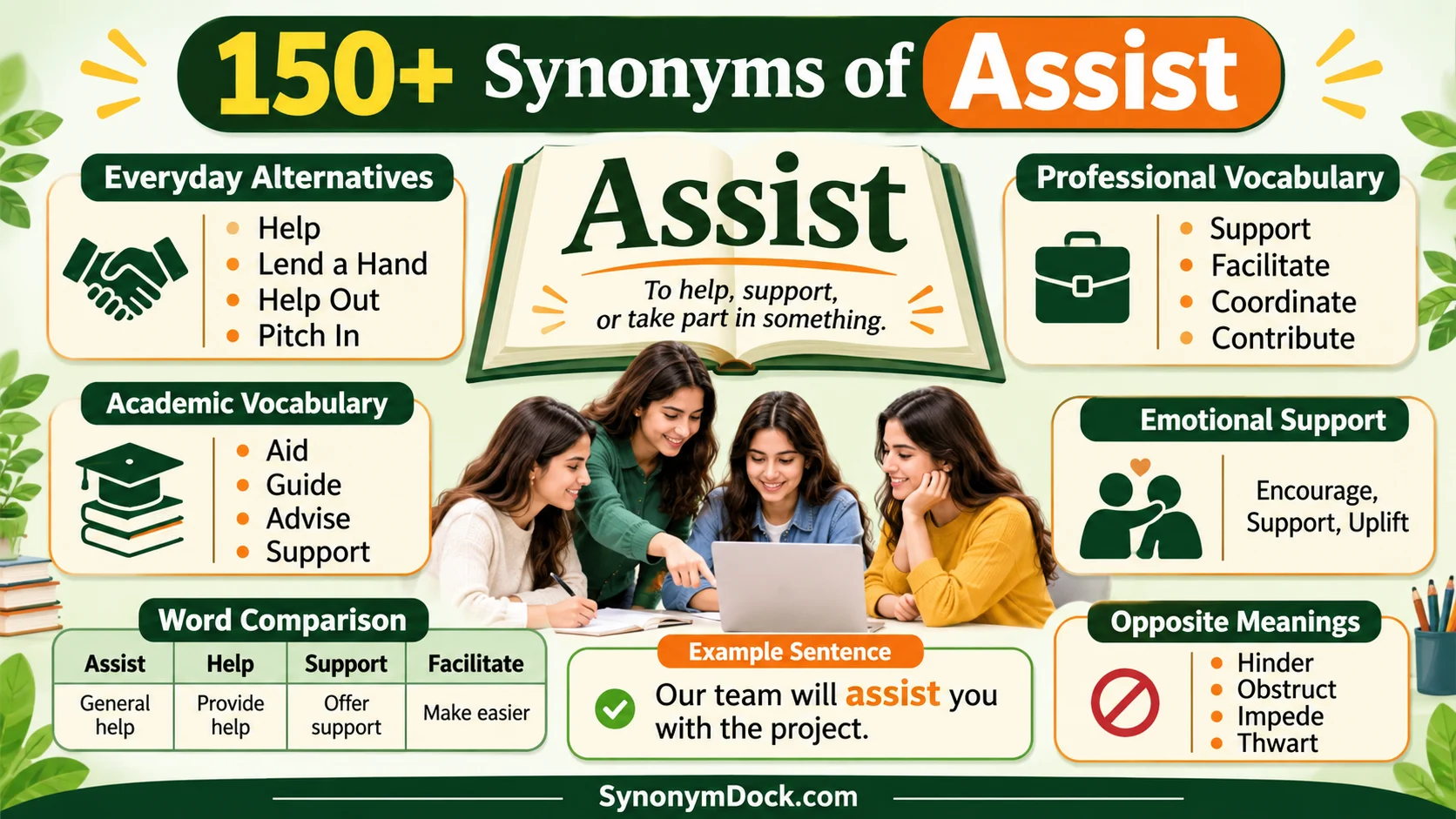
When writing emails, essays, resumes, or professional reports, you may notice that the word assist appears repeatedly. Although it communicates the idea of helping someone, choosing a more specific alternative can make your writing clearer and more engaging. Finding the right synonym of assist depends on the type of help you provide, the situation, and the impression you want to create.
Words such as support, aid, facilitate, guide, and contribute express different forms of assistance. Some sound natural in everyday conversation, while others are better suited to academic writing, business communication, and professional documents. Understanding these distinctions helps you choose vocabulary that communicates your intended meaning accurately.
What Are the Best Synonyms of Assist?
The best synonyms of assist include help, support, aid, facilitate, guide, contribute, cooperate, and serve. Assist is a neutral, slightly formal verb meaning to help someone complete a task or achieve a goal. Use support professionally, help conversationally, aid formally, and facilitate when making a process easier.
Best Alternatives by Context
| Context | Recommended Synonym |
| Formal writing | Aid |
| Academic writing | Support |
| Professional communication | Support |
| Business communication | Facilitate |
| Casual conversation | Help |
| Emotional writing | Stand by |
| Creative writing | Guide |
| Resume writing | Contribute to |
| Workplace communication | Collaborate |
| Practical tasks | Lend a hand |
Meaning, Tone, and Context of Assist
Simple Definition
Assist means to help someone by providing support, performing a task, sharing knowledge, or making an activity easier. It can describe practical help, professional cooperation, or support with a particular responsibility.
For example:
- The technician assisted the engineer with the installation.
- Our team will assist customers with their inquiries.
- The teacher assisted students with their research projects.
In each sentence, someone provides help to make another person’s task easier or more manageable.
Part of Speech
Assist is primarily used as a verb.
- Base form: Assist
- Third-person singular: Assists
- Past tense: Assisted
- Present participle: Assisting
- Noun: Assistance
- Related noun: Assistant
- Related adjective: Assistive
Overall Tone
Assist generally has a neutral and positive tone. It communicates helpful action without necessarily expressing strong emotion.
It is particularly common in workplaces, educational settings, customer service, healthcare communication, and formal writing.
Formality Level
Assist is neutral to semi-formal. It sounds professional without being excessively technical or old-fashioned.
Compare:
- Casual: Can you help me with this assignment?
- Professional: Could you assist me with this assignment?
- More specific: Could you guide me through the assignment requirements?
The best choice depends on the relationship between the speakers and the type of help being requested.
Common Uses
People commonly use assist when discussing:
- Helping colleagues complete workplace responsibilities.
- Supporting students with lessons or assignments.
- Providing customer service.
- Helping someone understand a process.
- Contributing to a team project.
- Supporting people during challenging situations.
- Making professional or administrative tasks easier.
Related Word Forms
| Word | Part of Speech | Example |
| Assist | Verb | I will assist the new employee. |
| Assistance | Noun | Thank you for your assistance. |
| Assistant | Noun | She works as a research assistant. |
| Assisted | Verb, past tense | He assisted the project manager. |
| Assisting | Verb, present participle | They are assisting local families. |
| Assistive | Adjective | The school purchased assistive technology. |
When and How to Use Assist
Use assist when someone provides practical help, professional support, or cooperation toward completing a task. It is especially useful when the situation requires a polite and professional tone.
Here are seven natural examples from different situations.
1. Professional Communication
Our department will assist you with the documentation required for your application.
2. Academic Writing
The research team assisted students in collecting and organizing relevant information.
3. Workplace Communication
I can assist my colleagues with the new software training.
4. Personal Communication
My brother assisted me with the preparations for the family gathering.
5. Business Email
Please let us know if you need further assistance with your order.
6. Resume Writing
Assisted the management team in coordinating daily operations and maintaining project records.
7. Social Media
Grateful to everyone who assisted us in making this community event successful.
Best Synonyms of Assist
No alternative replaces assist perfectly in every situation. The most suitable choice depends on whether you are providing practical help, emotional encouragement, professional cooperation, or expert guidance.
1. Professional Writing: Support
Support works well when describing ongoing help, resources, or encouragement.
Example: Our department supports employees throughout the training process.
2. Academic Writing: Aid
Aid is suitable for formal discussions of help, resources, and contributions.
Example: The additional research materials aided the students in understanding the topic.
3. Business Communication: Facilitate
Facilitate is useful when you make a process, discussion, or activity easier.
Example: The coordinator facilitated communication between the two departments.
4. Casual Conversation: Help
Help is the simplest and most natural alternative in everyday English.
Example: Could you help me carry these books?
5. Emotional Writing: Stand by
Stand by communicates loyalty and emotional support, especially during difficult situations.
Example: Her friends stood by her throughout the challenging period.
6. Creative Writing: Guide
Guide emphasizes direction, advice, or instruction rather than simply completing a task for someone.
Example: The experienced traveler guided the group through the unfamiliar city.
7. Resume Writing: Contribute to
Contribute to highlights your involvement in a project, activity, or organizational achievement.
Example: Contributed to the successful implementation of a new customer service system.
8. Workplace Communication: Collaborate
Collaborate describes working together toward a shared objective.
Example: I collaborated with the marketing team to prepare the campaign.
9. Stronger or More Direct Meaning: Lend a Hand
Lend a hand is a friendly expression for offering practical help.
Example: Several volunteers lent a hand during the school event.
10. Softer and More Considerate Meaning: Accommodate
Accommodate can describe making adjustments to meet someone’s needs. It is not a direct replacement in every sentence.
Example: The manager accommodated the employee’s request for a flexible schedule.
When Not to Use Assist
Although assist is useful, it can sometimes sound too general or fail to explain the exact contribution.
1. When You Mean Emotional Support
Less specific: I assisted my friend during a difficult time.
Better: I stood by my friend during a difficult time.
Why: Stood by communicates loyalty and emotional presence more clearly.
2. When You Mean Giving Expert Advice
Less specific: The professor assisted the students with their research.
More precise: The professor advised the students on their research.
Why: Advised identifies the type of help as professional or academic guidance.
3. When You Mean Working Together
Less specific: I assisted the design team on the project.
Better: I collaborated with the design team on the project.
Why: Collaborated emphasizes shared responsibility and teamwork.
4. When You Mean Making a Process Easier
Less specific: The new system assisted the application process.
Better: The new system streamlined the application process.
Why: Streamlined specifically means making a process more efficient.
5. When You Mean Providing Resources
Less specific: The organization assisted local schools with educational materials.
Better: The organization supplied local schools with educational materials.
Why: Supplied identifies the actual contribution rather than describing it generally.
6. When You Mean Teaching a Skill
Less specific: The instructor assisted the participants in learning the software.
Better: The instructor trained the participants to use the software.
Why: Trained clearly communicates instruction and skill development.
Words Commonly Confused With Assist
Several words are related to assist, but their meanings are not identical.
| Word | Main Difference | When to Use It | Example |
| Help | The broadest and most common word for making something easier. | Everyday communication. | Can you help me with this task? |
| Support | Emphasizes continued help, encouragement, or resources. | Workplace and personal situations. | The manager supported the new employee. |
| Aid | Often sounds more formal and may refer to practical or material help. | Reports and formal writing. | The program aids small businesses. |
| Guide | Focuses on direction, advice, or instruction. | Teaching and mentoring. | She guided the students through the project. |
| Facilitate | Means making an activity or process easier. | Meetings, processes, and business communication. | The coordinator facilitated the discussion. |
| Collaborate | Emphasizes working jointly with others. | Team projects and shared responsibilities. | We collaborated on the presentation. |
Best Synonyms of Assist by Context
The right alternative should describe the actual contribution rather than simply make a sentence sound more sophisticated.
| Context | Best Synonym | Why It Works | Example |
| Formal writing | Aid | Communicates help in a formal tone. | The findings aided further investigation. |
| Academic writing | Support | Works naturally when discussing evidence or research. | The results support the proposed explanation. |
| Professional communication | Support | Sounds clear and respectful. | Our team supports new employees. |
| Business emails | Help | Polite and direct in most business situations. | We are happy to help with your request. |
| Resume writing | Contribute to | Highlights personal involvement. | Contributed to process improvements. |
| Workplace communication | Collaborate | Shows shared effort. | We collaborated with the finance department. |
| Casual conversation | Help | Natural and familiar. | I’ll help you move the furniture. |
| Everyday speaking | Give a hand | Friendly and conversational. | Can you give me a hand? |
| Creative writing | Guide | Suggests direction and mentorship. | The old map guided the travelers. |
| Storytelling | Lead | Describes directing or showing the way. | She led the children through the forest. |
| Emotional writing | Stand by | Expresses loyalty and encouragement. | His family stood by him. |
| Strong emphasis | Champion | Expresses active support for a cause or person. | She championed the students’ interests. |
| Mild tone | Help | Simple without adding unnecessary emphasis. | I can help if you need anything. |
| Social media captions | Pitch in | Friendly expression for contributing effort. | Everyone pitched in to make the event successful. |
| American English | Lend a hand | Common conversational expression. | Neighbors lent a hand after the storm. |
| British English | Give a hand | Also natural in British English. | Could you give me a hand with this? |
How to Choose the Best Synonym of Assist
Selecting a suitable alternative becomes easier when you consider what kind of help you are describing.
1. Identify the Actual Meaning
Ask yourself what the person is doing.
- Providing general help: help
- Offering ongoing encouragement: support
- Giving resources: provide
- Offering direction: guide
- Working jointly: collaborate
- Making a process easier: facilitate
2. Consider Your Audience
A sentence written for a manager may require a different tone from a message sent to a friend.
Use support or facilitate in suitable professional contexts. Choose help or give a hand when speaking informally.
3. Match the Level of Formality
Formal writing often benefits from aid or provide assistance. However, simple language is usually more effective in ordinary business emails.
4. Consider the Purpose
A resume should show what you actually accomplished. Instead of writing “Assisted with company operations,” explain the responsibility, such as “Coordinated daily schedules” or “Maintained employee records.”
5. Check the Sentence Structure
Some alternatives require different grammatical patterns.
- Assist someone with a task.
- Help someone with a task.
- Aid someone in completing a task.
- Guide someone through a process.
- Contribute to a project.
A synonym should fit both the meaning and the grammar of your sentence.
Real Life Examples of Assist
These examples show how different alternatives can make communication more specific.
| Situation | Original Sentence | Improved Sentence |
| School | The teacher assisted the students. | The teacher guided the students through the lesson. |
| College | The professor assisted the research team. | The professor advised the research team. |
| Workplace | I assisted my colleagues with the report. | I supported my colleagues in preparing the report. |
| Business | The new system assisted customers. | The new system simplified the customer experience. |
| We can assist you with your inquiry. | We would be happy to help with your inquiry. | |
| Resume | Assisted with project management. | Coordinated project activities and tracked deadlines. |
| Conversation | Can you assist me? | Can you give me a hand? |
| Storytelling | The guide assisted the travelers. | The guide led the travelers through the mountains. |
| Blogging | These examples assist readers in understanding the topic. | These examples help readers understand the topic. |
| Social media | Volunteers assisted at the event. | Volunteers pitched in at the event. |
12 Best Synonyms of Assist
The following 12 alternatives are useful in different situations. Some are close synonyms, while others describe particular forms of assistance. Always check the context before replacing assist.
| Synonym | Simple Meaning | Best Used For | Example Sentence |
| Help | Make something easier for someone. | Everyday communication. | I can help you with the presentation. |
| Support | Provide practical or emotional backing. | Professional and personal situations. | The organization supports local students. |
| Aid | Provide useful help or resources. | Formal and academic writing. | The findings aided the investigation. |
| Assist | Give help toward completing a task. | General professional communication. | She assisted the director with the event. |
| Facilitate | Make an activity or process easier. | Meetings and business processes. | The manager facilitated the discussion. |
| Guide | Provide direction or instruction. | Teaching and mentoring. | The counselor guided students through their choices. |
| Advise | Offer recommendations or expert opinions. | Professional and academic situations. | The consultant advised the company. |
| Counsel | Give thoughtful guidance, often about a personal or serious matter. | Professional guidance and personal support. | The advisor counseled the students. |
| Encourage | Give confidence or motivation. | Emotional and educational contexts. | Her teacher encouraged her to participate. |
| Accompany | Go somewhere with another person. | Travel and personal situations. | I accompanied my colleague to the meeting. |
| Cooperate | Work willingly with others. | Shared responsibilities. | Both departments cooperated on the project. |
| Collaborate | Work jointly toward a common goal. | Professional and creative projects. | The writers collaborated on the article. |
| Contribute | Give effort, knowledge, or resources. | Teamwork and projects. | Everyone contributed to the campaign. |
| Serve | Provide a service or fulfill a helpful role. | Public and professional settings. | The organization serves local communities. |
Synonyms of Assist by Usage
Professional vs. Personal Synonyms
Professional choices:
- Support
- Facilitate
- Collaborate
- Contribute
- Provide
Personal choices:
- Help
- Encourage
- Stand by
- Give a hand
- Look after
For example, “I supported the new employee during training” sounds appropriate in a workplace report. “I gave my friend a hand with the decorations” sounds more natural in a personal conversation.
Formal vs. Conversational Synonyms
The level of formality should match the communication setting.
| Setting | Suitable Alternative |
| Research reports | Aid |
| Academic essays | Support |
| Business documents | Provide assistance |
| Presentations | Facilitate |
| Professional emails | Help or support |
| Casual conversations | Give a hand |
| Text messages | Help or pitch in |
Avoid choosing an unnecessarily complicated word when a familiar alternative communicates the message more clearly.
Academic Synonyms
Academic writing often requires words that explain how evidence, resources, or individuals contribute to a research process.
- Support: Use when evidence strengthens an argument.
- Aid: Use when something helps a process or investigation.
- Facilitate: Use when a method makes research activities easier.
- Contribute to: Use when describing a factor’s role in an outcome.
- Guide: Use when describing supervision or direction.
Example: The additional data supported the researchers’ conclusions.
This sentence is more precise than saying the data assisted the conclusions.
Professional and Business Synonyms
Different workplace responsibilities call for different vocabulary.
| Situation | Recommended Word | Example |
| Resume | Contribute | Contributed to improving customer satisfaction. |
| Interview | Support | I supported the team during a major transition. |
| Meetings | Facilitate | She facilitated the weekly planning meeting. |
| Presentations | Guide | The manager guided the audience through the findings. |
| Performance reviews | Coordinate | Coordinated daily activities across departments. |
| Client communication | Help | We are pleased to help you resolve this issue. |
| Team projects | Collaborate | Collaborated with colleagues to meet project deadlines. |
Resume tip: Replace vague statements such as “Assisted with administrative work” with specific responsibilities. For example, “Maintained records, organized schedules, and prepared weekly reports” gives employers a clearer picture of your contribution.
Creative and Literary Synonyms
Creative writing benefits from alternatives that show how assistance takes place.
- Guide: Suggests direction or mentorship.
- Lead: Emphasizes showing someone the way.
- Rescue: Describes helping someone escape danger or difficulty.
- Shelter: Focuses on providing protection.
- Encourage: Communicates emotional motivation.
- Stand by: Suggests loyalty during difficult moments.
Example: Instead of writing “The villagers assisted the traveler,” a story might say, “The villagers welcomed the traveler, offered shelter, and guided him toward the nearest town.”
The revised version shows the reader what the villagers actually did.
Slang or Modern Alternatives
There are no perfect slang replacements for assist, but several informal expressions are common in everyday American English.
| Expression | Meaning | Where It Fits |
| Give a hand | Help with a task. | Friendly conversations. |
| Pitch in | Join an effort. | Group activities. |
| Help out | Provide practical help. | Everyday situations. |
| Lend a hand | Offer assistance. | Informal and friendly communication. |
| Back someone up | Support someone, especially in a disagreement or difficult situation. | Casual conversation. |
These expressions are useful in conversation, but most are less suitable for formal research papers or professional reports.
Strongest to Mildest Synonyms
There is no universal intensity scale for synonyms of assist. Their strength depends on the type of help and the sentence. However, the following groups show how their emphasis can differ.
| Level of Emphasis | Words | What They Communicate |
| Mild | Help, aid | General assistance. |
| Moderate | Support, guide, encourage | More defined or continued help. |
| Strong | Champion, stand by, rescue | Active commitment, loyalty, or significant intervention. |
| Collaborative | Cooperate, collaborate, contribute | Shared effort toward a goal. |
Do not assume that a stronger-sounding word is always better. Rescue is appropriate when someone is saved from danger, not when a colleague simply helps with paperwork.
Emotional vs. Neutral Synonyms
Emotional alternatives:
- Stand by
- Encourage
- Champion
- Support
- Look after
These words can communicate care, loyalty, or personal commitment.
Neutral alternatives:
- Help
- Aid
- Assist
- Facilitate
- Provide
These are useful when the purpose is to describe an action without adding strong emotional meaning.
Antonyms of Assist
The opposite of assist is generally to make a task harder, prevent progress, or work against someone’s efforts. The best antonym depends on the situation.
| Antonym | Meaning | Example Sentence |
| Hinder | Make progress difficult. | Unnecessary rules hindered the project. |
| Obstruct | Block progress or movement. | The outdated system obstructed communication. |
| Impede | Slow down or interfere with progress. | Technical issues impeded the investigation. |
| Hamper | Make an activity more difficult. | Limited resources hampered the team’s efforts. |
| Oppose | Act against an idea or action. | Several members opposed the proposal. |
| Thwart | Prevent an effort from succeeding. | Poor planning thwarted their original strategy. |
| Undermine | Weaken someone’s efforts or confidence. | Constant criticism undermined the team’s confidence. |
| Sabotage | Deliberately damage an effort or plan. | His actions sabotaged the negotiations. |
| Block | Prevent something from proceeding. | The missing approval blocked the application. |
| Prevent | Stop something from happening. | The safety measures prevented further delays. |
| Discourage | Reduce someone’s confidence or motivation. | Negative comments discouraged the students. |
| Delay | Make something happen later than expected. | The missing documents delayed the process. |
| Restrain | Hold back or limit an action. | Strict restrictions restrained the group’s activities. |
| Frustrate | Prevent an effort from producing the desired result. | Repeated interruptions frustrated their progress. |
These are contextual opposites rather than interchangeable antonyms. For example, hinder is a strong general opposite of help, while oppose specifically means acting against someone or something.
Comparison: Assist vs. Similar Words
Assist vs. Help
Main Difference: Both words describe providing help. Help is more common and conversational, while assist often sounds more professional.
Which Is Stronger? Neither is inherently stronger. The difference is mainly tone and context.
Which Is More Formal? Assist is generally more formal.
When to Use Each: Choose help for everyday speaking and assist for professional situations.
Examples:
- Assist: The technician assisted the customer with the installation.
- Help: The technician helped the customer install the software.
Assist vs. Support
Main Difference: Assist often refers to helping with a particular task. Support can describe continued practical, emotional, or organizational backing.
Which Is Stronger? Support may suggest more sustained involvement, depending on context.
Which Is More Formal? Both are suitable for professional communication.
When to Use Each: Use assist for a specific responsibility and support for ongoing help or encouragement.
Examples:
- Assist: The manager assisted me with the report.
- Support: The manager supported me throughout the project.
Assist vs. Aid
Main Difference: Both mean to provide help, but aid often sounds more formal and can refer to resources or organized help.
Which Is Stronger? Neither is automatically stronger.
Which Is More Formal? Aid often sounds more formal.
When to Use Each: Use aid in formal or academic contexts and assist for general professional help.
Examples:
- Assist: The volunteers assisted the local residents.
- Aid: The organization provided aid to local residents.
Assist vs. Facilitate
Main Difference: Assist means to help someone. Facilitate means to make an activity, process, or interaction easier.
Which Is Stronger? They describe different kinds of involvement rather than different levels of strength.
Which Is More Formal? Facilitate often sounds more technical or formal.
When to Use Each: Choose facilitate when you improve how a process works.
Examples:
- Assist: The coordinator assisted the participants.
- Facilitate: The coordinator facilitated communication among the participants.
Assist vs. Guide
Main Difference: Guide emphasizes direction or instruction, while assist has a broader meaning.
Which Is Stronger? Guide is more specific, not necessarily stronger.
Which Is More Formal? Both work in professional and educational writing.
When to Use Each: Use guide when someone provides direction or teaches a process.
Examples:
- Assist: The teacher assisted the students.
- Guide: The teacher guided the students through the assignment.
Assist vs. Collaborate
Main Difference: Assist can describe one person helping another. Collaborate means working together toward a shared goal.
Which Is Stronger? Collaborate emphasizes joint participation.
Which Is More Formal? Both are appropriate in professional writing.
When to Use Each: Choose collaborate when the people involved share responsibility for the work.
Examples:
- Assist: I assisted the marketing manager.
- Collaborate: I collaborated with the marketing manager on the campaign.
Common Phrases and Expressions with Assist
These expressions are useful in everyday, academic, and professional communication.
1. Assist Someone With Something
Meaning: Help someone complete a particular task.
Example: The receptionist assisted visitors with the registration process.
2. Assist in Doing Something
Meaning: Help make an activity or result possible.
Example: The new equipment assisted in improving laboratory efficiency.
3. Assist Someone in Something
Meaning: Provide help with a particular activity or area.
Example: The counselor assisted students in choosing suitable courses.
4. Provide Assistance
Meaning: Give help or support.
Example: Our customer service team provides assistance throughout the application process.
5. Request Assistance
Meaning: Ask someone for help.
Example: Please contact the support team if you require further assistance.
6. Offer Assistance
Meaning: Make help available to someone.
Example: Several employees offered assistance during the office relocation.
7. Technical Assistance
Meaning: Help with technical problems or equipment.
Example: The company provides technical assistance to its customers.
8. Financial Assistance
Meaning: Money or financial support provided to someone.
Example: Eligible students can apply for financial assistance.
Common Mistakes to Avoid
Choosing an alternative without considering its meaning can make a sentence inaccurate. These common mistakes can help you use assist and related words more effectively.
1. Using Assist When Help Is More Natural
Incorrect or awkward: Can you assist me with carrying these grocery bags?
Better: Can you help me carry these grocery bags?
Why: Help sounds more natural in an ordinary conversation. Assist is possible, but it may sound unnecessarily formal.
2. Confusing Assist With Facilitate
Incorrect: The teacher facilitated the student with the homework.
Better: The teacher assisted the student with the homework.
Why: Facilitate means making a process easier. Assist is the appropriate choice when directly helping a student.
3. Using Collaborate When You Mean Help
Incorrect: The receptionist collaborated the visitor with the application.
Better: The receptionist helped the visitor complete the application.
Why: Collaborate normally requires a structure such as “collaborate with someone on something.” It describes joint work, not simply providing assistance.
4. Choosing an Informal Expression for Formal Writing
Less suitable: The organization pitched in to support the research.
Better: The organization contributed to the research.
Why: Pitched in is conversational. Contributed to is more suitable for an academic or formal report.
5. Choosing an Overly Dramatic Alternative
Incorrect: My colleague rescued me with the office report.
Better: My colleague helped me complete the office report.
Why: Rescued usually suggests saving someone from danger or a serious difficulty. It exaggerates an ordinary workplace situation.
6. Repeating Assist Too Often
Less effective: The teacher assisted the students and assisted them with their projects.
Better: The teacher guided the students and supported them with their projects.
Why: Using different accurate verbs makes the sentence smoother and clarifies the teacher’s contribution.
7. Choosing a Synonym With the Wrong Meaning
Incorrect: The manager advised the office supplies for the new department.
Better: The manager provided office supplies for the new department.
Why: Advise means to offer recommendations. Provide means to supply something needed.
Frequently Asked Questions
1. What are the best synonyms of assist?
The best synonyms of assist include help, support, aid, facilitate, guide, contribute, and cooperate. Choose help for everyday communication, support for ongoing assistance, and facilitate for making processes easier.
2. What are the best formal synonyms of assist?
Useful formal alternatives include aid, support, facilitate, provide assistance, and contribute to. The most suitable choice depends on the task. For example, facilitate works well when describing a process or organized activity.
3. What are common informal synonyms of assist?
Common informal alternatives include help, help out, give a hand, lend a hand, and pitch in. These expressions sound natural in conversations, messages, and friendly situations, but may be too casual for formal reports.
4. What is another word for assist in professional writing?
Support, facilitate, coordinate, contribute, and provide can replace assist in professional writing. Use coordinate for organizing activities and contribute when describing your involvement in a project.
5. What is the difference between assist and help?
Both words mean providing assistance, but help is more common in everyday English, while assist often sounds more formal. Use help in casual conversations and assist in professional situations.
6. What is the opposite of assist?
Common opposites of assist include hinder, obstruct, impede, hamper, and thwart. These words describe actions that make progress more difficult or prevent someone from achieving a particular goal.
Conclusion
Choosing the right synonym of assist makes your writing more precise and natural. Words such as help, support, aid, facilitate, guide, and collaborate describe different forms of assistance, so the best alternative depends on what someone actually does.
For everyday conversations, choose help or give a hand. In professional writing, consider support, facilitate, or contribute to. For academic work, aid and support are often suitable. Before replacing a word, check its meaning, grammatical structure, and tone. A useful vocabulary habit is to learn each synonym through a complete sentence rather than memorizing its definition alone.

Ethan Parker is an English language writer and vocabulary enthusiast at SynonymDock.com. He specializes in synonyms, word meanings, alternative expressions and practical English usage, creating clear and reliable content to help students, professionals, writers and English learners choose the right words with confidence.