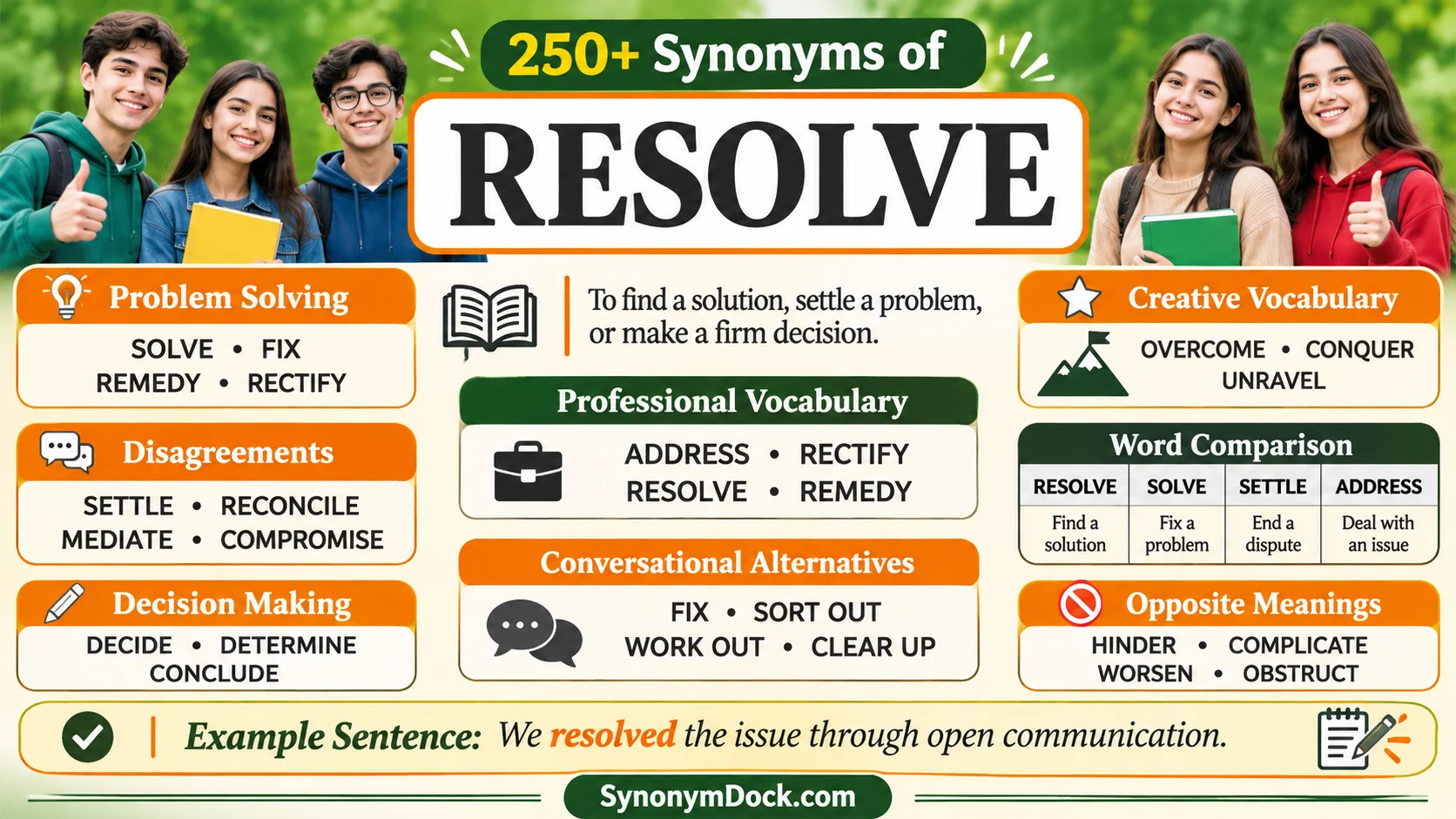
Finding the right synonym of resolve can help you explain whether you solved a problem, settled a disagreement, made a decision, or reached a conclusion. When writing emails, essays, business reports, or professional documents, you may find yourself using the word resolve repeatedly. It is a useful verb, but its meaning changes with the situation.
Words such as solve, settle, address, rectify, determine, and decide offer different ways to express these ideas. Some are suitable for formal writing, while others sound more natural in everyday conversations. Choosing the most accurate alternative makes your message clearer and helps readers understand exactly what happened.
What Are the Best Synonyms of Resolve?
The best synonyms of resolve include solve, settle, address, fix, rectify, remedy, determine, decide, clarify, and conclude. Resolve is a neutral to formal verb meaning to find a solution, settle a matter, or make a firm decision. Use solve for problems, settle for disputes, and determine for decisions or findings.
Best Alternatives by Context
| Context | Recommended Synonym |
| Formal writing | Rectify |
| Academic writing | Address |
| Professional communication | Resolve or address |
| Business communication | Settle |
| Casual conversation | Fix |
| Emotional writing | Reconcile |
| Creative writing | Overcome |
| Decision making | Determine |
| Disagreements | Settle |
| Complex problems | Find a solution |
Meaning, Tone, and Context of Resolve
Simple Definition
Resolve means to find a solution to a problem, bring a disagreement to an end, or make a firm decision. It can also describe the determination to achieve something despite difficulties.
The word has several common uses:
- Solve a problem: The technician resolved the software issue.
- Settle a disagreement: The two departments resolved their differences.
- Make a decision: The committee resolved to revise the policy.
- Show determination: She remained resolved to complete her education.
These meanings are connected, but their synonyms are not always the same. For example, solve works for a technical problem, while reconcile may be more appropriate when repairing a relationship.
Part of Speech
Resolve is primarily used as a verb. It can also function as a noun in the form resolve, meaning determination or firm purpose.
| Word Form | Part of Speech | Example |
| Resolve | Verb | We must resolve this issue. |
| Resolves | Verb, third-person singular | The manager resolves customer complaints. |
| Resolved | Verb, past tense | They resolved the disagreement. |
| Resolving | Verb, present participle | She is resolving the problem. |
| Resolution | Noun | The resolution of the dispute took several weeks. |
| Resolute | Adjective | He remained resolute despite the challenges. |
| Resolutely | Adverb | She resolutely defended her decision. |
| Resolve | Noun | His resolve remained strong. |
Overall Tone
Resolve generally has a neutral or positive tone.
- Positive: It can suggest determination, progress, and successful problem solving.
- Neutral: It can describe the practical settlement of an issue.
- Negative: It is not inherently negative, although the matter being resolved may involve an unfavorable situation.
For example, “The team resolved the conflict” sounds positive because it suggests progress. “The committee resolved to cancel the program” is neutral because it simply reports a decision.
Formality Level
Resolve is a neutral to formal word. It is common in business communication, academic writing, official documents, and everyday English.
| Level | Example |
| Formal | The organization will rectify the identified deficiencies. |
| Semi-formal | We are working to resolve the matter. |
| Neutral | They settled the disagreement. |
| Informal | We fixed the problem. |
Common Uses
People commonly use resolve when discussing:
- Technical problems and system errors.
- Workplace disagreements.
- Customer complaints.
- Business and legal matters.
- Academic questions and research challenges.
- Personal conflicts and misunderstandings.
- Decisions, intentions, and commitments.
When and How to Use Resolve
Use resolve when you want to describe solving a problem, reaching an agreement, or making a definite decision. It is especially useful when you want your writing to sound clear and professional.
Here are seven realistic examples from different situations.
1. Professional Communication
Our department is taking the necessary steps to resolve the issue before the next review.
2. Academic Writing
The researchers attempted to resolve the inconsistencies in the collected data.
3. Workplace Communication
The supervisor helped resolve the disagreement between the two employees.
4. Personal Communication
We talked openly and resolved our misunderstanding.
5. Business Email
Our support team is working to resolve your concern as quickly as possible.
6. Resume Writing
Resolved customer complaints by identifying concerns and coordinating appropriate solutions.
7. Social Media
A little patience and honest communication can help resolve many misunderstandings.
Best Synonyms of Resolve
No synonym of resolve works perfectly in every situation. The right alternative depends on whether you are solving a problem, ending a disagreement, making a decision, or demonstrating determination.
1. Professional Writing: Address
Address works well when describing an issue that needs attention or action. It does not necessarily mean that the issue has been completely solved.
Example: The management team addressed the concerns raised during the review.
2. Academic Writing: Examine or Solve
Solve is appropriate when a research question or specific problem has been answered. Examine is better when the researcher investigates an issue without claiming to have resolved it.
Example: The study proposes a method to solve the identified problem.
3. Business Communication: Settle
Settle is particularly useful when discussing disagreements, negotiations, payments, or disputes.
Example: Both companies agreed to settle the contractual dispute.
4. Casual Conversation: Fix
Fix is a simple and natural alternative when talking about everyday problems.
Example: I think we can fix this issue before tomorrow.
5. Emotional Writing: Reconcile
Reconcile is appropriate when people repair a relationship, overcome differences, or become comfortable with conflicting feelings.
Example: After several conversations, the siblings reconciled.
6. Creative Writing: Overcome
Overcome emphasizes successfully dealing with an obstacle or difficulty.
Example: The young traveler overcame the challenges that stood in her way.
7. Resume Writing: Rectify
Rectify communicates that you corrected an error or improved an unsatisfactory situation.
Example: Rectified reporting discrepancies by reviewing records and updating documentation.
8. Workplace Communication: Remedy
Remedy emphasizes correcting a problem or addressing its cause.
Example: The department introduced new procedures to remedy recurring delays.
9. Decision Making: Determine
Determine is suitable when reaching a conclusion after considering information or evidence.
Example: The committee determined the most suitable course of action.
10. Stronger Sense of Determination: Commit
Commit emphasizes a firm decision to take action or remain dedicated to a goal.
Example: She committed herself to completing the training program.
When Not to Use Resolve
Although resolve is versatile, it can sometimes be too broad or inaccurate. A more specific verb can explain the action more clearly.
1. When You Mean Giving Attention to an Issue
Less precise: The committee resolved the environmental concerns.
Better: The committee addressed the environmental concerns.
Why: Addressed means the committee dealt with the concerns. It does not automatically claim that every problem was solved.
2. When You Mean Repairing Something
Less natural: The technician resolved the broken printer.
Better: The technician repaired the printer.
Why: Repair specifically describes restoring something that is damaged or not working.
3. When You Mean Reaching an Agreement
Less specific: The two companies resolved the negotiation.
Better: The two companies settled the dispute.
Why: Settle is more natural when describing the successful conclusion of a disagreement or dispute.
4. When You Mean Making a Choice
Less precise: The manager resolved which proposal to accept.
Better: The manager decided which proposal to accept.
Why: Decide directly communicates the act of choosing between alternatives.
5. When You Mean Correcting an Error
Less specific: The accountant resolved the incorrect figures.
Better: The accountant corrected the incorrect figures.
Why: Correct clearly describes fixing an error in information or calculations.
6. When You Mean Showing Determination
Less specific: She resolved to continue despite the difficulties.
Alternative: She remained determined to continue despite the difficulties.
Why: Determined emphasizes a person’s commitment and willingness to continue.
7. When You Mean Explaining Something Clearly
Less specific: The teacher resolved the confusion about the assignment.
Better: The teacher clarified the assignment requirements.
Why: Clarify means making information easier to understand. It is more precise when the problem is a lack of understanding.
Words Commonly Confused With Resolve
Several words have meanings related to resolve, but they describe different actions.
| Word | Difference | When to Use It | Example |
| Solve | Find an answer or solution to a problem. | Mathematical, technical, and practical problems. | We solved the scheduling problem. |
| Settle | Bring a disagreement or uncertain matter to an end. | Disputes, negotiations, and payments. | They settled the disagreement. |
| Address | Give attention or take action regarding an issue. | Concerns, challenges, and responsibilities. | The report addresses several important questions. |
| Decide | Choose between possible options. | Personal, business, and organizational decisions. | We decided to postpone the meeting. |
| Rectify | Correct something that is wrong. | Errors, deficiencies, and procedural problems. | The team rectified the reporting error. |
| Reconcile | Restore agreement or make conflicting things compatible. | Relationships, accounts, and differences. | The two friends reconciled after their argument. |
Best Synonyms of Resolve by Context
The most effective synonym describes the actual result or action. Use the following recommendations to select the right word for different writing situations.
| Context | Best Synonym | Why It Works | Example |
| Formal writing | Rectify | Emphasizes correcting an identified problem. | The department rectified the procedural errors. |
| Academic writing | Address | Describes dealing with a research question or issue. | This paper addresses the limitations of the study. |
| Professional communication | Address | Sounds clear without overstating the result. | We will address your concerns. |
| Business emails | Settle | Works well for disputes and outstanding matters. | We hope to settle this matter promptly. |
| Resume writing | Rectify | Shows corrective action. | Rectified discrepancies in financial records. |
| Workplace communication | Resolve | Clearly describes bringing an issue to an end. | The supervisor resolved the scheduling conflict. |
| Casual conversation | Fix | Familiar and direct. | I’ll fix the problem. |
| Everyday speaking | Sort out | Natural for handling a difficulty or disagreement. | We need to sort out this misunderstanding. |
| Creative writing | Overcome | Emphasizes dealing successfully with obstacles. | She overcame the challenges before her. |
| Storytelling | Reconcile | Useful for repairing relationships or differences. | The brothers reconciled before the journey ended. |
| Emotional writing | Reconcile | Communicates restored understanding or acceptance. | They reconciled after years apart. |
| Strong emphasis | Remedy | Highlights corrective action. | The organization introduced measures to remedy the situation. |
| Mild tone | Address | Avoids claiming that an issue has been completely solved. | The team addressed the initial concerns. |
| Social media captions | Sort out | Sounds conversational and approachable. | Sometimes a good conversation helps sort things out. |
| American English | Fix | Common in everyday American communication. | We fixed the issue this morning. |
| British English | Sort out | Common conversational expression in British English. | We sorted out the problem yesterday. |
How to Choose the Best Synonym of Resolve
Choosing the right alternative becomes easier when you identify the exact meaning you want to communicate.
1. Identify What Is Being Resolved
Start by asking what kind of situation you are describing.
- A problem: solve or fix
- A disagreement: settle or reconcile
- An error: correct or rectify
- A concern: address
- A decision: determine or decide
- A difficult situation: overcome
- A complicated process: sort out
2. Consider Your Intended Result
Think about whether the issue has actually been solved.
If you only examined a problem or began taking action, address is often more accurate than resolve. If the issue has been successfully settled, resolve or solve may be appropriate.
3. Match the Tone to Your Audience
Use fix or sort out in informal conversations. Choose address, rectify, or settle when the context calls for a more professional tone.
4. Consider Emotional Strength
Some words communicate practical action, while others express personal commitment.
- Neutral: Address, solve, determine.
- Cooperative: Reconcile, negotiate, collaborate.
- Determined: Overcome, commit, persevere.
- Corrective: Rectify, remedy, repair.
5. Match the Writing Purpose
For academic writing, explain whether you investigated, answered, or addressed a question. In professional writing, identify the exact action you performed instead of relying on a broad verb.
6. Check the Grammar
Related words often require different sentence structures.
- Resolve a problem.
- Solve a problem.
- Address an issue.
- Settle a dispute.
- Decide on a solution.
- Reconcile differences.
- Determine the outcome.
A suitable synonym should fit naturally into the sentence without changing its grammatical meaning.
Real Life Examples of Resolve
These examples demonstrate how a more precise alternative can improve everyday and professional writing.
| Situation | Original Sentence | Improved Sentence |
| School | The teacher resolved the students’ confusion. | The teacher clarified the difficult lesson. |
| College | The researcher resolved the research question. | The researcher answered the research question. |
| Workplace | The manager resolved the disagreement. | The manager mediated the disagreement. |
| Business | The company resolved the contractual dispute. | The company settled the contractual dispute. |
| We will resolve your concern shortly. | We will address your concern shortly. | |
| Resume | Resolved administrative problems. | Rectified administrative errors and improved record accuracy. |
| Conversation | We need to resolve this issue. | We need to sort this out. |
| Storytelling | The hero resolved the obstacles. | The hero overcame the obstacles. |
| Blogging | This guide resolves common writing problems. | This guide addresses common writing problems. |
| Social media | We finally resolved our misunderstanding. | We finally cleared up our misunderstanding. |
12 Best Synonyms of Resolve
The following 12 alternatives cover the most useful meanings of resolve. Some describe solving a problem, while others refer to correcting an error, settling a disagreement, or making a firm decision.
| Synonym | Simple Meaning | Best Used For | Example Sentence |
| Solve | Find an answer to a problem. | Questions and practical challenges. | The students solved the difficult equation. |
| Settle | Bring a dispute or matter to an end. | Negotiations and disagreements. | Both parties settled the dispute. |
| Address | Deal with an issue or concern. | Professional and academic writing. | The report addresses the main challenges. |
| Fix | Put something right or make it work again. | Everyday and technical problems. | The technician fixed the computer issue. |
| Rectify | Correct something that is wrong. | Formal and professional writing. | The accountant rectified the reporting errors. |
| Remedy | Correct a problem or unsatisfactory situation. | Organizational and practical problems. | The new procedure remedied the delay. |
| Determine | Reach a conclusion after consideration. | Decisions and findings. | The panel determined the final outcome. |
| Decide | Make a choice or reach a decision. | Personal and professional choices. | She decided to accept the offer. |
| Clarify | Make something easier to understand. | Confusion and unclear information. | The teacher clarified the instructions. |
| Conclude | Bring something to an end or reach a judgment. | Discussions and investigations. | The committee concluded the review. |
| Reconcile | Restore agreement or harmony. | Relationships and differences. | The friends reconciled after their disagreement. |
| Correct | Remove an error or make something accurate. | Mistakes and inaccurate information. | The editor corrected the figures. |
Editorial note: This table needs a final deduplication before publication. Remedy appears twice, and resolve differences is a phrase rather than a single-word synonym. For 18 distinct entries, replace the second remedy with alleviate only when discussing reducing a problem’s severity, and replace resolve differences with reconcile only once. Do not count related phrases as separate single-word synonyms.
Synonyms of Resolve by Usage
Professional vs. Personal Synonyms
Professional choices:
- Address
- Rectify
- Settle
- Remedy
- Determine
- Mediate
Personal choices:
- Fix
- Sort out
- Reconcile
- Work through
- Clear up
- Make peace
For example, “The department rectified the reporting errors” works well in a business report. “We sorted out our misunderstanding” sounds more natural in a personal conversation.
Formal vs. Conversational Synonyms
Different settings call for different levels of formality.
| Setting | Suitable Alternative |
| Research reports | Address |
| Academic essays | Examine or solve |
| Business documents | Rectify |
| Presentations | Address |
| Professional emails | Resolve or settle |
| Casual conversations | Fix |
| Text messages | Sort out |
| Personal discussions | Work through |
Simple vocabulary is not less professional when it communicates the message accurately.
Academic Synonyms
Academic writing often discusses problems, research questions, inconsistencies, and conclusions. Choose the verb that accurately describes the researcher’s work.
- Address: Use when discussing a question, concern, or limitation.
- Solve: Use when a specific problem receives an answer.
- Determine: Use when establishing a result through analysis.
- Clarify: Use when explaining an unclear concept.
- Reconcile: Use when making conflicting findings or explanations compatible.
- Examine: Use when investigating an issue without claiming to solve it.
Example: The study examines the factors contributing to the problem and proposes possible solutions.
This is more accurate than claiming that the study resolved the issue if the research only investigated it.
Professional and Business Synonyms
The strongest alternative depends on the responsibility being described.
| Situation | Recommended Word | Example |
| Resume | Rectify | Rectified inconsistencies in financial reports. |
| Interview | Address | I addressed customer concerns through clear communication. |
| Meetings | Settle | The team settled the outstanding questions. |
| Presentations | Clarify | The presentation clarified the proposed changes. |
| Performance reviews | Resolve | Resolved recurring workflow issues. |
| Client communication | Address | We will address your concerns promptly. |
| Business emails | Settle | We hope to settle this matter soon. |
Resume tip: Avoid writing only “Resolved company problems.” Identify the problem and the action you took. For example, “Resolved recurring scheduling conflicts by coordinating team availability” gives a clearer picture of your contribution.
Creative and Literary Synonyms
Creative writing can use alternatives that show how a character deals with a conflict or difficulty.
- Overcome: Suggests successfully facing an obstacle.
- Reconcile: Describes restoring a relationship or accepting conflicting feelings.
- Conquer: Emphasizes defeating a major challenge.
- Settle: Describes bringing an argument or conflict to an end.
- Dispel: Means removing a feeling, doubt, or mistaken belief.
- Unravel: Describes working out a mystery or complicated situation.
Example: Instead of writing “The detective resolved the mystery,” you could write, “The detective unraveled the mystery by connecting the overlooked clues.”
The second sentence gives the reader a clearer sense of the character’s actions.
Slang or Modern Synonyms
There are no exact slang equivalents for every meaning of resolve. However, several informal expressions are common in everyday American English.
| Expression | Meaning | Where It Fits |
| Fix it | Correct a problem. | Casual conversations. |
| Sort it out | Deal with a complicated matter. | Informal discussions. |
| Work it out | Find a way to handle a problem or disagreement. | Personal and everyday situations. |
| Clear things up | Remove confusion or misunderstanding. | Conversations and messages. |
| Make things right | Correct a mistake or repair a situation. | Personal and professional communication. |
These expressions are natural in conversation but may sound too informal in academic reports or official documents.
Strongest to Mildest Synonyms
There is no universal intensity scale for synonyms of resolve. Their strength depends on the type of problem and the result being described. The following groups show differences in emphasis rather than a strict ranking.
| Level of Emphasis | Words | What They Communicate |
| Mild | Address, clarify | Giving attention or removing confusion. |
| Moderate | Solve, fix, settle | Finding a solution or bringing a matter to an end. |
| Strong | Rectify, remedy, overcome | Correcting a problem or successfully dealing with a challenge. |
| Very strong | Conquer, defeat | Overcoming a significant obstacle or opponent. |
Use conquer carefully. It is not an appropriate replacement when describing a minor administrative issue.
Emotional vs. Neutral Synonyms
Emotional alternatives:
- Reconcile
- Overcome
- Conquer
- Make peace
- Work through
These words can communicate personal effort, emotional recovery, or restored relationships.
Neutral alternatives:
- Address
- Solve
- Determine
- Correct
- Settle
- Clarify
These are useful when reporting an action or result without adding strong emotional meaning.
Antonyms of Resolve
The opposite of resolve depends on its meaning. When it means solving a problem, suitable opposites describe making the situation worse or preventing progress. When it means making a firm decision, opposites may describe uncertainty or hesitation.
The following 15 words are contextual opposites, not interchangeable antonyms in every sentence.
| Antonym | Meaning | Example Sentence |
| Complicate | Make a situation more difficult. | The extra requirements complicated the application process. |
| Aggravate | Make an existing problem more serious. | The delay aggravated the situation. |
| Worsen | Make something less satisfactory. | Poor communication worsened the disagreement. |
| Hinder | Make progress difficult. | Limited resources hindered the investigation. |
| Obstruct | Block progress or movement. | The missing approval obstructed the process. |
| Prolong | Make something continue longer. | Further arguments prolonged the dispute. |
| Escalate | Cause a situation to become more serious. | The disagreement escalated during the meeting. |
| Confuse | Make something difficult to understand. | The unclear instructions confused the students. |
| Obscure | Make information less clear. | The complicated wording obscured the main point. |
| Disrupt | Interrupt the normal progress of something. | The technical failure disrupted the process. |
| Abandon | Give up an effort or plan. | The team abandoned its attempt to reach an agreement. |
| Hesitate | Pause before making a decision or taking action. | She hesitated before accepting the proposal. |
| Waver | Become uncertain about a decision or intention. | He began to waver over his original decision. |
| Vacillate | Keep changing between different choices or opinions. | The committee vacillated between the two proposals. |
| Unsettle | Disturb a situation or make someone uncertain. | The unexpected announcement unsettled the employees. |
Comparison: Resolve vs. Similar Words
Resolve vs. Solve
Main Difference
Resolve can refer to solving a problem, settling a disagreement, or making a firm decision. Solve focuses more directly on finding an answer to a problem.
Which Is Stronger?
Neither is universally stronger. Solve is more specific when an answer or solution is required.
Which Is More Formal?
Both are suitable for academic and professional writing. Resolve may sound more appropriate when discussing disputes or complex matters.
When to Use Each
Use solve for puzzles, equations, and practical problems. Use resolve for disputes, conflicts, and matters requiring a final settlement.
Examples:
- Resolve: The two departments resolved their differences.
- Solve: The students solved the mathematical problem.
Resolve vs. Settle
Main Difference
Settle often means bringing a disagreement, dispute, or outstanding matter to an end. Resolve has a wider range of meanings.
Which Is Stronger?
Neither is inherently stronger. Settle is particularly specific when an agreement or final arrangement is reached.
Which Is More Formal?
Both are suitable for professional communication. Settle is especially common in legal, financial, and business contexts.
When to Use Each
Use settle for disputes, negotiations, and payments. Use resolve when discussing broader problems or conflicts.
Examples:
- Resolve: The manager resolved the workplace conflict.
- Settle: The companies settled their contractual dispute.
Resolve vs. Address
Main Difference
Address means giving attention to an issue or taking steps to deal with it. Resolve usually suggests that the issue has been solved or brought to an end.
Which Is Stronger?
Resolve generally suggests a more complete result.
Which Is More Formal?
Both are appropriate for formal and professional writing.
When to Use Each
Use address when action has begun or a concern is being considered. Use resolve when a solution has been reached.
Examples:
- Resolve: The team resolved the customer complaint.
- Address: The team addressed the customer’s concerns.
Resolve vs. Decide
Main Difference
Decide means choosing between options. Resolve can also mean making a firm decision, but it frequently describes solving a problem or settling a matter.
Which Is Stronger?
When describing commitment, resolve can suggest stronger determination. When describing a simple choice, decide is more direct.
Which Is More Formal?
Both are suitable for professional and academic writing.
When to Use Each
Use decide when selecting an option. Use resolve when expressing a firm intention or bringing a matter to an end.
Examples:
- Resolve: She resolved to complete the project.
- Decide: She decided to accept the position.
Resolve vs. Rectify
Main Difference
Rectify specifically means correcting something that is wrong. Resolve has broader meanings and does not always involve correcting an error.
Which Is Stronger?
Rectify is more specific about corrective action.
Which Is More Formal?
Rectify generally sounds more formal than resolve.
When to Use Each
Use rectify for errors, deficiencies, and procedural problems. Use resolve for general issues and disagreements.
Examples:
- Resolve: The manager resolved the complaint.
- Rectify: The accountant rectified the incorrect figures.
Resolve vs. Reconcile
Main Difference
Reconcile means restoring agreement, making conflicting things compatible, or restoring a relationship. Resolve can describe a wider range of problems and decisions.
Which Is Stronger?
Reconcile can suggest a meaningful restoration of harmony, especially in personal relationships.
Which Is More Formal?
Both are suitable for formal writing. Reconcile is common in financial and interpersonal contexts.
When to Use Each
Use reconcile for relationships, conflicting accounts, or differences. Use resolve for problems and disputes more generally.
Examples:
- Resolve: The two colleagues resolved the disagreement.
- Reconcile: The two colleagues reconciled after their disagreement.
Common Phrases and Expressions with Resolve
These expressions are commonly used in professional, academic, and everyday English.
1. Resolve an Issue
Meaning: Find a solution to a particular problem.
Example: Our technical team resolved the issue before the system update.
2. Resolve a Dispute
Meaning: Bring a disagreement or conflict to an end.
Example: Both parties agreed to resolve the dispute through negotiation.
3. Resolve a Conflict
Meaning: Find a way to settle opposing views or interests.
Example: The supervisor arranged a meeting to resolve the conflict.
4. Resolve a Problem
Meaning: Identify and remove the difficulty causing a problem.
Example: We need to resolve the problem before launching the new service.
5. Resolve to Do Something
Meaning: Make a firm decision or commitment to take action.
Example: She resolved to improve her writing skills.
6. Resolve Differences
Meaning: Find agreement between people who have different opinions.
Example: The two teams resolved their differences through open communication.
7. Remain Resolved
Meaning: Continue to be determined about a decision or goal.
Example: He remained resolved to finish his education.
8. Find a Resolution
Meaning: Reach an outcome that settles a problem or disagreement.
Example: The group worked together to find a resolution.
Common Mistakes to Avoid
Choosing a synonym without checking its meaning can make a sentence inaccurate. These examples highlight common mistakes involving resolve and related words.
1. Using Resolve When You Only Mean Address
Less accurate: The team resolved all the concerns raised in the meeting.
Better: The team addressed all the concerns raised in the meeting.
Why: If the team only discussed the concerns or began working on them, addressed is more accurate. Use resolved when the concerns have actually been settled.
2. Confusing Resolve With Decide
Incorrect: We solved to change the company policy.
Better: We decided to change the company policy.
Why: Decide is the correct verb for choosing a course of action. Solve refers to finding an answer to a problem.
3. Using an Informal Alternative in Formal Writing
Less suitable: The committee fixed the contractual disagreement.
Better: The committee settled the contractual dispute.
Why: Fixed is common in casual conversation. Settled is more precise for formal discussions involving disagreements or negotiations.
4. Choosing an Overly Dramatic Alternative
Less suitable: The manager conquered the scheduling problem.
Better: The manager resolved the scheduling problem.
Why: Conquer suggests defeating a major challenge or opponent. It may exaggerate an ordinary workplace task.
5. Repeating Resolve Too Often
Less effective: The team resolved the issue and resolved the customer’s concern.
Better: The team corrected the technical issue and addressed the customer’s concern.
Why: The revised sentence identifies two different actions and avoids unnecessary repetition.
6. Choosing a Synonym With the Wrong Meaning
Incorrect: The accountant reconciled the incorrect spelling in the report.
Better: The accountant corrected the spelling error in the report.
Why: Reconcile is used when making things consistent or restoring agreement. Correct is the appropriate choice for an ordinary spelling mistake.
7. Using Informal Expressions in Academic Writing
Less suitable: The study sorted out the main research problem.
Better: The study addressed the main research problem.
Why: Sorted out is conversational. Addressed is more appropriate for academic discussion, particularly when the study investigates a problem without necessarily solving it completely.
Frequently Asked Questions
1. What are the best synonyms of resolve?
The best synonyms of resolve include solve, settle, address, fix, rectify, remedy, determine, and reconcile. Use solve for problems, settle for disputes, and determine when reaching a conclusion.
2. What are the best formal synonyms of resolve?
Formal alternatives include rectify, remedy, settle, determine, address, and reconcile. Choose rectify for correcting errors, remedy for improving a problem, and settle for bringing disputes to an end.
3. What are common informal synonyms of resolve?
Common informal alternatives include fix, sort out, work out, and clear up. These expressions sound natural in conversations and messages when discussing everyday problems or misunderstandings.
4. What is another word for resolve in professional writing?
Address, rectify, settle, determine, and remedy are useful professional alternatives. Choose the word that describes your actual action, such as correcting an error, handling a concern, or reaching an agreement.
5. What is the difference between resolve and solve?
Solve focuses on finding an answer to a problem. Resolve has a broader meaning and can also describe settling disputes, making firm decisions, or bringing complicated matters to an end.
6. What is the opposite of resolve?
Contextual opposites include complicate, worsen, hinder, obstruct, prolong, and aggravate. When resolve means making a firm decision, words such as hesitate, waver, and vacillate express uncertainty instead.
Conclusion
Choosing the right synonym of resolve makes your writing more accurate, natural, and effective. Words such as solve, settle, address, rectify, remedy, determine, and reconcile express different ways of handling problems, disagreements, decisions, and personal challenges.
For everyday communication, choose fix or sort out. In professional writing, consider address, rectify, or settle, depending on the situation. Academic writing often benefits from address, determine, and examine. Remember that no synonym works perfectly in every context. A practical way to improve your vocabulary is to record each new word with an example sentence that shows when it is appropriate.
Source Verification Note
Definitions, meanings, and usage recommendations should be verified with trusted language references before publication. Recommended sources include:
- Cambridge Dictionary
- Oxford English Dictionary
- Merriam-Webster
- Collins Dictionary
- Britannica
Do not fabricate dictionary quotations or citations.

Ethan Parker is an English language writer and vocabulary enthusiast at SynonymDock.com. He specializes in synonyms, word meanings, alternative expressions and practical English usage, creating clear and reliable content to help students, professionals, writers and English learners choose the right words with confidence.