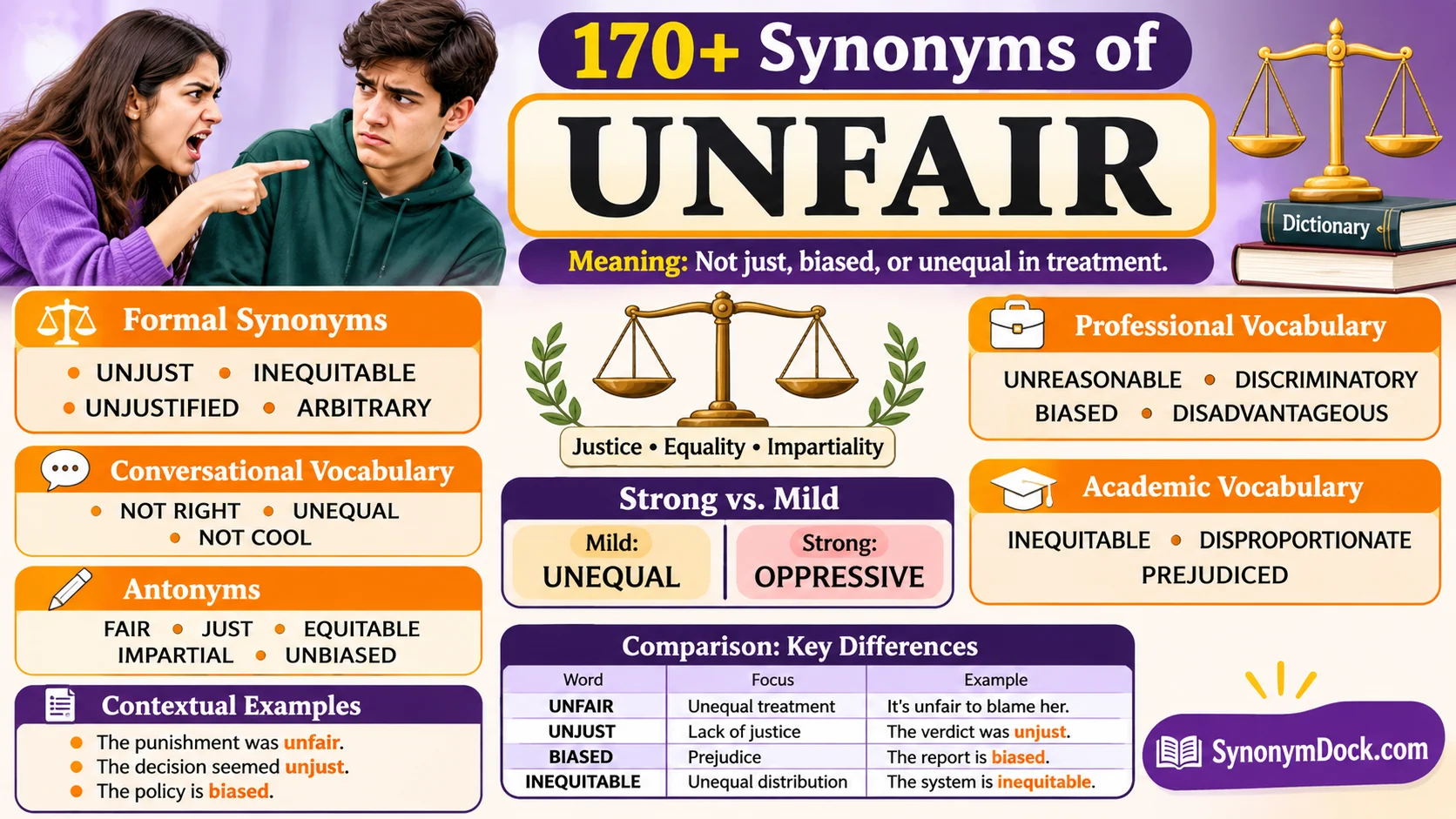
Have you ever used the word unfair repeatedly in an email, essay, social media caption, or professional discussion? Although it clearly expresses dissatisfaction with an unjust situation, repeating it can make your writing sound less precise. Finding the right synonym of unfair helps you explain whether something is biased, unreasonable, discriminatory, unequal, or simply unjust.
The best alternative depends on what makes a situation unfair. For example, biased describes favoritism, inequitable highlights unequal treatment, and unjust emphasizes a lack of fairness or justice. Understanding these differences helps you communicate your concerns more accurately in academic, personal, and professional settings.
What Are the Best Synonyms of “Unfair”?
The best synonyms of unfair include unjust, inequitable, biased, discriminatory, partial, unreasonable, one sided, prejudiced, and unequal. Unfair describes something that lacks justice, impartiality, or equal treatment. Use unjust in formal writing, biased for favoritism, inequitable in academic discussions, and unreasonable for decisions that lack sound justification.
Here are the strongest choices for different situations:
| Context | Best Synonym | Why It Works |
| Formal writing | Unjust | Emphasizes a lack of justice |
| Casual conversation | Not right | Sounds natural and conversational |
| Academic writing | Inequitable | Highlights unequal treatment |
| Professional communication | Unreasonable | Questions an unjustified decision |
| Emotional writing | Oppressive | Expresses serious and persistent unfairness |
| Creative writing | Biased | Describes favoritism or partiality |
| Business communication | Discriminatory | Identifies unequal treatment based on personal characteristics |
Meaning, Tone, and Context of Unfair
Simple Definition
Unfair describes something that is not reasonable, just, or impartial. It refers to situations in which someone receives unequal treatment, faces an unjust disadvantage, or experiences a decision that does not follow reasonable standards.
For example, giving one employee special treatment while ignoring another employee’s equally strong performance may be considered unfair.
Part of Speech
Unfair is an adjective. It describes a person, decision, situation, rule, action, or system that does not demonstrate fairness.
Examples:
- The manager made an unfair decision.
- Students complained about the unfair examination rules.
- It was unfair to blame everyone for one person’s mistake.
Overall Tone
Negative
Critical
The word generally communicates disapproval, dissatisfaction, or concern about unequal treatment.
However, its emotional strength depends on the situation. Calling a decision unfair expresses criticism, while describing a system as oppressive communicates a much stronger concern.
Formality Level
Unfair is a neutral to semiformal adjective.
It works naturally in everyday conversations, school assignments, workplace discussions, emails, and general writing.
For formal reports or academic discussions, alternatives such as inequitable, unjust, and discriminatory can communicate the specific problem more accurately.
Common Uses
Native English speakers commonly use unfair when discussing:
- Unequal treatment between individuals.
- Favoritism in schools or workplaces.
- Discrimination and social inequality.
- Unreasonable rules and regulations.
- Biased judgments and decisions.
- Unequal opportunities.
- Situations involving undeserved advantages or disadvantages.
Word Forms
| Word Form | Meaning | Example |
| Unfair | Lacking fairness | The decision was unfair. |
| Unfairly | In an unfair manner | She was unfairly criticized. |
| Unfairness | The quality or condition of lacking fairness | The unfairness of the policy concerned employees. |
| Fair | Just and reasonable | Everyone deserves fair treatment. |
| Fairness | The quality of being fair | Fairness should guide every decision. |
When and How to Use “Unfair”
Use unfair when you want to express that a decision, action, rule, or situation lacks justice, equal treatment, or reasonable judgment.
The word is particularly useful when you want to communicate dissatisfaction without using highly technical or emotional language.
Here are seven realistic examples.
1. Professional Context
The promotion process seemed unfair because several qualified employees were overlooked.
2. Academic Context
The researcher questioned whether the grading system was unfair to students with different learning needs.
3. Workplace Context
Employees considered the new scheduling policy unfair because some workers consistently received less favorable shifts.
4. Personal Context
I thought it was unfair that my brother received special privileges while I followed the same rules.
5. Email Context
I would appreciate an explanation of why this decision was made, as I believe the outcome may be unfair.
6. Resume and Career Context
A candidate may describe an unfair hiring process when discussing concerns about inconsistent evaluation criteria. However, a resume should focus on achievements rather than complaints.
7. Social Media Context
Everyone deserves equal opportunities, and unfair treatment should never become acceptable.
Best Synonyms of “Unfair”
Not every synonym communicates the same kind of unfairness. Some describe favoritism, while others emphasize unequal opportunities, unreasonable decisions, or violations of justice.
Choose an alternative according to the actual problem you want to describe.
Best Alternatives for Different Situations
| Context | Recommended Synonym | Why It Is the Best Choice |
| Professional writing | Unjust | Communicates a lack of fairness clearly and formally. |
| Academic writing | Inequitable | Highlights structural or systematic inequality. |
| Business communication | Unreasonable | Questions decisions without sounding unnecessarily emotional. |
| Casual conversation | Not right | Expresses dissatisfaction naturally. |
| Emotional writing | Oppressive | Conveys persistent and serious unfair treatment. |
| Creative writing | Biased | Creates a clear impression of favoritism. |
| Resume writing | Disadvantageous | Describes conditions that create an unfavorable position. |
| Workplace communication | Partial | Identifies favoritism toward particular individuals. |
| Stronger meaning | Discriminatory | Highlights unfair treatment based on personal characteristics. |
| Softer meaning | Unequal | Describes differences in treatment without automatically suggesting deliberate wrongdoing. |
When Not to Use “Unfair”
Although unfair is a useful word, it sometimes fails to explain the exact nature of a problem. A more specific alternative can make your writing clearer and more convincing.
1. When the Situation Involves Favoritism
Why unfair is less effective: The word does not identify whether someone is receiving preferential treatment.
Better synonym: Biased.
- General: The manager made an unfair selection.
- Improved: The manager made a biased selection.
The second sentence identifies favoritism as the central concern.
2. When Discussing Systematic Inequality
Why unfair is less effective: It may sound too general when discussing unequal access to opportunities or resources.
Better synonym: Inequitable.
- General: The distribution of educational resources was unfair.
- Improved: The distribution of educational resources was inequitable.
3. When Criticizing an Unjust Decision
Why unfair is less effective: It communicates dissatisfaction but does not emphasize the absence of justice.
Better synonym: Unjust.
- General: The court’s decision was unfair.
- Improved: The court’s decision was unjust.
4. When Describing Discrimination
Why unfair is less effective: It does not explain the nature of unequal treatment.
Better synonym: Discriminatory.
- General: The hiring policy was unfair to certain applicants.
- Improved: The hiring policy was discriminatory toward certain applicants.
Use this stronger description when the evidence supports it.
5. When a Decision Lacks Reasonable Judgment
Why unfair is less effective: It does not explain whether the decision was poorly justified.
Better synonym: Unreasonable.
- General: The new workplace rule was unfair.
- Improved: The new workplace rule was unreasonable.
6. When You Want a More Neutral Description
Why unfair is less effective: It can sound accusatory when you only want to identify a difference.
Better synonym: Unequal.
- General: The two departments received unfair resources.
- Improved: The two departments received unequal resources.
Words Commonly Confused With “Unfair”
Several words are closely related to unfair, but they communicate different problems. Understanding these distinctions helps prevent inaccurate word choices.
| Word | Main Difference | When to Use It | Example |
| Unjust | Emphasizes a lack of justice. | Legal, ethical, or moral discussions. | The punishment was unjust. |
| Biased | Suggests favoritism or prejudice. | Judgments, selections, and opinions. | The evaluation was biased. |
| Unequal | Describes a difference in amount, treatment, or opportunity. | Comparing resources or conditions. | Students received unequal support. |
| Inequitable | Highlights an unfair distribution or systemic imbalance. | Academic and social discussions. | The policy created inequitable outcomes. |
| Discriminatory | Describes unfair treatment connected to personal characteristics or group membership. | Employment, education, and civil rights. | The company was accused of discriminatory practices. |
| Unreasonable | Suggests a decision or demand lacks sensible justification. | Workplace rules and expectations. | The deadline was unreasonable. |
Best Synonyms of “Unfair” by Context
Selecting the right alternative requires understanding the purpose of your message. A word suitable for an academic paper may sound unnecessarily formal in a conversation.
The following recommendations cover common writing and communication situations.
| Context | Best Synonym | Why It Works | Example |
| Formal writing | Unjust | Communicates a violation of fairness. | The ruling was unjust. |
| Academic writing | Inequitable | Suitable for examining social disparities. | The system produces inequitable outcomes. |
| Professional communication | Unreasonable | Sounds measured and objective. | The expectation was unreasonable. |
| Business emails | Unjustified | Questions a decision without unnecessary emotion. | The additional charge appears unjustified. |
| Resume writing | Disadvantageous | Describes unfavorable conditions. | The previous arrangement was disadvantageous. |
| Workplace communication | Partial | Identifies favoritism. | The supervisor appeared partial. |
| Casual conversation | Not right | Sounds natural and direct. | That treatment just isn’t right. |
| Everyday speaking | Unjust | Expresses clear dissatisfaction. | It was unjust to blame everyone. |
| Creative writing | Biased | Establishes a character’s favoritism. | The judge seemed biased. |
| Storytelling | Oppressive | Describes persistent unfair conditions. | The villagers lived under an oppressive system. |
| Emotional writing | Cruel | Communicates harsh or insensitive treatment. | His response was cruel. |
| Strong emphasis | Discriminatory | Identifies serious unequal treatment. | The policy was discriminatory. |
| Mild tone | Unequal | Describes differences without assuming intention. | The workload was unequal. |
| Social media captions | Unjust | Expresses a clear position concisely. | Unjust treatment should never be normalized. |
| American English | Unfair | Common, natural, and widely understood. | The rules seem unfair. |
| British English | Unjust | A natural formal alternative in British writing too. | The ruling was unjust. |
How to Choose the Best Synonym of “Unfair”
Choosing an alternative should involve more than finding a word with a similar dictionary meaning. Consider what makes the situation unfair and what you want your audience to understand.
Follow these six steps.
1. Identify the Meaning
First, determine whether the problem involves favoritism, discrimination, unequal opportunities, or an unreasonable decision.
For example, biased is more precise than unfair when someone favors one candidate over another.
2. Consider Your Tone
Decide whether you want to sound neutral, critical, professional, or emotionally expressive.
Use unequal for a neutral observation and oppressive when describing serious and persistent injustice.
3. Understand Your Audience
Choose language that your readers can easily understand.
For everyday communication, unjust or unreasonable may work better than a more specialized academic expression.
4. Match the Emotional Strength
Some alternatives communicate stronger criticism than others.
For instance, unreasonable sounds measured, while discriminatory identifies a more serious concern.
5. Consider Your Writing Purpose
A business email requires tactful language, while an academic essay may benefit from precise terminology.
Use unjustified when questioning a decision and inequitable when discussing unequal systems.
6. Read the Sentence Again
A synonym should fit naturally into the sentence without changing its intended meaning.
If the replacement makes the sentence sound exaggerated or confusing, choose a simpler alternative.
Real Life Examples of “Unfair”
The following examples demonstrate how different synonyms can improve communication in everyday and professional situations.
| Situation | Original Sentence | Improved Sentence |
| School | The teacher’s decision was unfair. | The teacher’s decision was unjust. |
| College | The distribution of scholarships was unfair. | The distribution of scholarships was inequitable. |
| Workplace | The manager treated employees unfairly. | The manager showed partiality toward certain employees. |
| Business | The company introduced an unfair policy. | The company introduced an unreasonable policy. |
| I believe this charge is unfair. | I believe this charge is unjustified. | |
| Resume | The previous working conditions were unfair. | The previous working conditions were disadvantageous. |
| Conversation | That was an unfair thing to say. | That was not right to say. |
| Storytelling | The king ruled unfairly. | The king governed through an oppressive system. |
| Blogging | The system is unfair to small businesses. | The system places small businesses at a disadvantage. |
| Social media | Unfair treatment hurts everyone. | Inequitable treatment limits opportunities for everyone. |
18 Best Synonyms of “Unfair”
The following 18 alternatives represent useful vocabulary choices across formal, academic, professional, conversational, and creative writing.
Some words overlap with unfair only in particular contexts. Always check the meaning before replacing the original word.
| Synonym | Simple Meaning | Best Used For | Example Sentence |
| 1. Unjust | Not morally or legally fair. | Formal and ethical discussions. | The punishment was unjust. |
| 2. Inequitable | Not fairly distributed or balanced. | Academic and social discussions. | The policy created inequitable opportunities. |
| 3. Biased | Showing favoritism or prejudice. | Judgments and evaluations. | The selection process was biased. |
| 4. Discriminatory | Treating people unfairly based on certain characteristics. | Employment and social issues. | The organization rejected discriminatory practices. |
| 5. Partial | Favoring one person or side. | Personal and workplace situations. | The referee appeared partial. |
| 6. Prejudiced | Holding an unfair opinion about someone or a group. | Social and personal discussions. | The decision reflected a prejudiced attitude. |
| 7. Unequal | Not the same in amount or treatment. | Resources and opportunities. | The students received unequal support. |
| 8. Unreasonable | Not based on sensible judgment. | Rules and expectations. | The deadline was unreasonable. |
| 9. One sided | Favoring only one perspective. | Arguments and agreements. | The discussion presented a one sided view. |
| 10. Unjustified | Lacking a convincing reason. | Business and professional writing. | The additional expense was unjustified. |
| 11. Arbitrary | Based on personal choice rather than consistent rules. | Policies and decisions. | The committee applied arbitrary standards. |
| 12. Disproportionate | Excessive or unequal compared with something else. | Punishments and consequences. | The penalty was disproportionate to the mistake. |
| 13. Skewed | Distorted or unbalanced. | Statistics and evaluations. | The survey results were skewed. |
| 14. Lopsided | Uneven or heavily favoring one side. | Comparisons and competitions. | The agreement was lopsided. |
| 15. Oppressive | Imposing unjust restrictions or burdens. | Social and political writing. | Citizens challenged the oppressive system. |
Synonyms of “Unfair” by Usage
Different communication situations require different levels of precision and formality. Understanding where each alternative belongs helps you avoid awkward or exaggerated language.
Professional vs. Personal Synonyms
Professional writing should communicate concerns clearly without sounding unnecessarily emotional.
Best professional alternatives:
- Unjust: For decisions that violate fairness.
- Unreasonable: For expectations that lack sensible justification.
- Unjustified: For actions without adequate explanation.
- Inequitable: For unequal systems or resource distribution.
- Discriminatory: For unfair treatment based on protected or personal characteristics.
Best personal alternatives:
- Not right: For everyday disagreement.
- Biased: When someone shows favoritism.
- Unjust: When expressing a strong moral concern.
- Unequal: When comparing treatment.
- Partial: When someone favors another person.
Recommendation: Use unreasonable or unjustified when discussing a workplace concern. Choose not right or biased when speaking casually with friends and family.
Formal vs. Conversational Synonyms
Formal alternatives are particularly useful when discussing policies, decisions, and institutional practices.
| Writing Situation | Recommended Word | Example |
| Reports | Inequitable | The policy created inequitable outcomes. |
| Essays | Unjust | The decision raised serious ethical concerns because it was unjust. |
| Business writing | Unjustified | The increase appears unjustified. |
| Presentations | Discriminatory | The findings identified discriminatory practices. |
| Emails | Unreasonable | The proposed deadline seems unreasonable. |
| Casual conversations | Not right | That really isn’t right. |
| Texting | Unfair | That’s completely unfair. |
Academic Synonyms
Academic writing benefits from vocabulary that identifies the precise nature of an inequality or injustice.
Here are five useful alternatives.
1. Inequitable
Use this word when discussing unequal opportunities, resources, or outcomes.
Example: The study examined inequitable access to educational resources.
2. Discriminatory
Choose it when analyzing unfair treatment connected to identity or group membership.
Example: The report examined discriminatory employment practices.
3. Unjust
Use it when evaluating ethical, legal, or social decisions.
Example: The author argues that the policy is unjust.
4. Biased
Use it when discussing partial judgments, research methods, or selective interpretations.
Example: The findings may reflect biased sampling.
5. Disproportionate
Choose it when a response, punishment, or outcome is excessive compared with the situation.
Example: The consequences were disproportionate to the original violation.
These alternatives strengthen academic writing because they explain the particular issue rather than relying on a broad description.
Professional and Business Synonyms
Professional communication requires accuracy and tact. Instead of simply saying something is unfair, explain why the decision or arrangement creates a problem.
| Situation | Recommended Synonym | Example |
| Resume | Disadvantageous | The previous arrangement created disadvantageous working conditions. |
| Interview | Unequal | Candidates should receive equal consideration. |
| Meetings | Unreasonable | The proposed timeline appears unreasonable. |
| Presentations | Inequitable | The current distribution of resources is inequitable. |
| Performance reviews | Biased | The evaluation process may be biased. |
| Client communication | Unjustified | The additional charge appears unjustified. |
| Business emails | Unreasonable | I would appreciate a review of this unreasonable requirement. |
Professional writing tip: Avoid making unsupported accusations. Explain the evidence, identify the specific concern, and suggest a reasonable solution.
Creative and Literary Synonyms
Creative writing often requires stronger vocabulary to communicate a character’s experiences, emotions, and circumstances.
Consider these expressive alternatives:
- Oppressive: Suggests an environment controlled through unjust restrictions.
- Cruel: Emphasizes harsh or insensitive behavior.
- Biased: Reveals a character’s favoritism.
- Prejudiced: Highlights unfair assumptions about individuals or groups.
- Lopsided: Creates an image of an unequal arrangement.
- Unjust: Expresses a moral violation.
Example:
Basic: The villagers lived under an unfair government.
Improved: The villagers struggled under an oppressive government that denied them basic freedoms.
The improved version provides a clearer picture of the situation and its consequences.
Slang or Modern Synonyms
There is no exact modern slang replacement for unfair that works naturally in every situation. However, several informal expressions communicate a similar reaction.
| Expression | Meaning | Appropriate Use | Where to Avoid It |
| Not cool | Something is unacceptable or inconsiderate. | Friendly conversations. | Academic papers and formal reports. |
| Not right | Something seems morally or practically wrong. | Everyday speaking. | Technical writing requiring precision. |
| That’s messed up | Something is seriously wrong or upsetting. | Informal conversations. | Business emails and professional documents. |
| Rigged | A process has been manipulated to favor an outcome. | Informal discussions about manipulated competitions or decisions. | Situations where manipulation has not been established. |
These expressions are useful for casual communication, but formal vocabulary is more appropriate for professional and academic writing.
Strongest to Mildest Synonyms of “Unfair”
Not every alternative carries the same emotional strength. Some describe a simple imbalance, while others communicate serious injustice.
The following scale is approximate because intensity depends on context.
Mild
Unequal · Disadvantageous · Unreasonable
Describes an imbalance or unfavorable situation without necessarily suggesting deliberate wrongdoing.
Moderate
Biased · Partial · One sided · Unjustified
Identifies favoritism, incomplete judgment, or a lack of sufficient justification.
Strong
Unjust · Inequitable · Prejudiced · Discriminatory
Communicates serious concerns about fairness, justice, or unequal treatment.
Very Strong
Oppressive · Cruel
Expresses severe or persistent mistreatment, depending on the circumstances.
Remember that a stronger word is not automatically a better word. Select the alternative that accurately represents the situation.
Emotional vs. Neutral Synonyms
Some synonyms express personal feelings, while others simply describe an imbalance or questionable decision.
Emotional Synonyms
These alternatives communicate stronger criticism or moral concern.
| Word | Emotional Effect | Example |
| Oppressive | Suggests serious and persistent injustice. | The community opposed the oppressive rules. |
| Cruel | Highlights harsh treatment. | His response was cruel. |
| Unjust | Expresses moral disapproval. | The punishment was unjust. |
| Prejudiced | Communicates unfair assumptions. | The remarks reflected a prejudiced attitude. |
| Discriminatory | Identifies serious unequal treatment. | The policy was discriminatory. |
Use these words when the situation genuinely involves a significant moral or emotional concern.
Neutral Synonyms
These alternatives focus more on describing the situation than expressing personal feelings.
| Word | Neutral Meaning | Example |
| Unequal | Different in amount or treatment. | The teams received unequal resources. |
| Unreasonable | Lacking sensible justification. | The request was unreasonable. |
| Disproportionate | Out of balance with something else. | The response was disproportionate. |
| Skewed | Distorted or unbalanced. | The results were skewed. |
| Unjustified | Not adequately supported by reasons. | The expense was unjustified. |
Choose neutral vocabulary when writing reports, presenting findings, or discussing workplace concerns.
Antonyms of “Unfair”
Antonyms describe the opposite qualities of unfairness, including justice, equality, impartiality, and reasonable treatment.
The following 15 words and expressions represent useful opposites in different contexts.
| Antonym | Meaning | Example Sentence |
| 1. Fair | Treating people reasonably and equally. | The teacher established fair classroom rules. |
| 2. Just | Consistent with justice and moral principles. | The committee reached a just decision. |
| 3. Equitable | Distributing resources or opportunities fairly. | The program promotes equitable access to education. |
| 4. Impartial | Not favoring either side. | The judge remained impartial. |
| 5. Unbiased | Free from unfair preferences. | The researcher provided an unbiased assessment. |
| 6. Objective | Based on facts rather than personal opinions. | The evaluation followed objective criteria. |
| 7. Evenhanded | Treating different people or sides consistently. | The manager adopted an evenhanded approach. |
| 8. Neutral | Not supporting either side. | The mediator remained neutral. |
| 9. Balanced | Giving appropriate consideration to different sides. | The report presented a balanced perspective. |
| 10. Reasonable | Based on sensible judgment. | The employer introduced reasonable expectations. |
| 11. Legitimate | Lawful or supported by acceptable authority. | The company provided a legitimate explanation. |
| 12. Deserved | Earned through actions or merit. | She received the recognition she deserved. |
| 13. Nondiscriminatory | Not treating people unfairly based on personal characteristics. | The organization introduced nondiscriminatory hiring practices. |
| 14. Ethical | Consistent with accepted moral principles. | The business followed ethical standards. |
| 15. Proper | Following appropriate rules and standards. | The complaint received proper consideration. |
Comparison: “Unfair” vs. Similar Words
Understanding the differences between unfair and related vocabulary helps you select more accurate alternatives.
1. Unfair vs. Unjust
Main Difference
Unfair is a broad term for something that lacks fairness. Unjust focuses more specifically on the absence of justice or moral correctness.
Which Is Stronger?
Unjust often carries stronger moral or legal significance.
Which Is More Formal?
Both work in formal writing, but unjust is especially useful in ethical and legal discussions.
When to Use Each
Use unfair for everyday situations and unjust when evaluating justice or moral principles.
Examples
- Unfair: The teacher’s decision was unfair.
- Unjust: The punishment was unjust.
2. Unfair vs. Biased
Main Difference
Unfair describes a lack of fairness generally. Biased identifies favoritism, prejudice, or an unequal preference.
Which Is Stronger?
Biased is more specific, but its emotional strength depends on context.
Which Is More Formal?
Both are suitable for professional writing.
When to Use Each
Use unfair when the exact problem is unclear. Use biased when someone’s judgment favors a particular person or position.
Examples
- Unfair: The evaluation process was unfair.
- Biased: The evaluation process was biased toward experienced employees.
3. Unfair vs. Inequitable
Main Difference
Unfair is a general description, whereas inequitable emphasizes unequal distribution or access to resources and opportunities.
Which Is Stronger?
Inequitable sounds more specialized and analytical, especially in discussions about systemic inequality.
Which Is More Formal?
Inequitable is more common in academic and policy discussions.
When to Use Each
Use unfair in everyday language and inequitable when discussing structural disadvantages.
Examples
- Unfair: The education system is unfair.
- Inequitable: The education system provides inequitable access to resources.
4. Unfair vs. Unequal
Main Difference
Unfair suggests a lack of justice. Unequal simply means that two or more things are different in amount, size, treatment, or opportunity.
Which Is Stronger?
Unfair expresses a judgment, while unequal is generally more neutral.
Which Is More Formal?
Both work in academic and professional writing.
When to Use Each
Use unequal to describe a difference. Use unfair when that difference creates an unjust situation.
Examples
- Unfair: The distribution of work was unfair.
- Unequal: The distribution of work was unequal.
5. Unfair vs. Discriminatory
Main Difference
Unfair refers to a general lack of fairness. Discriminatory describes unfair treatment connected to particular characteristics or group membership.
Which Is Stronger?
Discriminatory is more specific and often more serious.
Which Is More Formal?
Both are appropriate in formal writing, but discriminatory is particularly relevant to employment, legal, and social discussions.
When to Use Each
Use unfair for general complaints and discriminatory when there is evidence of unequal treatment connected to personal characteristics.
Examples
- Unfair: The hiring process was unfair.
- Discriminatory: The hiring process involved discriminatory treatment.
6. Unfair vs. Unreasonable
Main Difference
Unfair suggests unequal or unjust treatment. Unreasonable describes something that does not make sense or lacks a sensible justification.
Which Is Stronger?
Unfair communicates a direct judgment about fairness. Unreasonable focuses on the quality of a decision or demand.
Which Is More Formal?
Both are natural in professional communication.
When to Use Each
Use unfair when someone receives unjust treatment. Use unreasonable when a rule, request, or expectation is excessive or poorly justified.
Examples
- Unfair: The employee received unfair treatment.
- Unreasonable: The employee received an unreasonable workload.
Common Phrases and Expressions with “Unfair”
These expressions are useful in everyday English, professional communication, and discussions about justice.
1. Unfair Treatment
Meaning: Treatment that does not provide reasonable or equal consideration.
Example: Employees should have a clear way to report unfair treatment.
2. Unfair Advantage
Meaning: A benefit that gives someone an unjustified advantage over others.
Example: The competition rules were changed to prevent any participant from gaining an unfair advantage.
3. Unfair Competition
Meaning: Competition involving dishonest or improper practices.
Example: The company filed a complaint about unfair competition in its industry.
4. Unfair Dismissal
Meaning: The termination of someone’s employment in circumstances considered unjust under applicable employment rules.
Example: The employee challenged the dismissal because he believed it was unfair.
5. Unfair Burden
Meaning: A responsibility or difficulty placed disproportionately on someone.
Example: The new policy placed an unfair burden on smaller businesses.
6. Unfair Rules
Meaning: Rules that create unequal or unreasonable conditions.
Example: Students requested a review of the unfair examination rules.
7. Unfair Disadvantage
Meaning: An unfavorable position caused by unequal circumstances or treatment.
Example: Limited access to technology can place students at an unfair disadvantage.
8. It Is Unfair to Say
Meaning: Used when someone believes a statement is inaccurate or unjust.
Example: It is unfair to say that the entire team failed because of one mistake.
Common Mistakes to Avoid
Using an incorrect synonym can change the meaning of your sentence. The following mistakes are particularly important for English learners, students, and professional writers.
1. Choosing a Vague Synonym Instead of a Precise One
Incorrect: The manager made an unfair decision.
Better: The manager made a biased decision.
Why It Matters: If favoritism is the actual problem, biased communicates the issue more clearly than unfair.
2. Confusing Unequal With Unfair
Incorrect: The two departments received unfair amounts of funding.
Better: The two departments received unequal amounts of funding.
Why It Matters: Unequal describes a difference. Whether that difference is unfair depends on the circumstances and the reasons behind it.
3. Using Informal Expressions in Academic Writing
Incorrect: The government’s decision was not cool.
Better: The government’s decision was unjust.
Why It Matters: Informal expressions can weaken the credibility and professional tone of academic writing.
4. Selecting an Overly Dramatic Synonym
Incorrect: The manager introduced an oppressive meeting schedule.
Better: The manager introduced an unreasonable meeting schedule.
Why It Matters: Oppressive suggests serious or persistent restrictions. Unreasonable is more appropriate when discussing an excessive schedule.
5. Repeating the Same Word Too Often
Incorrect: The unfair policy created unfair conditions and unfair opportunities.
Better: The inequitable policy created unequal conditions and limited opportunities.
Why It Matters: Appropriate vocabulary variation makes writing more engaging and helps explain different aspects of a problem.
6. Choosing the Wrong Emotional Tone
Incorrect: The unequal treatment was cruel.
Better: The unequal treatment was unjust.
Why It Matters: Cruel emphasizes harsh or insensitive behavior. Unjust is more appropriate when the central concern is a lack of fairness.
7. Using Slang in Professional Communication
Incorrect: The company’s decision was totally messed up.
Better: The company’s decision was unreasonable.
Why It Matters: Professional communication should prioritize clarity and measured language rather than casual expressions.
Frequently Asked Questions
1. What Are the Best Synonyms of “Unfair”?
The best synonyms of unfair include unjust, inequitable, biased, discriminatory, partial, unreasonable, unequal, prejudiced, and unjustified. The most appropriate choice depends on whether you are describing favoritism, discrimination, or unequal treatment.
2. What Are the Best Formal Synonyms of “Unfair”?
The strongest formal alternatives include unjust, inequitable, discriminatory, unjustified, and arbitrary. Use unjust for ethical concerns, inequitable for unequal systems, and arbitrary for decisions made without consistent standards.
3. What Are Common Informal Synonyms of “Unfair”?
Common informal alternatives include not right, not cool, and that’s messed up. These expressions work in everyday conversations and texting, but they are generally unsuitable for academic papers and professional reports.
4. What Is Another Word for “Unfair” in Professional Writing?
Unreasonable, unjustified, inequitable, and biased are useful professional alternatives. Choose unreasonable for excessive expectations, unjustified for unsupported decisions, and inequitable for unequal workplace policies or opportunities.
5. What Is the Difference Between “Unfair” and “Unjust”?
Unfair is a broad term describing a lack of reasonable or equal treatment. Unjust specifically emphasizes a violation of justice or moral principles, making it particularly useful in ethical, legal, and academic discussions.
6. What Is the Opposite of “Unfair”?
The opposite of unfair is fair. Other useful antonyms include just, equitable, impartial, unbiased, objective, evenhanded, and balanced. These words describe decisions and situations that demonstrate fairness and equal consideration.
Conclusion
Choosing the right synonym of unfair can make your writing more accurate, natural, and meaningful. Words such as unjust, inequitable, biased, discriminatory, and unreasonable each describe a different aspect of unfair treatment. The best alternative depends on whether you are discussing favoritism, unequal opportunities, questionable decisions, or serious injustice.
Remember that no synonym works perfectly in every situation. Consider your audience, intended meaning, emotional tone, and writing purpose before replacing a word. A useful vocabulary improvement tip is to write down three alternatives whenever you learn a new word, then practice using each one in a different sentence.

Ethan Parker is an English language writer and vocabulary enthusiast at SynonymDock.com. He specializes in synonyms, word meanings, alternative expressions and practical English usage, creating clear and reliable content to help students, professionals, writers and English learners choose the right words with confidence.