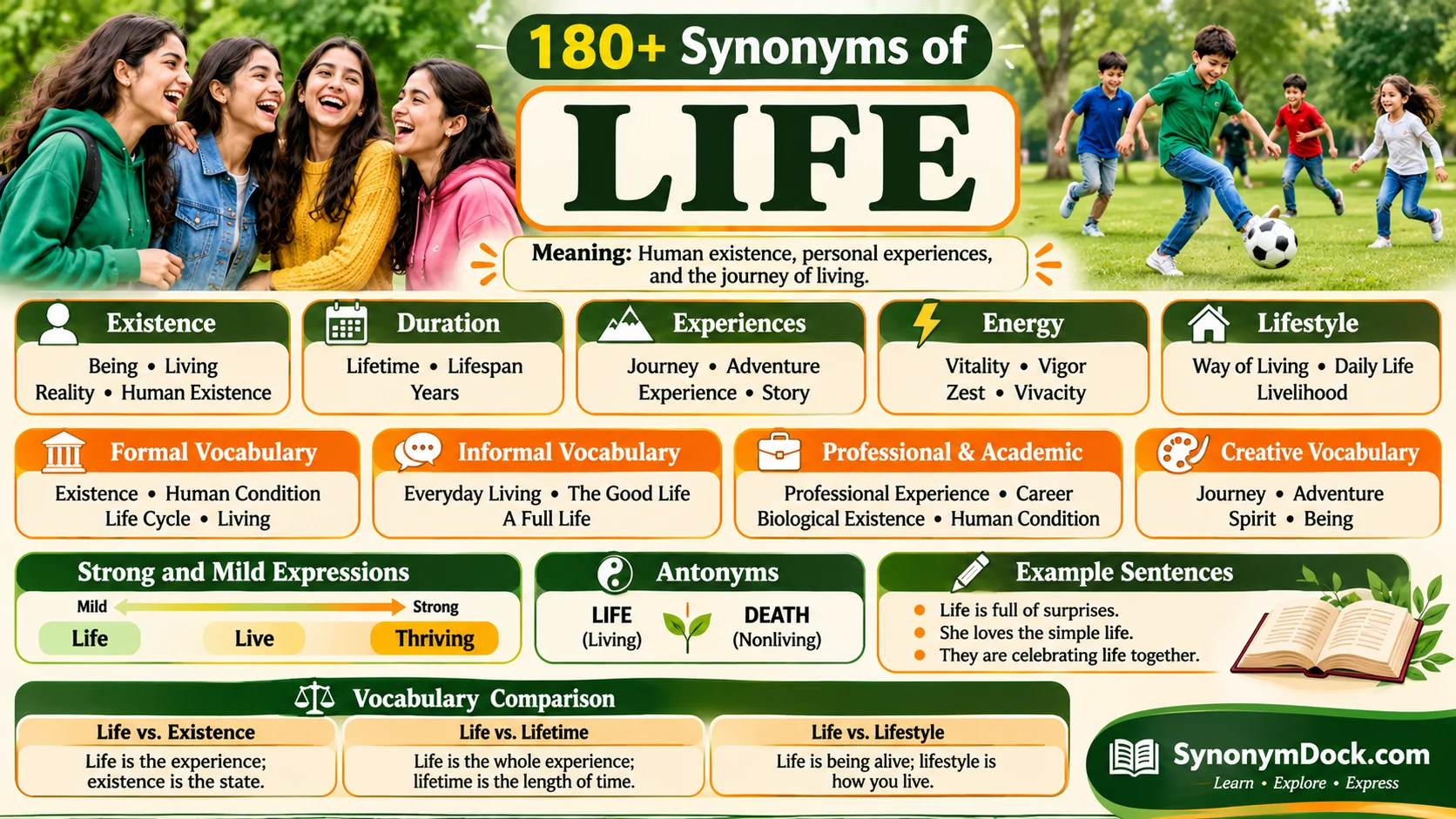
Finding the right synonym of life can help you communicate different ideas more precisely. For example, existence emphasizes the state of being alive, vitality describes energy and enthusiasm, lifetime refers to the period someone lives, and livelihood describes the way someone earns a living.
However, these alternatives are not interchangeable. Understanding their meanings, emotional associations, and appropriate contexts helps you choose words that make your writing clearer, more natural, and more effective.
What Are the Best Synonyms of “Life”?
The best synonyms of life include existence, living, being, vitality, lifetime, lifespan, experience, and living existence. Life generally refers to the state of being alive, the experiences a person has, or the period between birth and death. Use existence in formal writing, vitality for energy, lifetime for duration, and experience when discussing personal events.
Here are useful alternatives for different situations:
| Context | Best Alternative | Why It Works |
|---|---|---|
| Formal writing | Existence | Emphasizes the state of being |
| Casual conversation | Living | Sounds natural and familiar |
| Academic writing | Biological existence | Focuses on living organisms |
| Professional communication | Career experience | Refers to professional life |
| Emotional writing | Journey | Highlights personal experiences |
| Creative writing | Being | Adds philosophical depth |
| Resume writing | Professional experience | Describes career development |
| Stronger expression | Vitality | Emphasizes energy and enthusiasm |
| Personal writing | Lifetime | Refers to the years someone lives |
| Philosophical writing | Conscious existence | Highlights awareness and being |
Important distinction: Life has several meanings, so there is no single replacement that works in every sentence. Some words below are direct synonyms, while others are contextual alternatives that express a particular aspect of life.
Meaning, Tone, and Context
Simple Definition
Life is the condition that distinguishes living organisms from nonliving things. It also refers to the period during which a person or organism exists, together with the experiences, activities, and relationships that occur during that time.
For example:
- Life begins with the development of a living organism.
- Everyone experiences different challenges in life.
- She has dedicated her life to education.
Depending on the sentence, life can describe biological existence, personal experiences, energy, lifestyle, or the duration of someone’s existence.
Part of Speech
Life is primarily a noun.
It can be used as:
- A countable noun: Many people lead different lives.
- An uncountable noun: Life is full of opportunities.
- A subject in general statements: Life requires patience.
- An object in personal expressions: Education changed her life.
Overall Tone
The word life is generally neutral, but its emotional meaning depends on context.
| Tone | Example | Explanation |
|---|---|---|
| Positive | A wonderful life | Expresses happiness and satisfaction |
| Neutral | Human life | Describes existence objectively |
| Negative | A difficult life | Communicates hardship |
| Emotional | The love of my life | Expresses deep affection |
| Inspirational | Live your life fully | Encourages meaningful experiences |
Formality Level
Life is a neutral word that works in almost every communication setting.
- Formal: Human existence, quality of life, life expectancy.
- Semiformal: Work life, family life, personal life.
- Neutral: Everyday life, daily life, life experiences.
- Informal: That’s life, living your best life.
Common Uses
American English speakers commonly use life when discussing:
- Human existence: The importance of protecting human life.
- Personal experiences: Life teaches valuable lessons.
- Relationships: Family is an important part of life.
- Career development: She wants a better work life.
- Lifestyle: They enjoy a healthy lifestyle.
- Time and duration: He traveled extensively during his lifetime.
- Biology: Scientists study the origins of life.
- Philosophy: What gives life meaning?
Word Forms
| Word | Part of Speech | Meaning |
|---|---|---|
| Life | Noun | The condition or period of being alive |
| Lives | Plural noun | Multiple individual lives |
| Living | Noun, adjective | The state or act of being alive |
| Lively | Adjective | Full of energy and activity |
| Liveliness | Noun | Energy and enthusiasm |
| Lifeless | Adjective | Without life or vitality |
| Lifelessness | Noun | The condition of lacking life or energy |
Grammar tip: The plural of life is lives, not lifes. For example, “Their lives changed after graduation.”
When and How to Use “Life”
Life is appropriate when discussing existence, experiences, personal development, relationships, and the general human condition.
Here are seven practical examples.
1. Professional: Maintaining a healthy work life balance can improve employee satisfaction.
2. Academic: Human life depends on complex biological processes.
3. Workplace: Technology has changed the way people manage their professional lives.
4. Personal: My family has always played an important role in my life.
5. Email: Thank you for sharing your experience and explaining how it influenced your life.
6. Resume: Dedicated educator with extensive experience in academic and professional environments.
7. Social Media: Enjoy the little moments because they make life meaningful.
Notice that the best alternative depends on the intended meaning. In the resume example, professional experience communicates career history more clearly than simply using life.
Best Synonyms of “Life”
No synonym of life communicates exactly the same meaning in every situation. Some alternatives describe existence, others emphasize personal experiences, energy, duration, or the way someone lives.
Here are the best alternatives according to writing purpose.
Best Synonyms for Different Situations
| Writing Context | Recommended Synonym | Why It Is Suitable |
|---|---|---|
| Professional writing | Existence | Communicates the state of being in a formal tone |
| Academic writing | Living existence | Works when discussing living organisms |
| Business communication | Career | Focuses on professional development |
| Casual conversation | Living | Sounds natural in everyday speech |
| Emotional writing | Journey | Highlights personal experiences and changes |
| Creative writing | Being | Adds philosophical or literary depth |
| Resume writing | Professional experience | Communicates career history |
| Workplace communication | Work experience | Describes someone’s employment background |
| Stronger meaning | Vitality | Emphasizes energy and enthusiasm |
| Softer meaning | Everyday existence | Communicates ordinary experiences gently |
50+ Alternatives and Related Expressions for Life
The following words and expressions cover different meanings of life. They are context dependent rather than 50 interchangeable dictionary synonyms.
Existence and being
- Existence
- Being
- Living
- Living existence
- Conscious existence
- Human existence
- Mortal existence
- State of being
- Presence
- Reality
Duration and time
- Lifetime
- Lifespan
- Life span
- Duration
- Years
- Days
- Time on Earth
- Mortal years
- Entire existence
- Years of living
Experience and personal development
- Experience
- Journey
- Adventure
- Personal journey
- Human experience
- Life experience
- Personal history
- Story
- Path
- Course of existence
Energy and vitality
- Vitality
- Vivacity
- Liveliness
- Animation
- Vigor
- Spirit
- Energy
- Enthusiasm
- Dynamism
- Zest
Lifestyle and everyday activities
- Lifestyle
- Way of living
- Daily existence
- Everyday living
- Routine
- Living conditions
- Standard of living
- Livelihood
- Occupation
- Way of life
Creative and philosophical expressions
- Human condition
- Mortal journey
- Passage through time
- Journey through existence
- State of consciousness
These alternatives are useful for different purposes. For example, livelihood refers to the means of earning money, while vitality describes energy. Neither should replace life in a sentence unless that specific meaning is intended.
When Not to Use “Life”
Although life is a versatile word, it can sometimes sound too general. Replacing it with a more precise alternative can make your message easier to understand.
1. When Life Sounds Too General
Less effective: Education plays an important role in life.
Better: Education plays an important role in personal development.
Why: Personal development identifies the specific aspect of life being discussed.
2. When Life Sounds Too Vague
Less effective: She has a lot of life experience.
Better: She has extensive teaching experience.
Why: Teaching experience tells readers exactly what kind of knowledge she possesses.
3. When Life Is Too Informal for Academic Writing
Less effective: The study examines how people live their lives.
Better: The study examines human behavior and social existence.
Why: The revised sentence communicates the research subject more precisely.
4. When Life Does Not Express Energy
Less effective: The performer brought life to the stage.
Better: The performer brought vitality and enthusiasm to the stage.
Why: Vitality and enthusiasm communicate energy more directly.
5. When Life Does Not Express Duration
Less effective: She spent her life working as a teacher.
Better: She spent her entire career working as a teacher.
Why: Career specifically describes professional activity over time.
6. When Life Does Not Explain Financial Support
Less effective: Farming is their life.
Better: Farming is their livelihood.
Why: Livelihood communicates the means through which someone earns a living.
7. When Life Is Repeated Too Often
Less effective: Life is beautiful, and life offers opportunities to improve your life.
Better: Existence is full of possibilities, and every experience offers opportunities for personal growth.
Why: The revised sentence reduces repetition and communicates the message more effectively.
Words Commonly Confused With “Life”
Several English words are closely related to life but have different meanings.
| Word | Difference | When to Use It | Example |
|---|---|---|---|
| Existence | The state of being or having reality | Philosophy and formal writing | Human existence raises important questions. |
| Living | The condition or activity of being alive | Everyday communication | Living independently requires responsibility. |
| Lifetime | The entire period someone lives | Discussing duration | She achieved remarkable success during her lifetime. |
| Lifespan | The length of time an organism typically lives | Science and biology | The average lifespan varies among species. |
| Lifestyle | A person’s habits and way of living | Health and personal choices | A balanced lifestyle supports well-being. |
| Livelihood | The means of earning money | Employment and financial discussions | Teaching provides her livelihood. |
Best Synonyms of “Life” by Context
The following table recommends alternatives according to the purpose of your writing.
| Context | Best Synonym | Why It Works | Example |
|---|---|---|---|
| Formal writing | Existence | Sounds precise and objective | Human existence is complex. |
| Academic writing | Human existence | Fits philosophical and social discussions | Human existence has been widely studied. |
| Professional communication | Career | Focuses on professional development | Her career has progressed steadily. |
| Business emails | Professional experience | Describes career background | Your professional experience is valuable. |
| Resume writing | Work experience | Clearly communicates employment history | Five years of teaching experience. |
| Workplace communication | Work experience | Refers to practical employment knowledge | His work experience includes management. |
| Casual conversation | Living | Natural and conversational | Living in a new city is exciting. |
| Everyday speaking | Daily life | Describes ordinary activities | Technology has simplified daily life. |
| Creative writing | Journey | Suggests movement and personal change | Her journey inspired everyone. |
| Storytelling | Adventure | Highlights exciting experiences | Their adventure changed everything. |
| Emotional writing | Personal journey | Emphasizes growth and feelings | Recovery was a difficult personal journey. |
| Strong emphasis | Vitality | Communicates energy and enthusiasm | The community is full of vitality. |
| Mild tone | Everyday existence | Sounds reflective and neutral | She appreciated her quiet existence. |
| Social media captions | Lifestyle | Connects with personal habits and choices | Creating a lifestyle I enjoy. |
| American English | Life, living, existence | All are natural in different contexts | Living in America offers diverse experiences. |
| British English | Life, living, existence | These words are also standard in British English | Everyday life can be unpredictable. |
American vs. British English: There is no major difference in the basic synonyms of life between American and British English. Words such as existence, living, lifetime, and lifestyle are standard in both varieties.
How to Choose the Best Synonym of “Life”
Choosing the right alternative requires understanding what you want to communicate. Follow these six steps.
1. Identify the Intended Meaning
Ask yourself what life represents in your sentence.
- Existence: Choose being or existence.
- Duration: Choose lifetime or lifespan.
- Personal experiences: Choose journey or experience.
- Energy: Choose vitality or vivacity.
- Financial support: Choose livelihood.
2. Consider Your Audience
Your word choice should match the people reading your content.
For example, students may benefit from simple words such as living and experience. Academic readers may need more specific expressions such as human existence.
3. Match the Emotional Tone
Some alternatives communicate feelings more strongly than others.
- Neutral: Existence
- Positive: Vitality
- Inspirational: Journey
- Reflective: Being
- Exciting: Adventure
4. Consider the Writing Purpose
Different writing formats require different vocabulary.
A resume benefits from professional experience. An academic paper may require human existence. A personal blog can naturally use journey or everyday living.
5. Check the Level of Formality
Use familiar language in casual conversations and more precise terminology in academic or professional writing.
For example, way of life sounds natural in general communication, while mode of existence is more specialized and philosophical.
6. Read the Sentence Again
After replacing life, read the entire sentence.
If the alternative changes the original meaning, choose another word. A sophisticated expression is not automatically a better choice.
Real Life Examples of “Life”
Here are ten examples demonstrating how life and its contextual alternatives work in different situations.
| Context | Original Sentence | Improved Alternative |
|---|---|---|
| School | Life teaches us many lessons. | Every experience teaches us valuable lessons. |
| College | College life is full of opportunities. | The college experience offers many opportunities. |
| Workplace | Technology has changed work life. | Technology has transformed the modern workplace. |
| Business | His life in business has been successful. | His business career has been successful. |
| Your experience can change someone’s life. | Your guidance can influence someone’s personal journey. | |
| Resume | I have a good life of teaching experience. | I have extensive teaching experience. |
| Conversation | Life in this city is exciting. | Living in this city is exciting. |
| Storytelling | Her life was full of adventures. | Her journey was full of adventures. |
| Blogging | A healthy life requires good habits. | A healthy lifestyle requires good habits. |
| Social Media | Enjoy your life every day. | Make the most of every day. |
18 Best Synonyms of “Life”
The following 18 words are useful alternatives when their specific meanings match the sentence. Some are close synonyms, while others represent particular aspects of life.
| Synonym | Simple Meaning | Best Used For | Example Sentence |
|---|---|---|---|
| Existence | The state of being | Formal and philosophical writing | Human existence is worth exploring. |
| Living | The condition of being alive | Everyday communication | Living requires constant adaptation. |
| Lifetime | The entire period someone lives | Duration and achievements | She made a difference during her lifetime. |
| Lifespan | The length of an organism’s life | Biology and science | A turtle can have a long lifespan. |
| Vitality | Energy and liveliness | Inspirational and descriptive writing | Exercise can support physical vitality. |
| Vivacity | Lively enthusiasm | Creative descriptions | Her vivacity made the gathering enjoyable. |
| Liveliness | Active energy and excitement | Descriptive writing | The liveliness of the festival attracted visitors. |
| Lifestyle | A person’s way of living | Health and personal habits | A balanced lifestyle supports productivity. |
| Livelihood | A way of earning a living | Employment and economics | Agriculture remains their main livelihood. |
| Experience | Knowledge gained through events | Personal and professional development | Every experience offers a lesson. |
| Journey | A process of personal development | Emotional and creative writing | Her educational journey was inspiring. |
| Adventure | An exciting or unusual experience | Storytelling and informal writing | Their adventure created lasting memories. |
| Existence | The condition of being real or present | Formal discussions | The existence of life beyond Earth remains a scientific question. |
| Spirit | Energy, courage, or enthusiasm | Emotional and inspirational writing | Her spirit remained strong through challenges. |
Editorial note: Existence appears twice because it is a particularly important alternative with different contextual applications. For a final publication table, you may replace the second occurrence with reality if you want 18 distinct entries. Reality, however, is a related concept rather than a direct synonym in every context.
Synonyms of “Life” by Usage
The best alternative depends on whether you are discussing personal experiences, professional development, biological existence, or everyday activities.
Professional vs. Personal Synonyms
Professional writing benefits from precise vocabulary that identifies a person’s career, achievements, or work history.
| Professional Synonyms | Personal Synonyms |
|---|---|
| Career | Journey |
| Professional experience | Personal experience |
| Work experience | Everyday living |
| Occupation | Lifestyle |
| Career development | Life journey |
| Professional background | Personal history |
Recommendations:
- Use career when discussing professional progress.
- Use professional experience when describing employment history.
- Use journey when discussing personal growth.
- Use lifestyle when describing everyday habits.
- Use personal experience when referring to individual events.
Formal vs. Conversational Synonyms
Formal vocabulary is useful when writing for academic, professional, and business audiences. Conversational alternatives make everyday communication sound more natural.
| Formal Alternatives | Conversational Alternatives |
|---|---|
| Existence | Living |
| Human existence | Everyday life |
| Being | Way of living |
| Lifespan | Daily routine |
| Human condition | Life experiences |
| Mortal existence | Personal journey |
For reports and essays, existence and human condition can communicate complex ideas. In emails, presentations, and conversations, expressions such as everyday life and way of living are usually easier to understand.
Academic Synonyms
Academic writing requires accuracy rather than complicated vocabulary. The best alternative depends on whether your discussion concerns biology, philosophy, sociology, or human development.
| Academic Alternative | Appropriate Subject | Example |
|---|---|---|
| Biological existence | Biology | Biological existence depends on essential cellular processes. |
| Human existence | Philosophy | Human existence has been explored by philosophers. |
| Lifespan | Biology and psychology | Researchers examined changes across the human lifespan. |
| Human condition | Literature and philosophy | The novel explores the human condition. |
| Conscious existence | Philosophy | The discussion examines conscious existence. |
| Living organisms | Biology | Living organisms respond to environmental changes. |
| Mortality | Philosophy and medicine | The research considers human mortality. |
Why these work: Academic vocabulary identifies the subject more clearly. For example, lifespan is appropriate when discussing duration, whereas human existence is more suitable for broader philosophical questions.
Professional and Business Synonyms
In professional communication, life often needs to be replaced with a more specific term.
| Professional Situation | Recommended Alternative | Example |
|---|---|---|
| Resume | Professional experience | I have extensive professional experience in education. |
| Job interview | Career | My career has focused on teaching and academic development. |
| Business meeting | Business environment | The business environment continues to evolve. |
| Presentation | Professional journey | Her professional journey demonstrates consistent growth. |
| Performance review | Work experience | His work experience has strengthened his leadership skills. |
| Client communication | Business operations | Digital tools have improved daily business operations. |
| Business email | Personal experience | Thank you for sharing your personal experience. |
Resume recommendation: Avoid using general expressions such as my life in teaching when teaching experience communicates your qualifications more effectively.
Creative and Literary Synonyms
Creative writing often requires vocabulary that creates emotion, atmosphere, and imagery.
| Alternative | Creative Effect | Example |
|---|---|---|
| Journey | Suggests development and change | Every journey begins with a decision. |
| Adventure | Creates excitement | Their adventure began in a distant village. |
| Existence | Adds philosophical depth | His existence seemed connected to an unanswered question. |
| Being | Creates a reflective tone | She questioned the meaning of being. |
| Spirit | Suggests courage and energy | Her spirit inspired the entire community. |
| Vitality | Creates an energetic impression | The garden returned to vitality in spring. |
| Story | Highlights personal experiences | Every person carries a different story. |
Writers should select alternatives according to the atmosphere they want to create. Journey suggests progress, while existence creates a more reflective tone.
Slang or Modern Synonyms
Life does not have many direct modern slang replacements. However, several informal expressions are commonly used in American English.
| Expression | Meaning | Where It Works | Where to Avoid It |
|---|---|---|---|
| Best life | A satisfying or enjoyable lifestyle | Social media and casual conversations | Academic reports |
| Living it up | Enjoying yourself | Informal conversations | Business reports |
| Good vibes | A positive atmosphere | Captions and casual communication | Formal writing |
| Adulting | Managing adult responsibilities | Informal online communication | Professional documents |
| The good life | A comfortable or enjoyable lifestyle | Conversations and creative writing | Technical research |
These expressions are not direct synonyms. They describe particular attitudes or experiences associated with life.
Strongest to Mildest Synonyms
The intensity of life related words depends on their emotional meaning. The following scale is based on expressive strength rather than dictionary equivalence.
Mild
Existence
Living
Being
Neutral descriptions of being alive or existing.
Moderate
Experience
Journey
Lifestyle
Express personal experiences, development, and habits.
Strong
Vitality
Vigor
Vivacity
Communicate energy, enthusiasm, and liveliness.
Very Strong
Zest
Passion
Joie de vivre
Express intense enthusiasm and enjoyment of living. These are expressive associations, not exact replacements for life.
Emotional vs. Neutral Synonyms
The emotional strength of a word can change how readers understand a sentence.
Emotional Synonyms
These alternatives communicate feelings, enthusiasm, or personal experiences.
| Word | Emotional Meaning | Example |
|---|---|---|
| Journey | Personal growth and development | Her journey inspired many students. |
| Adventure | Excitement and discovery | Life became an unforgettable adventure. |
| Vitality | Energy and enthusiasm | The community showed remarkable vitality. |
| Zest | Enjoyment and enthusiasm | He approaches every challenge with zest. |
| Spirit | Courage and determination | Her spirit encouraged others. |
| Passion | Strong interest or enthusiasm | Teaching is her passion. |
| Joie de vivre | Enjoyment of living | Her joie de vivre made every gathering special. |
Neutral Synonyms
These alternatives communicate information without adding strong emotional associations.
| Word | Neutral Meaning | Example |
|---|---|---|
| Existence | State of being | Human existence is complex. |
| Living | Being alive | Living independently requires planning. |
| Lifetime | Period of someone’s life | She traveled widely during her lifetime. |
| Lifespan | Length of life | The lifespan of different species varies. |
| Duration | Length of time | The duration of the project was six months. |
| Being | State of existing | The discussion examines the nature of being. |
Recommendation: Choose emotional alternatives for personal essays, storytelling, and inspirational content. Use neutral alternatives for academic discussions, research, and objective explanations.
Antonyms of “Life”
The most direct antonym of life is death. It describes the end of biological life.
Other words can express related contrasting ideas, but they are not all exact antonyms. It would be misleading to present 15 unrelated words as interchangeable opposites.
| Opposite or Contrasting Term | Meaning | Example Sentence |
|---|---|---|
| Death | The end of biological life | The story explores the relationship between life and death. |
| Lifelessness | The absence of life or vitality | The winter landscape appeared to have a sense of lifelessness. |
| Nonexistence | The state of not existing | The philosophical debate examines existence and nonexistence. |
| Extinction | The disappearance of an entire species | Conservation efforts aim to prevent extinction. |
| Inanimation | The condition of being without life or animation | The contrast between animation and inanimation is central to the discussion. |
| Inactivity | The absence of activity | Long periods of inactivity can affect physical fitness. |
| Stillness | A state without movement or activity | The stillness of the room contrasted with the busy street. |
| Dormancy | A temporary inactive state | Some plants enter dormancy during winter. |
| Decomposition | The process of organic matter breaking down | Decomposition returns nutrients to the soil. |
| Ruin | A state of destruction or collapse | The abandoned building fell into ruin. |
| Desolation | A condition of emptiness or devastation | The landscape reflected years of desolation. |
| Decay | Gradual deterioration | The old structure showed signs of decay. |
| Inertia | Resistance to change or movement | The system remained trapped in inertia. |
| Emptiness | A lack of content or meaning | The room seemed filled with emptiness. |
| Destruction | The process of damaging or ending something | The destruction of the habitat threatened local wildlife. |
Accuracy note: Only death is the direct biological opposite of life. The other terms describe specific contrasting conditions or processes and should be used only when their meanings fit.
Comparison: “Life” vs. Similar Words
Understanding the differences between related words helps prevent inaccurate substitutions.
1. Life vs. Existence
Main Difference: Life refers to being alive and the experiences associated with living. Existence refers more broadly to the state of being real or present.
Which Is Stronger? Life often carries more personal and emotional meaning. Existence sounds more abstract and philosophical.
Which Is More Formal? Existence is generally more formal in philosophical and academic discussions.
When to Use Each:
- Use life when discussing experiences, relationships, or living organisms.
- Use existence when discussing the state of being or philosophical questions.
Examples:
- Life: Family plays an important role in my life.
- Existence: The theory questions the nature of human existence.
2. Life vs. Living
Main Difference: Life is a broad noun describing existence and experiences. Living can refer to the act or condition of being alive.
Which Is Stronger? Neither is universally stronger. Life is broader, while living emphasizes the process or condition.
Which Is More Formal? Both are appropriate in formal writing, depending on sentence structure.
When to Use Each:
- Use life for personal experiences and general existence.
- Use living when emphasizing the act of being alive or earning money.
Examples:
- Life: Life can bring unexpected opportunities.
- Living: Living independently requires financial planning.
3. Life vs. Lifetime
Main Difference: Life describes existence and experiences, whereas lifetime refers specifically to the period during which someone lives.
Which Is Stronger? Lifetime is more specific about duration.
Which Is More Formal? Both work in formal communication.
When to Use Each:
- Use life for general discussions.
- Use lifetime when referring to someone’s complete period of existence.
Examples:
- Life: She enjoys learning new skills.
- Lifetime: He received several awards during his lifetime.
4. Life vs. Lifestyle
Main Difference: Life refers to existence and experiences. Lifestyle describes someone’s habits, choices, and everyday way of living.
Which Is Stronger? Neither is stronger. Lifestyle is more specific.
Which Is More Formal? Both are suitable for professional and academic writing.
When to Use Each:
- Use life for general personal experiences.
- Use lifestyle when discussing habits, health, or daily routines.
Examples:
- Life: Education has changed her life.
- Lifestyle: Regular exercise is part of her lifestyle.
5. Life vs. Livelihood
Main Difference: Life refers to existence, while livelihood refers to the work or resources through which someone earns money.
Which Is Stronger? Livelihood is more specific about financial support.
Which Is More Formal? Livelihood is commonly used in formal economic and professional discussions.
When to Use Each:
- Use life for personal existence and experiences.
- Use livelihood when discussing employment and financial support.
Examples:
- Life: She wants to improve her life.
- Livelihood: Fishing provides a livelihood for many coastal families.
6. Life vs. Vitality
Main Difference: Life describes the condition of being alive. Vitality refers to energy, strength, and enthusiasm.
Which Is Stronger? Vitality conveys greater emphasis on energy and liveliness.
Which Is More Formal? Both work in formal writing, but vitality is more specialized.
When to Use Each:
- Use life for existence and experiences.
- Use vitality when describing energy, health, or enthusiasm.
Examples:
- Life: Plants need sunlight to sustain life.
- Vitality: The exercise program helped improve her vitality.
Common Phrases and Expressions with “Life”
These expressions are widely used in American English. Their meanings often differ from the literal meaning of the word.
1. A Way of Life
Meaning: A person’s usual habits, values, and manner of living.
Example: Helping others has always been a way of life for her family.
2. Quality of Life
Meaning: The overall comfort, health, and satisfaction someone experiences.
Example: Better public transportation can improve the quality of life in a city.
3. Life Experience
Meaning: Knowledge gained through personal events and situations.
Example: Her life experience helped her become a more understanding teacher.
4. Life Goes On
Meaning: Life continues despite difficulties or disappointing events.
Example: Even when plans change, life goes on.
5. Make a Living
Meaning: Earn enough money to support yourself.
Example: He makes a living by teaching English.
6. Bring Something to Life
Meaning: Make an idea, story, or project more interesting or realistic.
Example: The teacher used pictures to bring the lesson to life.
7. The Best of Both Worlds
Meaning: Enjoy the advantages of two different situations.
Example: Working remotely gives her the best of both worlds because she can earn money and spend more time with her family.
8. Larger Than Life
Meaning: Someone or something that seems unusually impressive, exciting, or important.
Example: The main character has a larger than life personality.
Common Mistakes to Avoid
Choosing the wrong synonym can change the meaning of your sentence. These common mistakes are worth avoiding.
Mistake 1: Using a Vague Alternative
Incorrect: She has a wonderful existence as a teacher.
Better: She has had a rewarding teaching career.
Why: Career identifies her professional experiences more clearly than existence.
Mistake 2: Confusing Life With Lifetime
Incorrect: His lifetime is full of interesting experiences.
Better: His life is full of interesting experiences.
Why: Life describes experiences generally, while lifetime emphasizes duration.
Mistake 3: Using Informal Expressions in Academic Writing
Incorrect: The research examines how people enjoy their best lives.
Better: The research examines factors that influence quality of life.
Why: Quality of life is more precise and suitable for academic research.
Mistake 4: Choosing an Overly Dramatic Alternative
Incorrect: Her existence was an extraordinary adventure every day.
Better: Her journey involved many exciting experiences.
Why: Journey communicates personal development without making the statement unnecessarily dramatic.
Mistake 5: Repeating the Same Word
Incorrect: Life teaches us about life, and these life lessons improve our lives.
Better: Experience teaches valuable lessons that support personal growth.
Why: The improved version avoids repetition while preserving the message.
Mistake 6: Confusing Vitality With Existence
Incorrect: Scientists study the vitality of all living organisms when discussing whether they are alive.
Better: Scientists study the biological characteristics of living organisms.
Why: Vitality emphasizes energy and vigor rather than the scientific definition of life.
Mistake 7: Using Slang in Professional Writing
Incorrect: Our company wants employees to live their best lives at work.
Better: Our company aims to support employee well-being and professional development.
Why: The revised statement sounds more appropriate for workplace policies and business communication.
Frequently Asked Questions
1. What are the best synonyms of life?
The best synonyms of life include existence, being, living, lifetime, lifespan, vitality, and experience. The right choice depends on whether you are discussing biological existence, personal experiences, energy, or duration.
2. What are the best formal synonyms of life?
Formal alternatives include existence, human existence, biological existence, lifespan, and human condition. These expressions work well in academic papers, research reports, philosophical discussions, and professional writing.
3. What are common informal synonyms of life?
Common informal alternatives and expressions include living, everyday life, lifestyle, personal journey, and the good life. They are useful in conversations, blogs, personal stories, and social media captions.
4. What is another word for life in professional writing?
Professional experience, career, work experience, and career development are useful alternatives when discussing employment. Choose the expression that accurately describes the person’s qualifications, professional history, or career progress.
5. What is the difference between life and existence?
Life generally describes being alive and experiencing the world. Existence refers more broadly to the state of being real or present. Existence is especially common in philosophical and formal discussions.
6. What is the opposite of life?
The direct opposite of life is death, which refers to the end of biological existence. Related contrasting terms include lifelessness, nonexistence, and extinction, although their meanings are not identical.
Conclusion
Choosing the right synonym of life can make your writing more precise, expressive, and natural. Words such as existence, being, lifetime, lifespan, vitality, and experience offer different ways to communicate ideas about living, personal development, and human existence.
Remember that no synonym works perfectly in every situation. Choose your words according to your audience, writing purpose, emotional tone, and level of formality. A practical vocabulary tip is to identify the exact meaning you want to express before replacing a familiar word with a more sophisticated alternative.

Ethan Parker is an English language writer and vocabulary enthusiast at SynonymDock.com. He specializes in synonyms, word meanings, alternative expressions and practical English usage, creating clear and reliable content to help students, professionals, writers and English learners choose the right words with confidence.