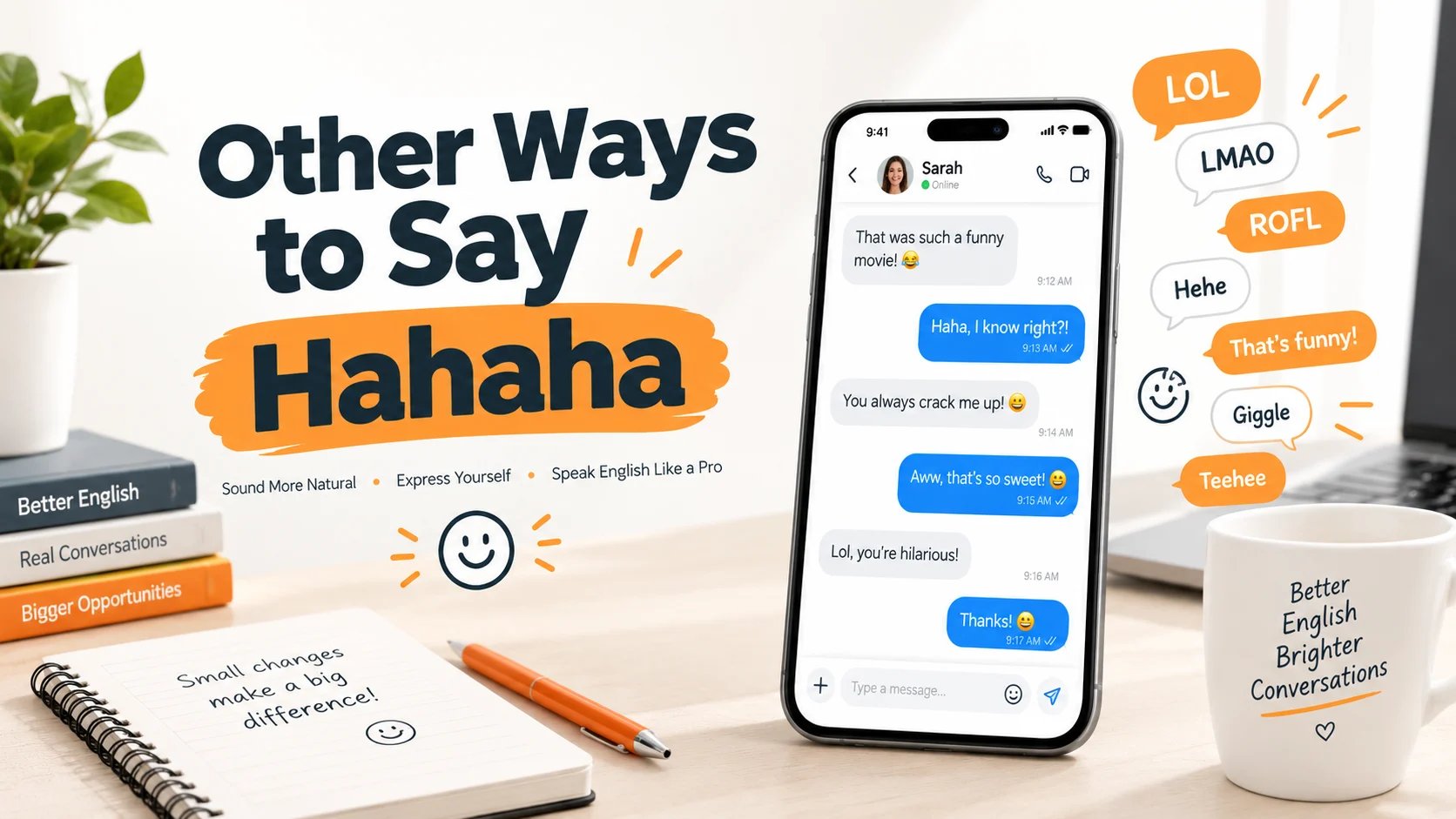
Other ways to say “hahaha” include “LOL,” “that’s hilarious,” “I’m cracking up,” “that’s so funny,” and “you’ve got me laughing.” Choose based on how casual, playful, or expressive you want to sound.
Best alternatives: LOL, that’s hilarious, I’m cracking up, that’s so funny, you’ve got me laughing.
“Hahaha” is one of the most common ways to show laughter in texts, chats, comments, and social media. It can show genuine amusement, friendliness, surprise, or even a lighthearted response when you do not know what else to say.
Still, repeating “hahaha” can make your messages feel predictable. Learning other ways to say “hahaha” gives you more options and helps you express exactly how funny, surprising, or playful something feels.
Whether you need alternatives for casual conversation, texting, social media, or more polished communication, the right expression depends on your relationship with the other person and the situation.
Formal Alternatives
Formal English usually does not replace “hahaha” with another form of written laughter. Instead, describe your reaction politely.
- That was quite amusing.
- I found that very amusing.
- That made me laugh.
- That was genuinely funny.
Pro Tip
In formal emails, academic writing, or professional documents, avoid typing “hahaha” or “LOL.” A simple sentence such as “That was very amusing” is more appropriate.
Professional Alternatives
For workplace chats and friendly professional conversations, use expressions that communicate warmth without sounding overly casual.
- That’s quite funny.
- You made me laugh.
- That was a good one.
- That gave me a laugh.
Pro Tip
Professional communication allows some humor, but your relationship with the recipient matters. A friendly workplace chat can be more relaxed than a formal client email.
Business Email Alternatives
Written business communication usually benefits from a restrained reaction.
- That was amusing.
- You certainly made me smile.
- That’s a good one.
- I had a good laugh at that.
Pro Tip
Use humor carefully in business emails. If the relationship is formal or unfamiliar, “That was amusing” is safer than “LOL!”
Academic Alternatives
Academic writing rarely needs a direct equivalent of “hahaha.”
- That was amusing.
- The comment was humorous.
- That was a humorous observation.
- The remark made me smile.
Pro Tip
In an academic essay, describe humor objectively rather than using conversational laughter.
Casual Alternatives
Casual conversation gives you much more freedom.
- LOL
- That’s hilarious!
- I’m cracking up!
- That’s so funny!
- You’ve got me laughing!
Pro Tip
These expressions work naturally in texts, group chats, comments, and conversations with friends.
Informal Expressions
If you want your message to sound especially relaxed, try:
- LMAO
- I can’t 😂
- I’m dead 😂
- You’re killing me!
- I’m dying laughing!
Pro Tip
These are highly informal expressions. They are best reserved for friends, social media, and casual messaging.
“The best alternative depends on the reaction you want to express, not simply the amount of laughter.”
What Does “Hahaha” Mean?
“Hahaha” is a written representation of laughter. People use it to show that something is funny, amusing, awkward, playful, or entertaining.
The number of “ha” sounds can also change the feeling. A short “haha” may sound like a light laugh, while “hahahahaha” can suggest stronger amusement.
For example:
“I forgot my own password again hahaha.”
Here, “hahaha” makes the sentence sound lighthearted rather than serious.
In digital communication, context matters greatly. “Haha” can sometimes soften a statement, acknowledge a joke, or make a message feel friendlier.
When to Use “Hahaha”
You can use “hahaha” in:
- Text messages
- Group chats
- Social media comments
- Friendly conversations
- Casual online conversations
- Humorous replies
- Informal direct messages
Avoid relying on it in:
- Academic essays
- Formal reports
- Job applications
- Professional presentations
- Formal business correspondence
- Serious workplace communication
Is “Hahaha” Professional or Polite?
Polite? Usually, yes, in a friendly context.
Professional? Depends on the workplace and relationship.
Formal? No.
Natural? Very natural in casual digital communication.
For example, replying to a close colleague with “Hahaha, that’s a good one!” may feel perfectly normal in an informal workplace chat. The same response may feel inappropriate in a formal message to a client.
Pros and Cons of Saying “Hahaha”
Pros
- Easy to understand
- Friendly
- Common in texting
- Shows amusement quickly
- Helps create a relaxed tone
Cons
- Can become repetitive
- Does not explain the strength of your reaction
- May sound overly casual
- Can be ambiguous in some contexts
- Is unsuitable for many formal situations
“Written laughter is casual by nature, so professional contexts usually call for a more deliberate reaction.”
Other Ways to Say “Hahaha” With Examples
There is no single replacement that works everywhere. “LOL” feels different from “That was hilarious,” and “I’m cracking up” feels different from “That made me smile.”
The following alternatives cover casual texting, spoken English, workplace communication, and situations where you want to sound more expressive.
1. Phrase: LOL
Meaning: “LOL” means “laughing out loud” and signals that you find something funny.
Explanation: It is extremely common in digital communication and is strongly associated with informal English. Native speakers use it in texts, comments, and chats, although its intensity can vary.
Example Sentence:
“LOL, I definitely did not expect that ending.”
Best Use: Casual texting
Avoid Using In: Formal emails
Tone: Casual, Friendly
Formality Level: ⭐⭐ Casual
Usage Frequency: Very Common
CEFR Level: B1
Common Collocations:
- LOL, that’s funny
- LOL, seriously?
- LOL, I can’t believe it
Context Variability:
- Spoken: Rarely used aloud as “LOL”; speakers normally laugh or say “That’s funny.”
- Professional: Appropriate only in very informal workplace chats.
- Casual: Very common in messages and social media.
2. Phrase: That’s Hilarious!
Meaning: This tells someone that you find what they said or did extremely funny.
Explanation: “That’s hilarious!” is more expressive than simply saying “haha.” It works naturally in both spoken conversation and informal messages.
Example Sentence:
“That’s hilarious! I can’t believe you actually said that.”
Best Use: Friendly conversation
Avoid Using In: Formal reports
Tone: Expressive, Friendly
Formality Level: ⭐⭐ Casual
Usage Frequency: Very Common
CEFR Level: B1
Common Collocations:
- absolutely hilarious
- genuinely hilarious
- that’s hilarious
Context Variability:
- Spoken: Very natural.
- Professional: Suitable only when workplace communication is relaxed.
- Casual: Excellent for friends and family.
3. Phrase: I’m Cracking Up!
Meaning: This means you are laughing a lot because something is very funny.
Explanation: “Cracking up” is an informal phrasal expression. It emphasizes your reaction rather than simply labeling something as funny.
Example Sentence:
“I’m cracking up over that message you just sent.”
Best Use: Casual conversation
Avoid Using In: Academic writing
Tone: Playful, Informal
Formality Level: ⭐⭐ Casual
Usage Frequency: Common
CEFR Level: B2
Common Collocations:
- cracking up over
- cracking up at
- absolutely cracking up
Context Variability:
- Spoken: Very natural.
- Professional: Usually too casual.
- Casual: Natural among friends.
4. Phrase: That’s So Funny!
Meaning: This is a simple way to say that something made you laugh.
Explanation: It is less intense than “That’s hilarious!” and works in many everyday situations. It is especially useful for English learners because the meaning is direct and easy to understand.
Example Sentence:
“That’s so funny I was thinking exactly the same thing.”
Best Use: Daily conversation
Avoid Using In: Formal writing
Tone: Friendly, Natural
Formality Level: ⭐⭐⭐ Neutral
Usage Frequency: Very Common
CEFR Level: B1
Common Collocations:
- so funny
- really funny
- incredibly funny
Context Variability:
- Spoken: Very natural.
- Professional: Possible in relaxed conversations.
- Casual: Excellent choice.
5. Phrase: You’ve Got Me Laughing!
Meaning: This means that something someone said or did has made you laugh.
Explanation: It focuses on the effect the other person has had on you. It sounds warm and conversational without being as informal as “LMAO.”
Example Sentence:
“You’ve got me laughing with these stories today.”
Best Use: Friendly conversation
Avoid Using In: Formal documents
Tone: Warm, Playful
Formality Level: ⭐⭐⭐ Neutral
Usage Frequency: Common
CEFR Level: B2
Common Collocations:
- got me laughing
- really got me laughing
- you’ve got me laughing
Context Variability:
- Spoken: Natural and friendly.
- Professional: Possible with familiar colleagues.
- Casual: Very suitable.
Native Speaker Tip
For everyday spoken English, “That’s so funny” and “That’s hilarious” are more natural than trying to reproduce typed laughter aloud. “LOL” is mainly a digital expression.
6. Phrase: That Made Me Laugh
Meaning: This directly says that something caused you to laugh.
Explanation: It is simple, natural, and less exaggerated than “That’s hilarious.” It can work in casual conversation and some friendly professional settings.
Example Sentence:
“Your comment during the meeting really made me laugh.”
Best Use: Everyday conversation
Avoid Using In: Academic essays
Tone: Natural, Friendly
Formality Level: ⭐⭐⭐ Neutral
Usage Frequency: Very Common
CEFR Level: B1
Common Collocations:
- really made me laugh
- made me laugh out loud
- that made me laugh
Context Variability:
- Spoken: Very natural.
- Professional: Fine in relaxed settings.
- Casual: Excellent.
7. Phrase: I Can’t 😂
Meaning: This informal expression shows that something is so funny or surprising that you do not know how to respond.
Explanation: The expression is intentionally incomplete. The emoji usually supplies the emotional meaning.
Example Sentence:
“I can’t 😂 That video was completely unexpected.”
Best Use: Texting
Avoid Using In: Formal communication
Tone: Playful, Very Casual
Formality Level: ⭐ Very Casual
Usage Frequency: Common
CEFR Level: B2
Common Collocations:
- I can’t 😂
- I seriously can’t
- I can’t with you
Context Variability:
- Spoken: “I can’t” can be spoken, but the digital expression is especially common in text.
- Professional: Avoid.
- Casual: Highly natural.
8. Phrase: You’re Killing Me!
Meaning: This informal expression means that someone is making you laugh a lot.
Explanation: It is not normally meant literally. It is a playful exaggeration used when someone’s joke or behavior is extremely amusing.
Example Sentence:
“You’re killing me! Where do you come up with these jokes?”
Best Use: Friendly conversation
Avoid Using In: Formal settings
Tone: Playful, Expressive
Formality Level: ⭐⭐ Casual
Usage Frequency: Common
CEFR Level: B2
Common Collocations:
- you’re killing me
- absolutely killing me
- you’re killing me with that
Context Variability:
- Spoken: Very natural.
- Professional: Usually too informal.
- Casual: Excellent with friends.
9. Phrase: I’m Dying Laughing!
Meaning: This is a strong informal expression meaning that something is extremely funny.
Explanation: It is hyperbolic, so it should not be interpreted literally. It is common in casual online and spoken communication.
Example Sentence:
“I’m dying laughing at that photo.”
Best Use: Casual messaging
Avoid Using In: Formal writing
Tone: Dramatic, Playful
Formality Level: ⭐ Very Casual
Usage Frequency: Common
CEFR Level: B2
Common Collocations:
- dying laughing
- absolutely dying
- dying over that joke
Context Variability:
- Spoken: Natural among friends.
- Professional: Avoid.
- Casual: Very common in informal contexts.
10. Phrase: I Had a Good Laugh
Meaning: This means that something provided an enjoyable laugh.
Explanation: It is more restrained than “I’m dying laughing.” It can sound warm and natural without being extremely informal.
Example Sentence:
“I had a good laugh reading your story this morning.”
Best Use: Friendly message
Avoid Using In: Formal reports
Tone: Warm, Relaxed
Formality Level: ⭐⭐⭐ Neutral
Usage Frequency: Common
CEFR Level: B2
Common Collocations:
- had a good laugh
- have a good laugh
- had a laugh about it
Context Variability:
- Spoken: Natural.
- Professional: Can work with familiar colleagues.
- Casual: Very suitable.
Native Speaker Tip
Expressions such as “That made me laugh” and “That’s hilarious” are broadly useful. Stronger expressions like “I’m dying laughing” are deliberately informal and should be matched to the relationship and setting.
11. Phrase: That Was a Good One
Meaning: This tells someone that their joke or humorous comment worked well.
Explanation: It is often used as a friendly reaction to a joke. The expression can sound understated, which makes it useful when you want to acknowledge humor without exaggerating.
Example Sentence:
“That was a good one I wasn’t expecting that.”
Best Use: Friendly conversation
Avoid Using In: Academic writing
Tone: Relaxed, Friendly
Formality Level: ⭐⭐⭐ Neutral
Usage Frequency: Common
CEFR Level: B1
Common Collocations:
- that was a good one
- that’s a good one
- you got me with that one
Context Variability:
- Spoken: Very natural.
- Professional: Possible in relaxed workplace conversations.
- Casual: Excellent.
12. Phrase: You Made Me Smile
Meaning: This says that something someone said or did caused a positive, happy reaction.
Explanation: It is gentler than expressions focused on laughter. Use it when something is amusing, sweet, or simply pleasant.
Example Sentence:
“That message really made me smile during a busy afternoon.”
Best Use: Warm messages
Avoid Using In: Technical reports
Tone: Warm, Polite
Formality Level: ⭐⭐⭐⭐ Formal
Usage Frequency: Common
CEFR Level: B1
Common Collocations:
- made me smile
- really made me smile
- put a smile on my face
Context Variability:
- Spoken: Natural.
- Professional: Suitable in warm, appropriate communication.
- Casual: Works very well.
13. Phrase: That Was Amusing
Meaning: This means that something was entertaining or funny.
Explanation: “Amusing” is more restrained and formal than “hilarious.” It can be useful when you want to acknowledge humor without sounding highly emotional.
Example Sentence:
“Your observation about the situation was quite amusing.”
Best Use: Professional conversation
Avoid Using In: Very casual texting
Tone: Polite, Restrained
Formality Level: ⭐⭐⭐⭐ Formal
Usage Frequency: Common
CEFR Level: B2
Common Collocations:
- quite amusing
- rather amusing
- genuinely amusing
Context Variability:
- Spoken: Natural, especially in careful speech.
- Professional: Suitable.
- Casual: May sound slightly formal depending on the situation.
14. Phrase: That’s Too Funny
Meaning: This emphasizes that something is extremely amusing.
Explanation: It is an expressive but natural casual phrase. It often appears in conversations when someone reacts enthusiastically to a joke or unexpected event.
Example Sentence:
“That’s too funny I never imagined you would choose that answer.”
Best Use: Casual conversation
Avoid Using In: Formal emails
Tone: Expressive, Friendly
Formality Level: ⭐⭐ Casual
Usage Frequency: Common
CEFR Level: B1
Common Collocations:
- too funny
- that’s too funny
- way too funny
Context Variability:
- Spoken: Very natural.
- Professional: Use only in relaxed settings.
- Casual: Excellent.
15. Phrase: I’m Laughing So Hard
Meaning: This strongly emphasizes that something is making you laugh.
Explanation: It is an informal expression often used in texting and social media. It is more expressive than simply saying “haha.”
Example Sentence:
“I’m laughing so hard at the way you described that situation.”
Best Use: Casual messaging
Avoid Using In: Formal communication
Tone: Energetic, Informal
Formality Level: ⭐⭐ Casual
Usage Frequency: Common
CEFR Level: B2
Common Collocations:
- laughing so hard
- laughing so hard at
- laughing so hard right now
Context Variability:
- Spoken: Natural in casual conversation.
- Professional: Generally too informal.
- Casual: Very natural.
Expert Insight
In professional communication, the goal is not to find a more sophisticated version of “hahaha.” Instead, choose a response that matches the relationship and purpose of the message.
For a client, “That was amusing” may be appropriate. With a close colleague, “That’s a good one!” can sound more natural. In an academic essay, simply avoid conversational laughter altogether.
Avoid These in Formal Situations
Some expressions are perfectly normal with friends but unsuitable for formal communication:
- LMAO highly informal and internet-based.
- I’m dead 😂 very casual and context-dependent.
- I’m dying laughing! exaggerated and informal.
- You’re killing me! playful but inappropriate in many formal contexts.
- Hahahahahaha conversational laughter is usually unnecessary in formal writing.
Better alternatives include:
- That was amusing.
- That made me smile.
- I found that quite amusing.
- That was a humorous observation.
“Fluent English is not about using the biggest word; it is about choosing the right expression for the situation.”
Top 10 Alternatives Compared
| Phrase | Tone | Formality | Best Use | Frequency |
| LOL | Casual | ⭐⭐ | Texting | Very Common |
| That’s hilarious! | Expressive | ⭐⭐ | Conversation | Very Common |
| I’m cracking up! | Playful | ⭐⭐ | Casual chat | Common |
| That’s so funny! | Friendly | ⭐⭐⭐ | Daily conversation | Very Common |
| You’ve got me laughing! | Warm | ⭐⭐⭐ | Friendly chat | Common |
| That made me laugh | Natural | ⭐⭐⭐ | Everyday English | Very Common |
| That was a good one | Relaxed | ⭐⭐⭐ | Jokes | Common |
| I had a good laugh | Warm | ⭐⭐⭐ | Messages | Common |
| You made me smile | Polite | ⭐⭐⭐⭐ | Warm communication | Common |
| That was amusing | Restrained | ⭐⭐⭐⭐ | Professional English | Common |
Which Expression Fits Which Situation?
Rather than looking for one universal replacement, consider the audience and setting.
Business Email
That was amusing.
It communicates a positive reaction without making the email sound overly casual.
Client Meeting
That was a good one.
Use this when the meeting is friendly and the relationship allows informal humor.
Academic Essay
The comment was humorous.
Academic writing generally requires description rather than conversational laughter.
Presentation
That’s a good point and a funny one.
This can work when a presentation includes light humor.
Workplace Discussion
That made me laugh.
It sounds natural while remaining less informal than internet slang.
Job Interview
That’s a good one.
Use it only if the interview moment is genuinely lighthearted; avoid forcing humor.
Team Collaboration
That’s hilarious!
This can work in an informal team environment where humor is already part of the conversation.
Everyday Conversation
That’s so funny!
This is one of the easiest and most natural alternatives for everyday spoken English.
Commonly Confused Expressions
“Haha” vs. “LOL”
Both can indicate laughter in digital communication. “LOL” is an abbreviation, while “haha” directly represents laughter.
“That’s Funny” vs. “That’s Hilarious”
“That’s funny” is broader and less intense. “That’s hilarious” suggests stronger amusement.
“I Had a Good Laugh” vs. “I’m Cracking Up”
“I had a good laugh” describes an enjoyable reaction, while “I’m cracking up” suggests that you are laughing strongly at that moment.
“That Was Amusing” vs. “That’s Hilarious”
“That was amusing” sounds restrained and can fit more formal contexts. “That’s hilarious” is much more expressive and casual.
Scenario Practice
1. Business Meeting
Your colleague makes a clever but appropriate joke during an informal team meeting.
Which phrase would you choose?
Answer: “That was a good one.”
It acknowledges the joke without sounding excessively informal.
2. Job Interview
The interviewer makes a lighthearted comment.
Which phrase would you choose?
Answer: “That’s a good one.”
It is friendly, but keep your response natural rather than forcing laughter.
3. Presentation
A classmate makes a genuinely funny observation.
Which phrase would you choose?
Answer: “That’s so funny!”
This sounds natural in a classroom discussion.
4. Class Discussion
Someone makes a humorous observation during a relaxed discussion.
Which phrase would you choose?
Answer: “That made me laugh.”
It is simple, clear, and natural.
5. Email Reply
A close colleague sends you a funny story in an informal work email.
Which phrase would you choose?
Answer: “You’ve got me laughing!”
It sounds warm and conversational, provided the workplace relationship is relaxed.
Mini Quiz
1. Which expression is most suitable for casual texting?
A. The remark was humorous.
B. LOL
C. That was quite amusing.
D. The observation was entertaining.
Answer: B. LOL
“LOL” is a common informal digital expression.
2. Which expression sounds more restrained and professional?
A. I’m dead 😂
B. LMAO
C. That was amusing.
D. I’m dying laughing!
Answer: C. That was amusing.
It communicates amusement without strong internet slang.
3. Which phrase shows strong casual laughter?
A. I’m cracking up!
B. The comment was humorous.
C. That was amusing.
D. I found that entertaining.
Answer: A. I’m cracking up!
It emphasizes a strong reaction.
4. Which expression is best for everyday spoken English?
A. That’s so funny!
B. LMAO
C. I’m dead 😂
D. Hahahahahahaha
Answer: A. That’s so funny!
It is natural, clear, and widely usable.
5. Which expression is generally inappropriate in formal writing?
A. That was amusing.
B. The comment was humorous.
C. I found that very amusing.
D. LOL
Answer: D. LOL
“LOL” is strongly associated with informal digital communication.
FAQs
What is the most formal way to say “hahaha”?
A more formal alternative is “That was amusing” or “I found that very amusing.” These expressions communicate that something was funny without using informal internet laughter. In highly formal writing, however, it is often better to describe the humorous element directly rather than respond with written laughter.
Which phrase is best for professional emails?
“That was amusing” is a safe professional option when you genuinely want to acknowledge humor. In a friendly workplace relationship, “That made me laugh” or “That was a good one” may sound more natural. Avoid “LOL,” “LMAO,” and similar internet expressions when the email is formal or addressed to an unfamiliar recipient.
What is the difference between “haha” and “LOL”?
Both can communicate laughter, but they work slightly differently. “Haha” represents the sound of laughter and can feel more conversational, while “LOL” is an abbreviation meaning “laughing out loud.” Both are mainly associated with informal digital communication.
Which alternative sounds most natural?
For everyday spoken English, “That’s so funny!” is one of the most natural choices. “That’s hilarious!” is also extremely common when something is particularly funny. For a calmer reaction, “That made me laugh” sounds natural without exaggerating the strength of your response.
Can I use these expressions in business meetings?
Some can be used, depending on the workplace culture and relationship. “That made me laugh” and “That’s a good one” can work in relaxed meetings. Strong internet expressions such as “LMAO” or “I’m dead 😂” are generally inappropriate for formal business communication.
Conclusion
Learning other ways to say “hahaha” gives you more control over your English. Expressions such as “That’s so funny,” “That’s hilarious,” and “That made me laugh” sound natural in everyday conversation, while “That was amusing” works better when you need a more restrained professional tone.
The key is to match your expression to the situation. Use casual phrases with friends, choose professional wording at work, and avoid internet slang in formal writing. With practice, you can move beyond repeated “hahaha” responses and communicate your reactions with greater variety and confidence.

2 thoughts on “Other Ways to Say Hahaha |15+ Examples For 2026”