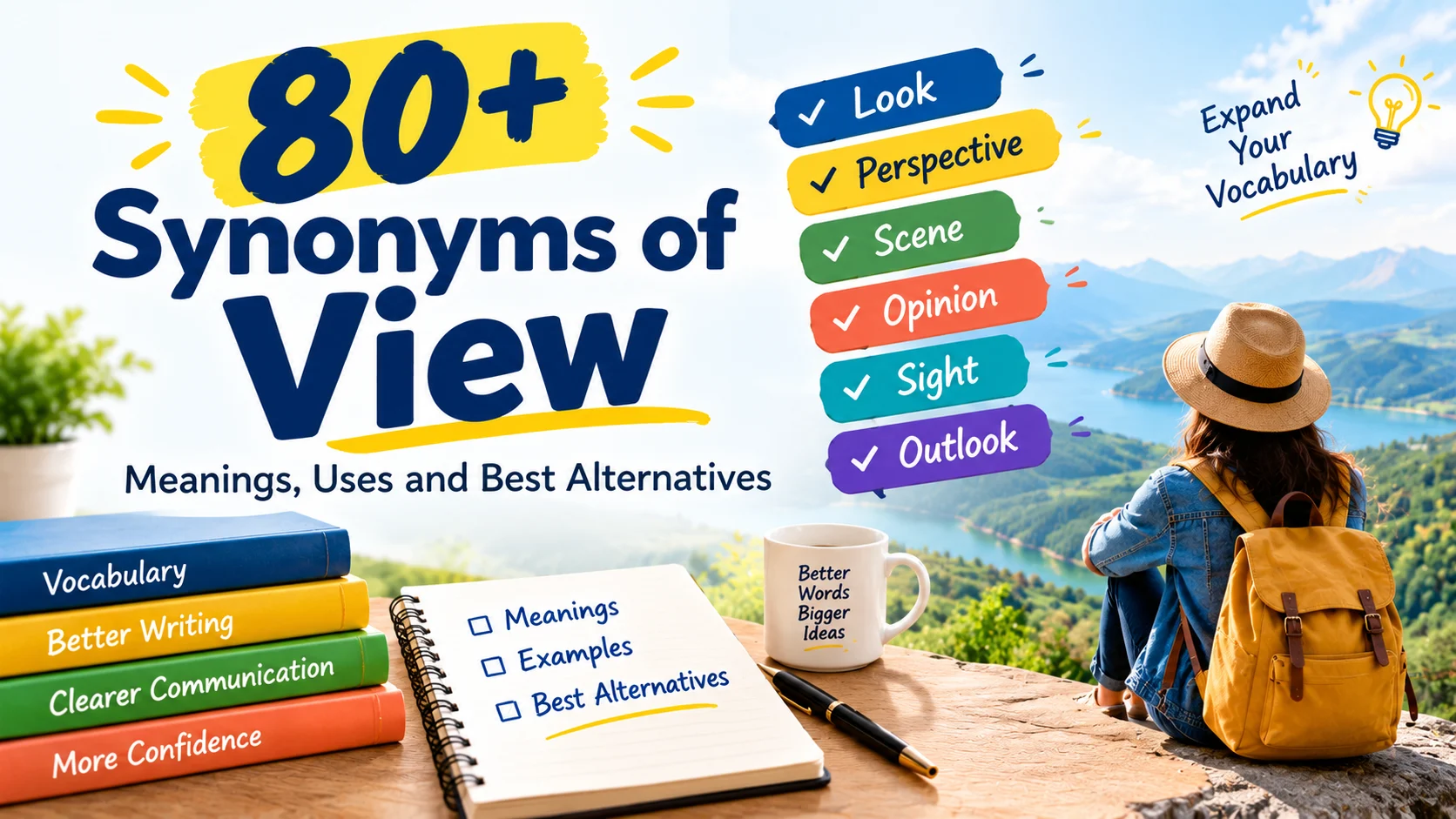
The word view means an opinion, belief, or what you can see from a place. For formal writing, choose perspective or viewpoint. For casual conversation, opinion or take works well. In academic writing, standpoint or position fits best. For professional communication, outlook or assessment is ideal. Creative writing benefits from scene or vista.
You are drafting an important email, polishing a school essay, or writing a social media caption. You notice the same word keeps appearing: view. It feels flat, repetitive, and slightly vague. You pause and wonder what other word could capture your meaning more precisely.
Finding the right synonym of view can transform a bland sentence into a clear, confident statement. The word view carries multiple meanings, from personal opinions to physical scenery, so the correct alternative depends entirely on your context. This guide will help you choose the perfect word every time.
Meaning, Tone, and Context
Simple Definition
View has two main meanings. First, it refers to an opinion, belief, or way of thinking about something. Second, it describes what you can see from a particular place or position.
Part of Speech
View functions primarily as a noun. It can also work as a verb meaning to look at or examine something.
Overall Tone
The word view is neutral. It does not carry strong positive or negative emotions on its own. Its tone shifts based on context and the words around it.
Formality Level
View sits at a neutral to semi-formal level. It works in everyday conversation, professional emails, academic papers, and business reports. This flexibility makes it a reliable but sometimes overused choice.
Common Uses
Native English speakers use view in many situations. You will hear it in business meetings when someone shares their perspective. It appears in academic writing when discussing theoretical positions. People use it in casual conversation when asking for someone’s opinion. It also describes scenery from a window, mountain, or building.
Word Forms
- Noun: view, views
- Verb: view, viewed, viewing
- Adjective: viewable
- Related forms: viewer, viewpoint, overview, review
- Opposite form: viewless (rare)
When and How to Use “View”
Choose view when you need a neutral, versatile word that fits both professional and personal settings. Here are seven realistic examples.
Professional: Our team’s view on the project timeline needs to be presented to leadership tomorrow.
Academic: The researcher’s view challenges established theories in cognitive psychology.
Workplace: I respect your view, but I think we should consider other options before deciding.
Personal: From my view, the situation seems more complicated than it appears.
Email: Thank you for sharing your view on the proposal. I will review it carefully.
Resume: Developed a strategic view of market trends to guide quarterly planning.
Social Media: My view from the mountain this morning was absolutely breathtaking.
Best Synonyms of “View”
No single synonym works perfectly in every situation. Each alternative carries its own tone, formality level, and emotional weight. The best choice depends on your audience, purpose, and the specific meaning you want to convey.
Professional Writing
Perspective works best for professional writing. It suggests a thoughtful, considered position rather than a casual opinion. Use it when you want to sound analytical and mature.
Academic Writing
Standpoint fits academic writing perfectly. It implies a theoretical or research-based position. This word signals intellectual rigor and careful reasoning.
Business Communication
Outlook suits business communication. It suggests a forward-looking assessment or prediction. Use it when discussing trends, forecasts, or strategic direction.
Casual Conversation
Take works well in casual conversation. It sounds modern, friendly, and approachable. Use it when you want to share your opinion without sounding formal.
Emotional Writing
Sentiment carries emotional weight. It suggests a feeling-based position rather than pure logic. Use it when expressing heartfelt opinions or collective feelings.
Creative Writing
Vista adds beauty and imagery. It describes a sweeping, picturesque scene. Use it in storytelling to paint a vivid picture for readers.
Resume Writing
Assessment strengthens resume writing. It sounds professional and action-oriented. Use it to describe your ability to evaluate situations or data.
Workplace Communication
Position works well in workplace communication. It suggests a defined stance on an issue. Use it when you need to state where you stand clearly.
Stronger Meaning
Conviction conveys strong, unwavering belief. It carries more emotional force than view. Use it when someone holds a firm, deeply held opinion.
Softer Meaning
Impression offers a gentler alternative. It suggests a tentative or evolving understanding. Use it when you want to sound less definitive.
When Not to Use “View”
View is not always the best choice. Sometimes it sounds too general, too weak, or simply wrong for the situation.
Too General: Saying “my view” when you mean a strong belief weakens your message. Better: “my conviction.” This sounds more decisive and passionate.
Too Vague: Using view when you mean a formal assessment confuses readers. Better: “my assessment.” This clarifies that you have evaluated evidence.
Too Formal: Using view in casual texting sounds stiff. Better: “my take.” This matches the relaxed tone of informal conversation.
Too Informal: Using view in a legal document may seem imprecise. Better: “position” or “stance.” These terms carry more authority in formal contexts.
Too Weak: Using view when you mean a deeply held belief undersells your point. Better: “conviction.” This word commands attention and respect.
Outdated: Using view to mean a mental survey sounds old-fashioned. Better: “perspective” or “outlook.” These words feel more current and natural.
Words Commonly Confused With “View”
View vs Opinion
Difference: View suggests a broader perspective, while opinion is a personal judgment.
Which Is Stronger? Opinion feels slightly more personal and subjective.
Which Is More Formal? Both work in formal writing, but view sounds more measured.
When to Use Each: Use view for considered positions. Use opinion for personal beliefs.
Examples:
View: Her view on education policy reflects years of research.
Opinion: My opinion is that we should wait before deciding.
View vs Perspective
Difference: View is general, while perspective implies a specific angle or framework.
Which Is Stronger? Perspective feels more analytical and thoughtful.
Which Is More Formal? Perspective is more formal and academic.
When to Use Each: Use view for simple opinions. Use perspective for nuanced positions.
Examples:
View: His view on the matter was clear.
Perspective: From a historical perspective, the decision makes sense.
View vs Vista
Difference: View can mean an opinion or scenery, while vista refers only to a beautiful, expansive scene.
Which Is Stronger? Vista carries more emotional and visual impact.
Which Is More Formal? Vista is more literary and descriptive.
When to Use Each: Use view for everyday descriptions. Use vista for dramatic scenery.
Examples:
View: The view from my office window is nice.
Vista: The vista from the cliff took our breath away.
View vs Standpoint
Difference: View is general, while standpoint emphasizes the position from which someone observes.
Which Is Stronger? Standpoint sounds more technical and precise.
Which Is More Formal? Standpoint is more formal and academic.
When to Use Each: Use view in everyday writing. Use standpoint in research or analysis.
Examples:
View: Her view on climate change is well known.
Standpoint: From an economic standpoint, the policy has merit.
View vs Sentiment
Difference: View is neutral, while sentiment carries emotional undertones.
Which Is Stronger? Sentiment feels warmer and more emotional.
Which Is More Formal? Sentiment is more formal and often used in business contexts.
When to Use Each: Use view for neutral opinions. Use sentiment for feelings and attitudes.
Examples:
View: Their view on the merger was positive.
Sentiment: Public sentiment shifted after the announcement.
View vs Outlook
Difference: View describes a current opinion, while outlook suggests a future-oriented perspective.
Which Is Stronger? Outlook implies forward thinking and prediction.
Which Is More Formal? Outlook is more formal and professional.
When to Use Each: Use view for present opinions. Use outlook for forecasts and trends.
Examples:
View: My view is that we should proceed.
Outlook: The economic outlook remains uncertain.
Best Synonyms of “View” by Context
| Context | Best Synonym | Why It Works | Example |
| Formal writing | Perspective | Sounds analytical and measured | The author’s perspective on the issue is compelling. |
| Academic writing | Standpoint | Signals theoretical rigor | From a sociological standpoint, the data is significant. |
| Professional communication | Outlook | Suggests forward thinking | Our outlook for the next quarter is optimistic. |
| Business emails | Assessment | Sounds evaluative and professional | Based on my assessment, we should revise the plan. |
| Resume writing | Position | Conveys clear professional stance | Developed a strong position on market strategy. |
| Workplace communication | Stance | Shows defined opinion | The team’s stance on the proposal was unanimous. |
| Casual conversation | Take | Sounds modern and friendly | What’s your take on the new movie? |
| Everyday speaking | Opinion | Simple and direct | In my opinion, we should wait. |
| Creative writing | Vista | Adds visual beauty | The vista stretched endlessly before them. |
| Storytelling | Scene | Creates imagery | The scene from the hilltop was unforgettable. |
| Emotional writing | Sentiment | Carries emotional weight | The sentiment among voters was hopeful. |
| Strong emphasis | Conviction | Shows unwavering belief | She spoke with conviction about the need for change. |
| Mild tone | Impression | Suggests tentative understanding | My impression is that they agree. |
| Social media captions | Vibes | Modern and casual | The vibes from this view are unmatched. |
| American English | Viewpoint | Common and natural in US writing | Her viewpoint on the issue differs from mine. |
| British English | Point of view | Preferred in UK formal writing | His point of view was carefully considered. |
How to Choose the Best Synonym of “View”
Choosing the right synonym requires answering a few simple questions.
What do you mean? If you mean an opinion, consider perspective, opinion, or take. If you mean scenery, consider vista, scene, or panorama.
Who is your audience? For professors and researchers, choose standpoint or perspective. For friends and family, choose take or opinion. For business clients, choose outlook or assessment.
What tone do you want? For a neutral tone, use view or opinion. For a stronger tone, use conviction. For a softer tone, use impression.
How formal should you sound? For formal writing, use perspective, standpoint, or position. For casual writing, use take or vibes.
What is your purpose? To inform, use assessment or outlook. To persuade, use conviction or stance. To entertain, use vista or scene.
Choose the synonym that communicates your message most clearly to your specific reader.
Real Life Examples of “View”
School: My teacher asked for my view on the book’s theme. Better: My teacher asked for my perspective on the book’s theme.
College: The professor’s view on the theory was controversial. Better: The professor’s standpoint on the theory was controversial.
Workplace: I shared my view during the meeting. Better: I shared my assessment during the meeting.
Business: The company’s view on sustainability is evolving. Better: The company’s outlook on sustainability is evolving.
Email: Please share your view on the proposal by Friday. Better: Please share your feedback on the proposal by Friday.
Resume: Demonstrated a global view of market dynamics. Better: Demonstrated a global perspective on market dynamics.
Conversation: What’s your view on this restaurant? Better: What’s your take on this restaurant?
Storytelling: The view from the castle was stunning. Better: The vista from the castle was stunning.
Blogging: In my view, morning routines change everything. Better: In my opinion, morning routines change everything.
Social Media: The view from my hike today was incredible. Better: The vista from my hike today was incredible.
18 Best Synonyms of “View”
| Synonym | Simple Meaning | Best Used For | Example Sentence |
| Perspective | A way of thinking about something | Professional and analytical writing | Her perspective on the issue was refreshing. |
| Opinion | A personal belief or judgment | Everyday conversation and informal writing | My opinion is that we should try again. |
| Viewpoint | A particular attitude or way of considering | General writing and discussions | His viewpoint differs from the majority. |
| Standpoint | A position from which things are viewed | Academic and technical writing | From a legal standpoint, the case is weak. |
| Outlook | A future-oriented perspective | Business and professional communication | The outlook for the industry is positive. |
| Assessment | An evaluation or judgment | Professional and business writing | My assessment is that we need more data. |
| Position | A defined stance on an issue | Workplace and formal writing | The company’s position on the matter is clear. |
| Stance | A publicly stated opinion | Professional and academic contexts | Her stance on the policy was unwavering. |
| Take | A personal interpretation | Casual conversation and social media | What’s your take on the new design? |
| Sentiment | A feeling or emotional attitude | Emotional and business writing | The sentiment among employees was positive. |
| Conviction | A firmly held belief | Persuasive and emotional writing | He spoke with conviction about the cause. |
| Impression | A tentative understanding | Soft and tentative writing | My impression is that they are interested. |
| Vista | A beautiful, expansive view | Creative and descriptive writing | The vista from the summit was breathtaking. |
| Scene | A view of a place or situation | Storytelling and descriptive writing | The scene outside was peaceful and quiet. |
| Panorama | A wide, unbroken view | Travel and creative writing | The panorama of the valley amazed us. |
| Angle | A particular way of approaching | Informal and professional writing | Let’s consider this from a different angle. |
| Belief | A strong feeling that something is true | Personal and philosophical writing | Her belief in education never wavered. |
| Judgment | An opinion formed after thought | Formal and professional writing | The judgment of the committee was final. |
Synonyms of “View” by Usage
Professional vs Personal Synonyms
In professional settings, choose perspective, assessment, outlook, or position. These words sound measured and authoritative. They signal that you have thought carefully about the topic.
In personal conversations, choose take, opinion, or angle. These words feel relaxed and approachable. They invite discussion rather than declare a final verdict.
Formal vs Conversational Synonyms
For reports, essays, and business writing, use perspective, standpoint, or position. These words carry weight and precision. They fit the expectations of formal communication.
For casual conversations, texting, and social media, use take, opinion, or vibes. These words match the informal, fast-paced nature of everyday communication.
Academic Synonyms
Standpoint, perspective, and position work best in academic writing. They sound precise and authoritative. These words signal that you understand the nuances of scholarly discourse.
Researchers use standpoint to describe theoretical frameworks. They use perspective to discuss different analytical approaches. They use position to state clear arguments.
Professional and Business Synonyms
For resumes, interviews, and meetings, choose assessment, outlook, or position. These words sound action-oriented and results-focused. They demonstrate your ability to evaluate situations and make decisions.
In client communication, use perspective or assessment. These words sound respectful and professional. They show that you value the client’s point of view while offering your own expert judgment.
Creative and Literary Synonyms
For storytelling, poetry, and descriptive writing, choose vista, scene, or panorama. These words paint pictures in the reader’s mind. They add beauty, emotion, and imagery to your writing.
Use vista for sweeping, dramatic landscapes. Use scene for intimate, detailed descriptions. Use panorama for wide, breathtaking views that inspire awe.
Slang or Modern Synonyms
Vibes: Meaning: a feeling or atmosphere. Acceptable in casual conversation and social media. Avoid in formal or professional writing.
Take: Meaning: a personal interpretation. Acceptable in informal discussions and podcasts. Avoid in academic papers or business reports.
Strongest to Mildest Synonyms
Mild: Impression, inclination, leaning
Moderate: View, opinion, perspective, viewpoint
Strong: Position, stance, assessment, outlook
Very Strong: Conviction, belief, judgment, sentiment
Emotional intensity increases as you move from mild to very strong. Mild synonyms suggest tentative, flexible thinking. Very strong synonyms convey firm, deeply held beliefs. Choose based on how much force you want your words to carry.
Emotional vs Neutral Synonyms
Emotional Synonyms
Sentiment, conviction, and belief carry emotional weight. They express feelings, values, and deeply held positions. Use them when you want to connect with readers on an emotional level.
Neutral Synonyms
View, opinion, perspective, and viewpoint communicate information without added emotion. They present positions calmly and objectively. Use them when you want to inform rather than persuade.
Antonyms of “View”
| Antonym | Meaning | Example Sentence |
| Blindness | Lack of sight or awareness | His blindness to the issue surprised everyone. |
| Ignorance | Lack of knowledge or information | Her ignorance of the facts led to poor decisions. |
| Disregard | Lack of attention or respect | His disregard for the rules caused problems. |
| Neglect | Failure to care for or attend to | The neglect of duty was unacceptable. |
| Overlook | Fail to notice or consider | They overlook important details too often. |
| Indifference | Lack of interest or concern | Her indifference to the outcome was puzzling. |
| Apathy | Lack of feeling or emotion | Voter apathy led to low turnout. |
| Unawareness | Lack of consciousness or knowledge | His unawareness of the danger was alarming. |
| Inattention | Lack of focus or notice | Inattention to detail caused errors. |
| Oblivion | State of being unaware | The issue faded into oblivion. |
| Disinterest | Lack of concern or curiosity | His disinterest in the project was obvious. |
| Insensitivity | Lack of awareness of others’ feelings | Her insensitivity hurt the team. |
| Narrow-mindedness | Lack of openness to new ideas | Narrow-mindedness limits growth. |
| Prejudice | Preconceived opinion not based on reason | Prejudice clouds honest judgment. |
| Bias | Unfair preference or inclination | Bias affected the final decision. |
Comparison: “View” vs Similar Words
View vs Opinion
Main Difference: View suggests a broader perspective, while opinion is a personal judgment.
Which Is Stronger? Opinion feels slightly more personal and subjective.
Which Is More Formal? View sounds more measured and professional.
When to Use Each: Use view for considered positions. Use opinion for personal beliefs.
Examples:
View: Her view on education policy reflects years of research.
Opinion: My opinion is that we should wait before deciding.
View vs Perspective
Main Difference: View is general, while perspective implies a specific angle or framework.
Which Is Stronger? Perspective feels more analytical and thoughtful.
Which Is More Formal? Perspective is more formal and academic.
When to Use Each: Use view for simple opinions. Use perspective for nuanced positions.
Examples:
View: His view on the matter was clear.
Perspective: From a historical perspective, the decision makes sense.
View vs Vista
Main Difference: View can mean an opinion or scenery, while vista refers only to a beautiful, expansive scene.
Which Is Stronger? Vista carries more emotional and visual impact.
Which Is More Formal? Vista is more literary and descriptive.
When to Use Each: Use view for everyday descriptions. Use vista for dramatic scenery.
Examples:
View: The view from my office window is nice.
Vista: The vista from the cliff took our breath away.
View vs Standpoint
Main Difference: View is general, while standpoint emphasizes the position from which someone observes.
Which Is Stronger? Standpoint sounds more technical and precise.
Which Is More Formal? Standpoint is more formal and academic.
When to Use Each: Use view in everyday writing. Use standpoint in research or analysis.
Examples:
View: Her view on climate change is well known.
Standpoint: From an economic standpoint, the policy has merit.
View vs Sentiment
Main Difference: View is neutral, while sentiment carries emotional undertones.
Which Is Stronger? Sentiment feels warmer and more emotional.
Which Is More Formal? Sentiment is more formal and often used in business contexts.
When to Use Each: Use view for neutral opinions. Use sentiment for feelings and attitudes.
Examples:
View: Their view on the merger was positive.
Sentiment: Public sentiment shifted after the announcement.
View vs Outlook
Main Difference: View describes a current opinion, while outlook suggests a future-oriented perspective.
Which Is Stronger? Outlook implies forward thinking and prediction.
Which Is More Formal? Outlook is more formal and professional.
When to Use Each: Use view for present opinions. Use outlook for forecasts and trends.
Examples:
View: My view is that we should proceed.
Outlook: The economic outlook remains uncertain.
Common Phrases and Expressions with “View”
In view of
Meaning: Considering or because of something.
Example: In view of the recent changes, we need to revise our plan.
Point of view
Meaning: A particular attitude or way of considering something.
Example: From my point of view, the decision was correct.
With a view to
Meaning: With the aim or purpose of doing something.
Example: She studied hard with a view to getting a scholarship.
A room with a view
Meaning: A room that overlooks a beautiful scene.
Example: We booked a room with a view of the ocean.
Take the long view
Meaning: Consider the long-term consequences.
Example: We should take the long view and invest in sustainable solutions.
In my view
Meaning: In my opinion.
Example: In my view, the project needs more time.
Bird’s-eye view
Meaning: A comprehensive overview from above.
Example: The report gives a bird’s-eye view of the industry.
World view
Meaning: A comprehensive philosophy or perspective on life.
Example: Travel can broaden your world view.
Common Mistakes to Avoid
Mistake 1: Choosing a vague synonym instead of a precise one
Incorrect: My view is that we should change.
Better: My assessment is that we should change.
Why: Assessment sounds more professional and evaluative. It shows you have analyzed the situation.
Mistake 2: Confusing view with opinion in formal writing
Incorrect: The study’s opinion on the data was clear.
Better: The study’s perspective on the data was clear.
Why: Studies do not have opinions. They have perspectives or findings.
Mistake 3: Using an informal synonym in formal writing
Incorrect: The CEO’s take on the merger was positive.
Better: The CEO’s assessment of the merger was positive.
Why: Take sounds too casual for formal business writing. Assessment sounds professional.
Mistake 4: Selecting an overly dramatic synonym
Incorrect: Her conviction about the lunch menu was intense.
Better: Her opinion about the lunch menu was clear.
Why: Conviction is too strong for trivial matters. It should be reserved for serious beliefs.
Mistake 5: Repeating the same word too often
Incorrect: My view is that your view should consider her view.
Better: My perspective is that your opinion should consider her viewpoint.
Why: Varying your word choice keeps writing fresh and engaging.
Mistake 6: Choosing a synonym with the wrong emotional tone
Incorrect: The sentiment from the window was beautiful.
Better: The view from the window was beautiful.
Why: Sentiment refers to feelings, not scenery. View is the correct choice for describing what you see.
Mistake 7: Using slang in academic or professional writing
Incorrect: The professor’s vibes on the theory were interesting.
Better: The professor’s perspective on the theory was interesting.
Why: Vibes is too casual for academic settings. Perspective sounds scholarly and appropriate.
Frequently Asked Questions
1. What are the best synonyms of “view”?
The best synonyms of view depend on context. Perspective, opinion, viewpoint, standpoint, outlook, assessment, and position are all excellent choices. For casual conversation, take works well. For scenery, vista and scene are ideal.
2. What are the best formal synonyms of “view”?
For formal writing, choose perspective, standpoint, position, assessment, or outlook. These words sound professional and authoritative. They fit academic papers, business reports, and official communication.
3. What are common informal synonyms of “view”?
Common informal synonyms include take, opinion, and angle. These words work well in casual conversation, texting, and social media. They sound relaxed and approachable.
4. What is another word for “view” in professional writing?
In professional writing, use assessment, outlook, perspective, or position. Assessment works for evaluations. Outlook suits forecasts. Perspective fits analytical discussions. Position conveys a clear stance.
5. What is the difference between “view” and “perspective”?
View is a general term for an opinion or what you see. Perspective implies a specific angle or framework for understanding something. Perspective sounds more analytical and thoughtful than view.
6. What is the opposite of “view”?
Opposites of view include blindness, ignorance, disregard, and neglect. These words suggest a lack of awareness, attention, or understanding. They contrast with the idea of having a clear opinion or sight.
Conclusion
The word view serves as a versatile tool in English communication. It can mean an opinion, a belief, or the scenery before your eyes. But relying on it too often makes your writing feel repetitive and vague.
Choosing the right synonym of view depends on your context, audience, and purpose. Use perspective for professional writing. Choose standpoint for academic work. Pick take for casual conversation. Select vista for creative descriptions.
No synonym works perfectly in every situation. The best word is the one that communicates your exact meaning to your specific reader. Consider tone, formality, and emotional weight before making your choice.
Here is one practical tip to improve your vocabulary today. When you write, pause at every instance of view and ask yourself if a more precise word would serve you better. Small word choices create big improvements in clarity and impact.
