\
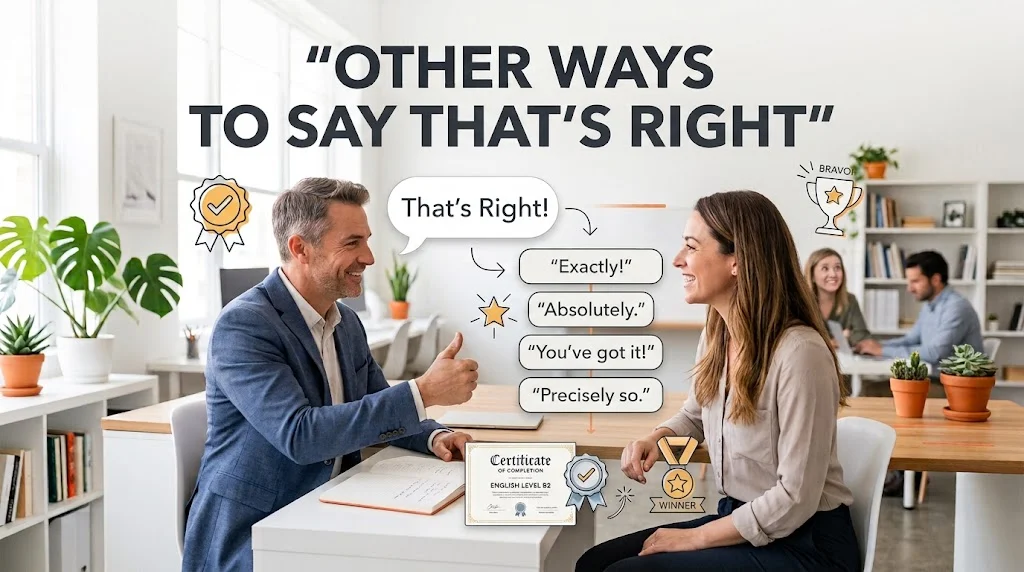
Looking for other ways to say that’s right? Try exactly, that’s correct, you’re absolutely right, I agree with you, or I couldn’t agree more. Choose the phrase based on your tone and situation.
5 best alternatives: Exactly, That’s correct, You’re absolutely right, I agree with you, I couldn’t agree more.
“That’s right” is a common English expression used to confirm that something is correct or agree with what someone has said. It works well in everyday conversations, meetings, explanations, and many professional situations.
However, using the same phrase repeatedly can make your English sound limited. Learning alternatives to “that’s right” gives you more control over tone, especially in business communication, academic discussions, emails, and fluent spoken English.
Knowing other ways to say that’s right also helps you sound more precise. Some expressions are formal and professional, while others are warmer, stronger, or more casual.
Formal Alternatives
- That is correct.
- That is accurate.
- I concur.
- Your assessment is correct.
Pro Tip
Use formal alternatives when accuracy matters, such as academic discussions, professional explanations, reports, or formal correspondence.
“Good English is not just about knowing more words; it is about choosing the right words for the situation.”
Professional Alternatives
- That’s correct.
- I agree with your assessment.
- You’re absolutely right.
- That aligns with my understanding.
Pro Tip
In workplace communication, choose expressions that confirm the other person without sounding unnecessarily dramatic or overly formal.
Business Email Alternatives
- That is correct.
- I can confirm that.
- That matches our records.
- I agree with your understanding.
Pro Tip
For business emails, phrases such as “I can confirm that” are useful when you are validating information rather than simply expressing agreement.
Academic Alternatives
- That is correct.
- That interpretation is accurate.
- I agree with this point.
- That observation is valid.
Pro Tip
Academic English often benefits from precise language. “That observation is valid” can be more useful than a conversational “That’s right” when discussing an argument or interpretation.
Casual Alternatives
- Exactly.
- Absolutely.
- You’re right.
- Definitely.
Pro Tip
These expressions work naturally in conversations with friends, classmates, and familiar colleagues. “Exactly” is especially common when you strongly identify with someone’s point.
Informal Expressions
- Yep, that’s it.
- You got it.
- That’s exactly it.
- For sure.
Pro Tip
These expressions are conversational and friendly. Avoid them in formal reports, academic essays, or highly formal business correspondence.
“The strongest alternative is not always the most formal one it is the one that fits the context.”
Common Mistakes
1. Using “You got it” in formal writing
Why it can be a problem: It is conversational and may sound too casual in professional documents.
Correct version: “That is correct.”
Example:
“Your interpretation is correct, and the figures support that conclusion.”
2. Assuming “I concur” sounds natural everywhere
Why it can be a problem: “I concur” is grammatically correct but more formal than ordinary conversation.
Correct version: Use “I agree” or “Exactly” in everyday situations.
Example:
“I agree with your recommendation.”
3. Using “Absolutely” when you only partly agree
Why it can be a problem: “Absolutely” can communicate strong agreement.
Correct version: “I agree with that point.”
Example:
“I agree with that point, although I see another issue.”
4. Confusing confirmation with agreement
Why it can be a problem: “That’s correct” usually confirms information, while “I agree” expresses agreement with an opinion or proposal.
Correct version: Choose the expression based on what you are responding to.
Example:
“That’s correct the meeting starts at nine.”
5. Overusing “That’s right”
Why it can be a problem: Repetition can make conversations and writing sound less varied.
Correct version: Alternate naturally between “Exactly,” “That’s correct,” “I agree,” and other suitable expressions.
Example:
“That’s correct. I agree with your second point as well.”
What Does “Other Ways to Say That’s Right” Mean?
The phrase “that’s right” can serve two closely related purposes.
First, it can confirm information:
“The deadline is Friday.”
“That’s right.”
Second, it can show agreement:
“We should contact the client before making the change.”
“That’s right.”
The best alternative depends on which meaning you intend. “That’s correct” focuses on accuracy, while “I agree” focuses on agreement.
When to Use “That’s Right”
“That’s right” is flexible and works in many contexts:
- Business meetings: Confirming information or agreeing with a colleague.
- Academic discussions: Confirming a factual point in conversation.
- Emails: Possible in friendly professional correspondence.
- Daily conversation: Very natural.
- Spoken English: Extremely common.
- Written English: Acceptable, but context matters.
- Formal communication: “That is correct” may sound more appropriate.
- Informal conversations: “Exactly” or “Absolutely” may sound more conversational.
The expression is particularly useful when someone expects a simple confirmation.
Is “That’s Right” Professional or Polite?
Polite? ✔ Yes
Professional? ✔ Usually
Formal? Sometimes
Natural? ✔ Yes
“That’s right” is generally professional enough for ordinary workplace conversations. However, formal documents and carefully written business correspondence may benefit from more precise wording.
Business-style example:
“That’s correct. The revised proposal was sent yesterday.”
This sounds professional because the phrase directly confirms information.
Pros and Cons
Pros
- Easy to understand
- Very common in spoken English
- Natural for confirmation
- Works in professional conversations
- Friendly without being overly casual
- Useful for quick responses
Cons
- Can become repetitive
- Does not always express strong agreement
- May be too conversational for formal writing
- Can sound vague when precise confirmation is needed
- Does not explain why you agree
Choosing Better Alternatives
Learning synonyms is most useful when you understand their differences. “Exactly” can emphasize agreement, “that’s correct” can confirm accuracy, and “I agree with your assessment” can sound more professional.
The following alternatives will help you vary your English without changing the intended meaning.
Expert Tip
Native speakers often choose expressions according to formality, relationship, and purpose. In a meeting, “Exactly” may sound natural; in a formal email, “I can confirm that” may be more suitable.
Other Ways to Say “That’s Right” With Examples
These 15 alternatives cover formal, professional, academic, neutral, casual, and informal English.
1. Phrase: That’s Correct
Meaning: This confirms that something someone said is accurate.
Explanation: “That’s correct” is one of the safest professional alternatives. It is neutral, clear, and suitable when confirming facts or information.
Example Sentence:
“That’s correct; the updated contract was approved yesterday.”
Best Use: Business Communication
Avoid Using In: Highly Casual Chat
Tone: Professional, Clear
Formality Level: ⭐⭐⭐⭐ Formal
Usage Frequency: Very Common
CEFR Level: B1
Common Collocations:
- that’s correct
- absolutely correct
- factually correct
- correct information
Context Variability:
- Spoken: “That’s correct.”
- Professional: “That’s correct, and I can confirm the date.”
- Casual: “Yep, that’s correct.”
2. Phrase: Exactly
Meaning: This strongly confirms that someone’s statement matches your understanding.
Explanation: “Exactly” is extremely natural in modern spoken English. It often means “You expressed exactly what I mean.”
Example Sentence:
“Exactly. That is the main issue we need to address.”
Best Use: Daily Conversation
Avoid Using In: Formal Reports
Tone: Natural, Confident
Formality Level: ⭐⭐⭐ Neutral
Usage Frequency: Very Common
CEFR Level: B1
Common Collocations:
- exactly right
- exactly what I mean
- exactly the point
- that’s exactly it
Context Variability:
- Spoken: “Exactly!”
- Professional: “Exactly. That is consistent with our findings.”
- Casual: “Exactly that’s what I was thinking.”
3. Phrase: You’re Absolutely Right
Meaning: This expresses strong agreement with another person.
Explanation: This phrase is warmer and stronger than simply saying “That’s right.” It works well when you want to clearly validate someone’s point.
Example Sentence:
“You’re absolutely right; we should check the figures before publishing them.”
Best Use: Workplace Meeting
Avoid Using In: Neutral Fact Confirmation
Tone: Warm, Strong
Formality Level: ⭐⭐⭐ Neutral
Usage Frequency: Very Common
CEFR Level: B1
Common Collocations:
- absolutely right
- completely right
- right about that
- you’re right
Context Variability:
- Spoken: “You’re absolutely right.”
- Professional: “You’re absolutely right about the timing.”
- Casual: “You’re absolutely right!”
4. Phrase: I Agree With You
Meaning: This directly states that you share another person’s opinion.
Explanation: Use this when the speaker has expressed an opinion, recommendation, or argument. It is more clearly about agreement than factual confirmation.
Example Sentence:
“I agree with you that the proposal needs more detail.”
Best Use: Workplace Discussion
Avoid Using In: Simple Fact Checks
Tone: Direct, Polite
Formality Level: ⭐⭐⭐ Neutral
Usage Frequency: Very Common
CEFR Level: B1
Common Collocations:
- agree with you
- agree completely
- agree on this point
- agree with the suggestion
Context Variability:
- Spoken: “I agree with you.”
- Professional: “I agree with you on that point.”
- Casual: “Yeah, I agree with you.”
5. Phrase: That Is Accurate
Meaning: This confirms that information or a description is factually accurate.
Explanation: “That is accurate” sounds more precise than “That’s right.” It is useful in professional and academic settings.
Example Sentence:
“That is accurate, although the final figure has changed slightly.”
Best Use: Formal Discussion
Avoid Using In: Friendly Chat
Tone: Precise, Professional
Formality Level: ⭐⭐⭐⭐ Formal
Usage Frequency: Common
CEFR Level: B2
Common Collocations:
- accurate information
- factually accurate
- accurate description
- accurate assessment
Context Variability:
- Spoken: “Yes, that is accurate.”
- Professional: “That is accurate according to our records.”
- Casual: “That sounds accurate.”
Native Speaker Tip
“Exactly” and “You’re absolutely right” are among the most natural choices in conversation. “That is accurate” is more precise and formal, so it is more common when accuracy matters.
“Natural English gives you choices; fluent English helps you know when to use them.”
6. Phrase: I Completely Agree
Meaning: This expresses strong agreement with an opinion or argument.
Explanation: “Completely” makes the agreement stronger than a simple “I agree.” It works well in discussions and professional conversations.
Example Sentence:
“I completely agree that customer feedback should guide the next revision.”
Best Use: Professional Discussion
Avoid Using In: Neutral Confirmation
Tone: Strong, Professional
Formality Level: ⭐⭐⭐ Neutral
Usage Frequency: Common
CEFR Level: B2
Common Collocations:
- completely agree
- completely agree with
- completely agree that
- agree completely
Context Variability:
- Spoken: “I completely agree.”
- Professional: “I completely agree with your recommendation.”
- Casual: “I completely agree with you.”
7. Phrase: I Concur
Meaning: This means that you formally agree with someone.
Explanation: “I concur” is grammatically correct but noticeably formal. It appears more often in formal discussions, official statements, and certain professional contexts than in everyday conversation.
Example Sentence:
“I concur with your assessment of the proposed changes.”
Best Use: Formal Discussion
Avoid Using In: Casual Conversation
Tone: Formal, Respectful
Formality Level: ⭐⭐⭐⭐⭐ Very Formal
Usage Frequency: Occasional
CEFR Level: C1
Common Collocations:
- concur with
- concur with the assessment
- concur with the recommendation
- fully concur
Context Variability:
- Spoken: “I concur.”
- Professional: “I concur with your assessment.”
- Casual: Usually avoid it.
8. Phrase: I Agree With Your Assessment
Meaning: This confirms that you share someone’s evaluation or judgment.
Explanation: This is particularly useful in professional settings where someone has analyzed a situation and offered a conclusion.
Example Sentence:
“I agree with your assessment that the current process needs improvement.”
Best Use: Business Meeting
Avoid Using In: Casual Chat
Tone: Professional, Thoughtful
Formality Level: ⭐⭐⭐⭐ Formal
Usage Frequency: Common
CEFR Level: B2
Common Collocations:
- agree with your assessment
- agree with the analysis
- agree with the evaluation
- assessment is correct
Context Variability:
- Spoken: “I agree with your assessment.”
- Professional: “I agree with your assessment of the project.”
- Casual: “I agree with your take on it.”
9. Phrase: That Aligns With My Understanding
Meaning: This indicates that new information matches what you already understand.
Explanation: This phrase is especially useful in workplace conversations because it confirms information without sounding overly enthusiastic.
Example Sentence:
“That aligns with my understanding of the revised schedule.”
Best Use: Workplace Meeting
Avoid Using In: Friendly Conversation
Tone: Professional, Neutral
Formality Level: ⭐⭐⭐⭐ Formal
Usage Frequency: Common
CEFR Level: C1
Common Collocations:
- aligns with my understanding
- aligns with our goals
- aligns with the findings
- aligns with expectations
Context Variability:
- Spoken: “That aligns with my understanding.”
- Professional: “That aligns with my understanding of the agreement.”
- Casual: “That matches what I understood.”
10. Phrase: I Couldn’t Agree More
Meaning: This expresses very strong agreement.
Explanation: The phrase is an idiomatic way to say that you agree completely. It is natural in conversation and also acceptable in many professional discussions.
Example Sentence:
“I couldn’t agree more; clear communication will make the transition easier.”
Best Use: Strong Agreement
Avoid Using In: Neutral Reports
Tone: Enthusiastic, Confident
Formality Level: ⭐⭐⭐ Neutral
Usage Frequency: Common
CEFR Level: B2
Common Collocations:
- couldn’t agree more
- couldn’t agree with you more
- absolutely agree
- strongly agree
Context Variability:
- Spoken: “I couldn’t agree more.”
- Professional: “I couldn’t agree more with that recommendation.”
- Casual: “Couldn’t agree more!”
Expert Insight
In professional emails, avoid choosing a phrase simply because it sounds sophisticated. “I agree with your assessment” is often more useful than “I concur” because it clearly identifies what you agree with.
11. Phrase: I Can Confirm That
Meaning: This formally confirms that information is true or correct.
Explanation: “I can confirm that” is particularly useful in business emails and professional correspondence. It focuses on verification rather than personal agreement.
Example Sentence:
“I can confirm that your application was received this morning.”
Best Use: Business Email
Avoid Using In: Casual Conversation
Tone: Professional, Clear
Formality Level: ⭐⭐⭐⭐ Formal
Usage Frequency: Very Common
CEFR Level: B2
Common Collocations:
- confirm that
- confirm receipt
- confirm the details
- confirm the date
Context Variability:
- Spoken: “I can confirm that.”
- Professional: “I can confirm that the documents were received.”
- Casual: “Yes, I can confirm that.”
12. Phrase: That’s Exactly It
Meaning: This strongly confirms that someone has identified the correct idea.
Explanation: It is common in spoken English when someone explains something accurately or finds the point you were trying to express.
Example Sentence:
“That’s exactly it the problem is not the price but the timing.”
Best Use: Spoken English
Avoid Using In: Formal Essays
Tone: Natural, Emphatic
Formality Level: ⭐⭐⭐ Neutral
Usage Frequency: Very Common
CEFR Level: B1
Common Collocations:
- exactly it
- that’s exactly it
- exactly what I mean
- exactly the point
Context Variability:
- Spoken: “That’s exactly it.”
- Professional: “That’s exactly it. The timing is the key issue.”
- Casual: “Yes, that’s exactly it!”
13. Phrase: That Observation Is Valid
Meaning: This indicates that another person’s observation has reasonable support or relevance.
Explanation: This phrase works particularly well in academic and analytical discussions. It sounds more measured than “You’re absolutely right.”
Example Sentence:
“That observation is valid, particularly when we consider the second set of results.”
Best Use: Academic Discussion
Avoid Using In: Casual Texting
Tone: Academic, Measured
Formality Level: ⭐⭐⭐⭐ Formal
Usage Frequency: Occasional
CEFR Level: C1
Common Collocations:
- valid observation
- valid point
- valid argument
- observation is valid
Context Variability:
- Spoken: “That observation is valid.”
- Professional: “That is a valid observation.”
- Casual: “That’s a fair point.”
14. Phrase: You Got It
Meaning: This can confirm that someone has understood or identified something correctly.
Explanation: “You got it” is friendly and informal. It is useful when responding to someone who has understood instructions or reached the correct answer.
Example Sentence:
“Which file should I send?”
“The revised version.”
“You got it.”
Best Use: Casual Conversation
Avoid Using In: Formal Emails
Tone: Friendly, Informal
Formality Level: ⭐⭐ Casual
Usage Frequency: Very Common
CEFR Level: B1
Common Collocations:
- you got it
- got it right
- got the idea
- you’ve got it
Context Variability:
- Spoken: “You got it.”
- Professional: Possible in a relaxed workplace.
- Casual: Very natural.
15. Phrase: Absolutely
Meaning: This strongly confirms or agrees with what someone has said.
Explanation: “Absolutely” is short, natural, and flexible. Depending on context, it can express agreement, enthusiastic confirmation, or willingness.
Example Sentence:
“Do you think we should revise the introduction?”
“Absolutely.”
Best Use: Everyday Conversation
Avoid Using In: Technical Confirmation
Tone: Confident, Positive
Formality Level: ⭐⭐⭐ Neutral
Usage Frequency: Very Common
CEFR Level: B1
Common Collocations:
- absolutely agree
- absolutely right
- absolutely correct
- absolutely essential
Context Variability:
- Spoken: “Absolutely.”
- Professional: “Absolutely. I agree with that approach.”
- Casual: “Absolutely!”
Native Speaker Tip
For modern everyday English, “Exactly,” “Absolutely,” “That’s correct,” and “You’re absolutely right” are usually more natural than “I concur.” “I concur” is correct, but it can sound unusually formal in an ordinary conversation.
Avoid These in Formal Situations
Some expressions are perfectly understandable but may sound too casual for formal professional communication.
- “Yep, that’s it.” Better: “That is correct.”
- “You got it.” Better: “I can confirm that.”
- “For sure.” Better: “I agree with that.”
- “Yeah, exactly.” Better: “Exactly” or “That is correct.”
- “Yep, you’re right.” Better: “You’re correct.”
This does not mean the casual expressions are “wrong.” The issue is context. A relaxed team chat has different language expectations from a client email or academic paper.
Best Phrases by Situation
| Situation | Best Phrase |
| Business Email | I can confirm that |
| Client Meeting | That’s correct |
| Academic Essay | That observation is valid |
| Presentation | Exactly |
| Workplace Discussion | I agree with your assessment |
| Job Interview | You’re absolutely right |
| Team Collaboration | I agree with you |
| Everyday Conversation | Exactly |
Top 10 Alternatives Compared
| Phrase | Tone | Formality | Best Use | Frequency |
| That’s correct | Professional | ⭐⭐⭐⭐ | Business | Very Common |
| Exactly | Natural | ⭐⭐⭐ | Conversation | Very Common |
| You’re absolutely right | Warm | ⭐⭐⭐ | Discussion | Very Common |
| I agree with you | Direct | ⭐⭐⭐ | General | Very Common |
| That is accurate | Precise | ⭐⭐⭐⭐ | Formal discussion | Common |
| I completely agree | Strong | ⭐⭐⭐ | Workplace | Common |
| I agree with your assessment | Professional | ⭐⭐⭐⭐ | Business | Common |
| That aligns with my understanding | Professional | ⭐⭐⭐⭐ | Workplace | Common |
| I couldn’t agree more | Emphatic | ⭐⭐⭐ | Discussion | Common |
| I can confirm that | Professional | ⭐⭐⭐⭐ | Very Common |
Which One Should You Use?
Best Overall
That’s correct is a dependable choice when you want to confirm information clearly and professionally.
Best Professional
I agree with your assessment works well when responding to someone’s analysis or judgment.
Best Academic
That observation is valid suits measured academic and analytical discussion.
Best Business Email
I can confirm that is useful when verifying information, dates, documents, or actions.
Best Everyday Conversation
Exactly is short, natural, and extremely common in spoken English.
Most Natural
Exactly often sounds more conversational than a longer formal alternative.
Most Polite
I agree with you is direct without sounding overly strong or dismissive.
Commonly Confused Phrases
“That’s right” vs. “That’s correct”
Both can confirm information. “That’s correct” sounds slightly more professional and precise, while “that’s right” is more conversational.
“I agree” vs. “I completely agree”
“I agree” expresses agreement without emphasizing its strength. “I completely agree” communicates stronger, more definite agreement.
“Exactly” vs. “I agree”
“Exactly” often means “That is precisely what I think” or “You have identified the point.” “I agree” directly states that you share an opinion.
“I concur” vs. “I agree”
Both mean agreement, but “I concur” is substantially more formal. In ordinary modern conversation, “I agree” is usually the more natural choice.
Scenario Practice
1. Business Meeting
A colleague says, “The client needs the revised proposal before Friday.”
Which phrase would you choose?
Answer: “That’s correct.”
It clearly confirms the information without sounding overly formal.
2. Job Interview
The interviewer says, “Good communication is essential when working with customers.”
Which phrase would you choose?
Answer: “I completely agree.”
It expresses clear agreement while remaining professional.
3. Presentation
A colleague summarizes the central point of your presentation exactly as you intended.
Which phrase would you choose?
Answer: “Exactly.”
It is concise and natural in spoken English.
4. Class Discussion
A student makes a thoughtful observation about a text.
Which phrase would you choose?
Answer: “That observation is valid.”
It acknowledges the point in an academic, measured way.
5. Email Reply
A client asks whether you received the requested documents.
Which phrase would you choose?
Answer: “I can confirm that.”
It directly communicates verification and fits professional email language.
Mini Quiz
1. Which phrase is most appropriate for confirming information in a business email?
A. Yep, that’s it.
B. You got it.
C. I can confirm that.
D. For sure.
2. Which expression sounds most natural in casual conversation?
A. I concur.
B. Exactly.
C. That observation is valid.
D. Your assessment is correct.
3. Which phrase expresses very strong agreement?
A. I couldn’t agree more.
B. That is accurate.
C. I can confirm that.
D. That’s correct.
4. Which phrase is most formal?
A. Exactly.
B. You got it.
C. I concur.
D. Absolutely.
5. Which expression is particularly useful for academic discussion?
A. Yep, you’re right.
B. You got it.
C. That observation is valid.
D. For sure.
Answer Key
1. C : I can confirm that. It is professional and verification-focused.
2. B : Exactly. It is highly common and natural in conversation.
3. A : I couldn’t agree more. It expresses very strong agreement.
4. C : I concur. It has a noticeably formal tone.
5. C : That observation is valid. It suits measured academic discussion.
Discussion Question
Which expression do you use most often when you want to say “that’s right,” and which new alternative will you try next?
FAQ
What is the most formal way to say “that’s right”?
“I concur” is one of the most formal alternatives, but it can sound unusually formal in everyday English. For professional communication, “That is correct” or “I agree with your assessment” is often more natural. Choose based on whether you are confirming a fact or agreeing with someone’s opinion.
Which phrase is best for professional emails?
“I can confirm that” is particularly useful for professional emails when you are verifying information, documents, dates, or actions. For opinions, “I agree with your assessment” may be better. “That’s right” is possible in a friendly workplace email, but more precise wording can make formal correspondence clearer.
What is the difference between “That’s right” and “That’s correct”?
Both expressions can confirm that information is accurate. “That’s right” is more conversational and flexible, while “That’s correct” has a slightly more professional and precise tone. In a casual conversation, either can work naturally. In formal communication, “That’s correct” is often the safer choice.
Which alternative sounds most natural?
“Exactly” is one of the most natural alternatives in modern spoken English. Native speakers frequently use it to show that someone has expressed the same idea they have in mind. “Absolutely,” “You’re absolutely right,” and “That’s correct” are also common, depending on whether you want emphasis or simple confirmation.
Can I use these expressions in business meetings?
Yes. Expressions such as “That’s correct,” “Exactly,” “I agree with you,” “I agree with your assessment,” and “I can confirm that” can all work in business meetings. The best choice depends on the situation. Use confirmation phrases for facts and agreement phrases for opinions, recommendations, and proposals.
Call to Action
Which alternative do you use most often? Share your favorite expression and help other English learners discover a more natural way to communicate.
Conclusion
Learning other ways to say “that’s right” gives you more than a longer vocabulary list. It helps you distinguish between confirming a fact, agreeing with an opinion, showing strong support, and responding casually. “Exactly,” “That’s correct,” “I agree with you,” and “I can confirm that” each carry a slightly different purpose and tone.
Practice these expressions in conversations, emails, meetings, presentations, and academic discussions. Start with the phrases that feel natural, then gradually add more precise professional alternatives. With regular practice, choosing the right expression becomes easier and your English becomes more confident, flexible, and natural.
