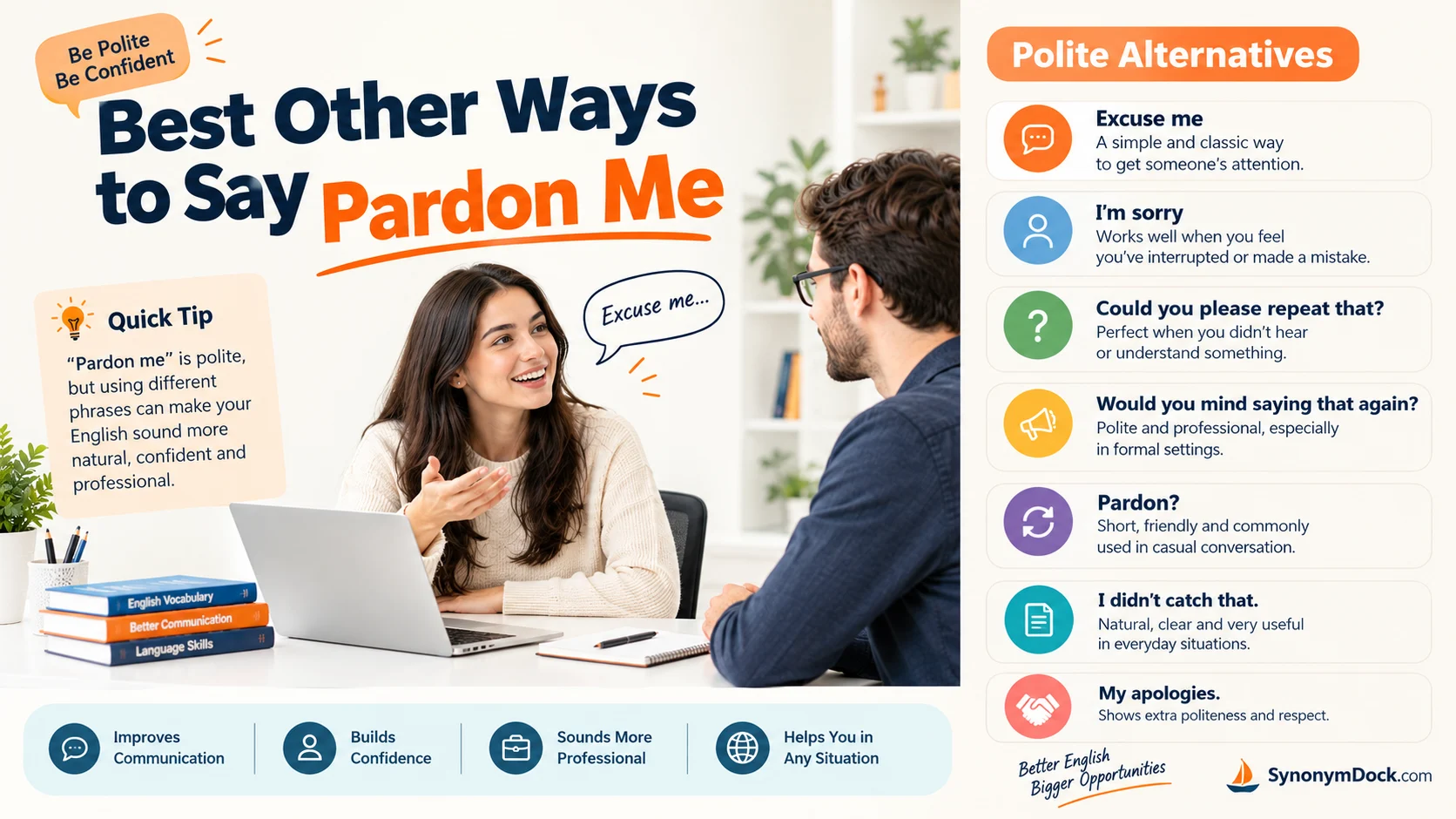
The best other ways to say pardon me include “excuse me,” “sorry,” “could you repeat that?”, “I beg your pardon,” and “would you mind repeating that?” Choose the phrase based on whether you need attention, an apology, an interruption, or clarification.
“Pardon me” is a polite English expression used to get attention, apologize for a small interruption, pass someone, or ask someone to repeat something. However, the best expression depends on the situation.
If you are searching for the best other ways to say pardon me, you need more than a list of synonyms. Some alternatives sound natural in everyday conversation, while others work better in professional meetings, academic settings, or formal communication.
Learning other ways to say pardon me gives you more control over tone. You can sound friendly, professional, respectful, or formal without repeating the same phrase in every conversation.
“Good vocabulary gives you choices; good communication helps you choose the right one.”
Formal Alternatives
- I beg your pardon.
- I apologize.
- I’m sorry to interrupt.
- Would you mind repeating that?
- May I ask you to repeat that?
Pro Tip
Use these expressions when the situation calls for extra politeness or formality. Avoid overly formal wording when a simple “Excuse me” would sound more natural.
Professional Alternatives
- Excuse me.
- Sorry to interrupt.
- Could you repeat that?
- Could you clarify that?
- May I interrupt for a moment?
Pro Tip
In workplace English, clear and courteous language usually works better than complicated wording. Choose the phrase that explains exactly what you need.
Business Email Alternatives
- Could you please clarify?
- Would you mind repeating that?
- I apologize for the interruption.
- May I ask for clarification?
- Sorry for the interruption.
Pro Tip
Email usually benefits from specific wording. Instead of simply writing “pardon me,” explain whether you need clarification, repetition, or an apology.
Academic Alternatives
- Could you clarify your point?
- Could you repeat the question?
- Could you explain that again?
- May I ask for clarification?
- Excuse me, could you repeat that?
Pro Tip
Academic communication rewards precision. If you missed a point, tell the speaker whether you need the statement repeated or explained.
Casual Alternatives
- Sorry?
- Excuse me?
- Could you say that again?
- Sorry, I missed that.
- What was that?
Pro Tip
These work well with friends, classmates, and people in relaxed settings. “What was that?” can sound abrupt if your tone is not friendly.
Informal Expressions
- Huh?
- What?
- Say that again?
- Come again?
- What did you say?
Pro Tip
These expressions are highly dependent on tone. They may sound natural among close friends but can seem blunt with strangers, teachers, clients, or coworkers.
“The most natural phrase is often the simplest one.”
COMMON MISTAKES
1. Using “pardon me” for everything
Why it is a problem: “Pardon me” has several uses, but English has more precise alternatives.
Better: Use “Excuse me” for attention and “Could you repeat that?” when you missed information.
Example: “Excuse me, could you tell me where the reception desk is?”
2. Saying “What?” to a professional
Why it is a problem: It can sound abrupt.
Better: “Could you repeat that, please?”
Example: “Could you repeat the final point, please?”
3. Using “I beg your pardon” casually
Why it is a problem: It can sound unusually formal or traditional in ordinary conversation.
Better: “Sorry?” or “Excuse me?”
Example: “Sorry, could you say that again?”
4. Treating “excuse me” as only an apology
Why it is a problem: “Excuse me” commonly gets attention or introduces an interruption.
Better: Use “I’m sorry” or “I apologize” when an actual apology is needed.
Example: “I apologize for interrupting the meeting.”
5. Ignoring tone
Why it is a problem: Even a polite expression can sound unfriendly when delivered sharply.
Better: Use a calm voice and add “please” when appropriate.
Example: “Pardon me, could you repeat that, please?”
WHAT DOES “BEST OTHER WAYS TO SAY PARDON ME” MEAN?
The phrase “best other ways to say pardon me” means alternative expressions that can replace “pardon me” in different situations.
“Pardon me” itself is correct English. It can be used when getting attention, interrupting, asking for repetition, or moving past someone.
Example: “Pardon me, could you tell me which platform the train leaves from?”
The important point is that there is no single perfect replacement. “Excuse me” often works for attention, while “Could you repeat that?” is more precise when you did not hear someone.
WHEN TO USE “PARDON ME”
You can use “pardon me” in several situations:
- Getting attention: “Pardon me, is this seat available?”
- Asking for repetition: “Pardon me? I didn’t hear that.”
- Interrupting: “Pardon me, may I add something?”
- Passing someone: “Pardon me, could I get through?”
- Correcting politely: “Pardon me, but I believe this is my seat.”
Business
“Pardon me” is acceptable in professional conversation, although “Excuse me” often sounds more natural.
Academic
It can be used when asking a lecturer or classmate to repeat something.
Emails
It is less common in professional email. “Could you please clarify?” is usually more precise.
Meetings
Use “Sorry to interrupt” or “May I interrupt for a moment?” when you want to speak.
Daily Conversation
“Excuse me,” “Sorry?” and “Could you say that again?” are highly natural choices.
Spoken English
Short expressions are often easier to use naturally.
Written English
Specific wording is usually better because the reader cannot hear your tone.
IS IT PROFESSIONAL OR POLITE?
Polite? ✔ Yes
Professional? ✔ Yes, depending on context
Formal? ✔ Moderately formal
Natural? ✔ Yes
“Pardon me” is polite, but it is not automatically more professional than “Excuse me.”
For example:
“Pardon me, could I add one point?”
This is polite and professional. However:
“May I add one point?”
is more direct and meeting-focused.
PROS AND CONS
Pros
- Polite and respectful
- Easy to understand
- Useful in several situations
- Can soften an interruption
- Suitable for spoken communication
Cons
- May sound more formal than necessary
- Can be less specific than alternatives
- “I beg your pardon” may sound traditional
- “Pardon?” can sound sharp with the wrong tone
- Not always ideal for professional email
TRANSITION TO THE MAIN LIST
The best alternative depends on what you are trying to communicate. Asking for attention, apologizing, interrupting, and requesting repetition are different communication goals.
The following 15 alternatives show how native English speakers can express these ideas naturally and appropriately.
EXPERT TIP
Expert Tip: Identify your purpose first. Do you need attention, repetition, clarification, permission to interrupt, or an apology? Once you know the purpose, choosing the right expression becomes much easier.
AVOID THESE EXPRESSIONS IN FORMAL SITUATIONS
| Expression | Problem | Better Alternative |
| Huh? | Very casual | Could you repeat that? |
| What? | Can sound blunt | Could you say that again? |
| Say what? | Very informal | I’m sorry, could you repeat that? |
| Come again? | Casual | Would you mind repeating that? |
| What did you say? | Can sound demanding | Could you clarify that, please? |
BEST PHRASES BY SITUATION
| Situation | Best Phrase |
| Business Email | Could you please clarify? |
| Client Meeting | Could you clarify that? |
| Academic Discussion | Could you repeat the question? |
| Presentation | Sorry to interrupt. |
| Workplace Discussion | May I interrupt for a moment? |
| Job Interview | I’m sorry, could you repeat the question? |
| Team Collaboration | Could you say that again? |
| Everyday Conversation | Excuse me? |
OTHER WAYS TO SAY “PARDON ME” (WITH EXAMPLES)
These alternatives can help you sound more fluent while choosing language that fits the situation. Some are neutral and conversational, while others are more formal or professional.
Remember that the “best” phrase depends on your purpose, audience, and relationship with the listener.
1. Phrase: Excuse Me
Meaning: A polite expression for getting attention, interrupting briefly, or asking for clarification.
Explanation: “Excuse me” is one of the most versatile alternatives to “pardon me.” It is natural in shops, offices, classrooms, public places, and everyday conversations.
Example Sentence: “Excuse me, could you point me toward the customer service desk?”
Best Use: Everyday Communication
Avoid Using In: Formal Essays
Tone: Polite, Neutral
Formality Level: ⭐⭐⭐ Neutral
Usage Frequency: Very Common
CEFR Level: B1
Common Collocations:
- excuse me
- excuse me, please
- excuse me for interrupting
- excuse me, could you
- excuse me, may I
Context Variability:
- Spoken: “Excuse me, did you drop this?”
- Professional: “Excuse me, could I ask a quick question?”
- Casual: “Excuse me, is anyone sitting here?”
2. Phrase: Sorry
Meaning: A short expression used for a minor apology or request for repetition.
Explanation: “Sorry” is extremely common in spoken English. With rising intonation, it can function as a polite request for someone to repeat what they said.
Example Sentence: “Sorry, I didn’t catch the last part of your explanation.”
Best Use: Spoken English
Avoid Using In: Formal Apology Letters
Tone: Friendly, Natural
Formality Level: ⭐⭐⭐ Neutral
Usage Frequency: Very Common
CEFR Level: A1
Common Collocations:
- sorry about that
- sorry for interrupting
- sorry, I missed that
- sorry, could you repeat that?
- really sorry
Context Variability:
- Spoken: “Sorry, what did you say?”
- Professional: “Sorry, could you repeat the figure?”
- Casual: “Sorry, I was distracted.”
3. Phrase: Could You Repeat That?
Meaning: A clear request asking someone to say something again.
Explanation: This is more specific than “pardon me.” It works particularly well in meetings, classrooms, interviews, phone calls, and presentations.
Example Sentence: “Could you repeat that? The connection broke up for a moment.”
Best Use: Meetings and Calls
Avoid Using In: Formal Essays
Tone: Clear, Polite
Formality Level: ⭐⭐⭐ Neutral
Usage Frequency: Very Common
CEFR Level: B1
Common Collocations:
- repeat that
- repeat the question
- repeat the last point
- repeat the instructions
- repeat the number
Context Variability:
- Spoken: “Could you repeat that, please?”
- Professional: “Could you repeat the deadline?”
- Casual: “Could you repeat that? I was looking away.”
4. Phrase: Could You Say That Again?
Meaning: A friendly request for someone to repeat their words.
Explanation: This sounds natural and conversational. It is slightly more relaxed than “Would you mind repeating that?” and works with colleagues, classmates, friends, and strangers.
Example Sentence: “Could you say that again? I want to make sure I understood you correctly.”
Best Use: Everyday Conversation
Avoid Using In: Highly Formal Letters
Tone: Friendly, Polite
Formality Level: ⭐⭐⭐ Neutral
Usage Frequency: Very Common
CEFR Level: A2
Common Collocations:
- say that again
- say it again
- say the name again
- say the question again
- say that more slowly
Context Variability:
- Spoken: “Could you say that again, please?”
- Professional: “Could you say that again so I can note it down?”
- Casual: “Could you say that again? I missed the joke.”
5. Phrase: Would You Mind Repeating That?
Meaning: A polite and somewhat formal request for repetition.
Explanation: This expression sounds considerate and works particularly well in professional conversations. It is more formal than “Sorry?” but still natural.
Example Sentence: “Would you mind repeating that last instruction?”
Best Use: Professional Conversation
Avoid Using In: Very Casual Chat
Tone: Respectful, Polite
Formality Level: ⭐⭐⭐⭐ Formal
Usage Frequency: Common
CEFR Level: B2
Common Collocations:
- mind repeating that
- mind explaining
- mind clarifying
- mind saying it again
- mind going over it
Context Variability:
- Spoken: “Would you mind repeating that?”
- Professional: “Would you mind repeating the client’s name?”
- Casual: “Would you mind repeating that? I wasn’t listening.”
Native Speaker Tip
“Excuse me,” “Sorry,” and “Could you repeat that?” are especially natural in modern spoken English. “Would you mind repeating that?” sounds more deliberately polite. “I beg your pardon” is more formal and traditional.
6. Phrase: I Beg Your Pardon
Meaning: A formal expression used to request repetition or express an emphatic response.
Explanation: This expression is correct but more formal than most everyday alternatives. Depending on tone, it can sometimes sound traditional or even confrontational.
Example Sentence: “I beg your pardon, could you clarify what you meant?”
Best Use: Formal Conversation
Avoid Using In: Relaxed Small Talk
Tone: Formal, Respectful
Formality Level: ⭐⭐⭐⭐⭐ Very Formal
Usage Frequency: Occasional
CEFR Level: C1
Common Collocations:
- beg your pardon
- I beg your pardon?
- I beg your pardon, but
- beg your forgiveness
Context Variability:
- Spoken: “I beg your pardon? I didn’t hear you.”
- Professional: “I beg your pardon, but could you explain that point?”
- Casual: Usually replaced by “Sorry?”
7. Phrase: I’m Sorry, Could You Repeat That?
Meaning: A polite apology followed by a direct request for repetition.
Explanation: This is useful when you did not hear someone clearly. “I’m sorry” softens the request without making it excessively formal.
Example Sentence: “I’m sorry, could you repeat that? I want to record the correct amount.”
Best Use: Professional Meetings
Avoid Using In: Quick Informal Replies
Tone: Polite, Considerate
Formality Level: ⭐⭐⭐⭐ Formal
Usage Frequency: Common
CEFR Level: B1
Common Collocations:
- I’m sorry
- repeat that
- repeat the question
- repeat the amount
- repeat the instructions
Context Variability:
- Spoken: “I’m sorry, could you repeat that?”
- Professional: “I’m sorry, could you repeat the project code?”
- Casual: “I’m sorry, I didn’t hear you.”
8. Phrase: Sorry to Interrupt
Meaning: A polite phrase used before speaking while someone else is talking.
Explanation: This is better than “pardon me” when your purpose is to interrupt. It acknowledges the other speaker and makes your intention clear.
Example Sentence: “Sorry to interrupt, but I have one detail to add.”
Best Use: Workplace Meetings
Avoid Using In: Asking Repetition
Tone: Respectful, Professional
Formality Level: ⭐⭐⭐⭐ Formal
Usage Frequency: Common
CEFR Level: B1
Common Collocations:
- sorry to interrupt
- interrupt briefly
- interrupt you
- interrupt the discussion
- interrupt for a moment
Context Variability:
- Spoken: “Sorry to interrupt, but your phone is ringing.”
- Professional: “Sorry to interrupt, but the client has joined the call.”
- Casual: “Sorry to interrupt, but I think you left your keys outside.”
9. Phrase: May I Interrupt for a Moment?
Meaning: A formal and courteous request for permission to speak.
Explanation: This works well in meetings, presentations, interviews, and formal discussions. It is more formal than “Can I jump in?”
Example Sentence: “May I interrupt for a moment to clarify one point?”
Best Use: Formal Meetings
Avoid Using In: Casual Chats
Tone: Formal, Respectful
Formality Level: ⭐⭐⭐⭐⭐ Very Formal
Usage Frequency: Common
CEFR Level: B2
Common Collocations:
- may I interrupt
- interrupt for a moment
- interrupt briefly
- interrupt the discussion
- interrupt to clarify
Context Variability:
- Spoken: “May I interrupt for a moment?”
- Professional: “May I interrupt to clarify the timeline?”
- Casual: “Can I jump in?” is usually more natural.
10. Phrase: Could You Clarify That?
Meaning: A polite request asking someone to explain an unclear point.
Explanation: This is not a direct replacement for every use of “pardon me,” but it is ideal when you heard the words yet did not understand their meaning.
Example Sentence: “Could you clarify that section of the proposal?”
Best Use: Workplace Discussion
Avoid Using In: Simple Greetings
Tone: Professional, Clear
Formality Level: ⭐⭐⭐⭐ Formal
Usage Frequency: Very Common
CEFR Level: B2
Common Collocations:
- clarify that
- clarify the point
- clarify the issue
- clarify the requirement
- clarify the meaning
Context Variability:
- Spoken: “Could you clarify that?”
- Professional: “Could you clarify the client’s requirement?”
- Casual: “Could you clarify what you mean?”
Expert Insight
In workplace English, specificity often sounds more professional than repeatedly saying “pardon me.” Use repeat when you did not hear the words and clarify when you heard them but need more explanation.
11. Phrase: Excuse Me, Could You Repeat That?
Meaning: A polite attention-getter combined with a clear request for repetition.
Explanation: This combination is useful because it establishes courtesy and immediately explains what you need.
Example Sentence: “Excuse me, could you repeat the room number?”
Best Use: Public or Workplace
Avoid Using In: Formal Essays
Tone: Polite, Clear
Formality Level: ⭐⭐⭐ Neutral
Usage Frequency: Very Common
CEFR Level: B1
Common Collocations:
- excuse me
- repeat that
- repeat the number
- repeat the name
- repeat the question
Context Variability:
- Spoken: “Excuse me, could you repeat that?”
- Professional: “Excuse me, could you repeat the final figure?”
- Casual: “Excuse me, could you repeat the address?”
12. Phrase: May I Ask You to Repeat That?
Meaning: A courteous and moderately formal request for repetition.
Explanation: This construction sounds careful and respectful. It is useful when “Sorry?” feels too informal.
Example Sentence: “May I ask you to repeat that last sentence?”
Best Use: Formal Discussion
Avoid Using In: Friendly Small Talk
Tone: Courteous, Formal
Formality Level: ⭐⭐⭐⭐ Formal
Usage Frequency: Occasional
CEFR Level: B2
Common Collocations:
- ask you to repeat
- repeat that
- repeat the sentence
- repeat the question
- repeat the information
Context Variability:
- Spoken: “May I ask you to repeat that?”
- Professional: “May I ask you to repeat the proposed date?”
- Casual: “Could you say that again?” is usually more natural.
13. Phrase: I Didn’t Catch That
Meaning: A conversational way to say that you did not hear or understand something.
Explanation: Here, “catch” means hear or understand successfully. This phrase is common in spoken English and can be softened with a follow-up request.
Example Sentence: “I didn’t catch that could you give me the address again?”
Best Use: Spoken Conversation
Avoid Using In: Formal Writing
Tone: Natural, Friendly
Formality Level: ⭐⭐⭐ Neutral
Usage Frequency: Common
CEFR Level: B2
Common Collocations:
- didn’t catch that
- catch the name
- catch the number
- catch the last part
- catch what you said
Context Variability:
- Spoken: “Sorry, I didn’t catch that.”
- Professional: “I didn’t catch the final deadline.”
- Casual: “I didn’t catch your name.”
14. Phrase: I Apologize for the Interruption
Meaning: A formal apology for interrupting someone.
Explanation: This is appropriate when an interruption genuinely requires an apology. It sounds more formal than “Sorry to interrupt.”
Example Sentence: “I apologize for the interruption, but we need to address an urgent issue.”
Best Use: Formal Workplace
Avoid Using In: Casual Conversation
Tone: Formal, Respectful
Formality Level: ⭐⭐⭐⭐⭐ Very Formal
Usage Frequency: Common
CEFR Level: B2
Common Collocations:
- apologize for the interruption
- apologize for interrupting
- apologize for the delay
- apologize for the inconvenience
- sincerely apologize
Context Variability:
- Spoken: “I apologize for interrupting.”
- Professional: “I apologize for the interruption; there is an urgent update.”
- Casual: “Sorry for interrupting” is more natural.
15. Phrase: Could I Get Your Attention for a Moment?
Meaning: A polite request asking a group to focus on you briefly.
Explanation: This is useful when speaking to several people. It is more specific than “pardon me” and works well in classrooms, presentations, and meetings.
Example Sentence: “Could I get your attention for a moment while I explain the next step?”
Best Use: Group Communication
Avoid Using In: Personal Apology
Tone: Professional, Polite
Formality Level: ⭐⭐⭐⭐ Formal
Usage Frequency: Common
CEFR Level: B2
Common Collocations:
- get your attention
- get everyone’s attention
- attention for a moment
- draw attention to
- ask for attention
Context Variability:
- Spoken: “Could I get your attention for a moment?”
- Professional: “Could I get your attention while I outline the revised schedule?”
- Casual: “Can I get your attention for a second?”
NATIVE SPEAKER TIP
Modern English usually favors short, specific expressions. “Excuse me” works for attention, “Could you repeat that?” handles missed information, and “Sorry to interrupt” works when entering someone’s turn.
“I beg your pardon” is still correct, but it is more formal and traditional than most everyday alternatives.
TOP 10 ALTERNATIVES COMPARED
| Phrase | Tone | Formality | Best Use | Frequency |
| Excuse me | Polite, Neutral | ⭐⭐⭐ | Everyday communication | Very Common |
| Sorry | Friendly, Natural | ⭐⭐⭐ | Spoken English | Very Common |
| Could you repeat that? | Clear, Polite | ⭐⭐⭐ | Meetings and calls | Very Common |
| Could you say that again? | Friendly, Polite | ⭐⭐⭐ | Conversation | Very Common |
| Would you mind repeating that? | Respectful | ⭐⭐⭐⭐ | Professional settings | Common |
| I beg your pardon | Formal | ⭐⭐⭐⭐⭐ | Formal conversation | Occasional |
| Sorry to interrupt | Professional | ⭐⭐⭐⭐ | Meetings | Common |
| May I interrupt for a moment? | Formal | ⭐⭐⭐⭐⭐ | Formal meetings | Common |
| Could you clarify that? | Professional | ⭐⭐⭐⭐ | Workplace discussion | Very Common |
| I didn’t catch that | Natural | ⭐⭐⭐ | Spoken English | Common |
WHICH ONE SHOULD YOU USE?
Best Overall
Excuse me is the most versatile choice for getting attention, approaching someone, or making a brief polite interruption.
Best Professional
Could you clarify that? works particularly well when you need an explanation in workplace communication.
Best Academic
Could you repeat the question? is clear and appropriate when you missed something during a class or discussion.
Best Business Email
Could you please clarify? is concise, professional, and specific.
Best Everyday Conversation
Could you say that again? sounds natural and friendly.
Most Natural
Excuse me is one of the most broadly useful alternatives.
Most Polite
Would you mind repeating that? makes a considerate request without sounding excessively formal.
COMMONLY CONFUSED PHRASES
“Excuse me” vs. “Sorry”
“Excuse me” commonly gets attention or introduces an interruption. “Sorry” more directly expresses an apology or signals that you did not hear something.
Excuse me: “Excuse me, is this your seat?”
Sorry: “Sorry, could you repeat that?”
“Pardon me” vs. “I beg your pardon”
“Pardon me” is polite and moderately formal. “I beg your pardon” is considerably more formal and can sometimes sound emphatic.
“Could you repeat that?” vs. “Could you clarify that?”
Use repeat when you did not hear the words. Use clarify when you heard the words but their meaning is unclear.
“Sorry to interrupt” vs. “May I interrupt?”
“Sorry to interrupt” acknowledges the interruption. “May I interrupt?” asks for permission before speaking.
SCENARIO PRACTICE
1. Business Meeting
You cannot hear the project deadline.
Which phrase would you choose?
Answer: “Could you repeat the deadline, please?”
It clearly identifies the missing information and sounds professional.
2. Job Interview
You miss part of the interviewer’s question.
Which phrase would you choose?
Answer: “I’m sorry, could you repeat the question?”
It is respectful and appropriate for a formal professional situation.
3. Presentation
You understand the words but not the speaker’s meaning.
Which phrase would you choose?
Answer: “Could you clarify that point?”
“Clarify” is better because you need an explanation, not simply repetition.
4. Class Discussion
Your teacher gives an instruction you did not hear.
Which phrase would you choose?
Answer: “Could you say that again, please?”
It sounds natural and respectful in an academic setting.
5. Email Reply
A client gives an unclear requirement.
Which phrase would you choose?
Answer: “Could you please clarify the requirement?”
This is specific and professional for written communication.
MINI QUIZ
1. You need to get a stranger’s attention politely.
A. Huh?
B. Excuse me.
C. What?
D. Say what?
Answer: B
2. You heard the speaker but do not understand the meaning.
A. Could you repeat that?
B. Could you clarify that?
C. Huh?
D. What did you say?
Answer: B
3. You need to interrupt a formal meeting.
A. What?
B. Come again?
C. May I interrupt for a moment?
D. Huh?
Answer: C
4. Which phrase is most casual?
A. I apologize for the interruption.
B. May I interrupt for a moment?
C. Sorry?
D. May I ask you to repeat that?
Answer: C
5. Which phrase suits a professional email?
A. Huh?
B. Say what?
C. Could you please clarify?
D. What?
Answer: C
Answer Key
- B “Excuse me” is a standard polite attention-getter.
- B “Clarify” asks for an explanation.
- C It is respectful and formal.
- C “Sorry?” is common in relaxed spoken English.
- C It is concise and professional.
FAQs
What are the best other ways to say pardon me?
The best alternatives depend on your purpose. Use “excuse me” to get attention, “sorry” for a minor apology, “could you repeat that?” when you did not hear someone, and “could you clarify that?” when the meaning is unclear. For formal situations, “I beg your pardon” can also work.
Which phrase is best for professional emails instead of “pardon me”?
In professional emails, a specific request usually sounds better than “pardon me.” Try “Could you please clarify?” when you need an explanation or “Would you mind repeating that?” when information was missed. If an interruption caused inconvenience, “I apologize for the interruption” may be more suitable.
Is “I beg your pardon” more polite than “excuse me”?
“I beg your pardon” is more formal, but greater formality does not automatically mean greater politeness. “Excuse me” is generally more natural in everyday English and remains courteous. “I beg your pardon” can sound traditional or emphatic, so use it when its formal tone fits the situation.
What is the difference between “pardon me” and “excuse me”?
Both expressions can politely get attention, introduce an interruption, or help you move past someone. “Excuse me” is generally more common in modern everyday speech. “Pardon me” can sound slightly more formal or traditional. When asking someone to repeat information, “Could you repeat that?” is often clearer.
Can I use “pardon me” in business meetings?
Yes. “Pardon me” is acceptable when you need to interrupt politely or ask someone to repeat something. However, modern business communication often favors specific expressions such as “Sorry to interrupt,” “Could you repeat that?” or “Could you clarify that point?” These phrases make your purpose immediately clear.
CONCLUSION
Knowing the best other ways to say pardon me helps you communicate with greater precision and confidence. “Excuse me” is versatile, “sorry” is natural in conversation, and “could you repeat that?” clearly handles missed information. More formal choices, such as “I beg your pardon,” can work when the setting calls for them. The key is to match your expression with your purpose, audience, and level of formality.
Practice these alternatives in everyday conversations, business emails, meetings, presentations, and classroom discussions. Instead of relying on one phrase every time, identify what you need to communicate first. With regular practice, your English can become more natural, flexible, and confident.
