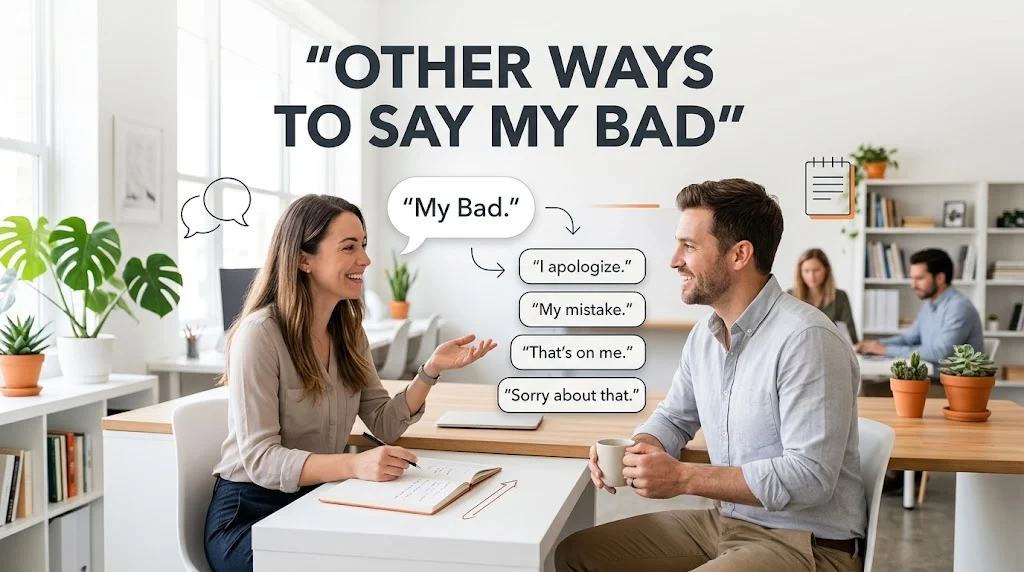
Other ways to say “my bad” include “I’m sorry,” “My mistake,” “I apologize,” “That was my fault,” and “I take responsibility.” Choose based on how formal, professional, or casual the situation is.
5 best alternatives: My mistake, I’m sorry, I apologize, That was my fault, I take responsibility.
“My bad” is a common informal way to admit a mistake, accept responsibility, or apologize for a small error. It is natural in casual conversations, texts, and friendly workplace interactions, but it can sound too relaxed in formal situations.
Learning alternatives to “my bad” gives you more control over your tone. Knowing other ways to say “my bad” can help you sound more fluent in conversations, emails, meetings, academic settings, and professional communication.
The best phrase depends on the situation. A quick “My mistake” may work with a colleague, while “I apologize for the error” is more appropriate in a professional email.
Quick Categories
Formal Alternatives
- I apologize.
- Please accept my apologies.
- I sincerely apologize.
- I take full responsibility.
- I regret the mistake.
Pro Tip
Use formal alternatives when the mistake affects a client, supervisor, academic submission, or official communication. Avoid sounding overly dramatic when the error is very minor.
Professional Alternatives
- My mistake.
- I apologize for the error.
- That was my oversight.
- I take responsibility for that.
- I’ll correct it immediately.
Pro Tip
In workplace communication, briefly acknowledge the mistake and, when useful, explain what you will do to fix it.
Business Email Alternatives
- I apologize for the oversight.
- Please accept my apologies.
- I’m sorry for the confusion.
- I apologize for the delay.
- Thank you for your understanding.
Pro Tip
Business emails usually benefit from a specific apology rather than the very casual “my bad.” Mentioning the problem makes your message clearer.
Academic Alternatives
- I apologize for the error.
- I acknowledge my mistake.
- I regret the oversight.
- I take responsibility for the error.
- I’m sorry for the misunderstanding.
Pro Tip
Academic writing normally favors precise, neutral language. “My bad” is better reserved for informal discussion with classmates or friends.
Casual Alternatives
- My mistake.
- Sorry about that.
- My fault.
- Oops, sorry.
- I messed up.
Pro Tip
These expressions work well with friends, family, classmates, and people you know well. Choose the level of apology according to how serious the mistake is.
Informal Expressions
- My bad.
- Oops!
- Whoops, my fault.
- Sorry!
- That’s on me.
Pro Tip
Informal expressions are conversational rather than formal. They can sound friendly and natural, but they are not suitable for every professional or academic context.
“Good English is not only about vocabulary; it is about choosing the right tone.”
What Does “My Bad” Mean?
“My bad” is an informal expression used to admit that you made a mistake or caused a minor problem.
It is similar to saying “That was my mistake” or “I’m sorry about that.” The expression is especially common in spoken English and casual digital communication.
Example:
“I sent you the wrong file. My bad!”
Grammatically, “my bad” is an informal fixed expression rather than a complete traditional sentence. It is widely understood, but it does not have the same level of formality as “I apologize.”
When to Use “My Bad”
You can use “my bad” when:
- You make a small mistake in a casual conversation.
- You give someone incorrect information and quickly correct it.
- You forget something minor.
- You accidentally interrupt someone.
- You send a message to the wrong person.
- You are talking with friends or familiar colleagues.
- You are using informal spoken English.
It is generally better to avoid it in:
- Formal business emails
- Client communication
- Job interviews
- Academic essays
- Official letters
- Serious complaints
- Formal presentations
In professional settings, a slightly more precise expression often sounds more appropriate.
Is “My Bad” Professional or Polite?
| Question | Answer |
| Polite? | ✔ Yes, in casual situations |
| Professional? | ⚠ Sometimes, depending on workplace culture |
| Formal? | ✘ No |
| Natural? | ✔ Very natural in informal speech |
| Suitable for clients? | Usually avoid |
| Suitable with close colleagues? | Often acceptable |
For example, saying “My bad I attached the wrong document” to a close colleague may be perfectly natural.
However, a client-facing email would usually sound better as:
“I apologize for attaching the incorrect document.”
The difference is not simply correctness. It is tone and context.
Pros and Cons of “My Bad”
Pros
- Easy to understand
- Short and natural
- Common in spoken English
- Friendly and relaxed
- Quickly accepts responsibility
Cons
- Too casual for formal writing
- Can sound careless in serious situations
- Not ideal for client communication
- Less respectful when the mistake is significant
- Does not always communicate a sincere apology
“A short apology works well for a small mistake; a serious mistake deserves more precise language.”
Choosing Better Alternatives
The alternatives below cover several levels of English, from everyday conversation to formal professional communication.
They can help you expand your vocabulary without replacing “my bad” everywhere. Instead, think about who you are speaking to, what happened, and how serious the mistake is.
Expert Tip
Native speakers often change their wording according to formality, workplace culture, and their relationship with the listener. A natural speaker does not use the most formal apology every time.
15 Other Ways to Say “My Bad”
1. Phrase: My Mistake
Meaning:
A simple way to admit that something was your fault.
Explanation:
“My mistake” is one of the closest and most useful alternatives to “my bad.” It is slightly more neutral and can work in both casual and professional conversations.
It sounds neutral, direct, and natural.
Example Sentence:
“My mistake I misunderstood the meeting time.”
Best Use:
Workplace Conversations
Avoid Using In:
Formal Apology Letters
Tone:
Direct, Polite
Formality Level:
⭐⭐⭐ Neutral
Usage Frequency:
Very Common
CEFR Level:
B1
Common Collocations:
- admit my mistake
- realize my mistake
- correct my mistake
- acknowledge my mistake
Context Variability:
- Spoken English: “My mistake. I thought you said Tuesday.”
- Professional English: “My mistake; I entered the wrong figure.”
- Casual Conversation: “My mistake I grabbed your notebook.”
2. Phrase: I’m Sorry
Meaning:
A common expression used to apologize for something you did wrong.
Explanation:
“I’m sorry” is more personal than “my mistake” and works in an enormous range of situations. It can be casual, polite, or sincere depending on the situation and your delivery.
Example Sentence:
“I’m sorry I interrupted you during the discussion.”
Best Use:
Everyday Conversation
Avoid Using In:
Highly Formal Reports
Tone:
Warm, Polite
Formality Level:
⭐⭐⭐ Neutral
Usage Frequency:
Very Common
CEFR Level:
A2
Common Collocations:
- I’m sorry about that
- I’m sorry for the mistake
- I’m sorry I forgot
- I’m sorry for the confusion
Context Variability:
- Spoken English: “I’m sorry I didn’t hear you.”
- Professional English: “I’m sorry for the confusion.”
- Casual Conversation: “I’m sorry! I totally forgot.”
3. Phrase: I Apologize
Meaning:
A more formal way to say that you are sorry.
Explanation:
“I apologize” is particularly useful in professional communication. It sounds more formal than “I’m sorry” and is common in emails, customer communication, and workplace situations.
Example Sentence:
“I apologize for the delay in responding to your message.”
Best Use:
Business Email
Avoid Using In:
Very Casual Chats
Tone:
Formal, Respectful
Formality Level:
⭐⭐⭐⭐ Formal
Usage Frequency:
Very Common
CEFR Level:
B2
Common Collocations:
- I apologize for the delay
- I apologize for the confusion
- I apologize for the error
- I sincerely apologize
Context Variability:
- Spoken English: “I apologize for the misunderstanding.”
- Professional English: “I apologize for the inconvenience.”
- Casual Conversation: Possible, but often more formal than necessary.
4. Phrase: That Was My Fault
Meaning:
A direct statement accepting responsibility for a mistake.
Explanation:
This phrase clearly tells the listener that you accept responsibility. It is natural in conversation and can also work at work when the situation does not require a highly formal apology.
Example Sentence:
“That was my fault; I should have checked the schedule.”
Best Use:
Workplace Meeting
Avoid Using In:
Formal Academic Writing
Tone:
Honest, Direct
Formality Level:
⭐⭐⭐ Neutral
Usage Frequency:
Common
CEFR Level:
B1
Common Collocations:
- completely my fault
- partly my fault
- admit it was my fault
- clearly my fault
Context Variability:
- Spoken English: “That was my fault. I gave you the wrong directions.”
- Professional English: “That was my fault, and I’ll correct the issue.”
- Casual Conversation: “That was my fault I forgot to call.”
5. Phrase: Sorry About That
Meaning:
A relaxed way to apologize for a mistake or inconvenience.
Explanation:
“Sorry about that” is extremely common in everyday English. It is softer and more conversational than “I apologize.”
Example Sentence:
“Sorry about that I accidentally closed the document.”
Best Use:
Daily Conversation
Avoid Using In:
Formal Complaints
Tone:
Friendly, Natural
Formality Level:
⭐⭐ Casual
Usage Frequency:
Very Common
CEFR Level:
B1
Common Collocations:
- sorry about that
- really sorry about that
- sorry about the confusion
- sorry about the delay
Context Variability:
- Spoken English: “Sorry about that. Please continue.”
- Professional English: “Sorry about that I’ve attached the correct file.”
- Casual Conversation: “Sorry about that! I forgot.”
Native Speaker Tip
“My mistake,” “I’m sorry,” and “Sorry about that” are among the most useful everyday choices. “I apologize” moves the tone toward formal or professional English.
6. Phrase: That’s on Me
Meaning:
An informal way to say that you accept responsibility.
Explanation:
“That’s on me” is modern conversational English. It emphasizes responsibility rather than simply expressing regret.
Example Sentence:
“The information was incorrect, and that’s on me.”
Best Use:
Team Conversation
Avoid Using In:
Formal Business Letters
Tone:
Casual, Responsible
Formality Level:
⭐⭐ Casual
Usage Frequency:
Common
CEFR Level:
B2
Common Collocations:
- that’s on me
- completely on me
- that part is on me
- the mistake is on me
Context Variability:
- Spoken English: “That’s on me I should have checked.”
- Professional English: Acceptable in relaxed teams, but not ideal for formal clients.
- Casual Conversation: “I forgot the tickets. That’s on me.”
7. Phrase: I Take Responsibility
Meaning:
A clear statement that you accept responsibility for an error or outcome.
Explanation:
This expression is stronger and more serious than “my bad.” It is useful when you want to demonstrate accountability, particularly at work.
Example Sentence:
“I take responsibility for the incorrect figures in the report.”
Best Use:
Workplace Communication
Avoid Using In:
Tiny Casual Mistakes
Tone:
Professional, Accountable
Formality Level:
⭐⭐⭐⭐ Formal
Usage Frequency:
Common
CEFR Level:
C1
Common Collocations:
- take full responsibility
- take responsibility for
- accept responsibility
- take responsibility for the error
Context Variability:
- Spoken English: “I take responsibility for the mistake.”
- Professional English: “I take full responsibility for the oversight.”
- Casual Conversation: Usually sounds more serious than necessary.
8. Phrase: I Regret the Mistake
Meaning:
A formal way to express regret about an error.
Explanation:
This expression is more formal and is particularly appropriate when the mistake needs a serious or carefully worded response.
Example Sentence:
“I regret the mistake and appreciate your patience while we resolve it.”
Best Use:
Formal Communication
Avoid Using In:
Friendly Texts
Tone:
Formal, Sincere
Formality Level:
⭐⭐⭐⭐ Formal
Usage Frequency:
Occasional
CEFR Level:
C1
Common Collocations:
- deeply regret
- sincerely regret
- regret the error
- regret the misunderstanding
Context Variability:
- Spoken English: Correct but somewhat formal.
- Professional English: Useful for serious situations.
- Casual Conversation: Usually unnecessarily formal.
9. Phrase: Please Accept My Apologies
Meaning:
A formal expression asking someone to accept your apology.
Explanation:
This phrase is especially common in formal correspondence. It is appropriate when you want your apology to sound respectful and deliberate.
Example Sentence:
“Please accept my apologies for the inconvenience caused.”
Best Use:
Business Email
Avoid Using In:
Casual Messages
Tone:
Formal, Respectful
Formality Level:
⭐⭐⭐⭐⭐ Very Formal
Usage Frequency:
Common
CEFR Level:
C1
Common Collocations:
- please accept my apologies
- sincere apologies
- deepest apologies
- accept my sincere apologies
Context Variability:
- Spoken English: Correct but formal.
- Professional English: Very appropriate in formal correspondence.
- Casual Conversation: Usually sounds too formal.
10. Phrase: I Apologize for the Oversight
Meaning:
A professional apology for failing to notice, check, or remember something.
Explanation:
“An oversight” normally refers to an unintentional failure to notice or handle something. This makes the phrase particularly useful in workplace and business communication.
Example Sentence:
“I apologize for the oversight; the attachment has now been included.”
Best Use:
Professional Email
Avoid Using In:
Casual Conversation
Tone:
Professional, Precise
Formality Level:
⭐⭐⭐⭐ Formal
Usage Frequency:
Common
CEFR Level:
C1
Common Collocations:
- apologize for the oversight
- unfortunate oversight
- minor oversight
- address the oversight
Context Variability:
- Spoken English: Suitable in professional discussions.
- Professional English: Excellent for business emails.
- Casual Conversation: Often sounds unnecessarily formal.
Expert Insight
In professional communication, an apology is strongest when it identifies the problem and shows the next step. “I apologize for the oversight. I’ve attached the corrected document” is more useful than a vague apology alone.
“Professional apologies work best when they acknowledge the problem and move toward a solution.”
11. Phrase: I Didn’t Mean To
Meaning:
A conversational way to explain that an action or mistake was unintentional.
Explanation:
“I didn’t mean to” focuses on intention rather than responsibility alone. It is useful when you accidentally upset, interrupt, or inconvenience someone.
Example Sentence:
“I didn’t mean to interrupt your presentation.”
Best Use:
Everyday Conversation
Avoid Using In:
Formal Apology
Tone:
Friendly, Apologetic
Formality Level:
⭐⭐ Casual
Usage Frequency:
Very Common
CEFR Level:
B1
Common Collocations:
- didn’t mean to interrupt
- didn’t mean to offend
- didn’t mean to forget
- didn’t mean to cause confusion
Context Variability:
- Spoken English: “I didn’t mean to interrupt.”
- Professional English: “I didn’t mean to create confusion.”
- Casual Conversation: “I didn’t mean to take your seat.”
12. Phrase: I Overlooked That
Meaning:
A professional way to say that you failed to notice something.
Explanation:
“Overlooked” is useful when your mistake resulted from missing a detail rather than deliberately ignoring it.
Example Sentence:
“I overlooked that requirement when reviewing the application.”
Best Use:
Workplace Email
Avoid Using In:
Very Casual Speech
Tone:
Professional, Neutral
Formality Level:
⭐⭐⭐⭐ Formal
Usage Frequency:
Common
CEFR Level:
B2
Common Collocations:
- overlooked a detail
- overlooked the requirement
- overlooked an issue
- completely overlooked
Context Variability:
- Spoken English: “I overlooked that detail.”
- Professional English: “I overlooked the final requirement.”
- Casual Conversation: Understandable, but “I missed that” may sound more natural.
13. Phrase: I Made an Error
Meaning:
A direct and neutral way to state that you made a mistake.
Explanation:
This phrase is more formal than “I made a mistake” and is particularly useful in professional or academic contexts.
Example Sentence:
“I made an error when entering the customer’s information.”
Best Use:
Formal Workplace
Avoid Using In:
Friendly Texts
Tone:
Neutral, Professional
Formality Level:
⭐⭐⭐⭐ Formal
Usage Frequency:
Common
CEFR Level:
B2
Common Collocations:
- make an error
- identify an error
- correct an error
- reporting error
Context Variability:
- Spoken English: “I made an error in the calculation.”
- Professional English: “I made an error when processing the request.”
- Casual Conversation: “I made a mistake” is usually more natural.
14. Phrase: I Should Have Checked
Meaning:
A way to acknowledge that you failed to verify something before acting.
Explanation:
This phrase is useful when the mistake happened because you did not check information carefully enough. It shows responsibility without sounding overly formal.
Example Sentence:
“I should have checked the attachment before sending the email.”
Best Use:
Workplace Discussion
Avoid Using In:
Formal Complaint Response
Tone:
Honest, Reflective
Formality Level:
⭐⭐⭐ Neutral
Usage Frequency:
Very Common
CEFR Level:
B1
Common Collocations:
- should have checked
- should have confirmed
- should have reviewed
- should have verified
Context Variability:
- Spoken English: “I should have checked the time.”
- Professional English: “I should have checked the figures first.”
- Casual Conversation: “I should have checked before I left.”
15. Phrase: I’m Sorry for the Confusion
Meaning:
A polite apology used when your actions or information caused misunderstanding.
Explanation:
This is particularly useful when several people are involved or when unclear information has created a problem. It works well in professional emails and conversations.
Example Sentence:
“I’m sorry for the confusion regarding the updated schedule.”
Best Use:
Business Communication
Avoid Using In:
Minor Personal Mistakes
Tone:
Polite, Professional
Formality Level:
⭐⭐⭐⭐ Formal
Usage Frequency:
Very Common
CEFR Level:
B2
Common Collocations:
- sorry for the confusion
- apologize for the confusion
- cause confusion
- avoid confusion
Context Variability:
- Spoken English: “I’m sorry for the confusion.”
- Professional English: “I’m sorry for the confusion regarding the deadline.”
- Casual Conversation: “Sorry for the confusion I meant Friday.”
Native Speaker Tip
For everyday situations, native speakers often prefer “My mistake,” “I’m sorry,” or “Sorry about that.” More formal choices such as “Please accept my apologies” are useful when the situation genuinely calls for a formal tone.
Avoid These Expressions in Formal Situations
Some alternatives are perfectly understandable but too casual for formal professional communication.
| Casual Expression | Why Avoid It | Better Alternative |
| My bad | Very informal | I apologize |
| Oops! | Sounds playful | I’m sorry for the error |
| My fault | Casual and blunt | I take responsibility |
| I messed up | Very conversational | I made an error |
| Whoops, sorry | Too casual | Please accept my apologies |
This does not mean these expressions are “bad English.” They simply belong to different communication settings.
Best Phrases by Situation
| Situation | Best Phrase |
| Business Email | I apologize for the oversight. |
| Client Meeting | I apologize for the confusion. |
| Academic Essay | I acknowledge my mistake. |
| Presentation | I apologize for the error. |
| Workplace Discussion | My mistake. |
| Job Interview | I take responsibility for that. |
| Team Collaboration | That was my fault. |
| Everyday Conversation | Sorry about that. |
Common Mistakes
Mistake 1: Using “My Bad” in Every Situation
Why it is incorrect:
The phrase is not grammatically wrong, but it is too informal for many professional contexts.
Correct version:
“I apologize for the mistake.”
Example:
“I apologize for the mistake in the report.”
Mistake 2: Saying “I Apologize” for Every Tiny Error
Why it can be awkward:
“I apologize” is correct but may sound unnecessarily formal for a small casual mistake.
Better version:
“My mistake.”
Example:
“My mistake I read the wrong date.”
Mistake 3: Using “I’m Sorry” Without Explaining the Problem
Why it can be weak:
A vague apology may leave the listener unsure what you are apologizing for.
Better version:
“I’m sorry for the delay.”
Example:
“I’m sorry for the delay in sending the document.”
Mistake 4: Confusing Responsibility With Regret
Why it matters:
“I take responsibility” emphasizes accountability, while “I’m sorry” emphasizes apology.
Correct use:
“I take responsibility for the error.”
Example:
“I take responsibility for the incorrect information.”
Mistake 5: Using Formal Language in Casual Conversation
Why it sounds unnatural:
Extremely formal wording can create unnecessary distance.
Better version:
“Sorry about that.”
Example:
“Sorry about that I forgot your book.”
“Fluent speakers do not simply know more words; they know when each word belongs.”
Top 10 Alternatives Compared
| Phrase | Tone | Formality | Best Use | Frequency |
| My mistake | Neutral | ⭐⭐⭐ | Workplace conversation | Very Common |
| I’m sorry | Warm | ⭐⭐⭐ | Everyday English | Very Common |
| I apologize | Respectful | ⭐⭐⭐⭐ | Business communication | Very Common |
| That was my fault | Direct | ⭐⭐⭐ | Meetings | Common |
| Sorry about that | Friendly | ⭐⭐ | Daily conversation | Very Common |
| That’s on me | Casual | ⭐⭐ | Team conversations | Common |
| I take responsibility | Accountable | ⭐⭐⭐⭐ | Professional settings | Common |
| Please accept my apologies | Formal | ⭐⭐⭐⭐⭐ | Formal emails | Common |
| I apologize for the oversight | Precise | ⭐⭐⭐⭐ | Business emails | Common |
| I’m sorry for the confusion | Polite | ⭐⭐⭐⭐ | Client communication | Very Common |
Which One Should You Use?
Best Overall
My mistake is a versatile choice because it is short, clear, and less casual than “my bad.”
Best Professional
I apologize works well when you need a respectful professional tone.
Best Academic
I acknowledge my mistake or I made an error fits situations where precision matters.
Best Business Email
I apologize for the oversight is useful when you missed a detail or requirement.
Best Everyday Conversation
Sorry about that sounds natural and friendly.
Most Natural
My mistake is an easy everyday replacement for “my bad.”
Most Polite
Please accept my apologies provides a clearly formal and respectful tone.
Commonly Confused Phrases
“My Mistake” vs. “I’m Sorry”
“My mistake” focuses on responsibility.
“I’m sorry” focuses more directly on apology.
“My mistake I entered the wrong date.”
“I’m sorry I caused confusion.”
“I Apologize” vs. “I Take Responsibility”
“I apologize” expresses regret.
“I take responsibility” emphasizes accountability.
“I apologize for the delay.”
“I take responsibility for the delay.”
“My Bad” vs. “That’s on Me”
Both are informal. However, “that’s on me” more strongly emphasizes accepting responsibility.
“I Overlooked That” vs. “I Made an Error”
“I overlooked that” suggests you failed to notice something. “I made an error” is broader and can describe many kinds of mistakes.
Scenario Practice
1. Business Meeting
You accidentally give your team an outdated figure.
Which phrase would you choose?
Answer: “I apologize for the error.”
Why: The situation is professional, and the mistake affects useful information.
2. Job Interview
You misunderstand a question and want to correct yourself.
Which phrase would you choose?
Answer: “I’m sorry I misunderstood the question.”
Why: It is polite, natural, and professional without sounding excessively formal.
3. Presentation
You notice that one slide contains an incorrect number.
Which phrase would you choose?
Answer: “I apologize for the error. Let me correct that figure.”
Why: It acknowledges the problem and immediately moves toward correction.
4. Class Discussion
You interrupt another student accidentally.
Which phrase would you choose?
Answer: “Sorry about that. Please continue.”
Why: This is polite and natural for an informal academic conversation.
5. Email Reply
You accidentally send the wrong attachment to a client.
Which phrase would you choose?
Answer: “I apologize for the oversight. Please find the correct attachment below.”
Why: It is professional, specific, and solution-focused.
Mini Quiz
1. Which phrase is most suitable for a formal business email?
A. My bad
B. Oops!
C. I apologize for the oversight
D. Whoops, sorry
2. Which phrase sounds most natural with a friend?
A. Please accept my apologies
B. Sorry about that
C. I regret the mistake
D. I take full responsibility
3. Which expression emphasizes accountability?
A. I take responsibility
B. Oops
C. Sorry!
D. My bad
4. You accidentally interrupt someone during a casual conversation. Which is best?
A. Please accept my apologies
B. I regret the interruption
C. Sorry about that
D. I take responsibility
5. Which phrase specifically suggests that you failed to notice something?
A. I overlooked that
B. My bad
C. I’m sorry
D. That’s on me
Answer Key
- C It is precise and professional.
- B It is natural and friendly.
- A It directly emphasizes accountability.
- C It suits casual spoken English.
- A “Overlook” means to fail to notice something.
FAQs
What is the most formal way to say “my bad”?
“Please accept my apologies” is one of the most formal alternatives. It is appropriate for formal correspondence and serious professional situations. For a business email, “I apologize for the error” or “I apologize for the oversight” may sound more natural because the wording identifies the specific problem.
Which phrase is best for professional emails?
“I apologize” is one of the safest professional alternatives to “my bad.” You can make it more precise by saying, “I apologize for the delay,” “I apologize for the confusion,” or “I apologize for the oversight.” Specific wording makes the email clearer and more useful to the reader.
What is the difference between “my mistake” and “I apologize”?
“My mistake” mainly acknowledges responsibility, while “I apologize” explicitly expresses regret. “My mistake” is usually neutral and conversational. “I apologize” is more formal and works particularly well in business emails, client communication, workplace meetings, and other professional settings.
Which alternative to “my bad” sounds most natural?
For everyday English, “my mistake,” “I’m sorry,” and “sorry about that” are highly natural choices. The best option depends on what happened. Use “my mistake” to acknowledge an error, “I’m sorry” to apologize, and “sorry about that” for a relaxed, conversational apology.
Can I use these expressions in business meetings?
Yes. Several alternatives work naturally in business meetings, including “my mistake,” “I apologize,” “that was my fault,” and “I take responsibility.” Avoid very casual expressions such as “my bad” or “oops” when speaking to clients or discussing a serious business problem.
Conclusion
Knowing other ways to say “my bad” helps you communicate with greater accuracy and confidence. While “my bad” is perfectly natural in casual English, alternatives such as “my mistake,” “I’m sorry,” “I apologize,” and “I take responsibility” give you more control over your tone.
The goal is not to replace one expression with another every time. Instead, practice choosing the phrase that fits your audience and situation. Use casual expressions with friends, neutral phrases with colleagues, and professional or formal language when the situation calls for it. With regular practice, your English will sound more flexible, natural, and confident.
