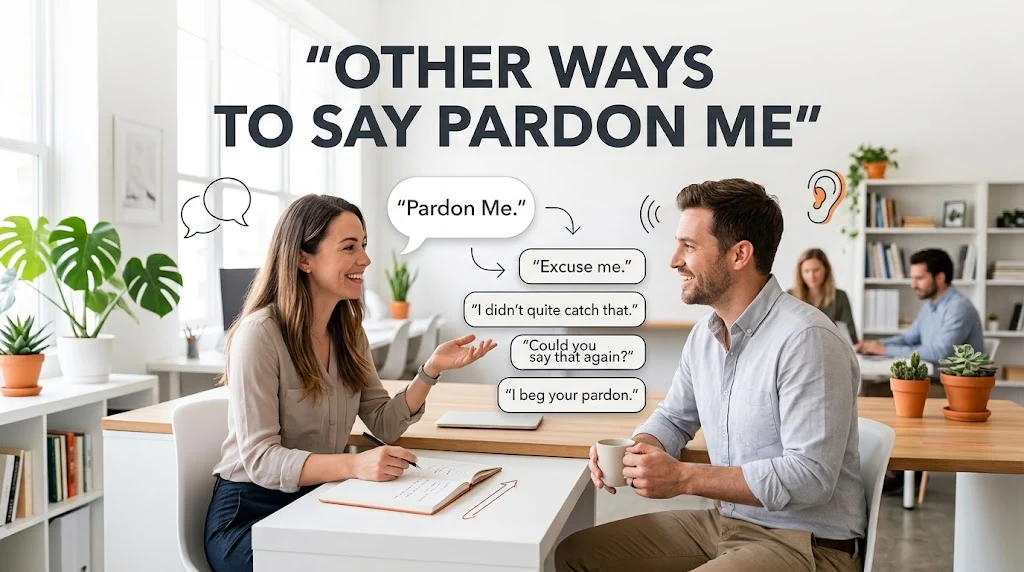
Other ways to say “pardon me” include excuse me, sorry, could you repeat that, I beg your pardon, may I ask you something, and could you please clarify? The best choice depends on whether you need to apologize, interrupt, get attention, or ask someone to repeat something.
Top 5 alternatives: Excuse me, Sorry, Could you repeat that?, I beg your pardon?, Could you please clarify?
“Pardon me” is a polite English expression used to get attention, interrupt someone, apologize for a minor inconvenience, or ask someone to repeat something. It is correct, but other expressions may sound more natural in modern conversation.
Learning alternatives to “pardon me” gives you more control over tone. The best other ways to say “pardon me” depend on the situation, your relationship with the listener, and whether you are speaking or writing.
In workplace meetings, business emails, classrooms, interviews, and everyday conversations, choosing the right expression can make your English sound clearer and more confident.
“Good English is not only about correct words it is also about choosing the right tone.”
Formal Alternatives
- I beg your pardon?
- Excuse me.
- Could you please repeat that?
- Would you mind repeating that?
- May I interrupt for a moment?
Pro Tip
Use these expressions when you need extra politeness, particularly with unfamiliar people, senior colleagues, teachers, or in formal conversations.
Professional Alternatives
- Excuse me.
- Could you clarify that?
- Could you repeat that, please?
- May I add something?
- Could you please elaborate?
Pro Tip
In professional English, be specific about your purpose. “Could you clarify that?” is usually more useful than simply saying “Pardon me.”
Business Email Alternatives
- Could you please clarify this point?
- Could you please confirm what you mean?
- Would you mind clarifying?
- Could you provide further details?
- May I ask for clarification?
Pro Tip
Avoid using “pardon me” repeatedly in business emails. Direct phrases such as “Could you please clarify?” sound clearer and more professional.
Academic Alternatives
- Could you repeat the question, please?
- Could you clarify the question?
- Would you mind explaining that again?
- May I ask you to elaborate?
- Could you please explain what you mean?
Pro Tip
Academic communication benefits from precise language. Explain what you need rather than relying on a vague request for repetition.
Casual Alternatives
- Sorry?
- Excuse me?
- What was that?
- Could you say that again?
- Come again?
Pro Tip
“Sorry?” and “Excuse me?” are especially common in everyday spoken English when you did not hear someone clearly.
Informal Expressions
- Sorry, what?
- What did you say?
- Say that again?
- Huh?
- Come again?
Pro Tip
These expressions belong mainly in relaxed conversations. Some can sound abrupt with strangers or in professional situations.
“The more specific your phrase, the easier it is for the listener to understand your intention.”
What Does “Pardon Me” Mean?
“Pardon me” is a polite expression used in several situations.
It can mean:
- Please excuse me.
- Please repeat what you said.
- May I interrupt?
- Sorry for getting in your way.
For example:
“Pardon me, could you tell me where the meeting room is?”
When used to request repetition, it can sound more formal or traditional than “Sorry?” or “Could you repeat that?”
Grammar
“Pardon” functions as a verb meaning to forgive or excuse. “Pardon me” literally presents the speaker as asking to be excused.
When to Use “Pardon Me”
You can use “pardon me” when:
- Getting someone’s attention politely
- Moving past someone
- Interrupting a conversation
- Asking someone to repeat something
- Apologizing for a minor interruption
- Speaking to someone you do not know
- Using deliberately polite language
Business
“Pardon me, could I ask a quick question?”
Academic
“Pardon me, could you repeat the final point?”
It is generally better to use a specific phrase such as:
“Could you please clarify the final point?”
Meetings
“Excuse me, may I add something?”
Daily Conversation
“Pardon me, is this seat taken?”
Spoken English
“Pardon me?” can request repetition, although “Sorry?” and “Could you repeat that?” are often more natural in modern everyday English.
Written English
“Pardon me” is less common in ordinary emails. More precise wording usually works better.
Is “Pardon Me” Professional or Polite?
Polite? ✔ Yes
Professional? ✔ Yes, depending on context
Formal? ✔ Often
Natural? ✔ Yes, but context matters
“Pardon me” is not unprofessional. However, it can sound somewhat formal or old-fashioned when used repeatedly.
For modern workplace communication, these are often more natural:
“Excuse me.”
“Could you clarify that?”
“Could you repeat that, please?”
Business Example
Instead of:
“Pardon me, what did you say?”
Try:
“Could you repeat that, please?”
The second version clearly communicates the purpose of your request.
Pros and Cons
Pros
- Polite and respectful
- Easy to understand
- Suitable for formal situations
- Useful when interrupting or requesting attention
- Works in both spoken and written contexts
Cons
- Can sound somewhat formal
- May sound old-fashioned in some contexts
- Does not always explain what you need
- Less direct than modern alternatives
- Can be awkward if overused
Main Alternatives to “Pardon Me”
These expressions are not interchangeable in every situation. Some apologize, some request repetition, and others politely interrupt.
Expert Tip: Native speakers usually choose the phrase that matches their exact purpose. Use “Sorry?” for a quick request for repetition, “Excuse me” for attention or interruption, and “Could you clarify?” when you need an explanation.
Other Ways to Say “Pardon Me” (With Examples)
These 15 alternatives cover formal, professional, academic, neutral, casual, and informal English. Pay attention to why each phrase is used rather than memorizing them as identical synonyms.
1. Phrase: Excuse Me
Meaning: A polite expression used to get attention, interrupt, apologize, or move past someone.
Explanation:
“Excuse me” is one of the most versatile alternatives to “pardon me.” It is extremely common among native speakers and works in both everyday and professional English.
It can sound polite without being excessively formal.
Example Sentence:
“Excuse me, could you tell me where the reception desk is?”
Best Use: Workplace, Daily Conversation
Avoid Using In: Very Formal Apologies
Tone: Polite, Natural
Formality Level: ⭐⭐⭐ Neutral
Usage Frequency: Very Common
CEFR Level: A2–B1
Common Collocations:
- excuse me, please
- excuse me for interrupting
- excuse me, could you
- excuse me, may I
Context Variability:
- Spoken: “Excuse me, could you repeat that?”
- Professional: “Excuse me, may I add something?”
- Casual: “Excuse me, is this yours?”
2. Phrase: Sorry?
Meaning: A short, polite request for someone to repeat what they said.
Explanation:
“Sorry?” is extremely common in British English and is also understood widely elsewhere. It usually means “I didn’t hear you” rather than “I apologize.”
It is natural in conversation but less suitable for formal writing.
Example Sentence:
“Sorry? I didn’t catch the last part.”
Best Use: Daily Conversation
Avoid Using In: Formal Emails
Tone: Friendly, Polite
Formality Level: ⭐⭐ Casual
Usage Frequency: Very Common
CEFR Level: A2
Common Collocations:
- sorry?
- sorry, I didn’t hear you
- sorry, what did you say?
- sorry, could you repeat that?
Context Variability:
- Spoken: “Sorry? Could you say that again?”
- Professional: “Sorry, could you repeat the figure?”
- Casual: “Sorry? What was that?”
3. Phrase: Could You Repeat That, Please?
Meaning: A polite request for someone to say something again.
Explanation:
This is clearer than “pardon me” when you did not hear someone. It is particularly useful in meetings, classrooms, interviews, and presentations.
Example Sentence:
“Could you repeat that, please? The connection broke up for a moment.”
Best Use: Workplace Meeting
Avoid Using In: Very Casual Texts
Tone: Polite, Professional
Formality Level: ⭐⭐⭐⭐ Formal
Usage Frequency: Very Common
CEFR Level: B1
Common Collocations:
- repeat that, please
- repeat the question
- repeat the last point
- repeat the instructions
Context Variability:
- Spoken: “Could you repeat that, please?”
- Professional: “Could you repeat the final recommendation?”
- Casual: “Could you repeat that?”
4. Phrase: Would You Mind Repeating That?
Meaning: A polite way to ask someone to say something again.
Explanation:
This expression is respectful and slightly more formal than “Could you repeat that?” It works well when speaking with clients, teachers, managers, or unfamiliar people.
Example Sentence:
“Would you mind repeating that? I want to make sure I understood correctly.”
Best Use: Professional Conversation
Avoid Using In: Quick Casual Chats
Tone: Respectful, Formal
Formality Level: ⭐⭐⭐⭐ Formal
Usage Frequency: Common
CEFR Level: B2
Common Collocations:
- mind repeating that
- mind explaining
- mind saying that again
- mind clarifying
Context Variability:
- Spoken: “Would you mind repeating that?”
- Professional: “Would you mind repeating the client’s request?”
- Casual: “Would you mind saying that again?”
5. Phrase: I Beg Your Pardon?
Meaning: A very polite or formal request for someone to repeat themselves.
Explanation:
“I beg your pardon?” is correct but more formal than most modern alternatives. It can also express surprise or mild offense depending on tone.
Example Sentence:
“I beg your pardon? Did you say the appointment was at three?”
Best Use: Formal Conversation
Avoid Using In: Casual Texting
Tone: Formal, Respectful
Formality Level: ⭐⭐⭐⭐⭐ Very Formal
Usage Frequency: Occasional
CEFR Level: C1
Common Collocations:
- beg your pardon
- I beg your pardon?
- beg your pardon for
- pardon me
Context Variability:
- Spoken: “I beg your pardon? I didn’t hear you.”
- Professional: “I beg your pardon, could you clarify that?”
- Casual: Usually unnecessary.
Native Speaker Tip
“Excuse me” and “Sorry?” are more common in ordinary modern conversation. “I beg your pardon?” is correct but can sound deliberately formal.
6. Phrase: Could You Clarify That?
Meaning: A professional request for more explanation or clearer information.
Explanation:
Use this when you heard the words but did not fully understand their meaning. It is different from asking someone simply to repeat themselves.
Example Sentence:
“Could you clarify that? I’m not sure which deadline you mean.”
Best Use: Business Meeting
Avoid Using In: Simple Repetition Requests
Tone: Professional, Direct
Formality Level: ⭐⭐⭐⭐ Formal
Usage Frequency: Very Common
CEFR Level: B2
Common Collocations:
- clarify that
- clarify the point
- clarify the requirements
- clarify your position
Context Variability:
- Spoken: “Could you clarify that?”
- Professional: “Could you clarify the revised requirements?”
- Casual: “Can you clarify that?”
7. Phrase: May I Interrupt for a Moment?
Meaning: A polite way to ask permission to interrupt someone.
Explanation:
This is not a direct synonym for every use of “pardon me,” but it is an excellent alternative when your purpose is to interrupt politely.
Example Sentence:
“May I interrupt for a moment to clarify one point?”
Best Use: Formal Meeting
Avoid Using In: Casual Friends
Tone: Respectful, Professional
Formality Level: ⭐⭐⭐⭐ Formal
Usage Frequency: Common
CEFR Level: B2
Common Collocations:
- may I interrupt
- interrupt for a moment
- interrupt briefly
- interrupt you
Context Variability:
- Spoken: “May I interrupt for a moment?”
- Professional: “May I interrupt to add one detail?”
- Casual: “Can I jump in for a second?”
8. Phrase: Could You Say That Again?
Meaning: A friendly request for someone to repeat something.
Explanation:
This sounds natural and conversational. It is less formal than “Would you mind repeating that?” but remains polite.
Example Sentence:
“Could you say that again? I was looking at the schedule.”
Best Use: Everyday Conversation
Avoid Using In: Formal Written Apologies
Tone: Friendly, Natural
Formality Level: ⭐⭐⭐ Neutral
Usage Frequency: Very Common
CEFR Level: A2–B1
Common Collocations:
- say that again
- say it again
- say that more slowly
- say the name again
Context Variability:
- Spoken: “Could you say that again?”
- Professional: “Could you say that again for everyone?”
- Casual: “Can you say that again?”
9. Phrase: May I Ask You Something?
Meaning: A polite way to get someone’s attention before asking a question.
Explanation:
This works when “pardon me” is being used to approach someone or begin a question. It does not mean that you failed to hear something.
Example Sentence:
“May I ask you something about the application process?”
Best Use: Professional Inquiry
Avoid Using In: Repetition Requests
Tone: Polite, Respectful
Formality Level: ⭐⭐⭐⭐ Formal
Usage Frequency: Common
CEFR Level: B1
Common Collocations:
- may I ask
- may I ask you
- may I ask a question
- may I ask something
Context Variability:
- Spoken: “May I ask you something?”
- Professional: “May I ask you about the timeline?”
- Casual: “Can I ask you something?”
10. Phrase: Could You Please Explain That Again?
Meaning: A polite request for someone to repeat or explain information.
Explanation:
This phrase is useful when repetition alone may not solve the problem. It asks the speaker to make the idea clearer.
Example Sentence:
“Could you please explain that again? I want to understand the procedure.”
Best Use: Academic Setting
Avoid Using In: Quick Casual Exchanges
Tone: Polite, Clear
Formality Level: ⭐⭐⭐⭐ Formal
Usage Frequency: Common
CEFR Level: B1–B2
Common Collocations:
- explain that again
- explain the process
- explain the procedure
- explain your reasoning
Context Variability:
- Spoken: “Could you explain that again?”
- Professional: “Could you explain the revised process?”
- Casual: “Can you explain that again?”
Native Speaker Tip
“Could you clarify that?” means you need clearer meaning, while “Could you repeat that?” means you need the words again. Choosing correctly makes your English more precise.
11. Phrase: Could You Please Elaborate?
Meaning: A formal request for more information or explanation.
Explanation:
“Elaborate” means to give more detail. It is useful in presentations, academic discussions, meetings, and professional conversations.
Example Sentence:
“Could you please elaborate on how the proposal affects the project timeline?”
Best Use: Business Discussion
Avoid Using In: Casual Chats
Tone: Professional, Formal
Formality Level: ⭐⭐⭐⭐ Formal
Usage Frequency: Common
CEFR Level: C1
Common Collocations:
- elaborate on the proposal
- elaborate on the point
- elaborate further
- elaborate on your answer
Context Variability:
- Spoken: “Could you elaborate?”
- Professional: “Could you elaborate on that recommendation?”
- Casual: “Can you explain that in more detail?”
12. Phrase: May I Add Something?
Meaning: A polite way to request permission to contribute to a conversation.
Explanation:
This is especially useful during meetings and discussions. It replaces “pardon me” when your real intention is to speak without sounding like you are taking over.
Example Sentence:
“May I add something before we move to the next topic?”
Best Use: Team Meeting
Avoid Using In: Asking Repetition
Tone: Polite, Professional
Formality Level: ⭐⭐⭐⭐ Formal
Usage Frequency: Common
CEFR Level: B1–B2
Common Collocations:
- add something
- add a point
- add a comment
- add to that
Context Variability:
- Spoken: “May I add something?”
- Professional: “May I add one point to that?”
- Casual: “Can I add something?”
13. Phrase: What Was That?
Meaning: An informal request for someone to repeat what they said.
Explanation:
This is common among people who know each other well. However, the direct wording can sound abrupt with strangers, customers, teachers, or senior colleagues.
Example Sentence:
“What was that? I couldn’t hear you over the noise.”
Best Use: Casual Conversation
Avoid Using In: Formal Meetings
Tone: Direct, Casual
Formality Level: ⭐⭐ Casual
Usage Frequency: Very Common
CEFR Level: A2
Common Collocations:
- what was that?
- what did you say?
- what was that again?
- what was that about?
Context Variability:
- Spoken: “What was that?”
- Professional: Better: “Could you repeat that, please?”
- Casual: “What was that again?”
14. Phrase: Come Again?
Meaning: An informal request for someone to repeat something.
Explanation:
“Come again?” is idiomatic and conversational. It can sound friendly among familiar speakers, but it is not a strong choice for formal communication.
Example Sentence:
“Come again? I didn’t catch the name of the restaurant.”
Best Use: Informal Conversation
Avoid Using In: Business Emails
Tone: Casual, Friendly
Formality Level: ⭐⭐ Casual
Usage Frequency: Occasional
CEFR Level: B2
Common Collocations:
- come again?
- didn’t catch that
- didn’t catch your name
- say that again
Context Variability:
- Spoken: “Come again?”
- Professional: Avoid; use “Could you repeat that?”
- Casual: “Come again? I missed that.”
15. Phrase: Sorry, What Do You Mean?
Meaning: A polite request for clarification when something is unclear.
Explanation:
This phrase is useful because it combines a soft apology with a direct request for meaning. It is natural in conversation and can also work in less formal workplace discussions.
Example Sentence:
“Sorry, what do you mean by ‘the revised version’?”
Best Use: Everyday Discussion
Avoid Using In: Formal Academic Writing
Tone: Natural, Polite
Formality Level: ⭐⭐⭐ Neutral
Usage Frequency: Very Common
CEFR Level: B1
Common Collocations:
- what do you mean?
- what do you mean by
- mean by that
- mean exactly
Context Variability:
- Spoken: “Sorry, what do you mean?”
- Professional: “Sorry, what do you mean by the revised figures?”
- Casual: “What do you mean?”
Native Speaker Tip
For modern everyday English, “Excuse me,” “Sorry?” and “Could you repeat that?” are generally more useful than “I beg your pardon?” The formal expression is correct, but it is less common in relaxed conversation.
“Natural English often comes from matching the expression to the situation, not choosing the longest phrase.”
Avoid These in Formal Situations
Some expressions are understandable but can sound too casual, abrupt, or conversational in professional communication.
1. “Huh?”
Why avoid it: It is extremely informal and may sound dismissive.
Better: “Could you repeat that, please?”
2. “What?”
Why avoid it: A single “What?” can sound abrupt.
Better: “Sorry, could you say that again?”
3. “What did you say?”
Why avoid it: Correct but relatively direct.
Better: “Would you mind repeating that?”
4. “Come again?”
Why avoid it: Conversational and idiomatic.
Better: “Could you clarify that?”
5. “Say that again.”
Why avoid it: It can sound like an instruction rather than a polite request.
Better: “Could you please repeat that?”
Best Phrases by Situation
| Situation | Best Phrase |
| Business Email | Could you please clarify this point? |
| Client Meeting | Would you mind repeating that? |
| Academic Essay | Could you clarify this point? |
| Presentation | May I add something? |
| Workplace Discussion | Could you clarify that? |
| Job Interview | Could you repeat the question, please? |
| Team Collaboration | May I add something? |
| Everyday Conversation | Excuse me / Sorry? |
Commonly Confused Phrases
“Excuse Me” vs. “Sorry?”
Excuse me is commonly used to get attention, interrupt, move past someone, or make a polite request.
Sorry? usually means you did not hear what someone said.
“Excuse me, could you help me?”
“Sorry? Could you repeat that?”
“I Beg Your Pardon” vs. “Pardon Me”
Both are polite, but “I beg your pardon?” generally sounds more formal. “Pardon me” can also be used when getting attention or excusing yourself.
“Could You Repeat That?” vs. “Could You Clarify That?”
Use repeat when you missed the words.
Use clarify when you heard the words but do not understand the meaning.
“I Beg Your Pardon?” vs. “Sorry?”
“I beg your pardon?” is more formal and less common in relaxed modern speech. “Sorry?” is short, natural, and widely used when asking someone to repeat themselves.
Top 10 Alternatives Compared
| Phrase | Tone | Formality | Best Use | Frequency |
| Excuse me | Polite, natural | Neutral | Daily & professional | Very Common |
| Sorry? | Friendly, polite | Casual | Conversation | Very Common |
| Could you repeat that, please? | Professional | Formal | Meetings | Very Common |
| Would you mind repeating that? | Respectful | Formal | Client communication | Common |
| I beg your pardon? | Formal | Very Formal | Formal conversation | Occasional |
| Could you clarify that? | Direct, professional | Formal | Workplace | Very Common |
| May I interrupt for a moment? | Respectful | Formal | Meetings | Common |
| Could you say that again? | Friendly | Neutral | Conversation | Very Common |
| May I ask you something? | Polite | Formal | Professional inquiry | Common |
| Could you please explain that again? | Clear, polite | Formal | Academic/workplace | Common |
Which One Should You Use?
Best Overall
Excuse me versatile, polite, natural, and appropriate in many everyday situations.
Best Professional
Could you clarify that? precise and useful when you need additional explanation.
Best Academic
Could you please explain that again? respectful and clear in classrooms or academic discussions.
Best Business Email
Could you please clarify this point? specific and professional without sounding stiff.
Best Everyday Conversation
Sorry? short and natural when you simply did not hear someone.
Most Natural
Excuse me one of the most flexible expressions in spoken English.
Most Polite
Would you mind repeating that? respectful without being excessively formal.
Scenario Practice
1. Business Meeting
Your manager explains a new procedure, but one part is unclear.
Which phrase would you choose?
Answer: “Could you clarify that?”
Why: You heard the information but need a clearer explanation.
2. Job Interview
The interviewer asks a question, but you do not hear it clearly.
Which phrase would you choose?
Answer: “Could you repeat the question, please?”
Why: This is respectful and professional.
3. Presentation
A colleague is discussing a project and you want to contribute.
Which phrase would you choose?
Answer: “May I add something?”
Why: You are asking for permission to contribute rather than requesting repetition.
4. Class Discussion
Your teacher gives an explanation, but you need more detail.
Which phrase would you choose?
Answer: “Could you please explain that again?”
Why: It politely asks for additional explanation.
5. Everyday Conversation
A friend says something while you are distracted.
Which phrase would you choose?
Answer: “Sorry?”
Why: It is short, natural, and common in informal conversation.
Mini Quiz
1. You cannot hear your interviewer clearly. What should you say?
A. Huh?
B. What?
C. Could you repeat the question, please?
D. Come again?
Answer: C
2. Your colleague makes a statement you do not understand. Which phrase fits best?
A. Could you clarify that?
B. Huh?
C. What?
D. Say that.
Answer: A
3. You want to politely enter a formal discussion.
A. What?
B. May I interrupt for a moment?
C. Huh?
D. Come again?
Answer: B
4. Which expression is the most casual?
A. Would you mind repeating that?
B. Could you clarify that?
C. I beg your pardon?
D. Huh?
Answer: D
5. Which phrase is most natural when you simply did not hear someone?
A. Sorry?
B. May I interrupt for a moment?
C. Could you please elaborate?
D. May I ask you something?
Answer: A
FAQ
What is the most formal way to say “pardon me”?
“I beg your pardon?” is one of the most formal alternatives when you want someone to repeat what they said. However, it can sound more traditional or formal than modern expressions such as “Could you repeat that, please?” Choose it when the situation calls for especially polite language.
Which phrase is best for professional emails?
For professional emails, use a specific expression such as “Could you please clarify this point?” or “Would you mind clarifying?” These phrases tell the reader exactly what you need. “Pardon me” is usually less precise and is uncommon in ordinary business email writing.
What is the difference between “pardon me” and “excuse me”?
Both can politely get attention, interrupt, or excuse a minor inconvenience. “Excuse me” is generally more versatile and common in modern spoken English. “Pardon me” can sound somewhat more formal. When asking someone to repeat information, context determines which expression sounds most natural.
Which alternative sounds most natural?
“Excuse me” is one of the most natural all-purpose alternatives. For repetition, “Sorry?” and “Could you repeat that?” are also highly natural. The best choice depends on whether you need attention, an apology, repetition, or clarification.
Can I use these expressions in business meetings?
Yes. Expressions such as “Excuse me,” “Could you clarify that?” “Would you mind repeating that?” and “May I add something?” work well in meetings. Avoid very casual expressions such as “Huh?” or “What?” when speaking with clients, managers, interviewers, or unfamiliar colleagues.
Conclusion
Learning different ways to say “pardon me” helps you communicate with greater precision. “Excuse me,” “Sorry?” “Could you repeat that?” and “Could you clarify that?” each serve slightly different purposes, while formal expressions such as “I beg your pardon?” create a more traditional tone.
Practice these alternatives in everyday conversations, emails, meetings, presentations, classrooms, and professional discussions. The goal is not to replace “pardon me” completely, but to choose the expression that fits your audience and situation. With regular practice, your English will sound more natural, flexible, and confident.

Ethan Parker is an English language writer and vocabulary enthusiast at SynonymDock.com. He specializes in synonyms, word meanings, alternative expressions and practical English usage, creating clear and reliable content to help students, professionals, writers and English learners choose the right words with confidence.