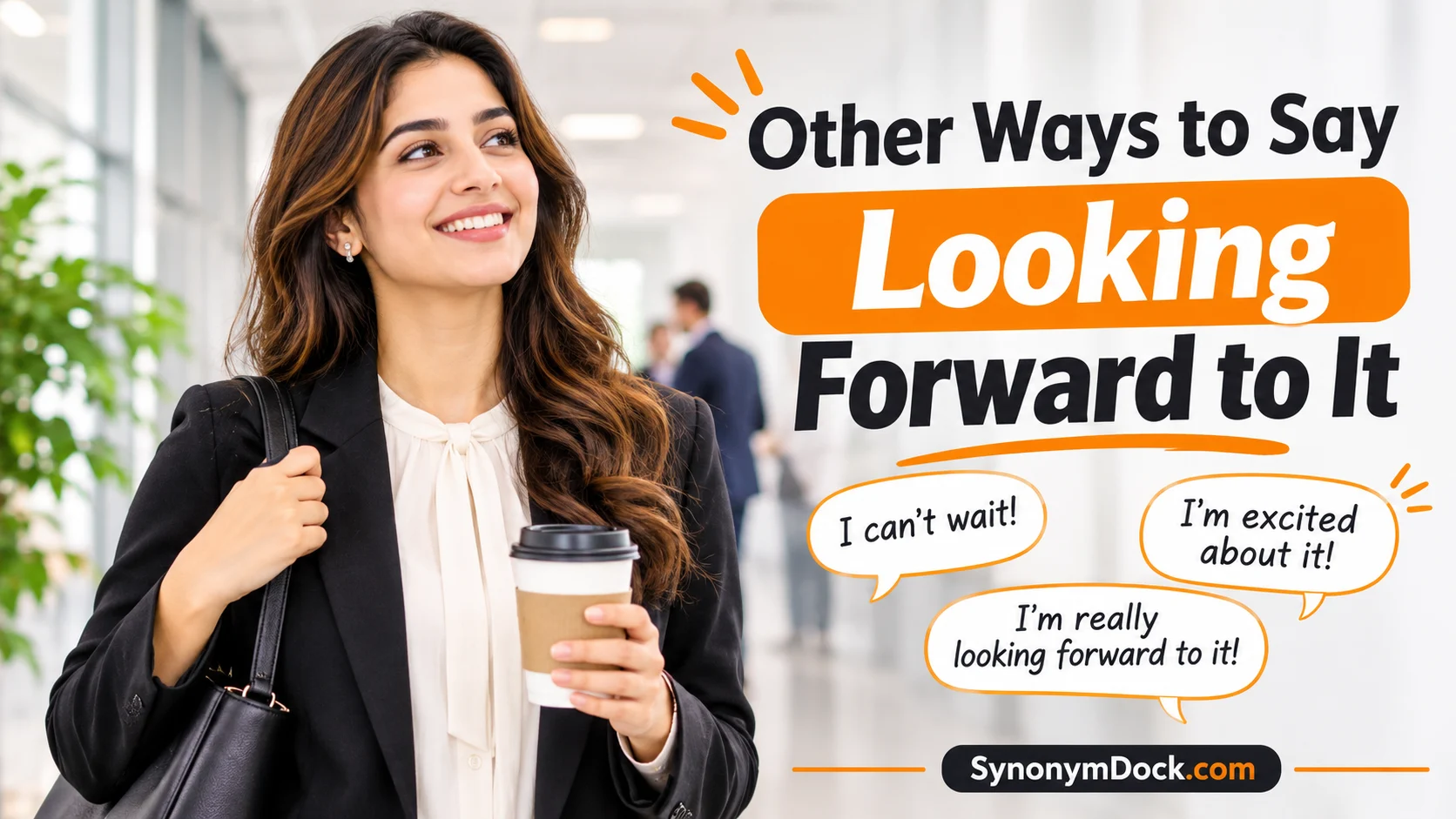
Other ways to say “looking forward to it” include I’m excited about it, I can’t wait, I’m eager for it, I’m anticipating it, I’m excited to see what happens, I’m eagerly awaiting it, and I’m really looking forward to it.
“Looking forward to it” is a natural English expression used when you feel positive anticipation about something that will happen in the future. It works well in conversations, emails, meetings, invitations, and professional communication.
If you want to avoid repeating the same phrase, there are many alternatives to “looking forward to it.” The best choice depends on your relationship with the reader, the level of excitement, and whether you are writing formally or casually.
Learning other ways to say “looking forward to it” can make your English sound more varied and precise without making it unnecessarily complicated.
Quick Categories
Formal Alternatives
- I eagerly anticipate it
- I anticipate it with great interest
- I am awaiting it with enthusiasm
- I look forward to the occasion
- I am keenly anticipating it
Pro Tip: Formal alternatives work best in professional correspondence, official invitations, and polished written communication. Avoid making everyday messages sound more formal than necessary.
Professional Alternatives
- I’m eager to get started
- I’m excited about the opportunity
- I’m anticipating our discussion
- I’m pleased to be part of it
- I’m keen to move forward
Pro Tip: In professional English, focus on enthusiasm without sounding overly excited. “I’m eager to get started” is often more natural than an extremely formal expression.
Business Email Alternatives
- I look forward to our meeting
- I’m looking forward to speaking with you
- I’m eager to discuss this further
- I look forward to working with you
- I’m excited about the opportunity
Pro Tip: Use “I look forward to” when you want a reliable, professional closing. It is especially common when referring to a specific future interaction.
Academic Alternatives
- I anticipate the discussion
- I look forward to exploring this topic
- I am eager to learn more
- I anticipate the opportunity to discuss this
- I look forward to examining the issue
Pro Tip: Academic writing usually benefits from precise language rather than highly emotional expressions such as “I can’t wait.”
Casual Alternatives
- I can’t wait
- I’m excited about it
- I’m really excited
- I’m so ready for it
- I’m excited to see you
Pro Tip: Casual expressions are suitable for friends, family, classmates, and relaxed conversations. They can sound too informal in some business situations.
Informal Expressions
- Can’t wait!
- So excited!
- Bring it on!
- I’m counting down the days
- I’m so ready
Pro Tip: These expressions show stronger excitement and personality. Use them with people who are comfortable with an informal communication style.
“The best alternative depends on excitement, context, and relationship.”
What Does “Looking Forward to It” Mean?
“Looking forward to it” means feeling pleased or excited about something expected to happen in the future.
The expression is especially common when someone has mentioned a future event, activity, meeting, trip, opportunity, or experience.
Grammar
The standard structure is:
look forward to + noun
- I look forward to the meeting.
It can also be followed by a gerund:
look forward to + verb-ing
- I look forward to meeting you.
A common learner mistake is using the infinitive after “to.”
❌ I look forward to meet you.
✅ I look forward to meeting you.
Natural Example
I’m looking forward to seeing everyone at the conference next week.
When to Use “Looking Forward to It”
You can use the expression in many situations:
- Business: discussing a future meeting or project
- Emails: closing a professional message
- Academic settings: anticipating a discussion or event
- Meetings: showing enthusiasm about a future conversation
- Daily conversation: talking about plans with friends
- Spoken English: expressing positive anticipation
- Written English: showing polite enthusiasm
- Formal communication: using “I look forward to
- Informal communication: using “I can’t wait” or “I’m excited”
The exact wording should match the situation.
Is “Looking Forward to It” Professional or Polite?
Yes. “Looking forward to it” is both polite and natural, but its level of formality depends on the full sentence.
| Quality | Suitable? |
| Polite | ✔ Yes |
| Professional | ✔ Yes |
| Formal | ✔ In the right structure |
| Natural | ✔ Very natural |
For example:
Professional:
I look forward to discussing the proposal with you.
Casual:
I’m really looking forward to it!
The professional version is more specific and controlled. The casual version expresses stronger personal excitement.
Pros and Cons
Pros
- Natural in everyday English
- Works well in professional communication
- Easy for English learners to use
- Expresses positive anticipation clearly
- Suitable for emails and conversations
Cons
- Can become repetitive
- May sound formulaic in frequent emails
- Does not always show the exact level of excitement
- Some alternatives may fit specific contexts better
Expert Tip
Expert Tip: Native speakers often choose the expression based on the strength of their excitement. “I look forward to” sounds controlled and professional, while “I can’t wait” sounds much more enthusiastic and informal.
Other Ways to Say “Looking Forward to It” With Examples
These alternatives do not all have exactly the same meaning or tone. Some emphasize professionalism, while others communicate strong excitement.
Use the phrase that fits the situation rather than simply choosing the most advanced-sounding expression.
1. Phrase: I’m Excited About It
Meaning:
You feel happy and enthusiastic about something that will happen.
Explanation:
This is a natural modern alternative that works in both spoken and written English. It is more openly enthusiastic than “I look forward to it.”
Example Sentence:
I’m excited about the workshop and everything we’ll learn there.
Best Use:
Casual conversation
Avoid Using In:
Formal academic writing
Tone:
Positive, Enthusiastic
Formality Level:
⭐⭐⭐ Neutral
Usage Frequency:
Very Common
CEFR Level:
B1
Common Collocations:
- excited about the opportunity
- excited about the event
- excited about the project
- excited about the trip
Context Variability:
- Spoken: I’m really excited about it.
- Professional: I’m excited about the opportunity to contribute.
- Casual: I’m so excited about the weekend!
2. Phrase: I Can’t Wait
Meaning:
You are very excited and want something to happen soon.
Explanation:
“I can’t wait” is one of the most common informal alternatives. It expresses stronger excitement than “looking forward to it,” so it is usually better for friends and relaxed conversations.
Example Sentence:
I can’t wait to see the new campus tomorrow.
Best Use:
Friendly conversation
Avoid Using In:
Formal correspondence
Tone:
Enthusiastic, Informal
Formality Level:
⭐⭐ Casual
Usage Frequency:
Very Common
CEFR Level:
B1
Common Collocations:
- can’t wait to see
- can’t wait to hear
- can’t wait to start
- can’t wait for the weekend
Context Variability:
- Spoken: I can’t wait to hear the news.
- Professional: Usually avoid it in formal business writing.
- Casual: I can’t wait for Saturday!
3. Phrase: I’m Eager for It
Meaning:
You are enthusiastic and ready for something to happen.
Explanation:
This expression is understandable and grammatically correct, but “I’m eager to” is often more natural when followed by an action.
Example Sentence:
I’m eager to begin the training program next month.
Best Use:
Professional communication
Avoid Using In:
Very casual texting
Tone:
Positive, Professional
Formality Level:
⭐⭐⭐⭐ Formal
Usage Frequency:
Common
CEFR Level:
B2
Common Collocations:
- eager to learn
- eager to begin
- eager to participate
- eager to contribute
Context Variability:
- Spoken: I’m eager to get started.
- Professional: I’m eager to contribute to the project.
- Casual: I’m eager to see what happens.
4. Phrase: I’m Looking Forward to It
Meaning:
You feel positive anticipation about something expected in the future.
Explanation:
This is the original expression and remains one of the safest choices. It is natural across many situations, from casual conversations to professional emails.
Example Sentence:
I’m looking forward to it and hope everything goes smoothly.
Best Use:
General communication
Avoid Using In:
Repeated email closings
Tone:
Friendly, Positive
Formality Level:
⭐⭐⭐ Neutral
Usage Frequency:
Very Common
CEFR Level:
B1
Common Collocations:
- looking forward to it
- looking forward to meeting
- looking forward to hearing
- looking forward to working together
Context Variability:
- Spoken: I’m looking forward to it.
- Professional: We’re looking forward to working with you.
- Casual: I’m really looking forward to it!
5. Phrase: I’m Excited to See What Happens
Meaning:
You are enthusiastic about an upcoming situation whose result is not yet known.
Explanation:
This expression adds curiosity to your anticipation. It works well when the future outcome is uncertain.
Example Sentence:
I’m excited to see what happens when we launch the new program.
Best Use:
Projects and events
Avoid Using In:
Highly formal notices
Tone:
Curious, Enthusiastic
Formality Level:
⭐⭐⭐ Neutral
Usage Frequency:
Common
CEFR Level:
B2
Common Collocations:
- excited to see
- see what happens
- excited to find out
- excited about the result
Context Variability:
- Spoken: I’m excited to see what happens.
- Professional: We’re excited to see how the new strategy performs.
- Casual: I’m excited to see what happens tomorrow!
Native Speaker Tip
“I’m excited about it” and “I’m looking forward to it” are both highly natural. “I can’t wait” is stronger and more casual, while “I’m eager to” fits professional contexts especially well.
“Natural English is not about using the fanciest phrase.”
6. Phrase: I’m Eager to Get Started
Meaning:
You are enthusiastic about beginning an activity, project, or task.
Explanation:
This is particularly useful in workplace communication. It shows motivation without sounding excessively emotional.
Example Sentence:
I’m eager to get started and contribute to the team’s next project.
Best Use:
Workplace communication
Avoid Using In:
Relaxed social plans
Tone:
Motivated, Professional
Formality Level:
⭐⭐⭐⭐ Formal
Usage Frequency:
Common
CEFR Level:
B2
Common Collocations:
- eager to get started
- eager to begin
- eager to contribute
- eager to help
Context Variability:
- Spoken: I’m eager to get started.
- Professional: We’re eager to get started on the implementation.
- Casual: I’m ready to get started!
7. Phrase: I’m Keen to
Meaning:
You are interested and enthusiastic about doing something.
Explanation:
“Keen to” is especially common in British English and is also widely understood elsewhere. It can sound professional while remaining conversational.
Example Sentence:
I’m keen to hear your thoughts on the proposal.
Best Use:
British workplace English
Avoid Using In:
Very formal documents
Tone:
Interested, Positive
Formality Level:
⭐⭐⭐ Neutral
Usage Frequency:
Common
CEFR Level:
B2
Common Collocations:
- keen to learn
- keen to discuss
- keen to participate
- keen to explore
Context Variability:
- Spoken: I’m keen to hear your ideas.
- Professional: We’re keen to explore this opportunity.
- Casual: I’m keen to try it.
8. Phrase: I’m Anticipating It
Meaning:
You expect something to happen and are thinking about it with interest.
Explanation:
“Anticipate” is more formal than “look forward to.” It works better in polished writing than in relaxed conversation.
Example Sentence:
We are anticipating a productive discussion during tomorrow’s meeting.
Best Use:
Formal writing
Avoid Using In:
Friendly texting
Tone:
Formal, Professional
Formality Level:
⭐⭐⭐⭐ Formal
Usage Frequency:
Common
CEFR Level:
C1
Common Collocations:
- anticipate the meeting
- anticipate the outcome
- anticipate the discussion
- anticipate the opportunity
Context Variability:
- Spoken: I’m anticipating a useful discussion.
- Professional: We anticipate a positive response.
- Casual: “I’m looking forward to it” sounds more natural.
9. Phrase: I’m Excited to Join
Meaning:
You feel enthusiastic about becoming part of an event, group, project, or organization.
Explanation:
This expression is useful when the future activity involves participation. It sounds warm and professional without being overly formal.
Example Sentence:
I’m excited to join the team and learn from everyone.
Best Use:
New opportunities
Avoid Using In:
Legal documents
Tone:
Warm, Professional
Formality Level:
⭐⭐⭐ Neutral
Usage Frequency:
Very Common
CEFR Level:
B1
Common Collocations:
- excited to join
- excited to be part of
- excited to participate
- excited to work with
Context Variability:
- Spoken: I’m excited to join you.
- Professional: I’m excited to join the organization.
- Casual: I’m excited to join the trip!
10. Phrase: I Look Forward to It
Meaning:
You politely express positive anticipation about a future event or interaction.
Explanation:
This version is particularly useful in professional emails. It sounds polished without being unnecessarily complicated.
Example Sentence:
Thank you for arranging the interview; I look forward to it.
Best Use:
Professional emails
Avoid Using In:
Highly casual messages
Tone:
Polite, Professional
Formality Level:
⭐⭐⭐⭐ Formal
Usage Frequency:
Very Common
CEFR Level:
B2
Common Collocations:
- look forward to hearing
- look forward to meeting
- look forward to discussing
- look forward to working together
Context Variability:
- Spoken: I look forward to seeing you.
- Professional: I look forward to discussing the proposal.
- Casual: I’m looking forward to it!
Expert Insight
In professional emails, specificity often sounds better than a vague closing. “I look forward to discussing the proposal” tells the reader exactly what you anticipate.
11. Phrase: I’m Eager to Learn More
Meaning:
You are interested in receiving more information or gaining more knowledge.
Explanation:
This phrase is excellent when anticipation is connected to learning. It is common in professional, academic, and interview contexts.
Example Sentence:
I’m eager to learn more about the research opportunities available.
Best Use:
Academic settings
Avoid Using In:
Casual invitations
Tone:
Curious, Professional
Formality Level:
⭐⭐⭐⭐ Formal
Usage Frequency:
Common
CEFR Level:
B2
Common Collocations:
- eager to learn
- eager to learn more
- eager to understand
- eager to explore
Context Variability:
- Spoken: I’m eager to learn more.
- Professional: I’m eager to learn more about the role.
- Casual: I’d love to hear more about it.
12. Phrase: I’m Counting Down the Days
Meaning:
You are extremely excited about an upcoming event and eagerly waiting for it.
Explanation:
This is an informal idiom that shows strong excitement. It is colorful and expressive, so it is not suitable for every professional situation.
Example Sentence:
I’m counting down the days until our family vacation.
Best Use:
Personal conversations
Avoid Using In:
Formal business emails
Tone:
Excited, Informal
Formality Level:
⭐⭐ Casual
Usage Frequency:
Common
CEFR Level:
B2
Common Collocations:
- counting down the days
- counting down to
- counting the days
- days until the event
Context Variability:
- Spoken: I’m counting down the days!
- Professional: Usually replace it with “I’m looking forward to”
- Casual: We’re counting down the days until the trip.
13. Phrase: I’m Excited for What’s Ahead
Meaning:
You feel positive about future opportunities, experiences, or changes.
Explanation:
This expression focuses on the future rather than one specific event. It works well when discussing a new stage, project, or opportunity.
Example Sentence:
After completing the course, I’m excited for what’s ahead.
Best Use:
Future opportunities
Avoid Using In:
Highly technical writing
Tone:
Optimistic, Positive
Formality Level:
⭐⭐⭐ Neutral
Usage Frequency:
Common
CEFR Level:
B2
Common Collocations:
- excited for what’s ahead
- excited about the future
- what lies ahead
- future opportunities
Context Variability:
- Spoken: I’m excited for what’s ahead.
- Professional: We’re excited about what lies ahead.
- Casual: I’m so excited for what’s next!
14. Phrase: I Eagerly Anticipate It
Meaning:
You are waiting for something with strong interest and enthusiasm.
Explanation:
This is a distinctly formal expression. It can work in polished correspondence, but it may sound stiff in ordinary conversation.
Example Sentence:
I eagerly anticipate the opportunity to discuss these findings with the committee.
Best Use:
Formal correspondence
Avoid Using In:
Casual conversation
Tone:
Formal, Respectful
Formality Level:
⭐⭐⭐⭐⭐ Very Formal
Usage Frequency:
Occasional
CEFR Level:
C1
Common Collocations:
- eagerly anticipate
- eagerly anticipate the opportunity
- eagerly anticipate the discussion
- eagerly await
Context Variability:
- Spoken: Possible, but formal.
- Professional: Suitable for highly polished correspondence.
- Casual: Use “I’m really looking forward to it.”
15. Phrase: I’m Really Excited About What’s Coming
Meaning:
You feel strong positive anticipation about an upcoming event or development.
Explanation:
This is conversational and energetic. It works especially well when speaking about several future developments rather than one specific event.
Example Sentence:
We’ve made great progress, and I’m really excited about what’s coming next.
Best Use:
Casual conversation
Avoid Using In:
Formal academic writing
Tone:
Warm, Enthusiastic
Formality Level:
⭐⭐ Casual
Usage Frequency:
Common
CEFR Level:
B2
Common Collocations:
- excited about what’s coming
- excited about what’s next
- really excited about
- excited about the future
Context Variability:
- Spoken: I’m really excited about what’s coming.
- Professional: We’re excited about the next stage of the project.
- Casual: I’m really excited about what’s coming!
Native Speaker Tip
For everyday English, “I’m looking forward to it” remains one of the most flexible choices. “I can’t wait” sounds more enthusiastic, while “I eagerly anticipate it” is much more formal.
“Formality should support your message, not hide it.”
Best Phrases by Situation
| Situation | Suitable Phrase |
| Business Email | I look forward to discussing this with you. |
| Client Meeting | I look forward to our discussion. |
| Academic Essay | I anticipate the discussion. |
| Presentation | I’m excited to share what comes next. |
| Workplace Discussion | I’m eager to get started. |
| Job Interview | I look forward to speaking with you. |
| Team Collaboration | I’m excited to work with the team. |
| Everyday Conversation | I’m really looking forward to it. |
Top 10 Alternatives Compared
| Phrase | Tone | Formality | Best Use | Frequency |
| I’m looking forward to it | Positive | ⭐⭐⭐ | General | Very Common |
| I look forward to it | Polite | ⭐⭐⭐⭐ | Business email | Very Common |
| I’m excited about it | Enthusiastic | ⭐⭐⭐ | General | Very Common |
| I can’t wait | Excited | ⭐⭐ | Casual | Very Common |
| I’m eager to get started | Motivated | ⭐⭐⭐⭐ | Workplace | Common |
| I’m keen to | Positive | ⭐⭐⭐ | Professional | Common |
| I’m eager to learn more | Curious | ⭐⭐⭐⭐ | Academic/work | Common |
| I’m anticipating it | Formal | ⭐⭐⭐⭐ | Formal writing | Common |
| I’m counting down the days | Playful | ⭐⭐ | Personal | Common |
| I eagerly anticipate it | Formal | ⭐⭐⭐⭐⭐ | Formal correspondence | Occasional |
Which One Should You Use?
Best Overall
I’m looking forward to it is the most flexible option for everyday positive anticipation.
Best Professional
I look forward to works well in professional emails and formal workplace communication.
Best Academic
I anticipate is suitable when you need a more formal academic tone.
Best Business Email
I look forward to discussing this with you is clear, polite, and specific.
Best Everyday Conversation
I can’t wait works naturally when you want to express strong excitement.
Most Natural
I’m looking forward to it is a dependable choice in ordinary conversation.
Most Polite
I look forward to provides a respectful and professional tone.
Commonly Confused Phrases
“I’m looking forward to it” vs. “I can’t wait”
Both express anticipation, but their intensity differs. “I can’t wait” usually sounds more excited and informal.
“I’m excited about it” vs. “I’m looking forward to it”
“I’m excited about it” puts more emphasis on your emotional enthusiasm. “I’m looking forward to it” focuses more on positive anticipation.
“I anticipate it” vs. “I look forward to it”
“Anticipate” can simply mean expect something. “Look forward to” clearly communicates positive feelings about the future event.
“I eagerly anticipate it” vs. “I’m looking forward to it”
“I eagerly anticipate it” is considerably more formal. In normal conversation, it may sound unnecessarily stiff.
Scenario Practice
1. Business Meeting
Situation: Your manager has scheduled a meeting about a new project.
Which phrase would you choose?
Answer: I’m looking forward to discussing the project.
Why: It sounds professional and clearly identifies the future activity.
2. Job Interview
Situation: You want to respond politely after receiving an interview invitation.
Which phrase would you choose?
Answer: I look forward to speaking with you.
Why: It is professional, concise, and appropriate for formal correspondence.
3. Presentation
Situation: You are preparing to present a new idea to your team.
Which phrase would you choose?
Answer: I’m excited to share the idea with the team.
Why: The expression communicates genuine enthusiasm without sounding too casual.
4. Class Discussion
Situation: Your teacher has announced an interesting discussion for tomorrow.
Which phrase would you choose?
Answer: I’m looking forward to the discussion.
Why: It works naturally in an academic setting without sounding overly formal.
5. Email Reply
Situation: A client has agreed to discuss a proposal next week.
Which phrase would you choose?
Answer: I look forward to discussing the proposal with you.
Why: It is specific, courteous, and suitable for professional email writing.
Mini Quiz
1. Which expression is most suitable for a formal business email?
A. I can’t wait!
B. I’m super excited!
C. I look forward to discussing this with you.
D. Bring it on!
Answer: C
2. Which phrase sounds most casual?
A. I eagerly anticipate it.
B. I can’t wait.
C. I anticipate the meeting.
D. I look forward to the discussion.
Answer: B
3. Which expression best shows strong excitement about a holiday?
A. I can’t wait for the holiday.
B. I eagerly anticipate the holiday.
C. I anticipate the holiday.
D. I look forward to the holiday.
Answer: A
4. Which phrase is especially useful when starting a new project?
A. I’m eager to get started.
B. I’m counting down the days.
C. Bring it on!
D. I’m so ready!
Answer: A
5. Which sentence is grammatically correct?
A. I look forward to meet you.
B. I look forward to meeting you.
C. I look forward to met you.
D. I look forward meeting you.
Answer: B
Answer Key
- C It is polite, specific, and professional.
- B “I can’t wait” is strongly conversational.
- A It expresses strong personal excitement.
- A It shows professional enthusiasm about beginning.
- B “Look forward to” is followed by a noun or gerund.
Frequently Asked Questions
What is the most formal way to say “looking forward to it”?
“I eagerly anticipate it” is one of the more formal alternatives. However, formal does not always mean better. In most professional emails, “I look forward to” sounds more natural, polished, and direct than a highly formal expression such as “I eagerly anticipate it.”
Which phrase is best for professional emails?
“I look forward to” is a dependable choice for professional emails. It works especially well when you specify the future action, such as “I look forward to discussing the proposal with you.” This sounds more precise and professional than using a vague expression repeatedly.
What is the difference between “I’m looking forward to it” and “I can’t wait”?
Both expressions show positive anticipation, but their tone is different. “I’m looking forward to it” is neutral and flexible, while “I can’t wait” expresses stronger excitement and is more casual. Use the second option mainly in relaxed conversations.
Which alternative sounds most natural?
“I’m looking forward to it” is one of the most natural general alternatives because it works in many contexts. For professional communication, “I look forward to” is often more suitable. In casual conversations, “I can’t wait” can sound more energetic.
Can I use these expressions in business meetings?
Yes, but choose them according to the situation. “I’m looking forward to discussing this” and “I’m eager to get started” fit professional meetings well. Very casual expressions such as “I’m counting down the days” or “Bring it on!” may not suit a formal workplace.
Conclusion
Knowing other ways to say “looking forward to it” helps you express anticipation with greater precision. “I’m looking forward to it” is flexible and natural, while “I look forward to” works especially well in professional emails. Other choices, such as “I’m eager to get started,” “I’m excited about it,” and “I can’t wait,” let you adjust the level of formality and enthusiasm.
The key is to match your expression to the situation. Practice these alternatives in conversations, emails, meetings, interviews, and academic settings. With regular use, you can make your English more varied, natural, and confident without forcing complicated vocabulary.

Ethan Parker is an English language writer and vocabulary enthusiast at SynonymDock.com. He specializes in synonyms, word meanings, alternative expressions and practical English usage, creating clear and reliable content to help students, professionals, writers and English learners choose the right words with confidence.
1 thought on “Other Ways to Say Looking Forward to It|57+ Examples For 2026”